 Slashdot Mirror
Education Chief Should Know About PLATO and the History of Online CS Education
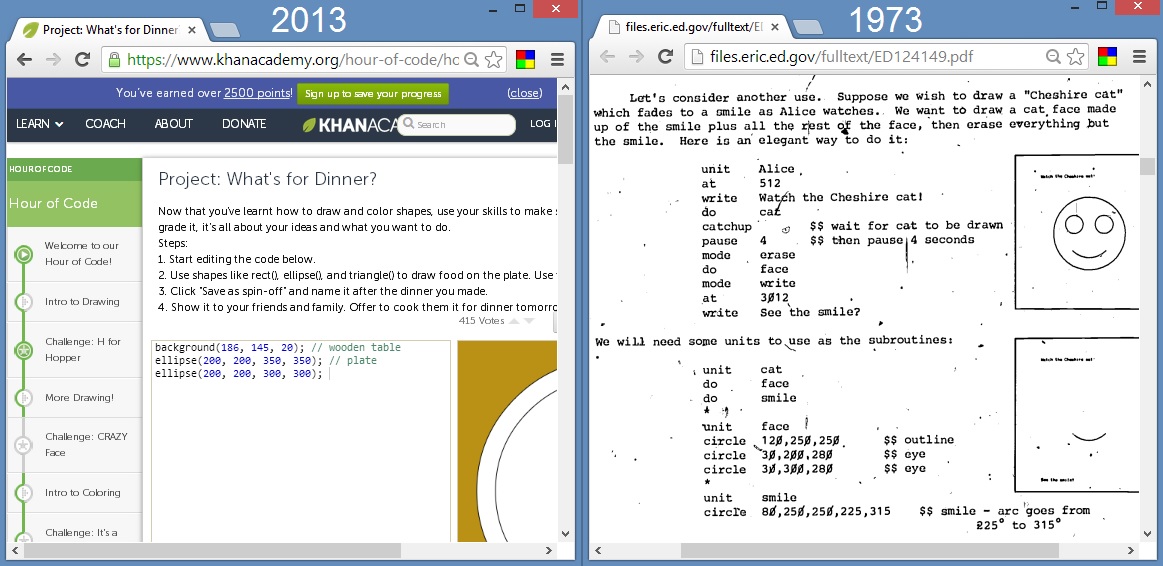
theodp writes Writing in Vanity Fair, U.S. Secretary of Education Arne Duncan marvels that his kids can learn to code online at their own pace thanks to "free" lessons from Khan Academy, which Duncan credits for "changing the way my kids learn" (Duncan calls out his kids' grade school for not offering coding). The 50-year-old Duncan, who complained last December that he "didn't have the opportunity to learn computer skills" while growing up attending the Univ. of Chicago Lab Schools and Yale, may be surprised to learn that the University of Illinois was teaching kids how to program online in the '70s with its PLATO system, and it didn't look all that different from what Khan Academy came up with for his kids 40 years later (Roger Ebert remarked in his 2011 TED Talk that seeing Khan Academy gave him a flashback to the PLATO system he reported on in the '60s). So, does it matter if the nation's education chief — who presides over a budget that includes $69 billion in discretionary spending — is clueless about The Hidden History of Ed-Tech? Some think so. "We can't move forward," Hack Education's Audrey Watters writes, "til we reconcile where we've been before." So, if Duncan doesn't want to shell out $200 to read a 40-year-old academic paper on the subject (that's a different problem!) to bring himself up to speed, he presumably can check out the free offerings at Ed.gov. A 1975 paper on Interactive Systems for Education, for instance, notes that 650 students were learning programming on PLATO during the Spring '75 semester, not bad considering that Khan Academy is boasting that it "helped over 2000 girls learn to code" in 2014 (after luring their teachers with funding from a $1,000,000 Google Award). Even young techies might be impressed by the extent of PLATO's circa-1975 online CS offerings, from lessons on data structures and numerical analysis to compilers, including BASIC, PL/I, SNOBOL, APL, and even good-old COBOL.
Studying Plato's "The Republic" will give people insight into politicians, their shitty actions, their ability to bullshit people, and give them some tools to see through the rhetoric and be more impacting to their Government. I have been saying for decades that we need to get these classes back into schools and teach rhetoric and logic to a much younger age instead of restricting this to very few people at a college level.
Oh wait, this is PLATO which has nothing to do with political thought.. Yes, lets continue to neglect educating people about those dangerous bits of knowledge and continue pushing the industrial education system. Nothing new here.
-The wise argue that there are few absolutes, the fool argues that there are no probabilities.
Except he's not. He knows about the Khan academy, and modern systems. He just doesn't know about some niche system from 40 years ago. Not knowing irrelevant details in the history of a subject doesn't make one ignorant of the subject. The entire premise of this story is completely false. It's the kind of intellectual masturbation that makes reasonable debate as to the guy's actual qualifications impossible.
I went to the University of Illinois in the 80’s, I’d heard of Plato, but didn’t get to experience it. That said I had gone to a community college my first two years (Blackhawk College in Moline) and remember a multimedia learning experience involved slides, audio, and text input that really seemed to accelerate my learning on some writing fundamentals that may not have been up to snuff after high school. I remember thinking this is the way education should be. That experience didn’t linger however and it was back to a slog of just regular book learning.
I have thought on this over an over the last few decades. I took the huge Stanford AI course by Sebastian Thrun and Peter Norvig. I did well, but it was a disappointment in presentation and did not feel to be the accelerated learning sensation I’d had all those years ago at Blackhawk.
Why are we re-writing Calculus books over and over? Why isn’t there some insanely great multimedia interactive national curriculum for this sort of stuff. Why when we are busing kids around aren’t they on tablets watching lectures and doing interactive lessons?
I have seen the argument over and over that kids need individualized attention by teachers to do well, but I fail to understand why all the drudge assignment work and pre-scripted presentations have to be created and done by those same teachers. Why aren’t the teachers more like facilitators helping the kids to navigate and understand the material as created and presented by the truly best presenters online?
We frequently find mistakes in the material our child brings home that the teachers have prepared. We send it back with corrections explained to the teachers, but why should I have to proof read the teacher’s material? And our local elementary school is supposedly among the best here in Maryland. I can only imagine how abysmal the homework assignments are at poorer schools. Again, why are the teachers creating the homework assignments? I understand tailoring the explanations to the students as they struggle to master something, I don’t understand why the bulk of of assignments have to be custom created by the teachers, especially when they are going to flub it so often.
My wife and I spend a great deal of time educating our daughter, I feel it is almost home schooling and she gets very little from school itself. While she is an straight A student and we are proud, I am also angry we have to invest so much time and energy to teach her what she should be getting in school. Yes our daughter absolutely wants harder assignments and material in school, but the teachers hold back students like our daughter to keep the material at a level the bulk of the class can keep up with.
Letter To Iran
On-line education systems are irrelevant to someone who is pushing on-line education systems?
Knowing historical trivia about a system from 40 years ago that was used by almost nobody is not particularly important.
It is also not important to master ALGOL before learning Java or C++, or to learn how to ride a horse before driving a car.
I think the point of the story is that Duncan has never shown any curiosity once he got out of college.
This is true for a vast majority of people who graduated from high school and/or college, who see learning as the end of a long journey and not the beginning of a neverending journey. The education system tells them to stop learning, so they stopped learning and go through life without questioning the world around them. Some are even proud of being stupid or ignorant.
PLATO was pretty wide-spread in the late 70's and early 80's. It's been largely forgotten, but that doesn't make it any less important. It would be like saying Xerox Park was irrelevant because not many people used it.
Speaking as someone who actually used PLATO (I think I was around 12 at the time), I learned the basics of Fortran, Pascal, APL, and COBOL. Do I use any of those today? No. Was it valuable learning how different programming languages approach the same problems? Yes.
Reinventing the wheel is a waste of time and money, and it's entirely possible that PLATO (a multi-user, nationwide network of e-learning systems) might actually have solved some of the problems facing e-learning today.
So not knowing anything about it is definitely a mark against Arne Duncan, although not necessarily a huge strike. Now, if no one in the e-learning section of his department knows about it, that's a major fail.