Slashdot Mirror


Education Chief Should Know About PLATO and the History of Online CS Education

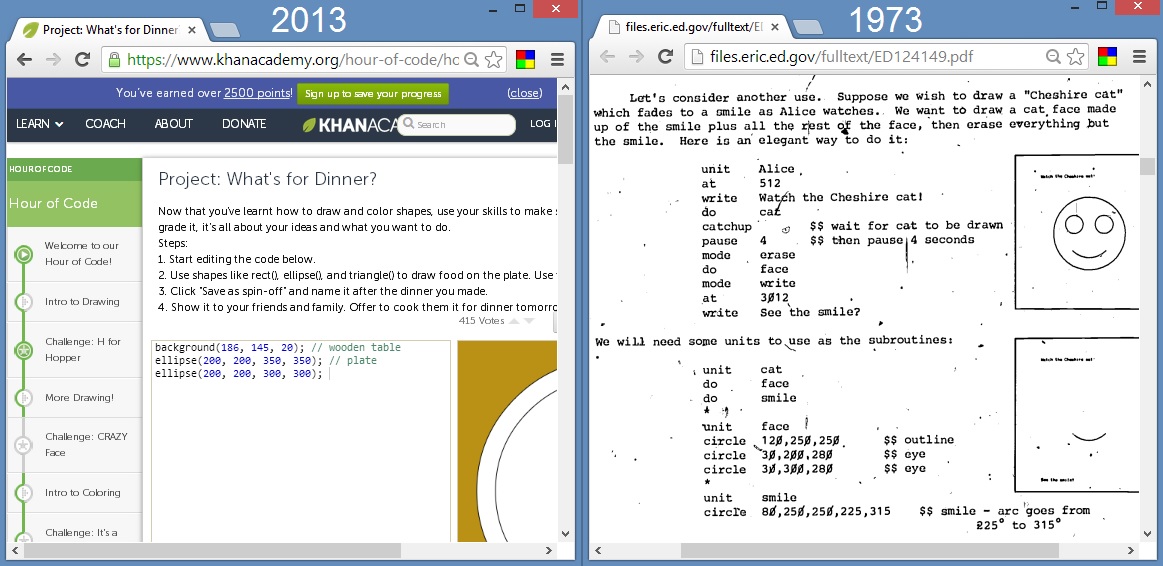
theodp writes Writing in Vanity Fair, U.S. Secretary of Education Arne Duncan marvels that his kids can learn to code online at their own pace thanks to "free" lessons from Khan Academy, which Duncan credits for "changing the way my kids learn" (Duncan calls out his kids' grade school for not offering coding). The 50-year-old Duncan, who complained last December that he "didn't have the opportunity to learn computer skills" while growing up attending the Univ. of Chicago Lab Schools and Yale, may be surprised to learn that the University of Illinois was teaching kids how to program online in the '70s with its PLATO system, and it didn't look all that different from what Khan Academy came up with for his kids 40 years later (Roger Ebert remarked in his 2011 TED Talk that seeing Khan Academy gave him a flashback to the PLATO system he reported on in the '60s). So, does it matter if the nation's education chief — who presides over a budget that includes $69 billion in discretionary spending — is clueless about The Hidden History of Ed-Tech? Some think so. "We can't move forward," Hack Education's Audrey Watters writes, "til we reconcile where we've been before." So, if Duncan doesn't want to shell out $200 to read a 40-year-old academic paper on the subject (that's a different problem!) to bring himself up to speed, he presumably can check out the free offerings at Ed.gov. A 1975 paper on Interactive Systems for Education, for instance, notes that 650 students were learning programming on PLATO during the Spring '75 semester, not bad considering that Khan Academy is boasting that it "helped over 2000 girls learn to code" in 2014 (after luring their teachers with funding from a $1,000,000 Google Award). Even young techies might be impressed by the extent of PLATO's circa-1975 online CS offerings, from lessons on data structures and numerical analysis to compilers, including BASIC, PL/I, SNOBOL, APL, and even good-old COBOL.
5 of 134 comments (clear)

  1. Not news by operagost · · Score: 4, Interesting

    A presidential appointee who is ignorant and unqualified? Horrors!

    --

    Gamingmuseum.com: Give your 3D accelerator a rest.
    1. Re:Not news by DerekLyons · · Score: 4, Interesting

      That's what the summary want you to believe. However, it's the summary that ignorant - because the submitter cannot seem to grasp that back in the 70's it was quite possible for kids in one place to have the opportunity and kids in another to not have that opportunity.

      I really shouldn't have to explain this, but as bias has already replaced facts in the summary and your reply, I guess I have to.

      Back then (remember, we're talking the 1970's), not everyone (even at 'elite' schools) had the opportunity to interact with a computers - especially if you weren't in a computer or science field. For kids at home? Home computers were very unusual. Home computers with a video screen and a modem and acess to a mainframe? Don't make me laugh. It's true in the latter half of the 70's that home computers began to be available and affordable, but they simply weren't that widespread. Radio Shack was selling the TRS-80 and it's derivatives... at the stunning rate of 10,000 a year. Commodore PET's sold at a similar rate, as did the Apple II (And the US had a population of 225 million - you do the math.) Nor did we have the public internet or the WWW.

      Now of course, we're going to have some other old farts pipe up and explain that *they* had access to this stuff back then - and then indulge in the logical fallacy of generalizing from their experience. (To those who make the mistake of claiming I'm doing the same - go back and look at those sales numbers in the previous paragraph. And digging around, I find similiar sales numbers for mini-computers in the same era.) They're wrong six ways from Sunday, computers simply weren't part of the everyday life of most people and almost all kids back in the 1970's. In 1978, my dad helped a local hospital install their first ever computerized patient data system.* The year I graduated high school (1981), it's was (local) newsworthy that the local stores of a major national chain were installing a computerized POS system. (The guy they moved into town to manage them was our neighbor.) They weren't even networked - tapes were shipped back and forth and he had to drive around town installing the tapes and collecting the ones with sales data to be shipped back to Headquarters. (I didn't even see my first punch card until my sophomore year in high school - and it was from Ma Bell.)

      That is the reality of computers in the late 1970's and very early 1980's. They were just barely beginning to move out of academia and the big corporations. Individual (home/turnkey) computers were available, but were pretty rare. Networks of computers practically unheard of. In the year Secretary Duncan would have graduated high school (1982), we were indeed on the cusp of a great revolution - but it hadn't happened yet. It would be almost another decade before home computers (and thus the chance for kids to interact with them) became nearly ubiquitous. And even so, as a computer salesman in '91 and '92 I still had to explain to people what computers were and why it was a good idea to have one, especially if they had kids.

      So, being a year older than Secretary Duncan, I don't find it all surprising he didn't have the chance to learn to code when he was a kid. I did, but I was a very inquisitive geek, he doesn't appear to have been. Nor do I find it surprising that he doesn't know about a semi-obscure academic experiment that happened when he was a kid. (And that seems to have actually trained only a couple of thousand kids across a decade and a half.) Nor does it actually matter much that he didn't, because the reality is the opportunity was very rare when he was a kid.

      *Which I always thought odd, because he was a printer with pretty much no experience with computers. It wasn't for many years that I found out that the hospital had hired him to help adapt their existing paper flow to the computer flow. (Back then, it frequently was printers who designed forms and often helped design the data flow - because the physical con

  2. I'm not sure it's relevant. by darkwing_bmf · · Score: 2, Interesting

    In the 60s and 70s, home PCs were not common, the Internet was a research project and long distance phone calls were expensive.

  3. Arne Duncan is a hack by jsepeta · · Score: 3, Interesting

    Arne Duncan's claim to fame is outsourcing Chicago schools to private for-profit corporations, undercutting the public school system. He's a world-class jerk and it's shameful that he's in charge of America's education policy. Shameful.

    --
    Remember kids, if you're not paying for the service, YOU ARE THE PRODUCT THAT IS BEING SOLD.
  4. Missing the point by jtara · · Score: 3, Interesting

    A lot of posters are missing the point, and stating that it's understandable that he didn't know about Plato, given it's limited availability.

    Perhaps excusable. I read Computer Lib/Dream Machines and, yes, that was my first knowledge of Plato. And I was a Computer Science student and hobbyist.

    But what he stated is that he did not have the opportunity to learn about computers. That's total nonsense. He apparently just avoided it. Any college student in engineering, social sciences, etc. in the 70's would have plenty of opportunity to take conventional classes, and in most schools they would have been required.