 Slashdot Mirror
Opportunity Rover Reaches Martian Day 4,000 of Its 90-Day Mission
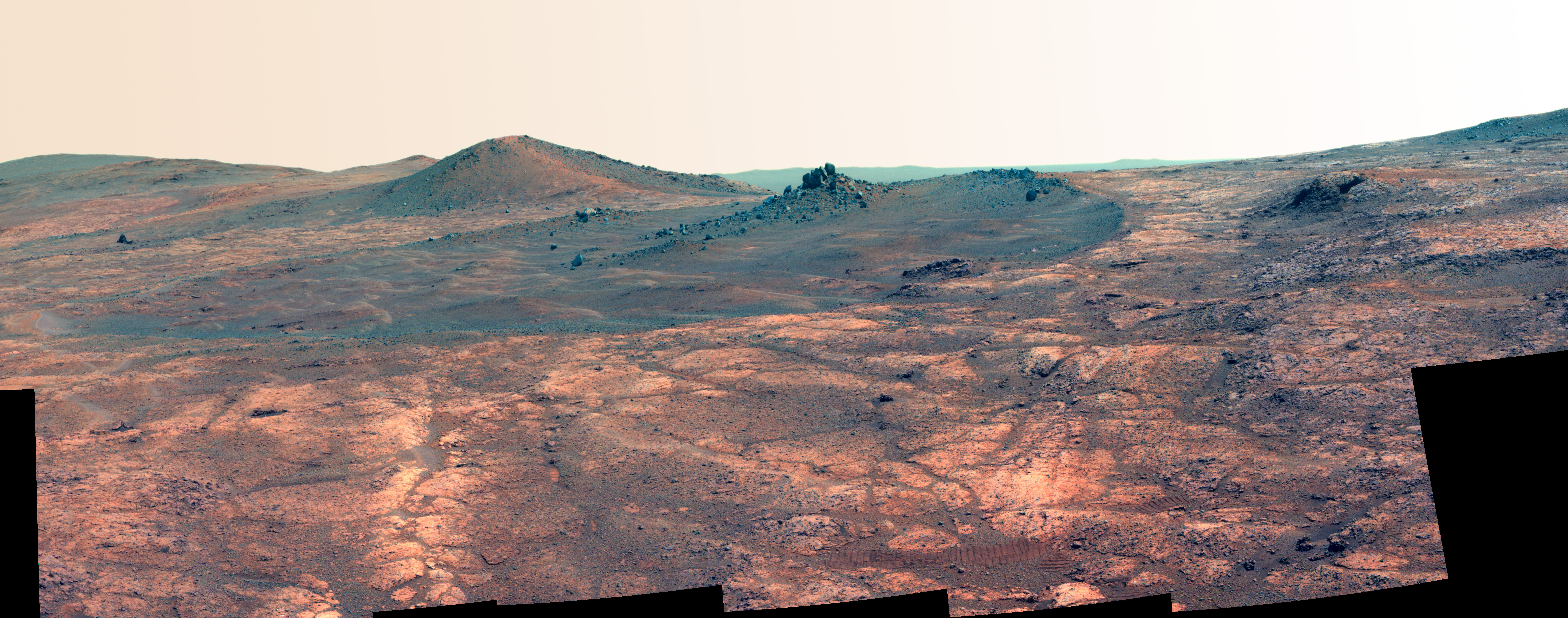
An anonymous reader writes: Let's take a moment to appreciate the incredible engineering, scientific, and planning skill that went into the construction and deployment of the Opportunity rover. It landed on Mars with the goal of surviving 90 sols (Martian days), and it has just logged its 4,000th sol of harvesting valuable data and sending it back to us. The Planetary Society blog has posted a detailed update on Opportunity's status, and its team's plans for the future. The rover's hardware, though incredibly resilient, is wearing down. They reformatted its flash drive to block off a corrupted sector, and that solved some software problems that had cropped up. They're currently trying to figure out why the rover unexpectedly rebooted itself. Those events are incredibly dangerous to the rover's survival, so their highest priority right now is diagnosing that issue.
Fortunately, weather on Mars is good where the rover is, and it's still able to harvest upwards of 500 Watt-hours of energy from its solar panels. Opportunity recently completed a marathon on Mars and took an impressive picture of the Spirit of St. Louis crater, and the rover will soon be on its way to enormous clay deposits that could provide valuable information about where we can look for water when we eventually put people on Mars. As always, you can look through Opportunity's images at the official website.
Fortunately, weather on Mars is good where the rover is, and it's still able to harvest upwards of 500 Watt-hours of energy from its solar panels. Opportunity recently completed a marathon on Mars and took an impressive picture of the Spirit of St. Louis crater, and the rover will soon be on its way to enormous clay deposits that could provide valuable information about where we can look for water when we eventually put people on Mars. As always, you can look through Opportunity's images at the official website.
https://xkcd.com/1504/
Also appropriate: https://www.xkcd.com/695/
Here's proof that we are capable of great civilian technology achievements when we have the will and the desire to invest in science and engineering instead of yet another boondoggle.
(manned missions)
Still, I have to point out that this amount of research could have been done by a motorized human in half a day. For a rough estimate, look at the path the rover traveled in these 4000 days:
http://planetary.s3.amazonaws....
"The agriculture ministry is not in charge of Gundam" - Japanese ministry official.
Of course it's lasted more than 90 days. That's because Opportunity never landed on Mars. All the images are created in a secret NASA location in Nevada.
Now if you'll excuse me I have to go monitor the Jade Helm Texas takeover.
Proverbs 21:19
https://xkcd.com/1504/
He was a lot nicer to Spirit, which had a similarly impressive run:
https://xkcd.com/695/
yeah, that's probably a good 100 years away, if not 500. Aside from dangers like radiation, nutrition, and other oh-so-subtle big things like gravity -- each of which is likely to kill a human long before they need their first water source -- there are also dangers in the trip itself, like radiation, nutrition, gravity, the vessel, going stir-crazy, and the time itself. Before all of that, there's the money, the interest, and the law. There's the communication delay, the medical equipment that doesn't exist, and the general goodbye-ness of it all. Oh, and then there's the actual "success" part -- ten failures does not a landing make. And finally, and I can't stress this enough we aren't going to mars the day after settling on the moon; and we sure as hell aren't going to mars before settling the moon.
So, figure another twenty years before ten humans live on the moon (the way they do on the space station now). Figure another twenty years before the moon is routinely stable, reliable, and worthwhile. Then figure fifty more years to actually give a damn about mars.
"eventually" appears as the heading on my to-do lists too. There's "now", "today", "tomorrow", "this week", "next week", "this month", "next month", "soon", "later", and "eventually". I think it 25 years I've yet to even start even one task from the "eventually" section.
Technology moves very quickly these days. Humans still don't. How about building a transit system that lets me get from new york to california in under EIGHT HOURS! then you can work on mars.
I mean with all the technical miracles NASA pulled off on that mission, they somehow managed to underestimate the longevity of the mission by 45x.
If I were a bit more cynical, I'd suggest NASA regularly lowers expectations of their missions for public relations purposes. But then I think, no, these are the guys who launched an elderly senator who oversaw their funding into space for totally legitimate scientific inquiry ("providing information on the effects of spaceflight and weightlessness on the elderly")...
(I know, unpopular to criticize NASA here, but just sayin'...)
Pretty sure you are going to need a drink long before low gravity messes with you.
Pretty much all other reasons you list as problems could be applied to a move to Wyoming, but people do that all the time.
"There is more worth loving than we have strength to love." - Brian Jay Stanley
Yes, a motorised human could cover that distance in 1/2 a day.
The point is, they weren't trying to set a speed record. They were doing science at the same time. While a human could achieve that distance in 1/2 a day, they could *not* achieve the same amount of science over that distance in 1/2 a day.
Why is a Martian day called a sol? Shouldn't that be the length of Sol's (the suns) day? Now what are we going to call the lengths of days on the other planets?
If you are not allowed to question your government then the government has answered your question.
But then I think, no, these are the guys who launched an elderly senator who oversaw their funding into space for totally legitimate scientific inquiry ("providing information on the effects of spaceflight and weightlessness on the elderly")...
(I know, unpopular to criticize NASA here, but just sayin'...)
Why do you think this wasn't legitimate research? Space travel may become common in the near(ish) future for citizens, and this is the sort of thing we need to know before we get there. With all the focus on civilian space tourists coming from other space programs, it's probably a good idea for this research to be done by a group who's in it for the science, not the money. Besides, it's not like it was really just "some elderly Senator" like you're implying - it was John Glenn, one of the very first astronauts. This is someone they sent up in his prime, and spent years testing. This is exactly the sort of subject who does make it legitimate research - someone they have large amounts of medical data on both Earthside and in space from before they were considered "elderly". This gives valuable data points at different points in his life. This is exactly the type of research science NASA is supposed to be doing.
It landed on Mars with the goal of surviving 90 sols (Martian days), and it has just logged its 4,000th
Good job soldier - and NASA engineers.
Antisthenes: "Wisdom begins by examining the words/names." - excuse my English, i am (slightly...) better with my Greek!
I hereby nominate the Mars Rovers for any and all honors which can be shoehorned into being something we can assign to them.
And kudos to the people who built it and kept it going.
Fourty-five times planned mission length is pretty damned awesome!!
Lost at C:>. Found at C.
Still, I have to point out that this amount of research could have been done by a motorized human in half a day. For a rough estimate, look at the path the rover traveled in these 4000 days:
And the entire project with two rovers and five extensions has cost $944 million. The SLS program will cost tens of billions to develop and even then a launch would eat over half the budget, before you actually have any crew capsule, lander, habitat, return craft or scientific equipment. If you really did an apples-to-apples comparison on the same budget, you'd realize we're getting a very good bang for the buck.
Live today, because you never know what tomorrow brings
Does anybody know why they originally expected it to work for only 90 days? I imagine the mission could have been very different had they known the rover would be able to stay alive for 50 times longer...
I mean with all the technical miracles NASA pulled off on that mission, they somehow managed to underestimate the longevity of the mission by 45x.
To be fair, 90 days was not, in fact, the estimated lifetime of the mission. It was the design specification of the mission. That is, each of the subsystems was designed with the specification "design a system that will operate for a minimum of 90 (Martian) days, even under worst-case conditions."
Think of it as a 90-day warranty-- after 90 days, it wasn't expected to be dead, it was just out of warranty.
(and note that since the engineering specification was validated by testing the subsystems to either three times design life, or testing to design life under three-sigma worst-case conditions, it would have been very difficult to design for 4000 days...)
http://www.geoffreylandis.com
Watt-hour is a unit of energy, not power, so the information doesn't make a sense. Maybe the author wanted to say "rover can get up to 500 watts out of his solar panels" or "It can get 500 watt-hours of energy per day"?
That research could have been collected in a day by a human being, sure.. but not before probably dozens of people died. just trying to get there.
We send probes because they are expendable.
File under 'M' for 'Manic ranting'
I think it can be both a media ploy and good research. Heck, if Glenn enjoyed the ride it was a three-fer!
If you designed something to last for 90 days and it lasts for 4000 you've over-engineered the solution. Time and money could clearly have been saved in the development and construction of the rover.
Now in this case, the fact that it has lasted far beyond its intended life has been a positive think. However, in much of the other work NASA does it is simply wasting money. NASA has a problem delivering projects on budget because it's focusing too much on reliability and safety and trying too hard to account for every eventuality. They're also too scared of failure and bad press.
I remember John Carmack saying he thinks SpaceX should be destroying more rockets. Instead of trying to make a rocket that's 100% guaranteed to work (as NASA would) they should make a good enough solution and work out the problems by having some of them fail. After destroying a few the issues will be worked out and you'll have a working rocket in the time it would take NASA to complete a paper study for the rocket design.
It was probably the Challenger incident that destroyed NASA. Since then they've developed a culture of, "no matter how much this costs or how long it takes it can't be allowed to fail." You'll never achieve your big goals with an attitude like that.
So, instead of years of slow science, we'd have a few decades of prep work, spend a trillion dollars, and then do all the science in half a day. Not sure we would have gained anything.
Personally I think a Martian has taken a liking to it and repairs it while it's sleeping.
"If any question why we died, Tell them because our fathers lied."
Robots don't need air, water, food, radiation protection, etc. A MASSIVE savings in travel and operations, and human safety. A human picking up rocks could not do much science. A robot can have multi-spectrum lighting, microscopic lenses, photographic recording, mass spectro, etc.
If humans go to Mars it should be to do what only humans can do (like have babies).
If you designed something to last for 90 days and it lasts for 4000 you've over-engineered the solution. Time and money could clearly have been saved in the development and construction of the rover.
Just shut up.
If you think I voted for Trump because of this post, you're wrong. I voted for Dr. Jill Stein of the Green Party. Again.
I have read stories that NASA considers to shutdown this rover mission due to budget cuts and priorities.
By that logic, we could send half of Washington D.C. up there.
We used to have a Bill of Rights. Now, with the rights gone, all we have left is the bill.
Still, I have to point out that this amount of research could have been done by a motorized human in half a day.
Funny enough, Opportunity has driven further than any of the lunar rovers did...
And how much science could be done by spending the same budget as it would take to get a person there on rovers? A lot of the basic science isn't about just looking around and drawing some conclusions, but about feeding samples into various machines, machines that would have to be made on Earth anyway even for a decent sized human mission. So what science would the human have done in half a day that a dozen or more rovers couldn't? Maybe try being specific instead of abstract.
I was kind of shocked when they were showing off a copy of it that UW Engineering had at UW Discovery Days a couple of weekends ago.
It's even smaller than a battery powered Formula 1 electric car.
Little in the middle but it's got much track.
-- Tigger warning: This post may contain tiggers! --
Don't get me wrong, I'm happy that the rover has lasted so long, but to call this excellent engineering is just plain wrong. If it lasted 90 days and no more that would be excellent because that was what was required. To last a lot longer implies that either the engineers did know what they were doing, or they over engineered everything they could and that would have resulted in many many dollars of extra spend that could have gone elsewhere.
You call it groupthink, but maybe you should consider that there is some reasoning behind it. Just look at what actual geology research on Earth involves these days.
I still know some colleagues that won't trust anyone else to gather samples for them, but they are all the older types. The vast majority of the actual research done now involves bringing back samples to analyze in the lab, and collecting the samples is just a bit of slightly trained labor. I can get new samples far more often now by training grad students and even undergrads to go collect things, and not have to be there myself. And the only reason they are sent instead of machines, is it is really cheap to send a student somewhere on Earth's surface for field work compared to a machine. But it is not like the science gets done any faster by being there myself to collect things, and I can double check their work from afar thanks to cell phone cameras.
Outside of when I want to travel some place for travel sake (and it fits within my schedule), the only time I've had to be on site was when doing work for the petroleum industry. That wasn't about increasing throughput, but just about latency. They had money to get portable versions of equipment on site, and wanted things analyzed right then, instead of a week or two later. Even then, outside of active sites, I've heard they use a lot less field work from the high paid geologists, and also just use lackey's to return samples to a central location to be analyzed.
The science is done by looking at measurements now, not by looking stumbling around the field. Scientists can look at measurements on Earth as well as they can on Mars, and do just as much science. About the only thing going for humans is they would be more efficient at walking, driving, and picking up things, basic labor task. But that is only if comparing things on a single-machine to person level, not on a dollar to dollar level. At the end of the day, the best way to increase science done on Mars is to get more equipment there, at more locations, regardless of whether a person or robot schools samples into the equipment.
Other than the fact that doing so would likely violate several intra-galactic treaties, that would be an excellent idea.
Faster! Faster! Faster would be better!
wyoming has radiation? communication delays? nothing to see, or to do? No medical equipment?
You're pretty sure about gravity not messing with you? It takes three days to die of thirst. It takes a week to die of thirst given one extra bottle of water from the transport ship. I don't know what that gravity would do to your digestive systems.
But isn't that the point? "Pretty sure" just ain't sure enough.
Oh yeah, and the effects of the gravity can guarantee your death immediately, even if you won't actually die for another two months.
Except that they can't... at least not the way that they do it naturally. I recall reading somewhere that mammal reproductivity is quite dependent on the earth's gravity, and attempts have a baby outside of that environment would most likely be fatal for the fetus, assuming that the attempt to become pregnant in the first place did not outright fail.
File under 'M' for 'Manic ranting'
Why do you think this wasn't legitimate research?
Because I'm cynical and I have an easier time believing that a powerful politician who oversees the budget said to NASA "come up with some plausible excuse I can go up in space again" and this "study of weightlessness on the elderly" was the best they could come up with. Do you really buy it was legit?
Look, I don't mind the symbolic trips (McCauliff for example), but when they are spending millions of dollars of taxpayer money for every passenger on board, it is unseemly to send the boss up as a space tourist. It's unsavory and smacks of undo influence--- and I say this as a very passionate Democrat and fan of a man who made amazing contributions to science and to the country as both an astronaut and a politician. But that said, he was at the time a politician overseeing the agency that paid for this trip, and that was my problem with it.
Yes, i'm familiar with the "we had lots of data about him in his prime" rationale. But, c'mon. Can you think of any other context in which this kind of unique expense for a single politician would be appropriate from a division of government he is responsible for overseeing?
The scientific community by and large is against manned missions.
Wouldn't it be nice, if ALL government projects, worked as good as the Opportunity Rover.
wyoming has radiation?
Hell yes! Have you measured background radiation in the rockies?
communication delays?
Ever tried to maintain cell signal on the way to Yellowstone?
nothing to see, or to do?
Once you've seen Frontier Days once...
No medical equipment?
I go up there all the time with no medical equipment.
I don't know what that gravity would do to your digestive systems.
That's why every astronaut has died immediately after return from space with even less gravity...
I have to break character here and say - you are SUCH a retard. That's enough fun for me. You may carry on if you wish.
"There is more worth loving than we have strength to love." - Brian Jay Stanley
Impressive power generation.
The unexpected reboot is clearly because it spotted something it shouldn't have. Can't let any photos of [elided] reach Earth. Can you imagine what would happen!?
The only reason why Humans have not been on Mars is that we can't find a really good reason to do it.
With continued Apollo-era funding, we'd have done it in the '80s. Few engineering challenges involved that aren't really just legwork.
Prediction for end of Universe #42: Fencepost error in Quantum_bogosort.cpp
If they called it a 'day', they wouldn't have known if it was an Earth day or a Mars day. If they relied on calling them 'Mars Day' or 'Earth Day', soon someone would have forgotten to maintain the prefix.
So they coined a new word to use for a Martian Day, and stuck to it.
For other planets, I expect that the same term will be used. 'Day' for time on Earth, 'Sol' for time on the planet. That said, we don't have all that many things that would have usable 'Sols'. Mercury's days last for months, Venus' day last for longer than its year. Maybe probes on minor planets, which look like they have days around 8 hours long.
Prediction for end of Universe #42: Fencepost error in Quantum_bogosort.cpp
I recall reading somewhere that mammal reproductivity is quite dependent on the earth's gravity, and attempts have a baby outside of that environment would most likely be fatal for the fetus, assuming that the attempt to become pregnant in the first place did not outright fail.
I'm going to go out on a limb here and speculate that the source you got that from was heavy on sophistry and light on science. There are complications for gestation in microgravity environments, but Mars isn't a microgravity environment. The effects of Mars level gravity on development of offspring and on the physiology of the already developed are still an unknown.
Opportunity is stuck on Gillgan's Island..
really.. need we have to say it ?
Water on Mars would make it more habitable than California.
Please EM Drive work, Please EM drive work, Please EM Drive work, Please EM drive work, Please EM Drive work, Please EM drive work,
Also, please let us marry little girls. They are so very cute and nice.
If the boss has proved previously that they can do the work, and then actually does some work on the trip then they are not a tourist are they? There were less than a dozen other people on the planet that could even be considered for the project at the time. Would you still be making a big deal of it if Dr Aldrin went instead?
That you agree that a trip to Mars is well within man's grasp, and that trying to make some point from how hard you find trans-continental flight is nonsense.
Prediction for end of Universe #42: Fencepost error in Quantum_bogosort.cpp
Plus the oldest of three Mars orbiters. This is to make room in the NASA planetary budget for current and new missions. The WH has proposed this before, but either NASA or Congress bypassed it.
Perhaps we should send rabbits:
http://www.theclassictoons.com/22/mad-as-a-mars-hare/
(go to 2:35 in the video or scroll down in the transcript to the conversation between Bugs and the Radio Voice)
45 years ago we used to walk on the moon regularily. Now we just send robots on Mars.
Wake me up when we go to another solar system. /Or when we walks on the sun. At night