 Slashdot Mirror
3 Years Ago, Microsoft Said Tech Should Fund K-12 CS Education. What Changed? (motherjones.com)
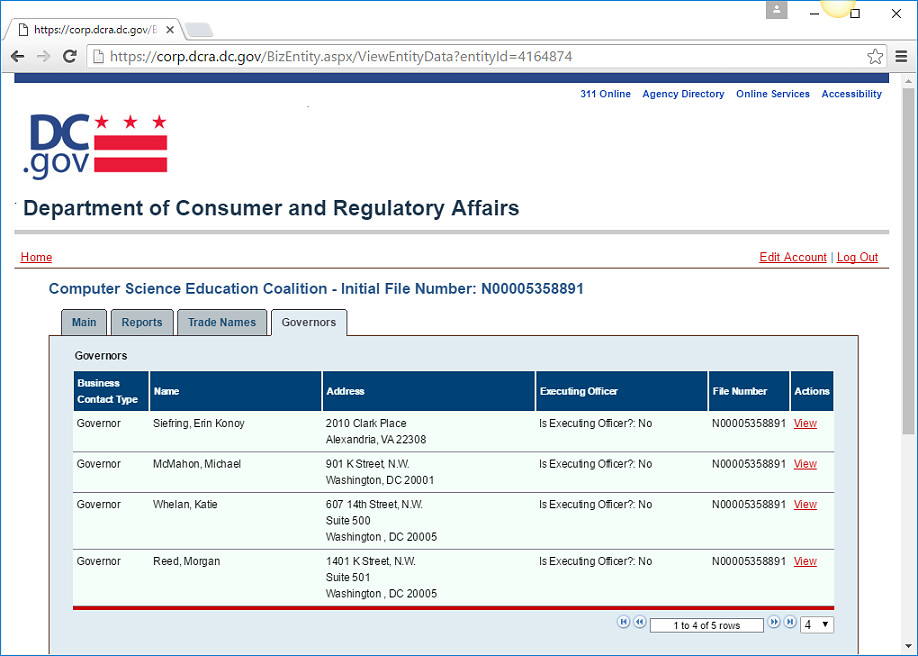
theodp writes: Last week, Microsoft and some of the biggest names in tech and corporate America threw their weight behind a Change.org petition that urged Congress to fund K-12 Computer Science education. The petition, started by the tech-backed CS Education Coalition (btw, 901 K Street NW is Microsoft's DC HQ) in partnership with tech-backed Code.org, now has 90,000+ supporters. But three years ago, Microsoft backed a very different Change.org petition that called for corporate America to foot the STEM education bill.
"While the need to expand high-skilled immigration is immediate," read the letter to Congress, "we also need to expand STEM opportunities in U.S. education. A positive proposal has emerged in Washington to create a national STEM education fund, paid for only by businesses using green cards and visas. This fund will help prepare Americans for 21st-century STEM jobs. The proposal is supported by a broad coalition [PDF] that includes Microsoft, GE, the National Council of La Raza, the National Association of Manufactures, and the National Science Teachers Association, to name a few."
The earlier petition, which wound up with 41,009 supporters, was started by Voices for Innovation, a self-described "Microsoft supported community" that says it's now "proud to support the Computer Science Education Coalition" as part of its efforts to "shape public policies for our 21st century digital economy and society." So, what changed? Well, Mother Jones did warn that what Microsoft promises and what it delivers for education isn't necessarily the same...
"While the need to expand high-skilled immigration is immediate," read the letter to Congress, "we also need to expand STEM opportunities in U.S. education. A positive proposal has emerged in Washington to create a national STEM education fund, paid for only by businesses using green cards and visas. This fund will help prepare Americans for 21st-century STEM jobs. The proposal is supported by a broad coalition [PDF] that includes Microsoft, GE, the National Council of La Raza, the National Association of Manufactures, and the National Science Teachers Association, to name a few."
The earlier petition, which wound up with 41,009 supporters, was started by Voices for Innovation, a self-described "Microsoft supported community" that says it's now "proud to support the Computer Science Education Coalition" as part of its efforts to "shape public policies for our 21st century digital economy and society." So, what changed? Well, Mother Jones did warn that what Microsoft promises and what it delivers for education isn't necessarily the same...
First, spend money on paying teachers, repairing buildings, buying computers and internet access for students who can't afford it (like many in the inner city schools), since all the books, etc are now e-books (not necessarily a bad thing). Hell, many of the kids in the poorer schools need breakfast and lunch.
Tech and programming education is a distant second to competency in English, Math and History. Our schools (especially the ones in poor areas) are crying out for money, just to competently teach the basics, never mind tech education.
Oh, and special ed, ELL for new immigrants, alternative tracks for low level learners, all those should also be getting funding before we start trying to teach everyone to be a programmer.
Remember folks, everyone working for Google, Facebook, Microsoft and Apple learned to code WITHOUT a nationwide secondary school program.
Priorities, people.
The ideal market would be multiple qualified candidates for every job opening.
Whether that occurs due to the proposed domestic educational steering program or due to H1B-type legislation doesn't much matter to them. If the government is also willing to pick up the tab, well, that's just gravy.
Happiness in intelligent people is the rarest thing I know.
Ernest Hemingway
I'm an educator. I teach Physics, CS, and Engineering. My advice is maybe. If your goal is to get your child to become a computer scientist, then no. If your goal is to expose your student to different ways of thinking, then absolutely. It's high school! No one should be making career choices at that age. High school, and parts of college, are all about developing agile minds that can incorporate many different ways of approaching tasks and problems. Most of my students are not going to be astrophysicists. However, all of them leave my class understanding how to use the scientific method in their lives. That's more important, imo.
80% of people who apply for programming courses at Universities fail in the first two semesters. Of the remaining 20%, over half of them can't create a proper mental model of what is going on and only get by with luck and determinism. Only 10% of people who even apply are useful, and those skills are power-curve distributed.