 Slashdot Mirror
3 Years Ago, Microsoft Said Tech Should Fund K-12 CS Education. What Changed? (motherjones.com)
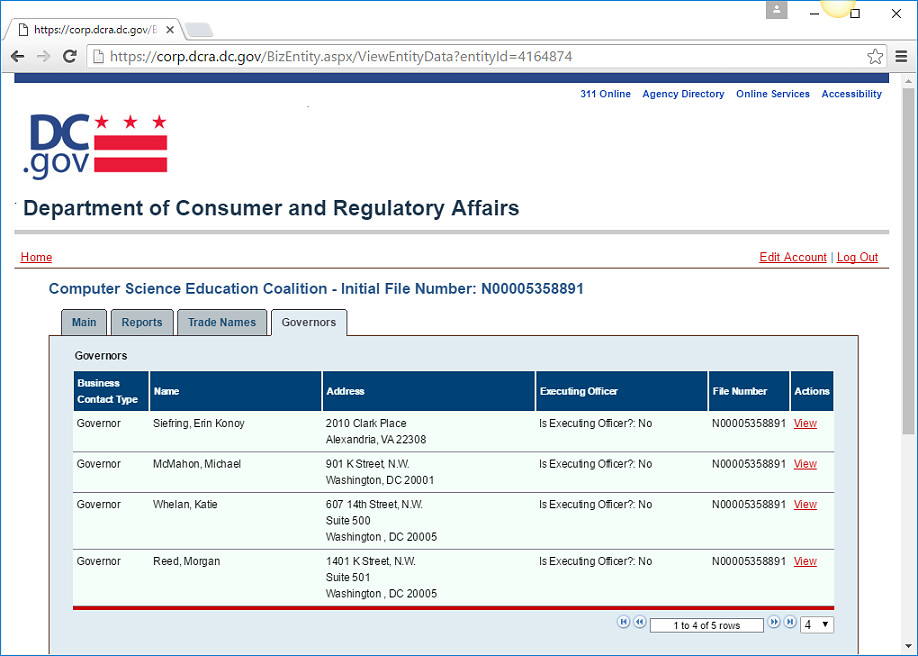
theodp writes: Last week, Microsoft and some of the biggest names in tech and corporate America threw their weight behind a Change.org petition that urged Congress to fund K-12 Computer Science education. The petition, started by the tech-backed CS Education Coalition (btw, 901 K Street NW is Microsoft's DC HQ) in partnership with tech-backed Code.org, now has 90,000+ supporters. But three years ago, Microsoft backed a very different Change.org petition that called for corporate America to foot the STEM education bill.
"While the need to expand high-skilled immigration is immediate," read the letter to Congress, "we also need to expand STEM opportunities in U.S. education. A positive proposal has emerged in Washington to create a national STEM education fund, paid for only by businesses using green cards and visas. This fund will help prepare Americans for 21st-century STEM jobs. The proposal is supported by a broad coalition [PDF] that includes Microsoft, GE, the National Council of La Raza, the National Association of Manufactures, and the National Science Teachers Association, to name a few."
The earlier petition, which wound up with 41,009 supporters, was started by Voices for Innovation, a self-described "Microsoft supported community" that says it's now "proud to support the Computer Science Education Coalition" as part of its efforts to "shape public policies for our 21st century digital economy and society." So, what changed? Well, Mother Jones did warn that what Microsoft promises and what it delivers for education isn't necessarily the same...
"While the need to expand high-skilled immigration is immediate," read the letter to Congress, "we also need to expand STEM opportunities in U.S. education. A positive proposal has emerged in Washington to create a national STEM education fund, paid for only by businesses using green cards and visas. This fund will help prepare Americans for 21st-century STEM jobs. The proposal is supported by a broad coalition [PDF] that includes Microsoft, GE, the National Council of La Raza, the National Association of Manufactures, and the National Science Teachers Association, to name a few."
The earlier petition, which wound up with 41,009 supporters, was started by Voices for Innovation, a self-described "Microsoft supported community" that says it's now "proud to support the Computer Science Education Coalition" as part of its efforts to "shape public policies for our 21st century digital economy and society." So, what changed? Well, Mother Jones did warn that what Microsoft promises and what it delivers for education isn't necessarily the same...
First, spend money on paying teachers, repairing buildings, buying computers and internet access for students who can't afford it (like many in the inner city schools), since all the books, etc are now e-books (not necessarily a bad thing). Hell, many of the kids in the poorer schools need breakfast and lunch.
Tech and programming education is a distant second to competency in English, Math and History. Our schools (especially the ones in poor areas) are crying out for money, just to competently teach the basics, never mind tech education.
Oh, and special ed, ELL for new immigrants, alternative tracks for low level learners, all those should also be getting funding before we start trying to teach everyone to be a programmer.
Remember folks, everyone working for Google, Facebook, Microsoft and Apple learned to code WITHOUT a nationwide secondary school program.
Priorities, people.
The ideal market would be multiple qualified candidates for every job opening.
Whether that occurs due to the proposed domestic educational steering program or due to H1B-type legislation doesn't much matter to them. If the government is also willing to pick up the tab, well, that's just gravy.
Happiness in intelligent people is the rarest thing I know.
Ernest Hemingway
Where would you steer them? I can't really think of a sector of the economy that can be adversely affected from the following factors...
Outsourcing, Automation, Obsolescence, Overly high regulation, Political interests to discredit you, Already saturated so the pay stinks, and/or extremely dangerous.
Computer Science and working in IT is just as risky as working in any other sector. Just as long as you work around the Outsourcing problem, you can become the factor causing the Automation, and Obsolescence.
However more to the point. Having Computer Science Education doesn't mean that kids need to go into a Computer Science field, but enter their field with a degree of understanding and respect towards the discipline. Realizing what is hard to do and what is easy is a good skill to have. In my professional life, I had numerous encounters with customers and managers who either say. Such process is impossible for a computer to do, while it has a lot of steps each step is logical (or sometimes just can be skipped) allowing for a quicky program that solved hours of laborious man hours. Then you get the seemingly simple request which is very easy to explain, and train a person to do. While for a computer it is a difficult tasks and the chances of failure are higher than the acceptable limit.
Computer Science is a discipline which is a subset of Math which focuses on the study of computation, and process workflow. You see many of these concepts being taught in other disciplines under different names, such as a MBA class in Business Operations which focuses heavily on performance algorithms, where instead of writing a program we look at a business process and find how to improve it.
If something is so important that you feel the need to post it on the internet... It probably isn't that important.
As the H-1B glut depresses wages, it will further discourage enrollment in STEM programs. It's a downward spiral that will result in no Americans going into STEM education paths.
I have young kids. I see that some kids genuinely are interested in math and science. Unfortunately most of these kids are being told by their parents that there are little opportunities in STEM fields.
I also see many more kids taking the vocational/technical track than when I was in school. Vo-tech seems to have lost it's stigma and is even being praised by many former tech workers.
The H-1B program has caused almost irreparable harm to the tech sector in the US. It may take a generation to undo the damage.
Computer Science Education Coalition Lobbyists: Cornerstone Government Affairs (Microsoft also a client), Penn Hill Group (Microsoft also a client),Third Dimension Strategies.
>> Microsoft, GE, the National Council of La Raza, the National Association of Manufactures, and the National Science Teachers Association
I see 2 corporations, 2 associations and one racist council (La Raza stands for "The Race"), members of which frequently advocate for re-conquering "Aztlan" (the american southwest, California to Colorado) and ceding control back to mexico. "The Race" has a large overlap with Mecha, a group that has the motto "For La Raza todo. Fuera de La Raza nada", translated meaning "For The Race, Everything. Outside The Race, Nothing".
http://humanevents.com/2006/04...
I'm an educator. I teach Physics, CS, and Engineering. My advice is maybe. If your goal is to get your child to become a computer scientist, then no. If your goal is to expose your student to different ways of thinking, then absolutely. It's high school! No one should be making career choices at that age. High school, and parts of college, are all about developing agile minds that can incorporate many different ways of approaching tasks and problems. Most of my students are not going to be astrophysicists. However, all of them leave my class understanding how to use the scientific method in their lives. That's more important, imo.
80% of people who apply for programming courses at Universities fail in the first two semesters. Of the remaining 20%, over half of them can't create a proper mental model of what is going on and only get by with luck and determinism. Only 10% of people who even apply are useful, and those skills are power-curve distributed.
Computer Science and working in IT is just as risky as working in any other sector.
I heard this after the dot com bust. People thought it was crazy for me to go back to community college to learn computer programming. But, hey, thanks to George W. following 9/11, I got a $3,000 tax credit to learn new job skills and going back to school was free. I went from working as a video game tester to working as help desk/desktop support technician. Today I'm doing computer security, making more money and paying more taxes. The future looks very bright in the next 20 years as the baby boomers retire and foreign workers will stay home to develop their own country.
Would I be crazy to steer my kids towards CS theses days?
I would use the term guide instead of steer, since the steering analogy implies they are forced down your path. But no, guiding your kids towards CS is not crazy.
Every sector of the economy will be affected by increased automation and increased global competition. Even jobs that need to be done locally, such as plumbing, would be affected by a large flux of displaced workers looking for more local work. So any worries about outsourcing or automation and how they will affect the job market 20-30 years for your children specifically is pointless.
Guiding them towards a well rounded education, whether formal or self-directed, is the most important thing you can do. Computer science will still almost certainly be a great specialization 20-30 years from now because it deals with the underpinnings of the newest phase in the world economy. Deep understanding of database technologies, artificial intelligence, programming languages, etc will be very useful knowledge until the day all humans are unemployable.
The second most important thing to teach is the value of networking. People who rely on job boards instead of their personal network for career opportunities a decade after college will do even worse in 20 years than they do today. If you teach your children that their technical competency will be the only factor in their professional success then you really are crazy, and doing them a grave disservice.
-- All that is necessary for the triumph of evil is that good men do nothing. -- Edmund Burke
http://www.nydailynews.com/opi...
Learning to code is overrated: An accomplished programmer would rather his kids learn to read and reason
BY Jeff Atwood
NEW YORK DAILY NEWS
Sunday, September 27, 2015, 5:00 AM
Mayor de Blasio is winning widespread praise for his recent promise that, within 10 years, all of New York Cityâ(TM)s public schoolchildren will take computer science classes. But as a career programmer who founded two successful software startups, I am deeply skeptical about teaching all kids to code.
When I became fascinated with computers as a teenager in the early 1980s, computers booted up to a black screen and a blinking cursor. You had to learn the right commands to get them to do anything at all. In other words, you were forced to become a computer programmer in order to be a computer user.
One of the great achievements of modern computing is that we no longer need to be programmers to create, build and get things done with the amazing supercomputers that everyone carries around in their pockets.
Thatâ(TM)s a victory we should claim for our kids â" rather than purposefully, almost gleefully sending them back to the era before computers became user-friendly tools.
Iâ(TM)m not saying young people should be oblivious to the way the sausage is made, any more than they should be oblivious to where their food comes from. Indeed, in the coming decades, there are thousands if not millions of good jobs waiting for skilled programmers and creative thinkers who understand the logic of programming.
But as someone whoâ(TM)s been immersed in the digital world for most of his life, I can attest: Computer science is less an intellectual discipline than a narrow vocational skill.
If someone tells you âoecoding is the new literacyâ because âoecomputers are everywhere today,â ask them how fuel injection works. By teaching low-level coding, I worry that we are effectively teaching our children the art of automobile repair. A valuable skill â" but if automobile manufacturers and engineers are doing their jobs correctly, one that shouldnâ(TM)t be much concern for average people, who happily use their cars as tools to get things done without ever needing to worry about rebuilding the transmission or even change the oil.
Thereâ(TM)s nothing wrong with basic exposure to computer science. But it should not come at the expense of fundamental skills such as reading, writing and mathematics â" and unfortunately today our schools, with limited time, have tons of pressure on them to convey those basics better.
Iâ(TM)ve known so many programmers who would have been much more successful in their careers if they had only been better writers, better critical thinkers, better back-of-the-envelope estimators, better communicators. And aside from success in careers, we have to ask the broader question: What kinds of people do we want children to grow up to be?
Itâ(TM)s true. Anyone can learn to code. But very few people can explain why they wrote a line of code, what that code does or convince other people to use it and help them build it. These are all essential human skills that have everything to do with the art of communicating with other people, and nothing at all to do with the writing code that a computer can understand.
Learning to talk to the computer is the easiest part. Computers, for better or worse, do exactly what you tell them to do, every time, in exactly the same way. The people â" well . . . youâ(TM)ll spend the rest of your life figuring that out. And from my perspective, the sooner you start, the better.
I want my children to understand how the Internet works. But this depends more on their acquisition of higher-order thinking than it does their understanding if ones and zeroes. It is essential that they that treat everything they read online critically.