 Slashdot Mirror
Nvidia Calls Out Intel For Cheating In Xeon Phi vs GPU Benchmarks (arstechnica.com)
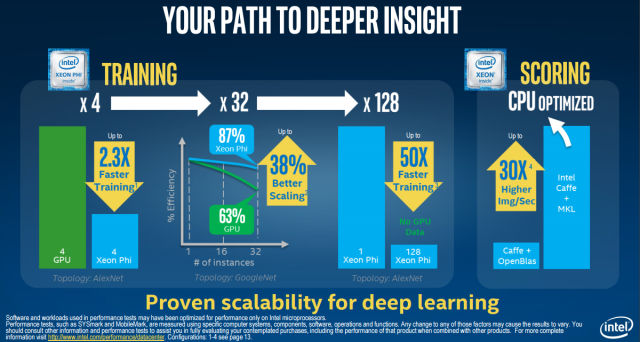
An anonymous reader writes: Nvidia has called out Intel for juicing its chip performance in specific benchmarks -- accusing Intel of publishing some incorrect "facts" about the performance of its long-overdue Knights Landing Xeon Phi cards. Nvidia's primary beef is with the following Intel slide, which was presented at a high performance computing conference (ISC 2016). Nvidia disputes Intel's claims that Xeon Phi provides "2.3x faster training" for neural networks and that it has "38 percent better scaling" across nodes. It looks like Intel opted for the classic using-an-old-version-of-some-benchmarking-software manoeuvre. Intel claimed that a Xeon Phi system is 2.3 times faster at training a neural network than a comparable Maxwell GPU system; Nvidia says that if Intel used an up-to-date version of the benchmark (Caffe AlexNet), the Maxwell system is actually 30 percent faster. And of course, Maxwell is Nvidia's last-gen part; the company says a comparable Pascal-based system would be 90 percent faster. On the 38-percent-better-scaling point, Nvidia says that Intel compared 32 of its new Xeon Phi servers against four-year-old Nvidia Kepler K20 servers being used in ORNL's Titan supercomputer. Nvidia states that modern GPUs, paired with a newer interconnect, scale "almost linearly up to 128 GPUs."
So Intel is the Volkswagon of CPUs?
The real reason that Nvidia is bitching up a storm is that KNL has received a very positive reception in the HPC world.
Oh, and KNL is actually an absolute bargain in comparison to the requirements to get a high-end Pascal system setup, not only because you can buy an entire KNL system (not just a GPU card) starting at only $5000, but because it's self-hosting and doesn't need a high-end Xeon CPU just to feed the GPU. To put it in perspective, you could build a cluster of 26 KNLs for the price of one of those 8-way systems Nvidia is selling.
http://www.colfax-intl.com/nd/...
AntiFA: An abbreviation for Anti First Amendment.
Both parties are quite guilty here
Twinstiq, game news
Intel is the next tech giant to have mass layoffs. It obviously is hitting a dead end if it is arguing over such small increments of performance. Moores Law was fun while it lasted, but depending on transistor count for performance gains isn't going to work.
Intel - Mellanox, Intel - NVidia, Intel - IBM tugs of war: both sides present the opposite results, so much opposite that the suspicion rises naturally. Intel's performance and marketing departments, what are you guys and gals mucking about?
After they spent the last decade going out of their way to force "improvements" into new games (that either never work or cause severe issues for pc games) just to make their overpriced cards look better than AMD, they can go fuck themselves.
Yawn, wake me when there's some actual news.
Also, anyone who puts much faith in Intel's claims is either naive or a company shill. This simply business as usual for Intel.
People in glass houses shouldn't throw stones... and buy some damn shades because seriously, nobody wants to see that!
Anons need not reply. Questions end with a question mark.
Intel has your markets in their crosshairs now and they have a track record of awesome when it comes to commercial chip success.
Apple's decision to move to X86 was strictly a numbers and profit game, not a better performance game.
No concept of what people on Slashdot know already. FBI you are retarded as fuck.
Are you trying to be a mirror of arstechnica, softpedia, zdnet, intel, and cnet now?
Fucking tools. Go back to your bat caves.
The biggest difference is that Knight Landing is a very high core count CPU. You can run an OS on it and program it in the same way you program any other conventional computer.
In contrast, programming a GPU is a pain in the neck unless the task at hand is very well mapped to the hardware.
"Pot, meet Kettle". Wasn't Nvidia doing some shady things a while back to make their benchmarking look better that it was?
IRQ polling? I'm a kernel developer, contributor to linuxppc, and system software engineer at a cpu company. Sorry but the claim is total bullshit. The terminology is barely coherent.
A better superscalar design and cache architecture tends to be a bigger deciding factor than CISC versus RISC. Certainly with CISC you're wasting some engineer's time designing translation and pipeline issue that would have otherwise been unnecessary. CPUs are frequently found with over a billion transistors these days, with a B, as in (1e9). A few extra transistors to do the CISC junk is no longer a significant portion of your wafer, unlike 30 years ago.