 Slashdot Mirror
Researchers Create Algorithm That Diagnoses Depression From Your Instagram Feed (inverse.com)
An anonymous reader quotes a report from Inverse: Harvard University's Andrew Reece and the University of Vermont's Chris Danforth crafted an algorithm that can correctly diagnose depression, with up to 70 percent accuracy, based on a patient's Instagram feed alone. After a careful screening process, the team analyzed almost 50,000 photos from 166 participants, all of whom were Instagram users and 71 of whom had already been diagnosed with clinical depression. Their results confirmed their two hypotheses: first, that "markers of depression are observable in Instagram user behavior," and second, that "these depressive signals are detectable in posts made even before the date of first diagnosis." The duo had good rationale for both hypotheses. Photos shared on Instagram, despite their innocent appearance, are data-laden: Photos are either taken during the day or at night, in- or outdoors. They may include or exclude people. The user may or may not have used a filter. You can imagine an algorithm drooling at these binary inputs, all of which reflect a person's preferences, and, in turn, their well-being. Metadata is likewise full of analyzable information: How many people liked the photo? How many commented on it? How often does the user post, and how often do they browse? Many studies have shown that depressed people both perceive less color in the world and prefer dark, anemic scenes and images. The majority of healthy people, on the other hand, prefer colorful things. [Reece and Danforth] collected each photo's hue, saturation, and value averages. Depressed people, they found, tended to post photos that were more bluish, unsaturated, and dark. "Increased hue, along with decreased brightness and saturation, predicted depression," they write. The researchers found that happy people post less than depressed people, happy people post photos with more people in them than their depressed counterparts. and that depressed participants were less likely to use filters. The majority of "healthy" participants chose the Valencia filter, while the majority of "depressed" participants chose the Inkwell filter. Inverse has a neat little chart embedded in their report that shows the usage of Instagram filters between depressed and healthy users.
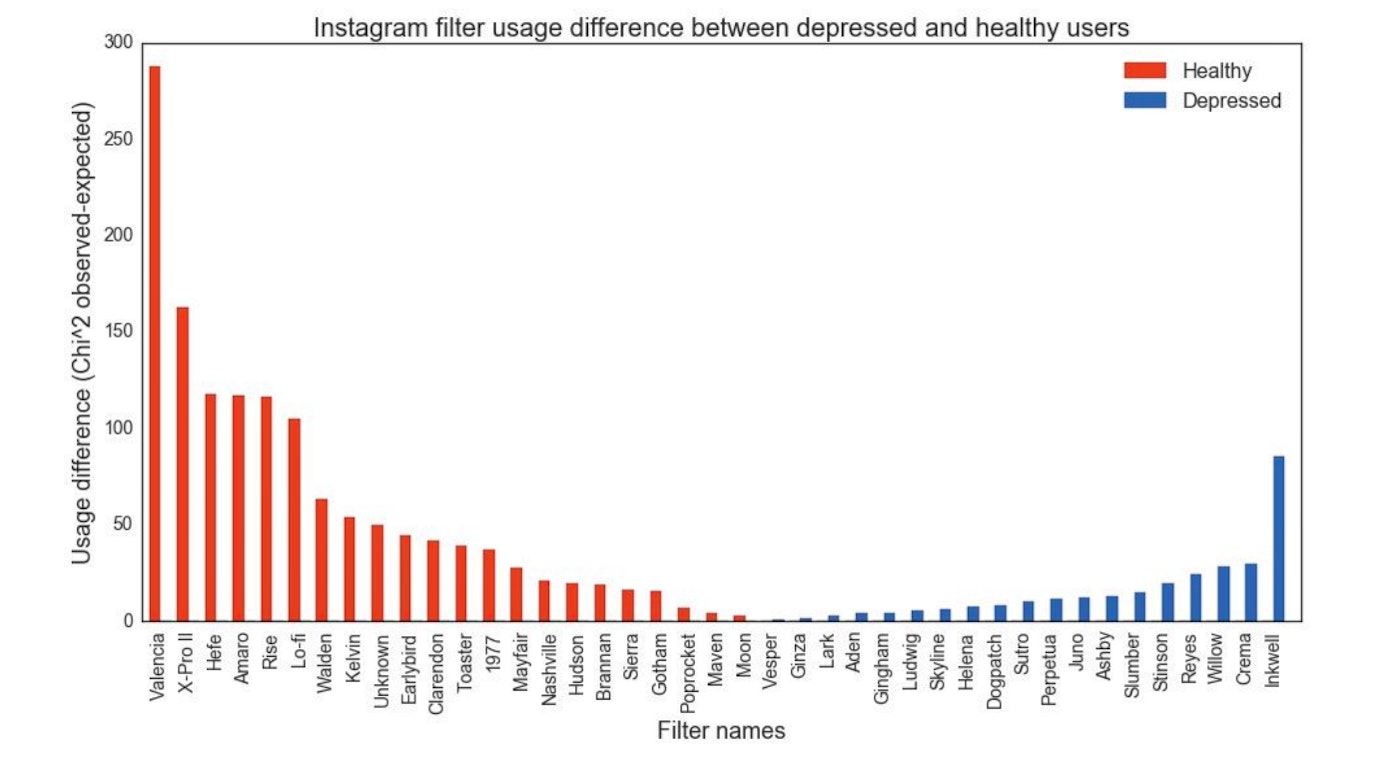
...After a careful screening process
What a load of specious bullshit.
And people who post a lot of pictures of rainbows are too happy.
If my instagram feed is nonexistent, does that make me a nihilist? Or is it indicative of me not basing my worth on what random people think about my every waking moment? (Or is that twitter or Facebook .. its had to tell these days)
I am Slashdot. Are you Slashdot as well?
Hmm, 166 users, 71 of whom were known depressed. 70% accuracy means they picked 50 of the depressed people as depressed, and 28 (or 29) of the non-depressed people as depressed.
Given that the national depression rate is 6.7% (take that with a grain of salt), we'd expect to see, based on this test, 32.7% of the population found to be depressed. Of that 32.7%, one in seven would actually be depressed....
Color me less than impressed with this study.
"I do not agree with what you say, but I will defend to the death your right to say it"
I must be suicidal since I don't use it at all
Why do you think all of this data mining is going on? This sounds tin-foil hat, but, eventually, if not already, the government is using or will use this data against its citizens.
Another tool for insurance companies to preemptively cancel your policy.
if (instragram_feed.active == true)
depression=true;
else
depression=false;
Weaselmancer
rediculous.
Are they finding people who are depressed because of chemicals in their brains, or are they undermining the entire medical model of depression by finding people who have awful lives and showing that having an awful life is the major cause of depression, not "chemical imbalance"?
then depression = yes
I think that might lead us to a conclusion that: "If you have an Instagram feed, you'll develop depression eventually"
As a clinically depressed person... My Instagram feed has a variety of photos with varying degrees of saturation, hues, and taken at various times of the day.
It turns out that phenomena which are well known to exist in meatspace turns out to hold true online too! Who would have thought?! There's a well spent research grant if I ever saw one. Nobel prize next?
It may seem like a fun toy, but given that some researchers are seriously questioning whether 'major depression' is a single well-defined illness, and whether human diagnostic means are reliable, does anybody seriously think this will work reliably in a clinical setting the way an ECG does.
John_Chalisque
... depressed people both perceive less color in the world and prefer dark, anemic scenes and images.
I just take really crappy pictures and my camera's flash is broken.
But in theory you could combine with other indicators. /. lately.
Group togher with all the other "Depression could be predicted based on your behaviour on XyZ social network" studies that have been mentioned here on
Then you can have an even smaller cohort of "potentially depressed social netowrk users".
And you could target them for prevention.
Instead of displaying ads, you could display public service announcement (about services that exist to support depressed people, etc.)
You could actively contact them (either through real human operator, or even chatbot. Or maybe FB/Instagram/etc. could send a trigger to the phone's on board Siri/OkGoogle/Cortana/etc. assistant) - there are short series of question that can reliably assess depression and pin point those who should be encouraged to seek professional care.
Or, because the thing is happening in the US, you could data mine the shit out of this.
You could bombard the user with fuck-tons of ads for fluoxetine (Prozac (tm) ).
The health insurance company could take the opportunity to kick their client before they get to costly.
The boss can fire the employee before they get too unproductive, but right after they've lost any will to fight back.
Databases will get hacked/leaked/doxed in attempt to blackmail the people.
Violent religious extremist organisations could leverage leaked database to try to find potentially suicidal people to whom quickly to sell a flag right before the person acts so the organisation can acknowledge the suicide.
And the NSA can spy on all of the above, just because they can.
"Sufficiently advanced satire is indistinguishable from reality." - [Tips: 1DrYakQDKCQ6y52z6QbnkxHXAocMZJE61o ]
Saya, is that you?
Correctly diagnose
70% Accuracy
CHOOSE ONE AND ONE ONLY!
..and when the Health Department comes to your door with a couple burly orderlies and informs you that 'you're depressed, citizen, and in the interests of your safety and the safety of the public, we're required to enforce antidepressants on you', what do you do then? Why are you people still using so-called 'social media'???
Are YOU using the TOOL, or is the TOOL using YOU? Think about it!
are waiting for those that these new algorithms deem unsuitable to lead a fruitful and socially useful life.
This is, in a nutshell, why the massively invasive and expensive surveillance state will both fail and be massively oppressive.
Because "70% accuracy" is currently a level that's considered an achievement, and that people don't seem to understand that 70% accuracy is next to worthless. Worse than useless, really.
The mistaken assumption is that, if you run this algorithm on a large population, that 70% of the people it identifies as depressed actually are depressed. But that's not close to what will happen, because people have bad intuition about type 1 and type 2 errors.
Let's assume about 5% of people are depressed (the actual figure depends on what sturdy you read, but let's assume that for now).
For every 1000 people, 50 are depressed and 950 are not.
With a 70% accurate test, we will see:
665 not-depressed people will be correctly not considered depressed.
285 people who aren't depressed will be incorrectly diagnosed depressed.
35 of the actually depressed people will be correctly diagnosed as depressed.
15 of the actually depressed people will not be caught.
So, coming out of this test, we'll have identified 310 people as "possibly depressed," even though only 11% of the people identified will actually be depressed. The VAST MAJORITY of the identified group (89%) are NOT depressed. The signal is lost in the noise. If you took this group and sent them to mandatory depression counseling, you'd be wasting a vast majority of your resources counseling people who don't need it, and still missing a lot of people who DO need it.
So, why did I title this post about surveillance states?
Imagine that, rather than depression, we were trying to test for someone being a terrorist sympathizer. Terrorist sympathizers are probably much less than 5% of the population. (In such cases, an even higher percentage of the people identified would NOT be sympathizers - the base rate matters a lot). But if you make the mistaken decision to trust the algorithm blindly because "it's 70% accurate!" (or even 90%, in a terrorist case), you'll have massive waste putting them all under heightened surveillance, because you "trust" your algorithm's output more than you should. Or because you have an unlimited budget and don't care.
And the collateral damage (especially in a terrorism example) can be massive. Because it's not necessarily just about the inconvenience of being under scrutiny. You could end up on a no-fly list. You could (according to some politicians) lose your right to trial by jury in a court of law, simply because you're SUSPECTED of being a terrorist.
Even more simply, people do things every day that might be technically against the law. Imagine a policeman following you around, watching every action, for several weeks. There's a "confirmation bias" need to feel like you've "done some good" and prosecute someone for a possibly unrelated but potentially illegal action, to "justify" the time they spent watching you - "crimes" that would go unnoticed and unprosecuted for people who were not under enhanced suspicion. Such prosecutions become self-fulfilling "see! We were right to be watching this person, because we caught all these dirty criminals"
Sorry, no. I can't imagine it. What the hell are you on?
Just count how many times they post vauge statuses and lyrics from 80's songs.
I'm a good cook. I'm a fantastic eater. - Steven Brust
Could they make any sense of that feed also ? Maybe it could detect the real affliction that haunt him.
It reads your Instagram feed and diagnoses narcissism.
There's something to be said about the improved efficiency of just posting a picture or a video, instead of writing a couple paragraphs trying to explain what happened. All communication mediums have their advantages. And their disadvantages. Trying to proclaim one as invariably inferior to your preferred medium does nothing but reveal your personal bias. There are always situations where each medium is better than the others.
Privacy concerns and general Facebook scumminess aside, a consolidated text/photo/video feed like Facebook/Instagram is the natural evolution of the web. At first everyone makes their own web page. But then it becomes burdensome to constantly check the web pages of all your friends to see if they've posted anything new. So you off-load that task onto a computer, which checks for any updates, and presents you with a consolidated list of updated pages. I would've preferred it to have happened in your browser which could automatically poll certain bookmarked sites every x hours, and put any of those pages updated since your last visit into a special folder (would be really handy for the list of web comics I follow). That way this functionality would cover the entire web instead of being limited to certain sites. But the masses seem to have picked Facebook/Instagram for this purpose.
Well, I guess it's better than a coin flip.
She was like chocolate when she drank... semi-sweet at first and then increasingly bitter.
A good friend sent me this article. My reaction is it's an application of Herman Rorschach's theories about how a person's projections are seen. Achromatic elements and others suggest a depressive state, etc.
So! Bravo to these researchers and their preliminary findings!
Robert Bischoff
"Increased hue, along with decreased brightness and saturation, predicted depression,"
hue = saturation
How can I increase hue while simultaneously decreasing it? Even the dictionary gets hue wrong...
hue |(h)yo| - noun - a color or shade
A color, yes, but not a shade... shade is when black is added to a hue; tint is when white is added to it.
No sig for you! Come back one year!
We've already confirmed your first name is Not. Is your last name Sure?
In fact, I'm so depressed, I can't remember my actual name.
Someone should tell them that Instagram, like Flickr before it, is a public photo sharing platform, used mainly to showcase photography, not pictures of friends and family. There's already Facebook for that, so you're unlikely to see that many pictures of people.
"..One hosts to look them up, one DNS to find them, and in the darkness BIND them."
...therefore, I must be depressed.
Or not.
There's a service called "FaceWash" that cleans up your FB account to make it suitable for inspection by prospective employers, etc. http://mashable.com/2013/01/25... I could easily see a similar application happening for Instagram. This could undermine the entire basis of using Instagram feeds as appraisal tools.
I'm not repeating myself
I'm an X window user; I'm an ex-Windows user
WHEN post=0 THEN 'Depressed'
amiright?
0% accuracy qualifies as "up to 70% accuracy".