Slashdot Mirror


New Analysis Shows Lamar Smith's Accusations On Climate Data Are Wrong (arstechnica.com)

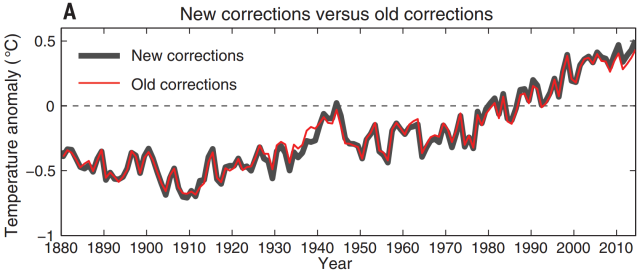
Layzej writes from a report via Ars Technica: In 2015, NOAA released version 4 of their marine temperature dataset called ERSST. The new dataset accounted for a known cooling bias introduced when ocean temperature measurements transitioned from being taken in ship engine intake valves to buoy-based measurements. The warming of the last couple decades increased ever so slightly in NOAA's new analysis. This was a red flag for U.S. House Science Committee Chair Lamar Smith (R-TX), who rejects the conclusions of climate science -- like the fact that the Earth's climate is warming. Suddenly he wanted to see the researchers' e-mails and echoed the accusations of contrarian blogs about scientists' supposedly nefarious adjustments to sea surface temperature measurements. Rather than invoking scientific conspiracies, issues like this should be settled by analyzing the data. A new study, led by University of California Berkeley's Zeke Hausfather, does just that -- and Rep. Smith won't like these results, either. To test the NOAA dataset, Zeke's team created instrumentally homogeneous temperature records from sensors available only over the last couple decades. As it happens, the Argo float data, the buoy data, and the satellite data each hew closer to the updated dataset that NOAA used. The older version (3b) gives a global average that is too cool in recent years, growing to an offset of about 0.06 degrees Celsius. The researchers repeat this same analysis for two more major sea surface datasets that are used by the UK Met Office and the Japanese Meteorological Agency for their global temperature records. Both of those datasets also drift cooler than the comparison data, but less so than NOAA's old dataset.
84 of 502 comments (clear)

  1. instrumentally homogeneous temperature records by mwvdlee · · Score: 5, Insightful

    You're not going to convince an idiot by providing evidence that he doesn't understand.

    --
    Slashdot social media options: AIM, ICQ, Yahoo, Jabber and Mobile Text. Why no MySpace?
    1. Re:instrumentally homogeneous temperature records by burtosis · · Score: 3, Insightful

      You're not going to convince an idiot by providing evidence that he doesn't understand.

      Due to climate science being too complicated to wrap up in one or two security blanket statements consisting of a pithy statement, we are all doomed to suffer the consequences. How many sheep carcasses, wolf tracks and turds do we need to find before people start actually doing something about the wolves, despite not seeing them personally?

    2. Re:instrumentally homogeneous temperature records by dywolf · · Score: 5, Informative

      200 years ago, and at roughly 330,000x faster than all previous known trends it's nothing like previous trends.
      go peddle your paid shilling somewhere else.

      --
      The guy who said the election was rigged won the presidency with the second-most votes.
    3. Re:instrumentally homogeneous temperature records by Ol+Olsoc · · Score: 4, Insightful

      You're not going to convince an idiot by providing evidence that he doesn't understand.

      Due to climate science being too complicated to wrap up in one or two security blanket statements consisting of a pithy statement, we are all doomed to suffer the consequences. How many sheep carcasses, wolf tracks and turds do we need to find before people start actually doing something about the wolves, despite not seeing them personally?

      But is it really that hard to understand?

      Once you accept that the greenhouse effect is real - and grade school children have been showing this at science fairs, and greenhouse owners have proven it for years, it doesn't take an Einstein to figure out that taking the Carbon that was removed from the atmosphere and putting it back in the atmosphere is going to have some effect.

      --
      The shepherds did so well protecting the flock that the sheep no longer believed that wolves existed.
    4. Re:instrumentally homogeneous temperature records by admin7087 · · Score: 2

      The simultaneously funny and sad thing about your statement is that even if that were true, it would be very wise and smart to invest in renewable energy for a long list of other reasons. Oil reserves will run out eventually, that's 100% sure, and so will natural gas. On a side note, most of the latter is produced by Russia, so if you want to be almost completely dependent on that country, please go ahead. Putin would be delighted to deliver large quantities of compressed liquid natural gas to the US. He wrote his final thesis at the then inofficial and secret KGB school on how to strategically influence and dominate other countries by exporting mineral and raw material resources including natural gas.

    5. Re:instrumentally homogeneous temperature records by silentcoder · · Score: 4, Interesting

      Or to quote Neil De Grasse Tyson: "It's basic physics. If you keep adding energy to a system, but you slow down the rate at which the energy can leave the system then the system gets hotter".

      --
      Unicode killed the ASCII-art *
    6. Re:instrumentally homogeneous temperature records by Maritz · · Score: 2

      You're not going to convince an idiot by providing evidence that he doesn't understand.

      We're pretending that he cares about the evidence are we?

      No. Like everyone else over there, he decided it wasn't true the moment he decided he didn't like it. End of fucking story.

      --
      I do not want your cheap brainburning drugs. They are useless for work. And I am a working man today.
    7. Re:instrumentally homogeneous temperature records by dehachel12 · · Score: 2

      solar and wind are crushing all other energy forms on cost, and EV will be cheaper to run/buy//maintain ... which is the only thing those people understand; so we WILL combat agw, whether they like it or not :D

    8. Re:instrumentally homogeneous temperature records by dywolf · · Score: 5, Informative

      while not large, yes actually it does have an effect, even on greenhouses.

      greenhouses work because glass (or plastic sheeting) does not well transmit infrared radiative energy. IE, its an insulator that blocks the transmission of radiative heating, or radiative transfer. visible and ultraviolet light passes through the glass and strikes the surface of the objects inside, including the molecules of air. some of this energy is then re-radiated as infrared light energy, ie, heat. Because the glass blocks the infrared from exiting the structure, the system becomes unbalanced.

      In thermodynamics terms, the greenhouse is an enclosed system with 1 input and no output.
      And therefore because Ei > Eo, the total energy of the system must increase, and this results in increased temperature inside.

      Now, it is completely possible to create a greenhouse (or simply, enclosed system) and control the gases inside, then measure the effect different compositions have on the total temperature increase when exposed to a source of radiative energy that can enter but not escape.

      In fact, that's exactly how it's been proven that CO2 is in fact a greenhouse gas as early as the 1800s by scientists studying the radiative effects of various gases, such as john Tyndall.

      --
      The guy who said the election was rigged won the presidency with the second-most votes.
    9. Re:instrumentally homogeneous temperature records by burtosis · · Score: 4, Insightful

      Or to quote Neil De Grasse Tyson: "It's basic physics. If you keep adding energy to a system, but you slow down the rate at which the energy can leave the system then the system gets hotter".

      Sadly you lose most people at basic physics. I know it's hard for most slashdotters to wrap their heads around it but many people were brought up believing science and math will never amount to anything except a lack of dates and "cool" friends. Most people tune out science and all they hear is the teacher from peanuts going "whanana naaa naa whwahna".

    10. Re:instrumentally homogeneous temperature records by Ol+Olsoc · · Score: 4, Informative

      There's no convection in a greenhouse.

      https://en.wikipedia.org/wiki/...

      From the article:

      The possibility of using carbon dioxide enrichment in greenhouse cultivation to enhance plant growth has been known for nearly 100 years.[18][19][20] After the development of equipment for the controlled serial enrichment of carbon dioxide, the technique was established on a broad scale in the Netherlands.[21] Secondary metabolites, e.g., cardiac glycosides in Digitalis lanata, are produced in higher amounts by greenhouse cultivation at enhanced temperature and at enhanced carbon dioxide concentration.[22] Commercial greenhouses are now frequently located near appropriate industrial facilities for mutual benefit. For example, Cornerways Nursery in the UK is strategically placed near a major sugar refinery,[23] consuming both waste heat and CO2 from the refinery which would otherwise be vented to atmosphere. The refinery reduces its carbon emissions, whilst the nursery enjoys boosted tomato yields and does not need to provide its own greenhouse heating.

      Go figure, eh?

      --
      The shepherds did so well protecting the flock that the sheep no longer believed that wolves existed.
    11. Re:instrumentally homogeneous temperature records by Anonymous Coward · · Score: 2, Informative

      unfortunately this has nothing at all to do with science. It has everything to do with politics and religion.

      republicans generally (this days) appear to want to say 'x isn't happening' if x is something that they do not see as 'good for business' or 'written in the bible'.

      It has nothing to do with whether or not they personally believe or disbelieve, can be educated/are educated. it has everything to do with their predisposition and desire to promote what they perceive as 'good for big business'.

      Like deregulation, for example: allowing businesses to throw toxic waste into my drinking water is good for business (in the short term) because it allows big business to avoid costs related to treating said toxic waste or disposing of it somewhere else other than my drinking water.

    12. Re:instrumentally homogeneous temperature records by Layzej · · Score: 2

      There was also the warming event roughly 130 years ago following the cooling event of Krakatoa, but honestly nothing like this sustained increase over time over the intervening mean.

      Krakatoa erupted in 1883. The 30 year trend leading up to that event is only 0.04/decade compared with 0.17/decade now: http://woodfortrees.org/plot/h...

      Not comparable.

    13. Re:instrumentally homogeneous temperature records by Ol+Olsoc · · Score: 3, Interesting

      That's right, CO2 which is 100-fold less important than water vapor is somehow determinant of Earth climate.... on a planet covered with 80% oceans...

      Where on earth did you come up with a ridiculous statement like that? Yes, Water vapor is the biggest greenhouse "gas" out there. But that doesn't mean that CO2 has no effect Or methane. That coal you might be fond of? That is not sequestered water is it? It is the sequestered carbon from the appropriately namedCarbiniferous age. This was an interesting time, with Average global temperatures of around 68 degrees - much warmer than today.

      Oxygen levels were a lot higher than today composing over 32 percent by volume. This is why the insects of th eage were so large. CO2 was around 800 ppm.

      Now here's where it gets interesting. Trees had developed Lignin which allowed them to grow very large, and a waxy substance developed that delayed decomposition. These trees were armed for bear Forests covered much of the land. These forests pulled a lot of CO2 out of the atmosphere, which over time cooled the planet. Finally by the end of the Pennsylvanian age, the earth had cooled enoughh that these tropical forests could no longer sustain themselves.

      But in the meantime, as the trees went through their life cycle, the dead trees would drop, and when the conditions were correct, they would be covered, compressed, and turned into coal. Sequestered Carbon it was. Millions of years worth, and finally ended when the planet had cooled to the etent that the tropical climate couldn't be continued.

      So fast forward to today. At the beginning of the industrial Revolution - generally attributed to 1750, we started digging up and using this sequestered material. And we've gone through a lot of it. In less than 300 years, we've re-introduced 800 terawatts worth of radiative forcing worth of Carbon that was sequestered over millions of years.

      That's a lot, in a very short time.

      So yeah Water vapor acts as a greenhouse "gas" that's really a very good thing. We need the Greenhouse effect to exist, as the Earth would be Arctic without it.

      --
      The shepherds did so well protecting the flock that the sheep no longer believed that wolves existed.
    14. Re:instrumentally homogeneous temperature records by fahrbot-bot · · Score: 2

      Or to quote Neil De Grasse Tyson: "It's basic physics. If you keep adding energy to a system, but you slow down the rate at which the energy can leave the system then the system gets hotter".

      Neil has the best geek pick-up lines.

      --
      It must have been something you assimilated. . . .
    15. Re:instrumentally homogeneous temperature records by mattwarden · · Score: 4, Insightful

      You appear to be taking the straw man arguments too literally. Very few people say there is no effect from human greenhouse emissions. I have heard Lamar say this in hearings (something like "No one here would disagree that human greenhouse gas emissions affect climate innsome way."). Here are some questions to which we do not know the answer (though people will reply with claims that we do):

      1) How big is the effect of human greenhouse emissions compared to natural temperature variation?
      2) On climate time scale, is the net impact of human greenhouse emissions throughout all systems negative, neutral, or positive, and on what dimensions should we measure that?

      My beef with the climate change people is the attitude of omniscience about a complex topic that nobody actually understands. We have pieces of the puzzle, and the climate change folks overcompensate for uncertainty with a condescending attitude and bullshit vending. The "98% scientific consensus" talking point is a great example. It's garbage, but because climate change people feel vulnerable with normal levels of uncertainty in scientific subjects, they exaggerate and fearmonger in substitution for fact based discussion about what we do and dont know.

      There is another way to deal with this uncertainty: risk. Argue that yes, we might be wrong about our cost-benefit analysis of certain policy prescriptions because like any field of science, especially relatively new ones, there is a lot we don't know. But the risk is hugely asymmetrical. If we are wrong, we probably spent money on stupid projects and increased poverty levels and income inequality relative to what would have otherwise been. If we are right, human life will confront existential threats. So logically we should err on the side of the uncertainty that minimizes downside.

      This is the sane argument, but I won't hold my breath (pardon the CO2 emission)

    16. Re:instrumentally homogeneous temperature records by Rob+Y. · · Score: 2

      Kind of like those assholes that say "there's nothing preventing you from paying more taxes than is asked". Sidesteps the collective moral issue - and doesn't really provide you with anything solid to fall back on. Unless you think the reason you're not doing those things is that they don't need to be done. Having allowed our greed-driven political system to turn this into a political issue - given the idiotic tribalism of our politics - has guaranteed nothing will be done until it's too late, and the Koch Brothers have retreated to their inland estates behind their high security fences.

      By the way, plenty of people voluntarily do all the things you mention - and it's not enough. Yes, people sometimes need to be compelled (or at least prodded - or flattered) into doing the right thing. And it doesn't help to have people profiting off of telling them that they don't need to do anything.

      --
      Posted from my Android phone. Oh, I can change this? There, that's better...
    17. Re:instrumentally homogeneous temperature records by thegarbz · · Score: 2

      Due to climate science being too complicated to wrap up in one or two security blanket statements consisting of a pithy statement, we are all doomed to suffer the consequences.

      The world is warming. 99.999% of scientists say so.

      There we go. Was that so hard to understand? Or are you proposing a global conspiracy reaching every corner of the globe, a conspiracy that shows not national boundaries and respects no international disagreements between nations? A conspiracy that would involve every country's scientific institutions agreeing on a common topic with only a handful of dissenters who are proven wrong time and time again by that nasty thing call math?

    18. Re:instrumentally homogeneous temperature records by apoc.famine · · Score: 2

      One major issue is that we're talking about global climate change. And the bulk is happening at the poles right now. One person or group of people or country even isn't going to consistently see clear evidence of climate change. It's 5F/-15C right now where I live. Last summer was mild and pleasant. Are we still trending higher year over year? Yep. But it's minor enough that we just don't notice it. This isn't "sheep carcasses, wolf tracks and turds" level impacts around here - it's a stray hair on the ground every few months.
       
      To carry the analogy forward, a few of us did DNA testing on the hairs and it's 100% wolf. And the sheep industry is putting up "missing dog" posters around here.
       
      Now, this isn't true everywhere on earth, and some places are definitely seeing clear evidence. The problem is that it will take a large percent seeing this before we do anything, and at that point, there won't be much to do.

      --
      Velociraptor = Distiraptor / Timeraptor
    19. Re:instrumentally homogeneous temperature records by blindseer · · Score: 2

      Greenhouses don't work like that. Sure, some of the effect is due to radiative transfer and so on like you describe but the primary effect is by restricting convection. A greenhouse is warm because the warm air cannot rise away and allow cooler air to replace it. It's warm primarily because it is an enclosed space. A greenhouse would be just as warm, perhaps warmer, if it was made of sheet metal instead of glass, but plants need light just as much as heat so glass it is.

      There is no similar "greenhouse effect" on Earth since CO2 does not restrict this airflow. Warm air still rises from the surface of the Earth and releases the heat into space.

      People "proving" this greenhouse effect with enclosed spaces containing differing concentrations of CO2 have been shown to be poorly done, outright falsified, or the effects were much smaller than models suggest. The primary heat trapping gas in the Earth atmosphere is actually water. This is an effect much too complex to show with a laboratory experiment.

      --
      I am armed because I am free. I am free because I am armed.
    20. Re:instrumentally homogeneous temperature records by Solandri · · Score: 4, Interesting

      greenhouses work because glass (or plastic sheeting) does not well transmit infrared radiative energy. IE, its an insulator that blocks the transmission of radiative heating, or radiative transfer. visible and ultraviolet light passes through the glass and strikes the surface of the objects inside, including the molecules of air. some of this energy is then re-radiated as infrared light energy, ie, heat. Because the glass blocks the infrared from exiting the structure, the system becomes unbalanced.

      In thermodynamics terms, the greenhouse is an enclosed system with 1 input and no output.
      And therefore because Ei > Eo, the total energy of the system must increase, and this results in increased temperature inside.

      This is the oversimplified explanation of climate change which I have problems with. Unfortunately, it is the argument parroted by nearly all the armchair climatologists as the reason why global warming is real and we must do something about it Right Now.

      From a thermodynamics standpoint, the rate of heat radiated by a black body is proportional to the fourth power of its temperature. The Ei > Eo state is a transitory state - it is only temporary. The temperature increases causes Eo to (quickly) increase, until Eo is large enough to match Ei.. So we end up with Ei = Eo again, but at a new, higher T. In other words, the system stabilizes at a new, higher temperature. This is why glass greenhouses don't continue to increase in temperature until the inside is hot enough to melt the glass. T^4 is a huge number. It only takes a small temperature increase to offset a large Ei increase (actually Pi would be more accurate - the rate of energy coming in, or power coming in).

      Unstable "runaway" systems are extremely rare in nature. The reason is simple - anything that's unstable tends to, over billions of years, destroy itself. So the overwhelming majority of things remaining in the universe are stable systems. There is no "delicate balance" of nature. There is no "runaway" greenhouse effect - all we're doing is shifting the equilibrium point. We know this to be true because global CO2 concentrations and temperatures have been higher in the past than they are today, and the Earth did not self-destruct - it is still around with life intact.

      Now, from all I've read, that new equilibrium temperature point is high enough to cause massive problems for human civilization if we don't address it. But the alarming layman's explanation of the greenhouse effect that you've given is just as wrong and misleading as the climate change deniers' explanations.

    21. Re:instrumentally homogeneous temperature records by riverat1 · · Score: 2

      There's nothing pristine about the historical data. In the case of sea surface temperatures they first used wooden buckets thrown over the side then hauled to the deck to have a thermometer stuck in it, then they switched to canvas buckets that have some issues with evaporative cooling. Then they started using engine cooling water intake ports, those have a problem of producing slightly warm readings due to their proximity to the engine room. Nowadays we have buoys and Argo floats. Since each of those methods produces its own biases you have to do something to bring them together for a complete record.

    22. Re:instrumentally homogeneous temperature records by silentcoder · · Score: 2

      - Oceans are not "water vapour".
      - They are 70% of the surface, not 80%
      - The average time a water molecule spends in the atmosphere is 11 days. For CO2 it's 80 years. The CO2 makes up the difference in impact by doing it for a crap load longer.
      - Heating from CO2 leads to more evaporation which increases the amount of water vapor.

      --
      Unicode killed the ASCII-art *
    23. Re:instrumentally homogeneous temperature records by dywolf · · Score: 2

      CO2 is the driver of a positive-feedback loop involving the water vapor portion of the water cycle, as it relates to water vapors heat trapping abilities.

      There, you've been edumicated.

      --
      The guy who said the election was rigged won the presidency with the second-most votes.
  2. Re:Who cares? by mwvdlee · · Score: 5, Informative

    Bullshit.
    It's the kind of obvious, blatant, easily disprovable but nonetheless convenient lie that leads to electing bullshit presidents.

    http://ec.europa.eu/eurostat/w...

    http://ec.europa.eu/eurostat/s...

    --
    Slashdot social media options: AIM, ICQ, Yahoo, Jabber and Mobile Text. Why no MySpace?
  3. Re:Two questions before I call BS. by DarkOx · · Score: 2

    Right an what is more likely? A sensor on a mostly passive buoy reads cold or sensor on a ship with people, heaters, engines, and everything else near by reads hot?

    --
    Repeal the 17th Amendment TODAY! Also Please Read http://www.gnu.org/philosophy/right-to-read.html
  4. Re:Who cares? by locofungus · · Score: 4, Informative

    From where are you getting your figures?

    http://ec.europa.eu/eurostat/s...

    That claims they're down 22% from 1990 levels.

    Those exclude LULUCF (land use changes) - perhaps you have inclusive figures? (Although I'd be surprised if LULUCF could be bigger than the significant reductions in everything else.)

    --
    God said, "div D = rho, div B = 0, curl E = -@B/@t, curl H = J + @D/@t," and there was light.
  5. Harness economic self interest by sjbe · · Score: 5, Insightful

    Suddenly he wanted to see the researchers' e-mails and echoed the accusations of contrarian blogs about scientists' supposedly nefarious adjustments to sea surface temperature measurements. Rather than invoking scientific conspiracies, issues like this should be settled by analyzing the data.

    Most people wouldn't understand the data if you clubbed them over the head with it. Doubly so for politicians with no scientific training. The problem in the argument is that one side of this argument isn't arguing with facts and is actually incentivized to demonize any data that contradicts their pre-determined conclusions. They see the argument in one of two ways (sometimes both). A) They see climate change data as a threat to their personal interests - usually financial ones. If you are a politician sponsored by a fossil fuel company, this threatens your self interest. B) They see the climate change argument as something coming from the Other. It's a tribal thing - that Other group supports it ergo it must be bad. Often they frame it as a conspiracy despite the absurdity of that statement.

    So in either case you have people who have no incentive whatsoever to acknowledge the data because it threatens what they hold dear. Rationality plays no role in it. The best way to combat this is to frame the argument in such a way as to align their incentives with the data. Point out how much money there is to be made/saved by working on the problem. Put it front and center as an economic issue. Figure out how to align solutions to the problem with economic and political self interest. Until you do that you're going to have this problem of certain politically powerful factions sticking their fingers in their ears and getting in the way.

    1. Re:Harness economic self interest by asylumx · · Score: 2

      The problem in the argument is that one side of this argument isn't arguing with facts and is actually incentivized to demonize any data that contradicts their pre-determined conclusions.

      In other words, it's politicized. Also, I would argue that neither side is actually arguing with facts. The facts may lean to one side, but that doesn't mean that the people arguing it actually have considered those facts.

    2. Re:Harness economic self interest by mbkennel · · Score: 2

      > If we observe a cycle happening dozens of times, but assert that THIS TIME it's somehow being driven a different mechanism, certainly the onus is on us to explain conclusively how & why the previous mechanism stopped and a new mechanism took over.

      Sure, that is very true.

      And the answer is the following:

      The evidence is geological, that when humans mined coal, there were no coal shafts and evidence of previous mining and combustion from 120,000 years ago. Instead, the isotopic and geological analysis shows that the carbon which is being emitted now is from human activities which didn't exist 120,000 years ago.

      Something new is definitely happening: human mining & combustion.

  6. Re:Or skeptics by mwvdlee · · Score: 2

    Exactly what I mean.
    The numbers weren't "fudged" in any way.
    They were corrected to eliminate a bias, but because you don't understand what that means, you can only label it "fudging".
    If you disagree with the method used for correction of the valitidy of the bias claims, then attack those on their merits.

    --
    Slashdot social media options: AIM, ICQ, Yahoo, Jabber and Mobile Text. Why no MySpace?
  7. Not even a debate by sjbe · · Score: 5, Informative

    Climate scientists haven't established Human caused global warming is real.

    You are wrong. It's not even really a debate among climate scientists at this point. So far all the data seems to clearly show that humans are a key factor in recent climate change. And even just on the face of it the notion that we could be dumping so many billions of tons of CO2 and other pollutants into the atmosphere without any effect or consequence is just absurd. If you want to argue that we are still pinning down the exact extent of the effect of our activities then you might have an argument. But to pretend that our activities have had no effect on global climate is ridiculous.

    That said, it doesn't really matter anyway. Even if hypothetically speaking humans weren't responsible at all for climate change we still would need to take action to deal with the reality of it. It's going to affect food supplies, energy resources, ecosystems, pollution, geopolitics, etc. The US Department of Defense (hardly a bastion of liberal thinking) considers it real and a significant threat to national security.

    So far we just have a gently upward trend starting about 400 years ago, very similar to the previous upward trends that were entirely natural.

    Yeah sorry but the data is just a tad more complicated than your little made up and cherry picked sound bite.

    1. Re:Not even a debate by haruchai · · Score: 2

      Perhaps the analysis of the Berkeley Earth http://berkeleyearth.org/ project will be more to your liking?
      They did a complete re-examination of all available datasets and looked at more data than any other single project to date.
      This included taking raw data, not just analyzed data sets that had already been sanitized as that seems to be a particular sticking point for skeptics.

      Their conclusions are at http://berkeleyearth.org/summa...

      --
      Pain is merely failure leaving the body
    2. Re:Not even a debate by dywolf · · Score: 2

      Go re-read your Adam Smith.
      Or this handy copy pasta:

      How Rent-Seeking Works
      Rent-seeking occurs when an individual or business attempts to make money from its resources without using those resources to provide a benefit to society or generate wealth for everyone. One of the most common ways companies in the 21st century engage in rent-seeking is by using their capital to contribute to politicians who influence the laws and regulations that govern and industry and how government subsidies are distributed within. If the company succeeds in receiving subsidies or in getting laws passed that restrict competition and create new barriers to entry into the industry, it has increased its share of existing wealth without increasing the total of that wealth. Moreover, it has earned income without actually producing anything or putting its capital at risk.

      Rent-Seeking Examples
      Lobbying for occupational licensing requirements represents a perfect example of rent-seeking. Airline pilots and doctors require rigorous licensing for obvious reasons, but in many U.S. states, expensive and onerous licensing is required for taxi drivers, florists and interior decorators. Often, these regulations exist as a result of lobbying efforts from existing industry participants. [[dywolf note-- Note that if environmental groups lobby for this, they don't gain any material benefit, ie, "share of the wealth" by doing so]] When licensing requirements prevent newcomers from competing, the revenue generated within an industry is divided between fewer players, resulting in a larger share of wealth accruing to each without any additional economic benefit. Furthermore, since competition drives down prices and lack of competition keeps them high, consumers pay more than they would in a truly efficient market unfettered by rent-seeking.

      If or when environmental groups do succeed in lobbying, they are not the only ones that benefit. When they benefit, not only yheir benefit not in the form of gaining a larger "share of the wealth", but we all benefit, whether its national parks that continue to exist, or pipelines that have sufficient safety standards that leaks and accidents are reduced to minimum or swiftly cleaned up.

      Rent seeking doesn't even apply. You have equated lobbying or non-productiveness (relative to the "market") with rent-seeking, and that is wrong.
      Worse, your example is "not even wrong". The concept does not even apply to your example.

      You example only reveals your own ignorance, about both rent-seeking, and how most environmental groups meet their funding needs.

      As I said: No, you don't know what rent-seeking is.

      --
      The guy who said the election was rigged won the presidency with the second-most votes.
  8. Hug a climate denier today by PopeRatzo · · Score: 2

    The "fudged data" is a core belief in the Church of Climate Denial. The fact that it wasn't fudged could cause serious cognitive dissonance among some of the most devout members. Although to be fair, it won't be reported at Breitbart or InfoWars, so maybe they'll stay blissfully insulated from this information.

    It's probably for the best that they be left that way.

    --
    You are welcome on my lawn.
    1. Re:Hug a climate denier today by radl33t · · Score: 3, Insightful

      And the odds of a global conspiracy with thousands (if not 10s of thousands) of actors? LoL

    2. Re:Hug a climate denier today by moeinvt · · Score: 2

      "The fact that it wasn't fudged ..."

      Bullshit.
      I guess it depends on what you mean by "fudged". If you're claiming that the data sets being used by climate scientists are raw, non-adjusted data, then you're in denial. The data is definitely "fudged", but there are compelling reasons for this "fudging".

      They have more than 100 years of temperature measurements from various weather stations around the world. Over that time period, most of the stations have been relocated numerous times. The early data were collected with mercury thermometers while later measurements were done with electronics. Stations have also changed the time of day at which they recorded the temperature readings. Areas around many stations have been gradually "urbanized" etc. etc.

      The data sets are very deliberately adjusted/fudged to attempt to account for these differences. That doesn't necessarily mean there is some conspiracy going on to perpetuate a hoax, but questioning the methods used to do the fudging is entirely reasonable.

    3. Re:Hug a climate denier today by PopeRatzo · · Score: 2

      The data sets are very deliberately adjusted/fudged to attempt to account for these differences. That doesn't necessarily mean there is some conspiracy going on to perpetuate a hoax, but questioning the methods used to do the fudging is entirely reasonable.

      Try to explain data science to a climate denier. They're totally invested in the idea that climate data is bogus because George Soros paid all the climate scientists to fake data in order to destroy freedom.

      --
      You are welcome on my lawn.
  9. Re:Or skeptics by Layzej · · Score: 5, Informative

    Right. During the late 20th century, ocean temperatures readings were primarily taken mechanically through an “engine-intake valve.” Ships pump water into their hull in order to cool the engine room, and a thermometer measures its temperature on the way. This can introduce bias to the numbers, though: Because engine rooms get hot, engine-intake-valve readings are skewed warmer than the actual ocean.

    Whereas 95 percent of NOAA’s readings came from ship engine rooms in the early 1990s, 85 percent now come from buoys, which provide a more accurate reading. It turns out that if you don't account for that known bias you get a result that is less accurate.

  10. Re:Two questions before I call BS. by locofungus · · Score: 5, Informative

    (2) Aren't they talking about data taken on ships by physically reading thermometers to an accuracy less than the claimed effect? As I was taught: If you don't know your error, you haven't made a measurement. In this case the error could be even greater than the effect itself!

    No.

    Over time the proportion of data contributed by taking measurements on ships has decreased.

    NOAA said "hey guys, this has introduced a systematic error into the data and we need to adjust for it"

    Other scientists were skeptical.

    This group decided to test it. So they took several independent data sets that each used just one measurement so that each dataset is internally consistent.

    They then discovered that all the data sets matched the NOAA adjusted combined data better than the previous unadjusted data.

    What their work indicates is that the slow migration from ship thermometer to buoy, satellite etc has hidden an extra 0.06C/decade of warming - and that the warming rate over the last several decades is much closer to the rate over the previous decades than was thought.

    (It should be pointed out that some statisticians don't accept that there was any statistically significant change in the warming rate over the last several decades even when using the pre NOAA (3b) data. My statistical knowledge isn't sufficient to be able to independently do the changepoint analysis necessary to confirm or refute this)

    --
    God said, "div D = rho, div B = 0, curl E = -@B/@t, curl H = J + @D/@t," and there was light.
  11. Intentional ignorance by sjbe · · Score: 2

    Nobody has demonstrated the small amount of warming we've had and can expect in future isn't beneficial to mankind and the biosphere

    Nobody who is actually informed about the issue agrees with you. Heck the US Department of Defense disagrees with you. Please explain how even the more modest of predicted consequences such as rising sea levels, food supply disruptions, extreme weather events, melting ice caps, etc are beneficial to earth.

    especially the biosphere, which quite likes CO2 and expends a lot of energy trying to keep itself warm above and below certain lines of latitude.

    Umm, what? The biosphere "quite likes CO2"? Are you trolling or just ignorant? We're releasing billions of tons of CO2 that has been sequestered out of the atmosphere for millions of years and you're arguing that's somehow a good thing? Support your (absurd) statement with a viable hypothesis and actual data.

    Aren't they talking about data taken on ships by physically reading thermometers to an accuracy less than the claimed effect?

    It isn't about the accuracy. It's about what is actually being measured. It's like the difference between trying to do astronomy in the middle of a light polluted city versus doing it in a dark and remote desert with calm dry air. You're trying to look at the same thing but the noise in the measurements is quite different and has to be accounted for.

    1. Re:Intentional ignorance by dywolf · · Score: 2

      JFC your grasp of thermodynamics is weak.

      you may not notice your room heating because it's not a perfectly enclosed system. it has substantial losses to the surrounding house via convection.

      the earth in contrast is much closer to the ideal enclosed system for the same reason that heat sinks don't work very well in space: no convection.

      note however that in fact burning a candle in your living, if it were sealed and approximated an enclosed system, would in fact warm it measurably.
      because thermodynamics.

      some of these folks were kind enough to actually do some of the thermo math and work it out: https://www.reddit.com/r/asksc... , but the gist is, yes, actually, a candle can raise the temp of your room by roughly 1 degree, which is a significant or measurable amount.

      similarly the human output of CO2, which is over 40 billion tons annually, does has a measurable impact despite its relatively small proportion of the atmosphere, in no small part due to a positive feedback loop involving water vapor (increase temp a lil bit via co2, more h20 in air, which is also a GH gas, which causes more warming, which causes more h2o in the air, which causes more warming....until the system reaches equilibrium and the warming stops...which right now cannot happen because were are still pumping several orders of magnitude more CO2 and methane into the atmosphere than the planetary system is capable of adjusting to.)

      further readings: "It's only a trace gas."

      Also note, that you are actively choosing to side with a nuclear physicist in the belief that he knows more bout climate science than actual climate scientists.
      Do you also then get home repair quotes from your car mechanic, or vice versa? How about heart surgery from a pediatrician? Steak tartare from your plumber? How deep does your silliness of valuing non-subject-matter-experts over subject-matter-experts go?

      --
      The guy who said the election was rigged won the presidency with the second-most votes.
  12. Is this how it goes?? by beheaderaswp · · Score: 2

    Interesting thought...

    What if the actual end of humanity is caused, because as an aggregate, we are smart enough to understand and avoid it, but the majority of our biomass isn't smart.

    Perhaps, we've got too much of a spread in ability between intelligent folks and those who are constitutionally incapable of understanding the complexities of a large data set. Or the mathematics needed to interpret it. Or lack the desire to do the work that leads to understanding.

    There's so many factors involved.

    --
    Another consultant who stuck it out.

    "We are the Priests, of the Temples of Syrinx..."
  13. Re:Or skeptics by Anonymous Coward · · Score: 2, Insightful

    Outstanding comment!

    You've perfectly parodied the "belligerent climate change denier asshole" tone and messaging, right down to calling scientists "ivory tower elitists" and accusing them of calling deniers "backwards rednecks" with zero proof. I've seen a lot of people try to pull off this kind of mockery online without anywhere near your level of success.

    Thanks for helping point out just how absurd the deniers are. Well done!

  14. Thrid party review by Layzej · · Score: 4, Informative

    The evaluation was performed by a third party that is not associated with NOAA. In fact, lead author Zeke is associated with the Berkeley BEST skeptics that were once the darlings of the climate contrarian movement - until the results of their audit were released and ended up confirming the consensus position.

    Regarding the graph, what you are looking at is the difference between the reference and the reconstruction. A negative trend means the reconstruction is lower than the reference. A positive trend means that the reconstruction is higher than the reference. A zero trend means that the reconstruction is bang on. You'll notice that the ERSSTv4 matches the instrumentally homogeneous reference datasets quite well. That's a good thing!

  15. Re:Two questions before I call BS. by minogully · · Score: 2

    You miss the point. It's not the planet we need to save. The planet will be fine. It's like how forest fires are great for forests in the long run. But don't tell that to the animals who die from habitat loss while they're waiting for the forest to regrow.

  16. Re: Who cares? by Notabadguy · · Score: 5, Informative
  17. Re:Or skeptics by silentcoder · · Score: 2

    These people can't tell the difference between "correcting for a known measurement problem" and "lying".

    Lets use a car analogy (this is slashdot after all). A car's speedometer is never completely accurate, in fact it has a margin of error of about 10 km/h. This is because it cannot actually measure the distance travelled, and it has to get this value by a proxy: the number of wheel rotations times the circumference of the wheel. Trouble is wheel circumference is not a constant. People put on tyres of different sizes, and the tyres themselves change shape as you drive - stretching and relaxing and all this introduces known errors in the measurement.
    Now to prevent this from introducing major safety risks (and getting lots of people undeserved fines) car manufacturers deliberately calibrate speedometers to overestimate speed. This way, if you drive at what the meter says is the speed limit you can be reliably sure that your actual speed is below the limit (by up to 10km/h).

    So if I want to know the ACTUAL speed at which I drove, and I don't have a way of measuring the exact distance and time - my best bet is to take the speed that was on the speedometer and subtract 10km/h from it.
    It isn't perfectly accurate but it's a lot more accurate than using the number directly (idiots of course, when learning this, subvert this by driving 10km/h ABOVE the speed limit - which would be fine if that margine of error was exact, you have no idea how close you actually are, or even if you are over when you do that).

    This is an adjustment like that. You have a measuring device, you know it has a deviation, and you correct for that deviation to get a more accurate answer than the raw device could give.

    --
    Unicode killed the ASCII-art *
  18. Re:Two questions before I call BS. by silentcoder · · Score: 3, Informative

    >I don't know and neither do you
    Yes... we do... because only one of the two options is even POSSIBLE. The other is literally declared impossible by Newton's first law and ALL THREE laws of thermodynamics. Put a ship engine intake thermometer and a buoy thermometer in the same water - it's physically impossible that the ship will NOT measure hotter than the buoy. Because those heaters, engines, people - all those things PRODUCE ENERGY. And energy cannot be destroyed, it cannot dissapear. It's there and it WILL affect the measurement.
    Luckily we DO know exactly by how MUCH it affects it - because we DO have buoy's to compare it with.

    > I mean I may be thick as a stick in a bucket of pig-shit
    There's no may be about it, but congratulations on the closest to true thing you've said all day (it would have been entirely true if you replaced 'may be' with 'am').

    >I do at least know these kinds of statistical shenanigans are usually bollocks.
    There was nothing statistical about this - and besides which, no they NEVER are - but professional liars like Steve Mcntyre will write screeds declaring the statistics invalid. Not because it is - because he is flat out lying to you about what the numbers mean (or even, on occasion, what those numbers ARE). It's not that he doesn't understand the statistics, he has the training and he does. It's that he knows YOU DO NOT. So he knows if how to tell a convincing lie. And you fall for it.
    Probably because of the above stated stick in a bucket of pig-shit problem.

    --
    Unicode killed the ASCII-art *
  19. Re:Two questions before I call BS. by silentcoder · · Score: 2, Informative

    Okay fucknuckle - please educate yourself on why medicine is one of the hardest scientific fields to study - and why that low replication rate tells you NOTHING about other sciences.

    Hint: because experimenting on people is very difficult to do ethically and there are a lot of things you OUGHT to do to get reliable scientific results which you CANNOT do because doing them would be considered mass murder.

    --
    Unicode killed the ASCII-art *
  20. Do greenhouses create their own heat? by Anonymous Coward · · Score: 4, Informative

    No. Therefore DESPITE NO HEATING FROM THE GLASS, the greenhouse heats up.

    And therefore one of the simplest and dumbest denier memes "how can it make"things warmer? That breaks the 2nd law of thermodynamics!" is shown to be bollocks.

    You see, if it were NOT proposed as an ANALOGY (look the word up, moron), your "complaint" that greenhouse glass isn't made of CO2 would stand up. But it isn't and it doesn't.

    The proof of AGW is

    1) CO2 causes heat to be trapped
    2) If the sun's output remains the same, the earth will warm
    3) We are burning fossil fuels, increasing the CO2 content of the atmosphere

    The greenhouse is an analogy.

    The greenhouse effect is the effect, and no greenhouses are required.

    1. Re:Do greenhouses create their own heat? by Impy+the+Impiuos+Imp · · Score: 2, Interesting

      I once pointed out how we had a ready-made carbon sequestration process in place already. Yard waste in landfills.

      Sadly, this was killed by a competing environmentalist impulse based on innumeracy: We are running out of space for landfills. So now many areas ban yard waste in landfills. And what landfills there are often are areated so they can continue to rot away underground, also releasing that CO2.

      Do your duty -- compost the yard waste to get the CO2 back into the atmosphere!

      When I pointed this out to the environmentalist, he immediately said, well, CO2 wasn't that important as a greenhouse gas.

      You have to pick and choose your environmentalist impulse values and pooh pooh any contrary ideas.

      --
      (-1: Post disagrees with my already-settled worldview) is not a valid mod option.
    2. Re:Do greenhouses create their own heat? by locofungus · · Score: 3, Interesting

      I despair.

      CO2 from biological matter doesn't directly matter. (Land use changes that destroy biological matter and don't replace it are a different matter)

      If it's plant based then all that CO2 that is released will have been recently extracted from the air to be incorporated into the plants tissues.

      If it's animal based then any and all CO2 that is released will, ultimately, have come from the C in plants which, in turn, will have come from CO2 in the air.

      it's really, really, easy to tell the difference between CO2 that has its source as the carbon cycle and "fossil" CO2 that has been sequestered for significant lengths of time. "Biological" CO2 will have been recently part of the atmosphere. Because C14 has a moderate half life (6Kyear), it will have needed to be sequestrated for tens to hundreds of millenia before all the (detectable) C14 will have decayed.

      Almost all C14 is generated in the upper atmosphere (by thermal neutron capture by N14). Therefore, if the material you are burning, composting, digesting, gives off CO2 that contains C14 then the carbon that it contains (recently) came from the atmosphere.

      --
      God said, "div D = rho, div B = 0, curl E = -@B/@t, curl H = J + @D/@t," and there was light.
    3. Re:Do greenhouses create their own heat? by Marxist+Hacker+42 · · Score: 2

      All of mankind's greenhouse gas emissions combined are now, post 2004 tipping point, completely minuscule compared to what is released by melting tundra. We're already fucked up past any point of coming back- so it's time to ADAPT to changing conditions instead of trying to stick a finger in the bolt hole while the dam crumbles around you.

      --
      SJW: a person who perceives an injustice, and while correcting it, commits a greater injustice.
    4. Re:Do greenhouses create their own heat? by IWannaBeAnAC · · Score: 2

      Sorry, the rate of natural oil production is actually about 10 barrels per day.

    5. Re:Do greenhouses create their own heat? by Rob+Y. · · Score: 3, Insightful

      Why it's almost as if fossil fuel-funded pols wanted us to reach a tipping point so that they could then say - there's no point attempting to stop it now. Party on and build those big seawalls. I wonder if they're investing in seawall technology now...

      Nothing in that tipping point argument says that it's useless to stop throwing fuel on the fire. Yes, the tipping point means that we've got our work cut out for us, and we should be preparing in addition to trying our best not to add to the problem, but based on how well we 'prepared' for preventing getting to this point, I don't see much happening there either.

      --
      Posted from my Android phone. Oh, I can change this? There, that's better...
    6. Re:Do greenhouses create their own heat? by david_thornley · · Score: 3, Insightful

      Ah, yes, the stages of denialism:

      1. It's not happening.

      2. It's not our fault.

      3. Our contribution isn't significant.

      4. It's not going to be that bad..

      5. It's too late to do anything useful, so there's no point in doing anything.

      --
      "When you have eliminated the unacceptable, whatever is left, however improbable, must be the truthiness" - Holmes
    7. Re:Do greenhouses create their own heat? by riverat1 · · Score: 2

      Last time CO2 was at 400 ppm sea levels were over 20 meters (70 feet) higher than they are now. Just sayin'.

    8. Re:Do greenhouses create their own heat? by gzuckier · · Score: 2

      Ah, yes, the stages of denialism:

      1. It's not happening.

      2. It's not our fault.

      3. Our contribution isn't significant.

      4. It's not going to be that bad..

      5. It's too late to do anything useful, so there's no point in doing anything.

      And the stages of metadenialism:

      1. It's not happening.

      2. Nobody's saying it's not happening, just that it's not our fault.

      3. Nobody's saying it's not our fault, just that our contribution isn't significant.

      4. Nobody's saying our contribution isn't significant, just that it's not going to be that bad.

      5. Nobody's saying it's not going to be that bad just that it's too late to do anything useful, so there's no point in doing anything.

      6. Nobody's saying it's too late to do anything useful so there's no point in doing anything, just that the liberals and scientists are to blame for politicizing the issue.

      The fun part is that they are currently saying all of these, simultaneously; in the apparent belief that they all agree with each other and form a coherent plan.

      --
      Star Trek transporters are just 3d printers.
  21. Re:Two questions before I call BS. by silentcoder · · Score: 2

    It's not entirely speculative - some are already happening. For example - there are vast swaths of methane (one of the worst greenhouse gasses) trapped below the alpine glaciers. As the glaciers are melting - this methane is escaping.
    This is already happening at such a fast rate that the Swedes are using the methane escaping from melting glaciers to burn in power plants.

    And they can't even burn it all - there's too much escaping over too wide a region.

    When you have CO2 induced melting of glaciers releasing formerly trapped methane which will trigger more severe warming, that's a perfect exanple of a feedback-loop effect, and it's happening right now.

    --
    Unicode killed the ASCII-art *
  22. Get yer data here. by hey! · · Score: 5, Informative

    On one hand the per capita CO2 emitted HAS increased from 4.3 tons per person in 1990 to 4.9 tons per person in 2014. This suggests that the world doesn't care.

    On the other hand the world is far wealthier than it was twenty-five years ago. If you look at CO2 per dollar of purchasing power (PPP GDP), the world reduced it's CO2 emissions per dollar by fifty-six percent. The per dollar of GDP emissions have declined most markedly in ... Europe. The major industrial countries of Europe scored per dollar reductions on the order of 60% - 80%. (UK 600 g/$ --> 200; France 367 g/$ --> 129; Germany 560->208; Denmar 597->148; UK 557->182). Most European countries emit less CO2 per person, in the cases of the largest industrialized countries (UK, France, Germany) dramatically so. Italy is the only industrialized country to score large increases in C02 over that period.

    SO here's the TL;DR: the world has tried and succeeded at becoming dramatically more carbon efficient -- about 2x as efficient on a dollar basis. That efficiency gain have not kept up with a Gross World Product that has more than doubled, and a population increase of over 1/3.

    There's a world of difference between doing nothing and not doing quite enough to solve the problem. What we have done is push a number of climate change consequences further into the future, and that makes a big difference. For many of us it means not living to see those changes.

    --
    Post may contain irony: discontinue use if experiencing mood swings, nausea or elevated blood pressure.
  23. Re:Two questions before I call BS. by silentcoder · · Score: 2

    I can't believe I have to explain this to a person who has learned to read and write but okay...

    O -- This is an apple. It is red.

    o/--\o -- This is a truck, it is red.

    The apple is like the truck: they are both red.

    BUT You can't drive the apple to work and you can't eat the truck. Just because one thing is like another thing in ONE way it does not mean it's like the other thing in ANY OTHER WAY.

    The above poster said climate change was like medicine only in one very specific way - you cannot conclude anything else from that.

    And you may also want to learn that DESPITE the difficulties in medical science it is still a thousand times more accurate than any other approach we have. Imperfect science is still MUCH better than non-science.

    Climate science is - ultimately - most like physics (in fact, about 90% of the time it IS nothing BUT physics), and anybody who tells you differently is deliberately trying to deceive you.

    --
    Unicode killed the ASCII-art *
  24. Prove the data wrong by sjbe · · Score: 4, Insightful

    No really, stop tickling my sides. Skeptical Science, a shill front organisation for rent-seeking environmentalists.

    Even if that is true it doesn't mean the data they are presenting is wrong. Prove the data wrong or shut up and go away.

    It does matter though, imho. It matters for reasons of integrity, especially public trust in science.

    The only lack of integrity is coming from the climate change deniers. They refuse to engage in a honest debate about or honest analysis of the evidence. Many of them have clear conflicts of interest (fossil fuel industry ties, etc) and don't even pretend to hide them. All the scientists are doing is presenting the evidence which is mountainous in volume at this point and growing all the time. If the climate deniers had an actual evidence based case they could easily cut through the BS by presenting actual evidence contradicting the current science models. They have no such evidence so they are making a political argument instead of a scientific one.

    1. Re:Prove the data wrong by apoc.famine · · Score: 4, Insightful

      I think you'll find it's the climate shills who aren't showing up to debate "deniers".

      Thank you for very clearly pointing out that you have absolutely no fucking clue what you're talking about. This isn't a fucking debate. That's your problem. That you think this is a debate shows a marked detachment from reality and how the world works.
       
      The reason nobody is showing up for a debate is that there's nothing to debate, and debating facts is something only stupid shills do.
       
      I'm sorry you don't like the fact that the battles fought to understand and quantify climate change are fought on a battleground you don't have access to. That battleground isn't on a debate floor where you can rant and scream that it's not climate change because this winter was cold. It's being fought with data sets and analysis in peer reviewed journals where qualified experts are welcome to tear any such research apart. And they do on a regular basis. The problem that you're having is that what they're tearing apart are techniques and reanalysis that changes the outcome by hundredths or tenths of degrees, and doesn't disprove climate change.

      Are there contrarians who're going to survive graduate school and end up with tenure?

      No. Because if you're still a contrarian, you're being one based on a belief not supported by the data. And grad school in the sciences is not about what you feel, it's about what you can prove or disprove. The battle to disprove climate change is over, and has been for a long time. That's not the battle being fought now, no matter how much you want it to be fought. You might as well rail against gravity.
       
      Again, I'm sorry that the facts aren't lining up with your worldview. But everything you think should be done is either a) not how you prove things or b) has been done and it proved climate change. You need to get over it.

      --
      Velociraptor = Distiraptor / Timeraptor
  25. Re: And without adjustments, trend is higher. by mwvdlee · · Score: 2

    Uncertainty is an unknown error.
    Bias is a known error.

    If the range of uncertainty is not "+/- 10" but, for instance, "+ 19/-1", you might as well just add 9 to the data and state uncertainty as "+/- 10".
    (I'm aware this example is over-simplified, just trying to explain that bias is not the same as uncertainty).

    --
    Slashdot social media options: AIM, ICQ, Yahoo, Jabber and Mobile Text. Why no MySpace?
  26. Re:Two questions before I call BS. by DarkOx · · Score: 3, Interesting

    Exactly, just because you are doing science does mean you abandon common sense. Most would call me a climate skeptic, but even I will admit there has been a warming trend over the period we have been taking actual measurements. Its not credible to assume a massive conspiracy exists to distort measurements. When the was suggestion of such it was investigated and debunked.

    I also know based on other day to day encounters with the observable universe that at least on the atomic/chemical scale I occupy thermodynamics is a reality. Finally I know trends are well trends, they continue unless there is a reason for them them to not continue. So when someone argues there as a been a pause in the warming trend the correct response is actually skepticism. A pause would be caused by something, so there are two possibilities we don't know the cause of the pause or the measurements are not correct. Since the measurement methodology was changed that should be the FIRST place we look. Here the interesting thing isn't the absolute values but the deltas. Allowing for some noise in the older measurements we see similar deltas in the data gather in the new measurements, the correct conclusion is the older absolute values are off but the deltas are probably still accurate.

    Think of this way, you have two thermometers in a room, one reads 68F the other 70F you turn the heat on and observe the readings again 30min later. The first now reads 70F the second now reads 72F. You can be pretty certain the room is 2F warmer than before, you might guess the actual temperature is 71F but your confidence in that should be low.

    There is a reasonable debate to be had about:
    1) Are human activities the primary driver of climate change or are other factors playing a more significant role
    2) Are these changes really outside the normal range our planet and ecosystem have experienced in the past
    2a) if no, is the rate of change outside the normal range
    3) Is this a good or bad thing, in terms of our own best interest?
    3a) how do you define 'our'

    Those are the real questions where climate change is concerned, not that it has changed since the start of the industrial era or that it is changing.

    --
    Repeal the 17th Amendment TODAY! Also Please Read http://www.gnu.org/philosophy/right-to-read.html
  27. Re:Two questions before I call BS. by Fragnet · · Score: 2

    There's no evidence the rate of change is higher (or indeed lower) than it has been in the past. The difficulty here is there's a divergence between what the models say and what the actual data says (notwithstanding the numerous and highly dubious "adjustments" made to the data).

    btw with respect to living off bacteria, we do of course (it's busy in your gut right now), but you'll note with interest the increase in agricultural productivity as the planet has warmed and there's more CO2 about. Now you're free to argue that we're going to reach a "tipping point" and the Earth is going to implode but that would be speculation (modelling) and more than likely completely wrong. Or at least open to debate and question (hence not worthy of the term "denial" - just disagreement).

  28. Arguing with facts by sjbe · · Score: 4, Insightful

    In other words, it's politicized.

    The climate deniers are the one's making it political. But because they have that's the reality we have to deal with. We can pretend it isn't political or we can deal with the fact that it is and get on with fixing the problem.

    Also, I would argue that neither side is actually arguing with facts.

    Nonsense. The scientists are arguing with almost nothing BUT facts. The fact that a bunch of mostly right wing fossil fuel shills are standing in the way of those facts is plain enough to see. One side has facts and scientific data. The other has economic self interest and little else. The notion that both sides aren't arguing with facts is just nonsense.

  29. Re:Funny how by hey! · · Score: 4, Informative

    Not so funny if you know how scientists think and communicate.

    Most of us live in a world where overstatement and oversimplification rule. Politicians certainly do it, but don't forget advertisers. Take that advertisement that says "Four out of five dentists recommend Trident for their patients who chew gum." We know it's bullshit, which is not quite the same as saying it is untrue. Four out of five neurosurgeons probably recommend .22 caliber bullets for their patients that shoot themselves in the head.

    Scientists don't communicate that way. My wife is a geophysicist who's believed in AGW since the mid 80s. Yet she's never been happy with the state of the data. Her trained response to something clear as night and day is to point out you've neglected to mention civil and nautical twilight. Although she expected the warming trend of the 90s to happen, the unequivocal nature of the data really irked her because data is supposed to be more contradictory than that.

    So it boils down to this: a politician won't change his mind unless the evidence is unequivocal, a scientist is reluctant to change his mind unless there is data to support both sides of a question.

    This means there is a huge incentive for a scientist to understate their results and make them seem more equivocal. Faced with a very large and dramatic effect, initial scientific reports will almost always understate it. That's because you have to give every possible benefit of the doubt to the null hypothesis.

    --
    Post may contain irony: discontinue use if experiencing mood swings, nausea or elevated blood pressure.
  30. Re:Two questions before I call BS. by silentcoder · · Score: 2

    No. Basic physics.

    There is energy entering the system all the time (because we haven't turned off the sun).
    If you have energy entering a system, and energy leaving the system.

    What happens if you reduce the rate at which it can leave ?

    It gets hotter.

    It's impossible for this to be wrong - unless Newton's first law is wrong. Because this IS Newton's first law.

    --
    Unicode killed the ASCII-art *
  31. Re: Who cares? by IWannaBeAnAC · · Score: 2, Informative

    Ignoring all other points but just focusing on one: The 'corrections' in this data set are, at most, 0.06 degrees C. That is only a couple of pixels on the XKCD comic. Do you know what a pixel is? Hint: it is really small. If you looked at the original comic, and the 'corrected' comic, you wouldn't be able to tell the difference, unless you looked very very closely.

  32. IPCC lead author upset by Layzej · · Score: 2

    Richard Tol, professor of the economics of climate change, was coordinating lead author for the United Nations Intergovernmental Panel on Climate Change

    I think he may have been upset when they pointed out that that he'd swapped a minus sign for a plus sign in his study. When you use the correct sign the economic outlook is less rosy. He ultimately admitted to the mistake and issued a correction to the original paper.

  33. Come on by fyngyrz · · Score: 2

    But at least, one day, you're be a drowned dopey cunt.

    Quite aside from the hyperbolic name-calling, this is precisely the kind of nonsensical rhetoric that makes people turn from considering any case for warming.

    Sea level rise, even if it is profoundly more than predicted, will "drown" no one. Because it is an extremely slow effect. You could have two broken legs, a large dog sitting on your back, and have your hands slipping in the mud when you tried to pull yourself along and you could still get away from sea level rise without any concerns of drowning. You can see it coming years, even decades, in advance, and you can step back at any time.

    The ocean related problems to be concerned with are ocean environmental changes such as acidification and temperature change; the land-related problems to be looking into are temperature change and rainfall pattern change. The data is leading, fairly obviously, to effects in both areas.

    Barring technical solutions (likely, frankly) or some forcing that isn't notably in play and is not accounted for, either some action will eventually have to be taken WRT greenhouse gas output, or eventually, there will in fact be serious problems. Which again, will not include drowning.

    --
    I've fallen off your lawn, and I can't get up.
  34. Hen ce my reply by fyngyrz · · Score: 2

    Hen increases in temperature are created.

    What a cock-up. I'm afraid your typo has come home to roost. No, the fact is, hen temperature differences are inherent in the environment. I live in Montana, and I can almost guarantee that my hens aren't at the same temperature as your hens. If you even have any hens. You're probably just another non-hen-having Internet recliner pilot / warrior. Bet you're having trouble even trying to coop with this reply, aren't you? Well, relax. I'm only egging you on. Sitting quietly by the sidelines just isn't the happy spiritual experience it was cracked up to be. So I've hatched a few replies like this one. In the hopes of incubating some laying-about to push out some remarks. Pretty hard-boiled, eh? C'mon, shell out some appreciation. That'd be pretty white of you, actually.

    --
    I've fallen off your lawn, and I can't get up.
  35. Re:We don't need data by apoc.famine · · Score: 4, Insightful

    All of that data is freely available. Why aren't you doing your own analysis on it?
     
    And if you ask me where to find it and how to analyze it, you can just fuck off. Because you are obviously not smart enough to do it, no matter how much you want to. The data is easy enough to find, but it turns out that science and statistics are hard, and the vast majority of the population isn't smart enough and doesn't have the skill-set to do anything meaningful with the data.

    Let's see those e-mails.

    Oh yes, right, those emails that have the tens and hundreds of gigabyte data sets attached to them. That's how scientists transfer their data, right? Just like I transfer my spreadsheets.

    --
    Velociraptor = Distiraptor / Timeraptor
  36. Re:Perhaps we can agree in this much by silentcoder · · Score: 2

    All but the last one. Unless you count "universities, museums, private research centers, thinktanks and organisations like the national geographic society and the American Geophysical Union" as "organisations which advocate political positions".

    In case you were wondering, I do not. In fact, what all those organisations have in common is that their prestige is almost entirely built upon being politically independent and loyal only to what the evidence says - regardless of whether politicians like that. Science, ultimately, is a protection mechanism - it is a tool for human minds to protect themselves.
    It protects us from a number of very grave threats:
    - The tendency of authority to try to define truth according to their interests
    - The strong tendency of humans to believe whatever makes us feel good
    - The absolutely atrocious abilities most humans have at risk assessment (since our savannah evolved skills don't work in this world).

    And that's just the top 3.

    Indeed, I pointed out a reason for the trend: when you have a massively well funded propaganda machine trying to convince the world you're just a mad doomsaying prophet it is incredibly bad for your career, status and survival to be alarmist. It's much safer a proposition to undersell your ideas when talking to the lay public. By being as uncontroversial as you can be without actually lying the problem away - you give that massive propaganda machine less ammunition.

    I think it's fairly obvious that most scientists in any field should at least be smart enough to do such an elementary calculation as that. Now knowing something is a bad idea doesn't always stop (even smart) people from doing it anyway, but it does have a deterring effect on most people.

    --
    Unicode killed the ASCII-art *
  37. It doesn't work that way. by mbkennel · · Score: 2

    > Because it is an extremely slow effect. You could have two broken legs, a large dog sitting on your back, and have your hands slipping in the mud when you tried to pull yourself along and you could still get away from sea level rise without any concerns of drowning. You can see it coming years, even decades, in advance, and you can step back at any time.

    What happens is that a large storm at high tide, which would normally have been an unpleasant day, is now a Katrina-like $100 billion disaster as miles of coastline is flooded and destroyed.

    1. Re: It doesn't work that way. by fyngyrz · · Score: 2

      What happens is that a large storm at high tide, which would normally have been an unpleasant day, is now a Katrina-like $100 billion disaster as miles of coastline is flooded and destroyed.

      No, absolutely not. Same answer. That same large storm, at the same high tide, would be only centimeters different (in a hundred years... not yet, certainly.) If you're only centimeters away from "miles of coastline is flooded and destroyed" disaster, you're too close to disaster. You should move. Not because the ocean is rising; but because where you live is inherently unsafe. If you stay, and something comes along that overwhelms your centimeter(s)-high threshold of disaster, it wasn't ocean rise that did you in; it was poor decision making on your part. If you're within centimeters of disaster, you should move. Now.

      --
      I've fallen off your lawn, and I can't get up.
    2. Re: It doesn't work that way. by Layzej · · Score: 2

      - in fact, the estimate you cite is absurd;

      We've been tracking at the very highest end of that projection for the last few decades. Perhaps reality is also absurd.

      you couldn't out-crawl even if your crutches floated away?

      How fast do buildings run? The real question is "What is the cost of adapting to projected sea level rise?", or worse, as you are suggesting, "what is the cost of abandoning the beach front properties?"

  38. Re:Two questions before I call BS. by mbkennel · · Score: 2

    In any case, the whole question here is about sea surface temperatures.

    Looking further deeper into the oceans (which has a higher heat capacity of course and therefore shows trends better) always showed an unremitting upward trend with no pause.

    https://www.nodc.noaa.gov/OC5/3M_HEAT_CONTENT/

  39. Sea level rise complaints are hysteria by fyngyrz · · Score: 2

    Climate change aside, any island that "drowns" from the centimeter-class sea level rise we're actually talking about here was an incredibly poor place to set up shop.

    There's no "environmental imperative" that says you can build or live any bloody unsafe place you want without taking the environment carefully into account. Try building your home on the edge of a swamp and complaining about the alligators on your porch. Or over a massive live cave system and then complaining about sinkholes.

    The environment happens. Planning is called for. And if planning won't cut it, or wasn't really part of the original settlement circumstance, then moving is called for. Not whining about the water lapping a tiny bit further up the beach. Anyone who tries to float (hah) the argument that "but the islands are drowning" is an uninformed twerp.

    --
    I've fallen off your lawn, and I can't get up.
  40. Re:Are you sure you are not just seeing inflation by hey! · · Score: 2

    This isn't just true of PPP GDP, any kind of GDP or price comparison over time needs to take inflation into account. I used a World Bank analysis prepared from ORNL data and presumably the bank knows to adjust for inflation. The reason to use PPP is what matters is the amount of consumption enabled per CO2 emitted. If a bushel of wheat costs 10x in Syria what it costs in Russia, should we value a bushel of wheat produced in Syria 10x as much as one produced in Russia? For some purposes, yes, but for this purpose no.

    It's impossible to do a precise comparison of standards of living across time periods because things change. How do you compare the value of computers from 1990 to the value of computers today? However if you look at the major industrial countries of Europe in general they've reduced per capita CO2 while increasing per capita GDP, often dramatically. So it's safe to say they're getting more CO2 efficient, even if we can't be entirely sure how to precisely calculate that.

    --
    Post may contain irony: discontinue use if experiencing mood swings, nausea or elevated blood pressure.
  41. MOD PARENT SIDEWAYS by serviscope_minor · · Score: 2

    Not really sure why your post is modded funny. Seems insightful, and not in the least bit amusing?

    --
    SJW n. One who posts facts.