Slashdot Mirror


New Analysis Shows Lamar Smith's Accusations On Climate Data Are Wrong (arstechnica.com)

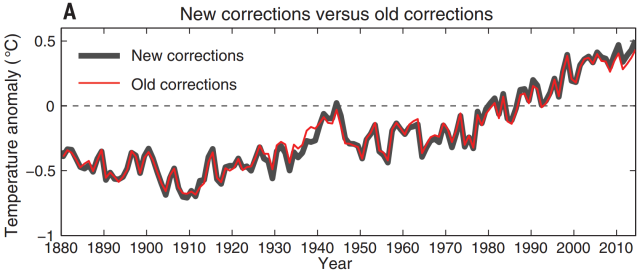
Layzej writes from a report via Ars Technica: In 2015, NOAA released version 4 of their marine temperature dataset called ERSST. The new dataset accounted for a known cooling bias introduced when ocean temperature measurements transitioned from being taken in ship engine intake valves to buoy-based measurements. The warming of the last couple decades increased ever so slightly in NOAA's new analysis. This was a red flag for U.S. House Science Committee Chair Lamar Smith (R-TX), who rejects the conclusions of climate science -- like the fact that the Earth's climate is warming. Suddenly he wanted to see the researchers' e-mails and echoed the accusations of contrarian blogs about scientists' supposedly nefarious adjustments to sea surface temperature measurements. Rather than invoking scientific conspiracies, issues like this should be settled by analyzing the data. A new study, led by University of California Berkeley's Zeke Hausfather, does just that -- and Rep. Smith won't like these results, either. To test the NOAA dataset, Zeke's team created instrumentally homogeneous temperature records from sensors available only over the last couple decades. As it happens, the Argo float data, the buoy data, and the satellite data each hew closer to the updated dataset that NOAA used. The older version (3b) gives a global average that is too cool in recent years, growing to an offset of about 0.06 degrees Celsius. The researchers repeat this same analysis for two more major sea surface datasets that are used by the UK Met Office and the Japanese Meteorological Agency for their global temperature records. Both of those datasets also drift cooler than the comparison data, but less so than NOAA's old dataset.
32 of 502 comments (clear)

  1. instrumentally homogeneous temperature records by mwvdlee · · Score: 5, Insightful

    You're not going to convince an idiot by providing evidence that he doesn't understand.

    --
    Slashdot social media options: AIM, ICQ, Yahoo, Jabber and Mobile Text. Why no MySpace?
    1. Re:instrumentally homogeneous temperature records by burtosis · · Score: 3, Insightful

      You're not going to convince an idiot by providing evidence that he doesn't understand.

      Due to climate science being too complicated to wrap up in one or two security blanket statements consisting of a pithy statement, we are all doomed to suffer the consequences. How many sheep carcasses, wolf tracks and turds do we need to find before people start actually doing something about the wolves, despite not seeing them personally?

    2. Re:instrumentally homogeneous temperature records by dywolf · · Score: 5, Informative

      200 years ago, and at roughly 330,000x faster than all previous known trends it's nothing like previous trends.
      go peddle your paid shilling somewhere else.

      --
      The guy who said the election was rigged won the presidency with the second-most votes.
    3. Re:instrumentally homogeneous temperature records by Ol+Olsoc · · Score: 4, Insightful

      You're not going to convince an idiot by providing evidence that he doesn't understand.

      Due to climate science being too complicated to wrap up in one or two security blanket statements consisting of a pithy statement, we are all doomed to suffer the consequences. How many sheep carcasses, wolf tracks and turds do we need to find before people start actually doing something about the wolves, despite not seeing them personally?

      But is it really that hard to understand?

      Once you accept that the greenhouse effect is real - and grade school children have been showing this at science fairs, and greenhouse owners have proven it for years, it doesn't take an Einstein to figure out that taking the Carbon that was removed from the atmosphere and putting it back in the atmosphere is going to have some effect.

      --
      The shepherds did so well protecting the flock that the sheep no longer believed that wolves existed.
    4. Re:instrumentally homogeneous temperature records by silentcoder · · Score: 4, Interesting

      Or to quote Neil De Grasse Tyson: "It's basic physics. If you keep adding energy to a system, but you slow down the rate at which the energy can leave the system then the system gets hotter".

      --
      Unicode killed the ASCII-art *
    5. Re:instrumentally homogeneous temperature records by dywolf · · Score: 5, Informative

      while not large, yes actually it does have an effect, even on greenhouses.

      greenhouses work because glass (or plastic sheeting) does not well transmit infrared radiative energy. IE, its an insulator that blocks the transmission of radiative heating, or radiative transfer. visible and ultraviolet light passes through the glass and strikes the surface of the objects inside, including the molecules of air. some of this energy is then re-radiated as infrared light energy, ie, heat. Because the glass blocks the infrared from exiting the structure, the system becomes unbalanced.

      In thermodynamics terms, the greenhouse is an enclosed system with 1 input and no output.
      And therefore because Ei > Eo, the total energy of the system must increase, and this results in increased temperature inside.

      Now, it is completely possible to create a greenhouse (or simply, enclosed system) and control the gases inside, then measure the effect different compositions have on the total temperature increase when exposed to a source of radiative energy that can enter but not escape.

      In fact, that's exactly how it's been proven that CO2 is in fact a greenhouse gas as early as the 1800s by scientists studying the radiative effects of various gases, such as john Tyndall.

      --
      The guy who said the election was rigged won the presidency with the second-most votes.
    6. Re:instrumentally homogeneous temperature records by burtosis · · Score: 4, Insightful

      Or to quote Neil De Grasse Tyson: "It's basic physics. If you keep adding energy to a system, but you slow down the rate at which the energy can leave the system then the system gets hotter".

      Sadly you lose most people at basic physics. I know it's hard for most slashdotters to wrap their heads around it but many people were brought up believing science and math will never amount to anything except a lack of dates and "cool" friends. Most people tune out science and all they hear is the teacher from peanuts going "whanana naaa naa whwahna".

    7. Re:instrumentally homogeneous temperature records by Ol+Olsoc · · Score: 4, Informative

      There's no convection in a greenhouse.

      https://en.wikipedia.org/wiki/...

      From the article:

      The possibility of using carbon dioxide enrichment in greenhouse cultivation to enhance plant growth has been known for nearly 100 years.[18][19][20] After the development of equipment for the controlled serial enrichment of carbon dioxide, the technique was established on a broad scale in the Netherlands.[21] Secondary metabolites, e.g., cardiac glycosides in Digitalis lanata, are produced in higher amounts by greenhouse cultivation at enhanced temperature and at enhanced carbon dioxide concentration.[22] Commercial greenhouses are now frequently located near appropriate industrial facilities for mutual benefit. For example, Cornerways Nursery in the UK is strategically placed near a major sugar refinery,[23] consuming both waste heat and CO2 from the refinery which would otherwise be vented to atmosphere. The refinery reduces its carbon emissions, whilst the nursery enjoys boosted tomato yields and does not need to provide its own greenhouse heating.

      Go figure, eh?

      --
      The shepherds did so well protecting the flock that the sheep no longer believed that wolves existed.
    8. Re:instrumentally homogeneous temperature records by Ol+Olsoc · · Score: 3, Interesting

      That's right, CO2 which is 100-fold less important than water vapor is somehow determinant of Earth climate.... on a planet covered with 80% oceans...

      Where on earth did you come up with a ridiculous statement like that? Yes, Water vapor is the biggest greenhouse "gas" out there. But that doesn't mean that CO2 has no effect Or methane. That coal you might be fond of? That is not sequestered water is it? It is the sequestered carbon from the appropriately namedCarbiniferous age. This was an interesting time, with Average global temperatures of around 68 degrees - much warmer than today.

      Oxygen levels were a lot higher than today composing over 32 percent by volume. This is why the insects of th eage were so large. CO2 was around 800 ppm.

      Now here's where it gets interesting. Trees had developed Lignin which allowed them to grow very large, and a waxy substance developed that delayed decomposition. These trees were armed for bear Forests covered much of the land. These forests pulled a lot of CO2 out of the atmosphere, which over time cooled the planet. Finally by the end of the Pennsylvanian age, the earth had cooled enoughh that these tropical forests could no longer sustain themselves.

      But in the meantime, as the trees went through their life cycle, the dead trees would drop, and when the conditions were correct, they would be covered, compressed, and turned into coal. Sequestered Carbon it was. Millions of years worth, and finally ended when the planet had cooled to the etent that the tropical climate couldn't be continued.

      So fast forward to today. At the beginning of the industrial Revolution - generally attributed to 1750, we started digging up and using this sequestered material. And we've gone through a lot of it. In less than 300 years, we've re-introduced 800 terawatts worth of radiative forcing worth of Carbon that was sequestered over millions of years.

      That's a lot, in a very short time.

      So yeah Water vapor acts as a greenhouse "gas" that's really a very good thing. We need the Greenhouse effect to exist, as the Earth would be Arctic without it.

      --
      The shepherds did so well protecting the flock that the sheep no longer believed that wolves existed.
    9. Re:instrumentally homogeneous temperature records by mattwarden · · Score: 4, Insightful

      You appear to be taking the straw man arguments too literally. Very few people say there is no effect from human greenhouse emissions. I have heard Lamar say this in hearings (something like "No one here would disagree that human greenhouse gas emissions affect climate innsome way."). Here are some questions to which we do not know the answer (though people will reply with claims that we do):

      1) How big is the effect of human greenhouse emissions compared to natural temperature variation?
      2) On climate time scale, is the net impact of human greenhouse emissions throughout all systems negative, neutral, or positive, and on what dimensions should we measure that?

      My beef with the climate change people is the attitude of omniscience about a complex topic that nobody actually understands. We have pieces of the puzzle, and the climate change folks overcompensate for uncertainty with a condescending attitude and bullshit vending. The "98% scientific consensus" talking point is a great example. It's garbage, but because climate change people feel vulnerable with normal levels of uncertainty in scientific subjects, they exaggerate and fearmonger in substitution for fact based discussion about what we do and dont know.

      There is another way to deal with this uncertainty: risk. Argue that yes, we might be wrong about our cost-benefit analysis of certain policy prescriptions because like any field of science, especially relatively new ones, there is a lot we don't know. But the risk is hugely asymmetrical. If we are wrong, we probably spent money on stupid projects and increased poverty levels and income inequality relative to what would have otherwise been. If we are right, human life will confront existential threats. So logically we should err on the side of the uncertainty that minimizes downside.

      This is the sane argument, but I won't hold my breath (pardon the CO2 emission)

    10. Re:instrumentally homogeneous temperature records by Solandri · · Score: 4, Interesting

      greenhouses work because glass (or plastic sheeting) does not well transmit infrared radiative energy. IE, its an insulator that blocks the transmission of radiative heating, or radiative transfer. visible and ultraviolet light passes through the glass and strikes the surface of the objects inside, including the molecules of air. some of this energy is then re-radiated as infrared light energy, ie, heat. Because the glass blocks the infrared from exiting the structure, the system becomes unbalanced.

      In thermodynamics terms, the greenhouse is an enclosed system with 1 input and no output.
      And therefore because Ei > Eo, the total energy of the system must increase, and this results in increased temperature inside.

      This is the oversimplified explanation of climate change which I have problems with. Unfortunately, it is the argument parroted by nearly all the armchair climatologists as the reason why global warming is real and we must do something about it Right Now.

      From a thermodynamics standpoint, the rate of heat radiated by a black body is proportional to the fourth power of its temperature. The Ei > Eo state is a transitory state - it is only temporary. The temperature increases causes Eo to (quickly) increase, until Eo is large enough to match Ei.. So we end up with Ei = Eo again, but at a new, higher T. In other words, the system stabilizes at a new, higher temperature. This is why glass greenhouses don't continue to increase in temperature until the inside is hot enough to melt the glass. T^4 is a huge number. It only takes a small temperature increase to offset a large Ei increase (actually Pi would be more accurate - the rate of energy coming in, or power coming in).

      Unstable "runaway" systems are extremely rare in nature. The reason is simple - anything that's unstable tends to, over billions of years, destroy itself. So the overwhelming majority of things remaining in the universe are stable systems. There is no "delicate balance" of nature. There is no "runaway" greenhouse effect - all we're doing is shifting the equilibrium point. We know this to be true because global CO2 concentrations and temperatures have been higher in the past than they are today, and the Earth did not self-destruct - it is still around with life intact.

      Now, from all I've read, that new equilibrium temperature point is high enough to cause massive problems for human civilization if we don't address it. But the alarming layman's explanation of the greenhouse effect that you've given is just as wrong and misleading as the climate change deniers' explanations.

  2. Re:Who cares? by mwvdlee · · Score: 5, Informative

    Bullshit.
    It's the kind of obvious, blatant, easily disprovable but nonetheless convenient lie that leads to electing bullshit presidents.

    http://ec.europa.eu/eurostat/w...

    http://ec.europa.eu/eurostat/s...

    --
    Slashdot social media options: AIM, ICQ, Yahoo, Jabber and Mobile Text. Why no MySpace?
  3. Re:Who cares? by locofungus · · Score: 4, Informative

    From where are you getting your figures?

    http://ec.europa.eu/eurostat/s...

    That claims they're down 22% from 1990 levels.

    Those exclude LULUCF (land use changes) - perhaps you have inclusive figures? (Although I'd be surprised if LULUCF could be bigger than the significant reductions in everything else.)

    --
    God said, "div D = rho, div B = 0, curl E = -@B/@t, curl H = J + @D/@t," and there was light.
  4. Harness economic self interest by sjbe · · Score: 5, Insightful

    Suddenly he wanted to see the researchers' e-mails and echoed the accusations of contrarian blogs about scientists' supposedly nefarious adjustments to sea surface temperature measurements. Rather than invoking scientific conspiracies, issues like this should be settled by analyzing the data.

    Most people wouldn't understand the data if you clubbed them over the head with it. Doubly so for politicians with no scientific training. The problem in the argument is that one side of this argument isn't arguing with facts and is actually incentivized to demonize any data that contradicts their pre-determined conclusions. They see the argument in one of two ways (sometimes both). A) They see climate change data as a threat to their personal interests - usually financial ones. If you are a politician sponsored by a fossil fuel company, this threatens your self interest. B) They see the climate change argument as something coming from the Other. It's a tribal thing - that Other group supports it ergo it must be bad. Often they frame it as a conspiracy despite the absurdity of that statement.

    So in either case you have people who have no incentive whatsoever to acknowledge the data because it threatens what they hold dear. Rationality plays no role in it. The best way to combat this is to frame the argument in such a way as to align their incentives with the data. Point out how much money there is to be made/saved by working on the problem. Put it front and center as an economic issue. Figure out how to align solutions to the problem with economic and political self interest. Until you do that you're going to have this problem of certain politically powerful factions sticking their fingers in their ears and getting in the way.

  5. Not even a debate by sjbe · · Score: 5, Informative

    Climate scientists haven't established Human caused global warming is real.

    You are wrong. It's not even really a debate among climate scientists at this point. So far all the data seems to clearly show that humans are a key factor in recent climate change. And even just on the face of it the notion that we could be dumping so many billions of tons of CO2 and other pollutants into the atmosphere without any effect or consequence is just absurd. If you want to argue that we are still pinning down the exact extent of the effect of our activities then you might have an argument. But to pretend that our activities have had no effect on global climate is ridiculous.

    That said, it doesn't really matter anyway. Even if hypothetically speaking humans weren't responsible at all for climate change we still would need to take action to deal with the reality of it. It's going to affect food supplies, energy resources, ecosystems, pollution, geopolitics, etc. The US Department of Defense (hardly a bastion of liberal thinking) considers it real and a significant threat to national security.

    So far we just have a gently upward trend starting about 400 years ago, very similar to the previous upward trends that were entirely natural.

    Yeah sorry but the data is just a tad more complicated than your little made up and cherry picked sound bite.

  6. Re:Or skeptics by Layzej · · Score: 5, Informative

    Right. During the late 20th century, ocean temperatures readings were primarily taken mechanically through an “engine-intake valve.” Ships pump water into their hull in order to cool the engine room, and a thermometer measures its temperature on the way. This can introduce bias to the numbers, though: Because engine rooms get hot, engine-intake-valve readings are skewed warmer than the actual ocean.

    Whereas 95 percent of NOAA’s readings came from ship engine rooms in the early 1990s, 85 percent now come from buoys, which provide a more accurate reading. It turns out that if you don't account for that known bias you get a result that is less accurate.

  7. Re:Two questions before I call BS. by locofungus · · Score: 5, Informative

    (2) Aren't they talking about data taken on ships by physically reading thermometers to an accuracy less than the claimed effect? As I was taught: If you don't know your error, you haven't made a measurement. In this case the error could be even greater than the effect itself!

    No.

    Over time the proportion of data contributed by taking measurements on ships has decreased.

    NOAA said "hey guys, this has introduced a systematic error into the data and we need to adjust for it"

    Other scientists were skeptical.

    This group decided to test it. So they took several independent data sets that each used just one measurement so that each dataset is internally consistent.

    They then discovered that all the data sets matched the NOAA adjusted combined data better than the previous unadjusted data.

    What their work indicates is that the slow migration from ship thermometer to buoy, satellite etc has hidden an extra 0.06C/decade of warming - and that the warming rate over the last several decades is much closer to the rate over the previous decades than was thought.

    (It should be pointed out that some statisticians don't accept that there was any statistically significant change in the warming rate over the last several decades even when using the pre NOAA (3b) data. My statistical knowledge isn't sufficient to be able to independently do the changepoint analysis necessary to confirm or refute this)

    --
    God said, "div D = rho, div B = 0, curl E = -@B/@t, curl H = J + @D/@t," and there was light.
  8. Thrid party review by Layzej · · Score: 4, Informative

    The evaluation was performed by a third party that is not associated with NOAA. In fact, lead author Zeke is associated with the Berkeley BEST skeptics that were once the darlings of the climate contrarian movement - until the results of their audit were released and ended up confirming the consensus position.

    Regarding the graph, what you are looking at is the difference between the reference and the reconstruction. A negative trend means the reconstruction is lower than the reference. A positive trend means that the reconstruction is higher than the reference. A zero trend means that the reconstruction is bang on. You'll notice that the ERSSTv4 matches the instrumentally homogeneous reference datasets quite well. That's a good thing!

  9. Re:Hug a climate denier today by radl33t · · Score: 3, Insightful

    And the odds of a global conspiracy with thousands (if not 10s of thousands) of actors? LoL

  10. Re: Who cares? by Notabadguy · · Score: 5, Informative
  11. Re:Two questions before I call BS. by silentcoder · · Score: 3, Informative

    >I don't know and neither do you
    Yes... we do... because only one of the two options is even POSSIBLE. The other is literally declared impossible by Newton's first law and ALL THREE laws of thermodynamics. Put a ship engine intake thermometer and a buoy thermometer in the same water - it's physically impossible that the ship will NOT measure hotter than the buoy. Because those heaters, engines, people - all those things PRODUCE ENERGY. And energy cannot be destroyed, it cannot dissapear. It's there and it WILL affect the measurement.
    Luckily we DO know exactly by how MUCH it affects it - because we DO have buoy's to compare it with.

    > I mean I may be thick as a stick in a bucket of pig-shit
    There's no may be about it, but congratulations on the closest to true thing you've said all day (it would have been entirely true if you replaced 'may be' with 'am').

    >I do at least know these kinds of statistical shenanigans are usually bollocks.
    There was nothing statistical about this - and besides which, no they NEVER are - but professional liars like Steve Mcntyre will write screeds declaring the statistics invalid. Not because it is - because he is flat out lying to you about what the numbers mean (or even, on occasion, what those numbers ARE). It's not that he doesn't understand the statistics, he has the training and he does. It's that he knows YOU DO NOT. So he knows if how to tell a convincing lie. And you fall for it.
    Probably because of the above stated stick in a bucket of pig-shit problem.

    --
    Unicode killed the ASCII-art *
  12. Do greenhouses create their own heat? by Anonymous Coward · · Score: 4, Informative

    No. Therefore DESPITE NO HEATING FROM THE GLASS, the greenhouse heats up.

    And therefore one of the simplest and dumbest denier memes "how can it make"things warmer? That breaks the 2nd law of thermodynamics!" is shown to be bollocks.

    You see, if it were NOT proposed as an ANALOGY (look the word up, moron), your "complaint" that greenhouse glass isn't made of CO2 would stand up. But it isn't and it doesn't.

    The proof of AGW is

    1) CO2 causes heat to be trapped
    2) If the sun's output remains the same, the earth will warm
    3) We are burning fossil fuels, increasing the CO2 content of the atmosphere

    The greenhouse is an analogy.

    The greenhouse effect is the effect, and no greenhouses are required.

    1. Re:Do greenhouses create their own heat? by locofungus · · Score: 3, Interesting

      I despair.

      CO2 from biological matter doesn't directly matter. (Land use changes that destroy biological matter and don't replace it are a different matter)

      If it's plant based then all that CO2 that is released will have been recently extracted from the air to be incorporated into the plants tissues.

      If it's animal based then any and all CO2 that is released will, ultimately, have come from the C in plants which, in turn, will have come from CO2 in the air.

      it's really, really, easy to tell the difference between CO2 that has its source as the carbon cycle and "fossil" CO2 that has been sequestered for significant lengths of time. "Biological" CO2 will have been recently part of the atmosphere. Because C14 has a moderate half life (6Kyear), it will have needed to be sequestrated for tens to hundreds of millenia before all the (detectable) C14 will have decayed.

      Almost all C14 is generated in the upper atmosphere (by thermal neutron capture by N14). Therefore, if the material you are burning, composting, digesting, gives off CO2 that contains C14 then the carbon that it contains (recently) came from the atmosphere.

      --
      God said, "div D = rho, div B = 0, curl E = -@B/@t, curl H = J + @D/@t," and there was light.
    2. Re:Do greenhouses create their own heat? by Rob+Y. · · Score: 3, Insightful

      Why it's almost as if fossil fuel-funded pols wanted us to reach a tipping point so that they could then say - there's no point attempting to stop it now. Party on and build those big seawalls. I wonder if they're investing in seawall technology now...

      Nothing in that tipping point argument says that it's useless to stop throwing fuel on the fire. Yes, the tipping point means that we've got our work cut out for us, and we should be preparing in addition to trying our best not to add to the problem, but based on how well we 'prepared' for preventing getting to this point, I don't see much happening there either.

      --
      Posted from my Android phone. Oh, I can change this? There, that's better...
    3. Re:Do greenhouses create their own heat? by david_thornley · · Score: 3, Insightful

      Ah, yes, the stages of denialism:

      1. It's not happening.

      2. It's not our fault.

      3. Our contribution isn't significant.

      4. It's not going to be that bad..

      5. It's too late to do anything useful, so there's no point in doing anything.

      --
      "When you have eliminated the unacceptable, whatever is left, however improbable, must be the truthiness" - Holmes
  13. Get yer data here. by hey! · · Score: 5, Informative

    On one hand the per capita CO2 emitted HAS increased from 4.3 tons per person in 1990 to 4.9 tons per person in 2014. This suggests that the world doesn't care.

    On the other hand the world is far wealthier than it was twenty-five years ago. If you look at CO2 per dollar of purchasing power (PPP GDP), the world reduced it's CO2 emissions per dollar by fifty-six percent. The per dollar of GDP emissions have declined most markedly in ... Europe. The major industrial countries of Europe scored per dollar reductions on the order of 60% - 80%. (UK 600 g/$ --> 200; France 367 g/$ --> 129; Germany 560->208; Denmar 597->148; UK 557->182). Most European countries emit less CO2 per person, in the cases of the largest industrialized countries (UK, France, Germany) dramatically so. Italy is the only industrialized country to score large increases in C02 over that period.

    SO here's the TL;DR: the world has tried and succeeded at becoming dramatically more carbon efficient -- about 2x as efficient on a dollar basis. That efficiency gain have not kept up with a Gross World Product that has more than doubled, and a population increase of over 1/3.

    There's a world of difference between doing nothing and not doing quite enough to solve the problem. What we have done is push a number of climate change consequences further into the future, and that makes a big difference. For many of us it means not living to see those changes.

    --
    Post may contain irony: discontinue use if experiencing mood swings, nausea or elevated blood pressure.
  14. Prove the data wrong by sjbe · · Score: 4, Insightful

    No really, stop tickling my sides. Skeptical Science, a shill front organisation for rent-seeking environmentalists.

    Even if that is true it doesn't mean the data they are presenting is wrong. Prove the data wrong or shut up and go away.

    It does matter though, imho. It matters for reasons of integrity, especially public trust in science.

    The only lack of integrity is coming from the climate change deniers. They refuse to engage in a honest debate about or honest analysis of the evidence. Many of them have clear conflicts of interest (fossil fuel industry ties, etc) and don't even pretend to hide them. All the scientists are doing is presenting the evidence which is mountainous in volume at this point and growing all the time. If the climate deniers had an actual evidence based case they could easily cut through the BS by presenting actual evidence contradicting the current science models. They have no such evidence so they are making a political argument instead of a scientific one.

    1. Re:Prove the data wrong by apoc.famine · · Score: 4, Insightful

      I think you'll find it's the climate shills who aren't showing up to debate "deniers".

      Thank you for very clearly pointing out that you have absolutely no fucking clue what you're talking about. This isn't a fucking debate. That's your problem. That you think this is a debate shows a marked detachment from reality and how the world works.
       
      The reason nobody is showing up for a debate is that there's nothing to debate, and debating facts is something only stupid shills do.
       
      I'm sorry you don't like the fact that the battles fought to understand and quantify climate change are fought on a battleground you don't have access to. That battleground isn't on a debate floor where you can rant and scream that it's not climate change because this winter was cold. It's being fought with data sets and analysis in peer reviewed journals where qualified experts are welcome to tear any such research apart. And they do on a regular basis. The problem that you're having is that what they're tearing apart are techniques and reanalysis that changes the outcome by hundredths or tenths of degrees, and doesn't disprove climate change.

      Are there contrarians who're going to survive graduate school and end up with tenure?

      No. Because if you're still a contrarian, you're being one based on a belief not supported by the data. And grad school in the sciences is not about what you feel, it's about what you can prove or disprove. The battle to disprove climate change is over, and has been for a long time. That's not the battle being fought now, no matter how much you want it to be fought. You might as well rail against gravity.
       
      Again, I'm sorry that the facts aren't lining up with your worldview. But everything you think should be done is either a) not how you prove things or b) has been done and it proved climate change. You need to get over it.

      --
      Velociraptor = Distiraptor / Timeraptor
  15. Re:Two questions before I call BS. by DarkOx · · Score: 3, Interesting

    Exactly, just because you are doing science does mean you abandon common sense. Most would call me a climate skeptic, but even I will admit there has been a warming trend over the period we have been taking actual measurements. Its not credible to assume a massive conspiracy exists to distort measurements. When the was suggestion of such it was investigated and debunked.

    I also know based on other day to day encounters with the observable universe that at least on the atomic/chemical scale I occupy thermodynamics is a reality. Finally I know trends are well trends, they continue unless there is a reason for them them to not continue. So when someone argues there as a been a pause in the warming trend the correct response is actually skepticism. A pause would be caused by something, so there are two possibilities we don't know the cause of the pause or the measurements are not correct. Since the measurement methodology was changed that should be the FIRST place we look. Here the interesting thing isn't the absolute values but the deltas. Allowing for some noise in the older measurements we see similar deltas in the data gather in the new measurements, the correct conclusion is the older absolute values are off but the deltas are probably still accurate.

    Think of this way, you have two thermometers in a room, one reads 68F the other 70F you turn the heat on and observe the readings again 30min later. The first now reads 70F the second now reads 72F. You can be pretty certain the room is 2F warmer than before, you might guess the actual temperature is 71F but your confidence in that should be low.

    There is a reasonable debate to be had about:
    1) Are human activities the primary driver of climate change or are other factors playing a more significant role
    2) Are these changes really outside the normal range our planet and ecosystem have experienced in the past
    2a) if no, is the rate of change outside the normal range
    3) Is this a good or bad thing, in terms of our own best interest?
    3a) how do you define 'our'

    Those are the real questions where climate change is concerned, not that it has changed since the start of the industrial era or that it is changing.

    --
    Repeal the 17th Amendment TODAY! Also Please Read http://www.gnu.org/philosophy/right-to-read.html
  16. Arguing with facts by sjbe · · Score: 4, Insightful

    In other words, it's politicized.

    The climate deniers are the one's making it political. But because they have that's the reality we have to deal with. We can pretend it isn't political or we can deal with the fact that it is and get on with fixing the problem.

    Also, I would argue that neither side is actually arguing with facts.

    Nonsense. The scientists are arguing with almost nothing BUT facts. The fact that a bunch of mostly right wing fossil fuel shills are standing in the way of those facts is plain enough to see. One side has facts and scientific data. The other has economic self interest and little else. The notion that both sides aren't arguing with facts is just nonsense.

  17. Re:Funny how by hey! · · Score: 4, Informative

    Not so funny if you know how scientists think and communicate.

    Most of us live in a world where overstatement and oversimplification rule. Politicians certainly do it, but don't forget advertisers. Take that advertisement that says "Four out of five dentists recommend Trident for their patients who chew gum." We know it's bullshit, which is not quite the same as saying it is untrue. Four out of five neurosurgeons probably recommend .22 caliber bullets for their patients that shoot themselves in the head.

    Scientists don't communicate that way. My wife is a geophysicist who's believed in AGW since the mid 80s. Yet she's never been happy with the state of the data. Her trained response to something clear as night and day is to point out you've neglected to mention civil and nautical twilight. Although she expected the warming trend of the 90s to happen, the unequivocal nature of the data really irked her because data is supposed to be more contradictory than that.

    So it boils down to this: a politician won't change his mind unless the evidence is unequivocal, a scientist is reluctant to change his mind unless there is data to support both sides of a question.

    This means there is a huge incentive for a scientist to understate their results and make them seem more equivocal. Faced with a very large and dramatic effect, initial scientific reports will almost always understate it. That's because you have to give every possible benefit of the doubt to the null hypothesis.

    --
    Post may contain irony: discontinue use if experiencing mood swings, nausea or elevated blood pressure.
  18. Re:We don't need data by apoc.famine · · Score: 4, Insightful

    All of that data is freely available. Why aren't you doing your own analysis on it?
     
    And if you ask me where to find it and how to analyze it, you can just fuck off. Because you are obviously not smart enough to do it, no matter how much you want to. The data is easy enough to find, but it turns out that science and statistics are hard, and the vast majority of the population isn't smart enough and doesn't have the skill-set to do anything meaningful with the data.

    Let's see those e-mails.

    Oh yes, right, those emails that have the tens and hundreds of gigabyte data sets attached to them. That's how scientists transfer their data, right? Just like I transfer my spreadsheets.

    --
    Velociraptor = Distiraptor / Timeraptor