 Slashdot Mirror
Raspberry Pi Gets Competitors (hackaday.com)
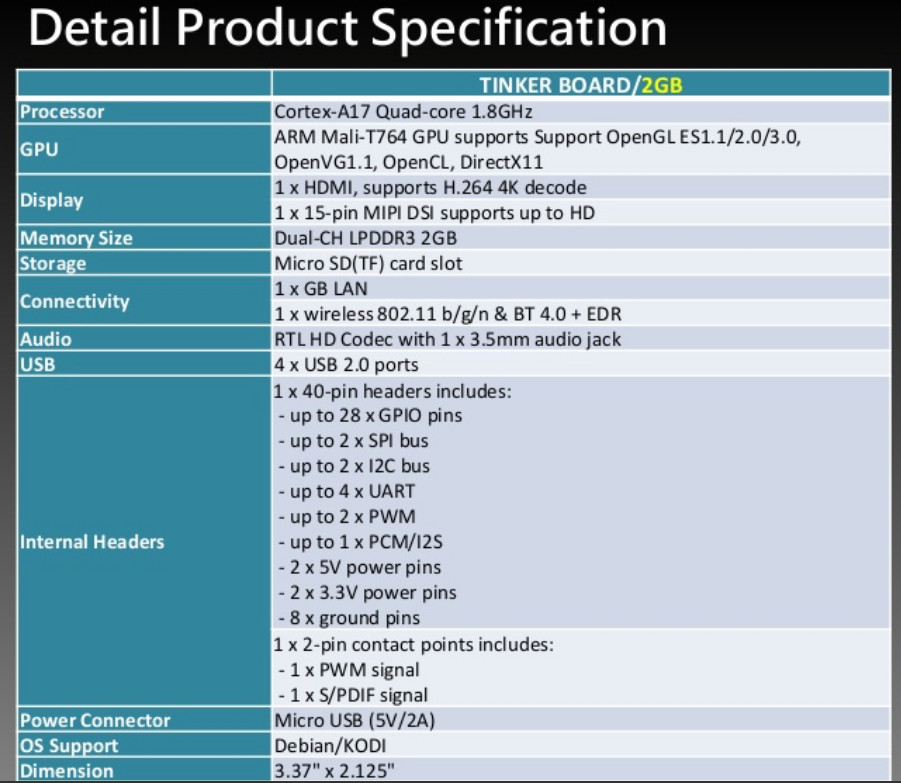
Hackaday reports that Asus has "quietly released their Tinker board that follows the Pi form factor very closely, and packs a 1.8 GHz quad-core ARM Cortes A17 alongside an impressive spec At £55 (about $68) where this is being written it's more expensive than the Pi, but Asus go to great lengths to demonstrate that it is significantly faster."
And though the Raspberry Pi foundation upgraded their Compute Module, Pine64 has just unveiled their new SOPINE A64 64-bit computing module, a smaller version of the $15 Pine64 computer. An anonymous reader quotes ComputerWorld: At $29, the SOPINE A64 roughly matches the price of the Raspberry Pi Compute Module 3, which ranges from $25 to $30. The new SOPINE will ship in February, according to the website. The SOPINE A64 can't operate as a standalone computer like the Pine64. It needs to be plugged in as a memory slot inside a computer. But if you want a full-blown computer, Pine64 also sells the $15 SOPINE Baseboard Model-A, which "complements the SOPINE A64 Compute Module and turns it into a full single board computer," according to the company...
The original Pine64 was crowdsourced and also became popular for its high-end components like a 64-bit chip and DDR3 memory... It has 2GB RAM, which is twice that of Raspberry Pi's compute module. SOPINE also has faster DDR3 memory, superior to DDR2 memory in Raspberry Pi Compute Module 3 board.
And though the Raspberry Pi foundation upgraded their Compute Module, Pine64 has just unveiled their new SOPINE A64 64-bit computing module, a smaller version of the $15 Pine64 computer. An anonymous reader quotes ComputerWorld: At $29, the SOPINE A64 roughly matches the price of the Raspberry Pi Compute Module 3, which ranges from $25 to $30. The new SOPINE will ship in February, according to the website. The SOPINE A64 can't operate as a standalone computer like the Pine64. It needs to be plugged in as a memory slot inside a computer. But if you want a full-blown computer, Pine64 also sells the $15 SOPINE Baseboard Model-A, which "complements the SOPINE A64 Compute Module and turns it into a full single board computer," according to the company...
The original Pine64 was crowdsourced and also became popular for its high-end components like a 64-bit chip and DDR3 memory... It has 2GB RAM, which is twice that of Raspberry Pi's compute module. SOPINE also has faster DDR3 memory, superior to DDR2 memory in Raspberry Pi Compute Module 3 board.
Raspberry Pi had competitors before it ever existed. Are people really this fucking dense around here?
The Pie has FreeBSD and other Linux distro support and lots of i/O to hook up other peripherals.
http://saveie6.com/
Oh so I can pay 2x and get something 2x faster. Wow. And I could pay 2x of $60 and get a whole chromebook or used laptop that was 8x faster. Or a I could buy a cheap android phone and have my rockchip with a touch screen and battery for that $60.
they just don't understand the price point logic of $35.
Likewise going the other way you can buy a cheaper and more powerful board like a Pine or an Orange PI, save yourself $10 in parts and then pay about $300 in time and effort (assuming your time is worth $50/hour) to get a linux distro and and all the needed packages that actually works on it. the orange PI's are junk because a usabale software set only gets ported a year or more after the board has been on the market. I bought one once, and had to download several different distro's for it till I got one with drivers that would support the Key board, Blue tooth, and screen I was using. And even then it was only using just 1 of it's 4 processors and no graphics acceleration from the Mali chip. that took hours to wade through. then when I tried to install other code the libraries didn't compile. Fast forward 3 years, and it works fine now but the rasperry PI 3 eclipsed it.
The whole point of the RPI is a bomb proof little circuit that has loads of well testd software so it's not the project, it's the thing you put into the project.
Some drink at the fountain of knowledge. Others just gargle.
I won't call Arduino a competitor Raspberry pi - different animals. An Arduino is an embedded system while Raspberry is a minicomputer. For example you would not want to use a Raspberry pi in something that will have its power pulled abruptly or on and off - unless you go though a lot of hoops to create a read only file system and even then it is risky to use it for something in the field or embedded in a another system.
I agree 100% with the parent that RasperberrryPi has no competitors. The pie is for the I/O ports for IOT devices and tinkering with something that well documented and supported with up to date and working kernel and opensource components and working hardware (not buggy).
The Raspergy Orange/zero and the more expensive Beagle miss the point. A faster chip with no or I/.O or proprietary buggy i/O incompatible with the Pie defeats the purpose. The cheaper units lack these and the more expensive units are faster but miss these or run outdated stuff that no one uses when you try to get a IOT camera hooked up.
http://saveie6.com/
The extra processor horsepower and RAM is nice but it seems like it is not matched by I/O. is the gigabit Ethernet tied to the processor? One of the drawbacks of the Pi (not Pie, BTW) is that Ethernet is off the internal USB2 hub.You could put gigabit Ethernet on a USB2 hub and get no increase in bandwidth. The Tinker has one micro-USB connector for power. Does it support OTG? (According to the Hackaday article it does have multiple USB 2.0 ports.) Sata would be nice too.
The biggest advantage of the Raspberry Pi is the community. It's going to be hard to match that. The RPi has hit critical mass when I can go to my local Microcenter and get a Pi 3 Model B for $30 US or a Pi zero for $5.
A big draw of the Pi is its price point. More expensive devices aren't necessarily competition. Less expensive devices like the C.H.I.P. are the ones I'd expect to take a bite out of Pi.
unless you go though a lot of hoops to create a read only file system and even then it is risky to use it for something in the field or embedded in a another system.
The hoops are not that bad. Just mount /tmp, /var/tmp, /var/log, /run and one or two others as tmpfs, and set up a few symlinks, like making sure /etc/resolv.conf points to a tmpfs FS (or just lock it to 8.8.8.8). Once you have it figured, it's straightforward.
There are guides for running debian as readonly root over NFS: most of those instructions (except the NFS bit) apply.
SJW n. One who posts facts.
Intel makes one called the MinnowBoard Max. It's in the $150 price range.
Intel has parts that would work(albeit a bit light on GPIO); I've got a dreadful little tablet here based on the Z3735G, and they packed that CPU, a gig of RAM, 16GB of flash, a 1024x600 touchscreen, some sort of BT and wifi, and a battery together for under $50.
If they hadn't also burdened the device with some of the more agonizing firmware I've had the pleasure of dealing with(AMI's dysfunctional take on 32-bit UEFI, no compatibility support module, on a 64-bit platform? Sign me up!); it'd actually be a decent little Linux toy, since that Atom is supported by intel GPU drivers, not the freaky PowerVR stuff.
As best I can tell, though, the Z-series Atoms didn't attract all that much interest(they are comparable to ARM devices aimed as similar price performance niches; but not particularly superior); and vendors weren't exactly clamoring to buy the chips; and Intel doesn't really like selling parts that cheap. They'd much rather try to sell you on a Core M or the like.
There isn't a whole lot of reason to do it; or apparent interest; but it could be done.
The Raspberry Pi 3 also doesn't have Gigabit Ethernet or a SATA port, two more reasons why it doesn't make for a very good file server.
It does make a pretty damn good embedded web server, though. You can install the full LAMP stack on the MicroSD card of that thing right from the Raspbian repos.
Yeah, I got a Raspberry Pi because I thought I could turn it into a cheap TV recorder with my USB TV stick. Something low power that I could easily leave on all the time so I wouldn't have to remember to leave my regular computer on just to record some program while I was out of the house or asleep.
Didn't work out. Everything had to breath through that slow USB interface so, while I got recordings, they were all chopped up.
In theory, theory and practice are the same; in practice they're different. (Yogi Berra & A. Einstein)
The thing I see missing in most of the Raspberry Pi competitors is curriculum. It's all fine and well to pop out a cheap single board computer and then port an operating system or two that runs on it. The part of Raspberry Pi that is missing is the curriculum and the value for education, which is what the RPi is all about.
The Raspberry Pi was developed to be a pedagogical tool for education. The Raspberry Pi Foundation works to get acceptance of the RPi devices into schools, and they help educators come up with curriculum to take advantage of the hardware. To get the hardware into the hands of kids who can then hack on it and learn. The Pi wasn't invented so that neckbeards could use it for their Media Center.