 Slashdot Mirror
Japanese Company Develops a Solar Cell With Record-Breaking 26%+ Efficiency (arstechnica.com)
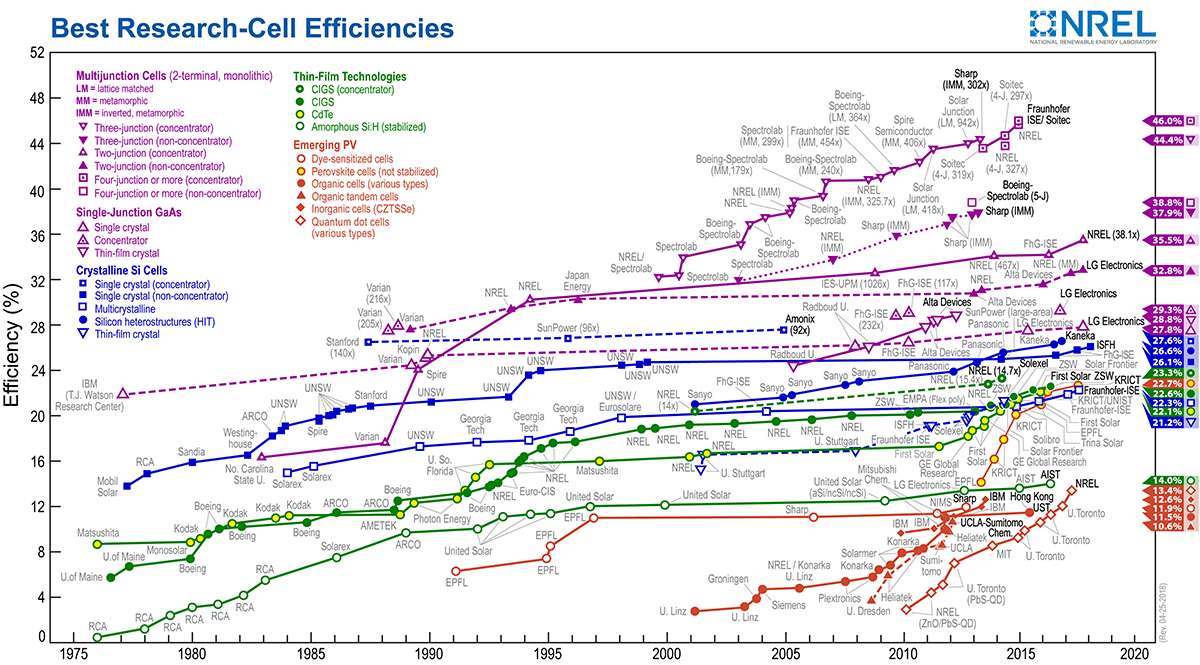
An anonymous reader quotes a report from Ars Technica: The silicon-based cells that make up a solar panel have a theoretical efficiency limit of 29 percent, but so far that number has proven elusive. Practical efficiency rates in the low-20-percent range have been considered very good for commercial solar panels. But researchers with Japanese chemical manufacturer Kaneka Corporation have built a solar cell with a photo conversion rate of 26.3 percent, breaking the previous record of 25.6 percent. Although it's just a 2.7 percent increase in efficiency, improvements in commercially viable solar cell technology are increasingly hard-won. Not only that, but the researchers noted in their paper that after they submitted their article to Nature Energy, they were able to further optimize their solar cell to achieve 26.6 percent efficiency. That result has been recognized by the National Renewable Energy Lab (NREL). In the Nature Energy paper, the researchers described building a 180.4 cm2 cell using high-quality thin-film heterojunction (HJ) -- that is, layering silicon within the cell to minimize band gaps where electron states can't exist. Controlling heterojunctions is a known technique among solar cell builders -- Panasonic uses it and will likely incorporate it into cells built for Tesla at the Solar City plant in Buffalo, and Kaneka has its own proprietary heterojunction techniques. For this record-breaking solar cell, the Kaneka researchers also placed low-resistance electrodes toward the rear of the cell, which maximized the number of photons that collected inside the cell from the front. And, as is common on many solar cells, they coated the front of the cell with a layer of amorphous silicon and an anti-reflective layer to protect the cell's components and collect photons more efficiently.
"26.3 percent, breaking the previous record of 25.6 percent. Although it's just a 2.7 percent increase"
Uh, what? Someone flunked elementary school math.
25.6 * 1.027 = 26.29
Lots of people flunk elementary maths... apparently.
If God forks the Universe every time you roll a die, he'd better have a damned good memory.
26.29 rounds to 26, not 27.
Nobody mentioned 27 though. 2.7 isn't 27.
And, although the wording clearly implies an absolute relationship, the correct relative formula would be 26.3/25.6=1.03 when significant digits are accommodated (which would be a 3% relative increase).
You're making the assumption that 26.3 and 25.6 are given with the full number of significant digits (which may not be the case), or that significant digits actually matter in a percentage figure (not an actual measurement) in popular scientific journalism. Get over yourself.
Well, at least you're in good company.
Someone's really salty to be shown wrong, eh?
This is only single cell solar cells, multi-junction cells have breached 46%. https://www.ise.fraunhofer.de/... At this point increases in efficiency are mostly masturbation, relying on complex materials/techniques that aren't worth the cost. The big transformation will occur when they get thin film solar cells that are more efficient so you can have solar cells without making ridiculous amounts of toxic waste.
The only thing holding me back now isn't efficiency, it's the cost of batteries. That's the real cost issue.