 Slashdot Mirror
Japanese Company Develops a Solar Cell With Record-Breaking 26%+ Efficiency (arstechnica.com)
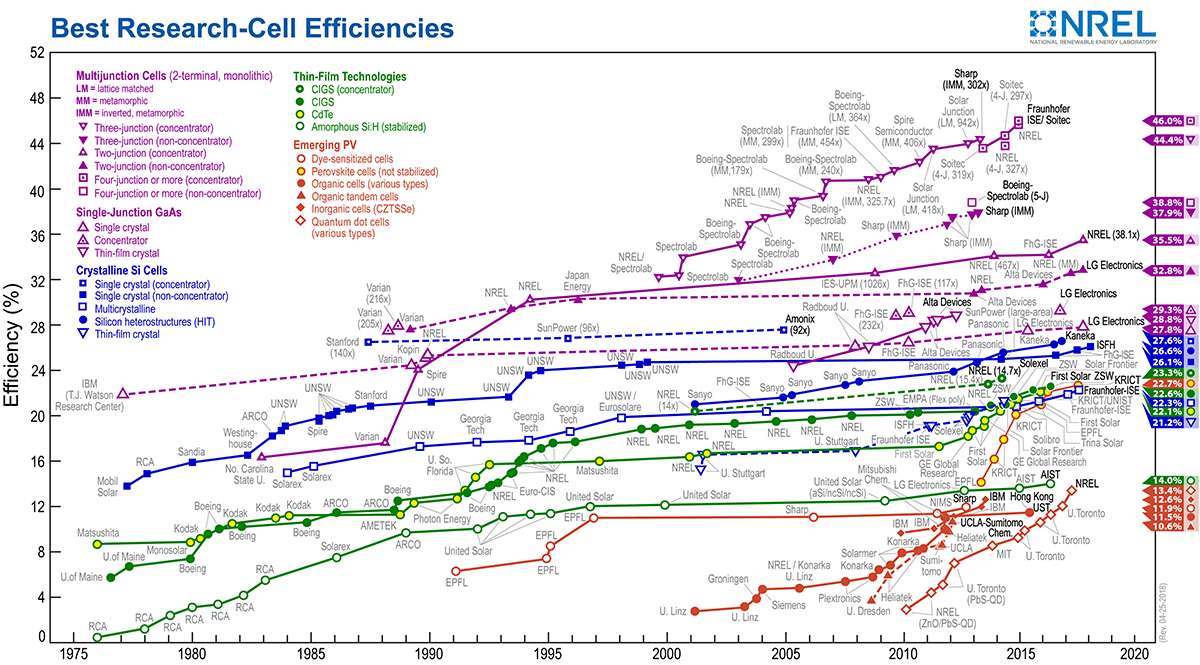
An anonymous reader quotes a report from Ars Technica: The silicon-based cells that make up a solar panel have a theoretical efficiency limit of 29 percent, but so far that number has proven elusive. Practical efficiency rates in the low-20-percent range have been considered very good for commercial solar panels. But researchers with Japanese chemical manufacturer Kaneka Corporation have built a solar cell with a photo conversion rate of 26.3 percent, breaking the previous record of 25.6 percent. Although it's just a 2.7 percent increase in efficiency, improvements in commercially viable solar cell technology are increasingly hard-won. Not only that, but the researchers noted in their paper that after they submitted their article to Nature Energy, they were able to further optimize their solar cell to achieve 26.6 percent efficiency. That result has been recognized by the National Renewable Energy Lab (NREL). In the Nature Energy paper, the researchers described building a 180.4 cm2 cell using high-quality thin-film heterojunction (HJ) -- that is, layering silicon within the cell to minimize band gaps where electron states can't exist. Controlling heterojunctions is a known technique among solar cell builders -- Panasonic uses it and will likely incorporate it into cells built for Tesla at the Solar City plant in Buffalo, and Kaneka has its own proprietary heterojunction techniques. For this record-breaking solar cell, the Kaneka researchers also placed low-resistance electrodes toward the rear of the cell, which maximized the number of photons that collected inside the cell from the front. And, as is common on many solar cells, they coated the front of the cell with a layer of amorphous silicon and an anti-reflective layer to protect the cell's components and collect photons more efficiently.
The only reasonable improvements are in reducing the cost of manufacturing and reducing the amazingly toxic byproducts of solar cell production.
Cost is not everything, that is pretty dumb economic thinking. Cost efficiency is everything, the return on capital investment. With branded solar energy systems, retained capital investment is as important as energy generated. Want it the price of a home with a top quality solar energy system versus a home without one. What premium can you start to charge on a home where the supply charge for electricity is higher than the cost of actual supply of electricity, a house that is basically black out proof. Where energy running cost for a car heads to zero.
So in mid level housing density, how close to an effective solar energy system for a two story town house, where a premium is paid, due to limited are for panels. It makes no sense with solar panels to have them anywhere else but as close as practicable to the point of demand, screw the insensate greed of the energy companies. Doing away with the electrical grid all together in suburban low density housing would be a major victory for the majority, screw the energy companies, they can pretty much choke on their own gas (tee hee).
Chaos - everything, everywhere, everywhen
Over time, though, the cost almost always comes down unless there's a reliance on highly valuable raw materials (such as gold).
This sig has been enciphered with a one-time pad. It could say almost anything.
...but solar cell efficiency only really matters when space is limited.
You are so stupid it's truly a shame your parents were not tortured for bringing you into this world. Even the Republicans support abortion for things as stupid as you.