 Slashdot Mirror
Japanese Company Develops a Solar Cell With Record-Breaking 26%+ Efficiency (arstechnica.com)
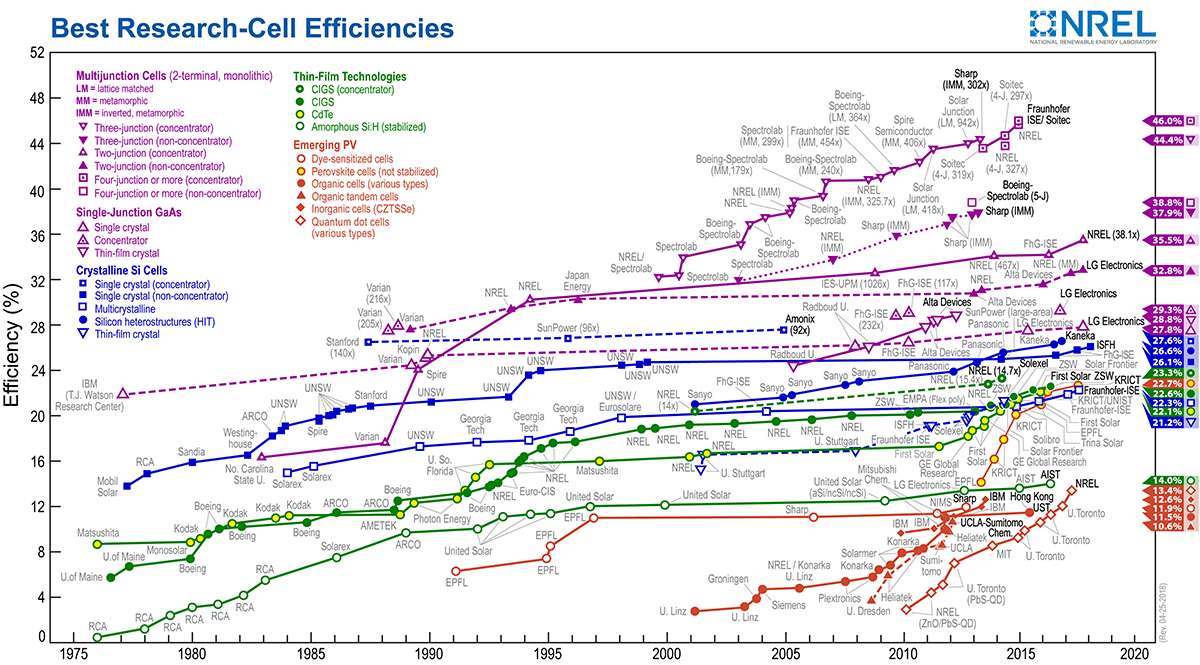
An anonymous reader quotes a report from Ars Technica: The silicon-based cells that make up a solar panel have a theoretical efficiency limit of 29 percent, but so far that number has proven elusive. Practical efficiency rates in the low-20-percent range have been considered very good for commercial solar panels. But researchers with Japanese chemical manufacturer Kaneka Corporation have built a solar cell with a photo conversion rate of 26.3 percent, breaking the previous record of 25.6 percent. Although it's just a 2.7 percent increase in efficiency, improvements in commercially viable solar cell technology are increasingly hard-won. Not only that, but the researchers noted in their paper that after they submitted their article to Nature Energy, they were able to further optimize their solar cell to achieve 26.6 percent efficiency. That result has been recognized by the National Renewable Energy Lab (NREL). In the Nature Energy paper, the researchers described building a 180.4 cm2 cell using high-quality thin-film heterojunction (HJ) -- that is, layering silicon within the cell to minimize band gaps where electron states can't exist. Controlling heterojunctions is a known technique among solar cell builders -- Panasonic uses it and will likely incorporate it into cells built for Tesla at the Solar City plant in Buffalo, and Kaneka has its own proprietary heterojunction techniques. For this record-breaking solar cell, the Kaneka researchers also placed low-resistance electrodes toward the rear of the cell, which maximized the number of photons that collected inside the cell from the front. And, as is common on many solar cells, they coated the front of the cell with a layer of amorphous silicon and an anti-reflective layer to protect the cell's components and collect photons more efficiently.
It can legitimately be read as
25.6%+2.7%=28.3% (huh?).
No, what you have just described is a 2.7 percentage point increase. The language is not ambiguous.
Good for you.
The solar roof installed on my workplace (a large school) costs tens of thousands and won't pay for itself in 20 years.
It isn't even warrantied for that long.
It very much depends on where you are, not whether your panel is vertical or not (sure, it's BETTER to be vertical, but if you don't have enough sun in the first place, it makes virtually no difference).
We even have one of those "this is how much energy you're generating, CO2 you've saved" screens inside the building it's on. It's currently generating.... 45W. I could run a small incandescent bulb from it. Before losses.
Fortunately, we don't try and push that into battery storage or anything, because it's just not worth it. I was once asked if we could show the stat to parents on the website. Ironically, the servers, network switches, etc. in use to display that stat on the school webpages would use something like 10 times more power than it would be generating, just to do so.
They didn't. He's either lying or doesn't realize it's generating in kilowatts.