 Slashdot Mirror
Windows Setup Error Messages Will Soon Actually Help Fix Problems (arstechnica.com)
An anonymous reader quotes a report from Ars Technica: The next major Windows release, the Windows 10 April 2019 Update (codenamed 19H1), is going to offer some significant improvements [to error messages]. Microsoft described them on its Windows Insider webcast, and they were spotted initially by WinFuture. Currently, the best case during installation is something like this screen.
The message says that an incompatible application is detected, and a Knowledge Base article is referenced. It turns out that most Windows users don't know what "KBxxxxxxx" actually means, and the article isn't hyperlinked to make accessing it any easier. Issues detected through the other setup experience aren't much better. Windows will offer to uninstall problem applications, but often the better solution is to upgrade the application in question. The new setup process aims to be both more informative and more useful. The general approach is to allow decisions to be made within the setup program where possible and to put meaningful descriptions in the error messages, rather than leaving people with just a KB number to go on. Further, the "learn more" links will take you directly to the relevant Knowledge Base article, rather than hoping that end users know what "KBxxxxxxxx" means. Third-party developers will also be able to provide information about upgrades and updates when applicable to resolving compatibility issues.
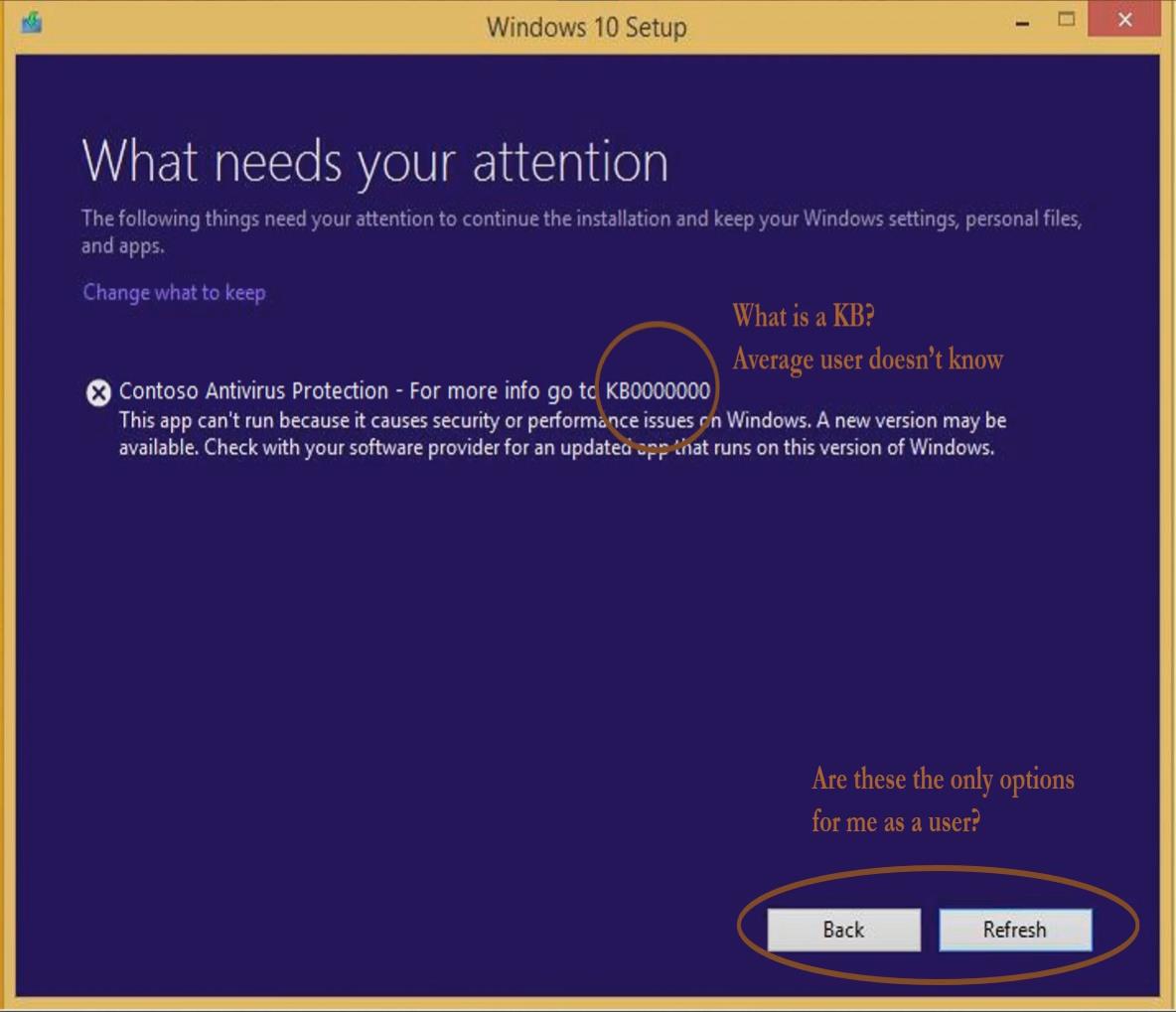
The message says that an incompatible application is detected, and a Knowledge Base article is referenced. It turns out that most Windows users don't know what "KBxxxxxxx" actually means, and the article isn't hyperlinked to make accessing it any easier. Issues detected through the other setup experience aren't much better. Windows will offer to uninstall problem applications, but often the better solution is to upgrade the application in question. The new setup process aims to be both more informative and more useful. The general approach is to allow decisions to be made within the setup program where possible and to put meaningful descriptions in the error messages, rather than leaving people with just a KB number to go on. Further, the "learn more" links will take you directly to the relevant Knowledge Base article, rather than hoping that end users know what "KBxxxxxxxx" means. Third-party developers will also be able to provide information about upgrades and updates when applicable to resolving compatibility issues.
It will tell you how to install Linux?
The only thing necessary for evil to triumph is for it to be pitted against a slightly greater evil
Who would have guessed that meaningful errors might be a good idea? I'm not holding my breath though, they will probably be some kind of nebulous "user friendly" error messages that link back to websites with 20 different unrelated causes.
Must be really dark and stuffy in your house.
"Windows Setup Error Messages Will Soon Actually Help Fix Problems"
Ha ha, yeah sure they will. As if the average Windows user will be able to understand a KB article and formulate a fix from it.
Just cruising through this digital world at 33 1/3 rpm...
"Hi, i'm clippy... it seems like you're having a systems error..."
With Win 10 already being so bloated, why don't they put OS images from their earlier history (MS-DOS, Win 3X and up->), Linux, and run these in VMs when an incompatibility crops up? No more problems with those incompatible programs a user/administrator might need. Of course, these VMs would crash from time to time just like in the good old days, when MS was running the BitBlt code 'borrowed' from Apple for their early Windows OSs and not the later Windows with legally gotten OpenBSD code.
Microsoft have been promising to create useful error messages since DOS (the original didn't have a version number). It's not as if they haven't had enough time to figure out how to do it, which leads me to believe they they simply don't know how.
is that more often than not, when you click on them, it takes you to a broken URL and redirects you to a generic Microsoft web page that asks how it can help you. The same outcome as clicking on the event log online help. Articles like this seem to praise MS for doing something new an innovative, where as they are really just fixing a feature they broke long ago
The linked image says, "Average user doesn't know".
What a joke! It should have read, "No user could possibly know."
Giving users useful information rather than "0x80000005 an unknown error has occurred". I wonder how much more productive people in the Windows ecosystem would be if Microsoft could be bothered to write their error messages properly.
Back then virtually every error message (particularly with networking) said "Contact your Administrator". See, problem fixed.
Well, considering one of the first thing the install routine does is to phone home to find out whether your copy of Windows happens to have the blessing from the gods of Redmond, you could just use that network connection for something useful too...
We used to have a Bill of Rights. Now, with the rights gone, all we have left is the bill.
Change from "KBxxxxxxx" to "Please contact your system administrator."
I think that was my favorite Win10 setup error. I got a nice big purple box that said "Something happened" up top and in the details section in all its glory:
"Something happened."
Nice.
try { // stuff
} catch (Exception e) { System.out.println("d'oh!"); }
Please wait an undetermined period of time for unspecified things to be done to our computer! If you are still staring at this screen in an hour, don't concern yourself with whether or not this process has failed, because you are only a user and should not concern yourself with what we may be installing and/or harvesting from you.
How long has Microsoft been writing software now? 35 years maybe. Its finally dawned on the company culture that perhaps error messages should help the user navigate ones poorly designed application! Brilliant! What will they think of next? Maybe regression testing with real data? User interface design ? It could be such a better user experience if MS would just make mice and keyboards.
Because if there is, people will click it, just to make it go away. They won't notice that you can go to a link for more information. They will just click the OK button and maybe try again. That's what OK buttons are for, after all!
I wonder what the KB article will be for "Unspecified Error" or "Unexpected Error."