Slashdot Mirror
Domain: aemo.com.au
Stories and comments across the archive that link to aemo.com.au.
Comments · 15
-
The hard reality
See https://www.aemo.com.au/Electricity/National-Electricity-Market-NEM/Data-dashboard click on SA to see what happens when green ideologues gain control of your political system. Tomorrow's forecast for the wholesale spot price of power from 1430 to 1930 is $14500/MWh. Guess what happens to industry and business when faced with costs like that?
-
Re:ROFL Subsidies created the problem
Cheaper then the $14.20 / Kwh the fossil fuel people charge. (Although that is due to a different issue)
https://reneweconomy.com.au/te...
That was the response of a senior Tesla Energy executive this week after the extraordinary scenes in South Australia’s electricity market on Monday, when the fossil fuel generators had a party and prices swung from $14,200/MWh
Also where is you 41cents/kWH cost.
http://www.aemo.com.au/ (who run the power grid) has the generators only getting 12c/kwh at peak or SA.
-
Re:Getting paid?
My understanding is that the model is based on slow spin-up fossil plants, and doesn't accurately account for a battery that can go from 0 to 100% in a fraction of a second.
That is correct. The fastest Frequency Control and Ancillary Services market in Australia is billed in 6 second changes and this is the primary of the 8 FCAS markets that the Tesla battery operates in. This is the same market used by emergency systems such as load-shedding / rapid loading. We used to participate in the latter service where I worked as we had some small gas turbines on site. The AEMO's control system could request setpoint changes every 4 seconds. So if somewhere a power plant tripped off line, it would be several seconds before AEMO knew, several seconds more for them to send us a signal, and then up to a minute for us to add a pathetically small about of power to or from the grid in response, and that's assuming we don't trip our turbines on load as a response to the swinging demand.
https://www.aemo.com.au/-/medi... This report details some of the performance differences compared to conventional FCAS providers. Specifically the two graphs on page 6 are quite telling. As is the following quote:
"The Market Ancillary Services Specification (MASS), which specifies each market ancillary service, and how it is to be quantified, does not address performance requirements for regulation FCAS. All regulation FCAS is essentially considered to be equal and interchangeable, and providers are paid the same price per MW of enabled service, regardless of performance." And that is Tesla's main gripe.Additionally there is the contingency response. On page 7 of the above report is shown how Tesla's battery added 20MW to correct a frequency event as a result of a coal plant tripping offline in less than 5 seconds. Tesla started correcting the issue before the AEMO would even have sent a signal out that there was a problem. And again the note says they don't get paid for this awesome performance.
The AEMO have been talking about adding a sub 1second market to the FCAS and overhauling the FCAS market since early last year. And so has every other major grid operator around the world as this fast technology comes on to the market. A lot of research has been done into this not only because the likes of Telsa want to get paid to play, but also if more of these services come online and the control system is incapable of reacting fast enough then it could lead to more instabilities than they were trying to solve in the first place.
-
Re:Getting paid?
Tesla got paid. It's Neoen who may not be getting paid, because the system is re-optimised in 15 minute increments, and Hornsdale responds much faster than that. They are working on 5-minute settlements now.
-
Re:Wth are they doing?
That is a peak for one 30 minute period. It is some function of the way the market is controlled, for instance yesterday the price peaked at $3/kWh, yet for the rest of the day it has hovered around $0.10 per kWh
Here's the past and future price estimates over 24 h
https://www.aemo.com.au/Electr...
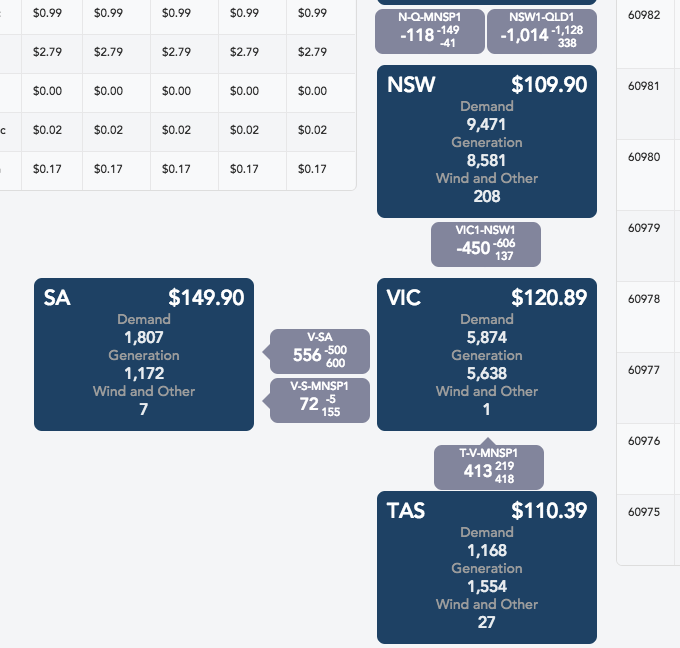
And here is the far more entertaining power flow between the states
https://www.aemo.com.au/Electr...
As I write the '57%' renewable SA system is absorbing all the coal power it can get from Victoria and its '57%' renewable generators are actually supplying less than 20% of the state's needs.
Here's a snapshot on a nice sunny windless day last Saturday where SA's renewable generators were producing virtually nothing. It demonstrates that you have to have 100% baseload generation, you cannot rely on renewables to replace them, at least until we install hundreds of batteries the size of the one in SA.
-
Re:Wth are they doing?
That is a peak for one 30 minute period. It is some function of the way the market is controlled, for instance yesterday the price peaked at $3/kWh, yet for the rest of the day it has hovered around $0.10 per kWh
Here's the past and future price estimates over 24 h
https://www.aemo.com.au/Electr...
And here is the far more entertaining power flow between the states
https://www.aemo.com.au/Electr...
As I write the '57%' renewable SA system is absorbing all the coal power it can get from Victoria and its '57%' renewable generators are actually supplying less than 20% of the state's needs.
Here's a snapshot on a nice sunny windless day last Saturday where SA's renewable generators were producing virtually nothing. It demonstrates that you have to have 100% baseload generation, you cannot rely on renewables to replace them, at least until we install hundreds of batteries the size of the one in SA.
-
Re:I don't see how it stopped an outage
http://www.aemo.com.au/-/media...
http://www.aemo.com.au/-/media...Seems like the 2,601GWh was replaced by
1,058GWh Gas
0,662Gwh Imports.
0,078GWh Rooftop PV
0,062GWh Diesel and small non-scheduled generation
0,021GWh WindWhat should they have replaced the coal with instead?
-
Re:I don't see how it stopped an outage
http://www.aemo.com.au/-/media...
http://www.aemo.com.au/-/media...Seems like the 2,601GWh was replaced by
1,058GWh Gas
0,662Gwh Imports.
0,078GWh Rooftop PV
0,062GWh Diesel and small non-scheduled generation
0,021GWh WindWhat should they have replaced the coal with instead?
-
Power Grid Inertia
There is a general misconception about what this battery system is doing. Traditional generation stores energy for short time response (faster then the governor can open or close the throttle) as rotating inertia. So large grids having many generators tend to have plenty of rotating inertia, with the demand for short term storage coming entirely from users.
In the new model with substantial wind and solar, wind and solar has a demand for short term stabilization without bringing along a corresponding amount of rotational inertia storage. What is most likely happening here is that the battery will be dispatched per the grid frequency control signal, rather than the energy dispatch signal.
IE Questions: What Is Inertia? And What’s Its Role In Grid Reliability?
AEMO publishes final report into the South Australian state-wide power outage
-
Re:Sending a signal
Wow, strong language from an AC. Bet you don't talk like that in real life. Well, no, probably you do, to women and children. While I enjoy winding up losers from the mendicant state, i'd point out that both of my houses are more than self sufficient for electricity. So, take your foul little tongue and stick it back up a politician's arsehole.
Here's the forecast for electricity shortages for the next year in South Australia. Click on the SA button. The red bits are 'reserve shortfalls', or as we might say, times when whole areas will have their supply cut. Enjoy, foul mouthed loser.
-
Re:A cure for which there is no disease
There is no discernible reason to invest scarce resources in "smart meters" (which are looking more like "dumb meters"). Ordinary old-style meters do an adequate job, and give employment to a lot of meter-readers. (That's a good thing, by the way). They are sufficiently accurate.
I don't know what reasons you were given for using smart meters, but where I live accuracy and saving the wages of people wasn't the ones we were given. It boiled down to one thing: being able to pass the real cost of power to the customer. The hope is the consumer will then change their usage patterns. Changing it is possible in theory as the thing we use most of our electricity for is moving heat around - things like heating water, cooling houses, refrigerators and freezes, cooking and so on. You have a fair amount of freedom on when you run some things (washing machines, dryers, dishwashers, hot water systems), and it's not hard to store heat (or cold for that matter - we used to do it using ice boxes).
The incentive to move your usage to when power is cheap is pretty big where I live as the cost of power varies by a factor of 500% or so during the day. But of course you need a meter that can measure power consumption at 15 minute intervals or so, and that's not something the old-style analogue meters can do. Some electricity retailers here already provide tariffs that vary during the day - but you must pay for a smart meter installed to take advantage of them. Some people do.
Whether any of this pans out remains to be seen. It may well be the cure is worse than the disease as you say, but not for any of the reasons you give. A 500% price differential provides one hell of an arbitrage opportunity, but it one the consumer can't take advantage of because of the limitations of those old style meters, so traditionally taking advantage of it has remained securely in the hands of the electricity cartel. Having a smart meter means the consumer can break into that cartel, something that hasn't been lost on Mr Elon Musk's battery salesman.
-
It happens every day
Here is a graph of electricity prices where I live for the current day: http://www.aemo.com.au/Electricity/Data/Price-and-Demand/Price-and-Demand-Graphs/Current-Dispatch-Interval-Price-and-Demand-Graph-QLD. Note the red line (whole sale price) drops off the bottom graph in the small hours of the morning. It's negative.
At least were I live it has nothing to do with renewables (the sun ain't shining at that time after all). Oddly it is because coal plants suffer the same problem renewables - they can't control the power quickly. No one is using power at the coal plants are producing at 3 AM so there is an oversupply, and it's costs more to shut the plant down for the hour or so than it does to pay people to find ways to use it.
This happens just about every fucking day! How is this news?
-
Re:Lift the gag order first...
I will tell you what I know. Their were two companies Telstra And Optus who both laid cable. Mostly around Melbourne Victoria (which is in the south of Australia but not the state of South Australia). I am not too sure about the details and most of the things online is about the NBN. (which was a full fibre to the home rollout until a new government came in and decided to use copper instead)
Here electricity is run mostly be a company ( http://www.aemo.com.au/About-t... ) that covers the whole east coast and South Australia. Everyone bids and they get the price of the amount they need. (I.e if they need 1000MW and the bids are -$5 100MW, 20 for 500 MW , 40 for 1000MW , 1000 for 1000MW , would mean the first 3 companies get $40 and the 3rd only provides 400MW)
-
Re:Funny money
PV doesn't make sense at any scale.
I've just installed a 2.5 kW Solar system on my house in Western Australia, at a cost of just over $2500. Based on initial readings, output from the unit looks like being between 3,500 to 5,000 kWh/year. My electricity provider charges between 30 and 45c per kWh, and pays 8c per kWh for electricity fed back into the grid.
So my payback time for the initial investment is somwhere between 1 and three years if I consume mostly self-generated power. The panels and inverter I've installed have a 25 year warranty,
How does this not make sense?
And I'm not alone in this, Australia faces an unprecedented oversupply of energy, with no new energy generation needed for 10 years. Coal power stations are sutting down, and even new gas power stations are being mothballed as they are unable to compete.
-
Re: There must be a very good reason...
Read-em and weep it's summer and it peaked at 5 oclock http://www.aemo.com.au/Electricity/Data/Price-and-Demand/Price-and-Demand-Graphs/Current-Dispatch-Interval-Price-and-Demand-Graph-QLD . Your right summer does push it back, and you can see that as it almost peaked at 2 oclock; that said it's also the holidays season so even more people than ususall were at home all day.