Slashdot Mirror
Domain: aetherltd.com
Stories and comments across the archive that link to aetherltd.com.
Comments · 17
-
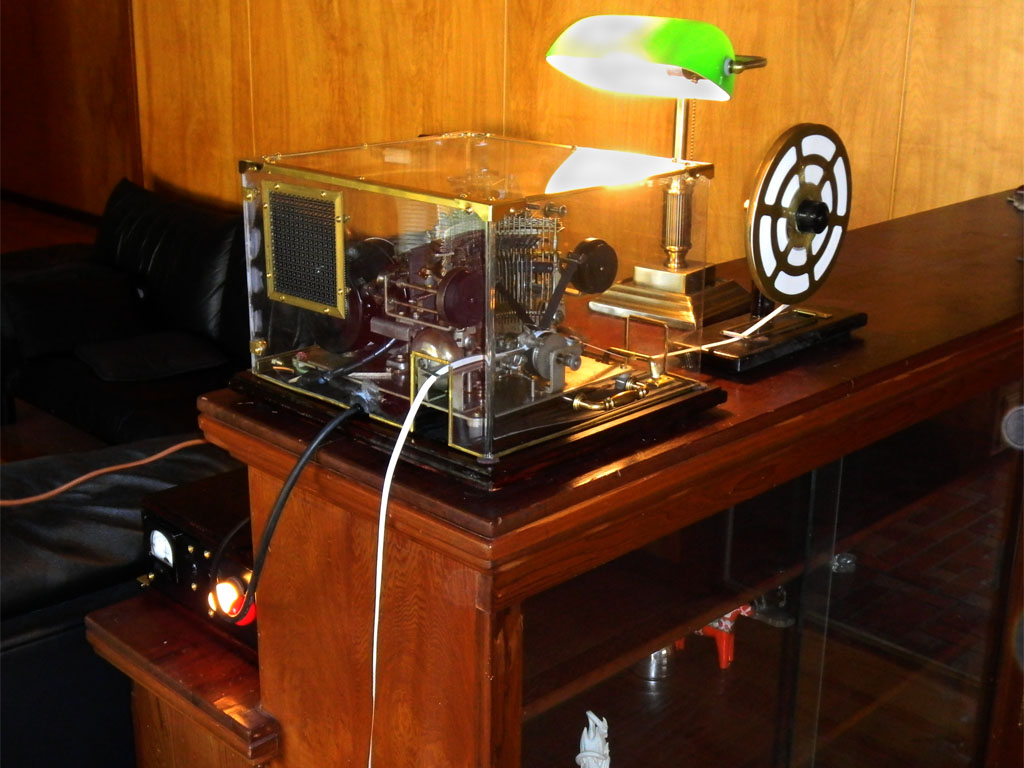
1926 model news printer
This is my news printer. Each morning I turn it on, and it prints a paper tape with the Reuters news summaries.
This is 1926 technology. The machine talks to a standard serial port at 45 baud, 5 bits, no parity, 1.5 stop bits.
-
Teletype machines
I have several Teletype machines from the 1926 to 1940 period. All are in good working order. They're completely repairable; it's possible to take one apart down to the individual parts and put it back together. But they're high-maintenance. There are several hundred oiling points on a Model 15 Teletype. There are things that have to be adjusted occasionally, and manuals and tools for doing that. Every few years, the entire machine has to be soaked in solvent to clean off excess oil, then relubricated and adjusted. This is the price of building a complex machine good for a century or more.
(The Model 33 of the minicomputer era is not one of the long-lived machines. This was by design. The Model 35 was the equivalent long-lived, high-maintenance product; the 33 required little mainenance but had a llimited life.)
-
The trouble with repairability
As a hobby, I repair old Teletype machines, from the 1920s and 1930s. These machines were designed for a long life of nearly continuous operation and to be repairable. I have 70 and 80 year old machines running. Everything unscrews (and every screw has a lock nut), everything is interchangeable, and all parts can be reached without dismantling too much. The detailed repair manuals still exist. If one of these machines hasn't been seriously damaged and has all the parts, it's usually repairable. This is as good as it gets in repairability.
The price of this is weight, bulk, and routine maintenance. The frame is cast steel. A printer weighs about 75 pounds, about twice the weight of an electric typewriter. There are over 500 oiling points to be oiled annually, plus about 50 points that require greasing. Every few years of operation, a full cleaning is required. This involves removing the two electrical parts, the motor and the selector electromagnet, and soaking the entire machine in solvent. Western Union did this to their machines routinely.
Then there are adjustments. There are spring tensions and clearances to be adjusted. A spring scale and a feather gauge are required. After any part replacement, there are adjustments to be performed according to the manual.
Nobody would put up with that bulk, weight, and maintenance today to get a machine capable of decades of operation. That is the price of repairability.
-
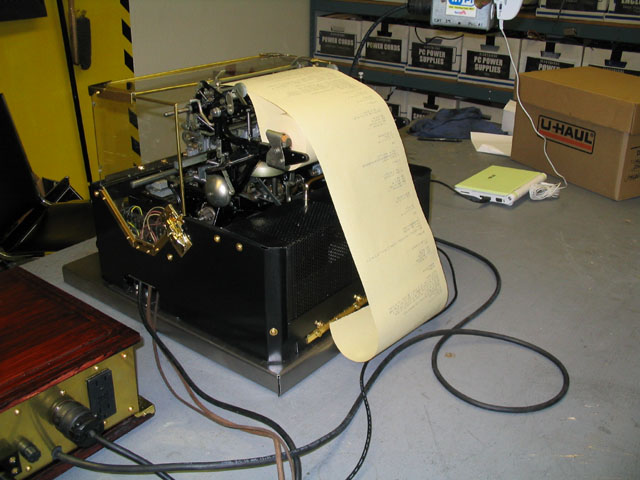
Re:A Teletype printer from 1924
That machine is a beautiful restoration,
Here's the restoration process, from "before" to "after".
-
Re:broadcom soc
The funniest thing I've found so far is a little example on page 11 where a 250 meg clock with a too-small implementation divider means you literally cannot run 300 baud RS232 with this dude.
As one of the people who needs 45 baud (I restore Teletype machines from the 1920s and 1930s) this is mildly annoying. It's also irksome that in Linux, you specify one of a set of standard named constants for well known speeds. In Windows, you specify a baud rate to the driver as an integer, which allows nonstandard baud rates UNIX was built for the PDP-11, which had a serial device with 14 fixed baud rates (16 with an external clock.) DOS was designed for the IBM PC, which used an 8250 UART, of which the 16550 is a successor, and could be set to any baud rate in its range by setting the divisor. That distinction persists three decades later in Linux and Windows 7.
-
Write once, debug everywhere
The days when you only had to special case for IE and Netscape now seem nostalgic.
I'll use some exotic features on my fun sites, like the Aetheric Message Machine Company, which makes heavy use of downloadable fonts. (This requires making the fonts available in four different formats.) But if it has to work, it's back to vanilla XHTML 1.1.
-
My printer only has capital letters
My printer only has capital letters, you insensitive clods.
-
Font issues.
Actually, that page is an excellent example of why you shouldn't use a display font for normal text.
With a system that does anti-aliasing of text (Windows 7, Vista(?), newer MacOS, newer Linux, etc.) it's not too bad. If your system doesn't, it looks awful. It looks terrible in Windows XP and earlier, even if you have a current browser. It's definitely not something ready for wide scale deployment given the current state of client platforms. I'm trying it for the amusement of the steampunk community.
Those are actual 19th century fonts, scanned in from a book of type styles circa 1900 and vectorized.
-
Minor improvements
(Read the "print" version of the article, instead of the "tiny blocks of text spread over many pages of ads" version.)
I have misgivings about HTML5. It gives the page more control, and the user less. That's been a trend in HTML for years, and it's getting worse.
I'm dreading "canvas". Ad blockers need to get smarter. Noticed that popups are winning over Firefox's popup blocking? We're also going to see pages that use 100% of the CPU just for display. We're going to need a browser option for "don't run canvas code for windows that aren't on top.
The "input type" mechanism for forms is lame. There are a number of standard types like "tel", but it's just text with no line breaks. They should have provided for either regular expressions or syntax like the COBOL Picture clause ("CREDIT_CARD_NUMBER PIC 9999-9999-9999-9999").
Dynamically-loaded fonts have been working for some time now in all the mainstream browsers. (IE6 and Firefox 3.5 were the last mainstream browsers not to have it.) We've been playing with that for our steampunk site. Downloadable fonts without anti-aliasing turn out to look ugly for small font sizes, because most of the display-type fonts have too much detail and not enough hinting for small font sizes. (In an annoying piece of Apple incompatibility, the iPad requires fonts in SVG, of all things. Everybody else, including Microsoft, is going to Web Open Font Format.) I'd recommend against using this feature much unless you have a good sense of typography. (Bad example: our steampunk search engine.)
-
We laugh at your puny VT320
That's not hooking a classic terminal to a netbook. This is hooking a classic terminal to a netbook. (More pictures.)
-
We laugh at your puny VT320
That's not hooking a classic terminal to a netbook. This is hooking a classic terminal to a netbook. (More pictures.)
-
Technet can't get fonts right
Amusingly, the Technet blog entry has text marked as "Calibri" font, with no alternatives. Calibri is a Microsoft-only font that comes with Vista. So non-Vista systems render the text in Times Roman. Calibri is a sans-serif font, and all the other fonts in that Wordpress theme are sans-serif, so the page looks awful.
Now that font downloading works in essentially all the current browsers, that's not necessary, at least if you stick to public-domain fonts. However, there aren't many public-domain fonts that don't suck at small type sizes. (Here's a page of mine with some downloaded fonts.) If you have anti-aliasing on, it looks OK; if not, the text font looks ugly. Interestingly, Linux and Macs do anti-aliasing routinely, but older Windows systems do not.
Google Docs has the same problem. Currently, it works like classic HTML; if you have the font locally, you can use it, but if not, you get some default. The stock fonts in Google Docs are the lowest common denominator: "Normal", "Normal/Serif", "Courier New", "Trebuchet", and "Verdana". If Google is going to make a big push on competing with Word, they need to do better than that. Google could make progress on this by buying twenty or so really good body fonts outright from a major font foundry, and setting them up for download on demand for Google Docs.
-
Comments on TechShop from a user
As someone who uses the Menlo Park TechShop, a few comments.
It's a very broad shop. It's not the only public shop in Silicon Valley. If you want to do electronics, Hacker Dojo has better workstations, where surface-mount work is possible. If you're building furniture, The Sawdust Shop has a better wood shop. But TechShop has both sewing machines and CNC milling machines, a stereolithography machine and a plasma cutter, which you usually don't find under one roof.
There are Silicon Valley companies which buy memberships and send their employees over to use the machine tools. The four big manual Bridgeport mills, the big lathes, and the stereolithography machine are usually being used by pros. TechShop gives classes constantly, but most of the people who use TechShop already have considerable familiarity with tools. They just need access to the bigger machines. It's a good place to learn how to use CNC machine tools. CNC software is quite good today, and TechShop has reasonable midrange CNC design software (Vectrix Cut2D/Cut3D, SolidWorks, etc.) installed on their rather sluggish Windows Vista desktop machines.
There's not much electronics and robotics work. Although TechShop gives Arduno programming classes, and people take them and build the projects, not much electronics gets built there. They have power supplies, meters, scopes, and soldering stations, but they're 1980s technology.
The most popular activity is cutting decorative patterns with the laser cutter. It's easy to do, and two laser cutters are busy doing it almost continuously. Those machines just need line art in CorelDraw; you don't have to learn SolidWorks or Vectrix and do real CNC programming. No one activity dominates, though; there are people building birdhouses and people building rocket engines.
-
Re:Current loop!
Well, I have a current loop device on my desk. I had to design and build a USB to current loop converter for a 60mA 120VDC current loop.
But that, of course, is a retro technology tour de force.
-
Re:What will happen is plastic in landfill
I have a Teletype Model 15, designed in 1930 and built during WWII
I've read through the two links, and I'm amazed at the level of attention spent on the work.
You also built the ragdoll physics engine?
-
Re:What will happen is plastic in landfill
A 45 year old typewriter looks good on display and most probably still types perfectly well. A 45 year old Dell will be a pile of plastic dust with an exploded lithium battery.
Painfully true. Restoring old computers is incredibly difficult. The sad thing about the Computer Museum in Silicon Valley is that almost nothing works. They've succeeded in restoring two IBM 1401 computers, but they had several of the original design team available. None of the their early personal computers are displayed as working devices.
On the other hand, I have a Teletype Model 15, designed in 1930 and built during WWII, working. I've even interfaced it to RSS and SMS feeds. Those machines were very well designed, overbuilt, and can run for decades if properly maintained. All mine needed was a thorough cleaning and oiling. All the metal is high quality steel. The main frame parts are steel castings, and all stamped parts are from stock at least 1/16 thick. And the machine has over 500 oiling points, ranging from a dozen oil reservoirs with spring-loaded caps to hundreds of points that just need a drop of oil.
Don't overrate mechanical nostalgia, though. Most consumer mechanical devices of that period were not very good. Many contain "pot metal", with a composition so awful that parts shatter if dropped, or simply with age. Early low-end wiring materials didn't last. Early plastics became brittle with age. Those gadgets were discarded long ago. The ones still around are the good ones.
-
Re:What will happen is plastic in landfill
A 45 year old typewriter looks good on display and most probably still types perfectly well. A 45 year old Dell will be a pile of plastic dust with an exploded lithium battery.
Painfully true. Restoring old computers is incredibly difficult. The sad thing about the Computer Museum in Silicon Valley is that almost nothing works. They've succeeded in restoring two IBM 1401 computers, but they had several of the original design team available. None of the their early personal computers are displayed as working devices.
On the other hand, I have a Teletype Model 15, designed in 1930 and built during WWII, working. I've even interfaced it to RSS and SMS feeds. Those machines were very well designed, overbuilt, and can run for decades if properly maintained. All mine needed was a thorough cleaning and oiling. All the metal is high quality steel. The main frame parts are steel castings, and all stamped parts are from stock at least 1/16 thick. And the machine has over 500 oiling points, ranging from a dozen oil reservoirs with spring-loaded caps to hundreds of points that just need a drop of oil.
Don't overrate mechanical nostalgia, though. Most consumer mechanical devices of that period were not very good. Many contain "pot metal", with a composition so awful that parts shatter if dropped, or simply with age. Early low-end wiring materials didn't last. Early plastics became brittle with age. Those gadgets were discarded long ago. The ones still around are the good ones.