Slashdot Mirror
Domain: airbnb.com
Stories and comments across the archive that link to airbnb.com.
Stories · 11
-
How Tech Companies Responded To Hurricane Florence (qz.com)
112-mph winds from Hurricane Florence battered the Carolinas on Saturday, resulting in at least 13 deaths and leaving more than 796,000 households with no electricity, according to CNN, with over 20,000 people evacuating to emergency shelters.
One Myrtle Beach resident spotted an alligator walking through their neighborhood, and the New York Post warns the hurricane "could displace venomous snakes from South Carolina's wetlands," uprooting "some 38 species of snakes -- including dangerous cottonmouths and copperhead vipers."
Cellphone carriers are offering free calling, texting, and data services to affected customers in the Carolinas, and Quartz reports that other tech companies are also trying to help: People fleeing Florence can find hundreds of places on Airbnb to stay for free; the company will screen applicants and cover homeowners for any damage up to $1 million. Harmany is an app created specifically to connect people during natural disasters. It's set up so that people who have a place can list it, adding it to a map where those needing shelter can find them. Gas Buddy, which lets users search for gas prices and availability by zip code, has set up a special "Florence Live Updates" page and section on its app so users can identify which gas stations are out of fuel, diesel, or power....
The main federal disaster agency, the Federal Emergency Management Agency (FEMA), has an app that is supposed to provide up-to-the minute information about the storm, shelters, and evacuation routes. It is crashing constantly, according to Android users. (Quartz's didn't have the same problems, but hitting the "get directions" button to one North Carolina shelter inexplicably opened up Uber.) FEMA also recommends the Red Cross's Hurricane app, which shows location specific weather alerts, has a flashlight and an alarm, and allows users to connect with people in their contacts, but doesn't have information on shelters.
And the data backup company Datto is even deploying equipment for free to bring back critical infrastructure. "With this storm, it looks like flooding will be as much of a danger as wind. It doesn't take a lot of water to knock out infrastructure like cable and internet. Things that can take weeks to build it back..." -
Airbnb Announces Its Plan To House 100,000 People In Need (backchannel.com)
New submitter mirandakatz writes: Airbnb has just unveiled its Open Homes Platform, a home-sharing site for hosts motivated by goodwill instead of profits -- and for guests motivated by need rather than wanderlust. Specifically, Airbnb is going to begin by connecting refugees with hosts in Canada, France, Greece, and the United States. Ultimately, refugees will be just one group that the site aims to help: Site visitors can also nominate other groups of people for temporary placements, and the platform will expand to include them eventually. At Backchannel, Jessi Hempel dives into the home-sharing platform's latest effort, and places it in the context of the company's broader business strategy. -
How Tech Companies Are Responding To Hurricane Matthew (vice.com)
South Carolina was hit by Hurricane Matthew at 11 a.m. EST, after the hurricane killed at least 300 people in Haiti (with Reuters estimating Haiti's death toll over 800). But as the U.S. declares a state of emergency for Florida, Georgia, South Carolina and North Carolina, and with the power out for more than a million people, an anonymous Slashdot reader looks at the role tech companies are playing in responding to the storm system: AirBNB "has been advertising free rooms in parts of Florida and South Carolina" reports Motherboard. AirBNB's Disaster Reponse Tool connects people needing shelter with volunteers who are offering their residences for free. Meanwhile, Uber promised to cap its "surge pricing" for the area, while Lyft promised its fares would rise no more than two times their normal rate.
But many escaped the path of the hurricane thanks to Shofur, a startup that books chartered buses and matches riders to low-cost tickets, according to the Daily Dot. "Through Thursday night and into the early morning hours of Friday, Shofur evacuated an estimated 10,000 Floridians and Georgians to areas such as Atlanta, Florida's west coast, and the panhandle."
NASA is also flying a huge 15,000-pound drone over the area to collect real-time weather data, while Verizon is testing a 17-foot drone which may one day provide LTE mobile connectivity to first responders. In addition, a Verizon spokesperson says drone-enabled connectivity has "set the stage" for connecting drones to their IoT platform next year. -
Airbnb Unveils Changes To Address Racial Discrimination (npr.org)
An anonymous reader quotes a report from NPR: Acknowledging that his company has "been slow on this issue," Airbnb CEO and co-founder Brian Chesky is rolling out changes aimed at addressing discrimination complaints against the home rental service. Among the changes: de-emphasizing the role of user photos in arranging stays. Here are some of the other changes Airbnb announced Thursday: Providing assistance to people who feel they've experienced discrimination; Anti-bias training for all staff; Setting public diversity goals for staff; Partnering with historically black colleges and universities to strengthen their recruitment pipeline. The move comes after longstanding complaints from African-American Airbnb customers who said their booking requests were turned down at a high rate. Black Airbnb users vented their frustration with the phenomenon of being rejected for a booking date -- only to see the same place get listed once again -- spawning the hashtag #AirbnbWhileBlack on Twitter. And those frustrations were borne out in a study that sent 6,400 requests to AirBnb hosts in five large U.S. cities; the requests were identical except for the customer's name. As the Hidden Brain podcast reported, "requests with African-American sounding names were roughly 16 percent less likely to be accepted than their white-sounding counterparts." -
Airbnb To Hand Over Data On 124 Hosts To New York Attorney General
Peer-to-peer lodging service Airbnb has agreed to hand over data on 124 of its hosts in New York as part of an investigation by the state's Attorney General into the operation of illegal hotels. The AG first requested data for almost all of Airbnb's hosts in the state, but after "legal wrangling," that number was whittled down to the current 124. The data in question will be unredacted personal information, meaning names and addresses. In a blog post, Airbnb's David Hantman said, "nothing about these hosting profiles suggests [the Attorney General] is after anyone but individuals who may be flagrantly misusing our platform." Airbnb is confident that the targets of this request are hosts considered to be "bad actors," but they don't explain what classifies somebody as a "bad actor." -
Couchsurfing Hacked, Sends Airbnb Prank Spam
Slashdot regular (and Couchsurfing.org volunteer) Bennett Haselton writes with a report that an anonymous prankster hacked the Couchsurfing.org website and sent spam to about 1 million members, snarkily advertising their commercial arch-rival Airbnb as "the new Couchsurfing." (Read on below for more on the breach.) As of now, the spam's been caught, but not the spammer.I've been a volunteer host on Couchsurfing.org for 16 months. Despite the ongoing controversies surrounding the site's changes in recent years, I've always found it to be a great way to meet travelers with fascinating stories and to make new friends, not to mention a way to force a deadline upon yourself to clean up your house before the next guest arrives.
On August 15, I received an email sent from "Couchsurfing <noreply@couchsurfing.org>" with the subject "Site Improvements", which read:
Hi!
We have some exciting news. Find out more about the new CouchSurfing here.
The CouchSurfing teambut the hyperlink on the word "here" did nothing when I clicked on it. So I looked at the HTML source code of the message and saw that the source code of the link was: We have some exciting news. Find out more about the new CouchSu= rfing <a href=3D=E2=80=9Chttps://www.airbnb.com/signup_login=E2=80=9D> her= e </a>.
So... the email from Couchsurfing was promoting a link to their commercial arch-rival, Airbnb.
At that point I assume the message was spam that had been sent from some third-party server and simply forged a return address from couchsurfing.org, but the message headers clearly showed that the message really had been sent from Couchsurfing: Received: from messaging3.couchsurfing.com (messaging3.couchsurfing.com. [54.236.187.135]) by mx.google.com with ESMTP id v7si15118226qay.99.2014.08.15.21.30.16 for <bennetthaselton@gmail.com>; The complete message headers and message source are here.
I sent a message to Couchsurfing tech support asking if they knew what had happened, and I started a thread on the Seattle Couchsurfing page, where several other users chimed in that they had received the same email. Couchsurfing support replied to me on August 18th:
Hello Bennett,
Thanks for your patience while we have been looking into this. As you saw yourself, some Couchsurfing members received an email in error on Friday night -- we apologize.
The part of Couchsurfing’s system that sends email to members was breached Friday night and an email was sent to approximately 1 million members. We take this very seriously, and we will continue to investigate and take all appropriate action until this situation is resolved.
There is no action you need to take to secure your account. Once we have further information, we will be sure to send out updates.
Warm Regards,Then on August 19th, I received an email from Couchsurfing (presumably along with all or most other Couchsurfing users) with the subject "Incorrect email -- our apologies":
Dear Bennett Haselton:
We're writing because you may have received an odd email from Couchsurfing in the last few days titled "Site Improvements."
We apologize for any confusion this may have caused -- it should not have been sent.
-- The Couchsurfing Team
Want more details? Find them herewhere the "here" link further explains: "The message was sent by an unauthorized user of our email system. No other systems were compromised, and we've addressed the circumstances that led to this unauthorized use."
So, kudos to Couchsurfing for at least alerting users that something had gone wrong. (Judging from the reactions in the thread that I started, most users who received the email simply deleted it without a second thought after seeing that the link didn't work, so Couchsurfing probably could have said nothing to their users at all, and gotten away with it. As of this writing, a Google News search for "couchsurfing hacked" turns up no other articles about the incident, so it's not as if there was a mob clamoring for answers that they had to respond to.)
On the other hand, I hope Couchsurfing is more forthcoming in the next few days about how much they know about what actually happened. When they say "We've addressed the circumstances that led to this unauthorized use," that probably means that they at least know whether the email was sent by (a) a disgruntled employee (or recently fired employee whose credentials still enabled them to access the server); or (b) someone who used an unpatched security hole to break in from the outside; or (c) something else. (I replied to the tech support ticket asking as much, but as of this writing I have not received a reply. I wasn't naive enough to think that they were probably going to tell me everything they knew, but it's one of those rituals that quasi-journalists engage in so that we can say "as of this writing I have not received a reply".)
Obviously I think it's unlikely that anyone at the real Airbnb would actually risk jail time by hacking Couchsurfing's servers to send out spam advertising the Airbnb website; it seems more like the actions of someone being snarky, possibly a former employee or an outsider with an axe to grind. Couchsurfing's apology email said "Once we have further information, we will be sure to send out updates." Hope so.
-
Airbnb Partners With Cities For Disaster Preparedness
An anonymous reader writes: Every time a city- or state-wide disaster strikes, services to help the victims slowly crop up over the following days and weeks. Sometimes they work well, sometimes they don't. Today, city officials in San Francisco and Portland announced a partnership with peer-to-peer lodging service Airbnb to work out some disaster-preparedness plans ahead of time. Airbnb will locate hosts in these cities who will commit to providing a place to stay for people who are displaced in a disaster, and then set up alerts and notifications to help people find these hosts during a crisis. The idea is that if wildfires or an earthquake forces thousands of people to evacuate their homes, they can easily be absorbed into an organized, distributed group of willing hosts, rather than being shunted to one area and forced to live in a school gymnasium or something similar. -
The Best Parking Apps You've Never Heard Of and Why You Haven't
Bennett Haselton writes "If you read no further, use either the BestParking or ParkMe app to search all nearby parking garages for the cheapest spot, based on the time you're arriving and leaving. I'm interested in the question of why so few people know about these apps, how is it that they've been partially crowded out by other 'parking apps' that are much less useful, and why our marketplace for ideas and intellectual properly is still so inefficient." Read below to see what Bennett has to say.I casually asked a couple of my friends in Seattle -- where street parking is often unavailable, and parking garages vary widely in price -- if they'd ever heard of an app that would let them find the cheapest available parking garage, based on the time they wanted to enter and the time they planned on leaving. (Street parking is usually cheaper if you can find it, but the app would be useful for times that you can't find any.) Most of my friends said that they'd never heard of such an app, but they'd definitely use one if it existed. I also looked up parking apps on Google but the small subset that I randomly tried out, didn't do what I needed. So I thought about writing a "Somebody-with-more-time-than-me-should-go-and-do-this-thing" article, similar to the ride-swapping piece, when one of my friends casually mentioned the BestParking app.
Well, I tried it and it worked. (Lest I be accused of undue favoritism, ParkMe does the same thing just as well, although I didn't find it until later.) In both apps, you bring up a map centered on your current location, or scroll the map to where you plan on looking for parking later. You enter the time that you'll be entering and leaving, and the app shows a map with each parking garage represented by an icon showing the dollar amount that it will cost to park for that time. Without these apps, comparing rates is an annoyingly complex process to do by hand, in a crowded city like Seattle with many garages with different rates (and different times when their "evening rates" kick in -- usually 5 PM, but ranging from 4 to 7 PM), but the apps factor all of that in to give you the cheapest garage for the given time range. You can tap the individual garage icons for more information (if you plan on returning by 11 PM but you're not sure, you'd probably prefer a 24-hour garage instead of one that locks up at midnight). Also, if you're sitting at your computer and you already know the neighborhood where you'll be parking later, you can do the same search on each of their websites. (Although if you are on your phone, please don't do this from a moving car, duh. In Seattle there are plenty of 3-minute spots where you can pull over and do a search.)
So, I've been quite happy with both apps -- but I thought it was interesting that almost none of my friends had ever heard of them. I threw a quick survey up on Amazon's Mechanical Turk website, which I've used before for crowdsourced surveys and other experiments. I polled 50 people, offering them 25 cents apiece to answer these questions:
Would you use these apps? Section A: Parking garage app
Suppose a website and/or smartphone app existed where you could specify a neighborhood of a city, and enter a start and end time for when you wanted to park, and the app would automatically find the cheapest parking garage for that time range (assuming its too hard to find street parking).
1. Are you aware of any such apps/websites that already exist? If yes, whats the name of the app? (No need to do a web search -- only answer "Yes" if you already know of such an app or website.)
2. Would you use such an app/website if it existed? (Or, if youre aware of such an app that already exists, do you use it?)
Yes/No Section B: Spare room rental app
Suppose a website and/or smartphone app existed where you could list a room in your house as a temporary rental, and visitors to your city could rent it out for a single night, or more.
3. Are you aware of any such apps/websites that already exist? If yes, whats the name of the app? (No need to do a web search -- only answer "Yes" if you already know of such an app or website.)
4. Would you use such an app/website if it existed? (Or, if youre aware of such an app that already exists, do you use it?)
Yes/No
The second section, about a spare room rental app, was thrown in as a control in the experiment -- I knew the answer to that question (AirBnB), and I thought a large portion of the survey-takers would too, so I wanted to make sure they weren't just filling out the survey with blow-off answers to get the 25 cents as fast as possible.
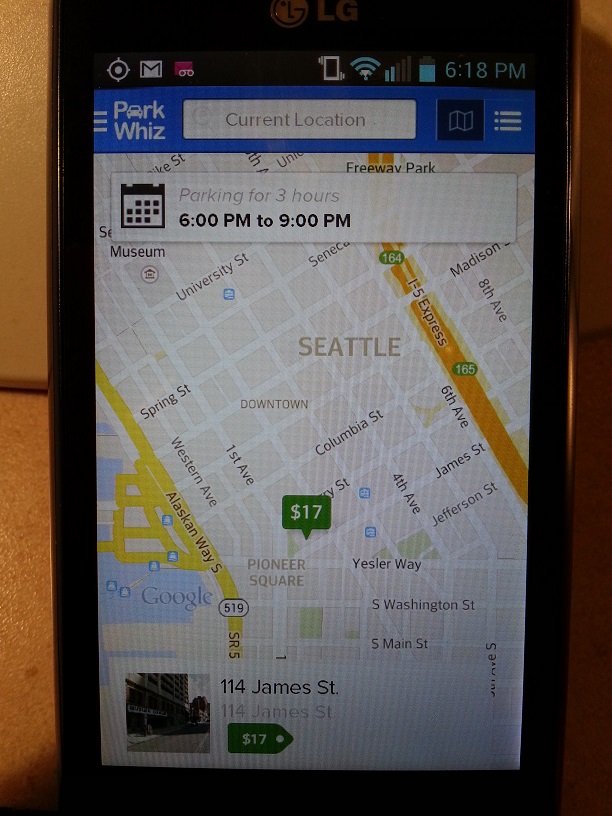
Of the 50 people who filled out the survey, 14 of them said they had heard of using AirBnB, Couchsurfing, or Craigslist for the purpose of renting out a room or finding one to rent (almost all of them mentioned AirBnB specifically). But of the same 50 respondents, only two of them mentioned any parking apps that they had heard of, and only one of them mentioned one of the two that I'd found which actually worked. (The other person mentioned an app called ParkWhiz, which, when I tested it out, only displayed one $17 parking garage in a neighborhood where I know of several $5 garages, which BestParking and ParkMe did list correctly.)
This seems to confirm the anecdotal evidence from my survey of my Seattle friends -- there is a great deficiency in awareness of these apps, relative to how useful people would find them if they knew about them.
So how is it that people are finding -- or not finding -- these apps? In a Google search for "parking app", the first result was an ad for ParkWhiz. BestParking and ParkMe did show up in the results, but so did another one called Parker, as well as a Mashable article by Kate Freeman listing "7 City Parking Apps to Save You Time, Money and Gas". Of the apps listed in the article, the only city-specific one that worked in Seattle (PrimoSpot) has been discontinued, and of the non-city-specific ones, only Parker is still around. (The article doesn't even mention BestParking or ParkMe, although I don't know if they existed when it was written.) Finally, a friend in my survey told me about an app called Parkopedia, which has over 100,000 downloads on Google Play (the same as BestParking, and more than ParkMe).
So even if it did occur to you to look for a parking-garage-finding app, the problem is that if you randomly picked one of the five most popular parking apps (BestParking, Parker, ParkMe, Parkopedia, and ParkWhiz), you might accidentally pick one of the three out of five that is a fail:
-
ParkWhiz, as noted above, only showed one $17 garage in a neighborhood full of other, cheaper garages.
-
Both ParkMe and Parkopedia display their results as a map with an icon marking each parking garage -- but with no price information. Simply having a map of parking garage locations isn't too useful, since you could get that by searching Google Maps for "parking" anyway. In both apps, you can click on parking garage icons to bring up a window showing their rates, but in Parker most of the listed garages just said "Contact facility for current rates". Parkopedia did usually display the rates for different garages -- but it's a pain to click on each of a dozen parking garage icons looking for the cheapest one. A typical area of downtown Seattle will have one garage where you can park for $5 for the evening, surrounded by garages where parking costs $10 or more, but Parkopedia doesn't make it easy to find it. And neither app lets you specify a start and end time for your parking so that you can find the cheapest garage for that time range.
So it seems odd that according to the Google Play store, Parkopedia has more downloads than ParkMe (100,000+ vs 50,000+), even though ParkMe seems a lot more useful. Meanwhile ParkWhiz, the one that found only one overpriced parking garage in a neighborhood full of cheaper ones, has fewer downloads but a slightly higher star rating in the app store than ParkMe. Of course in my parking-app survey of friends and Mechanical Turk users, the far-and-a-way winner was simply not knowing that any of these apps existed at all.
And here's why it matters to you even if you ride a granola-powered bike to work: I think this is a confirming instance of what I've been arguing for years, that the marketplace for ideas, inventions, and intellectual property is far less efficient than most people think it is. Every day a huge amount of human capital is squandered by people trying to jostle their competitors out of Google search results, or even just trying to raise the capital to advertise their products to people who would find them extremely useful, but will never find out about it if the venture capitalists don't come through with the money to advertise it. All of that is time and effort that could have instead gone towards making the products better.
I've suggested an algorithm based on "random-sample voting" as an antidote to some of these market inefficiencies, such as stopping people from buying votes on Digg, promoting the best ideas on Obama's "We The People" petition website, or even deciding whether J.K. Rowling is the world's greatest author or just lucky. Basically, in each scenario, the competing entities -- whether apps, or songs, or ideas for improving U.S. government policy -- would be rated by a sufficiently large random sample of qualified raters. ("Qualified raters" might mean economists in the case of the White House policy-petition website, or it might mean music consumers in the case of an algorithm to find the best new songs.) Each entity would receive an average rating from those raters, and then the entities with the highest average rating would be the ones promoted to the widest audience (at the top of Google search results, for example). It sounds deceptively simple, but it's far less amenable to "gaming the system", because you can't rope in your friends to vote for your app, or pay voters to rate you highly on Digg. The only way to win in this system is to make your song, idea, or app, the best that it can be -- which means your human capital is being channeled productively, instead of being wasted hiring an SEO company to try and knock your competition out of the top spot on Google.
If competition between parking apps worked this way, then all the current users of Parker, ParkWhiz and Parkopedia, would switch to BestParking and ParkMe, saving themselves a lot of hassle in the process, and those second-rate apps would have never even gotten on the ground unless they got their act together and implemented the same features. More broadly, if competition in the marketplace of ideas worked this way, then there wouldn't be so many users who really wish they could have an app like this, without realizing that the apps exist!
One striking thing about looking at a map of downtown parking garages, is how wildly the rates vary from each other, with $15 garages situated right next to the $5 ones. In theory, in a competitive marketplace, such rates should stabilize around a single price, for goods that are roughly comparable. But the $10 lots do still manage to get some customers who don't know any better, because it's just not practical to criss-cross a grid of several dozen city blocks looking for the cheapest garage. BestParking and ParkMe help people deal with this inefficient marketplace. So it's ironic that they're being held back by a marketplace for ideas that operates just as inefficiently in its own way.
-
-
If Ridesharing Is Banned, What About Ride-Trading?
Bennett Haselton writes "The city of Seattle just imposed new limits on commercial app-based ride-sharing companies like Uber and Lyft, effectively protecting taxi companies from low-cost competition in the form of smartphone apps. If other cities follow suit, could a company help ridesharers circumvent the restrictions by creating a ride-trading app, allowing drivers to earn 'miles' by driving passengers, and redeem those miles later to get rides for themselves?" Continue reading below to see what Bennett has to say.The cab companies got Seattle to crack down on ridesharing companies by arguing that by letting drivers charge money for rides, they were essentially operating illegal unlicensed taxi services. So it's not hard to imagine other cities taking similar action on the same ambiguous legal grounds, as Los Angeles did in sending cease-and-desist notices to Uber, Lyft and Sidecar, ordering them to stop operating entirely.
I tried some of these services and actually never saw what the big deal was. Much of the time, they were almost as expensive as taxis, much too pricey to use on a regular basis, and I would never use them unless my own poor planning left me somewhere without my own car and desperate somewhere faster than public transit could take me. Perhaps cab companies were afraid of where the services were eventually headed -- especially towards a model where drivers could set their own prices. As far as I know, currently all ridesharing services set a minimum price per mile and don't let drivers set their rate any lower. But many drivers would probably be willing to drive at a price lower than what the app allows, and a set-your-own-price model probably really would put the cab companies out of business.
Perhaps some cities will take a more benign view of ridesharing in the long run, but as long as money is changing hands, (1) the city will certainly view it as within their rights to regulate the ridesharing industry, and (2) taxi companies will be able to argue, not unreasonably, that the companies are effectively running unlicensed taxi services. Of course the real solution would be for cities to stop limiting the supply of taxi medallions and artificially enriching cab companies at everyone else's expense (if the city's concern is with rider "safety", they could increase the number of taxi medallions while still requiring all drivers to take safety training). But that doesn't seem likely to happen any time soon. So instead, what if a company created an app that attempted to circumvent the legal restrictions, by allowing users to trade rides -- not for cash, but for returning the favor?
Here's how it could work: When you sign up as a new user, you have a "miles" balance of zero. (The very first users of the system would have to start out with a nonzero balance, so that there are some units in the system to trade, but everyone who joins after that starts at zero.) You have to earn miles by giving someone else a ride before you can redeem your miles by getting a ride yourself. So you log in as a driver, and some other user "hails" you through their smartphone app, much as riders hail drivers through Uber or Lyft. You pick up a passenger and give them a ride to their destination, and at the end of the journey, they transfer a number of "miles" to you indicating how far you drove them. You now have a positive miles balance, and you can "spend" it by hailing a ride yourself later on. Drivers and riders could leave ratings for each other just as they do on Uber and Lyft. What Couchsurfing is to Airbnb, this service would be to Uber.
Since no money is changing hands, the arrangements would presumably not be covered by existing taxi statutes. You could even make an argument that a city couldn't pass a law regulating these ride-trades even if they wanted to, because as voluntary arrangements between consenting parties, they're protected under our First Amendment right of freedom of association! Of course, libertarians believe all commercial transactions between consenting parties ought to be exempt from regulation as well, but most state and local governments take a dim view of that premise. However, take money out of the equation, and you're on much stronger ground that your ride-trading arrangements aren't covered by existing laws.
(It is of course silly and inconsistent that the law often forbids selling something for money, but allows trading it for something of "value", or permits it if the nature of the trade is not made explicitly clear. If a girl sleeps with you and you occasionally "lend" her money, she's a high-maintenance girlfriend, but if she ever does you the courtesy of spelling out the arrangement explicitly, she's a prostitute and can go to jail. But as long as the government makes those silly and arbitrary distinctions, we might as well use them when they count in our favor.)
Would ride-trading with strangers be safe? Well, when a rider pages a driver, the system could tell the rider the license plate of the car associated with that driver's profile, so unless the driver was in a stolen car, the system would always have a record of the license plate (and, hence, the owner) of any car that picked up a passenger. More generally, if I were a user in a system like this and someone told me it sounded unsafe, I would just say the same thing I always say about Couchsurfing (where I've hosted over 50 people with no bad experiences). Namely: "Look, have you or any of your friends ever gone home with someone you met at a bar? And that's fine, I'm not judging you, I'm just saying that was a hell of a lot more risky than meeting up with someone in a system where you can read other people's references." Besides, in many cities there's already thriving subculture of slugging -- picking up total strangers so you can use the carpool lane and they get a free ride.
I feel like I would be happy to have this ride-trading service available if I ever wanted a quick ride across town and didn't have my car. The only "cost" to me would be the cost of giving someone an equal-length ride at some other point in time when I wasn't in a hurry. (Or even giving someone a lift to a place that I was already going.) It's an efficient transaction because it lets me spend miles when my time is valuable, and then rack up the miles later on when I have some time to kill that's not as valuable. You can realize even more efficiencies by letting people pay "premium rates" for periods when demand is high (Friday and Saturday nights) or supply is low (early mornings when people need rides to the airport), so that the balance of miles that you pay for a ride may be greater than the actual number of miles traveled.
On the other hand, there's an inefficiency in that the system cannot serve the needs of people who want a ride, but whose time is too valuable to spend it driving in order to "earn" the miles to redeem for the ride. This is a limitation in any system that bans money as a means of trade and only lets you trade a service for a repayment-in-kind of the same service.
To environmentalists who would object that this promotes greater car usage: First of all, it might result in more impromptu car pooling over routes that were being inadequately served by buses, in which case the passengers were going to have to take cars anyway, so they might as well be piled into fewer of them. But in any case, I would actually take the bus more if a service like this existed. I live in Bellevue, about a 20-minute bus ride outside of Seattle, and I'd gladly take the bus in to Seattle if I was going to a specific destination close to the bus line, and knew I was coming right back afterwards. The problem is that once I'm in Seattle, if I want to get to some other arbitrary destination in Seattle, taking public transit is slow and annoying (and, you may have heard, often involves some waiting around in the rain). I drive my car in to Seattle not because I want to drive to the city, but in order to have a car while I'm there. If I could summon a ride in under two minutes to take me anywhere else in the city (with the only price being to return the favor to someone else later), I wouldn't need my car and could take the bus downtown.
So, even assuming a service like this would be useful, why would a company create it? We know how Airbnb and Uber make money, by skimming a cut off of each transaction. But how would a company make money just by connecting riders and drivers for complimentary rides through a free app? Well, Couchsurfing connects users for free stays in each other's houses, and they got venture capitalists to invest $22 million. The thinking seems to be that if even a free a service has enough users, it must be worth something.
The major obstacle to deploying the system, is that the system would require a critical mass of users in any given city, before it could become effective. If there aren't enough drivers active in the city, then hailing a ride would take so long that after factoring in the delay, you might as well have taken the bus. You'd need enough drivers active to be reasonably sure that in any given neighborhood, you can catch a ride quickly -- and for the drivers have to be out in force, they have to know that there's a critical mass of riders who are ready to offer some miles in their balance for rides. Services that require a critical mass of users in order to be successful, are notoriously hard to get off the ground. If the project had the feeling of a social movement behind it -- in the spirit of resource sharing, as well as environmental friendliness insofar as people like me would be more likely to start using the bus -- perhaps the founders could sign up a base of users over time, prior to actually launching the service. And then once the number of enrolled users was large enough, could launch the live service with a critical mass of users already in place. (Of course, if they tried that out here, this being Seattle, most of those enrolled users who said they would show up, would probably flake out.)
-
AirBNB Opensources Chronos, a Cron Replacement
First time accepted submitter victorhooi writes "AirBNB has open-sourced Chronos- a scheduler built around Apache Mesos (a cluster manager). The scheduler is distributed and fault-tolerant, and allows specifying jobs in ISO8601 repeating notation, as well as creating dependent jobs. There's also a snazzy web interface to track and manage jobs, as well as a RESTful API." It's under the Apache License as seems to be the fashion with businesses releasing software nowadays. It looks like it might be useful if you have to manage a lot of machines with interconnected recurring processes; I know I wish this had existed a few years ago. -
SFPD Arrests Suspect In Airbnb Rental Trashing
theodp writes "Just days after it was reported that apartment sharing startup Airbnb had raised $112MM at a $1B+ valuation from investors that included Marc Andreessen and Jeff Bezos, Airbnb user EJ's blog entry on the ransacking of her apartment by Airbnb renters went viral, creating a PR nightmare that's turning into a war of words. CNET reports San Francisco police have confirmed that a 19-year-old woman has been arrested in the case, booked on possession of stolen property, methamphetamine, fraud charges, and an outstanding warrant."