Slashdot Mirror
Domain: anandtech.com
Stories and comments across the archive that link to anandtech.com.
Comments · 3,318
-
Better Review
For a more in-depth review that includes benchmarks and photos that weren't taken out on mom's patio table, Anandtech did a pretty good write-up. I'm even being so kind as to include a link to the printer-friendly version with everything on the same page.
http://www.anandtech.com/print/4277 -
Re:Graphics Performance
-
Re:Battery
They may go into a "shut down" state, but that doesn't mean they won't be drawing power. In reality a lot of the time all they are is clocked down.
Actually, the newer processors can shut down unused cores. There is a very small amount of leakage, but nearly insignificant. This article provides some information from the Lynnfield release. Obviously in the desktop environment the bonus from shutting down cores is clocking the one that is in use higher; but you can turn it around and just greatly reduce power consumption if you only need one core running. This should work fine with mobile processors, though I confess I don't know if the current dual core designs do so.
-
Re:Specs
-
When running on a mac, that is
Since the same computer is MUCH more power efficient running Mac OS X than running Windows, this seems to be an odd argument for Microsoft to be making.
Anandtech:Apple claims 10 hours of battery life for the MBP13 when running OS X, and Anand hit pretty close to that mark when testing it out with his light web browsing test. Now, we’ve shown before that OS X is more optimized for mobile power consumption than all versions of Windows, so going into this test the expectations were a fair bit lower.
And for good reason; the MBP13 (running Windows 7) showed fairly similar battery life to some of the older Core 2-based systems. With it’s 63.5 Wh lithium polymer battery, the MBP hits 5.5 hours on our ideal-case battery test, and exactly 5 hours on the web browsing test. While this is decent for the average Core 2 notebook, it’s pretty woeful compared to the OS X battery life of the MBP. If you have no reason to run Windows (program compatibility, gaming, etc) you’re better off in OS X just so that you can get about double the battery life.
Apple's Windows hardware drivers (Boot Camp) have lousy support for power saving features under Windows, so battery life under Windows is much lower than under OS X, where Apple has awesome driver support for power saving.
That doesn't mean that Windows can't have good battery life. Every other PC vendor puts effort into their Windows drivers, since every other PC vendor uses Windows as a primary OS.
-
They forgot AdBlock
Anandtech has done this before. They found that Firefox + AdBlock Plus yielded the best browsing battery life because Flash Ads are a huge power drain. It doesn't matter how good IE or Chrome get, I am still going to use Firefox because of NoScript and AdBlock Plus. Yes, I know that Chrome has AdBlock, but it doesn't really block the ads; just hide them, which completely defeats my goal; using less bandwidth. As sad as it is, not everyone can get unlimited internet.
Source:
http://www.anandtech.com/show/2834/5 -
Re:But IE9 runs only on bloated Windows...
Actually, Windows 7 is the most efficient version of windows, and all versions of windows are very power efficient.
-
Re:Odd argument
-
Odd argumentSince the same computer is MUCH more power efficient running Mac OS X than running Windows, this seems to be an odd argument for Microsoft to be making.
Anandtech:Apple claims 10 hours of battery life for the MBP13 when running OS X, and Anand hit pretty close to that mark when testing it out with his light web browsing test. Now, we’ve shown before that OS X is more optimized for mobile power consumption than all versions of Windows, so going into this test the expectations were a fair bit lower.
And for good reason; the MBP13 (running Windows 7) showed fairly similar battery life to some of the older Core 2-based systems. With it’s 63.5 Wh lithium polymer battery, the MBP hits 5.5 hours on our ideal-case battery test, and exactly 5 hours on the web browsing test. While this is decent for the average Core 2 notebook, it’s pretty woeful compared to the OS X battery life of the MBP. If you have no reason to run Windows (program compatibility, gaming, etc) you’re better off in OS X just so that you can get about double the battery life. -
Re:Text editing on OSX
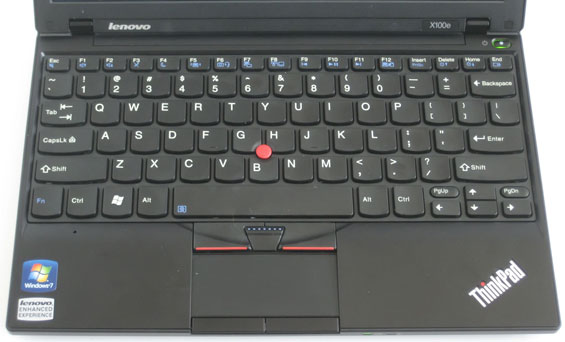
That's really useful on a lot of modern notebooks where the Home key (if it even exists) is some meta key combination of O. Or like on this modern ThinkPad, where the Home key is a tiny target between Backspace and Off. Don't miss!
The Mac OS and hardware were designed together, so the software makes up for hardware limitations (like a reduced keyboard area), and takes full advantage of the hardware advantages (like the far superior touch pads and touch mice).
As a side note, the Home key on my full-sized Mac keyboard works just fine in all Apple software and most third party software. And remapping it to send CMD+Right takes about 20 seconds under Settings.
-
Re:Power Safe Write Cache
No they didn't, read the white paper about it. You can see all the capacitors involved in the anandtech review even. In theory, this has finally fixed the problem that made Intel's drive unusable for high-performance databases, that the write cache was useless in that context because it lied about writes.
-
Re:*SMOOTCH!* Buh-bye Enterprise!
No. Two orders of magnitude is 100x. Good SLC vs good MLC is 10x, only a single order of magnitute longer lasting.
http://www.anandtech.com/show/2614/4
What you forget is MLC is about 2x cheaper than SLC, so you can get 2x the space for the same price. With wear leveling, extra space is extra lifespan, so MLC dies 5x faster than SLC.
What does that mean for you? I put my money (job) where my mouth is. Our reasonably high traffic OLTP database server uses Intel SSDs as filesystem-level write cache. We get an average write level of 10MB/sec. The minimum expected lifespan of the drive is 2 petabytes. That means we likely have SIX YEARS before the cells start to become unwritable. At that point, no data will be lost: the drive will report the write failures to the OS and store to cells that haven't become unwritable yet, and you will be able to continue operating for the next few months while you get a replacement drive.
-
Re:Big words...
Uh, yeah... I don't think so.
-
Re:Request for a new video card benchmark
While comparing video cards is all well and good, I make a formal nerd request that a decibel comparison be included in future reviews, say at idle fan speed, half maximum speed and full speed. Honestly it has gotten ridiculous - high end cards are just too damned loud. (switching to night-club mode) I MEAN WHAT IS THE POINT OF HAVING NICE GRAPHICS IF YOU CAN'T HEAR THE GAME YOU'RE PLAYING
You just need to find a better review site.
Looks like the 6990 is significantly quieter at low loads, but at very high loads (furmark) it isn't as far ahead.
-
Re:A GPU by any other name would render as slowly
No, full HD video is not particularly computing intense with dedicated hardware. The Intel Core i5-2500K decodes 5 simultanious 1080p streams according to Anandtech. Hell it even has HDMI 1.4a and 3D support if you're into that, this is "integrated" performance in 2011. I don't know how intensive Photoshop with thousand layers can get, but simple touchups of photos certainly do fine without a discrete GPU.
-
Re:Curious
Although nowhere near 45,000 tests, Anandtech recently ran a preview of the iPad 2 and did some browsing benchmarks to test the CPU where they loaded the pages for the iPad 2, Xoom, and the original iPad. Obviously the two tablets are different animals than the two phones, but given they run essentially the same OS and have beefier CPUs, we should expect similar results.
"The difference will become more obvious as users demand richer experiences and move to tablet computers with larger screens, said Guy Podjarny, chief technology officer of Blaze,"
-
Curious
Although nowhere near 45,000 tests, Anandtech recently ran a preview of the iPad 2 and did some browsing benchmarks to test the CPU where they loaded the pages for the iPad 2, Xoom, and the original iPad. Obviously the two tablets are different animals than the two phones, but given they run essentially the same OS and have beefier CPUs, we should expect similar results.
However, the iPad 2 is clearly faster in 7 of the 8 tests and the same speed as the Xoom in the remaining 1. It's possible that the websites used aren't good predictors for general load time though. Given that the two both have dual-core ARM chips running at similar clock rates, we shouldn't be seeing those results, especially if the ones from this study are a valid indicator of performance. The only other conclusions that can be drawn are that performance regressed in Android 3.0 (Or at least Motorola's implementation of it.), the Tegra 2 is a pile of crap, or that Apple is now somehow capable of making a significantly better SoC than many established players.
I can't speculate regarding the first, but given that the Xoom has a similar SunSpider result and a better BrowserMark result than the iPad 2, it's unlikely that either of the other two conclusions are correct. Would like to have additional data before concluding one way or the other, but it does appear as though some things are not adding up. -
Re:No real way to measure?
why not have a simple page that grabs the current time, loads a page in the iframe, when the iframe triggers it's ready() event, grab the current time and compare against the start for a load time analysis?
Because that may not be correct either. In their iPad 2 preview Anandtech went back to manual timing of web page loading because
"It turns out that Honeycomb's browser was stopping our page load timer sooner than iOS', which resulted in some funny numbers when we got to the 4.3/Honeycomb comparison. To ensure accuracy we went back to timing by hand (each test was repeated at least 5 times and we present an average of the results)."
While they don't talk about their method (either) they decided they couldn't trust whatever automated system they had. Obviously there are all kinds of assumptions and differences in the test bed but the basic point is you can't necessarily trust the browser to tell you when it's ready either as an embedded view or stand alone browser.
-
Re:You're Wrong.
"Seagate claims to be shipping a 3TB flavor of its Barracuda XT, but we haven't been able to find one that's actually for sale."
You can find them here. You can also find an article at Anantech called,The World's First 3TB HDD: Seagate GoFlex Desk 3TB Review here. There's a description about how to open the case and use them as internal drive. The Seagate external version is also $20 cheaper than the internal Hitachi 3TB.
-
Re:As posted before, Anandtech did it very well
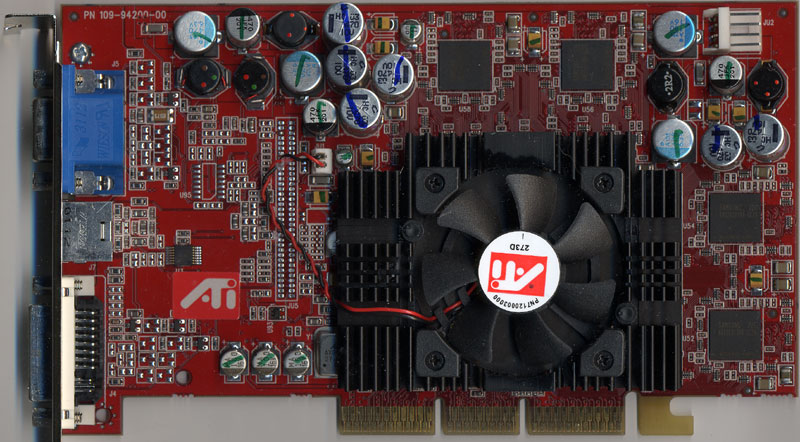
Actually, the Radeon 9700 was cooled by a fairly small fan over the GPU. The FX 5800 required a "gigantic" (at the time) two-slot blower, but even the fastest R300 didn't have a full shroud.
http://images.anandtech.com/reviews/video/ati/radeon9700pro/cardfront.jpg -
As posted before, Anandtech did it very well
and their review helps as well http://www.anandtech.com/show/4215/apple-ipad-2-benchmarked-dualcore-cortex-a9-powervr-sgx-543mp2
The key items to take away from both are, yeah the cameras suck but this is truly a real upgrade from the iPad. Performance alone puts is ahead of the older model as well as many available tablets. They did find out that the dual core processor is actually running at only 900mhz. While the Xoom pushes more pixels because of its 1280x800 versus 1078x768 the iPad2 pulls far ahead of it, beyond what the pixel count would account for. As for gaming, some games are already taking advantage of the new power, Infinity Blade has been updated and looks fantastic. This brings up the issue, will there be apps sold that are marked iPad2 required?
Better yet, its cheaper than its nearest competition. The only question is, how long before really good Android tablets come along?
\\* to prevent kharma whoring feel free to mark it funny
-
As posted before, Anandtech did it very well
and their review helps as well http://www.anandtech.com/show/4215/apple-ipad-2-benchmarked-dualcore-cortex-a9-powervr-sgx-543mp2
The key items to take away from both are, yeah the cameras suck but this is truly a real upgrade from the iPad. Performance alone puts is ahead of the older model as well as many available tablets. They did find out that the dual core processor is actually running at only 900mhz. While the Xoom pushes more pixels because of its 1280x800 versus 1078x768 the iPad2 pulls far ahead of it, beyond what the pixel count would account for. As for gaming, some games are already taking advantage of the new power, Infinity Blade has been updated and looks fantastic. This brings up the issue, will there be apps sold that are marked iPad2 required?
Better yet, its cheaper than its nearest competition. The only question is, how long before really good Android tablets come along?
\\* to prevent kharma whoring feel free to mark it funny
-
Anandtech performance review is more informing
and their review helps as well http://www.anandtech.com/show/4215/apple-ipad-2-benchmarked-dualcore-cortex-a9-powervr-sgx-543mp2
The key items to take away from both are, yeah the cameras suck but this is truly a real upgrade from the iPad. Performance alone puts is ahead of the older model as well as many available tablets. They did find out that the dual core processor is actually running at only 900mhz. While the Xoom pushes more pixels because of its 1280x800 versus 1078x768 the iPad2 pulls far ahead of it, beyond what the pixel count would account for. As for gaming, some games are already taking advantage of the new power, Infinity Blade has been updated and looks fantastic. This brings up the issue, will there be apps sold that are marked iPad2 required?
Better yet, its cheaper than its nearest competition. The only question is, how long before really good Android tablets come along?
-
Anandtech performance review is more informing
and their review helps as well http://www.anandtech.com/show/4215/apple-ipad-2-benchmarked-dualcore-cortex-a9-powervr-sgx-543mp2
The key items to take away from both are, yeah the cameras suck but this is truly a real upgrade from the iPad. Performance alone puts is ahead of the older model as well as many available tablets. They did find out that the dual core processor is actually running at only 900mhz. While the Xoom pushes more pixels because of its 1280x800 versus 1078x768 the iPad2 pulls far ahead of it, beyond what the pixel count would account for. As for gaming, some games are already taking advantage of the new power, Infinity Blade has been updated and looks fantastic. This brings up the issue, will there be apps sold that are marked iPad2 required?
Better yet, its cheaper than its nearest competition. The only question is, how long before really good Android tablets come along?
-
The target consumer for these cards.
For those who are asking who would need a card with such power.
Simply take a look at the benchmarks from various recent game titles.
http://www.anandtech.com/show/4209/amds-radeon-hd-6990-the-new-single-card-king/7If you run a 1920x1200 or higher monitor, especially 2560x1600 then much less than this card wont cut the 60fps that most gamers need to be able to compete well (thinking about multiplayer FPS games)
This card gets 64FPs average running a newer game like Metro 2033 at 1920x1200 with "very high settings". When you crank that up to 2560x1600, it only achieves 44.5FPS average and thats only a single 30" monitor.
I have more than one friend with triple 24" or 30" gaming monitor setups they would likely get 2 of these cards to drive new games at 5760x1200 or 7680x1600. Right now they use 3 GTX 580s which costs $1500. Even with 2 of these new cards, current games wont be able to run at high settings and achieve 60fps average.
Plus we haven't even thrown 3D monitors into the mix yet. Running in 3D mode takes about twice the power since it has to render the scene twice at different angles.
That audience is who these video cards are targeted at. People who have a hobby in computer gaming who want the greatest immersive experience possible and beyond outstanding graphics.
-
Other coverage
As always, I find AnandTech's coverage to have a few nuggets of information that most other publications don't. It's well worth a read, particularly for those curious about TRIM performance and degradation over time. There's also a nice page on average reliability around different SSD manufacturers.
Anand concludes by saying that the 510 is one of the fastest drives around today, but only worthwhile on a 6Gbps interface. He points out that they've swapped excellent random performance in the older X-25 for excellent sequential performance in the 510. The Vertex 3 still comes out on top, but the 510 should be more reliable. If OCZ can make their new drives more reliable, Intel will have an uphill battle to fight.
Then there's also the other SSDs, since we've only heard from OCZ and Intel thus far.
-
Re:Huh?
Read AnandTech's SSD Anthology, and all shall become clear (including why it's unreliable to try to securely wipe files from SSDs, as well as how they can go on deleting and rearranging stuff in the background)
http://www.anandtech.com/show/2738
(summary: SSD's basically have a mind of their own (of varying degrees of mediocrity) that tries to compensate for all of the shortcomings of flash storage so the OS doesn't have to worry about it)
-
Re:Don't forget about Sandforce/OCZ
I can only hope that OCZ changes their mind and decides to at least offer a more expensive 34nm version.
Is a 32nm version good enough for you? They are going to offer one of those called the Vertex 3 Pro. Source: http://www.anandtech.com/show/4186/ocz-vertex-3-preview-the-first-client-focused-sf2200/2
-
Intel showed the same thing 6 years ago
Including the same charts and graphs.
http://www.anandtech.com/show/1770
How this guy is going to get a patent on this stuff based upon his work in 2008 when Intel showed it onstage at IDF in 2005 is beyond me.
-
Don't forget about Sandforce/OCZ
Sandforce has already announced its new sata3 controller. On paper it looks like it will have much faster sequential writes than Intel, but it sounds like it will also have a shorter lifetime and shorter data retention times due to the use of 25nm NAND. Intel is wisely sticking with 34nm. It may be more expensive to manufacture, but is superior tech. I can only hope that OCZ changes their mind and decides to at least offer a more expensive 34nm version. OCZ won't be shipping their Vertex 3 drives until Q2 so Intel will have a big head start in the market.
The NAND industry seems to be doing its best to encourage ignorance on the disadvantages of smaller process sizes from the consumer POV and the ignorance seems to be widespread. Getting the facts on this issue can be a bit difficult. Here is a good thread on the topic.
http://forums.anandtech.com/showthread.php?t=2142742The following post sums it up better than I could. Note his point about data retention times as well. That is a point that is often ignored when the focus is solely on write cycles.
As flash cells are shrunk, they become less good. This is a fundamental feature of the technology. The overall volume of the cell becomes smaller, so less electrons can be stored in the cell (so the signal picked up by the electronics is weaker and less clear, so you get a higher error rate) and the insulating barriers around the cell must be made thinner, in order to save space - allowing the electrons to leak out of the cell more easily (reducing power off data retention time). The thinner insulation also wears out more quickly (reducing life cycles)
It's difficult to define a 'fundamantal' limit for flash, because it may be possible to work around poor performance, and as yet unknown new manufacturing techniques and semiconductor materials may be developed. However, it has been suggested in the scientific literature that 18-22 nm, is the realistic limit. Beyond that, the performance/reliability/lifespan of the flash would be too poor, no matter how much wear levelling, and how sophisticated the ECC codes were.
Enterprise grade SSD flash, will need higher specifications than flash for toy cameras. Enterprise applications are unlikely to tolerate 18 nm flash with 100 write cycles and one lost sector per 100 GB of data stored. However, this probably would be acceptable for toys or throwaway devices.
Some more coverage of the topic:
http://techon.nikkeibp.co.jp/article/HONSHI/20090528/170920/NAND Flash memory quality is also beginning to drop. Chips manufactured using 90nm-generation technology in 2004-05, for example, were assured for about 100,000 rewrites and data retention of about a decade. As multi-level architecture and smaller geometry are introduced, quality is showing a sharp decline. The 30nm 2-bit/cell chips expected to enter volume production in 2009-10 may well end up with a rewrite assurance of no more than 3,000 cycles, and a data retention time of about a year. The first 3-bit/cell chips are hitting the market now, with only a few hundred rewrites.
http://hardforum.com/showthread.php?t=1502663
Flash memory works by trapping electrons. Over time these electrons leak away, until the charge is too small for the data to be read any more. With smaller feature sizes (34 nm instead of 45 or 65 nm) this leakage is more significant and fewer electrons can be stored per bit, thus the time during which the stored value can be maintained is decreased.
-
Don't forget about Sandforce/OCZ
Sandforce has already announced its new sata3 controller. On paper it looks like it will have much faster sequential writes than Intel, but it sounds like it will also have a shorter lifetime and shorter data retention times due to the use of 25nm NAND. Intel is wisely sticking with 34nm. It may be more expensive to manufacture, but is superior tech. I can only hope that OCZ changes their mind and decides to at least offer a more expensive 34nm version. OCZ won't be shipping their Vertex 3 drives until Q2 so Intel will have a big head start in the market.
The NAND industry seems to be doing its best to encourage ignorance on the disadvantages of smaller process sizes from the consumer POV and the ignorance seems to be widespread. Getting the facts on this issue can be a bit difficult. Here is a good thread on the topic.
http://forums.anandtech.com/showthread.php?t=2142742The following post sums it up better than I could. Note his point about data retention times as well. That is a point that is often ignored when the focus is solely on write cycles.
As flash cells are shrunk, they become less good. This is a fundamental feature of the technology. The overall volume of the cell becomes smaller, so less electrons can be stored in the cell (so the signal picked up by the electronics is weaker and less clear, so you get a higher error rate) and the insulating barriers around the cell must be made thinner, in order to save space - allowing the electrons to leak out of the cell more easily (reducing power off data retention time). The thinner insulation also wears out more quickly (reducing life cycles)
It's difficult to define a 'fundamantal' limit for flash, because it may be possible to work around poor performance, and as yet unknown new manufacturing techniques and semiconductor materials may be developed. However, it has been suggested in the scientific literature that 18-22 nm, is the realistic limit. Beyond that, the performance/reliability/lifespan of the flash would be too poor, no matter how much wear levelling, and how sophisticated the ECC codes were.
Enterprise grade SSD flash, will need higher specifications than flash for toy cameras. Enterprise applications are unlikely to tolerate 18 nm flash with 100 write cycles and one lost sector per 100 GB of data stored. However, this probably would be acceptable for toys or throwaway devices.
Some more coverage of the topic:
http://techon.nikkeibp.co.jp/article/HONSHI/20090528/170920/NAND Flash memory quality is also beginning to drop. Chips manufactured using 90nm-generation technology in 2004-05, for example, were assured for about 100,000 rewrites and data retention of about a decade. As multi-level architecture and smaller geometry are introduced, quality is showing a sharp decline. The 30nm 2-bit/cell chips expected to enter volume production in 2009-10 may well end up with a rewrite assurance of no more than 3,000 cycles, and a data retention time of about a year. The first 3-bit/cell chips are hitting the market now, with only a few hundred rewrites.
http://hardforum.com/showthread.php?t=1502663
Flash memory works by trapping electrons. Over time these electrons leak away, until the charge is too small for the data to be read any more. With smaller feature sizes (34 nm instead of 45 or 65 nm) this leakage is more significant and fewer electrons can be stored per bit, thus the time during which the stored value can be maintained is decreased.
-
Re:On the graphics side
But even a crappy AMD/ATI card can dominate intel graphics. http://www.anandtech.com/show/4083/the-sandy-bridge-review-intel-core-i7-2600k-i5-2500k-core-i3-2100-tested/11
-
Re:This ARM right?
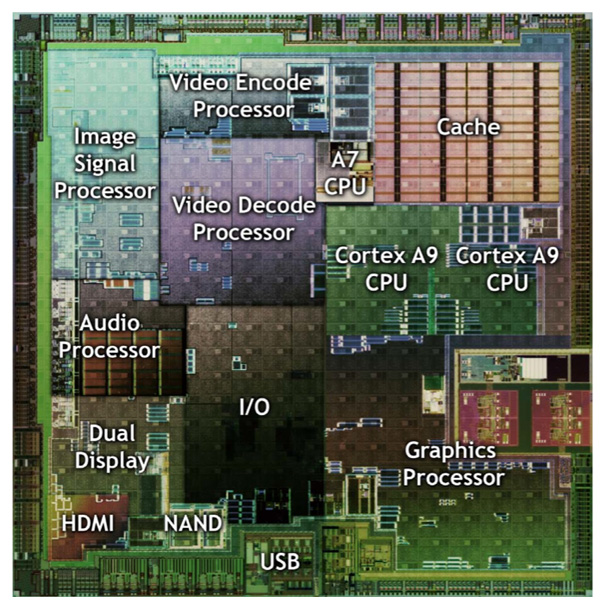
If it's anything like the Tegra 2 it's going to be regular Cortex-A9 cores, an Nvidia GPU, and the usual dedicated hardware found on most ARM SoCs. Here's a picture of the Tegra 2 so I imagine that the Tegra 3 will look similar, just with more cores and a beefier GPU.
However, the Tegra 2 doesn't perform any better than the Exynos from Samsung or TI's newest OMAP based on AnandTech benchmarks, so I don't expect Tegra 3 to be much different from other parts available at the time. Considering Sony has said their next PSP, which is targeted to ship around the holidays, is going to have a 4 C-A9 cores and 4 SGX543 graphics cores, the Tegra 3 probably won't be a runaway performance monster.
What I'm most excited for are the ARM Cortex-A15 products that should be out next year. Those will allow for much higher clock rates and should make for great netbook performance. Keep the usual SoC dedicated hardware components and battery life will be even more phenomenal. -
Re:This ARM right?
If it's anything like the Tegra 2 it's going to be regular Cortex-A9 cores, an Nvidia GPU, and the usual dedicated hardware found on most ARM SoCs. Here's a picture of the Tegra 2 so I imagine that the Tegra 3 will look similar, just with more cores and a beefier GPU.
However, the Tegra 2 doesn't perform any better than the Exynos from Samsung or TI's newest OMAP based on AnandTech benchmarks, so I don't expect Tegra 3 to be much different from other parts available at the time. Considering Sony has said their next PSP, which is targeted to ship around the holidays, is going to have a 4 C-A9 cores and 4 SGX543 graphics cores, the Tegra 3 probably won't be a runaway performance monster.
What I'm most excited for are the ARM Cortex-A15 products that should be out next year. Those will allow for much higher clock rates and should make for great netbook performance. Keep the usual SoC dedicated hardware components and battery life will be even more phenomenal. -
Re:high profile
-
Re:Wow, that would be redonkulously profitable.
Not that it matters to me, but I don't think you're reading http://www.anandtech.com/bench/Product/289?vs=203 correctly. In fairness, the page is badly done.
Yes, there are a few synthetic benchmarks at the top which give the i3 an edge by 5-15%. There is also (at the bottom) a benchmark of power consumption which heavily favors the i3. And yes, there are a couple ties.
However, the other ~30 benchmarks favor the Phenom -- frequently by 20-30%. But it's hard to see this just by skimming: for every single benchmark, you have to read the unit of measure (e.g. "total time - lower is better" or "effective rate - higher is better"). If you aren't extremely careful about reading the units of measure, then you'll walk away thinking that the i3 and Phenom frequently trade positions -- in reality, the Phenom consistently beats the i3, but the chart is badly prepared.
-
Re:Wow, that would be redonkulously profitable.
Notably the test you linked only covers the absolute worst case for the i3. If you look at this (from the same site) which covers a much wider range of benchmarks, you see the i3 wins as many as it loses, and by similar margins – i.e. it's roughly equal.
If that doesn't satisfy you though, you may want to step up to the i5 2500, which is still significantly cheeper than the phenom, and beats it in all but 3 tests.
-
Re:Wow, that would be redonkulously profitable.
Notably the test you linked only covers the absolute worst case for the i3. If you look at this (from the same site) which covers a much wider range of benchmarks, you see the i3 wins as many as it loses, and by similar margins – i.e. it's roughly equal.
If that doesn't satisfy you though, you may want to step up to the i5 2500, which is still significantly cheeper than the phenom, and beats it in all but 3 tests.
-
Re:Wow, that would be redonkulously profitable.
As was obvious from the start, the i3 gets beaten in the multithreaded tasks, but it offsets that by handing the X6 it's ass in the single threaded ones, so the two end up pretty much equal.
Alternatively, if you don't buy that, try the i5 2500 which wins in all but 3 tests and still costs significantly less.
-
Re:Wow, that would be redonkulously profitable.
As was obvious from the start, the i3 gets beaten in the multithreaded tasks, but it offsets that by handing the X6 it's ass in the single threaded ones, so the two end up pretty much equal.
Alternatively, if you don't buy that, try the i5 2500 which wins in all but 3 tests and still costs significantly less.
-
Re:Wow, that would be redonkulously profitable.
You may want to recheck those benchmarks. Just googled "core i3 2100 vs phenom", this was the first review I found:
http://www.anandtech.com/show/4083/the-sandy-bridge-review-intel-core-i7-2600k-i5-2500k-core-i3-2100-tested/16Second page shows the Phenom roundly trouncing the i3 in a large number of tests, and besting a number of the i7s. There were a few tests where the i3 was slightly superior, most others the phenom was 15-20% faster, and in some cases 50+% faster. Look at the encoding performance, the AMD slaughters the i3.
And from what I can see, the i3 is closer to $150, with its AMD equivalent-- the X2 645-- being closer to $120. On most benchmarks they are rather close to each other, but the AMD is a whopping 20% cheaper. Things arent quite what youre making them out to be.
-
Re:This is what I've been waiting for
Kinect adds a lag of about 200-250 milliseconds:
http://www.anandtech.com/print/4057
http://www.youtube.com/watch?v=MF9b5UiVq-QThat's fine for casual use, crap for the pros.
You can react faster than kinect - just watch the video and move your hand up/down when the person in the video does it. You can do it before Kinect does.
If you were playing an FPS using a kinect against someone who was using a low lag controller, many times you would already be "dead" before kinect recognized your action.
As for work, whenever possible, it's the humans that should be making stuff wait, not the computers/controllers/UI
-
Re:"Aging tech"...
The opposite is true... you are just willfully ignorant aren't you? The so called numbers you posted, the charts are not comparable, you really sound like you do not understand tech at all.
Lets take a look at a RESPECTABLE website that builds a review of the GENERAL USER CASE.
Notice also in the crap you posted that you are comparing a 3.4Ghz cpu to a 3.0 ghz cpu, most intelligent people who understand their PC's overclock their CPU's. Most people who know what they are doing and game overclock, so say you have an E8400 you're running it @ 3.6-4ghz, so it makes those performance comparisons moot.
Clock for clock (running at same ghz) the i7 and sandybridge is barely faster then core 2 in a cubic shit load of applications. There are special use cases like 3D rendering or video encoding, but for the average user and average gamer (most people) there is not a desperate overwhelming need to upgrade. You never countered my value for $ argument at all you just came up with corner cases not the general use case just to argue for no reason.
-
Re:"Aging tech"...
You are missing the point ENTIRELY... you made no rational numbers backed points what-so-ever, just rhetoric.
The numbers are common knowledge and easy to find. If you havent looked, then you are being willfully ignorant of the performance of these processors. A stock E8400 encodes HD H.264 video using x264 at about ~27 frames per second, while the stock 2600K does so at about ~63 FPS. Here is a citation for the willfully ignorant The disparity grows when both are overclocked.
So now the question is, why are you willfully ignorant? Do you own an E8400, willing to pretend that its not a significant under-performer these days?
x264 is a CPU-based open source video encoding library, used by many open source encoding packages. This is something real people do with their computers, and have done so for years now.This is why I qualified my first post by users who are interested in other work based apps.
You didnt qualify it with games, which is the only place (GPU-bound) where your argument actually is accurate. For applications, the 2600K is significantly faster than the E8400. Photoshop benchmark.. 3x, Excel benchmark.. 3x, WinRAR benchmark.. 2x. It is only games where your bullshit 30% figure seems to ring true.. only games...
-
Re:Fuck Intel
This is Intel's fault all the way.
Here's an article that describes the problem in pretty simple terms.
http://www.anandtech.com/show/4143/the-source-of-intels-cougar-point-sata-bug
It appears to only affect the 3gb SATA, and not the 6gb.
I suspect manufacturers will buy these cheap and just not implement the 3gb SATA feature, at least those that understand the problem.
-
Re:The price might seem a bit high
Tablet - Archos 101
All the reviews say it gets hot (up to 90 degrees), poor battery life, not very responsive, no official access to the Android market, no Bluetooth (for keyboards),
Phone - Fascinate? Incredible? Evo? Epic? Droid X?
They have less battery life than the iPhone:
http://www.anandtech.com/show/3791/the-sprint-htc-evo-4g-review/12And lower resolutions.
And the Incredible is more of a contemporary of the 3GS in terms of hardware.
-
Re:Remember the good 'ole days
Oh, but it's even better than that, from the manufacturer's point of view. The SATA flaw will take time to actually surface, and even then it'll only gradually make your machine unworkable, so by that time you'll be out of warranty, and the manufacturer won't care.
-
Re:Intel is getting ahead of this one
Quote from AnandTech Story
Intel maintains that Sandy Bridge CPUs are not affected, and current users are highly unlikely to encounter the issue even under heavy loads. So far Intel has only been able to document the issue after running extended testing at high temperatures (in a thermal chamber) and voltages.
So, no, it wasn't evident from the beginning. They had to devise torture tests to even see it.
See Anandtech (above) for the desired tidbits you were hoping for. -
More tech detail
For the chipheads, Anandtech has a good description of the underlying problem:
http://www.anandtech.com/show/4143/the-source-of-intels-cougar-point-sata-bug -
Re:Does anybody else think this sounds ominous?
Maybe you should have waited a few hours before posting your crackpot theories. The cause has been revealed:The PLL for the 3Gbps ports has transistors that are being over biased, which slowly fries the gate oxide.
http://www.anandtech.com/show/4143/the-source-of-intels-cougar-point-sata-bug