Slashdot Mirror
Domain: anandtech.com
Stories and comments across the archive that link to anandtech.com.
Comments · 3,318
-
Re:Does anybody else think this sounds ominous?
-
Re:Intel caught this one first?
According to Anandtech, it wasn't an internal catch, it was external.
Intel mentioned that after it had built over 100,000 chipsets it started to get some complaints from its customers about failures. Early last week Intel duplicated and confirmed the failure in house.
-
Over time == statistically
By "over time" they mean that every time a set of circumstances crop up for the bug to manifest, roll some dice. Eventually you'll get snake eyes and the bug will bite you. From this article:
"On its conference call to discuss the issue, Intel told me that it hasn’t been made aware of a single failure seen by end users. Intel expects that over 3 years of use it would see a failure rate of approximately 5 - 15% depending on usage model. Remember this problem isn’t a functional issue but rather one of those nasty statistical issues, so by nature it should take time to show up in large numbers (at the same time there should still be some very isolated incidents of failure early on)."
So it's not like the chip is dissolving or some such.
On the good news front, from this article:
"If you've already built a Sandy Bridge system, fortunately, there are some obvious workarounds available. Most enthusiast-class motherboards these days ship with extra SATA ports driven by auxiliary SATA controller chips from third-party suppliers like Marvell, and those ports aren't at risk for this problem. As we've noted, the two 6Gbps SATA ports on the 6-series chipset aren't, either. For a great many users, sidestepping this problem should be as simple as moving their storage device connections to the other ports. Given the relatively strong performance that we've seen out of Intel's SATA 6Gbps controller, we'd recommending attaching any fast, primary storage devices like SSDs or 7,200-RPM drives to the 6Gbps SATA ports if possible. Other drives, like large and slow-rotating HDDs, should be fine on the third-party controllers. Just be careful to ensure that you have all the right drivers installed and the boot order in the BIOS set correctly before making the move, so you don't cause yourself the headache of an unbootable system."
So it's not the huge deal that it seemed to be at first. Your 6Gbps ports are fine. It's your 3Gbps ports that are pooched. But if your board has a secondary controller like the Marvell controller - just move your drives to those ports (or plunk down $20 bucks and get an ePCI SATA board) and Bob's your uncle.
That being said though - dammit. I JUST ordered one of these boards last night from Newegg. I've always been an AMD fan, but I figured just this once I'd try Intel since they've been making some really great cpus lately. Haven't upgraded in five years and BANG - this hits.
If you'd like to make some quick cash, go to Vegas and place a few bets. Then have me root for the team you'd like to lose.
-
Re:Why Sandy Bridge ?
AMD has the bottom two tiers in a fierce headlock.
Really? care to cite some sources to back up that claim? most times i've done a comparison of similarlly performing chips (note that AMD don't get as high performance per clock as intel) the intel option has been more expensive but not hugely so.Where intel does lose out is platform flexibility, you can put AMDs cheapest chips on a top end board or their most expensive on a low end board. With intel you have different platforms for different levels of price and performance so you can't mix and match.
As for sandy bridge VS AMD afaict the fastest quad core AMD offers is the Phenom II X4 970 BE which costs just under $200. The i5 2500 costs just over $200 and beats it in every test anandtech include in their charts and in most of them it does so by a wide margin.
http://www.anandtech.com/bench/Product/288?vs=186 (note the 2500K is just a 2500 with an unlocked multiplier and some esoteric features disabled). IMO for the $500-$1000 desktop segment prior to this announcement there was* little reason to choose anything other than a 2500 or 2600 (add K suffix if you plan to overclock)As for the AMD hex cores they may be marginally better than a 2500 in some (but not all) highly multithreaded tasks but I would definately have taken the 2500 over them for normal desktop use.
* until todays announcement
-
Re:Intel caught this one first?
According to Anand's coverage, Intel said that they started getting customer complaints after they had shipped about 100k units, and their engineers managed to duplicate the problem early last week, the cause of which they figured out in a couple of days.
Source : http://www.anandtech.com/show/4142/intel-discovers-bug-in-6series-chipset-begins-recall
-
Re:Excellent! While they're at it...
I believe this won't be possible before Intel releases their Z68 chipset, so you're out of luck if your motherboard got a P67 chipset.
It is possible to do it with software on motherboards with the H67 chipset: http://www.anandtech.com/show/4113/lucid-enables-quick-sync-with-discrete-graphics-on-sandy-bridge
-
Re:No kidding
A tablet can't match a keyboard, mouse, and monitor for entering information. This is because the keyboard is an efficient means of entry, and has tactile feedback, and you can be looking at what you are doing without your hands occluding part of your view.
What happens if you give a tablet a mouse and a keyboard then with USB-on-the-go like they did with the Nokia N8 (scroll down, look for the picture with the keyboard and mouse attached to the phone).
-
Re:Musical chairs
Fusion is very interesting, maybe this is it
But I was thinking more about architectural improvements (for example hyperthreading http://www.anandtech.com/show/2594/8)
-
Re:AMD CPUs all over the place
What does volume matter if you don't have margins?
1. Intel has always been ahead on processing tech, often a generation in front or if not on a more mature process. That means AMD has bigger dies and lower yields, which directly inflate cost.
2. A lot of the expense is R&D, and with Intel having ~80% of the microprocessor market each AMD chip has to carry at least four times as much of the cost as each Intel chip.
3. Intel got a processor to match every one of AMDs, the reverse is not true. Intel makes high margins where they are alone and squeezes AMDs margin where they compete.Seriously, take a look at something like 3D rendering performance, which is usually extremely multi-threading friendly. The 2500K which sells for less than the 1100T is beating it in everything but the POV-ray test. Never mind that it's much faster and better for everything that doesn't take advantage of six cores. The Opteron vs Xeon battle looks the same, AMD had the advantage a while but they're struggling badly now there too. On the low end Intel has the Atom which is raking in money meaning AMD is losing a lot of low-end sales. They're boxed in and in every market they deliver "value" processors. That means in other words low income processors. So with low income and high costs, you post a loss.
-
Re:Intel integrated graphics
I'd rather they made their integrated graphics fast than simply support new DirectX capabilities. I don't really see the point of supporting certain features if the whole thing is going to be slow. I suppose it's easier to implement something than it is to implement it well.
Have you seen performance numbers for Sandy Bridge's on chip graphics? The "Intel graphics are slow" meme is dead. Sandy Bridge's integrated gpu beats most discrete graphics cards under $50. The Ivy Bridge solution will be even faster.
-
Intel integrated graphics at anandtech.com
You can find Sandy Bridge GPU benchmarks at http://www.anandtech.com/show/4083/the-sandy-bridge-review-intel-core-i7-2600k-i5-2500k-core-i3-2100-tested/11
"Intel's HD Graphics 3000 makes today's $40-$50 discrete GPUs redundant. The problem there is we've never been happy with $40-$50 discrete GPUs for anything but HTPC use. What I really want to see from Ivy Bridge and beyond is the ability to compete with $70 GPUs. Give us that level of performance and then I'll be happy.
The HD Graphics 2000 is not as impressive. It's generally faster than what we had with Clarkdale, but it's not exactly moving the industry forward. Intel should just do away with the 6 EU version, or at least give more desktop SKUs the 3000 GPU. The lack of DX11 is acceptable for SNB consumers but it's—again—not moving the industry forward. I believe Intel does want to take graphics seriously, but I need to see more going forward."
Note: all Sandy Bridge laptop CPU have Intel HD Graphics 3000
-
Re:Impressive?
Before spreading FUD maybe you should read this. Killbits aren't new in the CPU arena; this is just the first (AFAIK) with 3G support (which you (1) need to pay an additional fee for and (2) you need a supporting chipset and board).
For laptops I own I'd be thrilled about this feature. For desktops I own it's not a concern because it won't even exist in hobbyist components.
-
Just imagine ....
Just imagine a beowolf cluster of these? No, let's have some fun with math, instead.
FTFS:
'A team of three people accumulated a bunch of 6502 chips, applied sulfuric acid to them to strip the casing and expose the actual chips, used a high-resolution photomicroscope to scan the chips, applied computer graphics techniques to build a vector representation of the chip, and finally derived from the vector form what amounts to the circuit diagram of the chip: a list of all 3,510 transistors with inputs, outputs, and what they're connected to.
Okay, bear with me here:
- 45 Years Later, Does Moore's Law Still Hold True? ("Intel has packed just shy of a billion transistors into the 216 square millimeters of silicon that compose its latest chip... which linked article goes on to report: "The quad-core desktop Sandy Bridge die clocks in at 995 million transistors." )
- Researchers Claim 1,000 Core Chip Created (By using FPGAs, Glasgow University researchers have claimed a proof of concept 1,000 core chip that they demonstrated running an MPEG algorithm at a speed of 5Gbps.)
- Intel Talks 1000-Core Processors ("An experimental Intel chip shows the feasibility of building processors with 1,000 cores, an Intel researcher has asserted. The architecture for the Intel 48-core Single Chip Cloud Computer processor is 'arbitrarily scalable,' according to Timothy Mattson. 'This is an architecture that could, in principle, scale to 1,000 cores,' he said. 'I can just keep adding, adding, adding cores.'")
So let's perform a few calculations, shall we? There are 995,000,000 transistors in the Sandy Bridge Quad Core die. There are 3,150 transistors in the 6502. That means that within the space of the Sandy Bridge chip, there could be, instead, 315,873 complete 6502 cores!!
But wait, it gets better! Back in its day, IIRC the 6502 ran at what, 1MHz? 2MHz? With today's technology, we could run each of these cores at least one-thousand times faster than the original! That's like having another thousand times as many 6502 cores.
So, finally, in the space of just one Sandy Bridge Quad Core die, we could have the processing equivalent of over 300 Million 6502 cores!(*)
(*) Okay, granted, it would take a not insignificant amount of space on die to connect all these together, along with a metric ton of lines for sending data and address info to/from each 6502 processor. Nevertheless, I'm just boggled to see how far we've come from the chip that was in the first computer I ever bought!
-
Doesn't Optimizing for GPU Exacerbate Fragmenting?
Look at Samsung's Galaxy S browser. GPU accelerated and tile-based. I’m told it’s a result of Samsung’s PowerVR GPU optimizations.
Doesn't that require that the device have a PowerVR GPU on board? What about devices without PowerVR like the NexusOne, does it run on that?
When you optimize to GPUs, you have to optimize to all GPUs. I realize there are common instruction sets but the main selling point of Android is its versatility. If I start coding for only Snapdragon processors with PowerVR GPUs because it has a better UX, then it sort of destroys any benefit I get from Android and I might as well code for iOS because I know what that hardware will always be. A lot of the benefits of Android applications being Java byte code completely independent of the hardware are overlooked in this proposition.
The developers don't know what future devices are going to use for GPUs or their instruction sets. From one of the links Romain says:New devices might allow us to overcome the past limitations that made GPU support a not-so-good solution.
Doesn't optimization for particular hardware exacerbate their issues with fragmentation?
Well, it's open source, there's always the smug answer that Charles Ying can go fork Android himself and add this and watch all the handset manufacturers flock to his side. If you think it's best, get a team together and do it.
From Ying's article:Wake up, Android team. Windows Phone 7 just lapped you.
Can anyone tell me why that AnandTech article from March is evidence that Windows Phone 7 has lapped Android? And why it just happened?
-
Re:Windows 7
GPU accelerated desktop
Which one? GDI was hardware accelerated in Windows XP, but they threw out all that in Windows Vista and introduced window composition. We got nice transparency and no tearing while moving windows around, but much slower file browsing and awful tearing when resizing windows.
Windows 7 WDDM 1.1 brought back some GDI hardware acceleration but it still much more CPU intensive than XP. I look forward to a new PC that is as fast at regular file browsing as in Windows 7, as my previous PC was in Windows XP. A high end sandy bridge arcitecture CPU in late 2011. And maybe one of these new 120hz LCD monitors.
http://msdn.microsoft.com/en-us/library/ff729480(v=vs.85).aspx
http://www.youtube.com/watch?v=ToFgYylqP_U- The ASUS VG236H was my first exposure to 120Hz refresh displays that aren’t CRTs, and the difference is about as subtle as a dump truck driving through your living room. I spent the first half hour seriously just dragging windows back and forth across the desktop - from a 120Hz display to a 60Hz, stunned at how smooth and different 120Hz was. Yeah, it’s that different.
http://www.anandtech.com/show/3842/asus-vg236h-review-our-first-look-at-120hz -
Re:More Reviews...
IMO, this review about how Sandy Bridge finally makes quad-core mobile processors mainstream is particularly important:
http://www.anandtech.com/show/4084/intels-sandy-bridge-upheaval-in-the-mobile-landscape -
Additional Story ResourcesThis article is too significant to post only one source for the information. Here are the other top sites:
HotHardware Mobile: http://hothardware.com/Reviews/Intel-Core-i72820QM-Mobile-Sandy-Bridge-Processor-Review/
HH Desktop: http://hothardware.com/Reviews/Intel-Core-i72600K-and-i52500K-Processors-Debut/Anandtech: http://www.anandtech.com/show/4083/the-sandy-bridge-review-intel-core-i5-2600k-i5-2500k-and-core-i3-2100-tested
Tech Report: http://techreport.com/articles.x/20188Legit Reviews: http://legitreviews.com/article/1506/1/ (mobile)
Legit: http://legitreviews.com/article/1501/1/ (desktop) -
Re:Really??
Quadrant is a pretty flawed test.
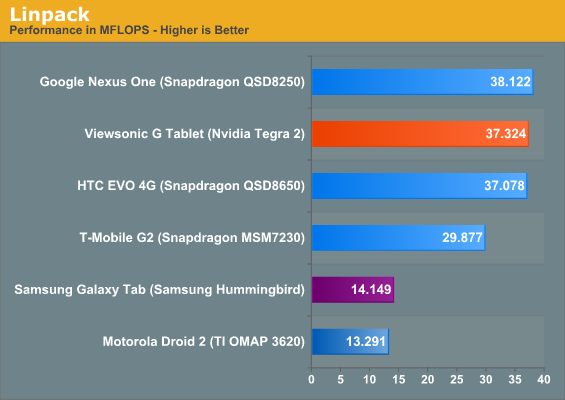
That said, based on some other benchmarks and their respective specs, tegra2 has roughly 2.5x more CPU power compared to the hummingbird SOC. (1ghz A9 runs 25% faster than 1ghz A8, and tegra 2 is a dual core A9) Anadtech's Linpack scores seem to show that too. (Ignore the bloated snapdragon class scores, it has floating point performance optimisations) Article here
GPU performance is where it gets interesting. It seems like the PowerVR 540 GPU on the hummingbird SoC is better than the GPU used in the Tegra 2 SoC. Odd considering nVidia make the tegra2. Instances where Tegra 2 outperforms the hummingbird in GPU benchmarks are as far as i can tell down to the extra CPU power (roughly 250% faster)
Samsung's upcoming Orion chip also looks promising, and is a closer match to the Tegra 2.
-
Re:Really??
Quadrant is a pretty flawed test.
That said, based on some other benchmarks and their respective specs, tegra2 has roughly 2.5x more CPU power compared to the hummingbird SOC. (1ghz A9 runs 25% faster than 1ghz A8, and tegra 2 is a dual core A9) Anadtech's Linpack scores seem to show that too. (Ignore the bloated snapdragon class scores, it has floating point performance optimisations) Article here
GPU performance is where it gets interesting. It seems like the PowerVR 540 GPU on the hummingbird SoC is better than the GPU used in the Tegra 2 SoC. Odd considering nVidia make the tegra2. Instances where Tegra 2 outperforms the hummingbird in GPU benchmarks are as far as i can tell down to the extra CPU power (roughly 250% faster)
Samsung's upcoming Orion chip also looks promising, and is a closer match to the Tegra 2.
-
Re:3 words for you
TFA is reporting a 100% success rate, but don't assume every 6950 is going to mod as well as this batch. It may be that the foundry have utterly nailed this chip and every single one is going to roll out at 6970 spec. But, it's probably just scale economies on the initial supply, scale economies do change over time. It might also be that *spins wheel* they deliberately did this because the 6970 is the only fully tested board yet. Or *spins wheel* they wanted these rumours to help sell their cards.
Or *spins wheel* their BIOS is coping brilliantly with potential problems, so even failures are being perceived as successes. For example, AMD's new approach is to underclock cards when they get near the TDP limit. Perhaps a "genuine" 6970 is only ever downclocking itself on Furmark, while the modded 6950's are doing so much more easily - quite plausable given you still only have the 6950 power connectors.
Anyone planning on buying one of these cards just found another reason to grab one sooner rather than later, but personally I'm going to be waiting a while anyway before considering modding mine.
-
Re:Not so much
P4 to core was a huge increase in performance per clock but that was some time ago and afaict increases since then have been more evoloutionary than revoloutionary.
I stand by my statement that the improvement in the last 3 years is closer to 2x that 4x at least for CPUs that are available at anything like a sane price, The hex cores push that to 3x but only if you have a heavily multi-threaded workload and nearly $1000 to drop on the CPU alone.
See for example an anadtech bench comparison of a Q6600 to an i7-950 http://www.anandtech.com/bench/Product/53?vs=100
But again you're talking speed. That's what this benchmark measures. Moore's law, on the other hand, talks about number of transistors.
The improvements that have come with the Westmere architecture are not to be scoffed at (unless all you look at are old code benchmarks[*]). Some of them include
- 32 nm processing
- six cores
- L3 cache shared by all cores
- huge page support
- graphics processor inside the CPU packaging
- lowered power usage
- SSE 4.2 and AES-NI instructions
- real mode virtualization
- Obsoleting the North Bridge.[*]: The benchmark is also flawed for the purpose of looking at what's new, in that it measure code compiled for the older CPUs, not what's possible on the new CPUs. So it's useful in telling you how your existing programs will run, not in telling you how things optimized for the new CPU will run.
-
Re:Not so much
In the last few years those things have been very distinct
P4 to core was a huge increase in performance per clock but that was some time ago and afaict increases since then have been more evoloutionary than revoloutionary.I stand by my statement that the improvement in the last 3 years is closer to 2x that 4x at least for CPUs that are available at anything like a sane price, The hex cores push that to 3x but only if you have a heavily multi-threaded workload and nearly $1000 to drop on the CPU alone.
See for example an anadtech bench comparison of a Q6600 to an i7-950 http://www.anandtech.com/bench/Product/53?vs=100
-
Re:Will Microsoft do its part?
But with what formats? See you really have to watch out for what I call "Intel speak" and I'll give an example: For years their chips could play high def MPG 1-2, but any other format would peg the CPU at 100% and bog the living hell out of the system.
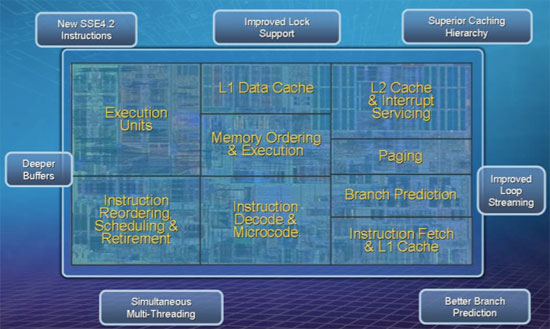
Well, if Anandtech is correct, then it's got dedicated HW decode support for at least most of the standards (MPEG2 & 4, H.264, DivX, VC1) to HD resolution. At least, that's what the slide says.
It doesn't sound like it'll be a problem.
-
Re:No games under Linux, yeah right.
And how are your framerates at maximum settings and resolution? Getting any visual or audio glitches and control problems? How much time do you have to spend configuring Wine for each game?
According to this, Wine gets on average 55 to 325 fewer frames per second than the same games running under Windows 7. -
Re:Ummm, kinda
Ok clear enough? However the problem is they fucked with the in-generation naming. Previously the 5870 was the highest end single GPU card, now the 6970 is. As such the situation you have is:
5750->6850
5770->6870
5850->6950
5870->6970Stop pretending this is an accident, it's deceptive marketing quite simply. Check out this graph. The 5870 and 5850 outperform the 6870 and 6850 respectively, and I'm not cherry picking graphs either it's across the board. No matter what ABCD system you use people will assume A+1 with all else being equal as a better card. It's not, it's a worse card. The truth of the matter is that both AMD and nVidia is in a bit of a bend here, they didn't get the 32nm process from TMSC they expected so their last round of cards are quite lackluster. If you have a relatively recent card the incentives to get a card in this generation are few. Currently they're not so much fighting each other, they're fighting themselves with people asking "Um, why should I upgrade my card again?". Hence the version numbers on steroids to make you think you moved up one generation and one performance level.
-
Re:Confusing naming
Heh, someone always brings that up whenever I mention videocardbenchmark.net, and I always point out that if they bothered to read the Anandtech in-depth review, it's pretty obvious why:
http://www.anandtech.com/show/2877
(5970 is basically two 5870 GPUs in one card, and looks like they had to downclock it slightly to make it stable).
To the driver, two GPUs on one card probably still looks like two separate GPUs, with several different ways to balance the load across them.
Most of those benchmarks are user-submitted... maybe the people with lots of money to throw at SLI rigs simply neglect to turn on the multiGPU option in their driver before running the benchmark? ^_^
I no longer have access to any SLI rigs, maybe you or someone else could download and run the benchmark and see if you can get the multiGPU option in the driver to make a difference.
-
Re:Confusing naming
Unless you have some sort of performance chart you can't tell shit.
http://www.videocardbenchmark.net/ gives a pretty comprehensive overview of just about every video card out there... this new AMD/ti video card will probably be added within the next few days. It's a great starting point before heading over to http://tomshardware.com/ or http://anandtech.com/ to read about all the details, caveats, and more comprehensive benchmark results.
Also, it tends to be the only good resource out there when trying to make comparisons between different market segments (what notebook GPU could keep up with my desktop GPU?) or completely different generations (would this cheap embedded GPU actually be a decent upgrade from my ancient media player box?)
-
Re:Crippled version of 580
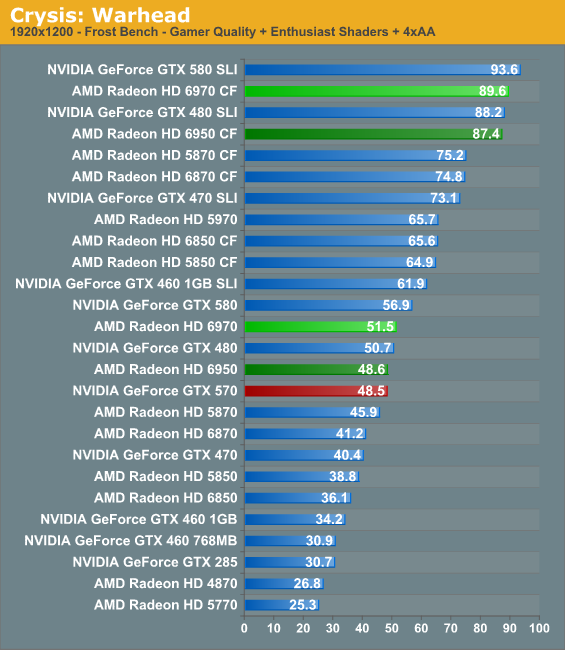
The performance is most certainly larger than 5% (Consider that it can have upwards of 50% performance improvement over the 470 which was launched earlier this year.), but you fail to consider that this performance will be delivered for fewer watts, saving power both in and of itself and through the reduced need for cooling. Benchmarks from AnandTech show that Crysis will give this card a workout when played at 2560 x 1600 with high settings, so it's somewhat disingenuous to claim that there's nothing out there that will tax this card. It's definitely a card for enthusiast gamers who want to use the highest resolutions and graphics settings so it's definitely not something the mainstream will care about.
The new cards also have significant compute advantages compared to previous generation cards. The 570 has 4x the performance of a 285 in some benchmarks. The 285 came out less than two years ago and cost significantly more at the time of release. OpenCL is allowing graphics cards the opportunity to do a lot of things other than just 3D rendering. For some workflows, investing in these powerful graphics cards is a lot better than buying better CPUs. -
Re:Crippled version of 580
The performance is most certainly larger than 5% (Consider that it can have upwards of 50% performance improvement over the 470 which was launched earlier this year.), but you fail to consider that this performance will be delivered for fewer watts, saving power both in and of itself and through the reduced need for cooling. Benchmarks from AnandTech show that Crysis will give this card a workout when played at 2560 x 1600 with high settings, so it's somewhat disingenuous to claim that there's nothing out there that will tax this card. It's definitely a card for enthusiast gamers who want to use the highest resolutions and graphics settings so it's definitely not something the mainstream will care about.
The new cards also have significant compute advantages compared to previous generation cards. The 570 has 4x the performance of a 285 in some benchmarks. The 285 came out less than two years ago and cost significantly more at the time of release. OpenCL is allowing graphics cards the opportunity to do a lot of things other than just 3D rendering. For some workflows, investing in these powerful graphics cards is a lot better than buying better CPUs. -
Re:When AMD turns to 28nm production...
Any chance Apple could use that for the next versions of Mac mini and MacBooks? Or is a Core 2 Duo with nVidia 320M still better than Fusion?
... according to Fudzilla.com
http://www.fudzilla.com/notebooks/item/20888-amd-apple-deal-is-28nm-notebooks
"Fusion goes Apple 28 / 32nm It all started here, when AMD’s Senior VP and Chief Sales Officer Emilio Ghilardi was brave enough to show an image of several Apple products in a Fusion presentation. After we wrote our part AMD was quick to deny it, perhaps a bit too quick, which gave us a reason to dig some more, only to find that we were on the right track.
We asked around and some sources close to Intel / Nvidia have denied the rumour saying that they know nothing about it. However, just a day later we managed to confirm that the leak is real and that Apple will indeed use Fusion, here.
Our industry sources have indicated that the deal will be announced in at some point 2011, that it will involve 28nm and 32nm Fusion parts particularly Krishna and that Apple plans to launch notebooks based on AMD chips. Apple is also not cold hearted on Trinity 32nm Fusion parts.
The announcement can be as far as a year away, as 28nm parts won't materialise until the second half of 2011 and since AMD doesn’t have a tablet chip, it won’t happen in iPad segment. At this point Apple doesn’t plan to use any AMD chips in desktop or server parts, but in case Bulldozer impresses us all, maybe Steve might change his mind.
So if you like Apple and love AMD, start saving money as roughly a year from now you should be able to buy Apple notebook with Fusion Krishna / Trinity class APU."
And if you want Fusion benchmarks, check the usual suspects: http://techreport.com/articles.x/19981 http://www.anandtech.com/show/4023/the-brazos-performance-preview-amd-e350-benchmarked
Invest that savings into AMD Stock and when the additions happen enjoy the ride. Apple will never use Intel or AMD in their embedded devices [iPhone, iPod, iPads] as their A# ARM based CPU/GPU combo they can control and develop with incredibly high ROI.
-
Re:They Why ZFS?
No ARC and no L2ARC and no ZIL I think.
But I do know at that speed, you possible don't want to add block deduplication, you need a lot of memory for that and CPU is probably already taxed. Just look at the thread about btrfs on the mailinglist, you will see that just doing checksums has to be done the right way just to keep up.
I think the -o nodatasum option actually disables the checksums, so that should tell you that the CPU's are probably already the bottleneck.
I think it is just a matter of time before some of these things will be implemented and btrfs is considered stable. The cool thing about btrfs is is, most of the features are added to the Linux kernel itself, it just is btrfs is one of the many users of that infrastructure. So other (future ?) filesystems can make of it as well.
I read somewhere that the btrfs b-tree is newer and thus possible even more suitable for filesystems like this. If that is true, maybe btrfs could end up at the top.
Here is some more info about a recent company using ZFS for their needs:
http://www.anandtech.com/show/3963/zfs-building-testing-and-benchmarking
-
Re:Fusion
-
When AMD turns to 28nm production...
Any chance Apple could use that for the next versions of Mac mini and MacBooks? Or is a Core 2 Duo with nVidia 320M still better than Fusion?
... according to Fudzilla.com
http://www.fudzilla.com/notebooks/item/20888-amd-apple-deal-is-28nm-notebooks
"Fusion goes Apple 28 / 32nm
It all started here, when AMD’s Senior VP and Chief Sales Officer Emilio Ghilardi was brave enough to show an image of several Apple products in a Fusion presentation. After we wrote our part AMD was quick to deny it, perhaps a bit too quick, which gave us a reason to dig some more, only to find that we were on the right track.We asked around and some sources close to Intel / Nvidia have denied the rumour saying that they know nothing about it. However, just a day later we managed to confirm that the leak is real and that Apple will indeed use Fusion, here.
Our industry sources have indicated that the deal will be announced in at some point 2011, that it will involve 28nm and 32nm Fusion parts particularly Krishna and that Apple plans to launch notebooks based on AMD chips. Apple is also not cold hearted on Trinity 32nm Fusion parts.
The announcement can be as far as a year away, as 28nm parts won't materialise until the second half of 2011 and since AMD doesn’t have a tablet chip, it won’t happen in iPad segment. At this point Apple doesn’t plan to use any AMD chips in desktop or server parts, but in case Bulldozer impresses us all, maybe Steve might change his mind.
So if you like Apple and love AMD, start saving money as roughly a year from now you should be able to buy Apple notebook with Fusion Krishna / Trinity class APU."
And if you want Fusion benchmarks, check the usual suspects:
http://techreport.com/articles.x/19981
http://www.anandtech.com/show/4023/the-brazos-performance-preview-amd-e350-benchmarked -
Re:They Why ZFS?
Not two tests, but a good overview of the benefits you can get from a ZFS system compared to some other storage options. http://www.anandtech.com/show/3963/zfs-building-testing-and-benchmarking
-
Re:Instruction set...
What layer? Their decoder is the translation, and although it doesn't take up 50%, it's not a trivial amount of space. Not only space, though, but pipeline: an instruction gets 5-deep into the pipeline just in terms of decoding whereas an equivalent A8 pipeline is only 3 stages. Branch penalties on x86 are nasty, which is why there's so much logic (caching decoded instructions, branch statistics, etc.) dedicated to alleviating the problem.
-
Re:They're not the only ones...
Yep, the new MacBook Air performs better than the old MacBook Air having processors of the same speed:
http://www.anandtech.com/show/3991/apples-2010-macbook-air-11-13inch-reviewed/6
Guess why. -
Re:If You're Late to the Party
WP7 is useless. Maybe WP8 will be interesting. who knows? Even Anandtech confirms in their review of the phone:
If you’re looking for a feature replacement to an Android phone or Windows Mobile device, WP7 will disappoint. Windows Phone is more like the iPhone than it is anything else. If you don’t like the iPhone (for reasons other than an inherent dislike for Apple), you probably won’t like Windows Phone. If your sole reason is disdain for Apple, then pick up a Windows Phone.
What I’m most excited about isn’t the fact that we’ll have another good competitor in the smartphone space, but rather the hope this gives me for Microsoft’s future products. Windows 7 was a nice OS, but it was nothing earth shattering and clearly did nothing to fend off Apple’s erosion of PC market share. Windows Phone 7 is a beacon of hope for Microsoft. If Windows Phone 8 and Windows 8 are designed with similar focus and clarity of thought as WP7 was, we may be looking at the beginning of Microsoft’s return.
So essentially, late to the party and failure. However, the new version of windows is 2 years off - are you going to think they're going to be positioned to compete by then, if they can't do it now? Guessing by the lack of a competitor now, I'm going to say no - not a chance.
-
Re:Competition is good.
Maybe in the ARM vs Atom championships?
When it comes to Atom, AMD is making a bid with their upcoming Ontario lineup for netbook/nettop dominance.
-
Good write ups, good card
http://www.pcper.com/article.php?aid=1034
http://www.hardocp.com/article/2010/11/09/nvidia_geforce_gtx_580_video_card_review
http://www.anandtech.com/show/4008/nvidias-geforce-gtx-580
http://www.legitreviews.com/article/1461/1/
http://www.techreport.com/articles.x/19934
http://www.bit-tech.net/hardware/graphics/2010/11/09/nvidia-geforce-gtx-580-review/1 -
Re:Am I the only one who is confused...
You're picking Intel's most expensive chip to try and prove a point, and failing horribly. Intel has a $279.99 offering on Newegg that beats the living shit out of the AMD processor for things normal people do on their home computers, and is damn close in the rest. Oh, and it uses far less power both at idle and at load. (Tom's didn't have power numbers for the i7-860).
Now, you might have a point about code "not being optimized for AMD blahblahblah", but here's a newsflash: Not only do the testing suites use libraries compiled with the Intel compiler, but so do nearly all the programs a home user runs on a normal basis. That means the argument is moot, because your average person doesn't give a shit what compiler Microsoft decided to use, and the ones who do can't just go "oh, let's use the AMD-optimized binaries!" - Intel performs better for the same price and lower wattage on real-world applications for this reason, period.
-
Re:I think this should be read more like...
Check Anandtech's review of the Macbook Air. Their battery test shows that flash and XviD both chew up about the same amount of battery (130 and 137 minutes battery lost, respectively), basically reinforcing my original statement, and your experience. Video decoding is pretty much the same in terms of processing power and battery consumption for most devices, not "an order of magnitude" different.
-
Re:Anything that gets phone makers to update...
uh, what? I think you just don't like android.
people root for additional features, not just "upgrades". People do happen to care about more than froyo, not everyone is a horse with blinders on.
examples: the shit the carriers take away: removal of bloatware, tethering, adding a percentage to the battery status as opposed to a "low/medium/high/full" battery status, changing the user interface, adding swype to phones that didn't have it, etc.
Android phones don't die off at all, people are still using the cliq and other phones that got upgraded to 2.1. I know people who still use the G1 because it is still being upgraded (hello? cyanogenmod?). What happens is no different than iphone: the old hardware isn't as good as the new hardware, and the new phones are also cheaper cost-wise.
Don't get me wrong, I don't mind google but don't love em, but when it comes to mobile phones they are the best for now - windows 7 phone doesn't even hold a candle to it nor is it intended to.. So until we get some better competition (which currently doesn't exist - iOS is not it), google will remain the best game in town.
-
Re:No kidding
Well that does lead one to ask a lot of questions, such as "how many HDD are in a rack", if a rack means 5 or 6 15k rpm HDD that were short-stroked(at this point whining about the cost of SSDs goes out the window). Maybe that can beat the SSD. But 6 or even 12 consumer level HDD used to their full capacity, cannot defeat a single SSD at random reads/writes:
-
Re:Spinning disks have left this customer
Why do you lie about HDD vs SSD random read/writes:
Even the 10K high-end pricey WD Velociraptor has a pathetic 0.8MB/throughput for random writes. Meanwhile a value level Intel SSD gets 35MB/sec throughput for random writes? How do you think putting 4 of those high end HDD together will make then faster than an SSD? The fact is they won't.
Plus if you think an SSD is a waste, why would you even entertain the suggestion of capping a 1TB HDD to 32GB? Do you have an benchmarks proving this is faster and really drops seeks to near zero?
-
Re:I tend to hold on to my tech for years...
With the finite number of read/writes to flash memory.
Spinning HDDs also have a limited life (5-10 yrs). I checked out life expectancies before buying my Intel X-25M earlier this year.
A quote from anadtech: "... Intel will guarantee that you can write 100GB of data to one of its MLC SSDs every day, for the next five years, and your data will remain intact."
This thread on Anandtech suggests lifetimes of 100s of years for home users.
Intel X-25m specs state 1.2 million hours Mean Time Before Failure (MTBF).
Of course I have a backup regime using rsync and CCClone and also store mail on external servers just in case - but I did this with the original HDD too
I don't want to be forced to part with a computer because it uses a proprietary flash storage system or be forced to purchase a proprietary replacement storage module. Things like iPods, smart phones, and PDAs are cheaper and easily replaced in whole, but I wouldn't want to face a replacement cost for a laptop.
X-25M and others(OCZ etc.) have standard SATA interface and form factor but yes, it would be a worry if the storage was soldered to the mobo.
-
Re:I tend to hold on to my tech for years...
With the finite number of read/writes to flash memory.
Spinning HDDs also have a limited life (5-10 yrs). I checked out life expectancies before buying my Intel X-25M earlier this year.
A quote from anadtech: "... Intel will guarantee that you can write 100GB of data to one of its MLC SSDs every day, for the next five years, and your data will remain intact."
This thread on Anandtech suggests lifetimes of 100s of years for home users.
Intel X-25m specs state 1.2 million hours Mean Time Before Failure (MTBF).
Of course I have a backup regime using rsync and CCClone and also store mail on external servers just in case - but I did this with the original HDD too
I don't want to be forced to part with a computer because it uses a proprietary flash storage system or be forced to purchase a proprietary replacement storage module. Things like iPods, smart phones, and PDAs are cheaper and easily replaced in whole, but I wouldn't want to face a replacement cost for a laptop.
X-25M and others(OCZ etc.) have standard SATA interface and form factor but yes, it would be a worry if the storage was soldered to the mobo.
-
OSX does not have TRIM yet
However many SSDs have garbage collection. In particular, drives with the SandForce controller do garbage collection and work fine in Macs (not to mention they're pretty good for price to performance based on benchmarks from AnandTech).
-
Re:Oh wow! New graphics cards!
That's great it works for you, but not everyone jsut plays old games. Any new game will bring a 4870 to its knees at the highest detail settings.
Just check out the benchmarks if you don't believe me:
http://www.anandtech.com/show/3987/amds-radeon-6870-6850-renewing-competition-in-the-midrange-market/6The 4850 is in a few tests, but you can look at the 5770 for the rest, it's quite close to the 4870.
Also, keep in mind a lot of gamers play in 1920x1200 and now 1920x1080, but even in 1680x1050, the 4870 or 5770 fails to exceed 30-40fps average in any recently game.
I've got a GTX480 and at 1920x1200 4xAA, it can be brought under 60fps in the newest games which is why some gamers have 2 of them in SLi.
-
Re:iPhone 4
This is a Samsung Epic review, not a comparison with other phones, as far as I can tell.
Err is that why other phones are in the graphs? For a more detailed and IMO better review this page on Anandtechhas wifi only comparison including the iphone 3gs and 4.
-
Re:Not impressed
actually the G2 has some of the best performance based on some benchmarks from AnandTech. If it's running bad on the G2, it's probably going to be worse on a lot of other phones. Of course this is still a beta so things will likely improve before the actual release, but you can't just dismiss the issues as being due to the hardware.