Slashdot Mirror
Domain: anandtech.com
Stories and comments across the archive that link to anandtech.com.
Comments · 3,318
-
Re:Ancient CPUs (upgrade comparison)
Tom's cpu chart is a great tool, but they don't generally compare older chips to newer ones. They also change the testing credentials from time to time, so there's no real way to directly compare old vs. new.
Anandtech has a new cpu benchmark site that compares everything from a single-core atom up to the top-of-the-line core i7. They've also recently added two pentium 4 chips to the mix so you really can directly compare them to the newer stuff. Check it out:
-
Re:Speed and latency matters
Yeah you're probably going to be right since:
Modern 1TB drive = 120MB/sec
Old 10GB drive= 10MB/secBut wise people care how long the site backups take. Because if the site _restore_ takes as long it's a problem. So that probably means moving to a "hot standby" sort of backup- which won't be as cheap since you'd need extra stuff - running live off your only backup system is not a good idea.
As for saying "for random access" there's SSDs, does that mean more of us will be using SSDs in the future, and fewer of us using 100TB drives? Or are Seagate and friends going to embed small flash buffers in their drives?
The buffers won't help for sustained random writes, but one would hope most random writes are bursts.
BTW many current Flash SSDs are slower for random writes. While Intel's are at about 23MB/sec, the rest can be amazingly bad - many even worse than "spinning disc drives"!
See: http://www.anandtech.com/printarticle.aspx?i=3531
Look for: "4KB Random Write Speed"
-
Another test at anandtech.com
http://it.anandtech.com/IT/showdoc.aspx?i=3571
Includes information about virtualization performance: http://it.anandtech.com/IT/showdoc.aspx?i=3571&p=9
Conclusion:
"The six-core Opteron is not an alternative to the mighty Xeons in every application. The Xeons are more versatile thanks to the higher clockspeeds, higher IPC, Hyperthreading and higher bandwidth to memory. The Xeon 55xx series is clearly the better choice in OLTP, ERP, webserving, rendering and there is little doubt that it will continue to reign in the bandwidth intensive HPC workloads. There are two types of applications where we feel that the AMD six-core deserves your attention: decision support databases and virtualization." -
Another test at anandtech.com
http://it.anandtech.com/IT/showdoc.aspx?i=3571
Includes information about virtualization performance: http://it.anandtech.com/IT/showdoc.aspx?i=3571&p=9
Conclusion:
"The six-core Opteron is not an alternative to the mighty Xeons in every application. The Xeons are more versatile thanks to the higher clockspeeds, higher IPC, Hyperthreading and higher bandwidth to memory. The Xeon 55xx series is clearly the better choice in OLTP, ERP, webserving, rendering and there is little doubt that it will continue to reign in the bandwidth intensive HPC workloads. There are two types of applications where we feel that the AMD six-core deserves your attention: decision support databases and virtualization." -
VMWARE server is bad choice for this app
Why would anyone use VMware Server in a production environment? It is not meant to be a heavy-duty hypervisor as it runs on top of another OS.
ESX 3.5 and 4.0 are meant to run mission critical applications.
Anandtech ran up 8 VMs on top several server CPUs, including the new six-core. Those 8 VMs include a heavy Oracle OLTP database (2x) and 100 GB large SQL Server database:
ESX 3.5 and 4.0 benchmarksVMware ESX is about running several instances of Windows and Linux on top of the same machine and manage them easily. FreeBSD Jails are of course a better solution if you just want lots and lots of small machines and the management overhead is zero. Jails are what is called "Container based virtualization".
Container based virtualization -
Re:Not the new desktop socket
Please refer to the excellent Anandtech preview article on Lynnfield that will be the first family of CPUs to use LGA 1156. Lynnfield has uses a dual-channel DDR3 controller instead of using triple-channel integrated memory controller in its uncore like Nehalem does. However, the dual-channel controller should still provide enough bandwidth for most desktop apps (the Nehalem architecture is not bandwidth constrained at all, unlike all previous generation CPUs including Core2 that used massive L2 caches to offset the memory bandwidth bottleneck due to the FSB).
However, the main difference between Lynnfield/LGA 1156 and LGA 1366 used in servers is the fact that it doesn't use QuickPath at all. Instead, it uses a combination of integrated PCIe 2.0 x16 controller (to talk to the graphics subsystem) and a (much slower) DMI controller to talk to everything else. Its an interesting alternative to QuickPath which is frankly expensive overkill for desktops anyway. The key advantage of the new socket will be significantly lower prices of motherboards and CPUs, which will allow Intel to provide some credible alternatives to AMD's current offerings that may be slower than Nehalem but are also much cheaper.
-
Re:Not the new desktop socket
LGA 1156: Also, there is 16 PCIe links on the processor die directly and there is only 2 GB/s connection from CPU to P55 PCH. No QPI. More information is here: http://www.anandtech.com/cpuchipsets/showdoc.aspx?i=3570&p=2
-
HP LP2475w and panel lotteries
That does look like a nice screen. My Westinghouse is nice, has an MVA panel, but is now only being sold with a TN (at first I felt ripped off, when I saw it go from $700 to $399... but then I checked out forums, so at least I know why).
It does seem like a lottery in getting a monitor with an IPS panel. This happens with Dells, HPs, and Samsung along with other companies, even Viewsonic. Hardly any brick and mortar stores sell these monitors so they have to be ordered online. Yet companies like Newegg that do sell them don't guaranty a monitor will have an IPS panel. What's worse is that they have bad exchange policies for monitors with dead or stuck pixels. I think Newegg requires 7 before they will exchange a monitor and they wait to test a returned monitor before shipping a replacement.
After searching and driving to different stores I found an employee at a Best Buy that found the HP online, at Best Buy for Business website. So if and when I get one, I'm hoping to in a month or two, I may be able to take it to Best Buy for an exchange. Normally for a purchase like that I'd also buy a buyer protection plan but in this case I won't have to, HP's warranty on it is a 3 year on site plan. If I have a problem I can call HP and they'll send a tech to me. Because of this instead of ordering it from Best Buy I may get it from B&H Photo and Video. Because of the panel lottery and dead, stuck, pixel issue I'll have to check their return policy first though.
Falcon
-
Re:Leopard 10.5.7 and DVI-HDMI connectors
That does look like a nice screen. My Westinghouse is nice, has an MVA panel, but is now only being sold with a TN (at first I felt ripped off, when I saw it go from $700 to $399... but then I checked out forums, so at least I know why).
-
Re:THIS JUST IN
I would expect someone on slashdot at the least to know that you can't just compare clock rates like that, and possibly even understand why the Atom does much less per clock than other architectures.
While we're on the subject, Anandtech made a good article explaining the technical details behind the it.
-
Re:I feel nerd-emasculated
Not trying to be offensive, but you are wrong. A GTX285 card is the most powerful single-GPU processor for gaming out there right now. 2 GTX 285 processors in SLI are the only thing that can play some games in 2560x1600 resolution at the highest quality settings. So to make your analogy more appropriate, its like the way an off-roader looks at a car designed to win the Baja 1000. Here is a benchmark that makes my point: http://www.anandtech.com/video/showdoc.aspx?i=3501&p=6
The article doesn't mention the price, but I suppose it would cost more than the GTX 295, so this card would be expensive. The advantage of it though, is you can stick enough graphics power in a single slot to power a 30 inch monitor at the highest settings with playable framerates in almost any game. So while I can not speak for every nerd, this is surely not tech purely for the sake of tech. No one could get something with half the RAM, less processor power to do everything this card can do that I know of. Perhaps you could prove me wrong on that point?
So while some think your post is insightful, I think you have no idea what you are talking about. This card was made to fill a niche in the high end gamers market, pure and simple. -
Re:GDDR3
Hmmm, maybe I was right:
http://www.anandtech.com/video/showdoc.aspx?i=3341&p=1
"The Radeon HD 4870 and 4850 both use a 256-bit memory bus like the 3870 before it (as well as NVIDIA's competing GeForce 9800 GTX), but total memory bandwidth on the 4870 ends up being 115.2GB/s thanks to the use of GDDR5. Note that this is more memory bandwidth than the GeForce GTX 260 which has a much wider 448-bit memory bus, but uses GDDR3 devices."
Different card, but you get the idea.
-
Re:So?
Here you go, along with many other game frame rates. Looks to me like Win7 beat XP on every one of them
-
Re:But...
Well, AnandTech benchmarked Windows 7 against XP. It did well, and beat XP in many categories. There you go, no need to thank me.
-
Re:So?
-
Re:Linux already has this
You've quoted the marketing fluff from the article about what Microsoft says TRIM support in Windows 7 will achieve. Do you think that this is a demonstration that you understand TRIM?
I'd refer you to the link higher up the thread. Now it's a hell of a long article, but at least it explains what TRIM is. It allows blocks to be invalidated on the drive directly. Without waiting for them to be overwritten. Note that this explanation is two short sentences and explains *exactly* what TRIM is. Your quote is a marketing attempt to explain what TRIM will achieve.
So the noop scheduler would be the correct choice for a drive that supports TRIM, as the GP claimed. Although the scheduler itself will still need direct support for sending TRIM commands to the storage.
-
Re:Linux already has this
noop scheduler != support for SSDs.
Sequential writes in common Flash SSDs are faster than random writes. Sequential reads are also usually faster than random reads.
See: http://www.anandtech.com/printarticle.aspx?i=3531
For RAM + battery based SSDs, while there's still a difference the difference should be unnoticeable for drive workloads.
-
Re:So?
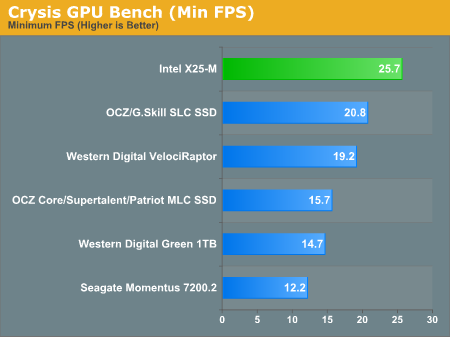
They also forgot the most important test with Crysis - framerates!
Older tests have proven that SSDs have a massive impact on the minimum framerate for texture hungry games. Waiting 15ms for some textures is bad since that wastes most of that whole frame.
I don't understand why the article writer is so enamored by burst speeds. Burst is just data coming in from cache... my old 320GB Seagate drives get burst speeds over 200MB/sec. I threw four of them in RAID and was enjoying a comfortable 700MB/sec burst speed; though sustained read was barely over 220MB/sec.
But burst almost never comes into play. The most likely scenario for seeing its effect would be... starting up a game, exiting, then starting the same game over again. Although I suppose burst is several seconds long, so it does reflect on the drives' skill in reading data before it's needed. (Something SSDs don't really have to do, so no impressive data bursts; just super high sustained read)
-
Re:Theoretical != Real World speeds
Hehe.
Actually, you may be disappointed if you buy SSDs for the boot speed. HDD manufacturers have done a remarkable job optimizing that. And in the case of an OS like Vista, the benefit from an SSD's low latency is dwarfed by the benefit from an HDD's raw read speed. Those 640GB Caviar drives are apparently one of the fastest booting HDDs/SSDs. (unless you go incredibly high end)
SSDs have been proven enormously helpful for games, though; especially games where you can't possibly store all the textures in memory, such as... Crysis.
I think your post is either terribly misinformed, or you are overstating yourself. I have no idea how can say a 320GB platter drive (and there are 500GB ones now too...) could possibly hope to outperform all but 'incredibly high end' drives. Look at the OCZ Vertex, or G.Skill Falcon (or the supertalent drives etc based on the same controller). The smaller sizes are around the price of a velciraptor (admittedly smaller though, but still large enough for vista + some apps), and they blow the velciraptor out of the water. Don't just take my word for it: http://www.overclock3d.net/reviews.php?/storage/ocz_vertex_120gb_sata2_ssd/7 And that crap about it being enormously helpful? Sure it definitely is desirable, but not even that benchmark you posted is fair for crysis (as they admit in the article...). For the vast majority of the time, SSDs only improve load time (note your floppy RAID array does not count).
-
Re:Theoretical != Real World speeds
Hehe.
Actually, you may be disappointed if you buy SSDs for the boot speed. HDD manufacturers have done a remarkable job optimizing that. And in the case of an OS like Vista, the benefit from an SSD's low latency is dwarfed by the benefit from an HDD's raw read speed. Those 640GB Caviar drives are apparently one of the fastest booting HDDs/SSDs. (unless you go incredibly high end)
SSDs have been proven enormously helpful for games, though; especially games where you can't possibly store all the textures in memory, such as... Crysis.
-
Re:What is the point?
Actually the limit is 300MB/s which some of the new drives are very close to reaching. One more generation of SSDs and they'll be bottlenecked by SATA 2.0.
-
Re:Atom
Check out Anandtech's Bench. Specifically, the new Atom 230 and 330.
It simply depends on what your task is. -
Re:OCZ Throttle
I recommend you read some or all of this Anandtech article about the current state of SSD drives. The author has a clear preference for Intel SSD, with data to back up his decision, but makes it very clear that every write and delete operation you do on an SSD drive brings it that much closer to extinction. I highly recommend you at least have a look at the diagrams in this article and re-evaluate how you use your very expensive SSD.
-
Re:How to get out of a recession in 2 easy steps..As arstechnica mad explicit, Intel's response that they "never sold below cost" is beside the point:
But, in the face of some of the specific allegations made by the EU, some of Otellini's statements seem almost besides the point. For example, Otellini states that, "Intel never sells products below cost," and "there has been absolutely zero harm to consumers." Both of those may be true, but that doesn't necessarily mean that Intel wasn't abusing its dominant market position.
What's more:
Intel has already said that they are going to appeal the fine, and that it âoeignores the reality of a highly competitive microprocessor market.â Notably, they arenâ(TM)t appealing the facts, but rather the conclusion (that it was harmful to consumers) and the fine. Itâ(TM)s likely that any appeal will take just as long as the initial examination, so itâ(TM)s unlikely that this will be over before 2011, if not later.
-
Anandtech explained this months ago
Once again I'm shocked by how terrible Slashdot is for anything hardware related. Just as has been said every time anyone has mentioned these pathetic articles from magazines like Computerworld (!), THIS ISN'T NEWS - ANANDTECH EXPLAINED IT VERY CLEARLY MONTHS AGO.
http://www.anandtech.com/storage/showdoc.aspx?i=3531
Even without reading an article, I'm surprised this isn't intuitively obvious to most Slashdot users. I'm also surprised that the majority of hardware articles posted here come from jokes like Computerworld. There needs to be a Shouldhavecheckedanandtech tag for stories.
Windows 7 actually eliminates this degradation for all SSDs through inclusion of the TRIM command, but the necessary cost is shorter device lifetime, which is why the TRIM command won't run automatically. Likely, other operating systems will include it within a couple years.
-
Re:Tom's Hardware
Which article would that be, or did you mean Anandtech ?:
-
Re:"Drastically affected its performance"
"your SSD will perform better than any platter based drive even when totally full"
I suggest you first read up on that:
http://www.anandtech.com/storage/showdoc.aspx?i=3531&p=8
Not just any SSD, some have stutter, some degrade in very bad ways, I would say: "if you choose wisely your SSD will perform better than any platter based drive. But you won't be buying the cheapest SSD" or something of that nature.
Good SSD's are very expensive in comparison to HDD's.
-
Anandtech talked about this back in March
-
Re:No Virtualization on some new Intel
A recent example would be the new Core 2 Quad Q8400, now with less VT!
It seems, though, that the article you reference has backpedaled on that claim:
Update #2: Intel has just confirmed that the Core 2 Quad Q8400 does support Intel's VT-x from the start, so the update below is incorrect. The Q8300, E5400, E5300, E7500 and E7400 will also end up transitioning to versions with VT-x support as well but only the Q8400 supports it from launch.
So it would seem that this oft-repeated wisdom of the masses is in fact wrong, and the Core 2 Quad Q8400 has VT support after all.
-
Therefore Headline is FALSE!
So according to what you're saying, and what the Anandtech article said, the headline is just plain Wrong!
http://www.anandtech.com/storage/showdoc.aspx?i=3531&p=1
The slowdown is only particular to NAND Flash. Dynamic RAM based solid state drives don't suffer from this phenomenon. (Gigabyte i-Ram and ACARD ANS-9010) However, they are definitely also Solid State Drives.
-
Re:Just a small dip in performance
Totally different issue. The problem here is inherent in all flash drives, but can be mitigated by clever controller design. AnandTech made an extensive report on this issue.
-
Not News
This is old news, and both the Intel drives and the OCZ Vertex have updated firmwares/controllers that remedy (but do not completely solve) the issue.
When we get support for TRIM, it will be even less of an issue, even on cheapo drives with crappy controllers/firmware.
The issue won't be completely solved ever, because of how SSD arranges flash memory and how flash memory can't really be overwritten in a single pass.
See anandtech's write up if you want details.
http://www.anandtech.com/printarticle.aspx?i=3531 -
Re:First generation SSD immaturity...
"This has nothing to do with technological immaturity or firmware bugs. It's simply a matter of SSDs using an optimization that hard drives can't due to their non-trivial seek times, and people are starting to realize that that optimization doesn't always work."
Actually it does, you should check out ANAND's article here:
http://www.anandtech.com/storage/showdoc.aspx?i=3531&p=8
There definitely IS some immaturity (broadly speaking) if you go through the entire article about how other SSD's were designed and their particular problems.
-
good article on the reasons behind this
http://www.anandtech.com/storage/showdoc.aspx?i=3531&p=4
Anandtech has a very detailed article that explains all about this and some ways to recover the lost speed (sometimes).
-
No Virtualization on some new Intel
AC obviously didn't read the article, which states clearly that Intel uses VT availbility as a market segregation tool.
A recent example would be the new Core 2 Quad Q8400, now with less VT!
-
Re:The reason people will move
mod up.
can anyone cite any thorough benchmarking or study that compares win7rc and win xpsp3 and says that xp is significantly and convincingly faster than win7. i can cite one that says the opposite. -
Re:Windows 98 FTW
and even when benchmarks done by some other people actually show win7 and xp neck to neck and win7 better for games. people need to understand that benchmarking results should be subjective.
-
Very Sneaky Summary - Lies Worthy of a Politician
The summary says that 7 isn't much faster than Vista, and then says that Vista is much slower than XP. The implication is that 7 is slower than XP, which a lot of people seem to be commenting on here. However, the summary is very deceptive. Notice the lack of a link to a direct XP to 7 comparison (there are plenty). Now notice that the "Vista is slow" article is from 2006, back when Vista was slow.
If you want to look at a comparison that isn't sadly out of date or intentionally obfuscating the relative performance of these operating systems, look here:
http://www.anandtech.com/systems/showdoc.aspx?i=3557&p=15
Click through all the performance pages. As usual, Anandtech does it right and is ignored by Slashdot, while some silly article by technically challenged people is featured. To summarize the direct comparison between 7, XP, and Vista:
Vista is usually slower than XP - by about 2%. 7 is usually faster than XP - by 2-10%. Everyone who is posting the "I hate MS as much as every other weirdo Slashdot fanatic but it makes sense than XP is the fastest" should cut it out and note instead that 7 is the fastest OS that Microsoft has produced since at least Win2k.
-
Re:Once upon a time
You seem to be off by a bit. The GTX 285 is the current best-performing single card from nVidia, and the 4850 shouldn't even really be considered high-end since it's basically a budget 4870 (which itself has since been replaced by the 4890 as the single-card performance leader for ATI).
Anandtech has a few reviews with some nice spec comparison charts for most of the current models, with more details in the articles they're attached to.
-
Re:Once upon a time
You seem to be off by a bit. The GTX 285 is the current best-performing single card from nVidia, and the 4850 shouldn't even really be considered high-end since it's basically a budget 4870 (which itself has since been replaced by the 4890 as the single-card performance leader for ATI).
Anandtech has a few reviews with some nice spec comparison charts for most of the current models, with more details in the articles they're attached to.
-
Re:Once upon a time
You seem to be off by a bit. The GTX 285 is the current best-performing single card from nVidia, and the 4850 shouldn't even really be considered high-end since it's basically a budget 4870 (which itself has since been replaced by the 4890 as the single-card performance leader for ATI).
Anandtech has a few reviews with some nice spec comparison charts for most of the current models, with more details in the articles they're attached to.
-
Re:Umm.. DUH!?
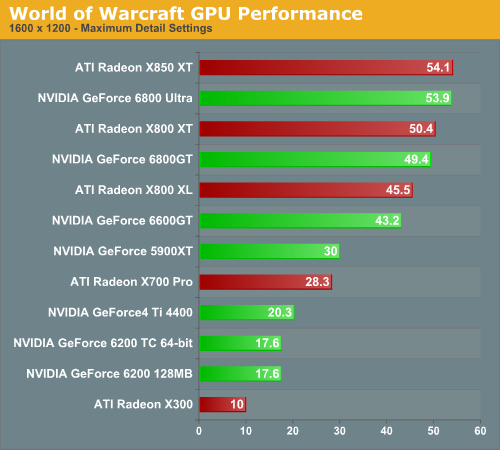
Shadows.. sounds like graphics card. Dying graphics cards don't usually get slow, though, they crash! What temperatures are you getting? If it's hitting up around 90 celsius it could be underclocking itself? A 7800 GTX is vastly more powerful than needed to play WoW at just about any res. Think: 70, maybe 100 FPS or more. http://images.anandtech.com/graphs/world%20of%20warcraft%20performance_032305120358/6552.png http://www.anandtech.com/video/showdoc.aspx?i=2381&p=5 Ditto for CPU. Do other games show the same problem?
-
Re:Umm.. DUH!?
Shadows.. sounds like graphics card. Dying graphics cards don't usually get slow, though, they crash! What temperatures are you getting? If it's hitting up around 90 celsius it could be underclocking itself? A 7800 GTX is vastly more powerful than needed to play WoW at just about any res. Think: 70, maybe 100 FPS or more. http://images.anandtech.com/graphs/world%20of%20warcraft%20performance_032305120358/6552.png http://www.anandtech.com/video/showdoc.aspx?i=2381&p=5 Ditto for CPU. Do other games show the same problem?
-
Oh no, we're all gonna die
Scan down on this series of graphs that Nintendo showed at the GDC to the graph titled "Nintendo driving US Growth." The level of sales of games across all platforms has been fairly flat for most of the decade... up until the Wii came out, at which point the other two consoles continued to sell at a mostly flat rate but Nintendo's went up and up.
It's sort of a harbinger and a point of relief. On the one hand, When you've hit a wall on the number of people who are really interested in devoting so much of their time to a 40+ hour game, the only way to go up is with people who aren't in that group. Microsoft wants more money just like everyone else, so they have to expand into the same area. But it's still a mark that there's a solid base of hardcore fans as well that are always going to need to be served, and when Microsoft's plans to make the XBox wii-ish fails to bring in a large new audience because they realize that they're not the Wii, they're going to have to think about serving the base that they've got already.
I'm also a bit loathe to decry the sudden death of hardcore gaming when just last year, 2008, we were decrying the fact that we were trying to find time to play Fable 2, MGS4, GTA4, Fallout 3, and a host of other solid games. The fact that release schedules aren't lining up very well in this year's favor isn't going to scare me off just yet, and that's just about the only real evidence that he offers that the hardcore gamer is about to die. What's more likely is that we just won't have the same glut of triple-A-grade content devoted to them.
I don't know why the hardcore gamers are worried, though. They're just gonna spend all their time playing Diablo 3 and Starcraft 2 in a couple of years anyway.
-
Re:You should be looking at random I/O speeds
I think you misunderstood. Your experience vs. mechanical drives has nothing to do with the issue. The AC said that the OCZ was faster than the Intel. Chris Daniel was simply saying "yes the OCZ is a bit faster for sequential acces, but random access (which is what most users experience the most) is better on the Intel"
If you look at Anand's article You will see that the OCZ beats the Intel slightly at sequential read (about 5%), and by a decent margin on sequential write (slightly less than 3x). However, these aren't things most users typically do...especially the writes. You are only likely to be doing that if you are working with editing large a/v files or something, and since large a/v files take up tons of space, a SSD probably isn't the best candidate for that anyway, given its current cost/storage metric. The OCZ might make sense working in a something like a professional AV editing environment, where you can copy the file off the server, work on it locally, and then copy it back to the server when done.
On the other hand, random reads and writes are something that virtually 100% of users experience on a regular basis, and this is where Intel really shines. On reads, Intel wins by a decent margin (slightly less than 2x the speed, and nearly half the latency). But then look at sequential writes, and Intel really takes the decisive win in that category. While the OCZ is a healthy 4x faster than Velociraptor, the Intel is just shy of 10x the performance of the OCZ (and thus nearly 40x the Velociraptor).
So, when you compare the Intel and the OCZ, the Intel loses slightly and decently on 2 operations that are less common, and it wins decently and decisively on 2 operations that are more common. Thus it's a pretty good stretch to try and say the OCZ is faster than the Intel.
-
Re:A first too
Intel could be the first among vendor/OS developers to admit drive fragmentation COULD BE an issue, in certain usage patterns.
Not quite, AFAIK, Anandtech broke the story here and though he did say the Intel was the SSD vendor who was the least affected by the fragmentation bug, he also details that OCZ had already made great progress in resolving it's issues and becoming the SSD price/preformance king.
-
Re:You should be looking at random I/O speeds
I'm not implying that you are in any way wrong or incorrect, but I recommend that you also read http://www.anandtech.com/printarticle.aspx?i=3531 in order to further reinforce your knowledge and experience in the topic at hand. I am pretty confident that you will find things in that very informative article that you didn't know and that also apply to your situation.
-
Re:Please, no more smokescreens.
The problems which that link discusses are general problems, not Intel's. Even in the worst case, the Intel drive is still better than all the other MLC drives. Anand did a very thorough analysis here and it's probably one of the best mainstream pieces of technical writing I've ever seen.
He basically justifies the whole existence of Anandtech with that one article.
-
You should be looking at random I/O speeds
The new OCZ & Samsung drives are faster (and larger) than the X25-M.
For sequential read/write -- yes, they are faster than Intel's offerings. Random read and write operations, on the other hand, are another story. That's one of the biggest issues that SSDs solve versus spinning platters, and no one has gotten it right so far, except Intel.
-
Every SSD has this problem
We've all read this by now, right?
http://www.anandtech.com/storage/showdoc.aspx?i=3531
The X25 has the same problem as all the other flash drives due to the need to erase in big chunks. Post-slowdown, the X25 is still faster than almost any other SSD that's brand new, and given the same usage, the X25 maintains the huge performance advantage it has from the start. I doubt Intel can really do much to improve this behavior without using TRIM.
I assume their "fix" will be slight tweaking of writing patterns done mostly to fool the mainstream press that had already been acting foolish by picked up this story without noticing the subtleties (such as the problem being present in all SSDs)