Slashdot Mirror
Domain: arxiv.org
Stories and comments across the archive that link to arxiv.org.
Stories · 808
-
Raining Extraterrestrial Microbes in Kerala?
jdfox writes "World Science is reporting on a controversial paper to be published shortly in the peer-reviewed research journal Astrophysics and Space Science, describing a strange red rain that fell in India in 2001, shortly after a meteor airburst event in the area. The authors posit that the red particles found in the raindrops may be extraterrestrial microbes. The authors' last two papers on the subject were unpublished: this published paper is more cautious. The paper can be viewed online, and should obviously be considered in context. More info on the 'panspermia' hypothesis can be found at Wikipedia." -
Raining Extraterrestrial Microbes in Kerala?
jdfox writes "World Science is reporting on a controversial paper to be published shortly in the peer-reviewed research journal Astrophysics and Space Science, describing a strange red rain that fell in India in 2001, shortly after a meteor airburst event in the area. The authors posit that the red particles found in the raindrops may be extraterrestrial microbes. The authors' last two papers on the subject were unpublished: this published paper is more cautious. The paper can be viewed online, and should obviously be considered in context. More info on the 'panspermia' hypothesis can be found at Wikipedia." -
Raining Extraterrestrial Microbes in Kerala?
jdfox writes "World Science is reporting on a controversial paper to be published shortly in the peer-reviewed research journal Astrophysics and Space Science, describing a strange red rain that fell in India in 2001, shortly after a meteor airburst event in the area. The authors posit that the red particles found in the raindrops may be extraterrestrial microbes. The authors' last two papers on the subject were unpublished: this published paper is more cautious. The paper can be viewed online, and should obviously be considered in context. More info on the 'panspermia' hypothesis can be found at Wikipedia." -
Totally Secure Non-Quantum Communications?
An anonymous reader writes "TEES is reporting that Dr Laszlo Kish, an associate professor at Texas A&M, has proposed a 'classical, not quantum, encryption scheme that relies on classical physical properties -- current and voltage. He said his scheme is absolutely secure, fast, robust, inexpensive and maintenance-free and relies on simultaneous encrypting of information by both the sender and the receiver.' The scheme uses properties similar to Johnson noise along with Kirchoff's Law to provide what he hopes to be an easier method of secure communications. Arxiv also has the full text [PDF Warning] of the paper." -
Search Engine Results Relatively Fair
perkr writes "The Economist and PhysicsWeb report on a study from Indiana University claiming that search engines have an egalitarian effect that gives new pages a greater chance to be discovered, compared to what would be the case in the absence of search engines. Based on an analysis of Web traffic and topology, this result contradicts the widely held 'Googlearchy' hypothesis according to which search engines amplify the rich-get-richer dynamics of the Web." -
Deep in the Core
meehawl writes "A video of what is currently thought to be the closest star to the supermassive black hole at the centre of our galaxy. The star orbits the black hole in a highly elliptical orbit with a period of 15 years or so, but at its closest approach it swings within 17 light hours of the black hole (around three times the distance between the Sun and Pluto). In the video, you can see the star ricochet past its closest approach to the black hole. This slingshot effect enabled astronomers to further pinpoint the mass of the black hole, which is confidently estimated at 2 million suns or so. The mass observation, coupled with the size constraints observed, indicates the object at the centre of the galaxy is definitely composed of some exotically dense form of matter." -
Quantum Information Can be Negative
nerdlygirl writes "In a development that would probably even puzzle Claude Shannon, information can be negative -- at least when the information is quantum. The discovery, by Horodecki, Oppenheim, and Winter, appears in the current edition of the leading journal Nature. If I tell you negative information, you'll know less. Apparently, researchers hope to use this to gain deeper insights into phenomena such as quantum teleportation and computation, as well as the very structure of the quantum world. More details can be found here and here A popular account of the article can be found on Oppenheim's homepage, and a free version of the article can be found in the arxiv for those of us without subscriptions to Nature." -
Help Solve the Mystery of the Pioneer Anomaly
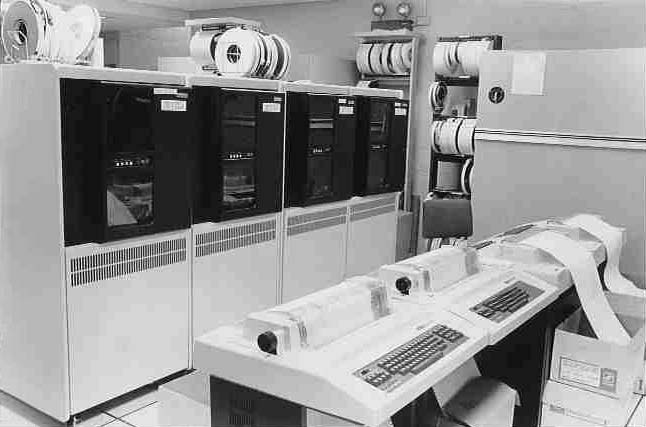
deglr6328 writes "Very soon, NASA will be dismantling and scrapping its only computer left which is able to access and process the data on its ancient 7- and 9-track magnetic tapes. "Who cares", you say? Well, the Planetary Society for one and they're hoping you might care as well. The data held on these (few hundred) tapes is no ordinary forgettable data, it is the complete archive of the first 15 years of all the data returned to Earth by the Pioneer spacecraft which were sent into interstellar space. This additional and thus far unexamined data (the data after 1988 is available and has already been examined) may hold the key to solving what is considered one of the top problems in physics today, the so called Pioneer anomaly, where the observed trajectory of these spacecraft (and a couple others) deviates noticeably from our very precise expectation. The reason for the anomaly may be as mundane as uneven radiation pressure or escaping thruster fuel or it may be as groundbreaking as a clue to completely new physics, perhaps related to dark matter or dark energy. The Planetary Society is planning on recovering this data and poring over it meticulously to look for something which may have been missed or hidden from current investigations into the phenomenon. They need money to do this, about $250,000, and are asking for donations to fund the project. You do not need to be a member to donate. There are no serious proposals to send any more spin-stabilized spacecraft on solar escape trajectories any time in the near future and this is probably the only tenable method we have to directly investigate this mystery in the interim." -
Nanotechnology and Society?
VoiceOfZule writes "Bringing advanced sci-tech and humanities grad students to teach undergrads about nanotech and its implications is a great idea. I was in this class on Nanotechnology and Society at the University of Wisconsin-Madison this spring, and a lot of the course materials were just put online along with a preprint paper about the new course, and some of the student research projects. The class was a lot of fun (some nano, some scitech studies, some scifi/future stuff), I learned a lot (about the reality of nanotech and its societal implications beyond the B.S. hype out there), and the world of nano now seems like a good career path to me. Are similar experiences going on across the country? In light of recent worries concerning science and engineering in the US, I hope so." -
Roger Penrose and the Road to Reality
jkauzlar (Joe Kauzlarich) writes "You've had a long, tedious day at work. You have some money in the bank and decide that you need to spend some of it on yourself rather than hand it over to the Man. Therefore, being a nerd, you go straight to the bookstore after work. You don't see anything exciting in the new releases for science fiction; you look at the new pop-science books, but nothing jumps out at you from the shelf- but wait... what's this massive new book by the acclaimed physicist Roger Penrose, The Road to Reality? The subtitle seems a bit presumptuous: 'A Complete Guide to the Laws of the Universe.' You pick up the heavy volume to inspect its contents ..." Read on for the rest of Kauzlarich's review. The Road to Reality: A Complete Guide to the Laws of the Universe author Roger Penrose pages 1136 publisher Knopf rating 10 reviewer Joe Kauzlarich ISBN 0679454438 summary General audience introduction to modern physicsFlipping through the eleven-hundred pages, you notice the gratuitous inclusion of mathematical formulae and the chapter titles on the page headers -- "Quantum algebra, geometry, and spin," "Gravity's role in quantum state reduction," "Calculus on manifolds" -- suggest a far more exclusive audience than yourself, a lowly paper-pusher with a four-year degree. "But then, what's this doing in the popular new releases?" you ask yourself, "Shouldn't it be hidden away in the darkened corner of the store's physics section?" But that's where you're wrong, you realize, glancing through the author's preface; this book is for you: Penrose has, it seems, composed a mathematical physics book for the general audience -- and not merely an introductory one, but one that takes you to the frontiers of modern theory.
The trouble with the common popular-science books that propose to illustrate modern physical theories is in their implicit premise of avoiding mathematical notation and concept in favor of plain English. This works to an extent, but ultimately breaks down when the nature of the subject matter itself is mathematical. Indeed, after reading the wonderful Dancing Wu Li Masters, the reader is no more prepared to plunge into a textbook on modern physics or to comprehend even the titles of the latest mathematical physics papers on Arxiv.org. Physicists know about the fundamental particles or the nature of space only through the mathematics that model the phenomena. Which is not to say that such English language renderings are useless, but they skillfully devise to distance themselves from what physicists actually do, as well as to reenforce readers' natural aversion to numbers and formulae.
Penrose's approach is not to dive head-first into the most strenuous material or to assume a proper background for the comprehension of advanced physics; instead, the first several chapters are devoted to building the necessary mathematical subtext for the remaining bulk of the book. The volume's length is not, as is often the case, a result of lengthy diversions or pedantry (needless complexity); Penrose keeps his eye on the ball throughout, consistently informing the reader how the topic at hand is related to the over-arching theme and infusing the more well-known pedagogy with creative insight, so that even a talented math major may learn from the introductory chapters on number systems or geometry. What's more, the careful organization of the disparate topics permits a fluid drift from one to the next. The effect is a single cohesive book and not a collection of notes or essays.
With 390 illustrations and a generous supply of endnotes and bibliography entries, it's clear that Penrose didn't consider the work completed with the text alone. The inclusion of short problems within the footnotes hints to the reader what concepts are important to understand. The usual footnote-commentary is withheld for the endnotes at the end of each chapter.
It's probable that the name "Roger Penrose" might excite some memories you may have of his previous works, published over a decade ago, both of which explore the mind-brain relationship. At least one of these (Shadows of the Mind -- the other is the more popular The Emperor's New Mind) proposes a quantum theoretical explanation for consciousness which was perhaps too liberal to have been taken seriously by neurologists. Penrose's efforts in quantum theory have, however, been more successful than those in neurology: in 1988 he was awarded the Wolf Prize, one of the very highest honors in mathematics (perhaps second only to the Fields Medal), along with Stephen Hawking, and has made invaluable contributions to quantum physics for the past several decades, proving himself to be one of the finest scientific minds of our day. In consequence to his stature, it's certainly a treat for laypeople that Penrose has donated the time and energy to the creation of a monumental expository work for general consumption.
Whereas the average pop-science journalist reaches upwards to accrue a book's material, Penrose's acknowledged expertise on the subject forces him back towards the ground again. If you think about it, I suppose this is as difficult a task, since much of what Penrose describes he's known for forty or fifty years (he was born in 1931). He apologizes in the final chapter for the necessity of handpicking among the dozen or so "theories of everything," sometimes according to his own professional biases. Today's leading theory, "String Theory" along with the theory of "Loop Quantum Gravity," and the little known "Twister Theory," are all covered in the later chapters; the first portion of the book builds the mathematical foundations for the succeeding chapters, which give an indepth treatment of quantum physics and quantum field theory. These topics are followed by the previously described "theories of everything."
A glance at the table of contents may make or break your purchasing decision; chances are, if you find the mysteries of the terms somehow galvanizing, then you'll enjoy the book. On the other hand, if the eclectic terms frighten you, you should perhaps look at the preface (where Penrose gives solace to anxious readers), or it may be best to avoid the book altogether.
As I mentioned earlier, little has been done for the general audience to explore the wide expanse between physics and mathematics. The Road to Reality is, in this respect, a virtually pioneering effort, and given its size, scope and quality, I would venture to guess it will remain the de facto text in its area for many decades to come, and may safely be placed on your bookshelf next to E.T. Bell's Men of Mathematics, Douglas Hofstadter's Gödel, Escher, Bach, or Benjamin Yandell's recent (*highly* recommended) The Honor's Class: Hilbert's Problem's and Their Solvers.
I am fortunate to have had some mathematics education and so am familiar with the basic principles of complex numbers, calculus, and geometry, making the first several chapters, while still insightful, less toilsome than it might've been. I suspect that the average bright high school graduate would have no trouble with Penrose's quick treatment of these concepts. I would recommend the reader have at least some familiarity with the basic terms of mathematics and physics (i.e. when Penrose mentions "set" you know he's referring to a particular mathematical structure) or the book could overwhelm you quickly. Additionally, readers would be at an advantage having read "English-based" modern physics books such as The Dancing Wu Li Masters, Michio Kaku's Hyperspace, Brian Greene's The Elegant Universe or a similar book about 20th century quantum physics. Either way, it's safe to say that despite the virtuosic readability of the text, it's still going to take an intellectual commitment on the part of the reader to reap all of the available knowledge."
You can purchase The Road to Reality: A Complete Guide to the Laws of the Universe from bn.com. Slashdot welcomes readers' book reviews -- to see your own review here, read the book review guidelines, then visit the submission page. -
Bang But No Splash
BishopBerkeley writes "When a drop of ethanol is dropped on a surface at low pressures (1/5 atmosphere or less), it makes no splash. Science offers a brief synopsis and fascinating pictures of the phenomenon. The results seem to confirm the (perhaps counterintuitive) prediction that more viscous liquids are more likely to splash, not less likely . Links to the researchers' home page at U of Chicago (as of now, the site is timing out) and pdf version of the article on arxiv can be found on the Science page also." -
Deriving Semantic Meaning From Google Results
prostoalex writes "New Scientist talks about Paul Vitanyi and Rudi Cilibrasi of the National Institute for Mathematics and Computer Science in Amsterdam and their work to extract meaning of words from Google's index. The pair demonstrates an unsupervised clustering algorithm, which 'distinguish between colours, numbers, different religions and Dutch painters based on the number of hits they return', according to New Scientist." -
Twin Prime Proof Proffered
HateBreeder writes "Continuing on a previous slashdot story regarding Arenstorf's proof of the existence of Infinitely Many Prime Twins, it seems that a hole has recently been found in the proof, however mathematicians remain hopeful that the proof can be corrected." -
Don't Read My Lips
scitex writes "Two economists, Rasa Karapandza and Milos Bozovic, from University Pompu Fabra, Barcelona wrote a very interesting paper "You Can Fool Some People Sometimes..." They say that on all US Presidential Elections from 1960, when presidential debates were held, won the candidate that used less future tense in the debate. First debate was televised in 1960. They predict that these elections will be won by George W. Bush. They used a similar approach to analyze performance of US companies and found that companies that use less future tense in their annual reports perform better. Will this change the way companies write they reports and presidential candidates speak?" -
German Scientists Create 5 qubit Quantum Register
CMan0 writes "In the University of Bonn, a team of scientists has built a 5 qubit register, using cesium atoms trapped by a laser-beam grid, The Register reports. They've been able to install an empty 5 bit register(i.e. all bits 0), change two of them to 1, and later read those 1s back. The next goal is to create an interaction between 2 bits. The full scientific article can be found here in PDF format." -
General Solution for Polynomial Equations?
An anonymous reader writes "On september 9, several media reported that a young Dutch student found a formula to determine the roots of any polynomial equation. Does this conflict with Abel's proof that such a formula cannot exist? Here is the news item (in Dutch) on his school's homepage." Another reader writes "A Dutch student at the Fontys school of physics has solved a math problem of several centuries old: finding the roots of any polynomial equation. Arxciv copy here. Although an exact solution has been proven impossible for higher orders, this is not the case for numeric solutions." -
Gravitation Anomaly Measured
Rob Riggs writes "Is there a hole in Einstein's Theory of Relativity? A story in The Economist talks about an apparent gravitation anomaly recorded during solar eclipses. According to Chris Duif at the Delft University of Technology, the 'Allais effect' is real, unexplained, and could be linked to another anomaly involving a the Pioneer spacecraft. More detailed information can be found in the paper he has just posted on arXiv.org." -
Dramatic Difference In Matter Vs. Antimatter
jma34 writes "The Stanford Linear Accelerator Center (SLAC) recently put up a press release announcing a 13% asymmetry between the interactions of matter and anti-matter. In most interactions matter and antimatter are mostly interchangeable, however our universe is matter dominated. This research helps to answer the question of where did all the antimatter go. PRL article here." -
Top 100 Papers in Physics Ranked
Rob Carr writes "What do physicists care about most? Who are the greatest minds of our time? What physics papers have had the greatest impact? Sidney Redner attempts to answer that question by looking at the citations of all journals in the Physical Review Journals since 1893. He ranked the top 100 papers based on their 'impact': the number of citations times the average age of the citations. Einstein's Relativity papers, which were not in Physical Review journals, are the most stunning absence. 'Fan Favorites' are there - Einstein does make the list for the Einstein Podolsky Rosen paper. Feynman, Dirac, Bethe, Wheeler are on the list. Stephen Hawking does not make the list. Yet Nobel Prize winner Walter Kohn, who is virtually unknown to the general public, is an author on five of the 100 papers, including the top two and one of the top 15 'hot' papers. The paper goes into the statistics of the citations, a fascinating area in it's own right. Some papers make an immediate splash, while others might wait 50 years before their importance becomes apparent. The vast majority die a quick and quiet death. It's tempting to wonder if Redner's paper conclusively proves Sturgeon's Law." -
Do Music and Language Obey the Same Rules?
Emre Sevinc writes "Ever felt as though a piece of music is speaking to you? You could be right: musical notes are strung together in the same patterns as words in a piece of literature, according to an Argentinian physicist. This article in Nature states that Damián H. Zanette's analysis also reveals a key difference between tonal compositions, which are written in a particular key, and atonal ones, which are not. This sheds light on why many people find it so hard to make sense of atonal works. In both written text and speech, the frequency with which different words are used follows a striking pattern. In the 1930s, American social scientist George Kingsley Zipf discovered that if he ranked words in literary texts according to the number of times they appeared, a word's rank was roughly proportional to the inverse of the its frequency squared. Herbert Simon later offered an explanation for this mathematical relationship. He argued that as a text progresses, it creates a meaningful context within which words that have been used already are more likely to appear than other, random words. For example, it is more likely that the rest of this article will contain the word 'music' than the word 'sausage'. Physicist Damian Zanette of the Balseiro Institute in Bariloche, Argentina, used this idea to test whether different types of music create a semantic context in a similar fashion." -
Metamath! The Quest for Omega
jkauzlar writes "Have you ever read a math book that was able to carry you through its proofs, heart racing, and make your skin tingle upon reaching its philosophically astounding conclusion? Rarely have I encountered such a book, but among those that I have found (such as the books written by Ian Stewart or Douglas Hofstadter), Gregory Chaitin's 'Metamath! The Quest for Omega' is a favorite. Chaitin takes the reader on a thrilling race through the history of computability research to arrive at the discovery of his own number, Omega." Read on for the rest of jkauzlar's review. MetaMath! The Quest for Omega author Gregory Chaitin pages 157 publisher Self-published e-book rating Excellent! reviewer Joe Kauzlarich ISBN n/a summary Limits of computabilityChaitin's goal is the casual reader's comprehension of an irreducible, uncomputable, and truly random real number. He doesn't actually find one of these numbers, of which there are an indenumerably infinite supply, but he comes as close as a person can to actually referring to it.
Does this sound mysterious (and a little weird)? It is! But this ties in to just the sort of problem mathematicians have been working on for the past hundred or so years. You may be familiar with Goedel's Incompleteness Theorem, in which he proves that no formal axiomatic system (FAS) is powerful enough to prove all of the true statements its notation can express. For a long time, many people were wondering if Fermat's Last Theorem could be one of these statements (although it was finally (and famously) proven by Andrew Wiles about a decade ago). This is the type of "metamathematical" problem Chaitin attacks with his arsenal of complexity and information theory.
Key to understanding the book's premise is understanding the problems involved in defining a truly random number. Chaitin works in binary, so it is easy to find a random number by flipping a coin multiple times, although defining what a random number is supposed to look like (without circularly using the word 'random') is impossible. If you can define exactly what it should look like, then you can use that definition to create (or compress (see below)) a random number. It would not, then, be random.
The next key word is 'reducibility' (or 'compressibility'). If a number is random then it cannot be reduced or compressed into a smaller equation or algorithm. The digits of pi appear to be random, but they are reducible. This entire infinitely long real number can be expressed with just a few symbols- 4*sum_(k=1)^n(((-1)^(k+1))/(2k-1)). The same is true with 'e' or the golden ratio. You might be aware of the distinction between denumerable and nondenumberable infinities-- Chaitin explains this in his book; in short, there are (at least) two kinds of infinite sets, those that map directly to the integers (e.g. the rationals) and those that don't (e.g. the reals). It has been shown that all computer programs may be mapped to integers and hence are denumerable. Any number that can be generated by a computer program (pi, e, etc) therefore is denumerable. For Chaitin's random real number to be truly random, we must look only at real numbers that are indenumerable (cannot be calculated-- otherwise it would be compressible).
Here is where we run into problems-- we can't possibly generate a random real number and we can't even define what it looks like! Chaitin discusses the philosophical arguments for the very existence of such a number, and in the end uses Turing's Halting Program idea to show that a random real number can exist-- and the random real number vaguely referenced in this way, he calls Omega, the halting probability. The probability that an arbitrary program halts is the random real number that Chaitin had been searching for.
But this is not giving away the ending by any means. In fact he tells us this before even embarking upon his journey. What is remarkable about the book is that, in plain English, and using ideas that a non-mathematician like myself can understand, in only 157 pages, Chaitin can explain the grandest ideas on the cutting edge of mathematics. "As you have no doubt noticed," began Chaitin's conclusion, "this is really a book on philosophy, not just a math book. And as Leibniz says... math and philosophy are inseparable."
Although the book can be read quickly and painlessly (there are only a few simple equations in the book), the insights it contains are profound and likely to stick in your brain for some time. Furthermore Chaitin's enthusiastic style is contagious and will leave you on the edge of your seat. He floats through dozens of interesting anecdotes about the great mathematicians-- Leibniz, Newton, Turing, Godel and others--, the process of mathematical discovery from the vantage-point of an actual mathematician, insights into the mind of a working mathematician, and the craft of mathematics, interjecting his own educated thoughts on all of these matters. His style is aimed towards those whose education in mathematics extends only a little past high school and the ideas are simply followed (don't worry if you can't follow my own explanations above; I'm not nearly as skilled an expositer as Chaitin!)
This book is available for free on Chaitin's own website (so why not give it a try?) and also at ArXiv.org. Slashdot welcomes readers' book reviews -- to see your own review here, carefully read the book review guidelines, then visit the submission page. -
Slashback: Nigritude, Indignation, Artifacts
Slashback brings you updates this evening on a handful of previous and ongoing Slashdot stories: read on below for more on how to manipulate Google rankings, what's wrong with Sun's Java Desktop, Claria's plucky response to L.L. Bean's suit, and a fly in the infinite-twin-primes theory.How to not make friends and influence rankings. Ben Michel contributes an update to the search-engine optimization (SEO) contest mentioned last month, the object of which was for contestants to create a site ranked highest by google for a nonsense phrase, "nigritude ultramarine."
Michel writes "The first phase of the competition ended last Monday, and the winner was the owner of a forum called nigritude ultramarine--previously known as Merkey.net. According to Brandon Suit, the owner of this forum, the key to his winning strategy was "getting high PR backlinks"--having other websites with high Page Ranks link to him and vice versa.
What impact does this have on SEO, and indeed for the rapidly growing search industry in general? The viability of certain underhanded methods in the pursuit of SEO has been clearly reinforced by many of the results of the contest--both Suit and his closest competitor, Philipp Lenssen, posted links in Wiki Sandboxes in order to better their standing. According to Suit, "If you want to manipulate [Google], you can." While search engines certainly have come a long ways from relevance-based searching, it seems that they still have significant changes to make before they can more accurately order results for any given query. The search engines' creators themselves must make countless revisions in their own, perhaps quixotic, quests to create the perfect tools to retrieve relevant data in the vast, ever-expanding realm of the internet."
However, not everyone is as matter-of-fact about this method of increasing search-engine visibility; May Kasahara is one of the webmasters and wiki users who isn't.
Kasahara writes: "The Search Engine Optimization contest previously mentioned on Slashdot has had a detrimental effect on wiki users and admins (including myself) lately , as the words 'Nigritude Ultramarine' have been showing up in wiki sandboxes across the web. A search on UseModWiki's homepage brought me to this informative entry, which in turn led me to Nigritude Ultramarine and the Wiki Sandbox Effect [note -- mentioned last week on Slashdot] and to these accompanying comments, mostly from very annoyed wiki users."
OK, so maybe "infinite" was a strong word. Prof.Phreak writes "Quoting wikipedia: On May 26, 2004, Richard Arenstorf of Vanderbilt University submitted a 38-page proof that there are, in fact, infinitely many twin primes. On June 3, Michel Balazard of Bordeaux reported that Lemma 8 on page 35 is false.[1] As is typical in mathematical proofs, the defect may be correctable or a substitute method may repair or replace the defect. Arenstorf withdrew his proof on June 8, noting "A serious error has been found in the paper, specifically, Lemma 8 is incorrect"."
What are these dashed lines all over your sacred cow? reifman writes "Slashdot's link to my article in the Seattle Weekly helped generate 175,000 page views and numerous letters and comments. The article seemed to touch a nerve in the Mac and Linux communities. I've posted a follow up responding to people's letters."
Updates from the Academic Affairs Division. zenrandom writes "As Case Western has just recently been reported, we may as well mention the initiative that will be connecting many schools in Ohio. Oarnet, a part of the Ohio Supercomputer Center and The Ohio State University is building a statewide academic and research fiber optic network. Composed of multiple metro-rings and over 1600 miles of fiber."
In unrelated college news, Mirell writes "After the FBI previously investigated an open records request filed for the tunnel blueprints at UT, students decide instead to enter via brute force. Hooligans - 1, War Against Terror - 0."
The problem with opening Pandora's Box. WC writes "The previous review on JDS2 ended with no successful installation so it wasn't very helpful on what to expect from the Sun distro. This new review has got a working installation but with a slew of new problems: more installation woes, unusable networking, buggy Nautilus and Mozilla window resizing artifacts among others. The author concludes that JDS2 is --effectively-- nothing but JDS 1.1 with the added Sun server software on top, but the desktop part has the same (and more) issues like JDS1 had."
Looking innocent is not their strong suit. tbase writes "As reported on News.com.com, Claria, formerly known as Gator, has sued L.L. Bean, charging the retailer with filing a frivolous lawsuit against its advertisers. As covered in a previous Slashdot story, L.L. Bean has filed suit against current and former Claria advertisers for advertising via pop ups over L.L. Bean's site."
-
There Are Infinitely Many Prime Twins
fustflum writes "R. F. Arenstorf from Vanderbilt University has presented a 38-page possible proof of the twin-prime conjecture using methods from classical analytic number theory. The paper is on arxiv.org and is freely available to the public. Twin primes are pairs of primes where both p and p + 2 are prime. "It is conjectured that there are an infinite number of twin primes ... but proving this remains one of the most elusive open problems in number theory." More information about twin primes can be found on Mathworld." -
There Are Infinitely Many Prime Twins
fustflum writes "R. F. Arenstorf from Vanderbilt University has presented a 38-page possible proof of the twin-prime conjecture using methods from classical analytic number theory. The paper is on arxiv.org and is freely available to the public. Twin primes are pairs of primes where both p and p + 2 are prime. "It is conjectured that there are an infinite number of twin primes ... but proving this remains one of the most elusive open problems in number theory." More information about twin primes can be found on Mathworld." -
Calculating A Theoretical Boundary To Computation
TMB writes "Lawrence Krauss and Glenn Starkman, astrophysicists at Case Western Reserve University (and in LK's case, author of a number of books including Physics of Star Trek), just submitted this nice little paper to Phys. Rev. Letters. It claims that in an accelerating universe, the existence of a future event horizon puts a fundamental physical limit on the total amount of calculation that can be done, even in an infinite time. This limit is much smaller than the traditional Hawking-Beckenstein entropy. Among other things, this implies that and Moore's Law must have a finite lifetime, here calculated to be 600 years, and that consciousness must be finite." -
Calculating A Theoretical Boundary To Computation
TMB writes "Lawrence Krauss and Glenn Starkman, astrophysicists at Case Western Reserve University (and in LK's case, author of a number of books including Physics of Star Trek), just submitted this nice little paper to Phys. Rev. Letters. It claims that in an accelerating universe, the existence of a future event horizon puts a fundamental physical limit on the total amount of calculation that can be done, even in an infinite time. This limit is much smaller than the traditional Hawking-Beckenstein entropy. Among other things, this implies that and Moore's Law must have a finite lifetime, here calculated to be 600 years, and that consciousness must be finite." -
The Future of Science Revealed!
Well, one science journalist's opinion, anyway. Charles Seife writes for Science magazine and is the author of Alpha and Omega: The Search for the Beginning and End of the Universe. These are his answers to your questions, and they're very detailed, to the point where you may want to set aside more than a few minutes of quiet time to read and digest them. Q1) "Publishing hype" by BobTheLawyer (#6606631)A1)I'm not embarrassed at all because it's not hype. Scientists now know how the universe will end. Of course, as with all things scientific, there's a big honking asterisk on the word "know," but before I get to that, let me explain why I feel justified in making such an arrogant statement.
We're in the middle of a scientific revolution, in the honest-to-god paradigm-shift sense. This revolution started in 1997 when two groups of astronomers, the High-Z Supernova Search Team and the Supernova Cosmology Project used the bright flashes of a particular type of dying star (a type-Ia supernova) to measure the expansion of the universe at different times in the past. Since then, a whole raft of astronomical observations -- of faint patterns in the afterglow of the big bang, of distributions of galaxies, of the composition of intergalactic clouds of gas, of distortions of light going around massive bodies -- have all forced cosmologists into a remarkable consensus about the composition of the universe and, yes, its fate.
Just to give you a little taste of what the difference in the state of knowledge was like: in 1997, if you asked an astronomer how old the universe is, you'd get an answer somewhere between 12 and 15 billion years. Now, you'll get an answer of 13.7 billion years, plus or minus about 100 million. That's a big jump in precision. Similarly, before 1997, nobody had a clue how the universe would end; now, cosmologists agree on its fate. Some of the details haven't been worked out (what an understatement!), but the gross picture of the ultimate fate of the cosmos seems to be pretty well established for the first time in history. And by the end of the decade, a lot of the details will be fleshed out.
The ongoing revolution isn't just astronomical; it's physical. A decade ago, nobody knew whether neutrinos have mass. (For those who aren't particle physicists, neutrinos are particles that so rarely interact with matter that they can easily pass through the Earth without noticing the big chunk of mass they've passed through. This property makes them exceedingly hard to study.) Now, neutrino physicists are in accord -- and they've concluded that neutrinos, collectively, weigh about as much as all the visible stars and galaxies in the universe combined. High-energy physicists are using an accelerator in Long Island to recreate the condition of the universe a few microseconds after the big bang. By next year, they will formally announce the creation of a new state of matter that existed only in the very, very early universe. (There are alreadystrong hints that they've succeeded.) And another particle accelerator under construction in Geneva is very likely going to discover the particle responsible for exotic dark matter. (More on this shortly.)
All these experiments, all these observations, are pointing in exactly the same direction; they reveal the composition of the universe and its fate. But as with any good scientific revolution, such as relativity or quantum mechanics, it generates more questions than it answers. Scientists now know how the universe will end, but that understanding comes at the cost of a new mystery in physics.
As to the asterisk on the word "know," scientists are acutely aware that their theories are subject to revision. But at the same time, they have good reasons for being confident about their theories -- and they are more confident about some theories than about others. The new cosmological picture that's emerged has a darn high confidence rating; extraordinary claims require extraordinary proof, and the scientific world wouldn't accept the ideas of dark matter, much less dark energy, if there weren't a number of independent lines of evidence that forced scientists to make that conclusion. And while they're not confident about many of the details of the cosmos and the mechanisms that shape it, they are pretty sure that the overall picture is correct. (More on this coming, too.)
Q2) [Almost] Serious question! by Noryungi (#6606694)
and
Q3) Why does the rate of expansion change? by Anonymous Coward (#6606745)
A2,3) The universe will end in... umm... you really want me to give away the ending to my book?
Actually, I reveal the answer in chapter four, because the understanding of the fate of the universe is just the beginning of the current cosmological revolution. So it's not a spoiler to say...
-- drum roll -- the universe will die a heat death, or "Dark & Cold" by your terminology.
In a big bang universe governed by the laws of general relativity, there are two possibilities. (Actually, there are more than two, but all the cases boil down to two real outcomes.) Big crunch or heat death, fire or ice.
The fate of the universe depends on how the universe expands. In general, things that expand cool down and things that are compressed heat up. (This is what causes a propane container to feel so cold after a barbecue -- all the gas that expanded.) After the big bang the universe was extremely hot and was seething with energy. As it expanded, it cooled; free-roaming quarks condensed into protons and neutrons, and wound up as hydrogen, helium, and a handful of other light elements and isotopes. About 400,000 years after the big bang, the universe cooled enough so that the electrons could combine with the nuclei and form neutral atoms. Now, about 14 billion years later, the universe is a pretty cool place.
The expansion of the universe is like a cannonball shot into the air. As the cannonball flies ever higher, the force of gravity tries to drag it back to earth, reducing its upward velocity and slowing it down as it zooms upward. If gravity is very strong, then the cannonball rapidly loses its speed and quickly comes crashing back to the ground. On the other hand, if gravity is very weak, then the cannonball might escape the pull of the earth entirely and zoom away into outer space.
Similarly, the big bang gave the universe an initial cannonshot of expansion. If the mutual gravitational attraction of the objects in the universe is very strong (if there's a lot of matter in the universe) the expansion will slow down, halt, and eventually reverse itself. After the cooling phase of expansion, the universe will begin to swallow itself, getting smaller and smaller each day. This will make it heat up. The skies will get brighter and brighter as galaxies and stars get closer and closer together, and eventually, the universe will become a bath of radiation once more. Electrons will separate from atoms, atoms and then protons and neutrons will shiver into their components, and the universe will collapse in a "big crunch," a reverse big bang. The cosmos will die a death by fire.
On the other hand, if there's not much matter in the universe, then the expansion of the universe will continue forever. The expansion will slow down, but it will never halt and never reverse itself. The universe continues to cool down, and for a long time, space will look pretty much as it does now. Stars will be born and die, and galaxies will age. The night sky would get darker and darker as distant objects get too dim to view, and eventually, as the hydrogen in the universe is consumed, stars and galaxies will begin to wink out. Many billions of years hence, the universe will be a lifeless soup of dim light and dead matter. It will be a death by ice.
In 1997 and 1998, the two supernova teams used the brightness of distant supernovae to measure the rate of expansion at different times in the past. (Because the speed of light is finite, looking into the distance is the same as looking into the past. This causes no end of tense problems when writing a book about cosmology.) What they found was absolutely gobsmacking. Not only was the universe's expansion not slowing down very much -- it was speeding up! The cannonball was zooming into the air faster and faster as if it were propelled by some sort of weird antigravity force. Not only was the cannonball going to escape, it is so OUTTA HERE! This means a death by ice.
Yegads -- an antigravity force. This was a really hard thing for scientists (and probably you) to accept. But there's a number of different lines of evidence that support the idea, and in the book I go through those lines of evidence in great detail. I'll have to settle for a brief summary here. In 2000, a balloon experiment known as Boomerang took very detailed pictures of the ubiquitous afterglow of the big bang, the cosmic microwave background (CMB). This afterglow has hot and cold spots in it, and for years, scientists have been making very, very detailed predictions about the size and distribution of those spots. The results of the Boomerang experiment and the DASI and WMAP experiments matched those predictions incredibly well, giving scientists great confidence in the underlying theory. It also allowed them to figure out the amount of matter and energy in the universe, and 73% of the "stuff" in the cosmos was dark energy, this antigravity force.
There are a number of other lines of evidence, too; the current distribution of galaxies, for example, implies the presence of an antigravity force, and just last month, scientists made a very nice measurement of something known as the late integrated Sachs-Wolfe effect. This effect can't occur unless you have something like dark energy counteracting gravity's pull.
Unfortunately, a fuller exposition requires a lot more writing -- it takes up several chapters in my book. (Shameless plug). But in summary, there's a number of independent observations that all point to the existence of a dark energy. Furthermore, the theories underlying the idea have made very specific predictions that have been verified with incredible precision. It's extraordinary stuff, but no matter how scientists look at it, they're forced by extraordinary evidence to make the same conclusion.
Yes, it's true that scientists don't know the mechanism of dark energy (though they're not entirely at sea) but there's little doubt that the cannonball is zooming into space faster and faster. They don't know precisely why, but the universe is being pushed toward its icy death by an antigravity force. Scientists are watching it happen.
And you don't need to wait billions of years to know the outcome -- you don't need to observe something directly to conclude that it's going to happen. The planet Pluto was discovered in 1930. So why don't people object to the statement that it takes about 250 years to complete an orbit? Just as you don't have to wait until 2180 to confirm the conclusions of Newtonian dynamics, you don't need to witness the end of the universe to be able to figure out its fate or validate the theory that leads you to that prediction.
Q4) Dark Matter by notcreative (#6606772)
A4) You are correct; the nature and location of dark matter are crucial puzzles in modern cosmology, but I think that the answers will be pretty much in hand by the end of the decade.
I've already mentioned results (most notably WMAP) that reveal the amount of "stuff" in the universe, and 73% of it is dark energy. The rest is matter. But the grand total of the matter locked up in visible stars is a mere 0.5% of the stuff in the universe. What is the other 26.5%? That's dark matter, and, in fact, there are two different types.
Scientists have known for decades that most of the matter in the universe is invisible to telescopes. In the 1960s, Vera Rubin measured the motion of stars wheeling around the center of the Andromeda galaxy and concluded that there had to be a lot more matter pulling on those stars than could be seen.
Despite what some contrarians say, dark matter isn't dogma; viable alternatives, like Moti Milgrom's MOND are taken seriously, if not accepted. Unfortunately, all of the alternatives, including MOND, fail in crucial ways. Besides, you can see dark matter, both directly and indirectly. The MACHO and OGLE projects see the twinkle of stars caused by a passing chunk of dark matter, and they can see the distortion of light caused by a huge amount of unseen mass sitting on the fabric of spacetime. (Distant galaxies are stretched into arcs around this gravitational lens.) This is allowing scientists to figure out just where dark matter resides. But at the same time, a number of observations lead scientists to conclude that the minority of the matter (dark or light) in the universe is ordinary, atomic matter -- the stuff of stars, planets, and people. Again, it will take too long to describe all the lines of evidence, but one powerful way of measuring the number of atoms in the universe is to look at the proportion of hydrogen to deuterium, helium, and lithium in primordial gas clouds. In the first three minutes of the universe, atoms were fusing, just as they do in a hydrogen bomb. The universe was a giant pressure cooker, turning protons and neutrons into heavier elements. If there are a lot of atoms, then there is a lot of fusion and a lot of heavy elements made; if there are not very many atoms, then the universe winds up being almost entirely hydrogen. By looking at the ratios of heavy elements to light elements, scientists concluded that atomic matter makes up about 4% of the "stuff" in the universe -- which is precisely what other measurements, like the CMB ones -- imply, too.
So, 27% of the stuff in the universe is matter: 4% "atomic" matter, leaving 23% to be made of "exotic" matter, stuff that's not made of atoms. I've already described some of that exotic matter; neutrinos make up about 0.5% of the stuff in the universe, about the same as the visible matter in the universe. What's the remainder?
That's the big open question, but one that I'd wager will be solved by the end of the decade. There are very good reasons -- particle physics ones, rather than cosmological ones -- for believing that the main constituent of dark matter is a proposed particle known as the LSP. If it is, then the LHC accelerator in Geneva will find it. If not, then the LSP almost certainly doesn't exist and the puzzle will be compounded -- but I think that scientists are extremely optimistic. Again, there's lots more detail in the book about the justification for this.
Q5) variable constants by Cally (#6607000)
A5) The point's well taken, and I'll get to it after a few remarks.
First, you're right in that the supernovae serve much the same purpose as Cepheid variable stars do -- they're both objects of known brightness, or "standard candles," that allow astronomers to make a precise measurement of the distance to a faraway galaxy. However, they are not the same thing. Cepheids are stars that pulsate and the rate of that pulsation reveals its intrinsic brightness. They're what Hubble used to spot the expansion of the universe in the 1920s, but they're relatively dim and impossible to find in very distant galaxies. Type-Ia supernovae are standard candles that are much, much brighter than Cepheids, and so can be seen halfway across the universe. (And as you note, since distant supernovae mean ancient supernovae, they reveal the expansion rate of the universe billions of years ago.)
Second, the time-varying speed of light (or more precisely, the time-varying fine structure constant) is a controversial idea. The scientists that made the observation in question are pretty solid and they're taken seriously. However, my impression is that mainstream thinking is that the results are due to a systematic error. That aside, the effect, even if real, is very small, and it has nothing to do with interpreting the data from standard candles. The interpretation there is quite well established; there's little question that scientists are seeing an expansion of the universe;. Alternative theories, like tired light, fail in countless ways and scientists have even seen the relativistic time dilation caused by the motion of the distant object.
But, yes, it's natural for a layperson to conclude that the concordance cosmological model is looking increasingly kludge-y, and you're naturally led to wonder whether scientists are trying to prop up a failing model with the equivalent of epicycles or aether. I don't think this is the case for a few reasons.
For one thing, the theory isn't really getting added to and made more complex; it's getting subtracted from and being made more simple. This seems counterintuitive, but it comes from the fact that modern big bang theory is really a class of theories, rather than one set-in-stone dictum about the way the universe is. All these theories agree on the basic physics about the manner of the universe's birth, the forces that drive the universe, and the physics behind them; the difference between the theories are the values of a handful of parameters that are not predicted by the theory. These parameters are inputs rather than outputs, and by pinning down the values of these inputs, the acceptable class of theories gets narrower and narrower.
Dark energy is one of these inputs. Although nobody took it seriously before 1998 -- everyone thought that the value of the parameter in question was zero -- it was lurking there nonetheless. It turns out that this parameter is not only non-zero, it's really big, much to everyone's surprise. But this doesn't add complexity to the model, especially since other parameters, such as the "curvature" of the universe as a whole, which many physicists thought would be non-trivial, turn out not to be important after all. (In other words, the universe seems to be slate flat, rather than saddle-shaped or sphere-like.)
So, from a mathematical viewpoint, the model is no more complex than it was in 1997, and is, in fact, significantly leaner. But what about from a physical viewpoint? Dark matter and dark energy seem to fly in the face of Occam. But here, too, the increase in complexity is much less than it appears. Long before this cosmological revolution, astronomers knew that dark matter had to exist; more recently, they've begun to see it. Even without worrying about cosmological questions, astrophysicists had accepted the existence of dark matter. Cosmological measurements like WMAP showed that these astrophysicists were right -- it was an independent confirmation that dark energy exists and that it comes in two forms, something that other astronomers had concluded a while ago.
Dark energy, on the other hand, has more claim to being a "hack" to the theory. It really is something new and unexpected (even though it was always a mathematical possibility, nobody in the physics world suspected it actually existed.) Nevertheless, the groundwork was already there, and modern big bang theory implicitly requires the existence of a form of dark energy in the very early universe. And since the 1930s, scientists knew that even the deepest vacuum is full of energy and can exert pressure (something known as the Casimir effect, which I describe in this book and in my previous book, Zero: The Biography of a Dangerous Idea). Thus, the idea of dark energy wasn't completely alien to physics before 1997, and in some sense, it was a necessary component.
Yes, it's possible that scientists are looking at the cosmos in the wrong way, and somebody will establish a simpler, more elegant theory that takes all these threads and weaves them together. (More on this shortly.) But at the moment, far from having a kludged-up theory, cosmologists have a leaner (if weirder) theory than ever before -- one that makes very precise predictions that are getting verified with stunning accuracy. I think this argues for increased confidence in the theory rather than for increased fear that it's falling apart.
Q6) Universe's container by bios10h (#6606748)
A6) It freaks a lot of people out. There's a lot of philosophical problems with having an infinite universe -- for example, if the universe is truly infinite, and if, as scientists believe, the number of quantum states of a finite volume is finite, then it's hard to escape the conclusion that, some great distance away, there's a bizarro-you on bizarro-earth reading bizarro-Slashdot. On the other hand, there's no positive evidence that I can think of that the universe is truly infinite; it's just the sparest conclusion in a mathematical sense, if not a philosophical sense.
But an infinite universe is not a foregone conclusion. Earlier this year, Max Tegmark at the University of Pennsylvania published an intriguing paper that looked at slight anomalies in the WMAP data that seem to imply that the universe is not only finite, but shaped like a donut. Nobody takes the idea terribly seriously, not even the author, because there are other statistical tests that seem to rule the donut-shaped universe out. But it's the sort of thing that people are looking at very closely.
Whether it's finite or infinite, in a mathematical sense, there's really no need for the universe to be "in" anything -- there are models where our universe is embedded in a higher-dimensional space, but there are models where it isn't. Philosophically, though, I don't see any advantage to embedding the universe in something bigger -- as you say, it just punts the problem forward. (Who, then, will contain the containers?)
It's one of those things that is hard to get comfortable with -- and even when you accept it, it sometimes can cause pangs of uncertainty. Quantum mechanics does this, too... it's just something that's hard to wrap your head around. Take solace in the fact that it's hard for everyone else, too.
Q7) How ultimate is the end of the universe? by Lane.exe (#6606766)
A7) If there were a collapse-type universe, yes, there could be a reboot and a new big bang. (And if Microsoft built the universe, a reboot would be coming sooner rather than later. *duck*)
In fact, the theory behind the cosmic microwave background stemmed from calculations to see whether this was possible. Remember the expansion-cooling/contraction-heating bit I mentioned a while ago? A physicist at Princeton was trying to figure out whether matter would break apart into its constituents in a collapsing universe, so he looked at how the universe heated up as it compressed. He then realized that his calculations worked equally well in reverse -- the young expanding universe was very hot but cooling -- and it had to have an afterglow: the CMB.
There are restrictions on this rebirth argument, though. For one thing, the fact that the universe will expand forever prevents a big crunch in our future, so we're at the end of the line if such a line existed. And in 2001, Alan Guth proved a mathematical theorem that shows that bang/crunch/bang universes can't have an infinite history; they must have started some finite time in the past. (Though there are a few ways around the theorem if you reject a few assumptions.) So yes, it's possible, but there is no reason to believe it actually happened, and there are very good reasons for thinking it won't happen in the future.
Q8) comparable ramifications? by sstory (#6606658)
A8) I'm not going to give the usual B.S. answers about spinoffs (though there are some). And I'm not going to evade the question by saying that genomics hasn't yielded any transformation, because the potential is certainly there. But I will answer this question obliquely.
If I asked you, "Quick! What's the most important scientific achievement of the 20th century?" how would you respond?
You would probably answer relativity or quantum mechanics, or perhaps the Apollo landings. Probably some would say the atom bomb. I suspect that only a handful of people would mention the computer, and even fewer people would say penicillin. (Am I right?)
Science has two faces -- it can transform society (for better or worse), and it can advance human knowledge. The two are not inextricably bound, though they often come together.
Relativity was a profound shift in our understanding of the way the universe works, but you have to look pretty hard to see a direct effect on our lives. Conversely, penicillin wasn't a central advance in understanding biological systems, but it affected all of us -- I suspect many people here on Slashdot wouldn't be alive today without penicillin and its descendants.
For me, though, relativity is a greater scientific triumph than penicillin -- even though penicillin is probably much more important to us. It altered our view of the universe and gave us a greater understanding of the fundamental laws of the universe -- it was a philosophical advance as much as it was a technical one. That's why we seem to admire Einstein more than Fleming and Newton more than Jenner.
The present cosmological revolution won't change our lives dramatically; heck, a good spam filter would probably have more direct effect on our quality of life. But at the same time, it will finally answer some of the most ancient questions of humanity -- where did the universe come from and how will it end -- and when it ends, we will have a firm grasp of the answer of the latter if not the former. It will be a towering intellectual achievement, and I think that is what will set it apart from even the human genome project.
Q9) What is the next paradigm shift? by geeber (#6606890)
A9) I disagree with the idea that there's no paradigm shifts left -- indeed, I think we're in the middle of one now. I think that it will be associated with one in the Standard Model of particle physics that will begin before the end of the decade.
It's hard to say where future paradigm shifts lie, but there are lots and lots of outstanding questions in science, some of which are incredibly basic, yet totally out of scientists' reach. For example, neurologists have a very good idea about how individual neurons work -- how they connect and communicate. But when it comes to explaining how a large sloppy hunk of neurons becomes a conscious entity, they're completely at sea. I don't think there's even a good definition of consciousness, which is crucial if you're going to study it seriously. Even more basic -- scientists are struggling to define what life is. There's a heck of a lot more work to do, and plenty of room for paradigm shifts.
Speaking of paradigm shifts, I'd like to take a bit of issue with the term (which I've used myself a number of times in the responses to these questions.)
For those who don't know, the idea of a "paradigm shift" comes from Thomas Kuhn's Structure of Scientific Revolutions, a seminal work in history of science. While I think that Kuhn's idea of a paradigm shift has a lot of merit -- models and philosophies do change suddenly and dramatically in the face of mounting conflicting evidence and despite resistance -- I think the term itself is misleading. It implies the complete abandonment of one idea and acceptance of a replacement.
In my view, this is not the way modern science works -- I think that science is cumulative. Each model extends and corrects the previous one, and while there might be a dramatic shift philosophically, there is almost never a dramatic shift physically. Relativity, for example, made a profound change in the way we think about time and space and gravity, yet the functional difference between Newton and Einstein is pretty small. All these complicated tensor equations are approximately equal to Newton's laws in the vast, vast majority of cases -- it's only under conditions of extreme gravity, extreme speed, extreme energy, or extreme time that relativistic predictions diverge from Newton's. Similarly with quantum mechanics.
While I think that relativity and quantum mechanics are paradigm shifts, they're not rejections of the Newtonian picture as much as they are extensions. The paradigm shift can be huge philosophically, but its effects tend to be small in magnitude. And with these small corrections, scientists extend the applicability of their model of the universe -- they can explain the orbit of Mercury or the photoelectric effect -- and in the cases where Newton's laws were strong, these models boil down to Newton's laws.
If I remember my Kuhn correctly, he explicitly rejected the idea of cumulative science; he really saw each model getting completely replaced by its successor, rather than as an extension -- and this leads, at least in my view, to the excesses of postmodernism.
I think that this issue goes to the heart of the questions about how scientists can be sure about the end of the universe if their models can be replaced at any time. To that I'd argue that, yes, all models are provisional, but even with "paradigm shifts" models are usually extended rather than replaced. The central findings of the previous model still hold with good accuracy in most cases, even if the philosophical underpinnings are badly shaken. Maybe scientists are missing some crucial understanding that will simplify the way we look at the universe -- and scientists are seriously pondering alternate models to things as widely accepted as the inflationary big bang -- but even if such a shift occurs, it probably won't invalidate today's discoveries.
Q10) What will it mean? by boatboy (#6607285)
A10) One thing's certain. If I knew the answers, I'd be even more insufferable than I am now.
Seriously, I'm not sure that knowing the answers would have a profound moral and sociological effect. While I think that asking and answering big questions is a hallmark of a prospering society, a society doesn't necessarily draw strength or stability from its intellectual curiosity. (For example, Athenian democracy lasted only about 80 years if I remember right.) Even the most profound philosophical ideas can wind up having little real effect on the everyday functioning of a civilization -- for example, I think that Godel's incompleteness theorem hasn't changed society in the slightest.
As for the next big question, I think there are some in biology: what is life? What is consciousness? How did life arise? Are we alone in the universe? In physics, I think there are profound questions yet to be answered in a realm that I'd describe as "information theory" in the broadest sense -- what's really going on in a black hole? What makes quantum mechanics so weird? And I think that answering the question about the true nature of dark energy will probably have to await a future cosmological revolution. But one of the wonderful things about science is that you don't really know what big questions are within your grasp until you begin to grasp them. We'll know the next revolution when it appears.
Editor's note: Due to long answer lengths, we linked to the questions instead of running them directly here in order to keep this page from getting too large. This was an experiment. If you have comments or questions about Slashdot interview formatting, please email Roblimo.
-
The Future of Science Revealed!
Well, one science journalist's opinion, anyway. Charles Seife writes for Science magazine and is the author of Alpha and Omega: The Search for the Beginning and End of the Universe. These are his answers to your questions, and they're very detailed, to the point where you may want to set aside more than a few minutes of quiet time to read and digest them. Q1) "Publishing hype" by BobTheLawyer (#6606631)A1)I'm not embarrassed at all because it's not hype. Scientists now know how the universe will end. Of course, as with all things scientific, there's a big honking asterisk on the word "know," but before I get to that, let me explain why I feel justified in making such an arrogant statement.
We're in the middle of a scientific revolution, in the honest-to-god paradigm-shift sense. This revolution started in 1997 when two groups of astronomers, the High-Z Supernova Search Team and the Supernova Cosmology Project used the bright flashes of a particular type of dying star (a type-Ia supernova) to measure the expansion of the universe at different times in the past. Since then, a whole raft of astronomical observations -- of faint patterns in the afterglow of the big bang, of distributions of galaxies, of the composition of intergalactic clouds of gas, of distortions of light going around massive bodies -- have all forced cosmologists into a remarkable consensus about the composition of the universe and, yes, its fate.
Just to give you a little taste of what the difference in the state of knowledge was like: in 1997, if you asked an astronomer how old the universe is, you'd get an answer somewhere between 12 and 15 billion years. Now, you'll get an answer of 13.7 billion years, plus or minus about 100 million. That's a big jump in precision. Similarly, before 1997, nobody had a clue how the universe would end; now, cosmologists agree on its fate. Some of the details haven't been worked out (what an understatement!), but the gross picture of the ultimate fate of the cosmos seems to be pretty well established for the first time in history. And by the end of the decade, a lot of the details will be fleshed out.
The ongoing revolution isn't just astronomical; it's physical. A decade ago, nobody knew whether neutrinos have mass. (For those who aren't particle physicists, neutrinos are particles that so rarely interact with matter that they can easily pass through the Earth without noticing the big chunk of mass they've passed through. This property makes them exceedingly hard to study.) Now, neutrino physicists are in accord -- and they've concluded that neutrinos, collectively, weigh about as much as all the visible stars and galaxies in the universe combined. High-energy physicists are using an accelerator in Long Island to recreate the condition of the universe a few microseconds after the big bang. By next year, they will formally announce the creation of a new state of matter that existed only in the very, very early universe. (There are alreadystrong hints that they've succeeded.) And another particle accelerator under construction in Geneva is very likely going to discover the particle responsible for exotic dark matter. (More on this shortly.)
All these experiments, all these observations, are pointing in exactly the same direction; they reveal the composition of the universe and its fate. But as with any good scientific revolution, such as relativity or quantum mechanics, it generates more questions than it answers. Scientists now know how the universe will end, but that understanding comes at the cost of a new mystery in physics.
As to the asterisk on the word "know," scientists are acutely aware that their theories are subject to revision. But at the same time, they have good reasons for being confident about their theories -- and they are more confident about some theories than about others. The new cosmological picture that's emerged has a darn high confidence rating; extraordinary claims require extraordinary proof, and the scientific world wouldn't accept the ideas of dark matter, much less dark energy, if there weren't a number of independent lines of evidence that forced scientists to make that conclusion. And while they're not confident about many of the details of the cosmos and the mechanisms that shape it, they are pretty sure that the overall picture is correct. (More on this coming, too.)
Q2) [Almost] Serious question! by Noryungi (#6606694)
and
Q3) Why does the rate of expansion change? by Anonymous Coward (#6606745)
A2,3) The universe will end in... umm... you really want me to give away the ending to my book?
Actually, I reveal the answer in chapter four, because the understanding of the fate of the universe is just the beginning of the current cosmological revolution. So it's not a spoiler to say...
-- drum roll -- the universe will die a heat death, or "Dark & Cold" by your terminology.
In a big bang universe governed by the laws of general relativity, there are two possibilities. (Actually, there are more than two, but all the cases boil down to two real outcomes.) Big crunch or heat death, fire or ice.
The fate of the universe depends on how the universe expands. In general, things that expand cool down and things that are compressed heat up. (This is what causes a propane container to feel so cold after a barbecue -- all the gas that expanded.) After the big bang the universe was extremely hot and was seething with energy. As it expanded, it cooled; free-roaming quarks condensed into protons and neutrons, and wound up as hydrogen, helium, and a handful of other light elements and isotopes. About 400,000 years after the big bang, the universe cooled enough so that the electrons could combine with the nuclei and form neutral atoms. Now, about 14 billion years later, the universe is a pretty cool place.
The expansion of the universe is like a cannonball shot into the air. As the cannonball flies ever higher, the force of gravity tries to drag it back to earth, reducing its upward velocity and slowing it down as it zooms upward. If gravity is very strong, then the cannonball rapidly loses its speed and quickly comes crashing back to the ground. On the other hand, if gravity is very weak, then the cannonball might escape the pull of the earth entirely and zoom away into outer space.
Similarly, the big bang gave the universe an initial cannonshot of expansion. If the mutual gravitational attraction of the objects in the universe is very strong (if there's a lot of matter in the universe) the expansion will slow down, halt, and eventually reverse itself. After the cooling phase of expansion, the universe will begin to swallow itself, getting smaller and smaller each day. This will make it heat up. The skies will get brighter and brighter as galaxies and stars get closer and closer together, and eventually, the universe will become a bath of radiation once more. Electrons will separate from atoms, atoms and then protons and neutrons will shiver into their components, and the universe will collapse in a "big crunch," a reverse big bang. The cosmos will die a death by fire.
On the other hand, if there's not much matter in the universe, then the expansion of the universe will continue forever. The expansion will slow down, but it will never halt and never reverse itself. The universe continues to cool down, and for a long time, space will look pretty much as it does now. Stars will be born and die, and galaxies will age. The night sky would get darker and darker as distant objects get too dim to view, and eventually, as the hydrogen in the universe is consumed, stars and galaxies will begin to wink out. Many billions of years hence, the universe will be a lifeless soup of dim light and dead matter. It will be a death by ice.
In 1997 and 1998, the two supernova teams used the brightness of distant supernovae to measure the rate of expansion at different times in the past. (Because the speed of light is finite, looking into the distance is the same as looking into the past. This causes no end of tense problems when writing a book about cosmology.) What they found was absolutely gobsmacking. Not only was the universe's expansion not slowing down very much -- it was speeding up! The cannonball was zooming into the air faster and faster as if it were propelled by some sort of weird antigravity force. Not only was the cannonball going to escape, it is so OUTTA HERE! This means a death by ice.
Yegads -- an antigravity force. This was a really hard thing for scientists (and probably you) to accept. But there's a number of different lines of evidence that support the idea, and in the book I go through those lines of evidence in great detail. I'll have to settle for a brief summary here. In 2000, a balloon experiment known as Boomerang took very detailed pictures of the ubiquitous afterglow of the big bang, the cosmic microwave background (CMB). This afterglow has hot and cold spots in it, and for years, scientists have been making very, very detailed predictions about the size and distribution of those spots. The results of the Boomerang experiment and the DASI and WMAP experiments matched those predictions incredibly well, giving scientists great confidence in the underlying theory. It also allowed them to figure out the amount of matter and energy in the universe, and 73% of the "stuff" in the cosmos was dark energy, this antigravity force.
There are a number of other lines of evidence, too; the current distribution of galaxies, for example, implies the presence of an antigravity force, and just last month, scientists made a very nice measurement of something known as the late integrated Sachs-Wolfe effect. This effect can't occur unless you have something like dark energy counteracting gravity's pull.
Unfortunately, a fuller exposition requires a lot more writing -- it takes up several chapters in my book. (Shameless plug). But in summary, there's a number of independent observations that all point to the existence of a dark energy. Furthermore, the theories underlying the idea have made very specific predictions that have been verified with incredible precision. It's extraordinary stuff, but no matter how scientists look at it, they're forced by extraordinary evidence to make the same conclusion.
Yes, it's true that scientists don't know the mechanism of dark energy (though they're not entirely at sea) but there's little doubt that the cannonball is zooming into space faster and faster. They don't know precisely why, but the universe is being pushed toward its icy death by an antigravity force. Scientists are watching it happen.
And you don't need to wait billions of years to know the outcome -- you don't need to observe something directly to conclude that it's going to happen. The planet Pluto was discovered in 1930. So why don't people object to the statement that it takes about 250 years to complete an orbit? Just as you don't have to wait until 2180 to confirm the conclusions of Newtonian dynamics, you don't need to witness the end of the universe to be able to figure out its fate or validate the theory that leads you to that prediction.
Q4) Dark Matter by notcreative (#6606772)
A4) You are correct; the nature and location of dark matter are crucial puzzles in modern cosmology, but I think that the answers will be pretty much in hand by the end of the decade.
I've already mentioned results (most notably WMAP) that reveal the amount of "stuff" in the universe, and 73% of it is dark energy. The rest is matter. But the grand total of the matter locked up in visible stars is a mere 0.5% of the stuff in the universe. What is the other 26.5%? That's dark matter, and, in fact, there are two different types.
Scientists have known for decades that most of the matter in the universe is invisible to telescopes. In the 1960s, Vera Rubin measured the motion of stars wheeling around the center of the Andromeda galaxy and concluded that there had to be a lot more matter pulling on those stars than could be seen.
Despite what some contrarians say, dark matter isn't dogma; viable alternatives, like Moti Milgrom's MOND are taken seriously, if not accepted. Unfortunately, all of the alternatives, including MOND, fail in crucial ways. Besides, you can see dark matter, both directly and indirectly. The MACHO and OGLE projects see the twinkle of stars caused by a passing chunk of dark matter, and they can see the distortion of light caused by a huge amount of unseen mass sitting on the fabric of spacetime. (Distant galaxies are stretched into arcs around this gravitational lens.) This is allowing scientists to figure out just where dark matter resides. But at the same time, a number of observations lead scientists to conclude that the minority of the matter (dark or light) in the universe is ordinary, atomic matter -- the stuff of stars, planets, and people. Again, it will take too long to describe all the lines of evidence, but one powerful way of measuring the number of atoms in the universe is to look at the proportion of hydrogen to deuterium, helium, and lithium in primordial gas clouds. In the first three minutes of the universe, atoms were fusing, just as they do in a hydrogen bomb. The universe was a giant pressure cooker, turning protons and neutrons into heavier elements. If there are a lot of atoms, then there is a lot of fusion and a lot of heavy elements made; if there are not very many atoms, then the universe winds up being almost entirely hydrogen. By looking at the ratios of heavy elements to light elements, scientists concluded that atomic matter makes up about 4% of the "stuff" in the universe -- which is precisely what other measurements, like the CMB ones -- imply, too.
So, 27% of the stuff in the universe is matter: 4% "atomic" matter, leaving 23% to be made of "exotic" matter, stuff that's not made of atoms. I've already described some of that exotic matter; neutrinos make up about 0.5% of the stuff in the universe, about the same as the visible matter in the universe. What's the remainder?
That's the big open question, but one that I'd wager will be solved by the end of the decade. There are very good reasons -- particle physics ones, rather than cosmological ones -- for believing that the main constituent of dark matter is a proposed particle known as the LSP. If it is, then the LHC accelerator in Geneva will find it. If not, then the LSP almost certainly doesn't exist and the puzzle will be compounded -- but I think that scientists are extremely optimistic. Again, there's lots more detail in the book about the justification for this.
Q5) variable constants by Cally (#6607000)
A5) The point's well taken, and I'll get to it after a few remarks.
First, you're right in that the supernovae serve much the same purpose as Cepheid variable stars do -- they're both objects of known brightness, or "standard candles," that allow astronomers to make a precise measurement of the distance to a faraway galaxy. However, they are not the same thing. Cepheids are stars that pulsate and the rate of that pulsation reveals its intrinsic brightness. They're what Hubble used to spot the expansion of the universe in the 1920s, but they're relatively dim and impossible to find in very distant galaxies. Type-Ia supernovae are standard candles that are much, much brighter than Cepheids, and so can be seen halfway across the universe. (And as you note, since distant supernovae mean ancient supernovae, they reveal the expansion rate of the universe billions of years ago.)
Second, the time-varying speed of light (or more precisely, the time-varying fine structure constant) is a controversial idea. The scientists that made the observation in question are pretty solid and they're taken seriously. However, my impression is that mainstream thinking is that the results are due to a systematic error. That aside, the effect, even if real, is very small, and it has nothing to do with interpreting the data from standard candles. The interpretation there is quite well established; there's little question that scientists are seeing an expansion of the universe;. Alternative theories, like tired light, fail in countless ways and scientists have even seen the relativistic time dilation caused by the motion of the distant object.
But, yes, it's natural for a layperson to conclude that the concordance cosmological model is looking increasingly kludge-y, and you're naturally led to wonder whether scientists are trying to prop up a failing model with the equivalent of epicycles or aether. I don't think this is the case for a few reasons.
For one thing, the theory isn't really getting added to and made more complex; it's getting subtracted from and being made more simple. This seems counterintuitive, but it comes from the fact that modern big bang theory is really a class of theories, rather than one set-in-stone dictum about the way the universe is. All these theories agree on the basic physics about the manner of the universe's birth, the forces that drive the universe, and the physics behind them; the difference between the theories are the values of a handful of parameters that are not predicted by the theory. These parameters are inputs rather than outputs, and by pinning down the values of these inputs, the acceptable class of theories gets narrower and narrower.
Dark energy is one of these inputs. Although nobody took it seriously before 1998 -- everyone thought that the value of the parameter in question was zero -- it was lurking there nonetheless. It turns out that this parameter is not only non-zero, it's really big, much to everyone's surprise. But this doesn't add complexity to the model, especially since other parameters, such as the "curvature" of the universe as a whole, which many physicists thought would be non-trivial, turn out not to be important after all. (In other words, the universe seems to be slate flat, rather than saddle-shaped or sphere-like.)
So, from a mathematical viewpoint, the model is no more complex than it was in 1997, and is, in fact, significantly leaner. But what about from a physical viewpoint? Dark matter and dark energy seem to fly in the face of Occam. But here, too, the increase in complexity is much less than it appears. Long before this cosmological revolution, astronomers knew that dark matter had to exist; more recently, they've begun to see it. Even without worrying about cosmological questions, astrophysicists had accepted the existence of dark matter. Cosmological measurements like WMAP showed that these astrophysicists were right -- it was an independent confirmation that dark energy exists and that it comes in two forms, something that other astronomers had concluded a while ago.
Dark energy, on the other hand, has more claim to being a "hack" to the theory. It really is something new and unexpected (even though it was always a mathematical possibility, nobody in the physics world suspected it actually existed.) Nevertheless, the groundwork was already there, and modern big bang theory implicitly requires the existence of a form of dark energy in the very early universe. And since the 1930s, scientists knew that even the deepest vacuum is full of energy and can exert pressure (something known as the Casimir effect, which I describe in this book and in my previous book, Zero: The Biography of a Dangerous Idea). Thus, the idea of dark energy wasn't completely alien to physics before 1997, and in some sense, it was a necessary component.
Yes, it's possible that scientists are looking at the cosmos in the wrong way, and somebody will establish a simpler, more elegant theory that takes all these threads and weaves them together. (More on this shortly.) But at the moment, far from having a kludged-up theory, cosmologists have a leaner (if weirder) theory than ever before -- one that makes very precise predictions that are getting verified with stunning accuracy. I think this argues for increased confidence in the theory rather than for increased fear that it's falling apart.
Q6) Universe's container by bios10h (#6606748)
A6) It freaks a lot of people out. There's a lot of philosophical problems with having an infinite universe -- for example, if the universe is truly infinite, and if, as scientists believe, the number of quantum states of a finite volume is finite, then it's hard to escape the conclusion that, some great distance away, there's a bizarro-you on bizarro-earth reading bizarro-Slashdot. On the other hand, there's no positive evidence that I can think of that the universe is truly infinite; it's just the sparest conclusion in a mathematical sense, if not a philosophical sense.
But an infinite universe is not a foregone conclusion. Earlier this year, Max Tegmark at the University of Pennsylvania published an intriguing paper that looked at slight anomalies in the WMAP data that seem to imply that the universe is not only finite, but shaped like a donut. Nobody takes the idea terribly seriously, not even the author, because there are other statistical tests that seem to rule the donut-shaped universe out. But it's the sort of thing that people are looking at very closely.
Whether it's finite or infinite, in a mathematical sense, there's really no need for the universe to be "in" anything -- there are models where our universe is embedded in a higher-dimensional space, but there are models where it isn't. Philosophically, though, I don't see any advantage to embedding the universe in something bigger -- as you say, it just punts the problem forward. (Who, then, will contain the containers?)
It's one of those things that is hard to get comfortable with -- and even when you accept it, it sometimes can cause pangs of uncertainty. Quantum mechanics does this, too... it's just something that's hard to wrap your head around. Take solace in the fact that it's hard for everyone else, too.
Q7) How ultimate is the end of the universe? by Lane.exe (#6606766)
A7) If there were a collapse-type universe, yes, there could be a reboot and a new big bang. (And if Microsoft built the universe, a reboot would be coming sooner rather than later. *duck*)
In fact, the theory behind the cosmic microwave background stemmed from calculations to see whether this was possible. Remember the expansion-cooling/contraction-heating bit I mentioned a while ago? A physicist at Princeton was trying to figure out whether matter would break apart into its constituents in a collapsing universe, so he looked at how the universe heated up as it compressed. He then realized that his calculations worked equally well in reverse -- the young expanding universe was very hot but cooling -- and it had to have an afterglow: the CMB.
There are restrictions on this rebirth argument, though. For one thing, the fact that the universe will expand forever prevents a big crunch in our future, so we're at the end of the line if such a line existed. And in 2001, Alan Guth proved a mathematical theorem that shows that bang/crunch/bang universes can't have an infinite history; they must have started some finite time in the past. (Though there are a few ways around the theorem if you reject a few assumptions.) So yes, it's possible, but there is no reason to believe it actually happened, and there are very good reasons for thinking it won't happen in the future.
Q8) comparable ramifications? by sstory (#6606658)
A8) I'm not going to give the usual B.S. answers about spinoffs (though there are some). And I'm not going to evade the question by saying that genomics hasn't yielded any transformation, because the potential is certainly there. But I will answer this question obliquely.
If I asked you, "Quick! What's the most important scientific achievement of the 20th century?" how would you respond?
You would probably answer relativity or quantum mechanics, or perhaps the Apollo landings. Probably some would say the atom bomb. I suspect that only a handful of people would mention the computer, and even fewer people would say penicillin. (Am I right?)
Science has two faces -- it can transform society (for better or worse), and it can advance human knowledge. The two are not inextricably bound, though they often come together.
Relativity was a profound shift in our understanding of the way the universe works, but you have to look pretty hard to see a direct effect on our lives. Conversely, penicillin wasn't a central advance in understanding biological systems, but it affected all of us -- I suspect many people here on Slashdot wouldn't be alive today without penicillin and its descendants.
For me, though, relativity is a greater scientific triumph than penicillin -- even though penicillin is probably much more important to us. It altered our view of the universe and gave us a greater understanding of the fundamental laws of the universe -- it was a philosophical advance as much as it was a technical one. That's why we seem to admire Einstein more than Fleming and Newton more than Jenner.
The present cosmological revolution won't change our lives dramatically; heck, a good spam filter would probably have more direct effect on our quality of life. But at the same time, it will finally answer some of the most ancient questions of humanity -- where did the universe come from and how will it end -- and when it ends, we will have a firm grasp of the answer of the latter if not the former. It will be a towering intellectual achievement, and I think that is what will set it apart from even the human genome project.
Q9) What is the next paradigm shift? by geeber (#6606890)
A9) I disagree with the idea that there's no paradigm shifts left -- indeed, I think we're in the middle of one now. I think that it will be associated with one in the Standard Model of particle physics that will begin before the end of the decade.
It's hard to say where future paradigm shifts lie, but there are lots and lots of outstanding questions in science, some of which are incredibly basic, yet totally out of scientists' reach. For example, neurologists have a very good idea about how individual neurons work -- how they connect and communicate. But when it comes to explaining how a large sloppy hunk of neurons becomes a conscious entity, they're completely at sea. I don't think there's even a good definition of consciousness, which is crucial if you're going to study it seriously. Even more basic -- scientists are struggling to define what life is. There's a heck of a lot more work to do, and plenty of room for paradigm shifts.
Speaking of paradigm shifts, I'd like to take a bit of issue with the term (which I've used myself a number of times in the responses to these questions.)
For those who don't know, the idea of a "paradigm shift" comes from Thomas Kuhn's Structure of Scientific Revolutions, a seminal work in history of science. While I think that Kuhn's idea of a paradigm shift has a lot of merit -- models and philosophies do change suddenly and dramatically in the face of mounting conflicting evidence and despite resistance -- I think the term itself is misleading. It implies the complete abandonment of one idea and acceptance of a replacement.
In my view, this is not the way modern science works -- I think that science is cumulative. Each model extends and corrects the previous one, and while there might be a dramatic shift philosophically, there is almost never a dramatic shift physically. Relativity, for example, made a profound change in the way we think about time and space and gravity, yet the functional difference between Newton and Einstein is pretty small. All these complicated tensor equations are approximately equal to Newton's laws in the vast, vast majority of cases -- it's only under conditions of extreme gravity, extreme speed, extreme energy, or extreme time that relativistic predictions diverge from Newton's. Similarly with quantum mechanics.
While I think that relativity and quantum mechanics are paradigm shifts, they're not rejections of the Newtonian picture as much as they are extensions. The paradigm shift can be huge philosophically, but its effects tend to be small in magnitude. And with these small corrections, scientists extend the applicability of their model of the universe -- they can explain the orbit of Mercury or the photoelectric effect -- and in the cases where Newton's laws were strong, these models boil down to Newton's laws.
If I remember my Kuhn correctly, he explicitly rejected the idea of cumulative science; he really saw each model getting completely replaced by its successor, rather than as an extension -- and this leads, at least in my view, to the excesses of postmodernism.
I think that this issue goes to the heart of the questions about how scientists can be sure about the end of the universe if their models can be replaced at any time. To that I'd argue that, yes, all models are provisional, but even with "paradigm shifts" models are usually extended rather than replaced. The central findings of the previous model still hold with good accuracy in most cases, even if the philosophical underpinnings are badly shaken. Maybe scientists are missing some crucial understanding that will simplify the way we look at the universe -- and scientists are seriously pondering alternate models to things as widely accepted as the inflationary big bang -- but even if such a shift occurs, it probably won't invalidate today's discoveries.
Q10) What will it mean? by boatboy (#6607285)
A10) One thing's certain. If I knew the answers, I'd be even more insufferable than I am now.
Seriously, I'm not sure that knowing the answers would have a profound moral and sociological effect. While I think that asking and answering big questions is a hallmark of a prospering society, a society doesn't necessarily draw strength or stability from its intellectual curiosity. (For example, Athenian democracy lasted only about 80 years if I remember right.) Even the most profound philosophical ideas can wind up having little real effect on the everyday functioning of a civilization -- for example, I think that Godel's incompleteness theorem hasn't changed society in the slightest.
As for the next big question, I think there are some in biology: what is life? What is consciousness? How did life arise? Are we alone in the universe? In physics, I think there are profound questions yet to be answered in a realm that I'd describe as "information theory" in the broadest sense -- what's really going on in a black hole? What makes quantum mechanics so weird? And I think that answering the question about the true nature of dark energy will probably have to await a future cosmological revolution. But one of the wonderful things about science is that you don't really know what big questions are within your grasp until you begin to grasp them. We'll know the next revolution when it appears.
Editor's note: Due to long answer lengths, we linked to the questions instead of running them directly here in order to keep this page from getting too large. This was an experiment. If you have comments or questions about Slashdot interview formatting, please email Roblimo.
-
Online Scientific Information Portals?
Knacklappen asks: "On August 5th, vascoda, Germany's new central access point for comprehensive scientific information, goes online. It will incorporate 23 virtual libraries and 4 scientific information networks, and offer these information for free. For the paying customer, there will also be access to electronic journals. What freely accessible scientific information portals do you use? I usually turn to the following when searching for articles: arxiv.org, AVEL, CiteSeer, dissonline.de, DOE Information Bridge, DSpace, ETD, NDLTD, OAIster, OPUS, TheO. Are there any others that you can recommend?" -
The Evolution of Software
An anonymous reader writes "Russian physicists Gorshenev and Pis'mak have posted a preprint claiming evidence that software projects naturally attain a state of self-organized criticality, in a process analogous to the contested theory of punctuated equilibrium in biological evolution (see also this paper by Bak and Boettcher). The software projects studied are FreeBSD, Mozilla, and GNU Emacs, by analyzing data from their CVS checkins." -
The Evolution of Software
An anonymous reader writes "Russian physicists Gorshenev and Pis'mak have posted a preprint claiming evidence that software projects naturally attain a state of self-organized criticality, in a process analogous to the contested theory of punctuated equilibrium in biological evolution (see also this paper by Bak and Boettcher). The software projects studied are FreeBSD, Mozilla, and GNU Emacs, by analyzing data from their CVS checkins." -
The Evolution of Software
An anonymous reader writes "Russian physicists Gorshenev and Pis'mak have posted a preprint claiming evidence that software projects naturally attain a state of self-organized criticality, in a process analogous to the contested theory of punctuated equilibrium in biological evolution (see also this paper by Bak and Boettcher). The software projects studied are FreeBSD, Mozilla, and GNU Emacs, by analyzing data from their CVS checkins." -
Solar Sailing and Physics
Roland Piquepaille writes "In this article, the New Scientist writes that the next generation of spacecraft might be propelled with the help of the sun. "Both NASA and the European Space Agency are developing solar sails and, although never tested, the concept is quite simple. A solar sail is essentially a giant mirror that reflects photons of sunlight back in the direction they came from." But Thomas Gold from Cornell University in New York says the proponents of solar sailing have forgotten about thermodynamics, the branch of physics governing heat transfer." And this is where it's becoming interesting. Gold's paper, "The solar sail and the mirror," states that "either Carnot's accepted rule is in error, or the solar sail proposal will not work at all." So, as this illustration from New Scientist shows, the real question is: "Can it really sail away?" We'll know it in September when the first tests are done. In the mean time, read this summary for more details and read the original stories for far more information." -
Debugging in OSS Always Faster
dex@ruunat writes "Damien Challet and Yann Le Du of the University of Oxford studied a model of software bug dynamics, which resulted in a paper on cond-mat this morning. In this paper they study the difference in evolution of number of bugs in open and closed source projects. They conclude: 'When the program is written from scratch, the first phase of development is characterized by a fast decline of the number of bugs, followed by a slow phase where most bugs have been fixed, hence, are hard to find'. Another, perhaps surprising conclusion is that debugging in open source projects is always faster than in closed source projects." -
Debugging in OSS Always Faster
dex@ruunat writes "Damien Challet and Yann Le Du of the University of Oxford studied a model of software bug dynamics, which resulted in a paper on cond-mat this morning. In this paper they study the difference in evolution of number of bugs in open and closed source projects. They conclude: 'When the program is written from scratch, the first phase of development is characterized by a fast decline of the number of bugs, followed by a slow phase where most bugs have been fixed, hence, are hard to find'. Another, perhaps surprising conclusion is that debugging in open source projects is always faster than in closed source projects." -
Maintaining Large Linux Clusters
pompousjerk writes "A paper landed on arXiv.org on Friday titled Installing, Running and Maintaining Large Linux Clusters at CERN [PDF]. The paper discusses the management of the 1000+ Linux nodes, upgrading from Red Hat 6.1 to 7.3, securely installing over the network, and more. They're doing this in preparation for Large Hadron Collider-class computation." -
Maintaining Large Linux Clusters
pompousjerk writes "A paper landed on arXiv.org on Friday titled Installing, Running and Maintaining Large Linux Clusters at CERN [PDF]. The paper discusses the management of the 1000+ Linux nodes, upgrading from Red Hat 6.1 to 7.3, securely installing over the network, and more. They're doing this in preparation for Large Hadron Collider-class computation." -
Maintaining Large Linux Clusters
pompousjerk writes "A paper landed on arXiv.org on Friday titled Installing, Running and Maintaining Large Linux Clusters at CERN [PDF]. The paper discusses the management of the 1000+ Linux nodes, upgrading from Red Hat 6.1 to 7.3, securely installing over the network, and more. They're doing this in preparation for Large Hadron Collider-class computation." -
Finding Friends Via Search Query Analysis
prostoalex writes "How many times have you met an interesting person, who happened to check out the same book in the library, or listen to the same music as you do? Researchers from University of Chicago suggest that it would be kinda cool if you could find like-minded people by analyzing the queries submitted to a Web search engine. Their PDF paper explains the research in more detail." -
Poincaré Conjecture May Be Solved
Flamerule writes "The New York Times is now reporting that Dr. Grigori (Grisha) Perelman, of the Steklov Institute of Mathematics of the Russian Academy of Sciences in St. Petersburg, appears to have solved the famous Poincaré Conjecture, one of the Clay Institute's million-dollar Millennium Prize problems. I first noticed a short blurb about this at the MathWorld homepage last week, but Google searches have revealed almost nothing but the date and times of some of his lectures this month, including a packed session at MIT (photos), in which he reportedly presented material that proves the Conjecture. More specifically, the relevant material comes from a paper ("The entropy formula for the Ricci flow and its geometric applications") from last November, and a follow-up that was just released last month." -
Poincaré Conjecture May Be Solved
Flamerule writes "The New York Times is now reporting that Dr. Grigori (Grisha) Perelman, of the Steklov Institute of Mathematics of the Russian Academy of Sciences in St. Petersburg, appears to have solved the famous Poincaré Conjecture, one of the Clay Institute's million-dollar Millennium Prize problems. I first noticed a short blurb about this at the MathWorld homepage last week, but Google searches have revealed almost nothing but the date and times of some of his lectures this month, including a packed session at MIT (photos), in which he reportedly presented material that proves the Conjecture. More specifically, the relevant material comes from a paper ("The entropy formula for the Ricci flow and its geometric applications") from last November, and a follow-up that was just released last month." -
Quantum Computing Programming Language
William Walker writes "The Economist has an article in its new issue describing attempts to write a programming language for quantum computers, if and when they appear. It does a good job of putting the challenges of qubits versus regular bits into layman's terms. ... The original paper is here." -
GZipping Life Forms: Deflate Reveals Bare-Bones
An anonymous reader writes "To distinguish images derived from living vs. non-living sources, USC and NASA JPL researchers report today using the standard gzip compression utility. As a measure of overall pattern complexity, they find that the inherent pixel content of biologically generated fossils produces higher image compression ratios [more data redundancy], compared to their non-biological counterparts. The more the file shrinks, the more likely it is that a living process was involved. A test is live online here. This extends the simple, but powerful, uses of gzip to biogenic fossil detectors, in addition to spam cop filters, DNA sequence comparisons, digital camera image crunchers, etc. In nine months, the two Mars rovers will send back the first microscopic-scale images of Mars rocks, which should be amenable to some of these same techniques: thus gzipping is apparently pretty zippy." -
New Transiting Extrasolar Planet
Shooter6947 writes "A new transiting extrasolar planet has been announced -- the only other known object that passes between its star and the Earth each orbit, a situation known as a transit, is HD209458b. The new planet, OGLE-TR-56b, is 0.9 times the mass of our own Jupiter and 1.3 times Jupiter's radius. It is the closest-in extrasolar planet yet found, with its year being only 1.2 days! Read about it from a cnn.com article or from the original scientific paper." -
Tetraneutron Discovered
Caid Raspa writes "According to this Press Release the French have (accidentally) produced six nuclei of tetraneutron (nucleus with four neutrons and no protons). Theoreticians have previously thought that tetraneutron does not exist. As there is no electric charge in these nuclei, they allow better studies of the nuclear forces. The scientific article is also available at arXiv.org." -
Tetris Is Hard: NP-Hard
bughunter writes "Analysts at MIT Laboratory for Computer Science, who have been busy translating, rotating and dropping, have demonstrated what the rest of us suspected: Tetris is hard. Technically, it's 'NP-hard,' meaning that there is no efficient way to calculate the necessary moves to "win," even if you know in advance the complete order of pieces, and are given all the time you need to make each move. At least there's one geek classic that refuses to fall to the scrutiny of mathematicians." -
A (Correct) Poincare Proof!?
aphyscher writes "About a year ago, there was an announcement that M.J. Dunwoody had proved the (in)famous Poincare conjecture. His paper turned out to have a slight problem, and so it remained unsolved... until perhaps now! Sergey Nikitin has posted a preprint of what may perhaps be an actual proof." -
More Strange Bose-Einstein Condensate Behavior
Allen Varney writes "According to a story on EurekAlert, an arXiv preprint server paper titled 'Scattering of atoms on a Bose-Einstein Condensate' reports that atoms striking a BEC sometimes appears to leave before they enter. 'This doesn't imply a breaking of the light-speed barrier, time travel or anything overly exotic but is a property of waves being broken down into component parts and being reassembled slightly differently. [...] As an atom hits the BEC, it is absorbed into the collective state but still exists as a vibration. The vibration travels through the BEC but can escape as an atom once more. The study reinforces the similarity between atoms as waves and light as waves.' Slashdot has talked about supposed faster-than-light travel once or twice (or more) before." -
More Strange Bose-Einstein Condensate Behavior
Allen Varney writes "According to a story on EurekAlert, an arXiv preprint server paper titled 'Scattering of atoms on a Bose-Einstein Condensate' reports that atoms striking a BEC sometimes appears to leave before they enter. 'This doesn't imply a breaking of the light-speed barrier, time travel or anything overly exotic but is a property of waves being broken down into component parts and being reassembled slightly differently. [...] As an atom hits the BEC, it is absorbed into the collective state but still exists as a vibration. The vibration travels through the BEC but can escape as an atom once more. The study reinforces the similarity between atoms as waves and light as waves.' Slashdot has talked about supposed faster-than-light travel once or twice (or more) before." -
Can Superconductors Block Gravitational Fields?
jswitte writes "Raymond Chiao, of the University of California at Berkel, believes that superconductors can convert electromagnetic radiation into gravitational radiation. His full paper can be found here. His theory is based on the idea that superconductors might be able to block the so-called 'gravitomagnetic' field just as they block the electomagnetic field in the famous Meissner effect allowing superconductors to levitate in magnetic fields. He claims that when he 'adds the gravitomagnetic field to the standard quantum equations for superconductivity, he confirms not only the gravitational Meissner-like effect but also a coupling between the two breeds of magnetic field. An ordinary magnetic field sets electrons in motion near the surface of a superconductor. Those electrons carry mass, and so their motion generates a gravitomagnetic field.'"