Slashdot Mirror
Domain: berkeley.edu
Stories and comments across the archive that link to berkeley.edu.
Comments · 3,539
-
SSETI?
Are they searching for aliens with this satellite?
-
Personal ExperienceI got my B.S. in CS in 1997, from a small school with 5 CS faculty at the time (only 3 of which were full profs). It was not a bad program, but not stellar; I managed to pick up a good internship which turned into a good job after graduation.
It was definitely harder for me to get in the door for that first job, though. I got lucky in many respects, whereas other folks from higher profile programs had an easier in. For the most part, though, I agree with the folks here saying your first job matters more than your degree. After my first job, experience and social networking were definitely more important than the degree itself.
On the other hand, I didn't want to finish with a B.S., I wanted to go back to grad school and eventually get into teaching at the college level. So after having been a part of the workforce for a few years, I applied to Ph.D. programs at several well known schools.
Despite my having very good grades and excellent references, most of them turned me down flat. I'm reasonable sure the primary reason was my undergraduate degree -- when you're competing with 9 other people for one slot in the program, it's easy to get tossed out for not having a degree from a well known university. My work supervisor at the time got his Ph.D. in CS from CMU, one of the programs to which I was applying. He wrote one of my recommendations. I got in. I think if he hadn't, they probably would have turned me away because of my undergraduate degree as well.
So I do think what program you're in does matter. It's also been my recent experience that the undergrads at the high profile program really do learn a lot more than I did in my undergraduate program. That doesn't mean it's true in all cases, but it certainly is true in my limited experience.
When I first applied to undergrad programs, I was accepted at several well-known programs, but I decided I wanted to go to smaller, more personal school instead. I liked the program I was in, but if I had a chance to do it over again, I would choose a different school.
Shorter summary: Granter of degree is not destiny, but is an important component of same.
Hope that helps!
-
Seti@home
Link your home computer to the Arecibo radio telescope in Puerto Rico
Plenty of
They use idle CPU cycles to analyze radio telescope observations for extraterrestrial signals.
SETI@home main page
Spread Firefox team . -
Seti@home
Link your home computer to the Arecibo radio telescope in Puerto Rico
Plenty of
They use idle CPU cycles to analyze radio telescope observations for extraterrestrial signals.
SETI@home main page
Spread Firefox team . -
Re:No thanks.
Alternatively http://www.me.berkeley.edu/mrcl/mini.html Mini Wankel engine to power the mini-generator
-
Tiny Engines
While genetically engineered microscopic hamsters may be some years away, research into tiny internal combustion engines that could drive such a generator is definitely being done. The work of the Berkeley Combustion Processes Lab was in the news a couple of years ago when they showed some prototypes. The stuff can be seen in some detail at http://www.me.berkeley.edu/mrcl/
-
Re:Analysis
There are several sites dedicated to critical readings of Watchmen, because it is so dense.
These are all dripping spoilers, so care should be taken in following these links. Having Watchmen spoiled is something I wouldn't wish on anyone.
Watching the detectives, a Hypertext guide to Watchmen.
Taking Off the Mask, a bacheolor's thesis by Samuel Asher Effron, class 1996.
-
The Original Cyclotron
I'm building an online version of an exhibit for the Bancroft Library at UC Berkeley, on the century of physics between 1868-1986. I got to handle what might be the original cyclotron built by Ernest Lawrence. It's either the original or a model of the original. Check it out:
http://www.ocf.berkeley.edu/~ashon/bancroft/exhibi t2/p3p2.htm#s2
Check out the backstory and the rest of the exhibit. There's scans of the journal articles Ernest Lawrence may have read that inspired his invention of the cyclotron.
The exhibit will soon be posted at the Bancroft Library's official website:
http://bancroft.berkeley.edu/
My contact info can be found at my website:
http://andrewhon.org/ -
The Original Cyclotron
I'm building an online version of an exhibit for the Bancroft Library at UC Berkeley, on the century of physics between 1868-1986. I got to handle what might be the original cyclotron built by Ernest Lawrence. It's either the original or a model of the original. Check it out:
http://www.ocf.berkeley.edu/~ashon/bancroft/exhibi t2/p3p2.htm#s2
Check out the backstory and the rest of the exhibit. There's scans of the journal articles Ernest Lawrence may have read that inspired his invention of the cyclotron.
The exhibit will soon be posted at the Bancroft Library's official website:
http://bancroft.berkeley.edu/
My contact info can be found at my website:
http://andrewhon.org/ -
Kyoto is a framework
One of the most important characteristics of the Kyoto Protocol is that it sets up a framework for countries to work together on global warming issues. The point is less what it proposes to do today (the cuts it asks for are a drop in the bucket compared to what is actually known to be necessary in the long run) than that it bring all parties to the table with a framework to work within. The protocol wasn't set in stone when the US refused to sign it. There was plenty of room for negotiation. As the largest CO2 emitter in the world (and the world's only superpower), the US had a great deal of sway over exactly what the Kyoto rules were. What we walked away from was the global discussion on how to address a massive global problem.
When you look at the probable damages predicted from more extreme weather events, and rising sea levels and then consider that renewable energy is the only viable long term energy solution for the entire world of consumers, it becomes clear that the economic arguments against moving to renewables is noting more than FUD.
Finally, any new industry that requires substantial infrastructure will inevitably create massive numbers of jobs. Investment in renewable energy will easily produce more jobs than comparable investments in oil, coal, or natural gas. See for example this PDF for an analysis of the jobs that renewables would create. -
What about switch voters?
My wife and I voted for Gore in '00 and Bush in '04. Switch voters weren't even considered a possibility in the results summany so does that mean I'm not allowed to vote for the other party? Think about it: there are a number of reasons someone might choose Bush over Kerry or vice-versa on the issues, not on the way they voted in the past or what their voter's registration card says.
My voters registration card says rebublican, perhaps I should switch to independent but that's not the point. -
Re:It's not a gap at all
Isn't it interesting that you instantly believed a report written by four students?
The primary author, Michael Hout, is a Professor, not a student.
That this report was not published by any respected journals?
It is a working paper which is usually the first step in the reporting of scientific results. Early results from subjects of topical interest are often reported this way.
That they call simple statistical techniques "complicated"?
RTFA. They compare several statistical measures and only refer to one set as more complicated than the base set. Nowhere do they say or infer that simple stats techniques are complicated. -
Re:OK, then why have the voting machines at all?
I think the main legit advantage of electronic voting is accessibility. See Electronic Voting - Overview and Issues.
A Quote:
Touch-screen systems easily accommodate multiple languages and even have audio capabilities, making them attractive for meeting accessibility goals
-
Actually, they did look at Ohio.
And found nothing amiss. Read the fucking article, you stupid liberal faggot! LINK
-
Re:Possible explanation -- the values votersNo.
RTFA:
Compared to counties with paper ballots, counties with electronic voting machines were significantly more likely to show increases in support for President Bush between 2000 and 2004. This effect cannot be explained by differences between counties in income, number of voters, change in voter turnout, or size of Hispanic/Latino population.
-
Nitpick of the Nitpick
Shame on all of us really, for hunting these creatures to near extinction, like the dinosaurs.
Hmm... Well, if humanity hunted the dinosaurs to near extinction, as your post implies, I suppose this means we didn't hunt them to complete extinction, which implies that there are still dinosaurs around today -- and that there were a lot more dinosaurs back in Cro-Magnon times.
Um...
Seriously, if you're going to engage in Green humanity-bashing, at least check that you're using the right stick. -
Re:Flowcharts
Yes, it is going to be pricey. Somewhere on the order of $20k for a development seat.
The learning curve is going to depend on what you want to do with it. Building charts in Stateflow is probably like Go, an afternoon to learn but a lifetime to master. There are only about 4 or 5 graphical elements to understand, and the syntax for actions & conditions is very C like. Learning to make good charts can be difficult, but I'd assumed you were already looking for that challenge if you were asking for a flowcharting language.
The learning curve is really going to kick in when you want to integrate the C code from your chart with the rest of your project.
As to users, I know there are some. The academic users (the pricing is much different for a university) seem to post to comp.soft-sys.matlab, while the commercial users complain directly to The Mathworks.
If you're looking for something a little cheaper, you might want to check into Ptolemy from Berkeley. The earlier version could do code generation from flow charts, but that hasn't quite made its way into the rewrite Ptolemy II.
-
BOINC (and other project) URL's
The BOINC open-source distributed computing main page: http://boinc.berkeley.edu
From there you can see the five projects currently using the BOINC platform (developed by the SETI@Home team) -
Because IBM are control freaks?For those of you who don't know Stanford's project, called Folding@Home, uses computer cycles to observe and find out more about how proteins fold.
Now how is this really different from IBM's project?
A skeptic might think that IBM simply want to have a foot in the door of these big anarchic distributed projects.
Despite the stunning power available to this kind of distributed computing, it is less useful than it appears. In my research area (computational biology), the effort of parallelizing an algorithm and collating the results is seldom worth the dividend in speedup. Supercomputers generally run idle at most universities, for this very reason.
Folding@home was a nice success story, and there are further applications of those models, e.g. simulations of prion aggregation (mad cow disease, Alzheimer's, etc). But (IMO) this is the exception, rather than the rule. Anyone who thinks that parallelization is a quick & easy panacea to difficult computational problems in general is living in a dream world (and I say that as a proud owner of several Macs with parallelized RISC CPUs *and* go-faster stripes).
I've lost count of the number of times I've heard these cheap parallelization ideas floated (another example is building cheap clusters out of console hardware which I reckon I first heard in 1996!). And every other month someone offers me supercomputer time... the problem is in redesigning the algorithm to work in parallel. Certain algorithms, such as MCMC, are better suited to this treatment than others.
Of course, then you have to persuade a bunch of other scientists that Your Algorithm is the most deserving, which is a political issue (but hey, if it saves those CPUs from being used for the eminently futile task of looking for bug-eyed aliens, maybe it's a good thing...)
-
Re:Forgive my ignorance...That was the first thing that popped into my head, too.
For those of you who don't know Stanford's project, called Folding@Home, uses computer cycles to observe and find out more about how proteins fold.
Now how is this really different from IBM's project?
From IBM's World Community Grid website:
"However, scientists still do not know the functions of a large fraction of human proteins. With an understanding of how each protein affects human health, scientists can develop new cures for human disease.
Huge amounts of data exist that can identify the role of individual proteins, but it must be analyzed to be useful. This analysis could take years to complete on super computers. World Community Grid hopes to shrink this time to months. Human Proteome Proteins are long and disordered chains folded into globs. The number of shapes that proteins can fold into is enormous. Searching through all of the possible shapes to identify the correct function of an individual protein is a tremendous challenge.
The Human Proteome Folding project will provide scientists with data that predicts the shape of a very large number of human proteins. These predictions will give scientists the clues they need to identify the biological functions of individual proteins within the human body. With an understanding of how each protein affects human health, scientists can develop new cures for human diseases such as cancer, HIV/AIDS, SARS, and malaria."
From Stanford's Folding@Home website:
"What are proteins and why do they "fold"? Proteins are biology's workhorses -- its "nanomachines." Before proteins can carry out their biochemical function, they remarkably assemble themselves, or "fold." The process of protein folding, while critical and fundamental to virtually all of biology, remains a mystery. Moreover, perhaps not surprisingly, when proteins do not fold correctly (i.e. "misfold"), there can be serious effects, including many well known diseases, such as Alzheimer's, Mad Cow (BSE), CJD, ALS, Huntington's, and Parkinson's disease."
"What does Folding@Home do? Folding@Home is a distributed computing project which studies protein folding, misfolding, aggregation, and related diseases. We use novel computational methods and large scale distributed computing, to simulate timescales thousands to millions of times longer than previously achieved. This has allowed us to simulate folding for the first time, and to now direct our approach to examine folding related disease."
They both sound like they're out to accomplish the same exact thing. I could not spot any real differences, anyone care to enlighten us?
-
Re:3 different types...
You should wait until you finish the course
"Something you know" is not restricted to passwords. It may be selecting a few images from a random set of images (Deja Vu), or applying an algorithm only you know to some data. Don't reduce human knowledge to passwords. It can take many forms. -
It does have more
The Internet definately has more data than Wal-Mart. Consider this old 2002 study. The "deep web" alone, comprised mostly of databases, comprises 91,850 TB of data. And this was a couple years ago. It doesn't include email or P2P either.
The definition they used for "Internet" was probably "web pages indexed with a search engine" which is definately not the entire Internet. -
Re:no spam
-
Re:Open source != gpl. Let the license wars begin!The current BSD license does not require retention of the original copyright/credit notices.
Yes it does. You're thinking of the advertising clause, which was deleted some time ago.
-
Re:Misguided article
Here's a whole page devoted to this... uh... art form.
-
Re:Not quite a backwards stepIt's true that HP has walked away from everything that made it successful between 1939 and 1999. In short they've walked away from all new technology and innovation/invention. On the other hand, nearly all of American industry is doing precisely the same thing with Amercan as a whole. The parallels to the decline of the British industrial revolution are frightening.
Where will the next generation of middle managers come from? The ranks of outsourcing engineerings in China & India. Where will the next generation after that of executives come from? The ranks of successive middle managers overseas. Where will the following generation of entrepeneurs come from? The ranks of all three overseas. Business people make a big deal about "supply chains" but apparently don't see when their own children's "job supply chain" is being destroyed by their own actions.
Strictly speaking HP was far more "money grubbing" during previous periods than they are now - now they simply are in a race to the bottom and to the end-of-life for the HP brand and corporation.
During the previous era, HP lived on mind-bogglingly large margins (as most techology companies do) which in turn funded a healthy R&D: HP essentially invented whole classes of products (R&d) or was the first to make whole classes of product finanical viable (r&D). HP "lived" on the upper leading edge of the Technology Adoption Curve usually entering markets at the inflection after the "Chasm" or 'C' and exiting markets on the trailing edge. Take the integral of the area under the curve and you get the product technology market capitalization and HP's previous strategy was to take most of it!
The "New HP" is now consciously dedicated itself to entering markets on the trailing edge of this curve and exiting on the trailing edge. Basically they are taking table scraps left by others, letting others control their destiny and limiting their own growth potential. Pretty much a recipe for death. HP is already a walking dead company and the current executive team have slandered and debased Bill's & Dave's legacy and triumph! We just waiting for the HP brand to be bled away.
-
Re:First you need to ask yourself these two questi
All that radioactive stuff is waste. It must be stored carefully, for long periods of time. And noone has a solution that works both politically, geologically, and medically.
Energy Amplifier
or more realistically, Integral Fast Reactor.
Both reuse waste. -
Re:First you need to ask yourself these two questiThe Integral Fast Reactor concept attempts to answer to both questions.
An IFR could even be used to burn existing n-waste.
-
Re:I can't vote for this guy
Duh! The government. Your "solution" to taxes is to give your money away first before the feds can get it. That's like avoiding a mugging by giving your wallet away.
I guess I don't understand the resistence to spending money on making the country better for everyone. You know: "promote the general welfare" and all? Give everyone a chance?
What is amazing to me is that after the turn of the century and before the depression, a metric fuck-ton of the nation's capital was concentrated in the top 1%, and life for the lowest 50% was notoriously bad. If the New Deal hadn't been enacted, what would life be like now? Would you even be considering to get rid of all taxes, so that the wealth could concentrate even more in those people who already have most of the money & power in this world? If so, why? I truly don't understand why you think that having money concentrate from a "free market" is better for everyone, and why it shouldn't be balanced by wealth distribution for the common good.
Providing a college education is not a <gasp> necessary function of government.
Federal grants can be used for community college; just check out a local community college and see if they are eligible for Pell grants. Since you can only get $4k/yr. from Pell grants, you wouldn't even be able to pay a full tuition at most 4-year colleges just through grants.
Again, what your saying is that people who are well off enough to afford to send their kids to college can do so, and that those kids will then get a good education and be able to get the highest paying jobs. This is a great mechanism to concentrate wealth to the few, who then are able to get politcal power and dominate the American society. How is this equitable or just?
Who said anything about corporations?
If not the done by the government, it will be done by private buisness, right? Unless you want everyone to be home-schooled, some group of people are going to be responsible for educating your kids. In a free market, I would guess that people who have billions of dollars will be able to dominate the market, as they have the means to invest in an infrastructure for the buisness of education. And, as they will be motivated by profit, I don't think they will be motivated to give the best possible education.
As much as I dislike corporations, I don't fall prey to the delusion that government is somehow better.
But the government is directly accountable to the people, because you can always vote them out. Free-markets encourage monopolies and trusts, as was proven by the early 1900's; monopolies will not be directly accountable to anyone, as you will have no choice on how schools are run. Why would buisness run schooling be better for everyone?
t's almost like the war on drugs. No, it's EXACTLY like the war on drugs. The more money we through at the problem, the bigger the problem becomes. For the past sixty years we've been foolishly subsidizing illiteracy.
Where is your proof that education is getting worse here in the US? I'd like to see some support for your claims, because I don't believe them.
A private education system will not be perfect. No one anywhere is claiming that.
OK, but why would it even be better? I just don't see any evidence for that. And, if people can't afford private education, and thus get little-to-no education, how could it possibly be better for them and their children?
What I think is that you want to stick your head in the sand, collect as much money as you possibly can, and disregard the facts that because of the way that wealth was redistributed in the 40's, 50's & 60's, massive infrastructure changes were made that help buisnesses and workers in this country, improving life for everyone. You seem to want to go back to the robber-baron days of the turn of the century, -
Re:This won't replace conventional PCBsi remember reading that they had already developed the neccessary semiconductor inks
-
I could be the king of..
Seti@home with one of these things!
-
Privacy will be a luxuryMy thinking is that in the not too distant future, privacy will be valued much higher than it is today. Currently a lot of people just don't give a crap, but that's only because it's under their radar. It'll get to the point where SnitchCam's are so cheap, ubiquitous, and the size of dust particles that you can never really be sure that even your bathroom is bugfree. More people will join the ranks of the "tinfoil hats".
At that point it'll be a cool luxury to retreat to renovated basements that are:
- faraday caged to prevent wireless devices from phoning home
- thermally insulated (my pot! none of your business
- sound proofed (my midget pr0n! none of your biz!)
- hermetically sealed with a double entrance (to prevent a non-wireless dust-sized coachroach spybot from entering/leaving on your coattails with recorded snoopdata
--
-
Re:Not jaded at all
More to the point, it seems that Raskin has had some chip on his shoulder since Jobs kicked him off the Mac team years ago. Raskin also uses this as another opportunity to hock his book. This is not even the first time this year. Witness an earlier occasion with Berkeley Groks in March of this year.
-
Boinc has a diffrent view
The quest for CPU power has been largely defeated by bloated software in applications and operating systems. Some programs I wrote in Basic on an Apple II ran faster than when written in a modern language on a G4 Dual-processor Mac with hardware 1,000 times faster.
That is quite odd of him to say. I just checked on seti@home, climate prediction and predictor@home via boinc, I don't see any Apple IIs on top of any lists. Well maybe the distributed computings teams should hire Jef Raskin and his Amazing Basic programming abilities - right?
I think sometimes, you wake up for an interview and haven't had coffee yet and say things that are not quite what you intended - it happens to me all the time ya know... -
Re:UC Berkeley has a wireless network
It's not completely over campus, but there's a good chance you'll find one by walking a bit.
The survey is pretty off though. We do provide students with free web pages, and, get this, Solaris shell accounts. Furthermore, all the dorm lounges I know have at least one CAT 5 connection, with the only exception being my dorm. -
So...
...are they selling this thing yet, or what?
Positively beautiful piece of equipment, if it did Midi it would be a great replacement for my MIR midi controller (which I use to control Pro Tools transport and to tweak my reverb). I particularly like the Tron-style buttons.
It doesn't seem to support MIDI, and I ask, WHY? I'm all for adoption of open standards, but is not MIDI, or even MTS, open and available for anyone to implement? I loooked up OSC and it looks very promising, but it is completely absent from Digidesign's or Logic's or Nuendo's web sites. This is a severe hinderance and makes the tool almost useless to people who do alot of post-production work, which would seem to be where their core audience is, given what I bet it costs.
This said, I bet Digidesign, if inclined, could make up a Personality file to allow this thing to control Pro Tools.
<rant quality="possible-unfair">
Also, I'm the first assistant at a post-sound house in LA--whose name is beneath the threshold of mention-- and I'm finding that with Control-24s, Pro Controls and other such gear every editor needs their own physical network segment, otherwise the LAN melts down. Desktop busses were invented for a reason, why don't they use them?</rant>
This would be much better as 1394, or... USB 2. There, I said it.PS. The OSC web site says that OSC has a PHP interface!
-
No MIDI Support?
The website mentions that the LEMUR isn't a MIDI device, instead it uses something called OSC (OpenSoundControl).
How does this affect the LEMUR's ability to interface with application such as Cakewalk's SONAR?
Does OSC provide a way to interface with MIDI applications? -
Cliff Stoll .. where are you?
Someone should call Cliff Stoll
sheesh -
Re:i can't get to the article, but...
A very useful tool for cheat checking of programs is MOSS. It is free, sorts out the cheating candidates, and provides a useable interface. Of course, one must check by hand for true cheating vs. false positives.
-
Re:Cheating.
You really don't want to cheat in a programming class with tools like this freely available. Working as a teaching assistant for a C and JAVA class, several students were caught and failed the class. Some were even expelled from the university.
-
Re:great news!
The premise of the article is also similar to the kinds of arguments people were making in the '80s about expert systems:
"We can develop inference systems for all these professions with voluminous, but highly specialized knowlege bases, and then we won't need the highly trained professionals anymore".
This also harkens to a software engineering fantasy that we can standardize and simplify hard problems. There are many who disagree with this point of view, including Fred Brooks.
An interesting take on the failures of software is Jaron Lanier's One Half of a Manifesto. (Actually even more enlightening is the debate that ensued around the manifesto (responses, reply).
-
Re:I'm curious
There is also a version of Java for HPC called Titanium being developed at UC Berkeley:
Titanium project homepage -
Re:Walmart is not a monopoly either
thelizman wrote:
WalMart has one of the most generous pay and benefits packages of any retail chain. In a small town like where I live, WalMart stores are typically the number one employer, with queues months long of people trying to a position
I don't know where you live and do not wish in any way to disparage your community, which is most probably an excellent part of the world. But as someone who has spent the last seven years as a "perma-temp" (also known as a "daily hire" and a "regular daily hire" in HR corporatespeak) with no benefits, no kick in to a 401(k) or pension or other retirement program, no paid sick days, no paid holidays, health insurance for me and my family out of my pocket, this is a sore point with me. I equate Wall-Mart with reprehensible employment practice.
Mind you, I do not work at Wall-Mart; never have and hope never to do that. Wall-Mart offers "McJobs" in communities in my area with no benefits. Then they advertise in order to try to counteract the claims made in court recently that they discriminate against woman and against minorities, that they lock their illegal alien cleaning workforce in the store overnight so that, if there were a medical emergency, the ambulance couldn't get to the sick or injured.
A recent report by the University of California at Berkeley states:
Wal-Mart workers in California earn on average 31 percent less than workers employed in large retail as a whole, receiving an average wage of $9.70 per hour compared to the $14.01 average hourly earnings for employees in large retail (firms with 1,000 or more employees). In addition, 23 percent fewer Wal-Mart workers are covered by employer-sponsored health insurance than large retail workers as a whole.
At these low-wages, many Wal-Mart workers rely on public safety net programs--such as food stamps, Medi-Cal, and subsidized housing--to make ends meet. The presence of Wal-Mart stores in California thus creates a hidden cost to the state's taxpayers.
To further question your particular observation, after Wal-Mart replied to the study and stated that their employees aren't paid so badly after all, the authors did more study and found:
If we compare Wal-Mart's stated California wages in 2004 ($10.37) to large retailers in the state overall ($14.82), we find a Wal-Mart wage penalty of 30%, virtually identical to the 31% we found in 2001.
Now this is California (or "Caleefornia," according to the Governor) and not Texas or Oklahoma. I live on the East Coast and know enough about workers at Wall-Mart to know that it's the place where you work if there is nothing else available in retail. A Wal-Mart job is typical of the "jobs" that Reagan touted as demonstrating the health of the American economy. Wal-Mart jobs don't pay anything like what a manufacturing sector job will pay, they don't pay or offer benefits like union jobs. In short, they're service industry jobs that do not enable workers to be able to pay for the college educations of their children or save for retirement.
Again, I do not wish to disparage you or your community. I also suspect that you may be young and not trying to save for a downpayment for a home while paying rent, trying to support a spouse and child, concerned about how the US will deal with the loss of sufficient income to keep Social Security going past 2030 and so on.
I think that, on that one point (generous pay and benefits for American workers) you may be misinformed.
-
Re:Well, what do you know?
Actually, from the reports about the report that I read, the study singles out Wal-Mart precisely because its policies are worse than chains such as Costco. But I don't know if that's in the report itself. If you've actually read the report, can you confirm?
Another problem with the Berkeley study is that it assumes that all Wal-Mart employees do not get health insurance through parents, spouses, or other employers. The actual results are likely to be much smaller.
Well, I still didn't read the actual report
"our methodology accounts for the fact that some individuals who have spouses working at a company with more generous health insurance are opting into such plans.... Given the greater rate of job based health coverage at large California retailers overall
I had guessed this about the methodology even before reading the response. I can't imagine a professional researcher/PhD without a personal axe to grind who wouldn't account for this in his research. -
Re:Already exist
Hydro power is cleaner, but at the expense of wildlife, and at the cost of destroying natural flood patterns and waterside ecosystems.
Everything has an impact. Some impacts are lesser, or more tolerable than others. But it is hard to explain to the Salmon why they are getting turned into paste by turbines because California needs more air conditioning.
We need more projects like CAESAR and Integral Fast Reactors to solve our energy problems... -
Re:Well, what do you know?
People on this list love to hate Wal*Mart, but that fact is that they are good for the economy and for the consumer
I don't know much about Wal-Mart firsthand as I've never lived near one. However, there was the study recently released by the University of California Labor Center which found that Wal-Mart's low-wage and health-insurance strategies actually cost California $86 million. That in essence, the public subsidizes Wal-Mart's labor costs.
So you may get lower prices at checkout but only because you pay taxes to otherwise subsidize Wal-Mart.
If the report is correct (and I admit I've only read the media coverage of the report, not the report itself), that's not true capitalism at all. -
Re:*DOES NOT COMPUTE*But it'll only be cheaper prices on the CDs Wal-mart wants to stock. And you can bet that Wal-mart will only stock the CDs it believes it can sell truckloads of. Volume over diversity, that's the American way.
Meanwhile, in order to keep their profit margins up, the RIAA cartel will charge even more for the less mainstream music. The public will buy more and more CDs at Wal-mart of lower and lower quality until it is no longer possible for artists to make money on anything other than radio-friendly pop. The music industry's very own Shoe Event Horizon.
-
Analysis & request for help
Disclaimer: I'm a graduate student doing research on quantum computing in optical lattices. I'm not affiliated with the group that published this article.
This result is quite exciting, because it demonstrates the feasibility of some of the techniques necessary for an optical lattice-based quantum computer. Imagine taking their 1-D lattice and turning it into a 3-D lattice, with about 30 atoms in each direction. That's a whole lot of qubits...
So what are the next steps?
1) A new means of addressing atoms (selecting one or two atoms on which to perform operations while excluding the rest) is necessary. Their magnetic gradient technique works fine for a small 1-D lattice, but it would likely be impractical for a large 3-D lattice (Maxwell's equation div B = 0 gives one major obstacle, which would require fancy tricks to overcome).
2) One and two-qubit gates need to be demonstrated using an appropriate addressing scheme.
3) Error correction, which would likely require quantum non-demolition measurements to check to see if an atom had been lost from a lattice site. Translation: we need to be able to measure if we've lost an atom from a lattice site, without disturbing the atom's state (i.e. measuring whether it's |0> or |1>).
4) Full-blown fault-tolerant computation.
My group plans to solve (1) using an addressable optical lattice. What that means is that the lattice spacing is sufficiently large that a laser can be focused on an individual atom (in 3-D, two lasers in orthogonal directions would be used). I'm currently doing simulations of one-qubit gates in this scheme.
That brings me to my question for slashdot: Some of the simulations I'll be doing (specifically, studying decoherence in the one and two qubit gates) will be very computationally intensive. They're also embarrassingly parallel, as they're essentially quantum Monte Carlo simulations. Would people be interested in a BOINC-based distributed computing project (a la SETI@home) to help develop quantum computers? If so, what kinds of things would help you get involved? Would you be interested in helping develop the software (it's C++)?
I probably won't be at that stage for another six months to a year, but it would be helpful to me to start planning now. I have just (last night) completed the core simulation engine, and would need to add code for decoherence, as well as adapt it to BOINC. The code will be GPL'd, of course. -
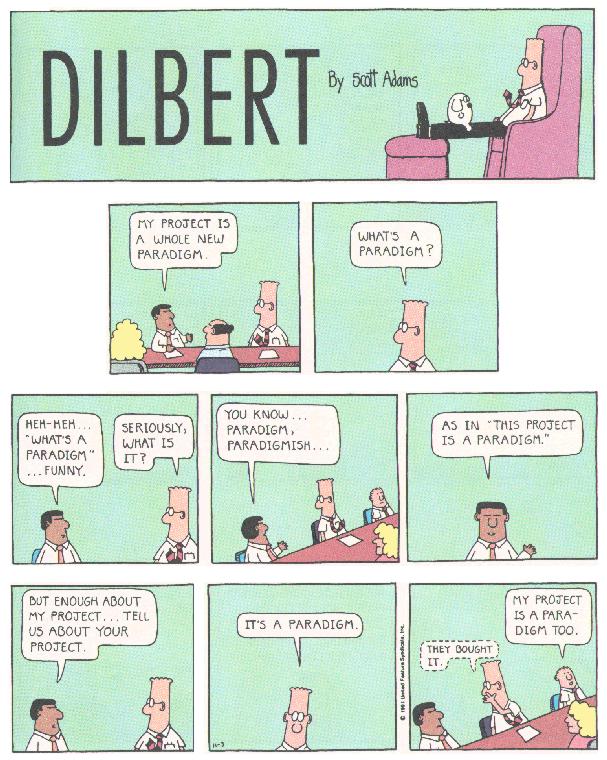
Re:I left my mission statement paperweight in the
It's a paradigm!
-
And what is the rest of Ohio up to?Checking the ratings (by results received for unversity teams) at SETI,
Ohio University ranks #3 and Ohio State is #12.
University rankings (world wide):
http://setiathome2.ssl.berkeley.edu/stats/team/tea m_type_7.htmlLooks like it's time to get the ax out and start cuttin' even more dead wood thar in Ohio.
Even large companies/corporation participate in SETI (but please don't tell the stock holders):
http://setiathome2.ssl.berkeley.edu/stats/team/tea m_type_3.html