Slashdot Mirror
Domain: bestbuy.com
Stories and comments across the archive that link to bestbuy.com.
Stories · 15
-
Huawei Got People To Write Fake Reviews For An Unreleased Phone (theverge.com)
As spotted by 9to5Google, Huawei has apparently posted fake reviews on Best Buy for its new Mate 10 Pro, which is available for pre-order in the U.S. despite not having any deals with U.S. carriers. "The fake reviews, which are exclusively on the Best Buy website, are likely the result of a contest Huawei ran on Facebook," reports The Verge. From the report: On January 31st, the company posted to a Facebook group with over 60,000 members, asking for people to leave comments on the Best Buy pre-sale page in exchange for a chance to beta test a Mate 10 Pro. The original post has been deleted, but 9to5Google obtained a screenshot before it went down. "Tell us how to why (sic) you WANT to own the Mate 10 Pro in the review section of our pre-sale Best Buy retail page," the post states. On the Best Buy site, there are currently 108 reviews for the phone, 103 of which were written on or after January 31st, the day Huawei posted the contest. Many of the comments directly reference not having any actual hands-on experience with the product itself, but give the phone a five star rating. "I can't wait to get my hands on this phone and demonstrate how amazing it is to people," reads one. "This device looks exciting and beautiful and it would be amazing to have a chance to beta test it," another reads. It seems Huawei is betting that loads of high ratings early on will make people trust the product and lead to higher sales. That's all well and good except that these types of reviews are strictly against Best Buy policy, as 9to5Google points out. "Huawei's first priority is always the consumer and we encourage our customers to share their experiences with our devices in their own voice and through authentic conversation," a Huawei representative told The Verge in a statement. "While there are reviews from beta testers with extensive knowledge of the product, they were in no way given monetary benefits for providing their honest opinions of the product. However, we are working to remove posts by beta testers where it isn't disclosed they participated in the review program." -
'Twas the Week Before the Week of Black Friday
theodp writes: It's almost time for America's answer to the Running of the Bulls (YouTube), kids. So, if you're dreaming of a cheap tech Christmas, it's time to peruse the 2015 Black Friday ads and make your game plan. Get lucky at Best Buy this year, and you could score a $299.99 Dell 15.6" touchscreen laptop (i3, 8GB memory, 1 TB HD), a $399.99 Microsoft 10.8" Surface 3 (Atom x7, 2GB memory, 64GB storage), $899.99 MacBook Pro 13.3" laptop (i5, 4GB memory, 500MB HD), $99 Acer 11.6" Chromebook (Celeron, 2GB memory, 16GB storage), or, for those on a tight budget, a $34.99 7" Amazon Fire tablet. Fight the crowds at Walmart, and you could snag a $199 HP 15.6" laptop (Celeron, 4GB memory, 500GB drive) or $199 iPad mini 2. And for stay-at-home shoppers, Dell's Windows 10 price-breakers include a $149.99 14" laptop (Celeron, 2GB memory, 32GB storage) and a $229 15.6" laptop (i3, 4GB memory, 500MB HD). So, in your experience, has Black Friday been like a claw machine — suckering you with big prizes, but never delivering — or have you actually walked away with a great deal? -
2014 Geek Gift Guide
With the holidays coming up, Bennett Haselton has updated his geek-oriented gift guide for 2014. He says: Some of my favorite gifts to give are still the ones that were listed in several different previously written posts, while a few new cool gift ideas emerged in 2014. Here are all my current best recommendations, listed in one place. Read on for the list, or to share any suggestions of your own.Most annual gift guides would only list new items. It would be considered a mortal sin of click-baiting to tell the reader, "Well, the coolest stuff we could tell you about, was stuff that we mentioned this time last year, so first and foremost we're just going to direct you to that."
Well, my job in writing a gift guide is not to dazzle people with "all new hottest gift item" recommendations, my job is to recommend the things that I think you would most enjoy giving and the recipient would most enjoy receiving, and the fact of the matter is that most of the gifts I would most highly recommend, were listed in different previously written articles. I'll provide that list in a second (with links back to the older articles describing them in more detail), but first some criteria for how I make the recommendations.
First, I'm assuming you want to go inexpensive. If you have unlimited cash, you don't need my help finding cool presents -- although for the record, the online store of New York's Museum of Modern Art has the best collection of things that incorporate "visual puns" that I really like, but which are usually overpriced for what the item does. (Check out this image of a set of nesting tables, for example -- which isn't even that much of a "neat idea", by their standards -- and try to guess how much they cost, before looking at the answer on the product page.) If you don't mind spending the money, they also sell a dandelion encased in acrylic ($375), a lamp in the shape of an open book ($190), a necklace of small rectangular mirrors creating an interesting 3D effect ($190), a porcelain vase that kind of looks like a crinkled paper bag ($120), a pair of candleholders that interlock without touching ($170), a serving tray that looks like the splash from a drop of water ($130), a clock that evokes an M.C. Escher "infinite staircase" optical illusion ($80), and a vase that exists in the shape of an outline ($65, which at this point sounds cheap). At the end of this gift guide I list some MoMA items that are somewhat more reasonably priced.
Second, I'm assuming you don't need help finding branded merchandise. I'm sure literally every combination of [Star Wars / LOTR / Game of Thrones / Star Trek / Hunger Games] and [coffee mug / beach towel / earrings / Christmas tree ornaments / shot glass / cufflinks] is available somewhere. It's not that these are bad gifts for the hardcore fan, it's that all you need to find them is to Google "Game of Thrones Christmas tree ornaments" and you'll find something. And occasionally you'll will find something in this "branded" category that jumps out as a pretty cool idea, like the TARDIS Tea Infuser or the Game of Thrones Dragonclaw Goblet or the light-up lightsaber chopsticks.
Third, I look mostly for novelty or decorative items that confound your senses or demonstrate some interesting scientific principle (or both), but that can still fit in to a semi-elegant environment without garishly calling attention to themselves. These color changing beads are kind of neat, but it would look weird having them lying around on top of a living room dresser along with a UV flashlight to demonstrate what they do. On the other hand, a Galileo thermometer can blend in pretty well the decorations on a mantlepiece.
The following are my current most-recommended gift ideas:
Custom Photomosaic
In this December 2013 post I described how to create a photomosaic (a patchwork of smaller pictures that, when viewed from a distance, take on the appearance of a larger picture) using two free (donation-supported) programs, one to download and save pictures en masse from a friend's Facebook profile, and the other to create the photomosaic using those photos. I still think they make amazing gifts, and the only cost is the cost of printing and framing it. You can even give the digital-only version as a gift that costs nothing at all, making a photomosaic from a friend's photos and sending it to them on the other side of the world, where they can print it themselves or use it as a desktop background. Everyone that I've given one of these to, has loved it.
Strandbeest kit
With this $35 kit, which I recommended as a Christmas gift last year, you can assemble a tabletop version of the legendary full-size Strandbeests, the eerily lifelike creatures created by Dutch artist Theo Jansen which walk across the beaches of Holland powered only by the wind. Assembly of the creature takes about 90 minutes, less if you make a family activity out of it and share the labor.
In the last year, a second model has been released, dubbed the "Rhinoceros Mini-Beest (technically, it was available a year ago, but the assembly instructions were only printed in Japanese; now it's available with English directions). I haven't assembled one of these myself yet, but it looks fine in the video.
There is also now a pre-assembled, motorized, remote-control version of the Strandbeest, although honestly, where's the fun in that? Part of the effect of the Strandbeest assembly kit is the feeling that you've breathed life into an inanimate object by putting it together from static parts. A remote-control toy that moves forwards and backwards on the ground is a little underwhelming when you can get an RC helicopter for the same price.
Levitron Revolution and Levitron Cherrywood
The Levitron Revolution ($70) consists of a circular magnetic disc that levitates about half an inch above an electrically powered square base, and can support up to a pound of weight on top of it while maintaining levitation. The Levitron Cherrywood ($35) consists of a top that has to be spun by hand, which levitates almost a full two inches above the cherrywood base containing an embedded magnet. As described in the first gift guide, the Levitron Cherrywood is more visually impressive because of the extra height of levitation, but the top almost always falls if you touch the top or move the base while the top is spinning. The Levitron Revolution only levitates the disc by half an inch, but you can embellish the appearance by placing other objects on top of it, like the pyrite crystal levitating in this video. (Also, the Levitron Revolution will continue levitating as long as power is supplied to it, making it a good decorative item; the Levitron Cherrywood has to be spun by hand and levitates for only about two minutes before air friction slows it down, so it works better as a toy or party activity.) Both of them take some practice to operate (the Levitron Cherrywood takes considerably more), but they're worth it.
Spare batteries for your friend's phone
I mentioned this in January 2013 as a life hack for smartphones and got pilloried for promoting what people called an "obvious" idea. But two years later, almost nobody that I know is carrying around fully charged extra batteries for their phones. It's easy, it works, and the spare batteries in my jacket pockets have gotten me out of a jam multiple times. If you know what type of phone your gift recipient uses, get them some extra batteries. (T-Mobile sent me extra batteries for my LG Optimus for free.)
The iPhone is the only phone I'm aware of that does not support this, because the battery is not meant to be removed or replaced by the user.
And yes, I know about the portable external battery products that can be used to charge a phone. These aren't as big or expensive as they used to be, but you still have to leave them plugged in to your phone while they're charging it, which is awkward if you're using your phone or carrying it in your pocket (compared to the 10 seconds it takes to swap out the battery).
Heat Wave car heater
This $40 device from Canadian company "Heat & Clean" sits on your dashboard and turns itself on at a pre-determined time, blowing hot air into the interior of the car for 20 minutes, all without starting the car. If all goes well, this means your car will be warm (or at least not as cold as it would have been) when you first get into it in the morning, and you don't have to wait several minutes for the air ventilation system to heat up. The Heat Wave is powered by the car's 12V charger, although Heat & Clean states that "has built-in circuitry to ensure that the health of the vehicle's battery is never compromised."
I can't vouch for the device's respect for your battery (the device unfortunately isn't sold on Amazon, which is usually where I go to find out if something does what it's supposed to), but I ordered one and verified that it works, then gave it to my aunt for her birthday. (If it kills her car, I will promptly make it up to her by taking it out of the gift guide.) Even though I tested the functionality, I didn't get the chance to see if the device actually helps much, because it's not cold enough yet here in Seattle to really feel the bite of the cold when you get into your car in the morning. (The other reason I personally won't get much benefit from this, is that I work from home and leave the house at a different time every day, so I never know in advance what time I'll be getting into my car the next morning.)
Most cars can be modified so they can be started remotely, so that they're warmed up by the time you go outside and get into them, but that modification usually costs a few hundred dollars. You might as well try the Heat Wave first to see if it does the job almost as well.
(To me, the obvious question is: Why not make a version of the Heat Wave that can be turned remotely, as well? For people like me who usually don't know the night before what time they'll be getting into their car the next day, but who often do know at least 20 minutes in advance, so they can turn it on remotely and start heating the car. The company does make a very different-looking product called the Heat Stick which can be activated remotely -- but at $300, that's more than it costs to add remote start to the actual car.)
It's Nuts 3D puzzle
Distributed by Grand Illusions in the UK, the It's Nuts 3D puzzle consists of a bolt and a pair of nuts threaded onto the bolt. As you can see in the video, when you rotate one nut, it moves in the direction that you'd expect, following the threading on the bolt -- but when you rotate the other nut the same way, it moves in the opposite direction. There are no hidden moving parts to make the illusion work, and you can unscrew both nuts right off of the bolt and examine them.
Having acquired one, I can say that the secret is a little bit easier to figure out when you're holding it in your hand and looking at it closely, than when you're watching the video. But it still makes a nice novelty conversation piece.
As a brain-tickler, this feels a bit overpriced at $40 - costing more than the aforementioned Levitron Cherrywood, which actually levitates. I bought It's Nuts mainly to fill out my collection off oddities since I already owned most of the other items in this list. Of course, unlike the Levitron, this takes no skill to operate (only a little bit of smarts to figure out the secret). I wouldn't foist the Levitron on my grandfather, but he would probably enjoy this one.
(Note that if you buy from the Grand Illusions website to ship to the United States, you'll pay the non-VAT rate -- but then you'll have to add about $14 in air mail shipping to the U.S. So you might want to combine this order with some other items from Grand Illusions -- search this article for "Grand Illusions" for the other recommended items, or browse their site and pick your own.)
Inverter Magnet
The Inverter Magnet, from Grand Illusions (also available from Amazon at a slightly higher price), consists of one disc magnet encased in rubber, which holds a second disc magnet in a permanent "force field" a few millimeters away when the two are slid across a table.
At $40, this might be more of a "collection filler-outer", since especially as a magnetic toy it compares unfavorably with the Levitron Cherrywood, which, to repeat, can actually fly. But again, the Inverter Magnet also takes no skill to operate.
Magna Nails
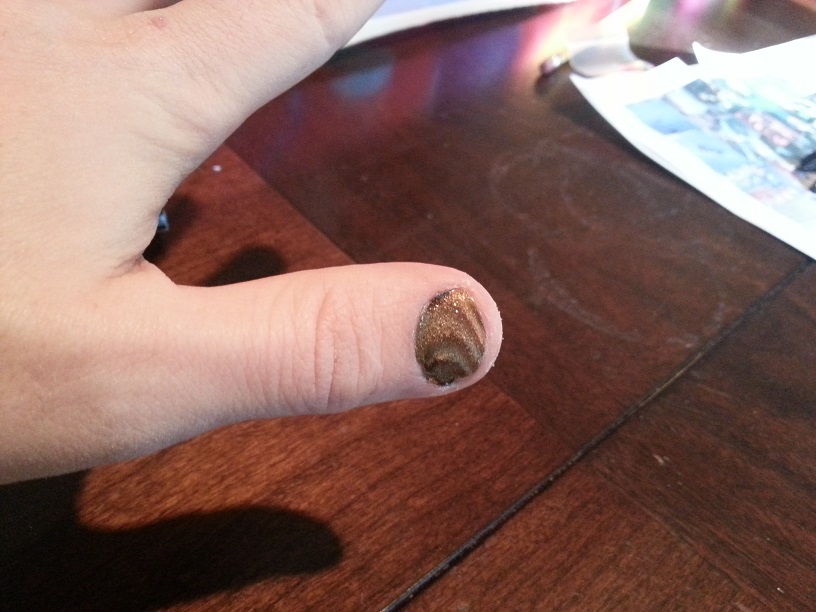
This nail polish (about $7 used on Amazon) forms a stripe pattern when you hold a magnet near your fingernail while the polish is trying. (There are many similar products on the market, searchable under "magnetic nail polish.") The appeal to young science geeks is that the iron filings in the nail polish align themselves along magnetic field lines in the vicinity of the magnet, forming the stripes.
I don't wear glittery nail polish (at least not as "Bennett Haselton"...), but I took one for the team to see if this works. It does. That's my thumb. (Apparently it looks better if you apply a "top coat" after the nail polish dries, but I didn't have any.) If you plan on testing it out before giving it as a gift, remember to pick up some nail polish remover to get it off.
A few things from MoMA that we can actually afford
- An appetizer serving dish complete with toothpick holder that looks like a porcupine ($28). This item probably has the highest price-to-cool-factor ratio of anything on this list, just barely within the limit of what I'd recommend, but it's elegant in addition to being funny, and the recipient would probably use it.
- A faux-wood cube clock ($38). This is interesting mostly for looking like a visual impossibility -- how can the digital numbers appear on the side of a block of wood, even fake wood? Unfortunately I think the photo is doctored, because this youtube video shows an undoctored shot of the cube clock, and you can easily see the un-illuminated LEDs on the side, which don't quite blend in with the wood. But it still makes for an elegant optical illusion.
Miscellaneous "Visual Puns"
- The ambiguous vase ($33) from Grand Illusions -- a real-life version of the Rubin vase optical illusion, where a vase suddenly takes on the appearance of two faces in profile.
- The glass water faucet ($50)
- The sliced grandfather clock ($36)
- Ulexite "television stones" ($10) - a rock that, when placed on a flat surface, will cause the markings on that surface to re-appear on the top face of the rock, due to the naturally occurring fiber optics in ulexite.
Of course, if you're now craving one of these items for yourself, order one and try it out before re-gifting, or set up an Amazon wish list in the last two weeks before Christmas. And remember to be good!
-
Bloomberg: Steve Jobs Behind NYC Crime Wave
theodp writes "Rudy Giuliani had John Gotti to worry about; Mike Bloomberg has Steve Jobs. Despite all-time lows for the city in homicides and shootings, NYC Mayor Michael Bloomberg said overall crime in New York City was up 3.3% in 2012 due to iPhone, iPad and other Apple device thefts, which have increased by 3,890 this year. 'If you just took away the jump in Apple, we'd be down for the year,' explained Marc La Vorgna, the mayor's press secretary. 'The proliferation of people carrying expensive devices around is so great,' La Vorgna added. 'It's something that's never had to be dealt with before.' Bloomberg also took to the radio, urging New Yorkers who didn't want to become a crime statistic to keep their iDevices in an interior, hard-to-reach pocket: 'Put it in a pocket in sort of a more body-fitting, tighter clothes, that you can feel if it was — if somebody put their hand in your pocket, not just an outside coat pocket.' But it seems the best way to fight the iCrime Wave might be to slash the $699 price of an iPhone (unactivated), which costs an estimated $207 to make. The U.S. phone subsidy model reportedly adds $400+ to the price of an iPhone. So, is offering unlocked alternatives at much more reasonable prices than an iPhone — like the $299 Nexus 4, for starters — the real key to taking a bite out of cellphone crime? After all, didn't dramatic price cuts pretty much kill car stereo theft?" -
Customers Gleefully Mock Best Buy's $1,095.99 HDMI
First time accepted submitter Forthan Red writes "It may be a pricing bot run amok, or a ridiculously over-inflated sense of worth, but Best Buy has been offering an HDMI cable for a whopping $1,095.99 (currently sold out!). While Best Buy seems to be oblivious to the absurdity of this price for a digital cable, those posting customer reviews are not. Enjoy the mockery!" One of my favorites is: "saved a ton of money on a new TV on black Friday and decided to use the extra cash to get the best cable available. At a whopping 3.3 feet in length, this cable is no joke. When all my friends come over to watch football, they always say 'WOW what kind of HDMI cable do you have?' I proudly tell them about my audioquest diamond and its advanced features such as its Dark Gray/Black finish. It is a great conversation piece! Not to mention it fits into my dvd player and tv perfectly." -
HP TouchPad To Be Liquidated At Fire Sale Prices
Hugh Pickens writes "According to an article by Tony Bradley, news is spreading quickly online that HP is going to clear out its vast TouchPad inventory by dropping the price to an offer you can't refuse. Rumor has it that beginning Saturday the 16Gb TouchPad will be $99, and the 32Gb TouchPad will be a measly $149. 'It is actually a fairly capable tablet. It's just not an iPad 2,' writes Bradley. 'For $500 it was a joke. For $300 it was still a shady deal. For $99 it's a steal.' HP has learned the hard way, and quickly pulled the plug on its tablet, proving that HP never had a solid tablet or mobile strategy and that it was really just looking for an excuse to get out. 'The reality is that my Best Buy is swimming in unsold HP TouchPad inventory,' adds Bradley. 'I went out tonight and picked mine up at the regular $400 price to beat the rush. Situations like this are why they invented price matching. I can just go back with my receipt once the fire sale starts and get the price adjusted and the difference refunded.'" -
Hotmailers Hawking Hoax Hunan Half-Offs
Frequent Slashdot contributor Bennett Haselton writes "An estimated 200,000 Hotmail users currently have their auto-reply set to a message spamming an advertisement for Chinese scam websites, which sell "discounted" electronics. Presumably the spammers compromised a large number of Hotmail accounts to pull this off, but wouldn't it be pretty easy for Hotmail to query for which users have that set as their auto-reply, and turn the auto-reply off for them?" Read below for Bennett's thoughts.After a recent mailing that I sent out to a subset of my proxy mailing list, I got back 18 auto-replies from Hotmail users, all substantially similar to this:
Dear friend:
We are an electronic products wholesale .Our products are of high quality and low price. If you want to do business , we can offer you the most reasonable discount to make you get more profits. We are expecting for your business.
Please visit our website: www.wedosale.com
Email: wedosale@vip.188.com .
MSN: wedosale@hotmail.com .
Looking forward to your contact and long cooperation with us!
Our mainly products such the phones, PSP, display TV, notebook, video, computers, Mp4, GPS, xbox 360, digital cameras and so on.
Welcome to visit our website!Some of the spam auto-replies advertised different websites, and the wording varied between the different auto-responses, but they were all similar advertisements for Chinese electronics "retailers." (And so, I assume, the websites are all fronts for the same company -- if multiple spammers had independently hacked Hotmail users' accounts to set their auto-replies, it would be vanishingly unlikely that those spammers would all happen to be electronics hawkers.) This was from a mailing that I sent to a set of subscribers that included about 26,000 users with "hotmail.com" e-mail addresses. If 18 out of 26,000 users in my sample have had their accounts hacked to send spam auto-replies, then this must be happening to a large number of Hotmail users -- not a large proportion (only one in 1,500, in my sample), but with about 300 million Hotmail users, that would still be a large absolute number.
The same spammers have apparently been spamming through Hotmail auto-replies for at least 11 months, according to this post in the Windows Live Help community forum from January 2009. At first, some pundits seemed to have assumed that spammers had created these accounts themselves and subscribed the accounts to people's lists, in order to spam the list owners (and, if it's a list that accepts subscriber posts, broadcast the spam to the other list readers). However, looking at the addresses in my proxy mailing list that were sending the spam auto-replies, I noticed that (1) our records show that the auto-reply-spamming subscribers joined the mailing list by various means, signing up through different Circumventor websites, not indicative of how a spammer would have joined the list by automated means, and (2) many of their email addresses are associated with legitimate-looking Myspace and Facebook accounts. Thus it looks as if these were real users who joined the list legitimately, and then got their accounts hacked by the spammers, who set those users' accounts to send the spam as an auto-response.
(If you happened to look at the spammers' www.wedosale.com website, at this point you might be thinking: I don't want to give money to spammers, but can I really get a Blackberry for only $295? Couldn't I just order from the website, and then if the goods don't show up or they're not as advertised, I can dispute the charge on my credit card? Well, I signed up for a dummy account on the www.wedosale.com page and got as far as the order page, and the only payment types that they accept are wire transfer, Western Union, and Moneygram -- precisely those types where you cannot get the money back or dispute fraudulent charges. If you've already gone and ordered a Blackberry, don't hold your breath.)
If my 26,000 users were a representative sample of the 300 million current Hotmail users, then with 1 out of 1,500 users in my sample being "infected," I could estimate that about 200,000 Hotmail users (1/1500 times 300 million) are currently set to send spam auto-replies. Hotmail claims to process 3 billion non-spam e-mails per day, for an average of about 10 non-spam e-mails per Hotmail user. That's the average for all users; what's the average for the infected users? Some factors would tend to lead to a lower average for infected users -- if they have lots of friends sending them mail, it's more likely that one of their friends would have told them about the auto-reply spam and told them to turn it off, so perhaps the users still sending the spams are the ones who don't receive a lot of messages from their friends. On the other hand, some of the infected accounts may be receiving more (non-spam) e-mail than average; one reason people sometimes abandon webmail accounts is that they're getting too much mail, even from newsletters like the Circumventor list that they had legitimately subscribed to. So, figuring that factors in both directions roughly cancel out, if each infected user is receiving the average number of 10 emails per day and sending 10 auto-reply spams in response, that's still a total of 2 million outgoing spams per day shilling for nonexistent Chinese iPhones.
These are just back-of-the-envelope calculations, but even I'm overestimating by a whole order of magnitude, that's still 0.2 million auto-reply spams per day, or about 70 million spams that will be sent by this one company through Hotmail's servers in the coming year, if Hotmail doesn't stop it. (And closer to a billion spams in the coming year if I'm not overestimating.)
And it's actually worse than that, because these spams are less likely than average to be filtered, since they're coming from Hotmail's servers. Normally you'd think that the content-based module of a spam filter would have no problem catching a message like the one at the top of this article, especially if millions of similar messages have been spewed out over the past year. However, messages from Hotmail's servers, regardless of content, are less likely to be blocked, since their network has a good reputation for sending little spam overall (due to measures such as requiring users to fill out a CAPTCHA when signing up, blocking each account from sending more than 500 messages per day, etc.). When I sent messages to the infected Hotmail users from my Gmail account, to see if the auto-responses would get through Gmail's spam filter, Gmail's blocked only half of the replies. When I mailed all the users again from my Hotmail account, the results were strange -- most of the users' accounts sent back no auto-reply at all, not even a reply that got routed to my junk folder. (Why would Hotmail accounts not send an auto-reply in response to a message from a Hotmail user? Please post if you have any idea what's going on there.) However, of the infected Hotmail accounts that did send a spam auto-reply, 100% of those auto-reply spams were delivered to my inbox. (Apparently, Hotmail's spam filter usually assumes that messages from other Hotmail users can't possibly be spam.) Only Yahoo Mail's spam filter, when I sent a test message to the infected users from my Yahoo Mail account, blocked all of the auto-replies as junk mail.
For the infected users on my mailing list, I sent them a link to a set of instructions I'd written about how to set and un-set their Hotmail auto-reply and how to change their Hotmail password, with the hopes that they'd eventually see the message and follow the steps. 18 users rescued, 200,000 to go.
So this is basically what's happening, but it still leaves some unanswered questions, such as: Why Hotmail accounts, but not Yahoo Mail, GMail, or AOL accounts? I've never noticed any auto-reply spam sent from any accounts at any of those other services. Whatever the spammers did to gain control of so many Hotmail accounts, if it was profitable for them, why didn't they do the same thing for Yahoo Mail? And, why did only one spammer do this? If they're sending between 1 and 10 million spams per day for free, they're probably making money at it. Whatever they did to hack those accounts, why wouldn't other spammers figure out the same method and copy them?
Presumably the Chinese spammers stole large numbers of passwords from Hotmail users either via a huge phishing attack, or through a security hole in Hotmail or some other part of the Windows Live service. If it was done via a security hole in Hotmail that the spammers discovered, then that would explain why the spammer's methods only worked for Hotmail accounts, and also why no other spammers have copied their techniques. (A phishing attack, on the other hand, would be easy to modify for other webmail services, and would also be easy for other spammers to emulate, so that's not consistent with the observed evidence so far.) I also found this post from blogger Stuart Shelton describing how his account was hacked by Chinese spammers -- and from the blog post, it's clear that he's very tech-savvy and would have been unlikely to fall for a run-of-the-mill password phish. If the attack happened even to people who know what they're doing, that seems to make the security hole explanation more likely.
Perhaps others can come up with some theories about what happened. It's easy to come up with guesses, but the hard part is to reconcile them with the fact that it has only affected Hotmail users so far, and no other spammer seems to have figured out how to copy the same technique yet.
But there's a much simpler question too: Why doesn't Microsoft just turn off the auto-replies for these users' accounts? They can query to see exactly which users have these messages in their auto-replies, and then un-set the auto-reply automatically. Yes, I know that even for a simple database operation like that, there's always more to it when you're managing hundreds of millions of accounts across multiple servers -- but if it will stop this one sender from sending between 50 million and 500 million spams (that in many cases will bypass people's spam filters) from Hotmail's servers in the coming year, isn't it probably worth it?
And even if it wasn't a phishing attack this time, sooner or later some other spammer will probably capture tens or hundreds of thousands of Hotmail accounts using a phish or some other method, and try spamming through auto-replies as well. So if Hotmail "fixes" this batch of auto-reply spam for practice, then the next time it happens, they'll know exactly what to do to take care of it.
I've written some columns where I strongly believed every word but expected a lot of opposition, some where I wasn't sure if I was right and just wanted to see what people thought, and . But I rarely argue something that I think is a no-brainer. Hotmail should un-set the auto-replies for those users whose accounts are spamming for nonexistent Chinese electronics knockoffs, before those accounts send another several hundred million spams in the coming year. Am I smoking crack?
Then again, maybe expectations for Hotmail shouldn't be set too high. I use SpeakEasy for my mail provider, and on about November 19th I found that all messages sent to hotmail.com addresses from SpeakEasy's servers were being bounced with an error message rejecting them for "spam-like characteristics."I called SpeakEasy and they confirmed that they knew Hotmail was blocking all mail from their users (although for "security reasons," SpeakEasy couldn't tell me what they were trying to do about it). The block wasn't lifted until about November 28th, when my messages started getting through again.
If SpeakEasy, which has been in business for 15 years, has annual revenues of $60 million, and was bought in 2007 by Best Buy, can't even get through to Microsoft in less than 10 days to tell them to stop blocking all mail from their servers, then Microsoft should first fix their postmaster trouble ticket system, so that people are not blocked from writing to their friends and family members at Hotmail for a week and a half. Then get to work on the spam auto-responders.
-
Best Buy Is Selling Ubuntu
SirLurksAlot writes "It appears that Best Buy is now selling Ubuntu, both through its Web site and in its brick-and-mortar locations. Going by the release on the product page, Ubuntu has actually been available for the low, low price of $19.99 since May 6th of this year. It is being packaged as the 'Complete Edition.' While they don't specify on the site what version is being offered, a quick call to a local store revealed it to be Hardy Heron, the latest Long Term Support version. How did this development fly under the radar for over two months without anybody noticing?" -
Best Buy Sued By Ohio
liryon writes "The Register is reporting that the state of Ohio has sued national electronics retailer Best Buy for misleading customers by repackaging used goods and then selling them as new, and for failing to pay rebate claims. The Register report can be found here, and the original story is here. I guess this is what you get for deciding the customer is not always right." See also the Ohio AG's press release. -
Best Buy Says Customers Not Always Right
linuxwrangler writes "Best Buy is one of the retailers that has now decided that the customer is not always right. Best Buy consultant Larry Selden has identified "demon customers" like those who file for a rebate then return the item. OK, I get that one (hey Best Buy: dump those customer-despised rebates and you won't have that problem...). Other categories like customers who only buy during sales are more interesting. Best Buy declined comment on how they are dealing with those customers. Some stores have actually "fired" customers. Welcome to the end result of all that customer information data mining." -
Widescreen (Finally) Winning
Yort writes "There's a little blurb over at the IMDB about customers at Blockbuster now generally preferring the widescreen, or letterbox, format over full-screen. This after Blockbuster tried to only stock full screen versions of movies a few years ago. I guess now the wife will have to let me buy that new widescreen TV, right?" -
How Well Did You Fare on "Black Friday"?
Quixote asks: "''Black Friday' is about over now. Though I wasn't among the faithful who queued up to get into the stores, I could see massive traffic jams in the local Best Buy, Target, etc. on my drive in to work. But it looks like the online offerings of some of the retailers are also pretty much slashdotted (I'm downloading a 500KB rebate form from CompUSA rebate center at the blazing speed of 800bytes/sec as I submit this story). So, how many of you avoided the long checkout lines and used the 'net instead? What are your experiences? What 'killer' deals did you get online, that you wouldn't have gotten in the store? And what are your thoughts on this whole phenomenon: why shouldn't the stores just get rid of this 'lets open the store at an unearthly hour' practice, and just move all of the 'Black Friday' sales online?" -
New Tech - What is RCA's VPORT?
JoshRoss asks: "I was looking at the televisions on Bestbuy and I noticed that the RCA televions have a new 'feature', the VPORT. I looked around for information about this and just found RCA press releases for their XBOX READY logo. What is the difference between the VPORT and S-Video?" Is it just me or are others disturbed by the fact that the VPORT is touted as an X-box only feature as opposed to a console feature, although I must admit, it does make sense from "product synergy" standpoint as mentioned in this interview. Does anyone have any details on what this type of port this really is. Will other console systems be able to take advantage of it? -
Is MiniDisc Dead?
dd5299 asks: "Is MiniDisc dead? This article in ZDNet grumbles about Sony dragging their feet with MD2 (650MB vs. the old 120MB). So, what is the future of MD? Sharp has started making MD players with PC Links , and now portable MD players are as low as $50. So, longterm, is MD dead?" -
Anti-DIVX article
Zane sent us an article from Best Buy that basically sums up all the problems with Circuit City's DivX Specs. Its actually a fairly complete article covering most of the major flaws of the format. Its interesting watching Best Buy & Circuit City duke it out too.
/cdn.vox-cdn.com/uploads/chorus_asset/file/10213289/mate_10_pro.png)