Slashdot Mirror
Domain: bitcoin.org
Stories and comments across the archive that link to bitcoin.org.
Comments · 158
-
Re:Better than fiat currencies
"Honest" in the sense of the paper outlining bitcoin's design.
Essentially, the obvious problem with a naive attempt at 'digital currency' is double spending: Unless you have a central authority of some sort, that clears all transactions, how do you prevent me from taking Bitcoin #2435345345 and sending it to two or more people?
An 'honest' node is a node performing operations such that bitcoin's decentralized anti-double-spending mechanism is upheld. A 'dishonest' or 'attacking' node is one using its CPU power to undermine the hash chain.
It has absolutely nothing to do with capitalism, or capitalism being honest or dishonest. My point was that(with the advent of extremely high performance specialized hardware) people who control botnets(that merely have CPU time, and maybe GPU time) are in an increasingly poor position to control more than a trivial slice of the computational capacity of the bitcoin network as a whole, which would prevent them from double-spending or other transaction-subverting attacks.
-
Re:Well the ultimate value of Bitcoin is
NOTICE TO JANE Q. PUBLIC:
The words "value" and "worth" are subjective in nature. You can read about this anywhere in a good dictionary.
Like other fiat currencies, bitcoin is without intrinsic value. Look it up.
There is no "standard" amount of computational time or computing power (hashrate) required to mine a bitcoin block. For any given hashrate/difficulty, there is an statistically expected amount of blocks that will be found over a given timeframe. Difficulty changes every two weeks in response to network hashrate in order to keep the amount of blocks found at a predictable, pre-defined rate. Since difficulty changes, the computational resources required to keep bitcoin production at a predictable rate changes.
It is entirely possible - although incredibly unlikely - that I could start my 7970 mining right now and find a block in the next few hours. My 25 bitcoins obviously would not have the same computational time wrapped up in them as the average block found by other miners/pools.
You keep saying that your silly claims are supported by any "good technical description of Bitcoin", yet you fail to provide any links. Here let me help you...there's this and this and most importantly this.
Oh wait...NONE of those resources mention anything about a bitcoin "value standard"! Maybe you should stop posting in this thread lest you make an even bigger fool of yourself.
-
Re:Well the ultimate value of Bitcoin is
As noted many times, you are wrong. If you actually look at the standard for Bitcoin you will see that it can't be redeemed or exchanged for something of value as part of the standard. Hence, by its standard, it doesn't have an intrinsic value.
-
Re:Well the ultimate value of Bitcoin isAgain, you are wrong for all the reasons that have already been stated. But let's actually look at the standard on Bitcoins:
By convention, the first transaction in a block is a special transaction that starts a new coin owned by the creator of the block. This adds an incentive for nodes to support the network, and provides a way to initially distribute coins into circulation, since there is no central authority to issue them. The steady addition of a constant of amount of new coins is analogous to gold miners expending resources to add gold to circulation. In our case, it is CPU time and electricity that is expended
As we see from the actual definition, resources are expended in creating new Bitcoins, but you can't redeem a Bitcoin for the effort (or for that matter anything else!) that went into its creation. So no, value is not built into the definition of Bitcoins.
-
Re:You're not kidding
I have some experience with both cryptography and decentralized systems of this kind. Which doesn't make me an expert. But I know enough to ask questions. I have had grave concerns about the validity of their design since I first read about it on slashdot some years back. It seemed to me the case had not been made that bitcoin was not vulnerable to rapid destruction of value, due to attacks on fundamental flaws in its design.
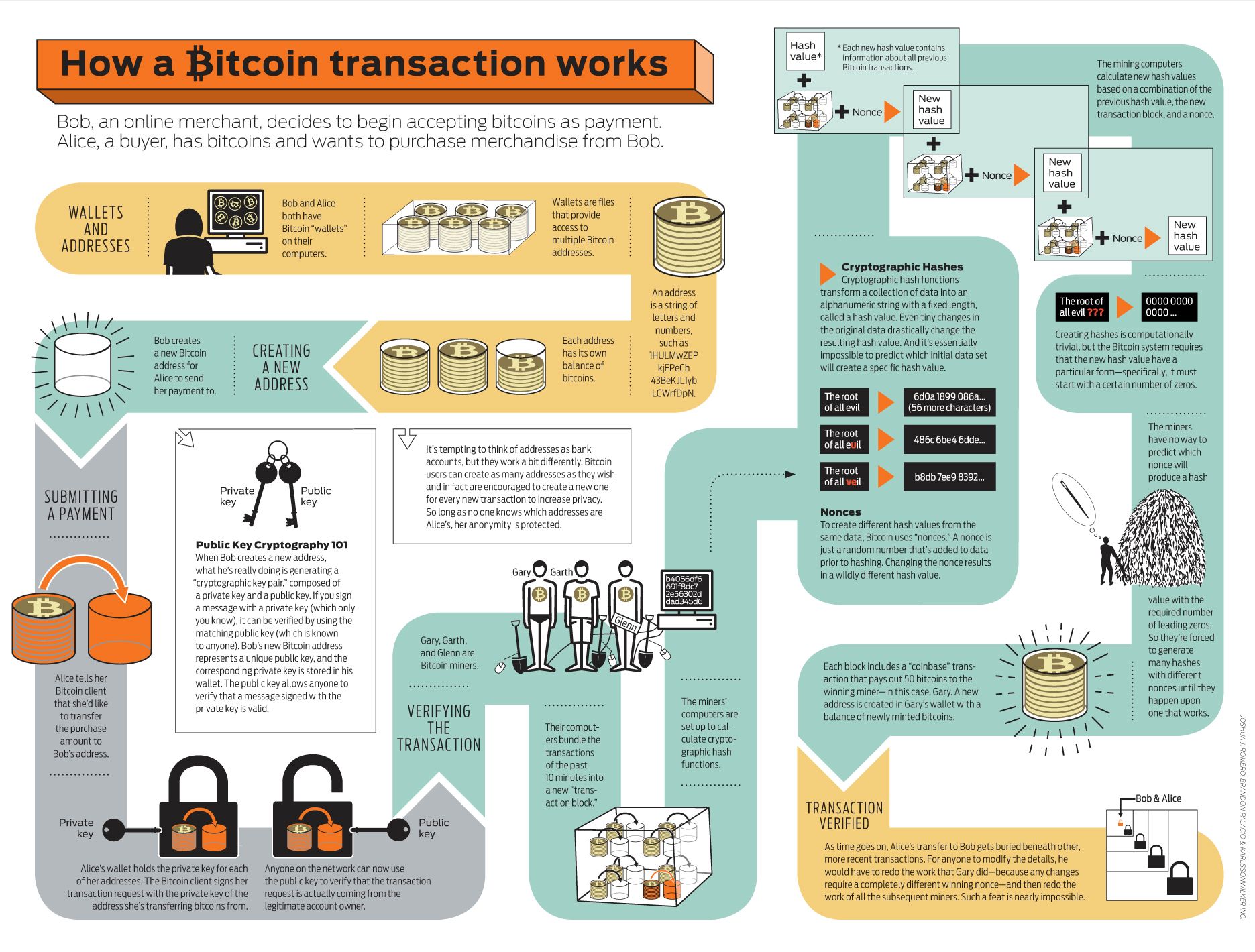
Here is the initial design spec: http://bitcoin.org/bitcoin.pdf. It very close to what is actually being used today. It seems very clear and solid in concept for such a short paper. Here is a graphical representation of the main processes involving cryptography: http://spectrum.ieee.org/img/06Bitcoin-1338412974774.jpg
I do not doubt your experience. I would like you to point out any flaws you see in the process that are not already mentioned in the original paper. I do not want to remain blind to potential threats to bitcoin. I would love to hear from anyone who can point them out.
-
Re:White paper on EXACTLY what a bitcoin is, pleas
"bitcoin white paper" is http://bitcoin.org/bitcoin.pdf, the white paper originally released by the creator of bitcoin.
The technical details are what they are, but it is an attempt at imposing uniqueness on computer data (no two bitcoins are the same). To introduce notions such as "value" or "currency" you must involve economics since they are economic terms.
A Bitcoin is nothing more than a rivalrous good (or an attempt at one), and other rivalrous goods have already been shown to be acceptable mediums of exhange (like cigarettes or sea shells). It just happens so that this involves computers.
-
Re:White paper on EXACTLY what a bitcoin is, pleas
I've looked, didn't find it. I just found some vague mumbo about cryptography with a ton of loaded buzzwords.
I want specifics.
1.) What is a bitcoin, EXACTLY?
2.) How divisible is a single bitcoin?
3.) All the specifics of any relevant protocols.You looked at what? First result of a google for "bitcoin white paper" is http://bitcoin.org/bitcoin.pdf, the white paper originally released by the creator of bitcoin.
-
I went back to Satoshi Nakamoto's paper.Assuming this is about money and not the environment... Bitcoin has been mostly off my radar, so I went back to the original paper describing the system. A very important aspect is this:
As long as a majority of CPU power is controlled by nodes that are not cooperating to attack the network, they'll generate the longest chain and outpace attackers.
If you can get enough CPUs together to break that requirement, then you'll be able to make some real money.
-
Re:Card to Card payments
> I've always wanted the ability to painlessly send someone money, directly,
Behold: http://bitcoin.org/en/
It's not everywhere yet, but it will be soon.
-
Re:What does it calculate?
This might be what you're looking for: http://bitcoin.org/bitcoin.pdf
-
Re:PayPal is not a bank
Are you a shill for the political elite, who, I am sure, want to regulate every single thing and creature under the Sun, so they can impose their own costs and controls over everybody?
I don't see transaction costs of PayPal being 'ridiculously high' at all, I like their service. In fact there ARE alternatives (and more), and I do not like them.
If you do not like their transaction costs, why are you using them? Nobody is FORCING you to use them, right? It's not like somebody is standing with a gun to your head, saying: here, use this PayPal, it's 'good for you', or is there?
PayPal's profit margins is their business, saying that banks would blush if they had those profit margins is disingenuous, banks get 'FDIC insurance', banks get fake credit from the Fed, banks post 'record earnings' based on spread they make from Fed's 0% interest rates to Treasury's 2-3% bond purchases.
I don't put debit card into PayPal I use my credit card, if PayPal wants problems it can get them and not from me, from the credit card company. So if your mode of operation: give anybody my banking information and never expect any problems, well, no amount of FDIC and 'consumer protection' will help you.
-
Re:Don't worry, Romney...I obviously know that bitcoins are mined, I meant that without the transaction chain it would be possible to copy bitcoins and make an unlimited supply.
A bitcoin is nothing but a really hard to create crypto string (the factor of some unimaginably large number).
Since you are being pedantic, I will point out that the proof of work has nothing to do with factoring. That would make no sense because factoring is an asymmetric problem, someone would first have to generate the composite number and they would already know the factors. If you were just trying to factor a random number it would not be very hard as the difficulty is proportional to the size of the factors and most numbers have small factors (or are prime, which is also easy to verify).
In actuality, the proof of work is to find a salt such that the hash of the previous transaction block and all pending transactions ends in a certain number of zeroes. This is also how bitcoins become harder to generate as time goes on, the number of zeroes required increases.when you say "i am giving these coins to that person" the transaction is queued up and carried out by god-knows-who, and the resulting bitcoins are *nothing like the original*.
The transactions are "queued" up as you say, but the verifiers are actually the miners. When you successfully find one the above hashes, you simultaneously create a new block in the transaction chain (which validates all transactions included in that block) and receive a number of newly mined bitcoins. In order for this all to work out, you have to broadcast your block to everyone in the network. If you did not, then they would continue to make the chain without your block and you would be "orphaned" out of the accepted transaction chain, losing your bitcoins. Since all transaction blocks must be broadcast, the entire chain is public and anyone can trace the provenance of any bitcoin in the network, as I have said. Even if you create new bitcoin addresses and transfer your coins to them, you are not laundering them because they will still be traceable back to your original account.
Read the white paper, it is all in there http://bitcoin.org/bitcoin.pdf -
Re:AC called it
I'm just trying to understand what possible reasons someone would otherwise be so upset that someone else did this. It didn't hurt anyone except those who choose to get involved. And the "early adoption" period was more than an entire YEAR, and there was lots of noise about Bitcoin during that year, it wasn't some big secret private project, and the early adopters were not trying to keep it from being adopted and hoard coins for themselves but were instead trying to make sure as many people knew about it as quickly as possible (in other words they were eager to give up their advantage, for the growth of the network, as shown by the staggering growth of Bitcoin during this time). They did not know that Bitcoin was going to be as big as it has been. There have been lots of failed crypto-currencies that have came before this and the original developer was not even (as far as I can tell) actively involved in the community using the Bitcoin network, so I don't believe their interests were in pumping and dumping. Nobody could have predicted it was going to be as successful as it was.
Imagine you took a huge risk and invested a ton of time into a project that had little to no chance of doing anything but using your GPU and CPU 24/7. What if in the end you woke up one morning and those coins you were mining at 300-500 a day were suddenly worth $30 a piece? Say you had several thousand because you started up the client and forgot about it and left it running on a server for several weeks, like some of my friends did. Would you hang on to all of them, or would you sell some? What answer did you choose and why?
Does that make you a dishonest person, or a criminal in any way? Furthermore, what business is it of yours if someone else chose to mine Bitcoin and this happened to them? Why does this make you anti-Bitcoin, that it happened to them?
The link someone posted earlier explaining how the technology worked from Wikipedia, and using it as evidence that it was a scam for the early adopters, was completely pulling that argument out of thin air because the description linked was a technical description and not any evidence of any wrong-doing or ill intentions by the early adopters of the technology. Because there is none.
Further, anyone who wants to discuss or understand this currency instead of foaming at the mouth should really just start by reading the white paper the original author published. It's clear that rather than a scam Bitcoin was started with at the very least educational intentions, and at the very most liberating intentions for people to conduct transactions with privacy. Sure, if such a technology exists at all that allows for international trading to take place, then people are going to do bad things with it, but it is not the technology's fault, nor were the developers of Bitcoin ever anything but fully transparent about the project, its goals, its source code, its licensing, the ideal use of the currency, etc. Again, "Bitcoin doesn't kill people, people kill people". Bitcoin is a very clever and novel idea and was not a ponzi scheme, as there can not be a ponzi scheme without a central controller, and was not a pump and dump, as can be evidenced by the continued existence and ongoing value of Bitcoins. The prices are set by market forces. If agricultural crop prices are determined by supply and demand (thus indirectly affected by weather patterns and climate), does that make the weather a pump-and-dump scam for the farmer?
People do bad things with cash, people use Bitcoins instead of cash. WHAT? BITCOIN DIDN'T MAKE THE BAD PEOPLE GOOD? BAD BITCOIN!
-
Re:West cutting its nose to spite its face
The only other way to transfer money out of a country is by converting it to something physical that you can stuff in a suit case and carry across the border
-
Re:Why? Bitcoin and Slashdot?
-
Re:Why? Bitcoin and Slashdot?
-
Re:Why? Bitcoin and Slashdot?
-
Re:Why? Bitcoin and Slashdot?
-
Re:Why? Bitcoin and Slashdot?
-
Re:Scaaam....
Citation needed, otherwise you're full of shit. Almost none of what you listed takes BitCoin natively; you have to convert to USD or other Government Backed currency before buying those services.
Everything I listed in my original post was purchased with BTC natively. Some of the links listed above are native, some are gift cards, which, as far as I know, no corporation has (yet) been able to get their gift cards backed by the government.
The quoted post said the only way to spend BTC was to buy illegal things on Silk Road (completely false) or convert to Government Backed Currency (also completely false).
So please, stop lying and spreading misinformation. If you are really just ignorant instead of a lying sack of shit, then please stop posting until you get even a modicum of accurate information.
-
Re:Scaaam....
Citation needed, otherwise you're full of shit. Almost none of what you listed takes BitCoin natively; you have to convert to USD or other Government Backed currency before buying those services.
Everything I listed in my original post was purchased with BTC natively. Some of the links listed above are native, some are gift cards, which, as far as I know, no corporation has (yet) been able to get their gift cards backed by the government.
The quoted post said the only way to spend BTC was to buy illegal things on Silk Road (completely false) or convert to Government Backed Currency (also completely false).
So please, stop lying and spreading misinformation. If you are really just ignorant instead of a lying sack of shit, then please stop posting until you get even a modicum of accurate information.
-
Re:Scaaam....
Citation needed, otherwise you're full of shit. Almost none of what you listed takes BitCoin natively; you have to convert to USD or other Government Backed currency before buying those services.
Everything I listed in my original post was purchased with BTC natively. Some of the links listed above are native, some are gift cards, which, as far as I know, no corporation has (yet) been able to get their gift cards backed by the government.
The quoted post said the only way to spend BTC was to buy illegal things on Silk Road (completely false) or convert to Government Backed Currency (also completely false).
So please, stop lying and spreading misinformation. If you are really just ignorant instead of a lying sack of shit, then please stop posting until you get even a modicum of accurate information.
-
Re:Scaaam....
Citation needed, otherwise you're full of shit. Almost none of what you listed takes BitCoin natively; you have to convert to USD or other Government Backed currency before buying those services.
Everything I listed in my original post was purchased with BTC natively. Some of the links listed above are native, some are gift cards, which, as far as I know, no corporation has (yet) been able to get their gift cards backed by the government.
The quoted post said the only way to spend BTC was to buy illegal things on Silk Road (completely false) or convert to Government Backed Currency (also completely false).
So please, stop lying and spreading misinformation. If you are really just ignorant instead of a lying sack of shit, then please stop posting until you get even a modicum of accurate information.
-
Re:Scaaam....
Citation needed, otherwise you're full of shit. Almost none of what you listed takes BitCoin natively; you have to convert to USD or other Government Backed currency before buying those services.
Everything I listed in my original post was purchased with BTC natively. Some of the links listed above are native, some are gift cards, which, as far as I know, no corporation has (yet) been able to get their gift cards backed by the government.
The quoted post said the only way to spend BTC was to buy illegal things on Silk Road (completely false) or convert to Government Backed Currency (also completely false).
So please, stop lying and spreading misinformation. If you are really just ignorant instead of a lying sack of shit, then please stop posting until you get even a modicum of accurate information.
-
Re:FPGA compatibility?
If you are referring something that people have already been running for a few months, you probably mean this. The modular miner thread seems to focus on raw price/performance, ignoring factors like the freedom to program the said FPGA without expensive licenses.
-
Re:Fairness is irrelevant
I can just go to a website and say "Give me [exchange rate] for X coins" and it becomes actual folding dollars?
Assuming someone's willing to buy them off you, sort of. You can convert them to virtual dollars that exist as a number in Mt Gox's database (which recently got hacked by a combination of a trivally-exploited SQL injection and the fact that the original site owner had a DB account with full access under the same username and easily-cracked password as his account on the site - after which they lied to everyone repeatedly until well after the point their story was obviously false).
What you'll have trouble doing is converting those virtual dollars into actual dollars. People have found their attempts to cash out repeatedly delayed no matter which method they use, and anyone in Europe is almost totally screwed - due to a combination of factors, including black hats stealing money from people's bank accounts by phishing and using Mt Gox to launder it through bitcoins their European bank account has been closed, and all the other exchanges don't have enough volume to sell large amounts of bitcoins.
There's also persistent rumours that Mt Gox doesn't actually have enough US dollars to back its clients' USD deposits as a result of criminals transferring in stolen money from other people's bank accounts and converting it to Bitcoins, and the transactions getting reversed later. These rumours predated Mt Gox admitting that this was in fact happening.
-
Re:FPGA compatibility?
People are on it: http://forum.bitcoin.org/index.php?topic=22426.0
-
Re:Bitcoin explained
Working below minimum wage is when you have to go out and get a job to survive and you're so desperate that you take something below what even the state considers reasonable for your survival. Choosing to spend time on free software projects voluntarily because they happen to interest you is not "working below minimum wage" - it's a hobby.
Could also be that he's incapable of landing or keeping other jobs than http://i.somethingawful.com/u/elpintogrande/june11/eroticbitconchat.JPG">pimping 16 year olds and pump-and-dump schemes. I wouldn't presume to know.
-
Re:The bitcoin faucet is already empty?
The coins haven't made it into the faucet yet. The faucet founder, Gavin Andresen (one of the core bitcoin developers), is still trying to determine when and how he will bring the donations in. http://forum.bitcoin.org/index.php?topic=20185.0 Meanwhile, the faucet funding has been pretty flaky, at least in the last 24 hours. Yesterday morning (US time), it was dry, yesterday evening it had some small funding, and now apparently it is dry again. I'm curious how big the EFF donation will really be.
-
Re:This is not really a bitcoin story
there was suspicion that they'd been compromised 7 days ago when over 500k was moved in one transaction http://forum.bitcoin.org/index.php?topic=15998.0
-
Re:The e-mail from Mt.Gox.
Gmail also flagged suspicious failed login attempts on my e-mail account...
That's not an accident; Google is watching out for you.
See http://forum.bitcoin.org/index.php?topic=19641.msg245983#msg245983
Hi guys,
The reason your Google accounts have been required to change the password is that you appeared in a list of public MtGox accounts. We do understand that you may not have been sharing your passwords, unfortunately as they were leaked in hashed form it is hard to know which ones will be found to be sharing passwords and which won't - this will be found out by brute forcers over the next 24-48 hours.
Again, apologies for the inconvenience, we know that choosing new passwords is a pain. Requiring password rotations is not a decision we take lightly. However this is standard procedure for credentials leaks. It is to avoid accounts showing up in the black market for hacked passwords, as Gmail account access can be used to obtain access at other sites (PayPal, Facebook, etc).
thanks,
Mike
Google abuse/anti-hijack team -
Re:Sounds phony?
-
That's NOT LulzSec's release.
At http://forum.bitcoin.org/index.php?topic=16457.0 the victim allinvain stated that, "a very large chunk of my bitcoin balance gone to the following address:
1KPTdMb6p7H3YCwsyFqrEmKGmsHqe1Q3jg"That just happens to be the same address for donations to LulzSec on some of their ASCII banners.... http://pastebin.com/88nGp508
Their actual release from their site has the bitcoin address:
176LRX4WRWD5LWDMbhr94ptb2MW9varCZPRefer to http://lulzsecurity.com/releases/bethesda_PRETENTIOUS%20PRESS%20STATEMENT.txt
Someone is either trying to frame them, or steal bitcoins from them. I would suspect the former.
-
LulzSec Connection
At http://forum.bitcoin.org/index.php?topic=16457.0 the victim allinvain stated that, "a very large chunk of my bitcoin balance gone to the following address: 1KPTdMb6p7H3YCwsyFqrEmKGmsHqe1Q3jg" That just happens to be the same address for donations to LulzSec on some of their ASCII banners.... http://pastebin.com/88nGp508
-
How to kill bitcoin (aka flood attack)
What if someone sends millions of 0.00000001 BC to millions of random adresses, or send 1BC back and forth to one adress a lot ?
Even satoshi admit that it would cause troubles : http://forum.bitcoin.org/index.php?topic=287.msg8810#msg8810
When it will become impratical to verify the hash of transactions, I think we can consider bitcoin dead. It only take one determined flooder. -
Re:Terminology
People have been calling the smallest fraction (0.00000001 BTC) a "Satoshi" after the creator.
http://forum.bitcoin.org/index.php?topic=2536.0 -
Amir's other services
Amir has been active in a number of projects that are trying to add legitimacy to Bitcoin. However, he has also posted on the Bitcoin forums offering "erotic Skype chat" with "two 16 year old girls together" or "one 16 year old girl and one 18 year old boy", in exchange for Bitcoins (source). Is he not worried that activities like this undermine his attempts to look legitimate? The services offered are, as far as I'm aware, completely illegal in the UK.
-
Re:Bitcoin continues to drop
Update: The main "BitCoin exchange", Mt. Gox, gives no information about the business entity behind the exchange, not even an address. The site has only "Tibanne Co. Ltd. (Japan)", which is an ISP in Tokyo.
Mt. Gox is a depository institution - you have to deposit BitCoins to sell them, and after the trade, you now have credit in some currency with Mt. Gox. Then you have to get the money out of Mt. Gox. The withdrawal process is slow. Also, on one forum, there's the comment from a Mt. Gox staffer (?) "If we have a lot of LR activity (like, about now), withdraws will be put on hold and executed later (ie. the next day) in the order they were received." That just screams "Ponzi scheme". They're an exchange; if they're honest, they should never have a cash flow problem.
The more I look at the BitCoin financial infrastructure, the more it looks like the High Yield Investment Program scams. Multiple offshore entities, withdrawal limits, unexpected delays in payouts, anonymous businesses. HYIP schemes are notable for being difficult to cash out of. They have to be, because they're Ponzi schemes.
-
Re:Bitcoin continues to drop
Update: The main "BitCoin exchange", Mt. Gox, gives no information about the business entity behind the exchange, not even an address. The site has only "Tibanne Co. Ltd. (Japan)", which is an ISP in Tokyo.
Mt. Gox is a depository institution - you have to deposit BitCoins to sell them, and after the trade, you now have credit in some currency with Mt. Gox. Then you have to get the money out of Mt. Gox. The withdrawal process is slow. Also, on one forum, there's the comment from a Mt. Gox staffer (?) "If we have a lot of LR activity (like, about now), withdraws will be put on hold and executed later (ie. the next day) in the order they were received." That just screams "Ponzi scheme". They're an exchange; if they're honest, they should never have a cash flow problem.
The more I look at the BitCoin financial infrastructure, the more it looks like the High Yield Investment Program scams. Multiple offshore entities, withdrawal limits, unexpected delays in payouts, anonymous businesses. HYIP schemes are notable for being difficult to cash out of. They have to be, because they're Ponzi schemes.
-
Re:Still wondering...
Any doubts about the cashing out of early adopters that made cheap and easy coin (bitcoin launched 10 months ago, when did you first hear about it?), go to the exchange and click on depth-of-market. There are several sellers offering lots of 1000+ coin (at $7-8 each). Clearly the winners are those who got in early, either mining with no competition or buying the currency eight months ago for 1/100 of it's current value...
Each hour approximately six computer in the world win a prize of 50 coin (based on cpu resources dedicated to solving an increasingly complex math crypto problem), but with the current number of people running the coin mining apps now, it currently would take an average computer years to win 50 coin.
It also seems like some big player or pool is gaming the system by turning their massive compute power on and off. Maybe they've found out how to manipulate the difficulty for max profit before it is recalculated?
-
Re:"Browser" based... actually a Java Applet.
There is a JavaScript miner as well.
A simple Google search provides these links:
Bitcoin JavaScipt Miner on Github
Slush made one tooBut what would be the point of actually using one? They'd be too slow.
-
Word of warning
Site uses only CPU mining, and I can guarantee you that you will be spending more on electricity than gaining in bitcoins with the current valuation. You need a powerful GPU or some other specialized hardware to do it profitably. It's cheaper and easier to just buy bitcoins.
That said, if it works as a steppingstone for you to get interested in Bitcoin, and actually familiarize yourself with the system, before coming to the wrong conclusion about its validity, then go for it.
Here are some places you can start with:
http://www.bitcoin.org/bitcoin.pdf for the original whitepaper that everything is based on (internalize this)
https://en.bitcoin.it/wiki/Myths for some of the more common myths flying around about bitcoins
https://en.bitcoin.it/wiki/Weaknesses for some ACTUAL weaknesses in the system, so you don't have to come up with the same old false ones that come up with these thread all the time. -
Re:Article Has a Very Strange Conflict
-
Re:Article Has a Very Strange Conflict
-
Re:Article Has a Very Strange Conflict
BitcoinExchange Services (forum thread; no independent website for now) offers various USD-denominated store-brand gift cards, pre-paid debit cards, and VISA gift cards in exchange for bitcoins (at a small premium). It looks like he/she/they may also accept bitcoins in exchange for USD via PayPal, although they stopped selling them via PayPal due to fear of frozen accounts. I haven't used this service myself, but the thread contains many positive reviews.
-
Re:May not work
A new public key is usually generated for each transaction, so this doesn't actually tell them anything.
See the Bitcoin paper, page 2, "Transactions": "Each owner transfers the coin to the next by digitally signing a hash of the previous transaction and the public key of the next owner and adding these to the end of the coin." Note, in the diagram, the "verify" link, where the previous owner's public key is transferred to the next owner, so the next owner can check that the previous owner owned the coin. If a party changes their public key, their coin hashes won't match their coins, and the next transaction will fail.
This has the useful property that your "coins" aren't valuable without your private key. If someone copies your coin files, they can't spend them unless they also obtain (i.e. steal) your private key. Conversely, if you lose your private key, your coins become worthless.
-
Re:Even after reading TFA
Here you go:
http://www.bitcoin.org/bitcoin.pdf -- or Google's cached version -- http://webcache.googleusercontent.com/search?q=cache:http://www.bitcoin.org/bitcoin.pdf
-
Re:Money is the tyrant, research its overthrow
Your thoughts on digital currency sounds a lot like Bitcoin.
-
Re:*yawn*
Interesting. Imho, any merchant not employing reasonably up to date fraud prevention system should be liable for more fraud. It's obviously evil to shift the liability onto the card holder though since liability was the only benefit they brought to the table to justify their transaction fees. If they really shifted off all their liability, we should all be switching to systems that exclude them, like bitcoin or even ripple.
-
Re:*yawn*
I'm convinced this article is simply FUD meant to push the insane content filters so desired by Australia's political class. You'll notice the site's name in cio.com.au. As pointed out down thread, the article basically proposes using "industry standards" as an end run around the legal hurdles Australian's leaders have encountered while trying to copy China's "Great Firewall".
We had another recent article explaining how the NSA decided that preventing intruders was impossible, instead concluding that security needed to permeate the whole process. If they fucking NSA cannot implement a sufficiently effective firewall, well I don't trust the ISP doing it either.
I'm afraid the only real solution will be modifying the end user experience to improve security. Two recent examples : Europe's adoption of EMV "Chip & PIN" smart cards, deprecating naive & dumb credit cards still used in America. Apple's Time Machine software provides a user experience that painlessly inspires people to spend hundreds of dollars on back up drives and follow sound backup procedures.
Apple's File Vault hasn't been nearly as effective at encouraging encryption as Time Machine has been at encouraging backups, but more serious approaches might work. You'll need some form of partial disk encryption if your using say bitcoin anyways. There are similarly many way of improving virus scanners to detect possible new botnets, less obtrusive, and less resource hungry.