Slashdot Mirror
Domain: blogspot.com
Stories and comments across the archive that link to blogspot.com.
Comments · 20,258
-
But Barbie...
My easy bake oven won't work with those! http://www.toysrus.com/sm-the-new-easy-bake-oven-
- pi-2297810.html
----
Run YOUR oven on solar: http://mdsolar.blogspot.com/2007/01/slashdot-users -selling-solar.html -
If an art campaign worried them...
I wonder how they'd react to actual guerrilla street art?
-
Re:Serious political, not serious techniacal
Well, the test worked so I'll try again.
The problem is actually physical. Looking at http://en.wikipedia.org/wiki/List_of_civilian_nucl ear_accidents we can estimate a Chernobyl sized event every 40 years if we allow one 50-50 nail biter (such as the incident last year in Sweden) per big event. This means that about 100 sq miles per year of arable land are made essentially permanently uninhabitable. This nuclear waste is basically too expensive to clean up.
I've heard of making glass and I've heard of spreading it thin, but your idea of spreading it thin and making it into glass is interesting. This is a little more energy intensive that people have been willing to go so far and may still come up against worries about leaching which killed Yucca Mountain.
---
Solar: it's cheaper http://mdsolar.blogspot.com/2007/01/slashdot-users -selling-solar.html -
Re:they forgot to mention
Of course, running 3D isn't as bad as an AJAX-y web app ruining the planet.
-
The only good thing about XP?
The Stonehenge background.
----
Solar rocks. http://mdsolar.blogspot.com/2007/01/slashdot-users -selling-solar.html -
Re:Not good for large installations.
The thin clients cost the same as the PC but do a lot less
If you stick with Windows RDP terminals, they can, particularly the Wyse Winterms. Now there are Linux terminals (that can be configured via LTSP to be RDP clients) as low as $90 in volume and $149. (The NTA 6020P is $149, although they have removed the line-item pricing for some reason).
So things are looking good for these units. The City of Largo has an administrator that keeps a blog that is interesting reading on how they are stepping up from basic terminals to using advanced terminals to add 3D eye candy, presumably driven by the cost savings over the past 5-10 years. I particularly like this posting that shows some daytime loads on the different servers. -
Re:Not good for large installations.
The thin clients cost the same as the PC but do a lot less
If you stick with Windows RDP terminals, they can, particularly the Wyse Winterms. Now there are Linux terminals (that can be configured via LTSP to be RDP clients) as low as $90 in volume and $149. (The NTA 6020P is $149, although they have removed the line-item pricing for some reason).
So things are looking good for these units. The City of Largo has an administrator that keeps a blog that is interesting reading on how they are stepping up from basic terminals to using advanced terminals to add 3D eye candy, presumably driven by the cost savings over the past 5-10 years. I particularly like this posting that shows some daytime loads on the different servers. -
Re:They're typical mediaI haven't read past the first page of the Argonne study, but this absolutely floors me:
As you can see, the fossil energy input per unit of ethanol is lower--0.74 million Btu fossil energy
According to this blog:
consumed for each 1 million Btu of ethanol delivered, compared to 1.23 million Btu of fossil energy
consumed for each million Btu of gasoline delivered.These claims are based on the use of two different accounting methods designed to show ethanol in a positive light. The energy balance for ethanol is calculated for the entire life cycle, and that for gasoline is calculated on the basis of a barrel of crude oil ready to be refined. We can calculate gasoline based on an entire life cycle to obtain a true apples to apples comparison. It takes only about 1 barrel of oil energy input to net 10-30 barrels of oil from the ground, depending on the source. So, this step has an efficiency of at least 1000%. Once the 85% energy efficiency is factored in for refining gasoline from the oil, the positive energy balance for gasoline ranges from 850% to well over 1,000%. That's why gasoline costs significantly less than ethanol on a BTU basis.
He also faults at least one USDA study for double-counting coproducts. This isn't an oil shill talking. In the same entry, he says, "I share the view that an oil peak is on the horizon, and I believe that it is critical for our very way of life to prepare for the imminent changes ahead."
As explained in your third link, "For every BTU dedicated to producing ethanol there is a 34% energy gain." By the same accounting practices, devoting a BTU to producing gasoline will net 8 to 10 BTUs of fossil fuel energy. I'd be interested to see how solar, wind, and fission ranked in such an analysis.
Pimentel may be off his rocker to claim that ethanol is a net energy loss, but I don't see that as the main issue. In the long term, ethanol could be seen as a method for energy storage, and all the energy inputs needed to produce it could be gotten from non-fossil sources, so ethanol might be viable even as a net energy loser. The real question is, "is this the most practical, efficient way to reduce our reliance on fossil fuels?" I don't think it is. It pushes up the prices of food, causes significant environmental degradation, and is a diversion from primarily electric plugins, which I think should be the ultimate goal. -
From 09 June *2003*Read this posting from back in 09 June 2003 What evidence of origin,ownership,copyright + GPL - Caldera/The SCO Group were F**ked from the beginning.
In other words ( from Wednesday, March 10, 2004 A plea for relief from Microsoft's escalating anti-competitive tactics. ):
The SCO Group has entered into a series of essentially inherently flawed lawsuits and fraudulent license claims against users of the Linux operating system. Since 1994, Caldera International and the Santa Cruz Operation have been accepting, profiting from and distributing software developed by hundreds of independent developers under the terms of the GPL and LGPL license. The SCO Group has failed to put forward any sustainable legal theory why it should not abide by the terms of the GPL license. Detailed investigation into other facts and evidence which regularly conflict with the SCO Group's various legal claims, filing, press and public statements, raises serous questions which can no longer be explained away by a lack of competence in either the SCO Group's CEOs or the SCO Group's legal representation.
-
Re:What does nuclear energy cost?
Generally, if it is down in the sig, it's a burma shave-style thing. I'd like people to get solar power on their roof and for a lot of people, going to http://mdsolar.blogspot.com/2007/01/slashdot-user
s -selling-solar.html is the best way to do this. I decided to list everyone I knew about because I'm pushing this hard and might get kind of annoying, as your question suggests might be happening, and I don't want people turned off the system just because it's me. Also, the number of people adoping the system is growing exponentially and about 10% of those getting the system are also deciding to sell it too. That means, I think, that before too long we'll have quite a lot of us selling and it does not hurt to work as a community on this.
If it is in the body (above the sig) then the blog subject is relevant (IMHO) to the discussion. So, in the parent of your comment (mine), the Amway marketing method is pretty relevant to how quickly renewables are adopted which is the main theme of engineer-poets' essay. Marketing is indeed a technology as it is pretty carefully engineered. And, it is THE way that people learn about a product or service. You don't read a news article about or review of a product if the producer has not pushed the product first. Word-of-mouth is the oldest form of marketing but it has been tweeked pretty substantially in the past century. As you can see, I'm an acedemic. I haven't sold anything since an odd job in the eighties. If you want to hear from an expert on this watch: http://www.theneighborhoodlive.com/common/presenta tion.htm. This a pitch, but it covers why the marketing method leads to rapid adoption.
In the second link, I might have just linked the flywheel directly, but I wanted an easy way to acknowledge who I got the link from and that is there in the blog. Energy storage is very important in a renewable energy based economy and this technology recommends itself in many ways over alternatives such as batteries or biomass storage for some applications. Both batteries and biomass storage (sorry engineer-poet) have environmental drawbacks and scale issues whereas flywheels fall in with wind turbines in terms of scalability and end-of-use issues. You'll see on the Real Energy Blog that I'm inspired by William McDonough, not to say that engineer-poet does not take end-of-use issues seriously, he does, but he does not yet routinely include these in calculations such as the energy in vrs. energy saved estimates whereas McDonough does. On the EcoAction Committee (see blog), we've run over many of his ideas independently but have not, as yet, decided to push them largely owing the impact on land use (which he is trying to address) and air pollution (which he is also working on).
So, I was very excited to see his work, which is so congruent with what we've been looking at, and thought the two links would be a help. I hope I've answered your question, but if not please let me know.
----
What!?!? No solar link??? -
Re:corporations don't made decisions...Nope. Can't happen.
Not in this country where the penalty for killing fish and crabs is higher than the penalty for killing a Human.
http://spewingforth.blogspot.com/2005/03/of-fish-
a nd-men-corporate-penalties.html To quote from the article:This summer, Motiva pleaded no contest to criminally negligent homicide and assault, only the second such prosecution in state history. The company was ordered to pay $46,000 in fines, then the maximum under state law, and $250,000 more to a victims fund.
If a human had done so, he would be doing some serious time in a Federal Prison. Since its a corporation, they have "fined" it.
Maybe we too should incorporate ourselves...
Hence retrospectively if you want to be the next Hannibal Lecter, better be born as a corporate -:))
-
Re:and when no district can turn down a FREE offer
Right now, OpenOffice, KOffice, AbiWord, Google Docs and SS and others all read ODF, so there's no way for them to lock each other out of the market like MS Office has locked most other office suites out.
Yes - and it's not like OpenOffice is leading in every part of the ODF format either. For example, take this from October 2006: "The formula editor of KOffice now supports OpenDocument and MathML and uses it as its default file format. It also surpasses the equivalent component in OpenOffice.org, scoring 70% on the W3C MathML test suite compared to 22% for OpenOffice.org Formula."
Sure, you might say it's a bit obscure but there's plenty work left just to support 100% of the ODF features, not to mention competing on usability, layout and so on which is a neverending story (remember, even if ODF can store any type of layout it doesn't mean designing it is easy or intuitive). Personally I very much look forward to KDE4 when all the K* applications will be competing against other OSS software on the Windows platform. KOffice, Konqueror, Krita are far from bad competitors to OpenOffice, Firefox and GIMP. -
Excuse me, what was your point?
Are you saying that ethanol SHOULD be a source of electricity (at what net efficiency from the source material?) or that it shouldn't be?
I propose ethanol as one of several storable products of an energy-production process which begins with non-edible biomass. The other storable products are charcoal and biodiesel (formed by transesterification of algal fatty acids) or light hydrocarbons (formed by thermochemical processing of the same fatty acids). The non-storable (but easily transported) product is electricity, which is the product of equally non-storable (and non-transportable) pyrolysis gas. Please see the section from "Bi-cycles and re-cycles" down to the bubble diagram before the next section header.
I don't think we should use ethanol to make electricity. Too many losses in the pathway, and far more complicated than starting with charcoal. -
Re:No such thing?
Regarding wind, at the cost level it is competitive with solar but it has more troubles fitting in. HOAs don't always want the towers needed to get the turbines into the wind flow. Some places are just sheltered. A plant that makes wind turbines has a similar advantage to one that makes solar panels: As it continues to produce, it is just making more and more capacity. A coal plant has fixed capacity and so you need to build another, but then you put a greater strain on fuel supply so it gets more expensive instead of cheaper. So, both solar and wind production facilities should make electricity somewhat less expensive going forward. Right now, the convenience of roofs has us concentrating on solar and we can offer fixed rate long term contract at the same rate people are paying now. Wind should be offered in the future though. Take a look at any of the links at http://mdsolar.blogspot.com/2007/01/slashdot-user
s -selling-solar.html to find out more. The calculator is set to an estimated 2.1% annual rate increase for utility supplied power compared to about 4.1% between 1969 and 2005, years when the inflation adjusted cost was the same http://www.eia.doe.gov/emeu/aer/pdf/pages/sec8_39. pdf. You'll enjoy the fact that the only place we don't compete yet is with hydro in the North West, another renewable. -
Funny you should say that
That was exactly my criticism a little over a year ago. (My politics are a long way from theirs, being mostly capitalist and small-l libertarian.)
So you know what they did? They asked me to be part of their policy-formation group. And I acted as critic and reality check.
I didn't sign onto their product because I thought it was way too timid (and if you've read Sustainability and EA2020, you'll know why), but I hadn't had time to finish my own analysis by their deadline so I cannot fault them. -
I sent him an e-mail.
If you want to read it, I copied it here, it's 1100+ words, so I won't paste it into the forums.
-
Oh, there's plenty wrong with ethanol
There's nothing wrong with Ethanol, save for studies 30 year out of date that are perpetuating the idea that it's energy negative.
The best corn ethanol can probably do is 1.5:1, maybe 1.8:1. This would still require 55%-67% of the product energy to be recycled to run the system. In short, at its best it's so far short of what we need that we should shut down the effort immediately and divert the money to things which can actually work.
Cellulosic ethanol would be better, but we use so much motor fuel in this country that we run into limits of carbon capture. We just can't grow enough biomass to even replace gasoline with it. (Syntec claims 100 gallons per ton with their gasification process. Replacing the energy of 140 billion gallons of gasoline would require about 210 billion gallons of ethanol. Got 2.1 billion tons of biomass handy? Even The Billion-Ton Vision only came up with 1.3 billion tons! For Iogen's enzymatic process yielding 70 gallons/ton, you'd have to start with 3 billion tons of inputs.)
The problem is, it doesn't matter if it can never work: the ethanol lobby uses some really dirty tricks to make sure they get your money.
Fixing this problem means eliminating the efficiency losses of both ethanol production and the internal combustion engine. Both have to go. -
Oh, there's plenty wrong with ethanol
There's nothing wrong with Ethanol, save for studies 30 year out of date that are perpetuating the idea that it's energy negative.
The best corn ethanol can probably do is 1.5:1, maybe 1.8:1. This would still require 55%-67% of the product energy to be recycled to run the system. In short, at its best it's so far short of what we need that we should shut down the effort immediately and divert the money to things which can actually work.
Cellulosic ethanol would be better, but we use so much motor fuel in this country that we run into limits of carbon capture. We just can't grow enough biomass to even replace gasoline with it. (Syntec claims 100 gallons per ton with their gasification process. Replacing the energy of 140 billion gallons of gasoline would require about 210 billion gallons of ethanol. Got 2.1 billion tons of biomass handy? Even The Billion-Ton Vision only came up with 1.3 billion tons! For Iogen's enzymatic process yielding 70 gallons/ton, you'd have to start with 3 billion tons of inputs.)
The problem is, it doesn't matter if it can never work: the ethanol lobby uses some really dirty tricks to make sure they get your money.
Fixing this problem means eliminating the efficiency losses of both ethanol production and the internal combustion engine. Both have to go. -
Re:Service & retailers: the other side of the
However you feel about the company, they do pride themselves on their customer satisfaction numbers.
I've never been a Verizon customer... but from what I've heard, "customer satisfaction" is not their top priority. -
Re:Best solution I know
Most people who are in sales are also customers. The first installs will be in September. Many people are choosing to wait until installs occur so you're hesitation is pretty natural. What is different here is the scale, a very large production facility and the sales model, rental rather than purchace. The customer experince so far is signing up and sending in some paper work. If you have questions about the contract terms, I'd be happy to answer them. Pick me out of the list at http://mdsolar.blogspot.com/2007/01/slashdot-user
s -selling-solar.html. The others there can help you as well. -
Re:Best solution I know
I've added you to the list at http://mdsolar.blogspot.com/2007/01/slashdot-user
s -selling-solar.html. Welcome!!! -
Re:What does nuclear energy cost?
OK, yes you've missed the whole gist of the argument but you've made it yourself. Solar is now cheaper than subsidizes nuclear power. Nuclear has already taken its scale advantage and can't get cheaper without more subsidies. Solar has further to go in scale. So, it displaces nuclear power, not on the basis of taste, as educated as the european sort may be, but on the basis of price. So, again, I invite you to save some money: http://mdsolar.blogspot.com/2007/01/slashdot-user
s -selling-solar.html. -
Re:What does nuclear energy cost?
http://mdsolar.blogspot.com/2007/01/why-renewable
s -displace-nukes-first.html
Muhahaha, you're so unbelievably full of shit.
- Nobody would tell "the renewables" to shut down. Pulling the plug and letting them blow their fuses is enough. That's how the real world works: whoever destabilises the grid is dumped.
- Nuclear plants can be throttled if the need arises. That's what the French are doing. CANDUs also go into hot standby, even if the grid goes haywire.
- Whatever needs to be shutdown is that which uses the most expensive fuel: first natural gas, then coal, then nuclear. That's actually a good thing, since coal kills 30.000 americans annually while nuclear power kills none.
- Your obsession about subsidies is ridiculous, considering how heavily piddle power (often misnamed as "renewable") is subsidised. -
Re:What does nuclear energy cost?
I'm a little confused by you response. You feel that goverment control was the problem for Chornobyl yet government control is the solution here. I used Chornobyl simply to scale the cost of a nuclear accident, not its probability. If there is an accident with containment failure then Chornobyl is what it looks like. Assuming our government control and your bottom line argument are correct and nuclear power in the US is perfectly safe and no accident can possibly happen, then why not repeal Price-Anderson since there should be no chance of liability where no accident can happen?
On the other hand, it is in the interest of the shareholders to run the nuclear plants as cheaply as possible, so subsidies help on that end and really we are just looking at tax payer financed profits. I think you were correct in the first place. Nuclear power is not possible without government subsidy. So, a market distortion, that has likely delayed the development of renewable energy, is what this is really what this is all about.
Now the market is moving past those subsides so why worry that the plants are going to be shut down? They're dinosaurs: http://mdsolar.blogspot.com/2007/01/why-renewables -displace-nukes-first.html. Let them go extinct.
----
Not sold on solar? That's OK, just live off your neightbors like the nuclear industry does. Send them to http://mdsolar.blogspot.com/2007/01/slashdot-users -selling-solar.html -
Re:What does nuclear energy cost?
I'm a little confused by you response. You feel that goverment control was the problem for Chornobyl yet government control is the solution here. I used Chornobyl simply to scale the cost of a nuclear accident, not its probability. If there is an accident with containment failure then Chornobyl is what it looks like. Assuming our government control and your bottom line argument are correct and nuclear power in the US is perfectly safe and no accident can possibly happen, then why not repeal Price-Anderson since there should be no chance of liability where no accident can happen?
On the other hand, it is in the interest of the shareholders to run the nuclear plants as cheaply as possible, so subsidies help on that end and really we are just looking at tax payer financed profits. I think you were correct in the first place. Nuclear power is not possible without government subsidy. So, a market distortion, that has likely delayed the development of renewable energy, is what this is really what this is all about.
Now the market is moving past those subsides so why worry that the plants are going to be shut down? They're dinosaurs: http://mdsolar.blogspot.com/2007/01/why-renewables -displace-nukes-first.html. Let them go extinct.
----
Not sold on solar? That's OK, just live off your neightbors like the nuclear industry does. Send them to http://mdsolar.blogspot.com/2007/01/slashdot-users -selling-solar.html -
Stiff upper lip
Well, we've ramped up quickly to save Europe before so I don't think that is the issue. And, if the initial indications of a reduced salinity in the North Atlantic continue to build, it would make WWII kind of pointless not to make some kind of effort. Our systems supply 100% of a home's power usage over a year. Granted, they still need the grid and other power sources, but those power sources are used that much less. We can do this up to about 25% of the power consumed on the grid without needing to reengineer the grid. So, it makes a lot of sense to start this way while at the same time planning for the reengineering that will be needed down the road. To me, energy storage is the key issue because a roof can do 100% already. I'm definitely taking suggestions on this at the Real Energy Blog: http://mdsolar.blogspot.com/.
Still, things do look ominous with the more rapid than anticipate melting in Greenland. We may have crossed a threshold on the circulation without having any sure way of knowing until the extreme effects are manifested. Still, does it not seem to you that a reduced heat input in the North Atlantic might slow the melting and thus bounce us back after a short while? -
Re:$0.12 per episode won't work <-- yes it does
Now the numbers above are completely fictional, I have no idea what the average viewership of BSG is, or the average cost per episode. If anyone can find these two items of information, we can calculate the minimum cost per episode to a viewer for BSG to be produced. I'm guessing it'll be closer to $1.99/episode than $0.12/episode.
It's harder to do with cable than broadcast, because cable channels get per-viewer subscriber fees for their revenues in addition to advertising. The subscriber fee is for the whole channel, so they can decide how the apportion it to a particular show.
For broadcast, it's basically around 60 to 80 cents that advertisers pay per viewer for a popular show. For broadcast, a solid popular show gets around 10 million viewers. Cable ratings are much lower. Battlestar Galactica specifically gets around 2 million viewers on a good night. But since it's on cable, they can still afford it since they have those subscriber fees.
Subscriber fees for the Sci-Fi channel are 16 cents per month per subscriber, and they have 79.88 million total subscribers, so $12.8 million a month. How much of that to apportion to Battlestar Galactica? That's what makes this hard. Flat per hour division gives you roughly $18,000 per hour. Cable ad rates are like $6500 per 30-second spot (who knows if the Sci-Fi channel can command a higher rate?), and assuming about 20 paid 30 second spots per hour (don't include promos, PSAs and the like), you get $148,000 revenue for an episode of BSG.
So: ~$150,000 revenue per show / ~2 million viewers = $0.075. Seven and a half cents per viewer is what they are happy to take in to show you BSG (they haven't canceled it, so they must think it's worth it). So it seems closer to your guessed at 12 cents than the $1.99. Don't worry for the media companies, they're swimming in profits. -
Re:What does nuclear energy cost?
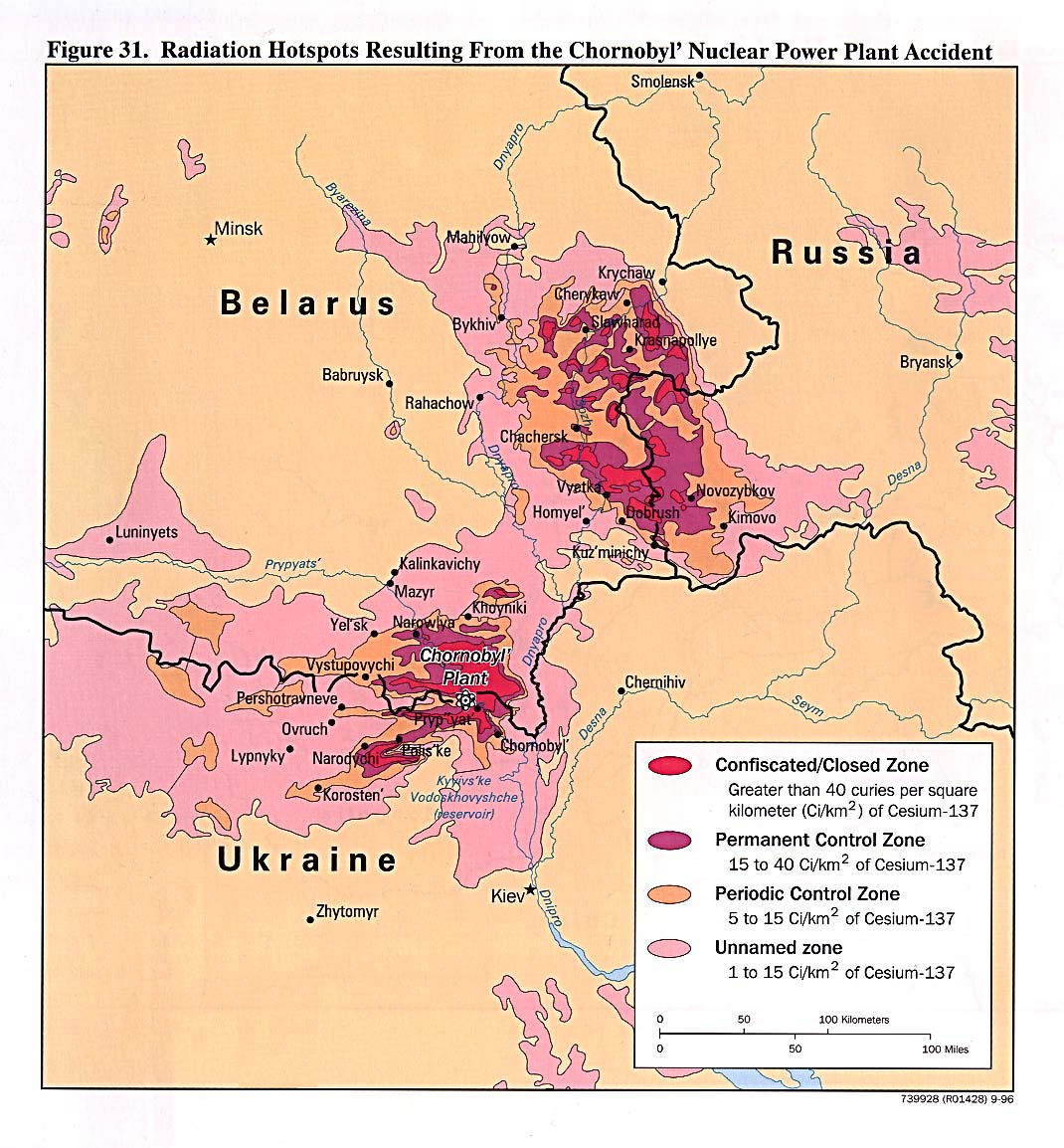
Yes, Price-Anderson is the Act that makes commercial use of nuclear power possible. For Chornobyl the periodic control zone is about 5000 sq mi (http://upload.wikimedia.org/wikipedia/commons/0/
0 7/Chornobyl_radiation_map.jpg) or 3.2 million acres. So, the limit of $10 billion liability comes to about $3000 per acre, not even what unimproved land sells for. With a $250,000 house per acre, we see the magnitude of the liability subsidy. You may feel that is fair, but I feel it is a market distortion. And, as you say, nuclear power is not possible without it. Nuclear power has not demonstrated itself to be clean even disregarding the waste problem as numerous accidents have shown.
What to do with the nuclear waste fund? Until we know that, we'd do best to stop making more waste.
----
Have a strange love for nukes? That's OK. You can still save money using solar. http://mdsolar.blogspot.com/2007/01/slashdot-users -selling-solar.html -
Re:Fusion is here
Actually, we can do it in much less time than that. Solar competes directly with coal. Look at this offer: http://mdsolar.blogspot.com/2007/01/slashdot-user
s -selling-solar.html [blogspot.com].
I'm looking but I don't see how you've solved the total watts / efficiency / surface area problem. By all means, the more solar/wind/biomass the better, but the math on covering every roof in the world with solar cells doesn't allow us to take the fossil fuel plants off-line before Europe gets very, very cold. -
Re:Fusion is here
Actually, we can do it in much less time than that. Solar competes directly with coal. Look at this offer: http://mdsolar.blogspot.com/2007/01/slashdot-user
s -selling-solar.html. -
Re:A couple more technologies
Actually solar grade silicon often comes from semiconductor scrap. It does not have to be as pure. But, as a poor cousin of the semiconductor industry, the supply of scrap is not in the control of the solar power industry. You're worries about high tempertures for long periods are largely addressed by larger scale production which helps with heat management. Solar is now cost competitive: http://mdsolar.blogspot.com/2007/01/slashdot-user
s -selling-solar.html -
Re:What does nuclear energy cost?
Only under a model where Yucca Mountian happens, without that, the DOE waste fund is a complete sham. Freedom from liability is another huge subsidy for the nuclear industry as well. For fossil fuels, we may be hopeful that plants will aid us in sequestration, though this still obviously takes a solar energy input. For nuclear waste, we're pretty much lacking a paddle in that proverbial creek.
---
Solar Energy: a market solution: http://mdsolar.blogspot.com/2007/01/slashdot-users -selling-solar.html -
Re:This is mentioned in the article
That was http://hardware.slashdot.org/article.pl?sid=06/12
/ 27/2054231 but the CNET article is gone now. The company site is http://www.greenfuelonline.com/. I miss the chart in the article showing the relative photosynthetic efficency of different crops. Algae can out on top, but still nowhere close to solar panels, so...
---
Sprout silicon leaves for no more than you're paying now: http://mdsolar.blogspot.com/2007/01/slashdot-users -selling-solar.html -
Re:What does nuclear energy cost?
Hum, you've forgotten the incredible subsidy nuclear power gets: It's been promised not to have to deal with the waste. That promise is not at all realistic since Yucca Mountian can't go forward. So, we're in a postion where we'll have to pay back all the energy we've ever gotten from nuclear power and then some. How much more expensive can you get? See: http://mdsolar.blogspot.com/2007/01/saving-not-bo
That article is a load of crap. Basically, what he is saying is that in order to clean up all of the waste we've generated, we need to use high energy particle accelerators to split apart every last atom of radioactive waste, and since the particle accelerator would require more energy to run then what we obtained from the nuclear power to begin with, it's therefore not worth the trouble. This is equivalent to saying that fossil fuels can't be economically used, because the energy required to rebind the molecules after they are combusted is greater then the energy used to burn them to begin with. It's a ridiculous argument and is wrong on so many levels I'm not going to go into it here unless you really want me to.r rowing.html
And your original point is wrong. You are backwards, power reactors don't receive subsidies to dispose of their waste. They've been paying into a DOE waste fund since 1982. The cost of waste disposal has already been factored into the economics of their operation. -
Re:Mostly right
No EXTRA heat generation, but my point is that none of our heat generation is of any importance. True, you can change the Earth's albedo slightly by putting a solar panel on a white roof, but the change in albedo caused by the melting of the northern ice and snow cover is hugely more important. This is the result of the increase in the CO2 concentration in the atmosphere. The present warming of the Earth is all about how we are changing the atmosphere and it's radiative transport, our very small contribution of energy use compared to the dominant solar input has no desernable effect. Even urban heat islands, where our energy use is concentrated, are primarily a radiative effect: http://en.wikipedia.org/wiki/Urban_heat_island.
---
Participate in real power: http://mdsolar.blogspot.com/2007/01/slashdot-users -selling-solar.html -
Because corn = money, that's why.The US has a huge farm lobby and agribusiness giants like ADM which make huge amounts of money on corn. Actually, the farmers have mostly made their money from subsidies, as production has glutted the market since the end of the acreage set-asides under Agr. Sec'y Earl Butz. ADM made massive amounts of money turning subsidized corn into fructose and selling it into a sweetener market driven by protectionist sugar tariffs, so it was natural for it to go to fermenting subsidized corn and selling it for the 51 cent/gallon fuel subsidy.
Unfortunately, just because it's money-positive doesn't do spit for energy. The energy balance of corn ethanol may be as low as breakeven, according to a recent MIT analysis; even the USDA's numbers only come out to 1.09:1 after you correct their math. Should you manage bring that up to 2:1, you can still generate barely 16 billion gallons-net of ethanol (energy equivalent to 10-11 billion gallons of gasoline) out of the entire US corn crop.
As for why we don't look at cellulose.... it's because cellulose is a tough polymer evolved to be hard for bugs to eat, and we are better off using pyrolysis (charring or burning it) instead of hydrolysis (breakdown into sugars) to get energy out of it.
Sustainability actually does propose converting cellulose to ethanol, but via a rather indirect path:- Pyrolyze cellulose to charcoal and fuel gas.
- Burn fuel gas in a molten-carbonate or solid-oxide fuel cell, producing carbon dioxide, electricity and waste heat.
- Feed carbon dioxide to a closed bioreactor with algae.
- Extract algal fats, sugars and starches.
- Ferment sugars and starches (easily handled with common yeasts) to ethanol.
- Distill ethanol using fuel-cell waste heat.
It goes by a roundabout route, but it doesn't require any funny business and it tries to get useful energy at every step. -
Because corn = money, that's why.The US has a huge farm lobby and agribusiness giants like ADM which make huge amounts of money on corn. Actually, the farmers have mostly made their money from subsidies, as production has glutted the market since the end of the acreage set-asides under Agr. Sec'y Earl Butz. ADM made massive amounts of money turning subsidized corn into fructose and selling it into a sweetener market driven by protectionist sugar tariffs, so it was natural for it to go to fermenting subsidized corn and selling it for the 51 cent/gallon fuel subsidy.
Unfortunately, just because it's money-positive doesn't do spit for energy. The energy balance of corn ethanol may be as low as breakeven, according to a recent MIT analysis; even the USDA's numbers only come out to 1.09:1 after you correct their math. Should you manage bring that up to 2:1, you can still generate barely 16 billion gallons-net of ethanol (energy equivalent to 10-11 billion gallons of gasoline) out of the entire US corn crop.
As for why we don't look at cellulose.... it's because cellulose is a tough polymer evolved to be hard for bugs to eat, and we are better off using pyrolysis (charring or burning it) instead of hydrolysis (breakdown into sugars) to get energy out of it.
Sustainability actually does propose converting cellulose to ethanol, but via a rather indirect path:- Pyrolyze cellulose to charcoal and fuel gas.
- Burn fuel gas in a molten-carbonate or solid-oxide fuel cell, producing carbon dioxide, electricity and waste heat.
- Feed carbon dioxide to a closed bioreactor with algae.
- Extract algal fats, sugars and starches.
- Ferment sugars and starches (easily handled with common yeasts) to ethanol.
- Distill ethanol using fuel-cell waste heat.
It goes by a roundabout route, but it doesn't require any funny business and it tries to get useful energy at every step. -
What does nuclear energy cost?
Hum, you've forgotten the incredible subsidy nuclear power gets: It's been promised not to have to deal with the waste. That promise is not at all realistic since Yucca Mountian can't go forward. So, we're in a postion where we'll have to pay back all the energy we've ever gotten from nuclear power and then some. How much more expensive can you get? See: http://mdsolar.blogspot.com/2007/01/saving-not-bo
r rowing.html
---
Get Real Energy: http://mdsolar.blogspot.com/2007/01/slashdot-users -selling-solar.html -
What does nuclear energy cost?
Hum, you've forgotten the incredible subsidy nuclear power gets: It's been promised not to have to deal with the waste. That promise is not at all realistic since Yucca Mountian can't go forward. So, we're in a postion where we'll have to pay back all the energy we've ever gotten from nuclear power and then some. How much more expensive can you get? See: http://mdsolar.blogspot.com/2007/01/saving-not-bo
r rowing.html
---
Get Real Energy: http://mdsolar.blogspot.com/2007/01/slashdot-users -selling-solar.html -
Re:A couple more technologies
I think you are confusing manufacturing cost with retail price. At current retail, set by the scarcity of solar grade silicon, the payback time is about 12 years. But manufacturing cost is much lower than this. The energy pay back time is less than 5 years, and, as you say, the input energy is typically renewable in any case.
---
Solar: it's what cooks dinner: http://mdsolar.blogspot.com/2007/01/slashdot-users -selling-solar.html -
Fusion is here
There is a perfectly good fusion reactor already and we orbit it. Tap in at http://mdsolar.blogspot.com/2007/01/slashdot-user
s -selling-solar.html. No need for fission at all. -
Mostly right
Well, actually any heat we generate is miniscule compared to what comes in every day from the Sun, so your take on nuclear power contributing to heating is not actually a big deal. But, you're right that the competition for resources involved with ethanol could be a problem. Some think it is a near term problem just because of governement incentives: http://www.earth-policy.org/Updates/2007/Update63
. htm.
If Brown is correct, then buying flour now would be a good hedge.
----
Solar doesn't increase grain futures. http://mdsolar.blogspot.com/2007/01/slashdot-users -selling-solar.html -
Re:This is mentioned in the article
Some recent work suggests that this might not be the case http://www.sciencemag.org/cgi/content/abstract/31
4 /5805/1598.
---
Beat the rush into renewables: http://mdsolar.blogspot.com/2007/01/slashdot-users -selling-solar.html -
A couple more technologies
This is a really nice piece of work. A couple of technologies that were missed are marketing mechanisms related to solar http://mdsolar.blogspot.com/2007/01/solar-power-a
m way-way.html and fly wheels http://mdsolar.blogspot.com/2007/01/saving-not-bor rowing.html, described on the Real Energy blog. -
A couple more technologies
This is a really nice piece of work. A couple of technologies that were missed are marketing mechanisms related to solar http://mdsolar.blogspot.com/2007/01/solar-power-a
m way-way.html and fly wheels http://mdsolar.blogspot.com/2007/01/saving-not-bor rowing.html, described on the Real Energy blog. -
Re:"Standard du jure" [sic]?
-
Re:Continuing its stunning streak
Slashdot didn't place, on the other hand, slashdot links to tech writing rather than reporting on technology itself, most of the time.
----
Got solar? http://mdsolar.blogspot.com/2007/01/slashdot-users -selling-solar.html -
Why copyright must expire
I recently picked up a copy of Fragile Things, and it lead me to write this post
This is why copyright MUST continue to expire, and DRM threatens that expiry. It's all very well to say that the copyright on a work has expired, but it might still be illegal to access that work because it has DRM which is protected by the DMCA and other copycat laws. -
Re:Self limiting
No, I was saying that raising the stakes increases both risks and rewards, Bruno is sort of a limiting case on the risk side. I also think the grapes are sourer on all sides of the fence, just as base motivations are present everywhere as you point out. But, for the level of creativity that might go beyond anything that a prize could adequately recognize, highly refined motivations probably have a role to play of necessity. I like prizes. I just think that they can limit total potential creativity and thus be counter productive if the goal is advancing science. If, in the Baconian view, it does not matter who does the work, then getting more groups on the problem may make up for the limiting tendency, but if, say, getting a Nobel makes people do less future work, and their potential contributions are unique, then it could end up being a loss. But Bacon might be right.
----
Burma Shave: http://mdsolar.blogspot.com/2007/01/slashdot-users -selling-solar.html -
Re:Don't use a consumer OS to do an RTOS job
As the other replies say, the TomTom runs Linux. But I can tell you that my experience with a Magellan Roadmate GPS and Windows CE, and that has just about all the stability I remember from my long distant days of Windows 98.