Slashdot Mirror
Domain: businessspectator.com.au
Stories and comments across the archive that link to businessspectator.com.au.
Comments · 24
-
What Aussies would give for 1Gbps!!!
Sad how Japan's yesterday is Australia's future:
Right now Australia's Internet is pathetically slow by first world standards - though competitive by third world standards.... YAY! Internet speeds: Australia ranks 44th, study cites direction of NBN as part of problem http://www.abc.net.au/news/201...
The Liberals are promising the NBN will deliver at least 25Mbps to most household... YAWN! The Coalition’s rebooted NBN plan proposes to use a mix of technologies, including Telstra’s copper network and cable networks, to deliver minimum broadband download speeds of 25Mbps to 90 per cent of households and businesses by 2020. http://www.businessspectator.c...
And the best you can get if you pay through the nose is 100Mbps? WHAT A JOKE! http://www.whistleout.com.au/B...
http://www.crikey.com.au/2014/... -
Re:Software is the wrong villian here.
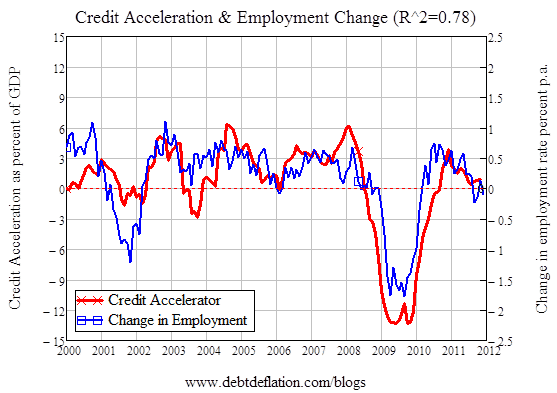
Money isn't a commodity like gold. When a bank issues a loan, they create an asset and liability at the same time. When you pay a loan back, the asset and liability are cancelled out. Most of our spending power is based on ledger records in a bank's double entry book-keeping system. But as an entire country, we haven't been paying back our loans at all. Each year we've borrowed more than we've repaid, even when you take inflation into account.
If you're running a business, your income is based on what your customers spend from their income plus new debt. Therefore the growth in your income is based on the growth of your customers income and the *acceleration* of their debt. If the acceleration of debt slows down and turns negative, even if the velocity of debt is still positive, your flow of income will reduce. If income is growing, you'll probably hire more people. If income falls you'll be forced to let people go.
So if we can extrapolate this to an entire economy, we should see a strong correlation between employment and the acceleration of debt. This, IMHO is the smoking gun.
For similar reasons I'd expect to see similar relationships between mortgage acceleration and house prices, or margin lending and share prices.
Private debt drives the economy. And yet economists have convinced themselves and us that we can safely ignore the role of banks debt and money. This situation is absolutely insane.
-
Re:This is further proof...
You forgot cheapest! More proof that nuclear power is the cheapest low-carbon power source, not a tech more popular on K street than Wall Street that gets by via being absolved of all potential liability for major accidents, getting huge loan guarantees, and being allowed to pass off cost overruns to consumers at-will and even still has trouble finding investors. Nuclear power has always been more popular on K-Street than Wall Street.
How did that "nuclear renaissance" work out for you all? Yeah, that sure bombed out fast. Gotta love an industry with a negative learning curve, where costs continually rise with time and scale rather than dropping (aka, learning of new potential problems and risks faster than refining the technology to lower costs).
Nuclear scares the public a lot more than it actually poses a risk to their health or life. But you know who it scares even more? Investors. Given the race out the door today, can you imagine what it'd be like if the industry wasn't let off the hook for potential damages over a maximum in the event of a major accident? No insurance company would touch the industry with a 10 foot pole. Nuclear accidents may not be good at killing people, but there's one thing that they're damned good at and that's costing a bloody fortune to remedy.
-
China's Complete Supply Chain
Recently this year the WTO ruled against China's practices in the rare earth market but some pundits have stated that this ruling doesn't matter because China controls the whole supply chain of rare earths. Would you care to comment on the efficacy of the WTO's ruling? Can you explain what part of the supply chain the US is missing? For example, we're missing mines but if we had mines we're missing refineries but if we had them we're missing
-
Re:Germany still building coal plants ...
BMW for one. Germany has been very aggressive in pushing green energy.
And just as aggressively building coal plants to back up the green sources. Coal has been a huge benefactor of the green push in Germany. Now admittedly these are modern, efficient and cleaner burning coal plants than what typically comes to mind. However the point needs to be made that renewables are almost always backed up by fossil fuels.
Expect some new nat gas plant to go up near Tesla too.
True. You should also mention that the coal plants built were to replace the older brown coal plants.
In the first half of 2014 Solar grew by 28 per cent in the first half of 2014 compared to 2013 and wind power grew by 19 per cent over the same period last year. brown coal generation is down four per cent and the production of hard coal-fired power plants decreased 11 per cent from 2013. Gas had the biggest decrease (preparing for the Russia
the amount produced by coal has decreased and renewables increased.
There's a pretty graph in the linked page.
The 2013 figure for brown coal was about the highest it's been though.
I'm keen to see how well Tesla manages this. -
Re:Makers and takers
Printing money that then sits in a bank vault doesn't cause inflation. Bernanke massively increased base money, with practically no effect on any other measure of the money in circulation.
-
Actually... negative prices!
According to this article:
http://www.businessspectator.com.au/article/2014/1/10/energy-markets/negative-spin-europes-amazing-electricity-prices
"Over the Christmas holiday, which typically causes a drop in energy demand, wholesale electricity prices in Germany, the Nordic region, the Czech Republic and Slovakia turned negative on excessive renewable energy production and mild weather."
On December 24, 2013, when industrial and business power demand dropped sharply, the price of German power for intra-day delivery fell to an average of -€35.45 per megawatt-hour between 0000 and 0600 in the morning, touching lows of -€62.03/MWh halfway through that period. -
Re:Not an issue, provided...
Fair point, but I still think that the NBN, as originally conceived, and once it gets some good momentum, has a good chance of getting close to its original budget.
As for connections to the home, the cables won't all be underground.
http://www.businessspectator.com.au/news/2013/4/3/nbn-buzz/nbn-co-uses-federal-law-access-nsw-power-poles -
Re:Yes.
The ratio of CEO compensation to average worker compensation is now approximately 10 times its value in 1950. This is approximately commensurate with the average increase in the Dow average adjusted for inflation.
Right; and one should hardly be surprised by this since our government continually passes more and more regulations that generally only benefits big businesses. The barrier to entry for a small or medium-sized firm to get on a public stock exchange is enormous. When competition is limited, one should not be surprised when the market can no longer efficiently remove wasteful players. Paying prices vastly more than necessary to secure a proper executive is, of course, very wasteful. But this is not a fundamental issue with CEO pay, this is an issue with regulation that keeps smaller firms out.
But why should CEOs receive the entire benefit of a growing economy when all actors have contributed to that growth? CEO compensation has no correlation with company performance.
As I see it, the problem has nothing to do with a free vs. a coerced market. The problem is that the market of executive compensation is entirely divorced from the market at large. "Stockholders... vote... for whatever the management recommends no matter how poor the management’s record of accomplishment may be". This is what I mean by oligarchy: a few privileged elites have control over this smaller market without the essential feedback cycles that stabilize prices in the larger economy.
Yes, and this smaller market is much easier to manipulate when it remains artificially small due to artificial barriers to entry. That said, your definition of oligarchy is quite arbitrary; even if you could absolutely measure the power the "privileged elites" have over a smaller market, at what ratio of power to size does it constitute an oligarchy? I do agree with your sentiment, and I think my paragraph above speaks to it.
The issue is that the market value of labor has plummeted in relation to productivity and in relation to the value of top earners. In the 50s one could work part time at a minimum wage job and pay rent and college tuition and walk away with a degree free and clear. Today, just to pay rent, one needs roommates or more than one part-time minimum-wage job, let alone any ability to pay for education in order to get a better job.
1950: $0.75/hour * 20 hours * 50 weeks = $750 wages $42 * 12 months = $504 rent $35 * 4 quarters = $140 tuition
2013: $7.25/hour * 20 hours * 50 weeks = $7250 wages $602 * 12 months = $7224 rent $3917 * 2 semesters = $7834 tuition
How do you measure productivity? GDP is a pretty useless measurement. Also, there is this silly notion that public sector consumption should actually be counted as production. Since there is no objective way to measure public sector "productivity" (since it is not part of a market), it should not be included in aggregates; also it is quite common for the public sector to be horribly inefficient with its "funds". Government makes up
-
Re:Yes.
The ratio of CEO compensation to average worker compensation is now approximately 10 times its value in 1950. This is approximately commensurate with the average increase in the Dow average adjusted for inflation.
But why should CEOs receive the entire benefit of a growing economy when all actors have contributed to that growth? CEO compensation has no correlation with company performance.
As I see it, the problem has nothing to do with a free vs. a coerced market. The problem is that the market of executive compensation is entirely divorced from the market at large. "Stockholders... vote... for whatever the management recommends no matter how poor the management’s record of accomplishment may be". This is what I mean by oligarchy: a few privileged elites have control over this smaller market without the essential feedback cycles that stabilize prices in the larger economy.
The issue is that the market value of labor has plummeted in relation to productivity and in relation to the value of top earners. In the 50s one could work part time at a minimum wage job and pay rent and college tuition and walk away with a degree free and clear. Today, just to pay rent, one needs roommates or more than one part-time minimum-wage job, let alone any ability to pay for education in order to get a better job.
1950:
$0.75/hour * 20 hours * 50 weeks = $750 wages
$42 * 12 months = $504 rent
$35 * 4 quarters = $140 tuition2013:
$7.25/hour * 20 hours * 50 weeks = $7250 wages
$602 * 12 months = $7224 rent
$3917 * 2 semesters = $7834 tuitionI believe that raising the average wage will have a better impact on the economy as a whole than raising executive compensation. I believe that income inequality is a social ill that should be addressed through policy -- not by Marxian state capture of the means of production and not through Randian private hoarding of the means of production, but through a hybrid realistic approach like "all employees should receive stock options or profit sharing if executives do".
-
Re:Fix it!
-
Re:What are you talking about ?
Very true. However, it's nowhere near as bad as the private debt to GDP ratio, and that's bad in all countries (except maybe Japan, which has be deleveraging for 20 years). It also isn't necessarily a Bad Thing, since one of the most important roles of government is to spend in a recession and tax in a boom economy. The problem is the fools who were running a deficit in a boom economy.
Most importantly, austerity has the opposite of the desired effect on the debt-to-GDP ratio, because it reduces the GDP faster than the debt. It's counter intuitive, but it's an empirical fact.
-
Re:Wow.
A perspective on Australia's government debt and spending based on average trends.
For some more depth on the dynamics of the economy and how governments should react to crisis, I'd suggest reading some of Steve Keen's research in this area. -
Re:At what cost?
Have a look at this:
http://www.businessspectator.com.au/article/2013/8/18/energy-markets/rwe-pulls-31gw-due-renewables
Renewables have made electricity so cheap that RWE is taking 3.1 GW of fossil fuel generating capacity off the market.
"The reason they give for that is that wholesale electricity prices are way down in Germany as a consequence of more renewable in the mix. They would be losing money if they needed to sell at these low prices." -
Re:Two years to go
Google has admitted in court that they don't think users have an expectation of privacy.
That's being blown out of proportion because Google's lawyers are echoing the Supreme Court ruling regarding your turning over information to any third party means that you have no reasonable expectation of privacy.
“a person has no legitimate expectation of privacy in information he voluntarily turns over to third parties.” Smith v. Maryland, 442 U.S. 735, 743-44 (1979). In particular, the Court noted that persons communicating through a service provided by an intermediary (in the Smith case, a telephone call routed through a telephone company) must necessarily expect that the communication will be subject to the intermediary’s systems. For example, the Court explained that in using the telephone, a person “voluntarily convey[s] numerical information to the telephone company and ‘expose[s]’ that information to its equipment in the ordinary course of business.”
Still, with Google's complicity and other US firms having to help the NSA and FBI with warrant-less searches of data, the bigger issue is that our best and brightest in terms of Technology and revenue will take a big hit as more and more people around the world push away from their services. So while complying with the law, these companies have hurt their own businesses. This includes all of the Telecom companies as well providing broadband services. This will open the door for other firms from competitors overseas to step on in at our expense. So while trying to defeat terrorism, the US has hurt the prestige of its high tech firms and further eroded our faith that our government.
I for one will encourage everybody I know to vote out every SOB in congress that has been there longer than 4 years because it was those assholes who opened the door for all of this spying on our citizens and violating our 4th amendment rights.
-
Two years to go
It'll take about two years for this problem to disappear.
There's an enormous monetary incentive for cloud services to implement good privacy. Anyone who doesn't implement it will get their lunch eaten by someone who does.
There's already a massive exodus away from US based servers, both at home and abroad. People are thinking through the ramifications of having their sensitive information used as "incentives" to help business. Your client lists, sales information, costs and accounting - if any part of your local network is in the cloud, the US can rifle through it and trade the information to another company in return for help fighting terrorism. Many people will choose to believe that this is not happening, but what the heck - who can tell any more?
This is a self-correcting problem.
Mega has announced an encrypted E-mail service, the client software will be open for public inspection, and none of it will be hosted on US servers.
Google has admitted in court that they don't think users have an expectation of privacy.
Which E-mail service would you rather use? The one from a sleazy convicted criminal, but with impenetrable security? Or the one from a company that always rifles through the contents, but promises to only do it for the better good?
-
Re:IT the bottleneck?"Well, it's not the IT people, rather the Information Technology part."
Cost savings are irrelevant when the data centre operators are outright price-gouging.
The world’s largest tech companies have failed to justify their Australian pricing regimes, with a 12-month government inquiry into the matter finding that Australians pay more for products for little to no legitimate reason. In a report, the committee found that Australians pay anywhere between 50 to 100 per cent more for IT-related goods than our overseas counterparts.
-
Re:Follow the Digital Harvest Trail
Happy to help:
http://www.computerworld.com.au/article/457047/nbn_fibre_splicers_strong_demand/
and the issues
http://www.businessspectator.com.au/news/2013/4/2/nbn-buzz/nbn-co-contractor-relations-weaken-further
" largely blaming construction companies' inability to hire skilled labour quickly enough"
Australia has a closed system for tech - protecting a guild like union history and high pay for skilled locals.
Mining needs skills too - eg heavy diesel maintenance
Sadly Australia does not reach out to the USA, Canada, UK, South Africa for worlds best skills.
Pay for 'education' (then work), protection visa and family reunion visa needs seem to push out real tech needs.
What places are left get filled with wage lowering staff that know not to make trouble....
Now if the job is in need, time is tight and your skilled, no locals are around at the price-
Try a few days of google searching set to site:au and send out a "few" emails.
All the best. -
Steeve Keen on the other hand...
... has had some reasonable success lately. While I don't know what his long term track record is, he was one of 12 economists recognised as having a mathematical model that predicted the oncoming recession.
-
Re:Wouldn't this amount to an expensive gamble?
-
Re:Not supprisingAgree entirely
Because the big four banks are already so large, it’s impossible for them collectively to grow at a faster rate than the overall economy. For one bank to enjoy higher growth means that they have to market share off the other three, and the big banks appear deeply reluctant to do this.
It’s clear from recent comments made by the banks that they’re dissatisfied with the rate at which their lending is growing. And this is backed by recent statistics from the Reserve Bank which show that while total bank lending for housing is relatively strong, (rising by 0.6 per cent in August to reach a level that’s 8.1 per cent higher than a year earlier), total business lending actually fell by 0.4 per cent in the month (and was down 4 per cent from a year earlier).
Faced with weak lending growth, the big banks will only be able to continue to report increases in their profits year after year if they are able to maintain – and, preferably build – their interest margins.
But this means that the banks are inevitably on a collision course with the rest of the community. -
Re:ChinaExactly right, what people don't realise is that china has a revanchist desire against the west for the past 150 years. The americans were not the main protagonists against them, but they represent the system. Suffice to say that the assumptions made by the US in engaging china don't agree with what the chinese themselves think:
...
China has long viewed American pre-eminence in the region as a historical accident and an aberration. The Chinese Communist Party (CCP) feels enormously uncomfortable existing in a regional order that is based not just on open trade, freedom of the seas and rule-of-law, but also on a democratic community backed by American naval power and military alliances. Look through Chinese strategic documents over the past decade and around four-fifths are about how best to bind, dilute, circumvent or supersede American power and influence.
Rudd is correct to suggest that China has become a "major stakeholder" in the regional and global system. But the broad-brush approach by America and its partners in Asia has been to encourage China to be a "responsible stakeholder" as it rises – one that will increasingly uphold and strengthen the existing order rather than seek to challenge or subvert it. But the latter is precisely what Beijing is looking to do, even as it has been a significant beneficiary of the current system.
Washington erroneously assumes it can shape Chinese goals and purposes. While encouraging China to be a responsible stakeholder is seen as an end-game in the US, internal debates within China reveal that Beijing sees behaving as a responsible stakeholder as a way to bide its time while it builds what it terms Chinese "comprehensive national power."
The responsible stakeholder approach is designed to entrench China as a status quo power because it has been allowed to benefit from the current system. For example, China benefits enormously from the US naval role in the South China Sea, which helps trade and commerce to thrive by protecting trade routes. Yet while the US devotes ships, troops and money to these efforts, China benefits as a security free-loader in the region instead of a trusted contributor.
China has not become an entrenched stakeholder within the US-led region. Indeed, its disruptive claims to over four-fifths of the South China Sea have only intensified, rather than faded, as it continues to rise within the existing order. This approach assumes there is no alternative for emerging states but to compete within the existing open and liberal order.
The responsible stakeholder framework does not account for the fact that rising participants – especially genuinely powerful ones – can seek to gradually dismantle and redesign the current order from within. Subversion and "winning without fighting," rather than confrontation and contest, is the prudent Chinese strategy for undermining both the US and the strength of Washington’s security alliances and partnerships in Asia-Pacific.
The responsible stakeholder framework also assumes that Chinese interests and ambitions are elastic and can be molded according to the circumstances of China's rise. This argument ignores compelling historical and contemporary evidence that China is predisposed to seek leadership of Asia and to recast the regional order according to its preferences. After all, regaining its paramount place in the region is inextricable from reversing what Chinese history books describe as 150 years of humiliation at the hands of western and Japanese powers.
http://www.businessspectator.com.au/bs.nsf/Article/China-power-economic-west-foreign-relations-policy-pd20100506-579DV?opendocument&src=rss
Unfortunately there's many similarities between interwar Germany and China a -
Re:All or nothing bet
"Trujillo's final dramatic quote to the analysts was "Nothing Stops Telstra"." (Business Spectator)
The man reeks of arrogance. Nothing good can come of letting the incumbant monopoly. I hope that Australia ends up with the network it really needs, rather than the one that Telstra has given them.
-
Re:I seriously doubt that
While I may have got my country wrong, this is clearly a new thing