Slashdot Mirror
Domain: cern.ch
Stories and comments across the archive that link to cern.ch.
Comments · 855
-
Re:The Problem with Something this Expensive
Actually, a lot of new technologies that have immediate applications in your daily life had to be invented.
For instance, the CERN Openlab http://proj-openlab-datagrid-public.web.cern.ch/pr oj-openlab-datagrid-public/ develops new networking, storage and parallel computing technologies that will help us deal with the incredible quantity of data that will be generated by the LHC experiments.
Along the same line, new tomographic methods will revolutionize the way we treat cancers and leverage medical imagery. http://bulletin.cern.ch/fre/articles.php?bullno=04 /2005&base=tra
So no, it's true, if you're part of a CERN member state, it wasn't what you paid for with your hard earned tax money. It's like a big chocolate box, it's be a shame to throw it all away just because you don't like almonds right ? -
Re:obligatory
Actually there is a blatant mistake in the NYTimes article. It says that collisions wil happen 30 million times a second.
Are you sure this is wrong? Not every bucket has to be filled, right? An LHC PDF document says that there are 2808 bunches in the 26659 meter ring at peak luminosity."Again and again and again -- 30 million times a second, in fact."
Nope. The LHC runs at 40MHz.... A number that is absolutely hard-coded into the design and can not be changed... Wrote an e-mail to the NYTimes. They are generally pretty good with correcting in due time.
Using Google as my calculator:
1 / (((26 658.883 m) / c) / 2 808) = 31.5773629 megahertz
or about 30 million collisions per second. But I didn't think about this too hard, so maybe you can point out my mistake. -
Re:17 miles.
I'm not sure what all pictures you are referring to (I glanced at the first page of the article and the 'pictures' link and didn't see anything that showed the site from the air) but a satellite photo on their site has the tunnel path overlaid onto it so you can see it better. Click on the map on that page I linked you to in order to see the satellite photo. Using Google Earth shows nothing on the surface of the Earth in that area other than some of their facilities in various locations around the ring. The tunnels themselves are underground ranging from 50 to 150 meters. By the way, the 17 miles refers to the circumference of the tunnels.
-
Re:Pictures of the "mundane" parts hereThe rest of the collider is mostly a 3 meter diameter tunnel (pic), which has a track for getting people and equipment around it as needed, and the beam conduit. The physical tunnel is being reused from an older collider that was retired in 2000 to make way for this one, and I presume was dug with a tunnel boring machine.
CERN has a page about the [http://sl-div.web.cern.ch/sl-div/history/lep_doc
. html construction of the LEP] collider, which previously occupied the tunnel. Three tunnel boring machines were used. -
Re:Compact?!
It's pretty compact compared to the size: 12,500 tons in a cylinder 21.6 meters long and 15 meters in diameter.
<shameless_plug>Oh, and they do have retina scanners and other outlandish technology!</shameless_plug>
-
Corrected summary
Circumference = 27 kilometers (~17.5 miles), cost = 8 billion USD (presumably, and only for the construction), energy consumption = ~120 MW, particle energy = 14 TeV.
More interesting statistics are available on the LHC outreach site.
What a half-assed attempt at a submission. Even the title is a mix between the SSC and the LHC.
-
Pictures of the "mundane" parts here
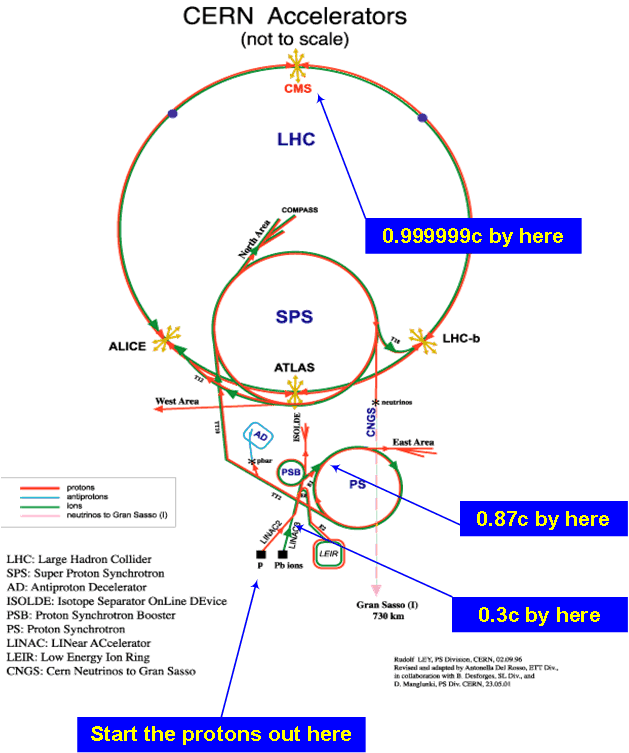
Here is a map showing the layout of the LHC. It actually consists of two rings and a couple of linear accelerator stages so they aren't injecting cold particles into the high energy beam. Keep in mind, the main ring is 17 miles around and about 100 meters underground. A lot of the people living inside its circumference probably don't actually realize what's going on underneath their feet, other than the various CERN campuses spread around the ring and all the nerdy looking people going in and out. In fact, there will be millions of particles whizzing around the track at ~99.9999% the speed of light...circling the entire distance 10,000 times a second.
What you see in the NY Times slide show is basically the most impressive parts of the LHC, the incredibly complex and massive detectors assembled in huge underground vaults. The remainder, while still fairly complicated and interesting, is orders of magnitude simpler.
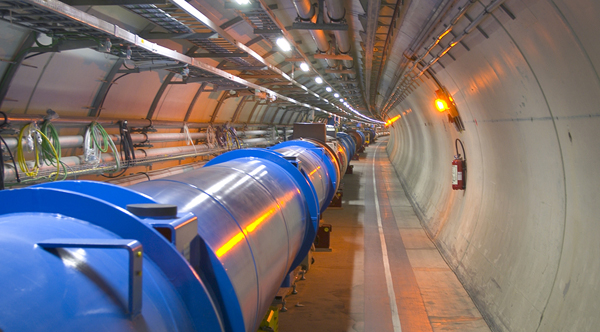
The rest of the collider is mostly a 3 meter diameter tunnel (pic), which has a track for getting people and equipment around it as needed, and the beam conduit. The physical tunnel is being reused from an older collider that was retired in 2000 to make way for this one, and I presume was dug with a tunnel boring machine.
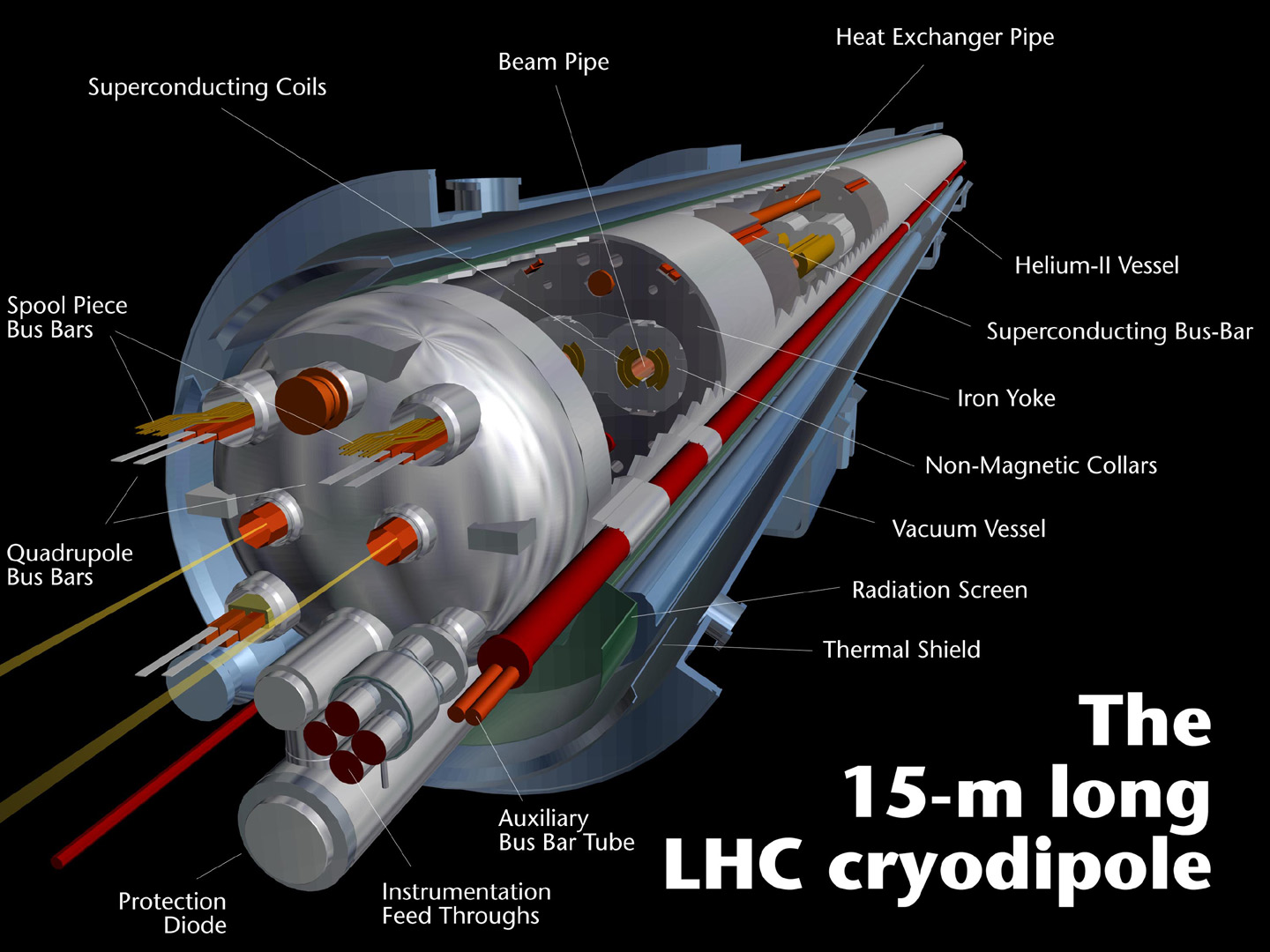
The conduit (CAD rendering) itself is more than just a pipe. The most important part is the two vacuum pipes inside that the beam runs through, and the 9,000+ magnets around the pipes that electromagnetically constrain and accellerate the particles so they follow the 17 mile loop instead of smashing uselessly into the walls. It also contains the electrical lines that power the magnets, and helium lines that keep them cool. Some stray collisions are expected, so it also contains a little bit of radiation shielding, although I don't believe people are supposed to be in the tunnel when it is operating.
More Pictures
LHC Outreach Page
Map showing cities and Swiss/French border -
Pictures of the "mundane" parts here
Here is a map showing the layout of the LHC. It actually consists of two rings and a couple of linear accelerator stages so they aren't injecting cold particles into the high energy beam. Keep in mind, the main ring is 17 miles around and about 100 meters underground. A lot of the people living inside its circumference probably don't actually realize what's going on underneath their feet, other than the various CERN campuses spread around the ring and all the nerdy looking people going in and out. In fact, there will be millions of particles whizzing around the track at ~99.9999% the speed of light...circling the entire distance 10,000 times a second.
What you see in the NY Times slide show is basically the most impressive parts of the LHC, the incredibly complex and massive detectors assembled in huge underground vaults. The remainder, while still fairly complicated and interesting, is orders of magnitude simpler.
The rest of the collider is mostly a 3 meter diameter tunnel (pic), which has a track for getting people and equipment around it as needed, and the beam conduit. The physical tunnel is being reused from an older collider that was retired in 2000 to make way for this one, and I presume was dug with a tunnel boring machine.
The conduit (CAD rendering) itself is more than just a pipe. The most important part is the two vacuum pipes inside that the beam runs through, and the 9,000+ magnets around the pipes that electromagnetically constrain and accellerate the particles so they follow the 17 mile loop instead of smashing uselessly into the walls. It also contains the electrical lines that power the magnets, and helium lines that keep them cool. Some stray collisions are expected, so it also contains a little bit of radiation shielding, although I don't believe people are supposed to be in the tunnel when it is operating.
More Pictures
LHC Outreach Page
Map showing cities and Swiss/French border -
Pictures of the "mundane" parts here
Here is a map showing the layout of the LHC. It actually consists of two rings and a couple of linear accelerator stages so they aren't injecting cold particles into the high energy beam. Keep in mind, the main ring is 17 miles around and about 100 meters underground. A lot of the people living inside its circumference probably don't actually realize what's going on underneath their feet, other than the various CERN campuses spread around the ring and all the nerdy looking people going in and out. In fact, there will be millions of particles whizzing around the track at ~99.9999% the speed of light...circling the entire distance 10,000 times a second.
What you see in the NY Times slide show is basically the most impressive parts of the LHC, the incredibly complex and massive detectors assembled in huge underground vaults. The remainder, while still fairly complicated and interesting, is orders of magnitude simpler.
The rest of the collider is mostly a 3 meter diameter tunnel (pic), which has a track for getting people and equipment around it as needed, and the beam conduit. The physical tunnel is being reused from an older collider that was retired in 2000 to make way for this one, and I presume was dug with a tunnel boring machine.
The conduit (CAD rendering) itself is more than just a pipe. The most important part is the two vacuum pipes inside that the beam runs through, and the 9,000+ magnets around the pipes that electromagnetically constrain and accellerate the particles so they follow the 17 mile loop instead of smashing uselessly into the walls. It also contains the electrical lines that power the magnets, and helium lines that keep them cool. Some stray collisions are expected, so it also contains a little bit of radiation shielding, although I don't believe people are supposed to be in the tunnel when it is operating.
More Pictures
LHC Outreach Page
Map showing cities and Swiss/French border -
Pictures of the "mundane" parts here
Here is a map showing the layout of the LHC. It actually consists of two rings and a couple of linear accelerator stages so they aren't injecting cold particles into the high energy beam. Keep in mind, the main ring is 17 miles around and about 100 meters underground. A lot of the people living inside its circumference probably don't actually realize what's going on underneath their feet, other than the various CERN campuses spread around the ring and all the nerdy looking people going in and out. In fact, there will be millions of particles whizzing around the track at ~99.9999% the speed of light...circling the entire distance 10,000 times a second.
What you see in the NY Times slide show is basically the most impressive parts of the LHC, the incredibly complex and massive detectors assembled in huge underground vaults. The remainder, while still fairly complicated and interesting, is orders of magnitude simpler.
The rest of the collider is mostly a 3 meter diameter tunnel (pic), which has a track for getting people and equipment around it as needed, and the beam conduit. The physical tunnel is being reused from an older collider that was retired in 2000 to make way for this one, and I presume was dug with a tunnel boring machine.
The conduit (CAD rendering) itself is more than just a pipe. The most important part is the two vacuum pipes inside that the beam runs through, and the 9,000+ magnets around the pipes that electromagnetically constrain and accellerate the particles so they follow the 17 mile loop instead of smashing uselessly into the walls. It also contains the electrical lines that power the magnets, and helium lines that keep them cool. Some stray collisions are expected, so it also contains a little bit of radiation shielding, although I don't believe people are supposed to be in the tunnel when it is operating.
More Pictures
LHC Outreach Page
Map showing cities and Swiss/French border -
Pictures of the "mundane" parts here
Here is a map showing the layout of the LHC. It actually consists of two rings and a couple of linear accelerator stages so they aren't injecting cold particles into the high energy beam. Keep in mind, the main ring is 17 miles around and about 100 meters underground. A lot of the people living inside its circumference probably don't actually realize what's going on underneath their feet, other than the various CERN campuses spread around the ring and all the nerdy looking people going in and out. In fact, there will be millions of particles whizzing around the track at ~99.9999% the speed of light...circling the entire distance 10,000 times a second.
What you see in the NY Times slide show is basically the most impressive parts of the LHC, the incredibly complex and massive detectors assembled in huge underground vaults. The remainder, while still fairly complicated and interesting, is orders of magnitude simpler.
The rest of the collider is mostly a 3 meter diameter tunnel (pic), which has a track for getting people and equipment around it as needed, and the beam conduit. The physical tunnel is being reused from an older collider that was retired in 2000 to make way for this one, and I presume was dug with a tunnel boring machine.
The conduit (CAD rendering) itself is more than just a pipe. The most important part is the two vacuum pipes inside that the beam runs through, and the 9,000+ magnets around the pipes that electromagnetically constrain and accellerate the particles so they follow the 17 mile loop instead of smashing uselessly into the walls. It also contains the electrical lines that power the magnets, and helium lines that keep them cool. Some stray collisions are expected, so it also contains a little bit of radiation shielding, although I don't believe people are supposed to be in the tunnel when it is operating.
More Pictures
LHC Outreach Page
Map showing cities and Swiss/French border -
Pictures of the "mundane" parts here
Here is a map showing the layout of the LHC. It actually consists of two rings and a couple of linear accelerator stages so they aren't injecting cold particles into the high energy beam. Keep in mind, the main ring is 17 miles around and about 100 meters underground. A lot of the people living inside its circumference probably don't actually realize what's going on underneath their feet, other than the various CERN campuses spread around the ring and all the nerdy looking people going in and out. In fact, there will be millions of particles whizzing around the track at ~99.9999% the speed of light...circling the entire distance 10,000 times a second.
What you see in the NY Times slide show is basically the most impressive parts of the LHC, the incredibly complex and massive detectors assembled in huge underground vaults. The remainder, while still fairly complicated and interesting, is orders of magnitude simpler.
The rest of the collider is mostly a 3 meter diameter tunnel (pic), which has a track for getting people and equipment around it as needed, and the beam conduit. The physical tunnel is being reused from an older collider that was retired in 2000 to make way for this one, and I presume was dug with a tunnel boring machine.
The conduit (CAD rendering) itself is more than just a pipe. The most important part is the two vacuum pipes inside that the beam runs through, and the 9,000+ magnets around the pipes that electromagnetically constrain and accellerate the particles so they follow the 17 mile loop instead of smashing uselessly into the walls. It also contains the electrical lines that power the magnets, and helium lines that keep them cool. Some stray collisions are expected, so it also contains a little bit of radiation shielding, although I don't believe people are supposed to be in the tunnel when it is operating.
More Pictures
LHC Outreach Page
Map showing cities and Swiss/French border -
Re:Two 7TeV Beams = 14TeV collision
Err.... Actually, this power does not go into the electromagnets directly. The electromagnets happen to be superconducting magnets, which, once powered, do not require more current. That's not where the power goes. The power goes into keeping it cool. 18kW of synchrotron radiation is dumped into the cryogenics system. The syncrotron radiation is due to the relativistic charged particles curving under the influence of the magnetic fields, but this dumped energy needs to be extracted before it results in a quench. A quench is defined as a superconducting magnet, which has no resistivity, transitioning into the resistive phase, due to the temperature rising locally above the critical point. Here is an interesting link to the power budget of CERN: link As you will see, the LHC eats up little power (given its size) compared to the SPS (Super Proton Synchrotron) which has conventional magnets and has much smaller radius. The SPS delivers 450MeV protons to the LHC, which then accelerates them upto 14TeV. But the SPS eats up more power than the LHC due to its conventional magnets. Hurray for super-conductivity. ps. you may not have realized this, but might like to know that your post resulted in an excited discussion in at least one CERN corridor...
-
Re:The Problem with Something this ExpensiveTo me endeavors like this are the most perfect expression of man. Vonnegut wrote in Breakfast of Champions,
Our awareness is all that is alive and maybe sacred in any of us. Everything else about us is dead machinery.
To plunge into the unknown is a moral imperative for any thinking being.
If all you care about are material practicalities, this thing is roughly 1/50th the current cost of a certain misadventure in the Middle East, and is more likely to produce cool stuff. One particularly exciting bit of technology already is the LHC's grid computing infrastructure. -
Re:No More Thought Experiments
The purpose of dark matter is not just to explain spiral galaxy rotational curves. The bigger problem is the energy budget of the universe.
If you ONLY read the NASA press releases with colorized images, that is, I am afraid your problem. There is over-whelming evidence for the existance of dark matter and what are scientists to do if the only thing that puts dark matter on a \.er's mind is just a pretty picture. If you are interested, go to arxiv.org and search for results from dark matter experiments and read the papers. Yes, they are technical. Yes, it produced many PhDs -- not a bad thing, last time I checked. And yes, the experimental evidence is overwhelming.
The number of people working on dark matter experiments, greatly exceeds the number of dark matter theorists, probably by an order of magnitude actually. This is *the* one field in astro-particle physics, where there is great wealth of data and that data is driving the evolution of the field. In particle physics, this is not the case! There is no data on particles which might form dark matter! There are too many theories! Hopefully, the tables will turn when the LHC at CERN turns on next year!
I should also point out that this is one of the "nicest" sort of theoretical astrophysics papers there is. It suggests a possible phenomena that produces an experimental signature in space experiments like or AMS.
-
Re:interesting
As a matter of fact, there are several experiments looking for dark matter from the sun. Yes, there could be some dark matter loosely bound to the sun's gravitational potential. I can not give a comprehensive list here but a good example is CAST . There are other dark matter experiments which may be sensitive to a signal from the sun such as CRESST and CDMS.
-
Re:I'm torn...
-
Presentation from Indian Institute of Technology
I've been at a computing-related conference in India about a year ago and one of the invited local speakers was talking about reality of broad-band delivery in India. Apparently the main issues are the average income which requires about 10-times lower prices for services (same for mobile phones) and problems with power-distribution, especially in rural areas. Here's a link to his slides: http://indico.cern.ch/materialDisplay.py?contribI
d =430&sessionId=0&materialId=slides&confId=048 -
Is it just me
or other people as well think that the magnet explosion was no accident? I bet that now CERN scientist are going to retaliate by aiming their neutrino beam at FermiLab trying to mess with their experiments.
-
Re:Not a Dupe
I guess I should cover my ass and point out that none of that post is priveleged information; beyond my meandering speculations, you can read the press release yourself:
The goal at CERN and Fermilab is now to redesign and repair the inner triplet magnets and, if necessary, the DFBX without affecting the LHC start-up schedule. Teams at CERN and Fermilab have identified potential repairs that could be carried out expeditiously without removing undamaged triplet magnets from the tunnel.. All three of the pressure-tested triplet magnets at Point 5, plus the associated DFBX, will be removed from the tunnel for inspection and, if necessary, repair. CERN will manage the redesign and repair effort and has scheduled a review for April 24-25 to validate the selected method. Fermilab will take part in the review. Repair of the triplet magnets would begin after validation by the reviewers. The immediate goal is to have a repaired triplet in another sector of the accelerator ready to participate in a pressure test scheduled for June 1.
Primary sources are always better than some guy commenting. -
Some real information
Here's Fermilab's statment. Of course they are an interested party, but at least their statement contains information, unlike the snide popular press article.
http://user.web.cern.ch/user/QuickLinks/Announceme nts/2007/LHCInnerTriplet.html -
For 64bit floats, the PS3 is a powerhouse
Cell is very optimized toward one data type for calculation: 64bit floats. If you want to efficiently use the PS3 in a cluster, just be aware that your code must:
a) use primarily 64bit floating point
b) either:
- fit code and data segments within 256K for each SPU
- crunch long enough between streamed data blocks such that DMA latency doesn't kill performance
c) have the entire calculation broken down into no more than six parts for streaming (one per SPU)
There are SPU userspace threading models that run cooperatively (similar to the old userspace pthreads, I guess), but the thread manager consumes valuable SPU RAM. Also, SPUs don't support a supervisor bit for memory protection... so... bad things happen when threaded code running on SPU goes tits up.
If you want to calculate 128bit floats, ints, or have lots of branch logic... buy a quad core2duo; cell don't do you any good.
BTW: Anyone here hacking GEANT or BLAST for Cell? -
Re:Sigh.
Europe virtually ignored the tech industry for decades
Yes, Tim Berners-Lee completely ignored technology when inventing the Web (whilst working at CERN) preferring to use homing pigeons instead of a packet-switching network.
Just because the EC is taking a known monopolist to task--and going the right way about it--doesn't mean there is some sort of European conspiracy going on. Microsoft have got a massive percentage (a bit out of date, can't seem to find anything current) of desktop market share and are using that to unfairly hamper competition. They use bundling and their API to stop people from developing for other platforms. They put the brakes on IE for as long as possible because they realised their API was (and still is) threatened by web based applications.
Unfortunately the US government failed to prosecute Microsoft fully so the EC are being forced to do it. It's sad but quite simple.
-
Re:Sigh.
Europe virtually ignored the tech industry for decades
Yes, Tim Berners-Lee completely ignored technology when inventing the Web (whilst working at CERN) preferring to use homing pigeons instead of a packet-switching network.
Just because the EC is taking a known monopolist to task--and going the right way about it--doesn't mean there is some sort of European conspiracy going on. Microsoft have got a massive percentage (a bit out of date, can't seem to find anything current) of desktop market share and are using that to unfairly hamper competition. They use bundling and their API to stop people from developing for other platforms. They put the brakes on IE for as long as possible because they realised their API was (and still is) threatened by web based applications.
Unfortunately the US government failed to prosecute Microsoft fully so the EC are being forced to do it. It's sad but quite simple.
-
RHEL(L)?
I use RHEL4 compatible distro called Scientific Linux CERN 4 (SLC4) on my laptop. I need it to run some CERN software (mainly Geant4 and ROOT). These packages mostly work on other systems as well but they work best on SLC4 because they have been thoroughly tested on this platform. On other (newer) distros expecially new GCC4 compiler causes some annoying problems. I really like many things in this distro: stability (both as in "doesn't crash" and "doesn't change insert-name-of-software-package-here version unexpectedly", upgrades generally don't break anything, graphical installation/administration tools are great, etc. etc. etc... There is only one problem: lack of software packages. There is no good way to install new versions of some graphical apps. This is not exclusively Red Hat problem. It exists on all Linux platforms. The problem is that software developers have "works-for-me" attitude: "If I have the latest distro probably everyone else has it too." So they code apps using the latest versions of libraries. Since I use this software on my laptop (which is my primary computer right now) I need both stability of RHEL4 and preferably new desktop software (because new software offers generally better features and usability).
I'm annoyed by this situation because I can't install new tools when I need/want them. This is very inflexible (imagine that: I'm blaming Linux for inflexibility...) The only solution to this problem seems to be virtualization. RHEL 4.5 update (and probably SLC 4.5 as well) is going to have Xen domU support. Maybe it will be then painless to move, say to Fedora 7 or RHEL5 based SLC5 and run SLC4 using virtualization... One can only hope...
-
RHEL(L)?
I use RHEL4 compatible distro called Scientific Linux CERN 4 (SLC4) on my laptop. I need it to run some CERN software (mainly Geant4 and ROOT). These packages mostly work on other systems as well but they work best on SLC4 because they have been thoroughly tested on this platform. On other (newer) distros expecially new GCC4 compiler causes some annoying problems. I really like many things in this distro: stability (both as in "doesn't crash" and "doesn't change insert-name-of-software-package-here version unexpectedly", upgrades generally don't break anything, graphical installation/administration tools are great, etc. etc. etc... There is only one problem: lack of software packages. There is no good way to install new versions of some graphical apps. This is not exclusively Red Hat problem. It exists on all Linux platforms. The problem is that software developers have "works-for-me" attitude: "If I have the latest distro probably everyone else has it too." So they code apps using the latest versions of libraries. Since I use this software on my laptop (which is my primary computer right now) I need both stability of RHEL4 and preferably new desktop software (because new software offers generally better features and usability).
I'm annoyed by this situation because I can't install new tools when I need/want them. This is very inflexible (imagine that: I'm blaming Linux for inflexibility...) The only solution to this problem seems to be virtualization. RHEL 4.5 update (and probably SLC 4.5 as well) is going to have Xen domU support. Maybe it will be then painless to move, say to Fedora 7 or RHEL5 based SLC5 and run SLC4 using virtualization... One can only hope...
-
Re: it's not as closed as you think :-)
At the moment there are still alternative methods of access so the forcible removal of body parts is not happening yet (except for people carrying a donor codicil, but that's organ
There are already scanners that check for things like body heat and (IMHO a more clever idea) a pulse in roughly the same way as a hospital finger pulse reader does it, but the pulse one has the problem that it's possible to pick up latent prints from the way it works (it's not a 'swipe' style scanner). But that too will be bypassed - it's the usual arms race.
You would be right with your millions vs. a few incidents (incidentally, also the same argument to put a terror threat into a reasonable perspective) if you consider that not everyone has data worth stealing except for your very identity. So you could say that the height of your presence on the food chain ought to directly correlate with an increased aversion to biometrics..
BTW, as a slight aside, the popping eyeball idea for bypassing biometrics was used in the "Angels and Demons" book by Dan Brown (better known for "The Davinci Code" -
Re: it's not as closed as you think :-)
At the moment there are still alternative methods of access so the forcible removal of body parts is not happening yet (except for people carrying a donor codicil, but that's organ
There are already scanners that check for things like body heat and (IMHO a more clever idea) a pulse in roughly the same way as a hospital finger pulse reader does it, but the pulse one has the problem that it's possible to pick up latent prints from the way it works (it's not a 'swipe' style scanner). But that too will be bypassed - it's the usual arms race.
You would be right with your millions vs. a few incidents (incidentally, also the same argument to put a terror threat into a reasonable perspective) if you consider that not everyone has data worth stealing except for your very identity. So you could say that the height of your presence on the food chain ought to directly correlate with an increased aversion to biometrics..
BTW, as a slight aside, the popping eyeball idea for bypassing biometrics was used in the "Angels and Demons" book by Dan Brown (better known for "The Davinci Code" -
Re:Incorrect.
you don't do anything to support your argument in that quote.
Let me break it down for you.
Calder offers local cooling as an example of how anthropogenic climate change scientists are wrong.
However, anthropogenic climate change scientists predict local cooling in their models.
Therefore, one of Calder's 'proofs' that anthropogenic climate change scientists are incorrect is faulty.
Please note that I am not commenting on Cosmic Ray/Cloud formation experiment, until it is indepentantly reproduced (CERN is currently doing this). -
Re:Power over Ethernet Could Help
Well, mechanical and electrically BLDCs motors are AC motors, with electronics included so that the AC that is needed to run the motor is generated from the input DC.
Wether the AC is sinusoid or rectangular doesn't matter much for most cases.
I guess once the electronics have reached a level of improvement where the energy loss in (and the cost of) them becomes negligible compared to that of the motor it won't matter much wether the electronics themself are fed by AC or DC.
But while DC-DC transformers that transform voltage DOWN have been available for some years now, I haven't seen a good approach to get voltage UP.
Even at the Solid-State High Voltage, DC Power Distribution & Control project at CERN http://accelconf.web.cern.ch/accelconf/p99/PAPERS
/ THDR5.PDF they still use AC and an AC Transformator to get the High voltage they then rectify into DC. But I have been out of the loop of that for a few years, anything new there? -
Another tool for the job: ROOT
One good tool for doing large scale data analysis is ROOT which has been developed at CERN. ROOT contains facilities for storing, analyzing and visualizing very large data sets fairly quickly. Online User's Guide contains a nice overview of the ROOT system.
-
Another tool for the job: ROOT
One good tool for doing large scale data analysis is ROOT which has been developed at CERN. ROOT contains facilities for storing, analyzing and visualizing very large data sets fairly quickly. Online User's Guide contains a nice overview of the ROOT system.
-
Re:Lots of data, but not as much as the LHC
The LHC will produce more data, but we also don't care about most of it. The vast majority of it is junk. The "interesting" physics (particles like W and Z bosons, top quarks, higgs, etc) are about 10^-9 of the events. It is a huge needle in a haystack problem and we throw out most data. We have many experts and professors who design "triggers" which, based on a subset of information that can be delivered to them in a reasonable time, decide whether a given proton-proton collison contains new physics. Many theorists these days are making dents in walls with their heads trying to think of ways these triggers might be missing important information, so that we can suggest changes before it's too late. This is a lot of dedicated silicon, FPGA's, VME crates, etc. Slashdotters should drool. Anyway, we throw out the vast majority of information.
By comparison, LSST is trying to store everything. Scroll up for an interesting comment about calibrating ambient brightness and seeing. I can't answer which will deliver more information, but both are incredibly interesting challenges.
Data challenges abound. We have designed the LHC Grid to distribute this information. There will be several data warehouses located around the world at national labs and universities. Even after the triggers decide what is "interesting", more sophisticated algorithms, with access to all the data in a single proton-proton collision are applied. Then, humans are applied to the data and we will try to dig out new signals from this.
In all this we expect to find (among other things) the origin of mass and Dark Matter, and we're working hard to prepare for the onslaught of data.
-- Bob
-
Re:Lots of data, but not as much as the LHC
Funny, but CERN itself makes that same misspelling of 'hadron' here. "This is the underground tunnel of the Large Hardon (sic) Collider (LHC)..."
-
Lots of data, but not as much as the LHC
That's a lot of data, but it's less than 1/10 as much data as the Large Hadron Collider will put out, and the LHC is supposed to be coming online within a year, not in six years. By the time the Large Synoptic Survey Telescope comes online, the LHC may have produced more data than the Large Synoptic Survey Telescope will over the life of the project.
I'd be interested to know more about the data handling methods they have in place for the LHC. I don't think they'll be using Excel.
*Note the correct, non-Frudian-Slip spelling of "hadron" -
Re:Does Dark Matter exist?
Taken directly from CERN
"What is "Dark matter" made of?
Measurements in astronomy imply that up to 90% or more of the Universe is not visible (i.e. does not emit electromagnetic radiation) . Scientists call this undetectable "stuff" dark matter.
Its presence is felt through the gravitational effects on the matter we can see. Stars in galaxies, for example, appear to be moving much faster than they would if they were influenced only by the visible matter in the galaxy.
The nature of dark matter and its role in the evolution of the universe are still unknown.
Probably it is made of several components, among which are neutrinos, dust, cold gas, and special particles predicted by the grand unification theories but not yet seen, the so called "superparticles".
Physicists hope to identify some of the elementary constituents of dark matter at the LHC."
As we can all see, the experts aren't even sure of the elementary principals yet.
Anyone want to expand on "superparticles." Seems as if they are referring to neutrinos. -
saving the kernel dump ..
"If you have listened to Linus and his lieutenants (Andrew Morton etc.), they say they are not focused on the desktop"
I can't actually recall reading anything Torvalds said regarding their focus. Do you have a link to what they actually said regarding the Desktop.
"They are focused on the high-end. Which makes sense to me - Microsoft dominates the desktop, the high-end is up for grabs right now"
The Desktop gets more visibility which is why when the average PHB decides to buy a server he chooses what he's already familar with, Windows. Ignoring the desktop would be a massive error.
"Linux has improved a lot for the high-end, but still needs work done. I just was speaking with someone from Oracle recently who told me how in an environment with a lot of Linuxes connected to a lot of SANs, the 2.4 kernel was complete junk. He did say things were getting better with the 2.6"
Has this been refered to on the kernel mailing list linux.kernel. Do other users of Oracle have this problem. You don't provide a lot of technical details. Is there a reference you can provide for such issues. Running a database is relativly trivial compared to calculating nuclear reactions or doing the graphics on 'Lord of the Ring' and would require very high-end equipment. What I don't understand how CERN and Weta Digital were able to get any work on the 'still needs work done' Linux OS.
"Hey here's another example - what if I want a fricking kernel dump when my system crashes? What, I can't dump it to disk like Solaris and every other enterprise UNIX does?"
You do seem to be unfortunate in your choice of OS. I don't know what use a kernel dump is unless you're actually compiling the kernel
"I have to send it over the network (which comes to a host of problems which I won't go into here)? Yes, yes, I know about the problems of doing this for a variety of hardware, but this is the sort of thing I'm talking about"
Yet more problems. I don't understand, I thought the kernel dump was a standard file saved locally and what's the difficulty in sending it over the network.
You paint a complete horror story of maintaining a Linux network. If I was reading this and had no first hand experience of using Linux I would run straight back to the nice safe OS that comes with training wheels attached. Kernel dump!!
was What do Linus and his lieutenants say? (Score:5, AstroT~1) -
Re:Robots, not people
Sure, manned space exploration is romantic and exciting, but manned missions to the moon accomplished nothing beyond nationalistic PR that culdn't have been done better by machines,
That's the theory often bandied about - but sadly, its not true. Even today, with four decades more research into robotics, we'd be hard pressed to duplicate the efforts of even a simple mission like Apollo 12. (Let alone the more complex missions of the later flights.) Or to put it simply; What Spirit and Opportunity have accomplished in nearly three years on Mars is roughly what an average field geologist could have accomplished in about three weeks.
and the ISS has produced no science worthy of its staggering cost.
Niether has the Large Hadron Collider... But then, both the ISS and the LHC are still under construction! Now, it's quite reasonable to complain that the ISS has taken too long to complete, or will be too expensive in the end... But to complain that an incomplete facility has produced no results is a sign of ignorance. -
I'd like to see...
How about an article on that neat analysis framework Fermi (and others) use for the terabytes of data they generate and have to sift through?
http://root.cern.ch/ (large scale repository for data analysis)
And how would you use Postgres for something like that anyway? Maybe something like:
http://www.greenplum.com/ (biggy-sized Postgres based data warehousing) -
Ok, here is another outdated test
Ok, this is yet another outdated report comparing three mainstream RDBMS'es - MySQL, PostgreSQL and ORACLE. It was done for yet another physical experiment - for choosing the proper system for storing data about the construction process of one of the LHC detectors - ALICE.
And this report is at least professional, which cannot be said about the one mentioned in the article.
http://dcdbappl1.cern.ch:8080/dcdb/archive/ttraczy k/db_compare/db_compare.html -
Re:My Suggestion to OO Developers
I've often wondered if there is a "Unix way" to do spreadsheets--that is, a way to put data in a plain text file and then do analysis on it
There ist root which only requires you to be creative in crude usage of c++. But then you can do more or less any data analysis you like, including good plotting tools. -
Re:Speculative Idea for a Spaceborne Collider...
It's got a completely different goal as well, it's an experiment looking for anti-matter.
The problem with the proposal of this cosmic-ray-focus-smash-thing in space is that it would be a fixed target experiment, so your centre of mass energy you can reach is far less than 10^20 GeV (goes with the square root of the energy). In fact it is in the range of what the LCH will reach. That's why they came up with this very nice reverse-kind of experiment at the LHC, LHCf, which will be used to model atmospheric showers from UHECR: http://bulletin.cern.ch/eng/articles.php?bullno=42 /2006&base=art -
Re:Speculative Idea for a Spaceborne Collider...
There is an experiment planned for the International Space Station for studying cosmic rays impacting with a target. It's called the Alpha Magnetic Spectrometer. It uses the same kind of detectors being built at the LHC (but smaller). According to the original plans, it should have been sent to the ISS already on a shuttle (I think the instruments are all finished and waiting in a warehouse somewhere), but after the shuttle accidents it was delayed. I don't know the status now, or whether it will ever fly at all.
It's not nearly as large as what you are proposing, though... -
Before you go rushing in...
This is an absolutely amazing project. Forget the space program; forget SETI--if this thing works as designed, pure science will gain more in 2008 than it did in the previous decade. But, they need your help! The energy output for this thing is just incredible that if an entire beam were to go off-course and hit the wall of the accelerator, there would be a rather sizable explosion. Even smaller errors can add up, damaging the accelerator over time. The LHC@home project lets you donate your spare CPU cycles to help calibrate the machine in order to minimize the risk of accidental wall collisions. Come on, I know there must be some physics geeks out there... show your support! Given the sorry state of pure science research in the USA, this may be your only chance...
Before you go rushing off, a word of warning... LHC@Home is just barely this side of an being an ex-parrot. With the near completion of the magnet system, work come in spurts with considerable time between them. (If you already run BOINC, it's quite suitable as a side project. If you don't already run BOINC, please consider also running one of the other available projects.) -
Re:cough HYPERCARD cough
Point 1: Yes, Interface Builder and NeXTstep predate the web: The "web" was _created_ with Interface Builder and NeXTstep! Tim Berners-Lee says "
The first web browser was implemented in NeXTstep and was also the first web editor. The World Wide Web application was a WYSIWYG editor with collaborative user editing features far beyind standard wiki today.
pictures: http://info.cern.ch/NextBrowser.html
"It has taken a long time for technology to catch up with Berners-Lee's original vision. The first ever web browser was also an editor, making the web an interactive medium, the problem was that it only ran on the NeXTStep operating system."
Tim Berners-Lee worte "I wrote the program using a NeXT computer. This had the advantage that there were some great tools available -it was a great computing environment in general. In fact, I could do in a couple of months what would take more like a year on other platforms, because on the NeXT, a lot of it was done for me already. There was an application builder to make all the menus as quickly as you could dream them up. there were all the software parts to make a wysiwyg (what you see is what you get - in other words direct manipulation of text on screen as on the printed - or browsed page) word processor. I just had to add hypertext, (by subclassing the Text object)"
http://www.w3.org/People/Berners-Lee/WorldWideWeb. html
Note: He did not write the program on a Mac using Hypercard nore could he reasonably.
12 November 1990 proposal: http://www.w3.org/Proposal.html "... we extend the application area by also allowing the users to add new material."
http://public.web.cern.ch/Public/Content/Chapters/ AboutCERN/Achievements/WorldWideWeb/WebHistory/Web History-en.html
http://en.wikipedia.org/wiki/Tim_Berners-Lee
Point 2: NeXTstep predates XML: Prior to standard XML, NeXTstep used ASCII "Propert Lists" which are exactly the same concept with a different syntax and no user definable type qualification. When XML was standardized, NeXTstep transitioned to using it.
Point 3: Very few people (possibly only you) would claim that dropping Hypercard and adopting NeXTstep was even a small step backward. You don't seem to understand what NeXTstep/Openstep/Cocoa is or what it enables or why it is still ahead of the crowd 18 years later.
Point 4: How is Hypercard anything other than a tool to let users create quick and dirty applications also knows as "hacks" ? Don't be so quick to call things "Third party extension and hacks" particularly when they are full featured commecial tools used to build serious applications. -
Re:cough HYPERCARD cough
Point 1: Yes, Interface Builder and NeXTstep predate the web: The "web" was _created_ with Interface Builder and NeXTstep! Tim Berners-Lee says "
The first web browser was implemented in NeXTstep and was also the first web editor. The World Wide Web application was a WYSIWYG editor with collaborative user editing features far beyind standard wiki today.
pictures: http://info.cern.ch/NextBrowser.html
"It has taken a long time for technology to catch up with Berners-Lee's original vision. The first ever web browser was also an editor, making the web an interactive medium, the problem was that it only ran on the NeXTStep operating system."
Tim Berners-Lee worte "I wrote the program using a NeXT computer. This had the advantage that there were some great tools available -it was a great computing environment in general. In fact, I could do in a couple of months what would take more like a year on other platforms, because on the NeXT, a lot of it was done for me already. There was an application builder to make all the menus as quickly as you could dream them up. there were all the software parts to make a wysiwyg (what you see is what you get - in other words direct manipulation of text on screen as on the printed - or browsed page) word processor. I just had to add hypertext, (by subclassing the Text object)"
http://www.w3.org/People/Berners-Lee/WorldWideWeb. html
Note: He did not write the program on a Mac using Hypercard nore could he reasonably.
12 November 1990 proposal: http://www.w3.org/Proposal.html "... we extend the application area by also allowing the users to add new material."
http://public.web.cern.ch/Public/Content/Chapters/ AboutCERN/Achievements/WorldWideWeb/WebHistory/Web History-en.html
http://en.wikipedia.org/wiki/Tim_Berners-Lee
Point 2: NeXTstep predates XML: Prior to standard XML, NeXTstep used ASCII "Propert Lists" which are exactly the same concept with a different syntax and no user definable type qualification. When XML was standardized, NeXTstep transitioned to using it.
Point 3: Very few people (possibly only you) would claim that dropping Hypercard and adopting NeXTstep was even a small step backward. You don't seem to understand what NeXTstep/Openstep/Cocoa is or what it enables or why it is still ahead of the crowd 18 years later.
Point 4: How is Hypercard anything other than a tool to let users create quick and dirty applications also knows as "hacks" ? Don't be so quick to call things "Third party extension and hacks" particularly when they are full featured commecial tools used to build serious applications. -
Re:Acknowledgement ...
-
LHC@home
It may be worth noting that some of the design work on this amazing project was actually done by Slashdot readers with no background in particle accelerators. LHC@home is a distributed computing project using the SixTrack program that helps simulate particles' travel in the accelerator to study the stability of their orbits. It has been critical data to the scientists that have been working on the project.
-
You can help!
This is an absolutely amazing project. Forget the space program; forget SETI--if this thing works as designed, pure science will gain more in 2008 than it did in the previous decade. But, they need your help! The energy output for this thing is just incredible that if an entire beam were to go off-course and hit the wall of the accelerator, there would be a rather sizable explosion. Even smaller errors can add up, damaging the accelerator over time. The LHC@home project lets you donate your spare CPU cycles to help calibrate the machine in order to minimize the risk of accidental wall collisions. Come on, I know there must be some physics geeks out there... show your support! Given the sorry state of pure science research in the USA, this may be your only chance...
-
Re:Acknowledgement ...
They even have their own supported Linux Distribution, currently based on Scientific Linux 3.x.