Slashdot Mirror
Domain: cfact.org
Stories and comments across the archive that link to cfact.org.
Comments · 19
-
Re:Theories are falsifiable, global warming is not
Water vapor dominates greenhouse gases. Furthermore, there is peer reviewed evidence that CO2 forcing as typically used is about twice what it should be, placing CO2 down in the 5-10% range of effect. It's water vapor, not CO2, that drives most climate change. And water vapor is overwhelmingly driven by solar activity.
-
Re:Where's the nukes?
Germany is a good example. I have more.
African nations kept in poverty over UN "green energy" mandates.
https://www.thegwpf.com/james-...Australia is feeling the pain too.
https://www.thegwpf.com/global...I happened across something on Germany.
http://notrickszone.com/2017/1...An article on the general threats posed to real people today by "green energy" mandates.
http://www.cfact.org/2017/10/0...I find the corn ethanol mandates exceedingly frustrating. That's food we are burning while people need to eat. Not only that I'll read about farmers buying this "brewer's grain" (the stuff left over from turning corn into ethanol) and feeding it to cattle. The problem is that while this grain has protein and minerals it doesn't have enough calories. What do the farmers do then? They buy up discarded corn syrup laden candy and mix it with the grain. Here's an idea, how about we give the corn to the cattle and send the candy to the ethanol producers? We can't do that though because using discarded candy to make ethanol isn't "green" enough, or some shit.
I know people complain that feeding corn to cattle is "unnatural" or something. Well, is feeding cattle brewer's grain mixed with expired Hershey bars somehow "better"? It must be because the laws that the "environmentalists" got passed made this happen.
To those that think we should not eat meat I'll say this, fuck you. If you want to talk about eating "naturally" then what's more natural than going out hunting for wild deer? People have been eating meat for a very long time. Domesticating animals might be recent on the grand scheme of things be we need meat in our diet to be healthy and to hunt for population control. What's wrong with going out to hunt a deer? Or a wild pig? Or hunt a bear? Speaking of which, hunting bans on polar bears has created a polar bear over population problem.
http://dailycaller.com/2017/10... -
Changes resources for the better, not worse
Climate change changes resource availability. Particularly water. If areas that once had water no longer have water
Except that is exactly backwards as to what happens as the earth warms. A generally warmer climate means water evaporates more quickly. If you believe that oceans are gong to rise significantly, that means even more surface area with water to evaporate more quickly...
Some weather patterns may change but overall there is more, not less, water as the climate warms.
If natural disasters increase linked to climate change
Which they aren't.
widespread homelessness and unrest.
Some areas being more like San Francisco is not doomsday. Perhaps they will get trendy toast shops.
Climate change has upset the status quo many times over history.
Again how is that doomsday? It is change, but it is certainly not an event that means the destruction of everything. It is something slowing down, and something starting anew.
Climate change whether man made or natural always upsets the status quo... but now we have nuclear weapons.
Not everyone, and the ones that do are generally stable enough not to use them because of shifting changes. Except of course for Iran but you can ask Oabma why he thought it was a good idea to make sure Iran would have nuclear weapons.
Oh and North Korea, but come on. They aren't shifting anywhere.
-
Re:Prove the data wrong
They refuse to engage in a honest debate
I think you'll find it's the climate shills who aren't showing up to debate "deniers". It's policy. You know, if you show up to debate them you give them legitimacy. So you're probably 99.9% wrong about that (I'll give you 0.1% doubt because you know, there's always a possibility I'm wrong here).
Many of them have clear conflicts of interest
Why do you think energy companies are depressed about "climate change"? They can hoover up huge subsidies from government from their "green" initiatives. Goldman Sachs can trade carbon credits! Yes, the giant vampire squid on the face of Humanity is on your side on this. Muggins like me pay the costs of course, when we get our bills.
If the climate deniers had an actual evidence based case they could easily cut through the BS
Well there are 1,000 scientists here that you would call "deniers" but they don't get the same mountain of publicity and support, mostly because this is a political cause, not a scientific one. I like this comment:
They have no such evidence
Yes you see the problem here don't you. Are there contrarians who're going to survive graduate school and end up with tenure? It must be very hard to argue against the paradigm when the big ticket studies are funded by a government determined on the point. It's called bias. There's a lot of it about.
-
Timeo the Government et dona ferentes
My Latin is rusty, but the sentiment should be clear — the government should stay away from the industry and the markets. Its only legitimate role is to enforce laws and contracts.
Trying to boost certain industries, while a welcome contrast to the previous Administrations' attempts to sabotage some, is just as suspicious and ultimately unfair.
Maybe it is Ok for the State department to champion American companies abroad. Hopefully, Trump is not planning to go beyond the above listed activities and will not, as President, repeat the stunt he pulled with Carrier as President-elect.
-
Wrong, wrong, wrong
-
Re:Perspective
So, publishing helps you get funding - keeps you employed, so to speak. I assume publishing a bogus paper doesn't help so much does it? Or one that says everyone else is wrong, and the organization funding your research is wrong as well? Not a popular paper I suppose...
As far as Hansen et al. cooking the books, here's one good source but you can literally go through the raw data, and see how it's been adjusted many times, and it happens regularly. Interesting that nearly all the adjustments tend to make the temperature increase "higher" than what the actual data said, too...
Of course, the adjustments warning of massive calamity that can only be saved by huge "investments" and control by Big Government - the same entity that provides all those NIH and other grants - have no financial impact on those who do the adjustments, right?
-
Re:records go back to 1880, very funny
wrong, they are not filtered out, instead a correction factor is applied
Steve S. Goddard has made it his career to track these "corrections" and missing data points for the USHCN (Historical Climatology Network). He has uncovered a lot of "corrections" where there should be none, and inappropriate "filling in" of missing data points. Not to mention that the "missing" data points have been overwhelmingly in areas of colder climate. He has easily 100 examples of deliberate distortion of the data in USHCN, and he has even tracked this progressive re-writing of history over the last couple of decades.
Here is just one of a great many examples.
Steve has also found many historical records that directly contradict what modern "climate scientists" have been saying about the past 200 years. And make no mistake: these are scientific papers, and government's own data he has been collecting.
Not to mention that through May of this year, not only were large parts of the Northern hemisphere experiencing record cold (including the averaged United States temperatures), but the Antarctic sea ice in the Southern hemisphere was also setting records. That is hardly my only source... I have been following the climate reports because my own region was experiencing record weather.
And please don't give me this "weather vs climate" guff, because we are discussing a single month, which is by definition weather.
It hardly seems credible that with all that world record cold virtually everywhere (except for the Pacific El Nino event), that May could have ALSO been a "record warm" month. It just doesn't add up. Just like so many of NOAA's other figures. -
Re:Buy a Prius as your next car...
Bird deaths are no myth:
http://www.cfact.org/2013/03/1...
CFACT is not a remotely reliable source, nor to they cite any such source. Google Scholar is usually good at finding real research papers on the topic. This is the top hit for 2013, and while it finds some bird mortality due to wind turbines, it estimates the effect to be much lower than that of other anthropogenic risks for birds, even assuming a 10-fold increase in wind turbines.
There is no silver bullet, nor will we ever manage to return the planet to Garden of Eden conditions. But "there is no single perfect solution, therefore let's not do anything" is not a viable approach to life. Perfect solutions to any problem are exceedingly rare, but that does not stop us from improving situations.
-
Re:Buy a Prius as your next car...
Bird deaths are no myth:
http://www.cfact.org/2013/03/1...
Nobody's saying it is.
But how does it stack up when compared to other bird killers (like glass windows, cars, etc)?
-
Re:Buy a Prius as your next car...
Bird deaths are no myth:
http://www.cfact.org/2013/03/1...
and keep in mind that wind power is a very small portion of the power produced in the country now. Ramp it up to produce 100%, and you're going to have nowhere where you wont be able to see a turbine, and nowhere a bird can fly and expect to live a normal lifetime.
Drilling absolutely should be done for both sustainability and geopolitical reasons. We cannot convert the entire vehicular complement of transportation in this country to electricity for decades, and possibly never if the magic battery is not invented. Still no one knows how to build it. When they do, then we can get on with battery powered cars that can perform like internal combustion engined cars, and semi-trucks and boats / ships too. This may never happen.
And, BTW, fracking has been around since the 40's. Whats you're problem? Are you one of those enviros that opposes everything?
What we have to do is to keep costs down as long as possible, and that means petroleum. Only with the prosperity brought to us by petroleum will we have the research money to possibly perfect something that actually works, be it wind, solar, geothermal, whatever.
And we still have to research geo-engineering because the damn commies in China are NOT going to quit digging coal, ever. We either figure out a way to take the CO2 out of the air in order to reduce its concentration, or figure out how to live with a warmer planet. Maybe put some $$$ behind getting this working:
-
Re:Mission accomplished
Jane Q. Public writes "Christ Turney, a climate researcher at University of New South Wales, and some other researchers chartered a ship to go to Antarctica to further their Anthropogenic Global Warming ("climate change") research. The expedition, consisting of 74 researchers and crew, radioed for help on Christmas day, stating that they are trapped in the ice. A chinese ice breaker called "Snow Dragon" came within a few miles of the stuck ship but had to turn back. The researchers and crew are now hoping that the ice breaker Aurora Australis, out of Australia, will be able to reach them." [Jane Q. Public, 2013-12-28]
As Tom Curtis noted:
"There is an irony about the various sailors, scientist, reporters and tourists currently being trapped in sea ice. They are not trapped because of the growth of Antarctic Sea Ice. Although the current Antarctic SI is 1.5 million square kilometers greater than 1979-2008 mean for this time of year, it is nonetheless melting rapidly, including just north of Commonwealth Bay where the Shokalskey is trapped. Rather, it is trapped as a consequence of portions of ice shelves breaking of the Antarctic coast line. Specifically, in 2010, Iceberg B-9B, a remnant of a calving event on the Ross Ice Shelf in 1987, collided with the tongue of the Metz Glacier, breaking it of. The debris from that collision, it appears, has remained more or less in situe for the last three years, until b winds shifted out from the terminus of the Metz Glacier towards Commonwealth Bay, trapping the Shokalskey. This is described in more detail on the mission blog."
Tom also noted that the mission's 2nd goal was to "explore changes in ocean circulation caused by the growth of extensive fast ice and its impact on life in Commonwealth Bay."
For some strange reason, the CFACT link Jane provided tells a different story.
-
AGW is religion, not science
1. Antarctic Global Warming Expedition Ship Trapped in Sea Ice. You may have heard about the Russian vessel trapped 100 miles away from land in 10 feet thick ice in Antarctica and how three ice breakers have failed to rescue it. What you may not have heard is this ship is filled with Climate Scientists studying Global Warming. They are comparing data from 100 years ago when there was no sea ice in the same location.
2. Yachts Trapped in Sea Ice in the Arctic Last Summer. You probably didnt hear about all the yachts, sailboats, rowboats, and kayaks that got trapped by sea ice while trying to sail the fabled Northwest Passage. They were promised an ice free passage.
3. Global Sea Ice at Record Levels. Al Gore and John Kerry 5 years ago predicted that 2013 would be ice free in the arctic. You probably havent heard that the exact opposite came true. 2013 is currently at the second highest volume of sea ice ever recorded and will probably break the all time record before the season is over.
4. Half of Meteorologists Dont Believe in Global Warming. Nearly half of meteorologists and atmospheric science experts donâ(TM)t believe that human activities are the driving force behind global warming, according to a survey by the American Meteorological Society.
5. Only 75 Climate Scientists Believe in Global Warming. You probably have heard ad nauseum that 97% percent of Climate Scientists believe in global warming. That stat was based on a study which counted only 75 of 77 Climate Scientists. Compared to the over 31,000 scientists who have signed a petition saying they dont believe in Global Warming. Thats only 2.3 in 1,000 or
6. NASA caught fudging historical temps to make it look like the globe is warming. By massively cooling the past in their recent graphs, NASA has exaggerated the amount of warming they report by nearly twice as much as they did 13 years ago.
7. Polar Bear Population at Record Levels. Since we've been keeping count the Polar Bear population is estimated at a record high of 20k to 25k. 5,000 are expected to be born around the New Year in Russia alone.
8. Obama Allows Wind Farms to Kill Eagles Without Penalties. Over 50 years ago the green movement started with the book Silent Spring which alleged that DDT was killing the Bald Eagle. Now we have come full circle by allowing wind power companies to kill eagles without penalty because its good for the planet.
9. The Oceans Arent Rising. Remember in 2009 when the officials of the Maldives held a press conference under water to show that their islands were sinking because of global warming. Well a new study do
-
Re:What a nonsense post...
The big issue with solar/wind not being a base load supply is that, when deployed on a large scale, are incompatible with base load supplies optimized for moderately constant use.
The beauty of solar is that it provides most of its output on nice sunny days. You know, when everyone is running their AC.
Solar would help to take the spikes off that load.
Wind is simply cheaper than solar, and provides some extra power. I frankly don't think it is a very good use of land, I think it is a problem at large scale for birds, but those are separate issues. There is a lot of real estate on roofs that solar PV can be installed on without using a single foot of extra land and without really bothering anyone.
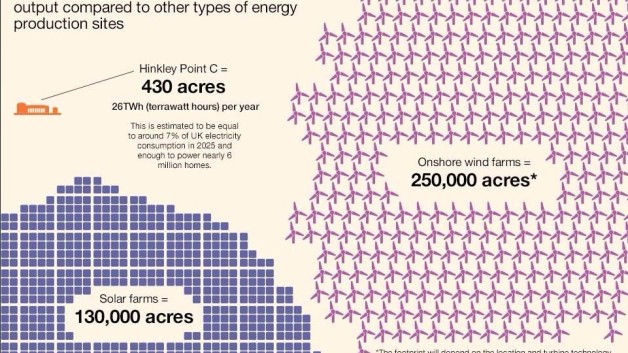
I wish to draw your attention to this image. For the power of a single nuclear reactor, you can use 430 acres of land for the nuclear reactor or 130,000 acres for solar PV panels.
Now imagine you need to install 1,000 nuclear reactors to replace coal power plants. Do you want to use 430,000 acres of land, or 130 million acres of land?
Now fast forward 50 years, there are now 14 billion people in the world, standards of living are rising and we need to produce triple the amount of power due to the increased number of people, plus their higher standard of living. Now you can either use 1.3 million acres of land for nuclear or 390 million acres for solar. But of course for 14 billion people we also need to grow twice as much food, and they all need somewhere to live.
At some point, we should consider the increasing demands of humanity in the future for more energy and the limited useful space on Earth to live and grow food, not all of the planet can be covered by stuff humans do, not even a small percentage of it, or we risk upsetting the nature balance with simply too much man made stuff.
Perhaps fusion will come online at some point and replace all this nonsense. Of course, much the same was said about nuclear 50 years ago, so who the heck knows.
-
Re:Overpopulation is myth disconnected from realit
This will immediately reduce food demand and, for double bonus, the saved money can be donated to charity.
I only take issue with this one statement.
Hopefully that charity is not in the form of free food. That way leads to more poverty, suffering and starvation [1].
(There's also a whole argument on how population will always rise to a limiting cap and how education and Women's rights is creating a cap lower than breeding-until-we-starve or war-ourselves-out. I'd rather focus on the free food fallacy.)
How? Once farmers can afford a better future for themselves and their children then can afford some labor saving devices, those huge populations to till the soil disappear. They can't when their livelihood is undermined by 'charity.'
Let's use the out of date first/second/third world country model, since it fits closest to the breakdown in your argument [2].
It is not the relatively wealthy people living in cities who are staving, but the poor farmers who cannot farm competitively with free food given in terms of 'charity.'
Compared to every other labor-intensive industry, farming sucks:
- needs a lot of land
- needs lots of water (often of drinking quality)
- high future risk
- mandatory large labor pool with neither the free time to improve themselves when in demand or income at all when not in demand.
- the product (food) ships poorly and spoils readily when stored
Even in the "first world" the farmers are heavily subsidized to protect their non-competitive industry [3].
The only real reason to farm (or ranch) is that you cannot get food any other way. (Queue meme about "Star Trek replicators and the post-farming society.")
The only African countries with first-world type wages have barred these 'charity' food dumps and have protectionism for their farmers. Food is expensive there, but then people are not starving due to collapsed local farming industry. (This excludes countries like the Republic of Congo which has incredible wage disparity and a Petroleum based economy.) The old story of an American farmer's child going to the big city to make their fortune seems to work in Africa as well.
The key to bringing a "third world" country out of the third world is to first not destroy its indigenous markets [4]. Then the population curve works out like other industrialized nations as farming efficiency improves and farming becomes a marginalized industry. (Unless you somehow think Africans are different from all other people.)
Dumping McDonald's leftovers onto people never solved anyone's problems yesterday and it won't start solving them tomorrow either [5].
How about scholarships to improve the education of ex-farmers and get them out of what is a dead-end career so they can feed their families?
- 1. http://www.ncpa.org/pub/ba547
- 2. http://www.nationsonline.org/oneworld/third_world_countries.htm
- 3. http://www.cfact.org/a/2134/Commonsense-wisdom-from-African-farmers
- 4. http://econlib.org/library/Enc/AgriculturalSubsidyPrograms.html
- 5. http://www.thefreemanonline.org/columns/it-just-aint-so/ending-farm-subsidies-wouldnt-help-the-third-world-it-just-aint-so/
-
Re:It's funny how stupid they are{{citation needed}}
'cos the only pages I can find about are pretty pro concentrated solar power and the rest of the pages against the Mojave desert development seem to be from oil lobby groups.
-
BETTER IDEAS OUT THERE
This is a great piece of the puzzle, allowing methane waste from landfills to be re-cycled. It is only a stepping stone to truly revolutionary and sustainable development. Methane is desirable as a fuel source as it can be generated from both waste and mining. But it is a secondary product of biomass decay. I think that truly revolutionary technologies are available and more advantageous as they stop the actual material from being taken to the landfill in the first place, and can replace oil. Such revolutionary technologies as that can be more effective by solving several problems at once.
-
Re:Extraordinary claimsThe article didn't count oil that went into raising the turkeys (for working the land, pesticides, heat/light, transportation to the processing plant and so on). The process is certainly of use because it reduces the external fuel needs of the turkey operation. It's not clear to me, though, whether the process breaks even with these other costs taken into account. Does the process produce enough fuel to fully power all of the farms that generate the turkeys?
I'd also like to know more about the inputs to the system. 500 barrels of oil must take a lot of turkey guts, especially as they are mostly water (which is burned off during coking). According to a CFACT article, it takes 1 ton of turkey to make 640 pounds of oil, 100 pounds of gasses, and 60 pounds of solids. This is surprising to me, I thought more water would be present; they are getting 40% "useful" material out of the turkey waste. The top production is based on estimates of 200tons/day of turkey waste. How many farms feed into this turkey processing plant, and how many such plants are there?
Another issue is the cost per barrel. The FAQ has a bit more information, and it seems to suggest the price is still a bit high, although hopefully it can be brought down.
It seems this is an interesting conservation measure that can reduce the amount of consumption while doing something useful with waste byproducts. The waste reduction seems like the most useful benefit for now (perhaps the original motivation for ConAgra to get involved in the project, as the process "will dramatically reduce the charges it faces for disposing of waste"). I think it's too early, though, to start investing in turkey gut futures.
-
Pot, Kettle
a report by the California Student Public Interest Research Group entitled "Ripoff 101"... several practices that force students...
"Ripoff 101" could also describe Public Interest Research Groups.
http://www.foxnews.com/story/0,2933,80925,00.html
Nader Scams College Kids
Thursday, March 13, 2003
By Radley Balko
Each semester, Meremac Community College in St. Louis, Mo., charged Crystal Lewis for a service called "MOPIRG." "I hadn't the slightest idea what it was," she says. The fine print on her bill read: "If you opt not to support MOPIRG, please deduct this amount from your payment." So she did. But she still wasn't sure what she was no longer paying for.
She was paying for a myriad of causes and advocacy efforts sponsored, endorsed and overseen by Ralph Nader. And if you're in college or have kids in college, the odds are pretty good that you're supporting Ralph Nader too. You probably didn't know that, did you? And that's just the way Nader and his nationwide network of Public Interest Research Groups (PIRGS) would like to keep it.
The PIRG idea was born in the late 1960s, but really caught on through the 1970s and 1980s. It has again picked up momentum in the last few years, due mainly to the publicity that accompanied Nader's presidential campaign. The scam varies from campus to campus, but it basically works like this:
Each time a college student registers for classes, he or she is automatically billed somewhere between three and eight dollars, all of which goes directly to the local PIRG chapter. There, it's funneled directly to the state chapter, where it's used to lobby state legislatures on issues like tougher emissions standards, campaign finance reform and a bevy of other environmental and anti-corporate causes. Very little if any of the money actually stays at the campus where it's generated.
It's also used as "seed money" for more fund-raising campaigns. And about 10 percent of the money goes to USPIRG, the national chapter, where it's used to lobby on the federal level.
The standard procedure for start-up campus PIRGs works like this:
First, they attempt to institute mandatory, nonrefundable "contributions" from the student body either through a student referendum, a petition drive or by going through school administrators. The University of Wisconsin requires all of its students to donate to the local PIRG chapter, as does the University of Oregon, and about a third of the state colleges in New York's SUNY system.
If that doesn't work, PIRG chapters attempt to institute a "reverse check" system, where each student automatically donates to PIRG each time he registers for classes, unless he specifically knows to look for an already checked box asking for his support -- and "unchecks" it.
If they can't win support there, PIRG groups will attempt a "refundable fee" system, where each student is automatically billed, but can request a refund by taking the bill to the university registrar or bursar's office, filling out some paperwork, then taking the form to the local PIRG's campus office to get the money back.
Such systems rake in millions for PIRGs because they put the burden on college students to educate themselves about each line item on their tuition bill, or to go to great effort for a comparatively small refund, particularly unlikely when mom and dad or Mr. Perkins and Mr. Stafford are paying for college anyway.
Craig Rucker is executive director for the Committee for a Constructive Tomorrow, an organization that's been fighting the PIRG scams for years. Rucker estimates that Nader's causes take in somewhere between $10 and $20 million annually from college students, most all of it unwittingly.
What's remarkable is the blatant, tran