Slashdot Mirror
Domain: chrismartenson.com
Stories and comments across the archive that link to chrismartenson.com.
Comments · 32
-
Re:It begins....
-
Re:you're a troll but even so....
Have a look at his map. http://media.chrismartenson.com/images/US-military-presence-around-Iran.png
And then consider the US did this: http://en.wikipedia.org/wiki/Operation_Ajax
In this situation, it would be insane for Iran not to want nukes.
-
Yes, because debt IS money
Money is borrowed into existence. Paying off debt causes the destruction of money.
Right now there is about 9.5 trillion in money, 50 trillion in debt, of which 14 is public.
If the government pays off it's debt it would cause a massive depression because all the money would disappear.
This is why you have exponentially growing debt.
http://media.chrismartenson.com/images/credit-market-doublings.jpgBasically the monetary system is totally messed up and has been since 1971. What's required is monetary reform.
-
No, nothing to do with deregulation.
It has been going on long before the deregulation, since 1971... Actually mid 1960s since it was the Vietnam war spending which started the problem.
The 2008 crash was the end of a credit bubble which had been blowing up since Nixon took the US dollar off of the gold standard. Nothing but debt backing the dollar.
Chris Martenson has a good chart of total US debt. Matches an exponential curve to 98%. Doubling period of about 7 years. Eventually you just run out of people to suck into the Ponzi scheme.
http://media.chrismartenson.com/images/credit-market-doublings.jpg
Totally irrelevant which political side was in power. 9% growth in debt every year for 40 years.
You want to see a 40 year exponentially growing credit bubble in action?
http://chart.finance.yahoo.com/z?s=^DJI&t=my&q=l&l=off&z=l&a=v&p=s&lang=en-US®ion=US
Now there is a truly impressive Ponzi scam.
-
Re:Could Someone Help Me Out With This?
Either you have to raise taxes or cut spending.
...OR you "print" more money and hand it to the MIC so they can spend it at todays value, before the rest of the population cottons on that it must be devalued. Don't worry, all that printed cash eventually "filters downs" to weaker hands, forming bubbles here and there like in the housing market. Take a course that explains it with references: one of many (worth starting at chapter 1 but if your in a hurry)....
-
Re:BitCoins are simply a hobby, not a currency
Mod parent up: +5 Funny
>Say what you will about the Federal Reserve, they have kept the dollar
>remarkably stable in terms of inflation and deflation compared to what came before.Thanks for the LOLz...
Here's a chart of the CPI since 1800 (based on 1967 reference). Note the "hockey-stick" spike in the graph starting in 1971, when Nixon closed the gold window. Note also that the dollars in your pocket are worth less than 10% of what they were when the Federal Reserve Act was signed into law. (More details on the history of inflation here.)
The USA has gone off and on a "private central bank" system several times over its history. The period you seem to be talking about in the early 1800's was one of the "on" times. Andrew "Stonewall" Jackson considered it one of his greatest achievements as president to have "killed the bank."
For more on the history of money and central banks, check out some of Bill Still's documentaries.
-
Re:Bitcoin to revolutionise economy
Why do you believe there is a relationship between the creation of real stuff and credit?
For example, the amount of credit in existence changes quite dramatically year on year, we are talking growth of about ~10% per year, i think about 9% is around the average. 9% growth gives a doubling period of about 7 years. So, you would expect the real stuff (you know, the wealth) to grow similarly, twice as many businesses, twice as many buildings, roads, cars, planes, boats etc etc. every 7 years.
Hmm, perhaps not.
Secondly, why does the debt ever need to be paid off? Just because you belly-feel that debt is bad?
Well no. Debt is an exponential function. It grows at a given percentage per unit time.
For example:
http://media.chrismartenson.com/images/credit-market-doublings.jpgAt some point one of two things has to happen. 1, there has to be significant inflation to the point that the debt is made irrelevant, with all the chaos that involves. 2. The interest on the debt will grow to the point where all of the economic activity is simply paying interest, with all the chaos that involves.
One is inflation, the other, deflation.
We are at ~50 trilllion now, so the debt has to double to ~100 trillion dollars over the next 7 years or so. The credit has to double to match in order to pay the interest. What do you reckon? Can *everyone* double up on their debts in the next 7 years?
Basically, it's the resulting chaos caused by growing interest on unpayable debts which I think is probably bad. Perhaps the Greeks would agree.
-
Re:CDOs weren't the problem
Another angle on the problem. Look at the graph of Debt to GDP going back past the Great Depression. Based on that graph, we were in "serious risk of depression" territory back in the 90's. It's only inventions like CDO's that aim to leverage absolutely everything that have managed to keep the debt bubble growing. But hey, what could possibly go wrong with exponential growth in debt.
-
Re:What?
In other news today: 1 out of 7 Americans living below the poverty line (43.6 million Americans whose families). Big news making the rounds on the world scene - converting the US into the laughing stock of the "first world". Someone should have stopped that from leaking out of the US Census Bureau too, damn it
And note well that this is the same government that routinely pleads poverty when the suggestion of national health care comes up.
Tax payer funds (direct and the much larger indirect money supply inflation is not destined for mating US society better, silly. It goes to things like bailing out banks when the fail business 101, building tanks and stuff.
-
Money
The problem isn't exactly "running out of money"; banks are generally happy to conjure up more. The problem is that Federal Reserve Notes are history's greatest Ponzi scheme, and the gig is just about up.
Soldiers as well as defense contractors like to be paid in something of worth, preferably that can be carried without a wheelbarrow. And without them, who is going to loot whom? -
Re:Don't worry BP ...
And how are they going to raise rates when none of their competitors face a multi-billion dollar charge?
Because the entire oil industry will see an increase in the cost of oil per barrel. Major catastrophe at a large oil field = less supply = increased cost. As we have seen in recent years, the industry is susceptible to volatility based on global events and market speculation.
But it is actually worse than just an increase in price. We are likely in the early stages of government positioning for control of oil supplies. In 20-50 years, there may not be any such thing as a private oil company as governments assume strategic control of oil resources in the name of "national security."
Interesting article on this very subject.
-
Re:Who exactly is fighting back?
It's a simple economic argument: in 100 years time, we'll be much richer (that's an assumption of course) and so the cost of any mitigation will be that much less than it is now. Moreover, we'll have a century of technological advance behind us which will also reduce costs.
We are NOT going to be much richer in 100 years. We have banked our future (in the form of massive debt) on faith that our economy will continue to grow, all the while spending huge amounts of cheap energy to make it grow. That won't be possible for much longer - energy is becoming harder and more expensive to get, with no relief in sight.
Once we have to depend on good old-fashioned muscle power to make our economy run, it will necessarily get much less complex. Science will change radically.
If you're not familiar with Chris Martenson's Crash Course, I highly recommend it to understand why we are approaching a "perfect storm" of energy, economic, and environmental challenges.
-
Re:Love the spin
Actually, the problems today began back in the 80's...
Actually, it started its long slide August 15th, 1971... in response to a little war going on at the time in Vietnam. What happened on August 15th, 1971? If you do not know I suggest watching this series of videos, in particular chapter 9 "A Brief History of US Money".
"Everything that follows, is a result of what you see here."
-
Re:The New Ethics in America
The bubble couldn't have happened without their willful participation. The banks couldn't have done it without your neighbours help. So, yes indeed, what goes around has come around. Your neighbours helped f*ck you over. They were the crucial element without which the housing bubble could not have happened.
Your anger, like most peoples, is woefully misdirected . The bubble would have happened anyway in [pick your asset] and is irrelevant where it occurred - you need to understand how. That most of the herd think it was the banks and real estate buyers fault is of no surprise - just people responsible covering their arse's with misdirection - successfully I might add.
-
Re:The New Ethics in America
The bubble couldn't have happened without their willful participation. The banks couldn't have done it without your neighbours help. So, yes indeed, what goes around has come around. Your neighbours helped f*ck you over. They were the crucial element without which the housing bubble could not have happened.
Your anger, like most peoples, is woefully misdirected . The bubble would have happened anyway in [pick your asset] and is irrelevant where it occurred - you need to understand how. That most of the herd think it was the banks and real estate buyers fault is of no surprise - just people responsible covering their arse's with misdirection - successfully I might add.
-
Not a level/transparent/open playing field
if conditions exist that favor making money through "immoral behavior" then that is what will happen.
Some point to (substantial) evidence that the playing field itself could be called as you say, "immoral": http://www.chrismartenson.com/crashcourse/chapter-15-bubbles (ch16 and 17 as well) and some related news: http://www.google.com/search?q=audit+the+fed
-
Re:Same as gas stations
As the other person wrote, the problem is that Government figures for inflation are based on diddled statistics. For example, they regularly leave certain items out of the "basket" of goods they use to measure inflation, on various thin "justifications", in order to manipulate the outcome. Not conspiracy theory, just fact.
This article, while a few years old, explains some of the methodology behind the "official" Consumer Price Index.
What's worse, is that the way the Bureau of Labor Statistics (the agency that calculates Consumer Price Index) does those calculations is utterly bizarre. For example, we know that when times get tough, people tighten their belts. Say you are used to buying extra-lean ground beef for $3.00 a pound. Last year, prices went up and now you can only afford the regular ground beef (with three times as much fat), for the same $3.00. According to the BLS, there is no price increase because you can still buy an "acceptable substitute" for $3.00 a pound. (No, I am not joking, that is one of the ways they adjust their figures.)
There are so many other "adjustments" they make, I could not begin to list them here, and they almost invariably are "adjusted" in ways that make inflation appear to be lower than it actually is.
This link describes some of the other ways in which CPI figures are distorted by government. And even that is hardly comprehensive description.
And it should be noted that Moore's Law does not apply to celery or gasoline, or for that matter most other things. My grocery bill, based on the basic foods *I* buy, went up by probably about 50% last year. That's a pretty big jump. Gasoline was up, and so many other things. My costs went WAY up (as well as costs to most, if not all, people with whom I have discussed this). And yet, the the government's figures for inflation in the year 2008 comes to approximately 3.8%.
And that's BULLSHIT, even if you factor in the drops in housing prices. -
Re:Not a crisis
We don't have coal of the current quality, with the current ease of access for centuries with current trends in consumption and population growth.
This is quite an interesting, and worrying, read:
http://www.chrismartenson.com/crashcourse -
Guys, energy will get expensive...
Whether you like or not.. Check this "Crash Course" for a dose of reality: http://www.chrismartenson.com/crashcourse . We will have to deal with a lot worse than the fearsome "Smart Grid" sooner than later...
-
Re:One Last Time:OK. Facts:
1. EROEI on Oil has been declining steadily. In the 1920s it was up around 100:1. In 1990 it was down to about 20:1. It is now down around 10:1 or less (deep sea oil has an especially nasty return). for starters, Read the article on Wikipedia I linked to, the one you so blithely ignored without any supporting FACTS.
2. EROEI on gas is also declining. In Canada, it is expected to hit 1:1 around 2014 (according to an article based on data from Jean Leherrere, an internationally renowned expert in oil and gas exploration. He was in charge of Total Canadaâ(TM)s exploration from 1966 to 1971. )
3. You write: But we know that the EROEI for oil is going to go up, and possibly soon. and the fact is, no We Don't. In fact we know just the opposite is in effect. A recent chart based on recent data shows a dramatic collapse in EROEI of oil in the 2010 - 2020 range.
4. You wrote: . At the moment, that would have a really horrid energy return because of the current inefficiencies in solar panels. Wrong it would have a horrible energy return because it TAKES MORE ENERGY to make Hydrogen than you can get from burning Hydrogen. This is called Thermodynamics. It's like gravity, only far less forgiving.
5. Ultracapacitor technology from companies like eeStor are in the process of bringing a system that stores and expends electricity for a projected $40 per kW. The amount of energy that goes into building an ultracapacitor is high, but over a series of charges the EROEI goes into a high positive range. Even at 2:1 it would be vastly superior to hydrogen, which by definition can never be even 1:1.
So, Hydrogen has crappy EROEI, oil's EROEI is declining, and there are other superior technologies available. Then there are the manifest problems with Hydrogen itself, such as:
1. it hates being bottled. This is a well known problem - hydrogen atoms are the smallest and it is impossible to keep it bottled.
2. It hates bottles. This is also a well know fact - over time hydrogen embrittles the material that holds it.
3. It burns with an invisible flame, and it burns readily.
4. to keep it at a pressure where it has an energy density that is of value to humans, it has to be kept at an extremely low temperature, making it more dangerous, less amenable to maintained capture (bottled), and this intense refrigeration (a few degrees above zeroK) is extremely energy intensive, reducing its EROEI even farther.
I reiterate there will be no hydrogen economy. Hydrogen is a very poor and inferior choice for an energy carrier and a stupid choice for a fuel.
I have responded with more facts than your argument merits.
I do not do so to "make nice". The facts on hydrogen have been out for years, and as I noted, only "true believers" still buy into the mythology of the hydrogen economy.
Unfortunately, slashdot has a large number of such people (as evidenced by the score to my original post) and this is not to slashdot's advantage, much less civilisation itself.
If you want a primer on what is going on, go here and watch all the videos.
RS
-
Re:Why not have both?
This "one version will overtake all the rest" mentality is a meat-space concept and has no place on the Internet.
Wrong. Because they have to grow, and once all of the little guys are gone, they can only grow at the expense of each other. Therefore there can be only one.
-
Re:Conservative blind side...
-
Re:HAHAHA you will become US China. I mean U.S.
You're talking about China like it's this little unimportant thing. China owns the US in terms of debt and exports. In the coming decades, China is going to be the number 1 superpower, and the US will be *nowhere*. Trust me.
You might want to read this:
http://www.chrismartenson.com/ -
Re:Be Skeptical of Drug Company "Scientific" Claim
If I had mod points, I'd mod you up.
I just shake my head (from afar) way too often when I see the path the USA has headed down. It is ultimately leading to the USA being a much poorer country in the future.
(ps. Go to http://www.chrismartenson.com/crashcourse for a great look at the worlds future) -
Try this web site
It pretty much explains exactly why the age of speed exists at all and why it's coming to an end Real Soon Now.
http://www.chrismartenson.com/crashcourse
-
Re:Is anyone surprised?
Of course, the billions of dollars keeping AIG and the megabanks on life support is only worth it if you actually believe that the government will be able to successfully stabilize them. Do you find the level of transparency forthcoming from the treasury encouraging? Do you think it is wise to buy these "troubled assets" at above market rates? These things don't seem encouraging if we're looking to turn a profit for the taxpayer and not just leave the taxpayer as the last sucker.
The fact is that a lot of the money created in this boom never existed except on paper. Do you think that making these dollars loaned into existence (cite: http://www.chrismartenson.com/crashcourse/chapter-7-money-creation ) into real dollars will not lead to the very Zimbabwe-style inflation that you think that the AIG bailouts are protecting us from?
Then there's the issue that we're maxing out the US credit card on a gamble that we can actually fix a problem that we don't understand since there were few or no regulators watching. You point to Sweden's bailouts as a success, but what about Japan's "lost economic decade"? (cite: http://www.guardian.co.uk/business/2008/sep/30/japan.japan ) This is an extreme gamble, especially for a country essentially surviving on foreign credit, that in the worst case could lead to government collapse.
I do not believe that Wall Street has been honest about its assets versus liabilities. I do not believe that the inflationary risks or the risk of losing billions or trillions of taxpayer money in the event that the treasury cannot actually save the banks or AIG (as you know, these two things are related, since survival of banks is related to whether AIG can come through on its CDS obligations) is worth the potential benefit of saving them. Because the details were unknown even to the executives at the time, I doubt that anyone in Washington does either. A more reasonable idea might have been to give bailout money to the FDIC, and save taxpayer assets with taxpayer money should a bank actually have to fold to the FDIC.
By the way, when I have a memory leak, I typically start by shutting down the offending application. I question whether you actually understand the situation well enough to be qualified in throwing "sheep" around. In fact, if anyone's a sheep, one might even say it would be the one trusting enough to think that what goes against common sense is a good idea. But then, maybe you have some really good answers to the issues above that I don't. I'll be interested to see which is the case.
-
Re:Oil versus Electricity InfrastructureAmigori wrote:
Based on your logic, I should start investing in horses and drawn-carriages. Both are renewable and sustainable, minimal emissions during use and construction, and minimal nasty chemicals used during manufacturing, much of the world does not have current access to them, and they can travel places other transportation cannot. Think of the demand for veterinarians and blacksmiths, plus tack and riding gear, and carpenters and farmers too. Horses are natural, so we can have as many of them as we need without consequence, right?
It's actually worse than that, IMHO. Hint: the ONLY technology that has been PROVEN by countless cultures all over the world to be sustainable over countless millennia is NEOLITHIC.
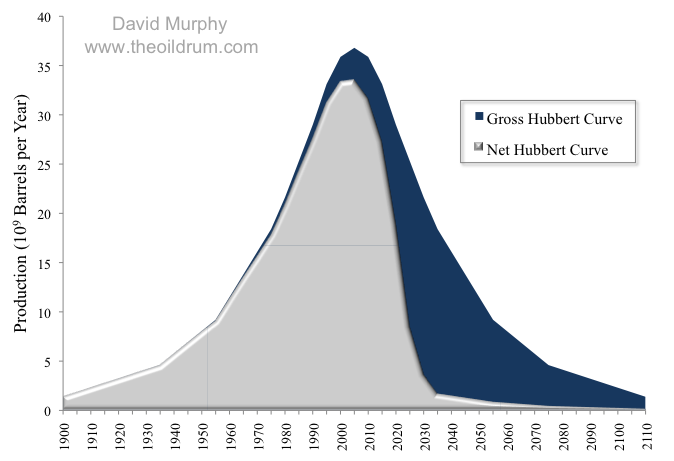
As far as peak in oil goes, here is the data from the EIA and the IEA and CAPP. If those organisations are outside what you consider expert, we have nothing to discuss. Read THIS.
I am well aware of the economic clusterfuck that surrounds us. I am not certain that other currencies will *immediately* supplant the dollar. I do think that over the next decade we could see the formation of a "currency basket" where a variety of important currencies trade or value as a control group, say, the USD, EUR, RMB, JPY, and if the Russians can sit still long enough, maybe the RUB.
I've been researching this a great deal since 1998, and I urge you to do the following:
super-insulate your house.
get your heating off fossil fuel.
live close to work where you can walk to it, or ride a bike or take a bus or subway.
learn to grow high calorie value food in your backyard (i.e., beets, beans, carrots, peppers, potatoes, parsnips, etc. Yes. Wheat? No.)
Learn to deal with greater temp variation NOW, so it's not such a shock later.
Use electric assist solar hot water.
See if you can live with a small or no refrigerator. if you MUST have one, get a small SunFrost.
Learn to can food.
Compost your food scraps.I can guarantee you, the next 20 years will look nothing like the past 20 years. This is well explained here in this Crash Course.
good luck compadre...
RS
-
Re:Corporate culture
From Chris Martenson
Let's review a few Key Facts. You have to find oil before you can produce it, and Key Fact #1 is that world oil discoveries peaked in 1964. US discoveries peaked in 1930, and 40 years later production peaked. We are now 44 years after the global discovery peak.
Key Fact #2 is that world production of conventional crude has been flat for the past four years, even as prices have increased by 140%. Taken together, Key Facts #1 and #2 suggest the possibility that Peak Oil is already upon us. If true, then we are going to wish with all our hearts that we had begun preparing for this moment a decade or more ago.
Key Fact #3 is that the US oil imports are the energy equivalent of more than 750 nuclear power plants, which is seven times as many nuclear plants as currently exist here, and nearly twice the total number of nuclear plants in the entire world..
Key Concept #9 of the Crash Course is that Peak Oil is a well defined process that is nothing more than a physical description of how oil fields age. We have literally thousands of studied examples under our belts and this is not open to debate. Only when the peak might arrive is up for discussion.
Mostly hidden from us in plain sight is Key Concept #10: The amount of work that oil performs for you is equivalent to having hundreds of slaves. It is this work that makes our lives what they are - staggeringly comfortable by historical standards. The average middle class life in western society would be the envy of kings in times past.
Key Concept #11 is that Oil is a magical substance of finite supply but of unlimited importance. This cannot be overstated.
[...]
And finally, what we need to keep a careful eye out for is the supply of oil being exceeded by demand, and this raises Key Concept # 12: Oil exports are being hit two ways - by rising demand and declining production. This raises the prospect that the moment when the world's nations finally realize that there is not enough oil to supply everybody may come much sooner than most suspect. Exponential functions are hard for most humans to grasp, and oil exports are being doubly squeezed, subjecting them to a surprisingly high rate of decline.The charts he's referring to are in the video on the linked page, of which all the quoted text above is a transcript.
That quote is the summarization of the topic of peak oil. The video is worth watching (or at least the rest of the transcript worth reading) because the details are sordid and hard to argue with. One of them is that we tend to fail to account for the oil-producing countries' increased use of oil internally, another curve that tends toward the exponential, and the effects that will have on their oil exports. If Mexico, #3 supplier to the US, continues on its current path of production and usage, their exports will stop by 2012. That's a big void to fill.
Other chapters there discuss alternative energy and how, even if we can do more than break even, the energy returns (what we get out minus what we put in) are much, much smaller than with oil. I don't think we're 10 years away from peak; I think it's happening now and we'll have big problems less than 5 years down the road as prices skyrocket due to increasing scarcity and demand.
-
Re:Citation, please
I keep posting the link in my sig when I feel it is appropriate, and while I fear I'm beginning to sound like a broken record, now is one of those times.
The Crash Course is a 20-part video series, most chapters under 7 minutes long, that explores the various issues that are all coming to a head, including peak oil, world population, global warming, the money supply, and a few others. It's full of exponential curves that would be exciting except for the ceilings they are approaching at an increasingly alarming rate.
It's pretty well put together and highly informative. If you're skeptical about all the gloom and doom because it's usually spouted by ACs, you owe it to yourself to get the information from a source far less shrill and far more credible. IMO you'll be pretty convinced after watching, and even if you're not you will certainly be better informed.
-
Re:Great
The UT endowment dropped nearly 30% over the past year. The state senate has been on a witch hunt to blame everyone but themselves. The man who was running the endowments, Robert Rowling, resigned because he was being criticized for following his contractual obligation to pay bonuses for the previous year. The senate claimed he should have broken this obligation in the face of large losses.
Part of the problem with our political system is that so many of the people in power were born into money. If more of them actually knew what it meant to depend on public education, maybe it would be taken more seriously. From my point of view there are three areas that are worth spending on, and they all fall under the broad category of infrastructure:
1. Energy Independence
2. Education
3. Public InfrastructureOur nation became powerful because we had the best of all 3 of these areas above any other nation. Now, we are ignoring them for more immediate desires. People seem to think that pumping more money into the economy will solve the problem, but unless you are actually producing goods or improving our ability to produce goods with that money, all it does is cause inflation.
This would not be a horrible thing if there were no physical limits to growth, but we are about to hit a huge one - Energy. Now that the production of oil is hitting an inevitable peek, the price will skyrocket (and not because of a bubble this time) until eventually, all the producing nations will stop exporting. We will be forced to rely on our large supply of coal, but it will not be able to scale up fast enough, nor will any of the renewable sources of energy that actually have long-term viability (Solar and Wind, mainly).
If any of you are interested in learning how to think about the economy, I suggest you take a look at this website: http://www.chrismartenson.com/crashcourse/chapter-17a-peak-oil
Chris Martenson has an amazing ability to view the issue from all of the important angles, and he shows you how they all fit together, and he backs everything up with undeniable facts. If you have time, watch all of it. If not, at least watch the parts on bubbles and peak oil.
-
Re:This doesn't sound right
That's actually a very interesting point. With fractional reserve lending, the monetary system we currently use, an original $1,000 deposit into a bank balloons into $10,000 of real money. So they theoretically _could_ use the RIAA tactic as a $9M potential is essentially removed with the withdrawal of $900,000.
Going back to the OP, that would mean 18 withdrawals per card over a 30-minute period, or just under two minutes per transaction. We are now in the domain of the eminently plausible.
-
Why defend the current system?
the obvious outcome of libertarian ideology: the rich prosper, the rest face the choice between slavery or death.
People cite this as a failing of libertarian ideology when the reality is that it is happening under our current debt-based economy to an extent much greater than libertarian policies would harbor. The current system rewards the already filthy rich, demonstrated by the continued growth of the gap between rich and poor (in the USA, anyway). The way the system is engineered, there must always be a greater amount of debt than money because all money is loaned into existence. For the very rich, this is a boon because lending money now usually results in payment with interest, increasing their wealth. For everybody else, it means that we end up buying a lot on credit and face increasing debt levels due to the same interest. And that's not even going into the hidden wealth-eroding effects of inflation that disproportionately affect the middle and lower classes: it used to be that only one source of income was needed to maintain a family; now most households require two incomes just to get by, not even increasing in net wealth.
Libertarianism is not a magic bullet that will eradicate poverty, but I submit that poverty will never be eradicated. The best we can do is to mitigate its effects on people as much as possible without causing problems for the whole society. Lots of slashdotters believe that more socialist policies are the answer to that. I personally believe that more libertarian policies and a healthy dose of community would serve us better, and further, that libertarian policies would tend to increase our sense of community. Unfortunately I cannot yet articulate this theory as well I'd like to, but the basics lie in each individual's levels of empathy, ability (including financial means), and personal responsibility. I possess a ton of empathy and a decent chunk of ability (though not financial means), but I have been pretty irresponsible because I viewed poverty as "someone else's problem." After all, the government is taking care of it, right?
It seems to me that the outcome of libertarian ideology is that the industrious prosper while the lazy face the choice between action or death*. The small number of individuals who are incapable of doing very much are cared for by their local communities and by charity organizations, much as they are today. There is decidedly less room for "slavery" in a libertarian society than in the one we have now, where many of us (myself included) are like indentured servants working to pay back the credit binge we've been on since birth.
*This has little to do with our current system, and I am not implying that if you are poor, you must be lazy.