Slashdot Mirror
Domain: cleanenergywire.org
Stories and comments across the archive that link to cleanenergywire.org.
Comments · 46
-
Re:You're looking at non-facts.
"So what's the long term plan to store the heavy metals and the byproducts from solar panel production?
Those byproducts don't exist, moron."Perhaps you should bother to educate yourself before spouting off like a fool.
https://www.forbes.com/sites/m...https://www.cleanenergywire.or...
-
Re:Expensive and unreliable
This old one again. Look, its not possible to make enough Li-ion batteries (or batteries of any type) to back up a grid for even a day. Your solution is off by about a factor of 100x in terms of being about to do what you claim.
A straw man. I never said that (that this was a "solution" "to back up a grid for even a day"), even though there are reasons to believe that you're completely wrong about that, too. Why do you believe that it is impossible to manufacture 7 kWh of batteries per citizen of Earth? And why that random "100x" factor, of all things?
Germany has higher energy costs because of renewables. They had lower costs in 2010.
Lots of countries had lower costs in 2010, for reasons having nothing to do with renewables.
Then they installed a lot of renewables (from 2010-now) and now they have higher costs.
Setting aside post hoc ergo propter hoc, any extra costs Germany incurred specifically in the renewable generation field around 2010 or so are the results of the feed in tariff rate subsidies that were fixed for the installations at that time. These were high initially because of the discrepancy between renewable generation equipment available at that time and the bulk electricity price at that time and were necessary to stimulate the market. One can perhaps argue whether they were set at levels that would minimize long-term costs to the state and maximize the value thus obtained, but in any case, as the costs of the former went down, so did the subsidies, now basically at zero levels. These are grandfathered for the old installations and effectively sunk costs. They can't possibly have rationally any bearing on your reasoning about why not to install new renewable generation equipment *today*. Yet for some reason you seem to be obsessed by them.
Also, more CO2 output because of all the natural gas they burn to backup their wind. But don't let facts get in your unicorn's way.
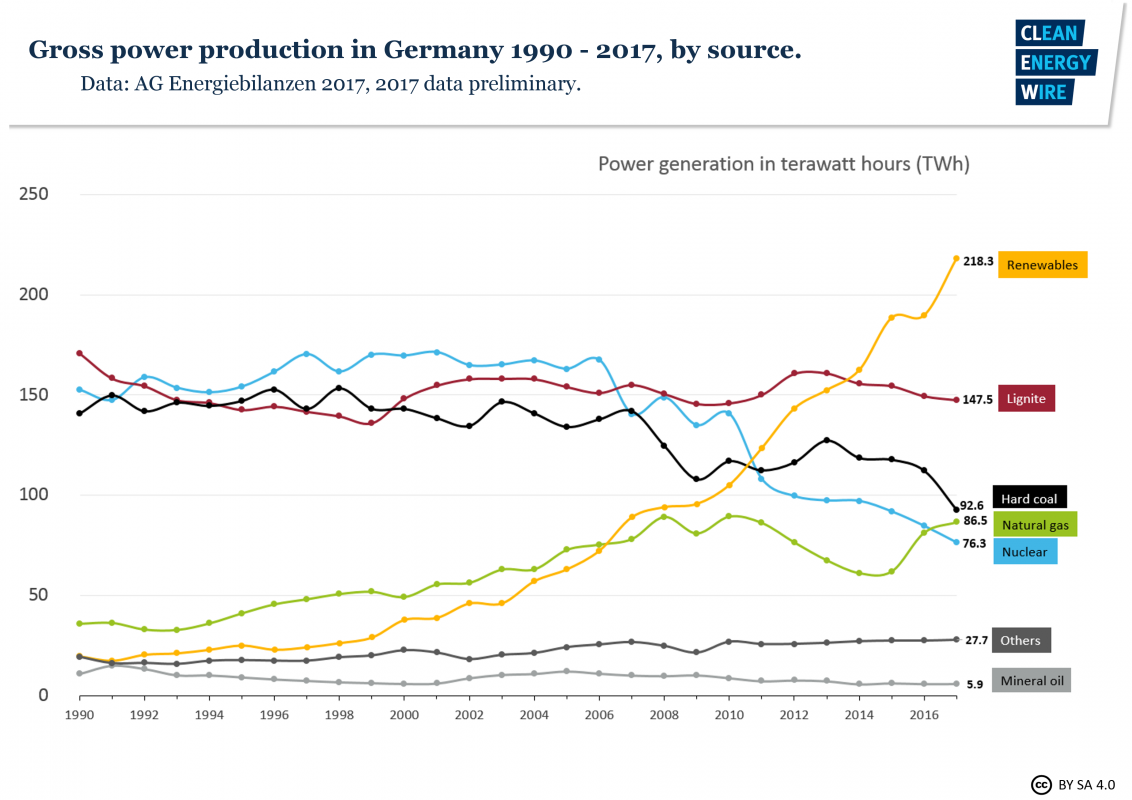
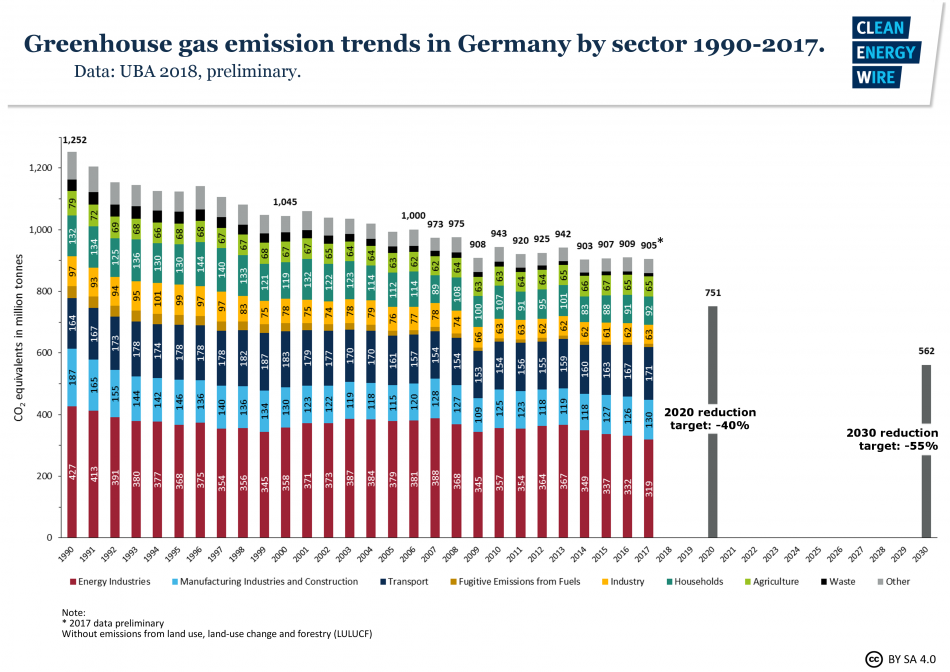
Ah, facts. Facts like these? The natural gas generation has increased since 2010 by...wait, minus 2 TWh? Oh, look, the CO2 output in the energy sector decreased between 2010 and 2017 as well. In fact, it went down from 356 to 313 Mt, even though generation increased from around 635 TWh to around 650 TWh. Wait...is that actually a 14% decrease of CO2 emissions per kWh? By space, how is it posssible?
-
Re:Expensive and unreliable
This old one again. Look, its not possible to make enough Li-ion batteries (or batteries of any type) to back up a grid for even a day. Your solution is off by about a factor of 100x in terms of being about to do what you claim.
A straw man. I never said that (that this was a "solution" "to back up a grid for even a day"), even though there are reasons to believe that you're completely wrong about that, too. Why do you believe that it is impossible to manufacture 7 kWh of batteries per citizen of Earth? And why that random "100x" factor, of all things?
Germany has higher energy costs because of renewables. They had lower costs in 2010.
Lots of countries had lower costs in 2010, for reasons having nothing to do with renewables.
Then they installed a lot of renewables (from 2010-now) and now they have higher costs.
Setting aside post hoc ergo propter hoc, any extra costs Germany incurred specifically in the renewable generation field around 2010 or so are the results of the feed in tariff rate subsidies that were fixed for the installations at that time. These were high initially because of the discrepancy between renewable generation equipment available at that time and the bulk electricity price at that time and were necessary to stimulate the market. One can perhaps argue whether they were set at levels that would minimize long-term costs to the state and maximize the value thus obtained, but in any case, as the costs of the former went down, so did the subsidies, now basically at zero levels. These are grandfathered for the old installations and effectively sunk costs. They can't possibly have rationally any bearing on your reasoning about why not to install new renewable generation equipment *today*. Yet for some reason you seem to be obsessed by them.
Also, more CO2 output because of all the natural gas they burn to backup their wind. But don't let facts get in your unicorn's way.
Ah, facts. Facts like these? The natural gas generation has increased since 2010 by...wait, minus 2 TWh? Oh, look, the CO2 output in the energy sector decreased between 2010 and 2017 as well. In fact, it went down from 356 to 313 Mt, even though generation increased from around 635 TWh to around 650 TWh. Wait...is that actually a 14% decrease of CO2 emissions per kWh? By space, how is it posssible?
-
Re: You might try telling that to the French
It has always been ?
You really have no idea how outrageously low the energy costs in the US have historically been, do you? Otherwise you wouldn't be asking such stupid questions.
https://www.eurotrib.com/story/2013/7/2/174936/9080
And your point with that is...what, that Germany developed identically to the rest of Europe in the time period in question (first chart), thus doing nothing significantly worse than other European countries? Or that German prices are only slightly higher than in other EU countries, even before accounting for Germans' much higher purchasing power (second chart)? Or what exactly are you trying to prove?
Kind of funny how the U.S. was able to reduce the cost of electricity
Thus proving my claim about the cheap natural resources available in the US (fracking, currently).
while in Germany it tripled
I'm pretty sure the average price of electricity in Germany hasn't tripled - unless you somehow ignored inflation and used nominal values only (according to this breakdown, for example, in the 12-year 2006-2018 period, the residential prices have increased roughly from 24 to 29 real cents per kWh (2018 value)). But you haven't really pointed out any such data, so it's difficult to divine what you're going off of.
-
Re:Was Article Summary run through google translat
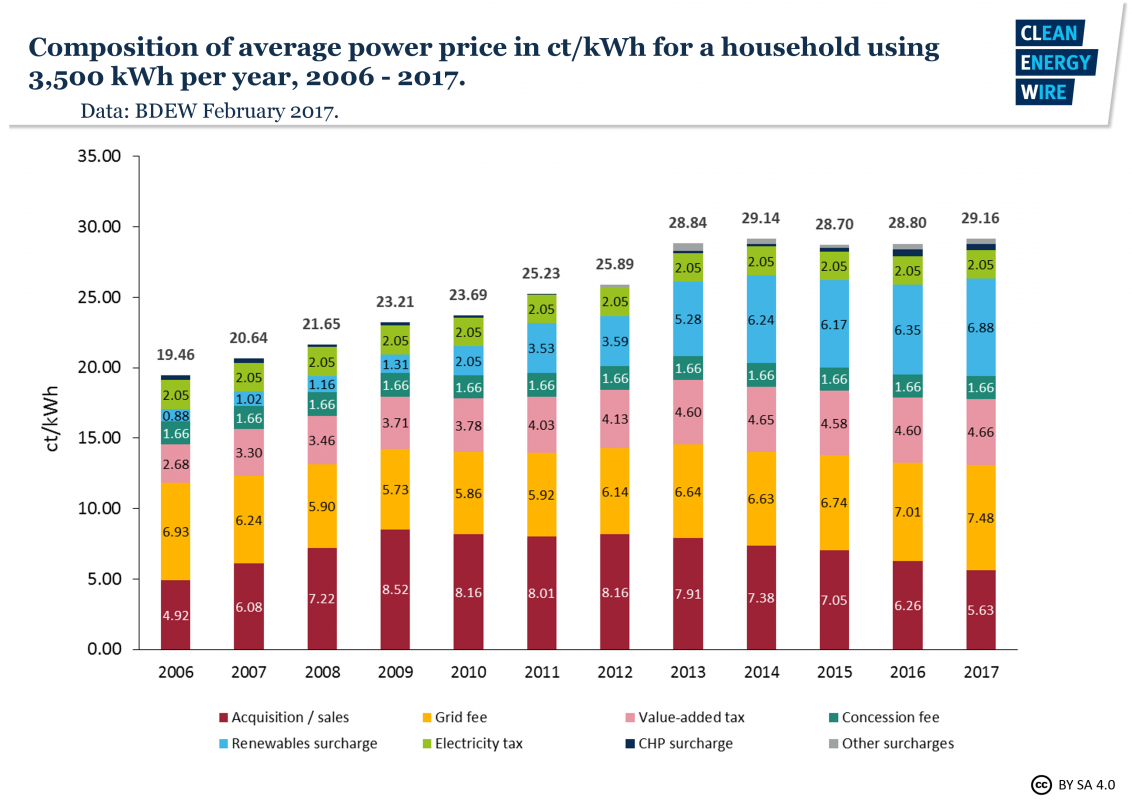
It is not three times more. The surcharge for renewables is about 23% of the total price. Here is the decomposition:
https://www.cleanenergywire.or...
And it was a very deliberate political decision to not hide it in general taxes but make the price of electricity higher. The idea is to encourage saving which also works. And yes, poorer people are never happy about higher prices but it is still not a major burden. I would rather be poor in Germany with high electricity prices and social subsidies and free healthcare than most anywhere else.
-
Re:Was Article Summary run through google translat
Mein Gott! I knew it was bad, but per these two sources, one and two, for households it's 33 US cents per kWh, 33.29 from the last and Bing's currency conversion calculator. Three times the general US price indeed, and I've heard its really pinching people in the winter. I guess it was more than low natural gas prices that prompted BASF to do their lastest rounds of expansion in the US, especially Texas, which has its own grid since it's big enough to have a stable one and that avoids a lot of Federal regulation.
Merkel had better hope the current anti-Green counter-revolution in France doesn't spread (which historically has been a bad bet).
-
Re:Germany's strange power strategy
But after the Fukushima disaster, they closed down all their nuclear power plants. To make up for it, they have to expand the use of coal
This is false, the decrease in nuclear output has been more than adequately followed by an increase in renewable generation.
and buy electricity from nuclear power plants in France
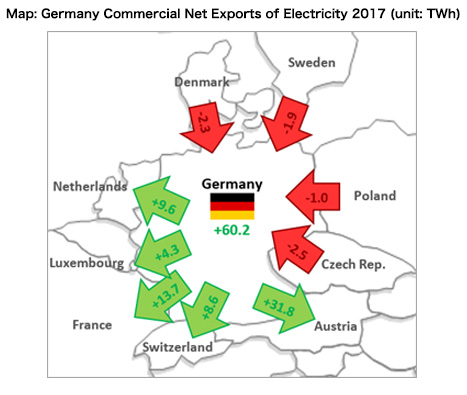
This is also false, Germany has actually shifted into net exports.
-
Re:Go Poland go! (to hell)
Germany also increased their coal based power generation.
-
Re:Wind and sun are as "free" as coal and uranium
The wind and sun as sources of energy are as "free" as coal...
Yah, no. Coal doesn't fall on you from the sky.
Earth to you: the future powered by wind and sun is already here. What rock do you live under?
-
Re: Alas, it won't get past the anti-nuke hysteric
Here is some additional info that might help you better understand the finance based challenges facing Germany going forward;
https://www.cleanenergywire.or... -
Re: Alas, it won't get past the anti-nuke hysteric
-
Re: Alas, it won't get past the anti-nuke hysteric
Not in the electrical sector from adding wind and solar. They've seen improvements outside of generation due to efficiency. But their emissions per kwh generated have basically been flat for the last 8-10 years.
-
Re: Alas, it won't get past the anti-nuke hysteric
-
Re:God damn it
The plants that the enormous new strip mines at Garzweiler and Hambach are being exploited to supply. Hambach alone will cover 85 square kilometers. And now that Germany's last anthracite at Bottrop is exhausted, all of that new production is lignite - basically, damp firewood. A tiny fraction of that amount of coal in uranium would be supplying the same industrial baseload carbon-free. Instead, notwithstanding Germany's expensive investment in solar and wind, its carbon output is actually increasing.
-
Re:Germany is increasing coal use. Duh.
From your very link. Lookie here: https://www.cleanenergywire.or...
2009: hard coal 27.3, lignite: 21.1
2016: hard coal 27.4, lignite: 21.4
In absolute numbers coal use has slightly increased. In relative numbers it has decreased, since a lot of solar/wind/natgas generation was added.
So yep, Germany can talk tough but it can't get rid of coal power. And local greenie idiot "leadership" there knows this perfectly well, so there are no real large-scale protests against coal. And if they try to do it, then serious people from German industry will have some words with them. -
Re:Germany is increasing coal use. Duh.
Where do you get your odd numbers from?
Grmany reduced its power production from coal by about 30%https://www.cleanenergywire.or...
Plenty of charts to pick from
-
Re:Germany is increasing coal use. Duh.
Now look numbers for 2009->2016. Brown coal: 145 -> 149, hard coal: 107 -> 112. Doesn't look as great, does it?
Germany CO2 emissions: https://www.cleanenergywire.or...
2017 coal use dip will likely be temporary, since a new coal power plant is being prepared for launch: Datteln 4. -
Re:Germany is increasing coal use. Duh.
Coal usage in Germany is dropping year by year, idiot.
The share of power from lignite fell from 31.1 percent in 1990 to 23.1 percent in 2016. Since 2005, the contribution to gross power generation from lignite has remained largely stable at around 23-24 percent. Renewables contributed 29 percent in both 2015 and 2016, according to the AG Energiebilanzen. Thus lignite remains the second most important power source in Germany. [Source]
-
Germany is increasing coal use. Duh.
Germany has one of the highest electricity rates _and_ they are forced to increased coal use: https://www.cleanenergywire.or...
The 2020 emission reduction target is now completely out of reach. But don't worry, they are going to build more coal power plants instead: https://energytransition.org/2... -
Are YOU sure about that? GR 35% from renewables.
Germany's economy is larger than CA but using renewables they have more energy than they can use.
Nope.
During brief times of year, that MAY be true, as with the headline you are thinking of where German power pricing was negative on Christmas day in December.
However most of the time Germans are importing power because they shut down all nuclear plants - they are currently producing about 35% of their power from renewables
But all that importing and expensive renewable power facilities means that Germans pay some of the highest power rates in the world. Even if on Christmas you do get a break because the office buildings are shut down...
-
Re: 100 percent green energy by 2025
They may well of done but that doesn't change the fact that their electricity is cheap with a ton of fees and taxes to the point where those fees and taxes are 80% of the total for residential customers.
composition-average-german-household-power-price-2006-2017.png (PNG Image, 1132 x 800 pixels) -
Re: Germany 2nd Most Expensive Power in the West
French bills look low, but actually when you factor in the tax diverted to EDF and the other French energy companies, it's insanely expensive.
Please cite your source. This is just a fabricated rationalization. Frances nuclear plants have been paid for for quite some time. Not only is Germany subsidizing power at higher rates than anyone else, they are trying to figure out how to pay for it outside of the rate structure, including added taxes;
https://www.cleanenergywire.or... -
An article to piss just about everyone off
If your a libertarian you'll hate this:
composition-average-german-household-power-price-2006-2017.png (PNG Image, 1132 x 800 pixels)
If you're left wing you'll hate that too.
If you're right wing you'll hate all of the renewables stuff.German is doing a remarkable job of making renewables look bad, their public pay insane amounts whilst electricity gets offered for free or less to factories when they're all closed for Christmas.
-
Re:Germany 2nd Most Expensive Power in the West
Which has nothing much to do with the actual cost of renewables, German residential consumers pay:
For the electricity (under 1/5th of the total)
Grid Fee (excessively high)
VAT (value added tax, VALUE?!??!)
Concession fee (WTF?)
Renewables Surcharge (excessively high)
Electricity tax (would you like some tax to go with you're taxed tax)
CHP surcharge (they're just making shit up now)
Other Surcharges (Yes, more surcharges, plural)composition-average-german-household-power-price-2006-2017.png (PNG Image, 1132 x 800 pixels)
What German households pay for power | Clean Energy WireSummary, they are paying 29.16ct per kWh for 5.63ct worth of electricity.
-
Re:Germany 2nd Most Expensive Power in the West
Which has nothing much to do with the actual cost of renewables, German residential consumers pay:
For the electricity (under 1/5th of the total)
Grid Fee (excessively high)
VAT (value added tax, VALUE?!??!)
Concession fee (WTF?)
Renewables Surcharge (excessively high)
Electricity tax (would you like some tax to go with you're taxed tax)
CHP surcharge (they're just making shit up now)
Other Surcharges (Yes, more surcharges, plural)composition-average-german-household-power-price-2006-2017.png (PNG Image, 1132 x 800 pixels)
What German households pay for power | Clean Energy WireSummary, they are paying 29.16ct per kWh for 5.63ct worth of electricity.
-
Re:Germany 2nd Most Expensive Power in the West
Residential electric bills are mostly taxes and fees. You conveniently left that fact out.
You're not helping your case by mentioning taxes and fees. Roughly half of those taxes and fees directly subsidizes green energy. Much of Europe is heading down a similar path as you mentioned.
-
Re:Misleading
-
Re:fucking krauts
Quality of life in Germany remains high. Base energy cost is comparable to the rest of western Europe, including France, it's just the tax that makes it more expensive to consumers.
Germans and French people pay more way more than Americans for energy
http://dailycaller.com/2016/05...
And German CO2 emissions are still rising, not falling
https://www.cleanenergywire.or...
German energy-related COâ emissions rose almost 1 percent in 2016, despite a fall in coal use and the ongoing expansion of renewable energy sources, according to first estimates by energy market research group AG Energiebilanzen.
Meanwhile US CO2 emissions are falling
https://www.forbes.com/sites/r...
Last week, in an interview with Fox News, Environmental Protection Agency Administrator Scott Pruitt claimed: "We are leading the nation - excuse me - the world with respect to our CO2 footprint in reductions."
The Washington Post fact-checked this claim and rated it "Three Pinocchios," which means they rate the claim mostly false. They further wrote that Pruitt's usage of data appeared to be a "deliberate effort to mislead the public."
I agree that this is a nuanced issue, but the data mostly support Pruitt's claim.
According to the 2017 BP Statistical Review of World Energy, since 2005 annual U.S. carbon dioxide emissions have declined by 758 million metric tons. That is by far the largest decline of any country in the world over that timespan and is nearly as large as the 770 million metric ton decline for the entire European Union.
By comparison, the second largest decline during that period was registered by the United Kingdom, which reported a 170 million metric ton decline. At the same time, China's carbon dioxide emissions grew by 3 billion metric tons, and India's grew by 1 billion metric tons.
It's interesting they mention the UK. The UK's CO2 emissions fell during the 'dash to gas'. Newly privatised electricity companies switched from coal to cheaper gas powered stations. And those gas powered stations emitted less CO2 per MW generated
https://en.wikipedia.org/wiki/...
I.e. if you want cheap power and falling CO2 emissions privatise and deregulate. If you want expensive power and flat or rising CO2 emissions, go the German route.
-
Re:They're not burning too much coal
So German's electrical trade is not an objective fact, but just an opinion you make up entirely from scratch? As a great person once said, "What a maroon."
https://www.ise.fraunhofer.de/...
https://www.cleanenergywire.or...Germany hasn't imported more than they exported since 2002! And they haven't had two years in a row as a net importer since 95! If you can read the chart you'll find out that currently they produce almost double the electricity they use; and the increase has mostly been solar and onshore wind.
In fact Germany's usage in 2016 was 593TWh (down from a peak of 621 in 2007). Their production was 648TWh. Surely you would agree that 648 is larger than 593?!
-
Re:fucking krauts
TFA is trying to make the situation seem bad, when in fact it's good.
The 2020 plan is extremely ambitious. It was supposed to be really, really hard to meet and they knew as far back as 2013 that they were likely to miss it. The idea isn't to set an easy goal that can be met with minimal effort, it's a Kennedy style moon shot. It worked too, like the US there is a lot of public support for it and willingness to put the effort in.
The 2020 goal was a 22% cut in emissions, but it looking like a 15% cut will be possible. Some people say that is a failure... Ignoring that it's still a massive cut. Coal plan shut-downs started last year and will continue into 2019, so picking stats from just before this started is unfair.
The 2050 plan is the bigger, longer term goal that involves really massive cuts to emissions. 2020 is just a step on the way to it.
Quality of life in Germany remains high. Base energy cost is comparable to the rest of western Europe, including France, it's just the tax that makes it more expensive to consumers. And there are big discounts available for those less well off. They decided to pay for clean energy, that was a conscious decision and the electorate have had multiple opportunities to express their support for it.
-
Re:That's not happening without nuclear power
How about you link to an article that doesn't use five year old data?
https://www.forbes.com/sites/j...
http://notrickszone.com/2017/1...
https://www.cleanenergywire.or...The majority of CO2 reductions from Germany in the past 25 years has been from shutting down old Soviet designed power plants that Germany inherited from reunification. If there are any of these inefficient power plants left then any future shutdowns will have diminishing returns on CO2 reductions. A large part of their current zero emission electricity is from currently operating nuclear power. Shutting them down will only increase their CO2 output since nothing has a lower CO2 footprint than nuclear. Wind and hydroelectric have marginally lower CO2 output if good spots are found. Germany ran out of rivers to dam long ago, and their optimal wind locations will only last so long before their CO2 output exceeds nuclear.
http://www.world-nuclear.org/u...
I know the link I provided is from a nuclear power advocacy site, they only compiled data from other sources and funded no studies themselves.
-
Re:Setback for clean energy
Because they're nowhere near it, the curves on the graphing paper don't point their way, and it gets harder the longer you go. Not easier. (You always pick the lowers hanging fruits first.)
Current projections on when Germany will rid itself of coal, is "so far into the future that we might as well say never". I.e. 20 years or so.
In 1980 Sweden had a referendum that lead to the decision that nuclear power would be shut down in Sweden in 2010. In 2010 we had relatively more nuclear power than in 1980. We had about the same nuclear mix as we always had. Not one iota of difference in all those years.
It's easy to make a political decision that you won't have to answer for. But deciding that things should be shut down here and now, that's not so easy. Shutting down coal in Germany will cost money. No-one will want to pay it when it's about to happen.
So, I'm willing to bet good money the German electricity future will depend on coal for the foreseeable future. And that's bad. Really bad. They could have slashed their CO2 emissions if they'd kept nuclear and banned coal instead.
-
Re:Clueless journalist
You only need to disconnect he plant from the grid.
You don't think switching tens of megawatts of power on and of from the grid is going to cause problems?
Hint: to sell energy for a negative price to a different region/country, you need to make a desicion, set up the deal on a kind of stock market, wait for a buyer, and switch the grid to transport it that way.
https://www.cleanenergywire.or...
Hint: I worked nearly ten years for one of the mayour power companies here.
I'm not convinced you're even ten years old, let alone been involved in the industry that long.
=Smidge= -
Explanation
Before too many people jump in blaming this on subsidies, they should read this:
https://www.cleanenergywire.or...
My understanding is that basically if you have energy sources which can't be quickly or cheaply shut down, and supply exceeds demand, the price can turn negative so that the grid can dump the excess power. -
Re:The scientists are talking, who is listening?
Total coal and gas have increased since 2011, coincident with their last nuclear reduction. Sorry that once again your un-researched claim doesn't match reality;
https://www.cleanenergywire.or... -
Re:Not bad
If you knew what a "regressive tax" is, I expect you would not have isolated the word "regressive" from its context.
Irony++
I have no idea what renewable energy government subsidies exist in Germany, nor do I understand their impact on taxation, but the parent comment makes the clear assertion that there is a greater relative financial burden on poorer consumers & taxpayers than on the more wealthy.
Whether or not this is true, the concept itself is internally consistent and semantically accurate.
Its complicated. Here is some discussion about what they might need to do going forward, which includes taxing other business to help pay for renewables;
https://www.cleanenergywire.or... -
Re:Not bad
If I were German I'd worry about some of the disturbing choices presented in this article. Hopefully this isn't serious, I can't tell. They are literally recommending taxing things besides energy and surcharging other industries to pay for renewables. This will hide the rising costs from directly impacting electricity prices
https://www.cleanenergywire.or... -
Re:Not bad
And the overall trend is clearly still upward;
https://www.cleanenergywire.or... -
Re:Not bad
It is expected to be nuclear free by around 2023
I personally think this is their main problem. Right now the focus of all industrialized nations should be on ditching the use of fossil fuels as rapidly as possible. Nuclear power is an effective way of producing energy to cover up for what cannot be produced by renewables. Right now as they're adamant on ditching nuclear as well, their CO2 emissions are rising and they're unlikely to meet their emission goals, because increased demand has to be met with increased used of natural gas, which, while better than coal for sure, is not as good emissions wise as nuclear.
Now don't get me wrong, I think nuclear is not a permanent solution so the idea of going fully renewable is good. I just think their implementation and schedule is slightly foolish. If they kept some of the nuclear and used that to provide the rest of what they need, they wouldn't have to use natural gas, or import as much energy from abroad.
The main reason I stopped voting for the Green party here in Finland was their illogical opposition to the use of nuclear energy as part of a strategy to cut down on emissions. Because the 'green' crowd has absurd fears of nuclear due to radiation they end up favoring policies which in the short-to-mid term drive emissions up, all in the name of protecting the environment.
The challenges with storing nuclear waste are much easier to solve than the challenges we're going to amass by continuing to release CO2 in current amounts, which is why I don't favor adopting the German approach even though we do have the same goal in mind.
The problem with Nuclear in Germany is and always will be the same.... PR, politics and the spotty history of nuclear power. The industry keeps claiming nuclear is the safest best and most environmentally friendly option out there and yet all the public sees is that we keep getting incidents like Three Mile Island, perpetual SNAFUS like Sellafield, and downright disasters like Chernobyl and Fukushima due to a combination of greedy executives and widespread industry incompetence. Fukushima was actually one of the prime movers behind the decision to ditch nuclear. I'm sure you can write us a lecture on why none of these incidents matter and why nuclear is ultra safe but the public just does not want to know. The way the Germans see it there are safer alternatives than Nuclear such as Fusion in the wings that are beginning to look like they might pan out and since they are on track with track with renewables and energy-to-gas technology which is a very safe fallback plan they decided to ditch Nuclear and the political baggage that comes with it. Seems easier than ramming nuclear down the throats of 80 million people, 65 million of whom don't want to have anything to do with it. If you screw up a nuclear plant in densely populated Germany your most immediate problem is that you just irradiated a couple of million people, if you screw up a wind farm your biggest problem is getting sued by a group of irate investors.
-
Re:Not bad
It is expected to be nuclear free by around 2023
I personally think this is their main problem. Right now the focus of all industrialized nations should be on ditching the use of fossil fuels as rapidly as possible. Nuclear power is an effective way of producing energy to cover up for what cannot be produced by renewables. Right now as they're adamant on ditching nuclear as well, their CO2 emissions are rising and they're unlikely to meet their emission goals, because increased demand has to be met with increased used of natural gas, which, while better than coal for sure, is not as good emissions wise as nuclear.
Now don't get me wrong, I think nuclear is not a permanent solution so the idea of going fully renewable is good. I just think their implementation and schedule is slightly foolish. If they kept some of the nuclear and used that to provide the rest of what they need, they wouldn't have to use natural gas, or import as much energy from abroad.
The main reason I stopped voting for the Green party here in Finland was their illogical opposition to the use of nuclear energy as part of a strategy to cut down on emissions. Because the 'green' crowd has absurd fears of nuclear due to radiation they end up favoring policies which in the short-to-mid term drive emissions up, all in the name of protecting the environment.
The challenges with storing nuclear waste are much easier to solve than the challenges we're going to amass by continuing to release CO2 in current amounts, which is why I don't favor adopting the German approach even though we do have the same goal in mind.
-
Re:Not bad
Most of the world does not pay 0.0688 EUR/kWh as green energy subsidy: https://www.cleanenergywire.or...
-
Re: he bet on the winner
Look at Germany - they've got enough solar and wind power to supply _all_ their needs.
Replying to this post rather than GP since it has a higher rating. The GP's statement is completely false. Due to their shift in nuclear energy policy, Germany has to burn a lot of coal, most of it the dirtiest type, lignite. See the gross power production chart, renewables provided Germany with only about a third of its energy, far short of the _all_ that you contended.
-
Re:Thats really cheap
First US usage of power is about 4 times higher per household than Germany, possibly due to Germans mostly not having or using AC in the warmer months. This makes summer the power usage low in Germany. In the US the summer months are the usage high.
http://shrinkthatfootprint.com...
https://www.eia.gov/electricit...The government (ie taxpayers) subsidize the tune of 20 billion Euros per year and rising (hiding the actual cost)
http://www.bloomberg.com/view/...
http://www.greentechmedia.com/...
http://www.seia.org/research-r...German prices per kwh are higher (~.34 per kwh) vs US (~.15) mostly due to tax/tariff on energy, and regulatory procedures related to the infrastructure payments of solar and other renewables. The prices are rising so fast the government has had to begin a more restrictive path on new solar.
https://www.eia.gov/electricit...
https://www.cleanenergywire.or...Based solely on price per kwh and predictable capacity, solar is awful. More specifically awful for germany, because of geography and weather trends.
http://www.forbes.com/sites/qu...This unpredictability is causing massive new production plants using coal. This is a reult of shutting down nuclear and building solar which only generates an average of >10% of potential capacity. Altogether the solar plan's end result is not bringing them closer to meeting their climate pollution goals.
https://carboncounter.wordpres..."when the wind suddenly stops blowing, and in particular during the cold season, supply becomes scarce. That's when heavy oil and coal power plants have to be fired up to close the gap, which is why Germany's energy producers in 2012 actually released more climate-damaging carbon dioxide into the atmosphere than in 2011. If there is still an electricity shortfall, energy-hungry plants like the ArcelorMittal steel mill in Hamburg are sometimes asked to shut down production to protect the grid. Of course, ordinary electricity customers are then expected to pay for the compensation these businesses are entitled to for lost profits."
-
Re:Nukes rule
I have seen values for Germany up to 13 t CO2 per capita. While this sucks big time, one third is produced by traffic, another third is from heating
So what? France doesn't have road traffic and heating?
Have I implied that? Nope.
However, Germany is significant colder than France which requires more heating. France is more centralized which may result in less daily traffic. Usually in France they do not drive not so obsessive big cars as some Germans do (especially in the South).
http://www.weatheronline.co.uk...
http://www.weatheronline.co.uk...One key source are the lignite coal plants, which could be switched off today.
FYI https://www.cleanenergywire.or...
It would be nice to have a similar source for France. However, I could not find one.France has been generating 80-90% of it's electricity from low carbon sources since the 1990's and you expect kudos for thinking about maybe closing down some fucking lignite burning power plants at some undefined time between now and 2020.
I personally, would prefer to shut them down right now. They are only still a thing because the social democrats do not want to harm RWE which is a huge source of income in North Rhine-Westphalia. There is no disagreement on that topic. I do not like them. They suck. But nuclear is not the answer to the problem. It is just another problem.
Oh, fucking great, you're proud that they're going to close 13% of the lignite burning plants.
No I am not happy with that and you would have already noticed that when you would really try to understand anything I am saying, but you rather rattle about how mean I am because I do not support you nuclear is better idea.
Are we going to have more high particulate pollution days this summer when the wind happens to be blowing from Germany?
If the coal plants are still on? Very unlikely as it would require wind blowing from the north east to the south west. But you might want to observe the values
http://aqicn.org/city/paris/
http://aqicn.org/city/berlin/Anyway, in summer Germany most likely requires less power from coal plants as we additionally will have more energy from solar power. Energy consumption is higher in winter.
How many people are being killed every year by the air pollution from your biomass and coal plants? 10's of Chernobyl's a year? 100's? 1000's?
Do you have any reliable figures? And still, I do not want coal plants. Coal sucks. I also do not want to have to cleanup the aftermath of a nuclear plant blowing up and storing the waste for thousands of years.
-
Re:That's exactly right
Well, Germany _is_ dumb. Here's the actual energy mix: https://www.cleanenergywire.or... And I'll just leave this: http://www.theenergycollective...
-
Re: Mission accomplished
Sigh. When someone has something to say about your superstitious beliefs, it doesn't automatically mean they are making stuff up: you could start here..
Now, in fairness, in 2014, German CO2 emissions fell quite significantly, but that is very, very hard to tie to energiwende, since the entire CO2 emission drop can be explained by a dramatic reduction in energy consumption in 2014. Now, this energy consumption reduction can be tied directly to a mild winter, so 2014 is, most likely, an anomaly. You can read more about that in this very eco-friendly publication. It's cool to see how they wriggle and worm to try not to put the "blame" of the 2014 CO2 emission reduction on the lower energy consumption.
There are other articles covering some of this also.
Currently, most renewable alternatives are, as the Tesla home batteries, woefully inadequate for the task at hand, at least in large parts of the world. Oh, and the Tesla home battery stuff is a sad, sad, sad joke.