Slashdot Mirror
Domain: cleantechnica.com
Stories and comments across the archive that link to cleantechnica.com.
Comments · 375
-
Re:Good. IndieGoGo should do it too
What decade are you from, out of curiosity?
I span many decades, though I wonder if you're from the future, seeing as how you present figures that are around double that of current mainstream stuff.
Currently, we're pushing ~40% in top end photovoltaics ~35% in midrange/prosumer, lowly consumer stuff bought off Alibaba easily reaches 25%
Let's see:
2014 review says 15% for consumer grade panels.
44.7% is the world record. However, these cells are disallowed because they're all concentrator types - they're designed for use with mirrors and such to feed them 100X+ concentrated sunlight.
21.5% is the world record for consumer grade panels.After that we had to adjust because they'd be non-optimally placed(flat vs angled, under shade, etc...), where the light has to penetrate through thick and fairly dirty glass*, etc...
blue is far more efficient than red in terms of input power/output
Huh, looks like red LEDs are still more efficient than blue. The reason we use blue LEDs(well, ultraviolet ones), is that you can change blue to red(and the other colors) with a simple phosphor, but not vice versa.
Oh, and Monochromatic efficiencies are more in the 1/3rd range, not 70%. You also have to account for the power conditioning electronics to buffer output between the solar panels(or nighttime power transmission) and the LEDs. They can be highly efficient as well(90%+), but it's still there.
Your math is about 40 years behind.
I'll give you 1. Which was when we examined the issue.
*They found that their 'traction surface' dropped power production by about 15% compared to the bare panel. That would drop a 21.5% efficient panel to 18.3%.
-
Re:Good. IndieGoGo should do it too
What decade are you from, out of curiosity?
I span many decades, though I wonder if you're from the future, seeing as how you present figures that are around double that of current mainstream stuff.
Currently, we're pushing ~40% in top end photovoltaics ~35% in midrange/prosumer, lowly consumer stuff bought off Alibaba easily reaches 25%
Let's see:
2014 review says 15% for consumer grade panels.
44.7% is the world record. However, these cells are disallowed because they're all concentrator types - they're designed for use with mirrors and such to feed them 100X+ concentrated sunlight.
21.5% is the world record for consumer grade panels.After that we had to adjust because they'd be non-optimally placed(flat vs angled, under shade, etc...), where the light has to penetrate through thick and fairly dirty glass*, etc...
blue is far more efficient than red in terms of input power/output
Huh, looks like red LEDs are still more efficient than blue. The reason we use blue LEDs(well, ultraviolet ones), is that you can change blue to red(and the other colors) with a simple phosphor, but not vice versa.
Oh, and Monochromatic efficiencies are more in the 1/3rd range, not 70%. You also have to account for the power conditioning electronics to buffer output between the solar panels(or nighttime power transmission) and the LEDs. They can be highly efficient as well(90%+), but it's still there.
Your math is about 40 years behind.
I'll give you 1. Which was when we examined the issue.
*They found that their 'traction surface' dropped power production by about 15% compared to the bare panel. That would drop a 21.5% efficient panel to 18.3%.
-
Anderman obviously doesn't read /.
"Stanford Team Creates Stable Lithium Anode Using Honeycomb Film" "The linked article suggests that the 200-mile-range, $25,000 electric car is a more realistic concept with batteries made with this technology" http://beta.slashdot.org/story... http://cleantechnica.com/2014/...
-
Re:Batteries? Seriously?
A electrically powered bus with overhead wires _and_ a battery could go down every road, more or less.
A hybrid system is a good idea, but in 'most' cases would be used where the overhead wires already exist due to the capital costs being sunk.
As such, putting a battery into them is a good way to extend the range of your electric buses beyond the wiring, but I tend to picture it like a heat map. Depending on the size of the battery you put in, it's only a 'temporary' fix if the city keeps expanding.
1. Battery Swap stations. If you think the driver would need to 'hop out' you should check out Tesla's swap video. However, the problem here is capital in nature - you have to build the station(s) and populate them with batteries. Going with a Tesla model S 85 kwh battery gives us a very conservative $22k per battery - you'd get less range powering a bus than an efficient car, and currently Tesla is paying the least per kwh of any EV manufacturer. Going with a relatively small time bus maker? The battery will almost certainly be more expensive.
2. Battery Trailer: Some of these buses are already long enough, and another set of axles adds complexity to an already extra-long vehicle. -
Re:Indeed...
So I guess this never happened: http://cleantechnica.com/2014/...
Yea, that website doesn't have a dog in this hunt now does it.. The US Department of Energy's numbers are flat wrong then? In the USA, I don't think so."
Don't like the message so moan about the messenger eh. That 5c / kWh is a signed 20 year deal. Does it matter who is reporting that deal?
Did I say the sun shines at night? A lot of energy is used for air conditioning in the US, what better way to supply the energy needed with solar PV.
Like it or not, solar is a lot cheaper than you seem to think it is, the US DOE figures are clearly out of date.
"The DOE says that PV Solar is at least 4 times more expensive"
Where do they say that, take a look at the date the figure is referring to.
another 40% cost drop is not in the future
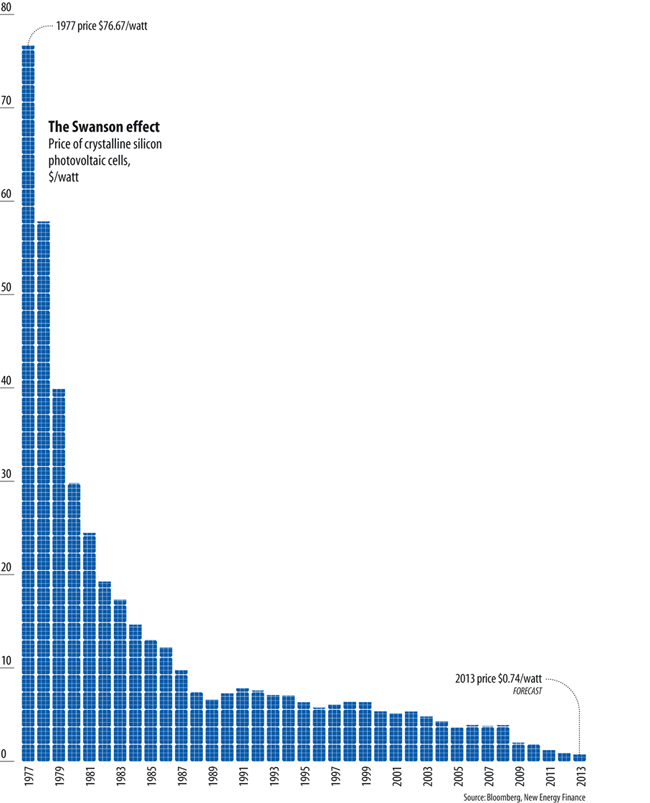
Perhaps you'd like to back that up with reasoning. I have solid reason to believe the price will drop - there are a lot of solar PV factories being built right now globally, when the investment for the factories is paid off, the price of solar will fall, that also goes for the factories built over the last decade. So, there is a lot of competition, constant improvements in solar PV manufacture and efficiency. That is why the price of solar panels will continue to fall - like it has over the last 3+ decades, from about $75 per KW to 0.75 per KW.
If you don't believe me, do your homework, google solar PV prices plummet.
-
Re:Indeed...
So I guess this never happened: http://cleantechnica.com/2014/...
Yea, that website doesn't have a dog in this hunt now does it.. The US Department of Energy's numbers are flat wrong then? In the USA, I don't think so.
Look, you can believe what you want and come up with links to "prove" your view, but if you are choosing to ignore the data provided by the US Department of Energy, you are going to have to endure the scorn you richly deserve. I'm not saying the government data is correct in all cases, only that the department of Energy is about as close as you can get to an unbiased opinion, at least for the costs of energy production in the USA.
PV Solar is not a viable solution and another 40% cost drop is not in the future. The DOE says that PV Solar is at least 4 times more expensive. This isn't going to change all that much for various reasons, chief of which is that it will only work when the sun shines. The sun never shines at night and during the day it can be hit and miss, which contributes to a "availability factor" of about 25% (in sunny areas) or much less (in cloudy areas). Try as you might, you cannot fix that with technology. Don't start down the path to thinking that we can just store excess then use it when we need it later, that drives the "cost" of solar up by another factor of 4 (or more) due to conversion losses, and makes your position logically even worse.
-
Re:Indeed...
So I guess this never happened:
http://cleantechnica.com/2014/...Why would I want to read information that is many years out of date when the cost of solar PV has been dropping by 40% per annum and has every reason to continue dropping. The EIA predictions are absurd to say the least. That page is pretty bad.
Even if all technological advances in solar panels stopped, the price of solar PV would drop further because most of the solar PV factories are being built right now, once the investment that put those factories in place is paid off, the price of solar PV will fall further.
-
Re:Indeed...
operating costs for 61 nuclear sites in 2012. The average came to $44/MWh
Add to that construction costs, decommissioning costs and nuclear fuel reprocessing / storage costs and you've got one very expensive method of producing electricity.
http://www.world-nuclear.org/i...
Why aren't there more nuclear fuel reprocessing plants? Because it's horrendously expensive.
http://belfercenter.ksg.harvar...Cost of building maintaining, removing new Wind farms?
Less than $36.5 per MWh
Wind Technologies Market ReportWith the numerous ways of matching and storing wind energy,nuclear can not compete
Wind power is continuously getting cheaper, solar power is continuously getting cheaper and there is good reason for that to continue. Storage technologies are also getting cheaper. Solar is set to become the 2nd cheapest form of energy, after Wind.
http://cleantechnica.com/2014/... -
Re:Nickel-Iron Battery -- could we make it better?
And: http://cleantechnica.com/2012/...
"Nickel-Iron (Ni-Fe) batteries -- developed over a century ago by Thomas Edison -- are gradually replacing lead-acid batteries at a number of applications, especially for solar PV and renewable energy power systems. Unlike lead-acid batteries, they are highly reliable, featuring a longer service life and pollution-free operation.
"The Nickel-Iron technology is great, because it's like rediscovering this great invention," adds Williams. "The fact that Thomas Edison developed this technology makes the history even more exciting."
Modern Ni-Fe batteries are primarily used for stationary applications and usually last longer than their lead-acid counterparts. Williams says he expects at least 20+ years from his batteries, adding that some batteries over 50 years of age are still working well. He cites a "perfectly reversible polish / tarnish reaction" as a principle reason for top performance. As for pricing and performance comparisons, the Ni-Fe battery is more expensive than a lead-acid battery, yet it delivers three times more discharge, in addition to lasting far longer, says Williams."I wonder what the problem is with making these batteries a lot cheaper?
Compressed air storage (like in salt mines) is also an interesting idea:
http://en.wikipedia.org/wiki/C... -
Re:In other news...
"but until it makes financial sense enough to get places like China and India to start using this stuff"
They are:
Chinaâ(TM)s Coal Consumption Has Finally Decreased
Beijing Cut Coal Use By 7 Percent, Proving IntentionsHow many times do I have to say renewables are getting cheap?
http://costofsolar.com/cost-of...
(2013 charts out of date - solar is cheaper now!)Solar is not 4-5 times more expensive now, it is reaching parity with coal.
Solar at Grid Parity in Utah, a Coal State With No RPS"a huge jump in technology."
Lots of them, and they're not slowing down.
http://bxhorn.com/wp-content/u...I have given you the proof that wind is cheapest and you choose to ignore it. How can a generator that requires fuel competewith a generator that doesn't require fuel?
Like I said, your arguments are all out of date.
There is ZERO chance that solar will knock off 3/4ths of their costs in the next decade.
It's funny, because if you care to look, you'll see that from 1977 the price of solar went from $76.00 a watt to less thaqn $0.74 a watt now, that's one hundred times less.
You seem to be having difficulty facing the truth of the current situation.
Global installed wind:
http://www.eenews.net/assets/2...Global installed solar (take your pick):
https://www.google.co.uk/searc... -
Re:In other news...
"but until it makes financial sense enough to get places like China and India to start using this stuff"
They are:
Chinaâ(TM)s Coal Consumption Has Finally Decreased
Beijing Cut Coal Use By 7 Percent, Proving IntentionsHow many times do I have to say renewables are getting cheap?
http://costofsolar.com/cost-of...
(2013 charts out of date - solar is cheaper now!)Solar is not 4-5 times more expensive now, it is reaching parity with coal.
Solar at Grid Parity in Utah, a Coal State With No RPS"a huge jump in technology."
Lots of them, and they're not slowing down.
http://bxhorn.com/wp-content/u...I have given you the proof that wind is cheapest and you choose to ignore it. How can a generator that requires fuel competewith a generator that doesn't require fuel?
Like I said, your arguments are all out of date.
There is ZERO chance that solar will knock off 3/4ths of their costs in the next decade.
It's funny, because if you care to look, you'll see that from 1977 the price of solar went from $76.00 a watt to less thaqn $0.74 a watt now, that's one hundred times less.
You seem to be having difficulty facing the truth of the current situation.
Global installed wind:
http://www.eenews.net/assets/2...Global installed solar (take your pick):
https://www.google.co.uk/searc... -
Re:In other news...
Your argument regarding killing people is absurd, you don't seem to be able to accept the fact that wind is cheap and solar is about to get very cheap too.
There is currently $5 trillion invested into fossil fuels, I happen to think that renewables can do just as good as job especially if we invested 5 trillion.Where Can The Fossil Fuel Investments Go?
Places where USA has no control? China has some good reasons to cut down coal usage, not least because half their population is choking to death.
Chinaâ(TM)s Coal Consumption Has Finally DecreasedCutting down on coal use cuts CO2 emissions, cutting down on gas use cuts CO2 emissions, cutting down Diesel use cuts CO2 emissions.
Different forms of power emit largely different amounts of CO2.
According to Sovacool's analysis, nuclear power, at 66 gCO2e/kWh emissions is well below scrubbed coal-fired plants, which emit 960 gCO2e/kWh, and natural gas-fired plants, at 443 gCO2e/kWh. However, nuclear emits twice as much carbon as solar photovoltaic, at 32 gCO2e/kWh, and six times as much as onshore wind farms, at 10 gCO2e/kWh.
http://www.nature.com/climate/...
We need to be careful with the environment in all respects,
I agree.
-
Re:In other news...
Your argument regarding killing people is absurd, you don't seem to be able to accept the fact that wind is cheap and solar is about to get very cheap too.
There is currently $5 trillion invested into fossil fuels, I happen to think that renewables can do just as good as job especially if we invested 5 trillion.Where Can The Fossil Fuel Investments Go?
Places where USA has no control? China has some good reasons to cut down coal usage, not least because half their population is choking to death.
Chinaâ(TM)s Coal Consumption Has Finally DecreasedCutting down on coal use cuts CO2 emissions, cutting down on gas use cuts CO2 emissions, cutting down Diesel use cuts CO2 emissions.
Different forms of power emit largely different amounts of CO2.
According to Sovacool's analysis, nuclear power, at 66 gCO2e/kWh emissions is well below scrubbed coal-fired plants, which emit 960 gCO2e/kWh, and natural gas-fired plants, at 443 gCO2e/kWh. However, nuclear emits twice as much carbon as solar photovoltaic, at 32 gCO2e/kWh, and six times as much as onshore wind farms, at 10 gCO2e/kWh.
http://www.nature.com/climate/...
We need to be careful with the environment in all respects,
I agree.
-
Re:In other news...
Wind Technologies Market Report
$25 per mWh is the price agreed in the power purchase agreement (PPA), so it is not "I wish" it is actual contractual average price paid over a bunch of contracts - some are cheaper.
Page 11, subsidies over 20 years amounting to 1.15c per kwh
Wind still getting cheaper: 2013 Wind PPA Prices In US Interior Averaged 2.1 Cents/ KWH
Can a gas powered station give 10, 20 or 30 year price guarantees?
-
Re:In other news...
Renewables are not yet ready or cost effective
I'm sorry but the use by date has expired for that argument.
Wind generation PPAs are currently as low as 2.5c per kWh, the subsidy only amounts to about 1.25c per kWh
How Low Can Wind Energy Go? 2.5c Per Kilowatt-Hour Is Just The BeginningSolar is getting cheaper every year and reached grid parity for most of the worlds population 2 years ago. In UK and Germany we are installing residential Solar PV for a small fraction of the US installation costs and even in rainy cloudy England Solar could pay for itself without subsidy and then go on to provide extremely cheap electricity.
Wind and Solar can be complemented with Hydro, pumped hydro, geothermal, biogas, battery storage, compressed air storage, wave and tidal power etc.
Windmills are a bit better, but are still not cost effective, use water in dry areas
Windmills use water!!!! No, they don't! lol.
Not much geothermal potential!!! Wrong.
http://www.treehugger.com/rene...If we stop buying their stuff, the price just goes down and folks like China and poor countries in Africa will just burn what we don't, and the terrorists get rich off of them.
No, it doesn't work like that, if 10% of world demand disappears then mines shut down, any price drop is temporary. "terrorists get rich" doesn't deserve a response.
-
Re:Define:expensive
By the time it takes to get a nucleur system on line, renewables have lept forward in efficiency. I'm not against nucleur either but you seem to be implying its a waste of time with solar etc until its perfect, but how does it get better unless its made, used and refined? you can't keep it in the shed until its perfected otherwise it'll stay in the shed.
" Expecting the populace of the north central and northeast US to climb up on the roofs of their houses to sweep off solar panels is nuts." no, i'm sure there are ways to automate that if needed, cars have wipers (mine automatically works when its wet), why not the same for panels (as an example). but if its not practical for solar/wind your area then don't do it, simple.
"Sure, being able to remove YOURSELF from the grid might be a good move. FOR YOU. Lots and lots of people simply don't have that sort of luxury" - no, unfortunately its not a luxury i can buy but its an aspiration for me and a target ideal for all.
"You're thinking like a guy who installs single family septic systems. Tack on a million more people? Sure! Just scale the single family system up, right?" - not sure what you mean here but if every one has their own septic tank (where possible) and that can also be used to generate power. but that again is a choice for them. Most waste disposal is based on hundred year old ideas - have a read here for ideas in the pipeline http://cleantechnica.com/?s=to...
I prefer spreading the risk of power generation not all the eggs in one basket -
Re:I believe solar thermal does benefit from scale
Here are a few links that might help..
http://cleantechnica.com/2014/...
http://cleantechnica.com/2014/...
http://cleantechnica.com/2014/...
http://cleantechnica.com/categ... -
Re:I believe solar thermal does benefit from scale
Here are a few links that might help..
http://cleantechnica.com/2014/...
http://cleantechnica.com/2014/...
http://cleantechnica.com/2014/...
http://cleantechnica.com/categ... -
Re:I believe solar thermal does benefit from scale
Here are a few links that might help..
http://cleantechnica.com/2014/...
http://cleantechnica.com/2014/...
http://cleantechnica.com/2014/...
http://cleantechnica.com/categ... -
Re:I believe solar thermal does benefit from scale
Here are a few links that might help..
http://cleantechnica.com/2014/...
http://cleantechnica.com/2014/...
http://cleantechnica.com/2014/...
http://cleantechnica.com/categ... -
Re:Finally!!
You hit the nail on the head, Solar installation costs less than half in Germany, see chart here:
why-german-solar-is-so-much-cheaper-than-u-s-solar-updated-study
-
Re:Wouldn't electric cars have the opposite effect
But that's changing. With better batteries, electric cars plugged into the grid can act as a large storage system.
We are a long way from when a portable battery can compete with a tank full of diesel fuel in power density. It is vaporware at best...
The batteries can be both filled and drained by the grid, meaning that energy can be stored and pulled from the network of cars that are sitting idle
Sure. And the liquid fuel can be transfered from one gas-tank to another — and with less of it lost due to spillage.
So, as Morgan Stanley suggests, the age of the centralized power source may soon be over.
I wish it were true, but I doubt it — and suspect, MS is either engaging in wishful thinking or simply trolling the rest of us, while keeping their stocks of power-producers (and buying more).
-
Why aren't electric utitlies pushing electrics?Solar panel prices are falling through the roof, scratch that, there is no damage to the roof. Some studies show that SolarPV might deliver electricity cheaper than grid in 25 states in just two years. Energy storage price break through is likely to happen first to homes than cars because storage for home does not have weight, volume and crashworthiness constraints. Already utility companies are worried and doing what they do best. Lobby the local government and utility commissions.
But one sure fire way to keep their customers tied to the grid is to encourage electric cars. If every home is charging two or three cars overnight they might not be able to ditch the grid. Since night load for the utilities is just 66% to 70% of peak day time load they can serve this market without additional investment in power plants.
Peeling off a large customer base from gasoline companies to the grid would be in the long term interests of the electric utilities. Why aren't they doing it?
-
Re:Tech likely to disrupt:
Near-instant charging.
Irrelevant. You're still limited by supply rates and feed wire heating. Top end li-ion cells can charge in a matter of minutes on the small scale. In practice it's supply rate and cooling that limits you.
Much higher discharge rates
Irrelevant. What, you think cars have multi-megawatt inverters and motors? And again, top-end li-ions can have couple minut discharges.
and that without developing significant heat, because their series resistance is negligible
Slow charge and discharge of li-ions (normal usage) is usually over 99% efficiency. Fast charge is usually 94-97%. Fast discharge is irrelevant because the rest of the car can't handle using multiple megawatts at once (what, you think the car's going to get 0-100 times measured in milliseconds?) Older supercaps are less efficient than older li-ions due to an increase in the internal resistance (more in this in a minute)
Enormously more charge/discharge cycles than anything in battery tech
10 years-ish isn't good enough for you? Fine, reduce the depth of discharge to get 15-20 years. You'll still be an order of magnitude higher energy density than ultracaps.
you could will ultracaps used in a vehicle context to your children
You've been way overstating (and repeating a common mythology) about ultracaps. They don't actually last that long. Here's an info sheet from an ultracap manufacturer. Scroll down to "Life Expectancy".
The life expectancy of supercapacitors is identical to aluminum electrolytic capacitors
It's pure nonsense that they last forever. Some are rated for longer. For example Ioxus rates theirs at 10 years. But 10 years is pretty common for higher end EV battery packs, too.
This concept that ultracapacitors are something that you can "gift to your children" is just bull. They degrade, too. Following an exponential degradation curve dominated by increasing internal resistance.. So please stop with this nonsense.
Much wider range of usable performance over temperature; much colder, much hotter.
As per the above, operating out of the ideal temperature range cuts your ultracap lifespan. Commercial ultracaps aren't generally rated for wider temperature operating ranges than high-end li-ions, as you'll see from the various linked caps in this post, which are just a random sampling (for example, the Cooper Bussmann aerogel caps are only rated down to -25C, which is not impressive at all). And there's only a rather small range that's necessary for human-operated vehicles on the surface of the Earth. The ambient temperature outside isn't going to reach cold enough to liquify oxygen or melt zinc.
Much less need for recycling
Show me a single type of ultracap which can be recycled at all.
They can't be overcharged at their rated voltage
The
-
Re:Saved?
This means those that cannot afford the systems end up "stuck" on the grid
AFAIK In the UK there are services that will install solar, bill you for the energy you use and they make their money from that and the excess electricity.
US too: http://cleantechnica.com/2014/...
Solar will cost less than coal in about two years time, the price drops have been massive, installing should get cheaper too with the larger scale of installations due to the cheaper panels.
If there is consequently an oversupply of coal then one would expect the price of coal to fall, etc.
-
Re:Saved?
Solar is already price competitive in some places and is set to get cheaper. In Italy Ikea are set to save on costs with solar without any subsidy. As solar prices drop, this will become possible in many more places, warehouse roofs are ideal for solar.
http://cleantechnica.com/2014/...
All that's needed is investment into large scale storage. There are a lot of ways this can be done, see: http://en.wikipedia.org/wiki/G...
-
Re:Details Please?
Modded you up as everything you say is true. Here's some further facts illustrating that without tax breaks/subsidies, Solar is at most a "wash" at best for consumers:
SOLAR FACTS:
- Most Efficient Solar Panel - 44.7% efficient Fraunhofer Q-Cell (1), AVERAGE efficiency between American's top 5 retailers: 17% (Kyocera KD+SunPower+SunPower+SolarWorld+Canadian Solar), which is crap compared to corporate use panels that average 21%.
- Photovoltaic (PV) Degradation Rate - Every Solar panel loses between 0.5% and 4% of its efficiency per year (depending on a-Si, CdTe and CIGS films) further resulting in a constant decline in ones ROI (2)
- Solar pricing is a monopoly: Green Building Programs that offer incentives (http://www.dsireusa.org/) are in decline year-over-year due to reduced cost of panels. (3)REFERENCES:
1) http://cleantechnica.com/2014/...
2) http://www.nrel.gov/docs/fy12o...
2) http://energyinformative.org/l...
3) http://www.energymanagertoday.... -
Re:Except nobodies doing that
If you want an example of wind power
total cost of $0.062 per kWh composed of $0.04 production and $0.022 tax credit (or ~ £40 / MWH )
-
Re:Infrastructure
This study says that's not the case:
-
Re:Hydrogen Vs Batteries
I've read that the grid is already capable of charging large numbers of EV cars. For instance: http://cleantechnica.com/2014/...
Also, if the electric company offers off-peak discounts, people would almost certainly take advantage (my Honda Fit EV, and most if not all of the other major EVs can be programmed to charge at a specific time, i.e. I just enter into my smartphone when I want the car to charge and it will then delay charging until that time. You can force it to charge immediately if you think you'll need to use the car again that day before normal charging time).
-
Re:It's a pipe dream.
Currently, most solar cells STILL don't make back their manufacturing costs within the lifetime of the product.
Whoever told you this desperately needs their pants extinguished. If the above statement were ever true, it at least hasn't been so for over two decades, which is as far back as I could find data.
Here's another link from the DOE that shows the worst current-gen rooftop PV estimated payback time at no more than 4 years in the US, with some as low as 1 year. Average estimated life span is 30 years, an order of magnitude greater.
A research paper, this time for Hong Kong, shows an EPBT of 7.1 years with optimum orientation and 20 years with worst possible orientation. Even installed incompetently, they still break even before they break down.
-
Decommisiong is expensive because.....
The plants are breaking down. They are used. Decommissioning Maine Yankee (900 MWe) took eight years and cost $500 million. It ran for 25 years. For Humboldt Bay(63 MWe) it is $982.3 million http://www.dra.ca.gov/general.... it ran for 13 years. Vermont Yankee (620 MWe) is expected to cost $1 billion to decommission http://cleantechnica.com/2014/... after a run of 42 years. This estimate will likely balloon. There is severe ground contamination at the plant site and perhaps beyond its perimeter as well. Crystal River (860 MWe) ran for 32 years and is estimated to cost $1.18. billion http://www.tampabay.com/news/b... This is low ball because sea level rise will make the site vulnerable to storm surge and letting it sit for 60 years will not be an option. The more contamination, the greater the decommissioning cost. Extending licenses for power plants may double or triple the decommissioning cost owing to larger contamination and for sea level plants, a rush to decommission as the storm surge risk becomes higher.
-
Re:Good for them.. at least the jury got it right.
Considering the US wastes 61 to 86 percent of its energy, we've got plenty of room for improvement. Even the Toyota Prius is only 25% fuel efficient. Your average auto is around 10%. and that does NOT include all the losses involved in finding/refining/delivering the gas. Again lot's of room for improvement.
-
Re:They forget the coolness factor
Considering that there's a 3-month waiting list to purchase a Model S, I reckon Mr. Musk doesn't much care what you think of him or his fans. He's got his hands full just trying to keep up with demand for his cars (and rockets, and solar panels), not to mention his five kids.
As for the GP's point, I agree that there's a niche opportunity for Nissan here, but it is limited. This increase in range will no doubt boost their sales, but it won't close the gap. And that window will only be open for a couple of years before Tesla comes out with their Model E, which is projected to have a 200mi range at the $35k price point. In any case, it's great for consumers that we'll have a broader range of choices in the EV market at various price points.
What interests me more is the rapid evolution of battery technology in recent years. I wonder if Elon didn't jump the gun a bit in committing to his "giga factory" for Li-ion batteries instead of waiting for the (potentially) better solution with Zinc-air batteries.
-
Re:So how many of them are actually qualified
(Link heavy...) I think you got the wrong end of the stick, there.
Some studies have been done that show a minimum 30% penetration is possible for *any* region (and this one stopped their modeling at 30%, so its likely higher)...
http://www.renewableenergyworl...An earlier study from Europe (no link at moment) put the figure around 40%.
Another US study comes in around 45%...
http://arstechnica.com/science...UK study comes in at >90%...
http://www.gizmag.com/uk-natio...German study comes in at 100%...
http://onlinelibrary.wiley.com...
More on this...
http://www.renewablesinternati...Some of these show cost savings from adding renewables, another one showed costs rising about 10-15%.
Iowa already got over 25% of power from renewables in 2013; not sure about the mix but I don't recall hydro being a big player there. The state has set a 40% target for 2015!
As for diverse power generation, that is a good rule of thumb, however the non-renewable generators cannot continue to operate in the long-term and nuclear in particular is even worse than variable renewables as the latter has a large correlation with demand curves. Anyone scanning the field for the past few years, however, is getting the idea that a diversity of storage will be at least as important. And there are a LOT of different options. The state of the art in this field has moved completely beyond the 1990s consensus that your post is predicated on.
Hydropower operating permits are up: http://grist.org/news/america-...
In Germany, they have closed a deal with Norway which has vast hydropower resources.
Batteries are considered the least economic storage solution, but I suggest you google "flow batteries". Here are some examples other storage types:
Zynth batteries
http://www.eosenergystorage.co...Battery EV storage pilot in US
http://www.latimes.com/busines...Ice bears (cold storage for hot nights)
http://www.renewgridmag.com/e1...Undersea pumped hydro (you read that right)
http://cleantechnica.com/2013/...Power-to-gas
http://www.nasdaq.com/press-re...Molten salt
http://spectrum.ieee.org/energ... -
Bogus
Energy payback times are about 5% of the system lifetimes for solar. http://cleantechnica.com/2013/... That comes to an energy returned on energy invested of about 20, not counting the effect of recycling which can bring that up over 80 over a century or so. Nothing, aside from early shallow oil deposits, now long since depleted, is as good as solar PV on this score.
-
Re:Consumer acceptance?
scarcity of materials? You are kidding. Right? Lithium is in the top 10 most abundant materials. A new lithium mine was found in Wyoming that has no less than 3/4 million tonnes of lithium. However, they believe that it is actually around 18 million tonnes. And that is just one mine in America. Many others are out there. More importantly, both japan and South Korea are working on how to get it from the ocean. And we have several companies working on seperating it from geo-thermal generators post steam.
And as to battery costs, they have been going down about 10% every couple of years. But here you go.
That leads to things like this claiming drops of 20-30% each year (pretty steep, but not as steep as what China did with solar cells) and that is just with Lithium-ion. It does not include lithium air, or even the zinc battery work, etc. -
Stock Bump too
The Consumer Reports article plus solid financial news and analyst forecasts for Tesla today and widely circulating speculation about their planned Gigafactory to be announced in a couple weeks with an aim of cutting battery costs by at least 50%, all lead to a surge in the stock today (2/25).
Even the confirmation that the Model X would indeed not surface until 2015 seemed to have no effect.
The stock was up as high as 17%, and closed up just under 14% (+$30 on the day to $248). With Morgan Stanley estimating a $320 price there is probably significant growth left, It seems they will have no problem funding that 5 to 7 Billion dollar battery plant. The "giga" refers to Tesla's need to build the equivalent of all of the world’s current production of lithium ion batteries under one factory roof. May be time to invest in on Lithium stocks as well.
Of course, the next drunk that crashes his car and lives to watch it burn will provide a stock dip, but that just sounds like importunity knocking.
Still, I predict Haters going to Hate. They should be arriving in about 3 seconds.....
-
I don't always like cleantech, but when I do...
-
If it can be scaled up?
Laugh more like if it can get past the energy industry trying to squash renewables:
One example: http://cleantechnica.com/2013/03/06/missouri-could-squash-economic-development-from-renewable-energy-in-the-state/Which indicates to me that solar and other renewables are becoming feasible and economic.
-
Re:Nuclear: only interim solution, permanent waste
I think there are a bunch of links in this Slashdot discussion claiming otherwise. On the surface, it makes sense: shut down nuclear plants, and what else are you going to do? Solar just can't produce that amount of power (yet).
To confirm this, I just did a quick Google search for "Germany Coal Nuclear Solar":
https://www.google.com/search?q=germany+coal+nuclear+solar&ie=utf-8&oe=utf-8&aq=t&rls=org.mozilla:en-US:official&client=firefox-a
which seems to confirm the increase in coal burning, although the Poland connection seems to be false.http://www.world-nuclear.org/info/Country-Profiles/Countries-G-N/Germany/
"More than half of Germany’s electricity was generated from coal in the first half of 2013, compared with 43% in 2010." but it says nothing about the shutdown of nuclear reactors.http://cleantechnica.com/2013/02/05/debunking-common-myths-about-nuclear-coal-power-in-germany-this-time-repeated-by-the-guardian/
"coal (including lignite) is up around 5%...have nothing to do with nuclear in Germany."http://www.csmonitor.com/Environment/Energy-Voices/2013/0716/The-dirty-coal-behind-Germany-s-clean-energy
This sites the 5% figure but doesn't mention why. "Germany has managed to be praised by environmentalists more than any other developed nation and yet is building more coal plants than more or less any other developed country" but it has no specifics.http://www.dissentmagazine.org/article/green-energy-bust-in-germany
This one claims the same thing.
"Germany is indeed avoiding blackouts—by opening new coal- and gas-fired plants. Renewable electricity is proving so unreliable and chaotic..."http://canadafreepress.com/index.php/article/57035
"they are now building coal-fired electricity generation and shuttering nuclear power plants..."I don't know what to believe now. Ultimately, we would need to see the energy mix numbers from the German power companies/government to know for sure. Just pointing out that new coal plants are being built doesn't mean much. They might be replacing existing ones, or making cleaner/smaller ones.
-
Re:TL;DR
-
Re:they've had this place since what 2010?
esides, where is all the electricity going to come from to do from pure water?
Seems like a good application for solar.
Possibly eventually even bypass the electricity step and just use solar energy to produce hydrogen directly.
5% efficiency so we're not exactly there yet, but its a possible direction for future breakthroughs.
In the meantime, solar electric arrays to power electrolysis seems like it beats "coal plants".
-
Re:Delays not surprising
Or, more solar and wind plugged into decentralised local grids. See: Germany and Denmark who are doing just that without the benefit of Texas Sun.
Lets check on Germany and run the numbers.
Germany peaked at 23.9 GW. At the peak, it was providing for 40% of Germany's electrical usage. Impressive.
But that's the peak. How about overall?
Wolfram Alpha gives 549.1 billion kwh/year for German's total electricity consumption. It also gives 19.1 billion kwh a year from solar, tide or waves and 46 billion kwh a year from wind.
Now we're mixing data from different years (so this is a rough estimate), but I'm seeing a total of 65.1 billion kwh/year from solar + wind, with a usage of 549.1 billion kwh/year. So about 12%. Compare this to to the 94.1 billion kwh/year from nuclear.
Now this neglects another problem - the variability of solar and wind. If solar and wind make up a small fraction of the grid, or it's possible to sell to neighboring countries, it's pretty easy to sell excess energy when it's windy/sunny, and use other power plants when it's not. I'm not sure what overcapacity the US would need if it primarily resorted to wind & solar power.
Not to mention the false dichotomy. We can build solar, we can build wind, we can build nuclear - but we can also build coal power plants, natural gas power plants, and oil power plants.
There's nothing preventing us from building both nuclear and renewable energy power plants in order to reduce the reliance on fossil fuel power plants. If you believe that anthropological global warming is a real problem, I'd suggest that reducing CO2 emissions through a combination of solar, wind & nuclear would be quicker than reducing CO2 emissions by just wind & solar, or by just nuclear.
-
Wind power may be to blame
Wind power sometimes puts the wholesale price of electricity down to zero in Texas. http://cleantechnica.com/2011/10/20/wholesale-price-of-electricity-drops-to-0-00-in-texas-due-to-wind-energy/ So natural gas may simply be acting a the medium through which wind discourages nuclear power. This has been the case in the Midwest. http://will.illinois.edu/nfs/RenaissanceinReverse7.18.2013.pdf Wind power has cut off the top of the gas generation price curve and forced a reactor to close down there through the subsequent lowering of the wholesale electricity price. Gas can still be expensive if the less efficient turbines are used. Wind lowers demand for those.
-
Re:That's because it has a software governor.
416 horse power and it can only do 132 mph is nothing to brag about.
It's not a technical limitation. The Model S has a software governor that caps its top speed. Part of the "tuning" package Tesla plans to offer for German Model S customers is a raise on the cap to somewhere closer to the "gentlemen's agreement" of 155 MPH that most auto manufacturers limit their cars with.
There's also a hidden menu setting to turn off the governor. See the video at just before the 1:00 mark. I haven't read anything about people trying it, though.
That's because nobody knows the password to get into that hidden menu.
-
That's because it has a software governor.
416 horse power and it can only do 132 mph is nothing to brag about.
It's not a technical limitation. The Model S has a software governor that caps its top speed. Part of the "tuning" package Tesla plans to offer for German Model S customers is a raise on the cap to somewhere closer to the "gentlemen's agreement" of 155 MPH that most auto manufacturers limit their cars with.
There's also a hidden menu setting to turn off the governor. See the video at just before the 1:00 mark. I haven't read anything about people trying it, though.
-
Re:Assumptions
What bullshit - ALL power has to be backed up.
Even if your nuke plant has 100% uptime, shit happens on the grid and if something takes its substation offline, you suddenly need to find 1 or 2 GW to keep things running. We didn't invent spinning reserve when the 1st wind turbine hit the grid - those plants have been there for decades.
http://cleantechnica.com/2013/07/21/intermittency-of-renewable-energy/
http://cleantechnica.com/2013/09/28/5-7-trillion-worth-renewables-added-grid-costs/
-
Re:Assumptions
What bullshit - ALL power has to be backed up.
Even if your nuke plant has 100% uptime, shit happens on the grid and if something takes its substation offline, you suddenly need to find 1 or 2 GW to keep things running. We didn't invent spinning reserve when the 1st wind turbine hit the grid - those plants have been there for decades.
http://cleantechnica.com/2013/07/21/intermittency-of-renewable-energy/
http://cleantechnica.com/2013/09/28/5-7-trillion-worth-renewables-added-grid-costs/
-
Re:Uh... anyone check electric grid capacity?
Actually solar can work, you can easily build a 200amp 100% solar charging station.
http://cleantechnica.com/2013/09/02/solar-integrated-ev-fast-charging-station-eco-station-gets-coda-energy-storage-system/
CODA energy is putting them all over the place.