Slashdot Mirror
Domain: code.org
Stories and comments across the archive that link to code.org.
Comments · 39
-
Re:Self Reporting
There are 4 questions on the site. However, I feel that all questions are not really relevant that much in the sense of surveying for computer science learning school...
- How many students do an Hour of Code?
- How many students do computer programming in an after-school program?
- How many students take at least 10 hours of computer programming integrated into a non-Computer Science course (such as TechEd, Math, Science, Art, Library or general classroom/homeroom)?
- How many students take a semester or year-long computer science course that includes at least 20 hours of coding/computer programming?Let's talk about these questions. First question, Code.org is asking about how many students that are "using" its site. This is and advertising and is bias toward itself that it is teaching "computer science." Computer Science IS NOT EQUAL TO programming, period.
The second question is vague. What does "computer programming" mean in this case? There are different level of programming including computer languages. This question is going to lump everything together as a black and white. The gray area will be included in either side depending on the person who answers/fills in their form.
The third question is somewhat irrelevant. Asking if you do programming doesn't mean you are doing Computer Science.
The fourth question is misleading. It is obvious that the question implies that Computer Science IS programming, but it is NOT TRUE. Programming is one of major factors in Computer Science but not Computer Science. There are many other things else in Computer Science (e.g. theory, algorithm, analysis, etc.). What one needs in Computer Science is to have capability to program. The main difference among computer languages is usually the syntax. If one understands the fundamental part of Computer Science, programming is just to demonstrate a more understandable expression of a solution.
-
Re:Self Reporting
There are 4 questions on the site. However, I feel that all questions are not really relevant that much in the sense of surveying for computer science learning school...
- How many students do an Hour of Code?
- How many students do computer programming in an after-school program?
- How many students take at least 10 hours of computer programming integrated into a non-Computer Science course (such as TechEd, Math, Science, Art, Library or general classroom/homeroom)?
- How many students take a semester or year-long computer science course that includes at least 20 hours of coding/computer programming?Let's talk about these questions. First question, Code.org is asking about how many students that are "using" its site. This is and advertising and is bias toward itself that it is teaching "computer science." Computer Science IS NOT EQUAL TO programming, period.
The second question is vague. What does "computer programming" mean in this case? There are different level of programming including computer languages. This question is going to lump everything together as a black and white. The gray area will be included in either side depending on the person who answers/fills in their form.
The third question is somewhat irrelevant. Asking if you do programming doesn't mean you are doing Computer Science.
The fourth question is misleading. It is obvious that the question implies that Computer Science IS programming, but it is NOT TRUE. Programming is one of major factors in Computer Science but not Computer Science. There are many other things else in Computer Science (e.g. theory, algorithm, analysis, etc.). What one needs in Computer Science is to have capability to program. The main difference among computer languages is usually the syntax. If one understands the fundamental part of Computer Science, programming is just to demonstrate a more understandable expression of a solution.
-
It's helping, but it's not at levels of impact yet
I've got kids in middle and high school and clearly this comp-sci-in-the-classroom and STEM are really big hot-button topics right now. I see what my kids bring home, and it's not anything great. So some handful of teachers with absolutely zero give-a-shit went to a workshop and hot-glued the proverbial H-bridge Whisker-sensor 'robot' together and put together groups of 3-4 kids for 20 minutes? Or paused the keyboard words-per-minute work in the computer class to let kids navigate to code.org/starwars to fuck around for the last 30 minutes of class dragging visual blocks that write insanely deep if-statements all over the place? Big deal. I never see one kid (including my own) yet come home and say, "Show me more" because it's back to Youtube or Netflix because the value, thinking and logic component was never there. Unfortunately, tear it a part if you want, but that's the day-to-day truth I'm seeing.
Are good are you at doing anything when you, at best, barely-and-occasionally do it? Not good at all and what is being done at that level is not engaging enough to anyone who wants to 'know more'. I've been doing tech, code slinging, SA/DBA/network, and engineering work for 15 years and I still feel like I have a lot to learn every day, and I feel like I can even remotely call myself well-rounded and somewhat polished. And I feel bad for teachers, because a lot of them are doing it solely because it's a requirement and, hey, teachers don't get paid shit for what they put up with, and it impacts their review to get whatever nominal performance or cost-of-living raise on their contract (if any) they were looking for.
Furthermore, ya 'Big Silicon' is donating to it, and millions of dollars is a big deal, but not impacting much. It looks good philanthropically speaking, but it's a way to hide money and be tax except, too, if it's non-profit. What was the biggest donation amount I saw, $10M? Amazon owner net work is almost $1 Trillion. Microsoft? $560 Billion. Facebook? $74 Billion. Google? $500 billion. Their fucking brand is SO BIG, these 'push-CS' movements are not a move to build new crops of 10+ year future talent to keep that sustaining, it just looks good and it's a tax break.
-
Sorry Code.org
All of the computers in my classroom are running Linux, which apparently does not meet your requirements.
-
Re:Yey!I thought the game looked okay (especially for a one-hour thing), but then I saw what he'd actually had to do. The things that were done for him:
- Drawing the game board.
- Collision detection between ball and player, goal, and walls
- The bounce logic.
- Events delivered for the buttons.
- The mechanic for introducing a new ball into the game.
- The score management. This is like those lego sets that have about half a dozen pieces and can be quickly assembled into a single design of spaceship. Yes, sure, you've built something, but there was little creativity or effort involved. It's not a bad learning tool (and for something that expects people with no programming experience to get something done in an hour, it's fine) but if he doesn't realise how much harder all of the pre-defined bits were to write than the simple logic for gluing them all together then he's now dangerously ignorant.
-
python or (i guess) javascript first
Do you think Apple could encourage young programmers more by also shipping their Macs with BASIC?
no.
I think coders should start with something like Python (and I *guess* Javascript but I wouldn't advise it) then move down to C, then progress from there depending on their interest.
Most coders know only one method of learning to code: excruciating brute force trial and error
There's no *rational* reason for learning to code to be annoying at all, but we do this to ourselves because it reinforces difficulties we overcame in the past.
One example, this code.org Star Wars Javascript tutorial: https://studio.code.org/s/star...
It's perfect...also there are a few great "getting started with programming Python/Javascript" books by No Starch Press I would recommend.
-
Re: Code.org
This is quite clear by the mutual ego stroking of the members over their proprietary closed 'solutions' for education rather than a focus on simpler and freely available solutions that already exist.
Can you please explain what these "proprietary closed solutions" are and the "freely available solutions" that already exist are? In reading through code.org I can see that almost all of it is based on technologies that are open source and/or open standards. Your comment is too vague to distinguish whether you're referring to the tools or the curriculum being open/closed.
The courses are licensed under non-commercial Creative Commons Attribution licenses and are primarily focussed on Javascript. Of course it is in the interest of people in the industry to ignore these facts and not teach computer science in school because then it remains a less common skill in order to demand inflated salaries. So while there is a lot of criticism directed at what is being taught and that XYZ language would be better in an effort to dismiss it there is no effort going towards actually developing a curriculum for XYZ language because it is not about the critics offering an education it is about preventing education to maintain inflated salaries.
-
Re:MS Office is NOT CompSci
I don't agree. This link gives you a better idea of what type of course it will likely be. Seems to be fairly reasonable as a computer science curriculum. I can tell you from personal experience that a real master's degree in computer science from a major university is not very useful anyway. I have yet to find a practical application of Rice's Theorem in my day job.
-
Well Played, Microsoft!
Think Tanks: How a Bill [Gates Agenda] Becomes a Law: In 2012, the Center for Technology Innovation at Brookings hosted a forum on STEM education and immigration reforms, where fabricating a crisis was discussed as a strategy to succeed with Microsoft's agenda after earlier lobbying attempts by Bill Gates and Microsoft had failed. "So, Brad [Microsoft General Counsel Brad Smith]," asked the Brookings Institution's Darrell West at the event, "you're the only [one] who mentioned this topic of making the problem bigger. So, we galvanize action by really producing a crisis, I take it?" "Yeah," Smith replied (video). And, with the help of nonprofit organizations like Code.org and FWD.us that were founded shortly thereafter, a national K-12 CS and tech immigration crisis was indeed created.
Microsoft supports White House initiative to expand access to computer science: " Microsoft is one of many companies in the tech sector that is committed to this effort [said Microsoft President Brad Smith]. In addition to our business initiatives, those of us who are involved in philanthropy, including such groups as Code.org, will do more. The private sector and philanthropy cannot fill this gap without public funding. And if we're going to accelerate progress as a nation, we need federal funding. That's why today's proposal is so important. It can provide the accelerant to help more states and school districts progress more quickly."
-
stick to the minecraft version
Oddly enough, the Minecraft version of Hour of Code is strictly from a 'turtle' perspective. (There is no 'move left' command, but rather 'rotate left' and then 'move forward' commands - the move command is always 'move the direction that 'steve/alex' is facing, and the rotate is always relative to the "character's" current orientation ). Yes, my girlfriend's daughter had to figure out which way to turn Alex based on which way she wanted him to face and which way he was facing, which involved pointing in different directions - I was impressed she was getting it right though!
Perhaps this lines up with the established 'first person' perspective of Minecraft, that no doubt most of the users would be already be familiar with compared with the Frozen and Star Wars, which are both movie based.
But, yeah, sidestep the issue. Use the Minecraft version.
-
Re: Look Around You
Except if you actually looked at the material you would realize you are wrong, so why would you say that?
Please do show me how they are teaching kids to use MS software. Seriously does the MS hatred run so deep in some around here that it completely inhibits rational brain function? If MS has achieved one thing in their history it is that they managed to mentally castrate some of you folks, you see "Microsoft" and you can no longer function.
They are teaching algrebra in computer science as well as programming fundamentals using Snap (developed at Berkeley) and Javascript. But by all means, don't let facts get in the way of your anti-MS FUD.
-
Re: Look Around You
Except if you actually looked at the material you would realize you are wrong, so why would you say that?
Please do show me how they are teaching kids to use MS software. Seriously does the MS hatred run so deep in some around here that it completely inhibits rational brain function? If MS has achieved one thing in their history it is that they managed to mentally castrate some of you folks, you see "Microsoft" and you can no longer function.
They are teaching algrebra in computer science as well as programming fundamentals using Snap (developed at Berkeley) and Javascript. But by all means, don't let facts get in the way of your anti-MS FUD.
-
Re: Look Around You
Except if you actually looked at the material you would realize you are wrong, so why would you say that?
Please do show me how they are teaching kids to use MS software. Seriously does the MS hatred run so deep in some around here that it completely inhibits rational brain function? If MS has achieved one thing in their history it is that they managed to mentally castrate some of you folks, you see "Microsoft" and you can no longer function.
They are teaching algrebra in computer science as well as programming fundamentals using Snap (developed at Berkeley) and Javascript. But by all means, don't let facts get in the way of your anti-MS FUD.
-
Re:Error in the specification?
Josh S. (Code.org Support)
Nov 13, 12:39
Hi,
Thanks for writing in about this. This is a known bug we're looking into a fix for as we speak. Please try again in a few days and write back if you're still experiencing troubles.
Best,
Code.org StaffNov 13, 12:12
Bug in Course starwars Stage 1 Puzzle 9
https://studio.code.org/s/star...
Amazon CloudFrontThe instructions to mean that each pilot is worth 100 points. The tutorial deems that a failure; the programmer has to award more points for each to succeed. I think the problem statement doesn't match the success criteria.
-
Error in the specification?
I think there's an error in the problem specification for this puzzle. Nice job giving the prospective programmer a realistic view of the industry.
https://studio.code.org/s/star...
If you add only 100 points for each pilot (per the instructions), that makes 300 points, which the tutorial deems a failure.
-
K-5 CS Teachers Trained at Microsoft Store
Taught by Code.org Affiliates who are experienced computer science educators, our free workshops will prepare you to teach the Code Studio courses for grades K-5. Workshop details: The Microsoft Store @ The Domain will host a FREE Code.org workshop. FREE CPEs for educator re-certification will be provided!..Priority: Title I Schools. Waiting List: Non-Title I Schools. THANK YOU GOOGLE & MICROSOFT FOR SPONSORING THIS EVENT!
-
Re:Am I missing something with Code.org?
In the "Teacher Home Page" you can create new sections that are assigned to specific courses. You can see the courses offered at the bottom of the Teacher Dashboard here: http://code.org/teacher-dashbo... .
Courses 1-4 are far more extensive than the hour of code or Introduction to Computer science courses. You could make separate sections for each course so that students can progress up the ladder on their own or change the course for the entire section at once by editing the section. You can track progress throughout the course. Each course includes some group and "unplugged" activities that you can do when the entire group is there.
-
Re:Hour of Code
My 7 year old just finished an Hour of Code on http://code.org/learn too.
Hey loved it. It felt like a game to him. He wasn't overwhelmed. He was excited. He said, "I am going to be a computer worker like you daddy" afterwords.
-
Start of a FAQ for /.
Can we get a FAQ please? Here are the common answers:
* Visually with Angry Birds characters: http://learn.code.org/hoc/1
* Scratch
* http://coderdojo.com/
* Minecraft mods
* http://www.learntomod.com./
* https://pragprog.com/book/ahmi...
* http://codecombat.com/
* http://boardgamegeek.com/board...
* http://boardgamegeek.com/board...
* http://www.gamebooks.org/show_...
* http://venturebeat.com/2014/06...
* http://meetedison.com/
* BASIC
* Vic-20 C64 Compute! magazine
* Raspberry Pi
* Arduino
* Logo -
Re:LOGO
You can laugh at LOGO, but I've been having my 8-year-old daughter play with code.org, and it is mostly the same thing.
-
How to influence the innumerate with CS Ed stats!
Why we need $400 million to teach K-12 CS: 1. "Only 10 percent of schools teach it [CS]." 2. "No Girls, Blacks, or Hispanics Take AP Computer Science Exam in Some States." 3. "Currently, only 25 states allow computer science to count as a mathematics or science credit towards graduation."
-
Code.org
We just did the Hour of Code at my workplace for the kids. Lots of tutorials for beginners on there. MichaelSmith above me also mentioned Scratch, and that's an excellent visual approach to learning procedural programming.
-
Show Her The Frozen Coding Lessons
Let her know that princesses are programming too now.
-
Apple's Ellen Feis Ad: Worse Than Targeting Boys?
If you were trying to discourage girls from trying to program computers, you'd be hard-pressed to top Apple's famous Ellen Feis 'Switch' ad (2002 Slashdot discussion). Btw, by introducing 'The Computer for The Rest of Us' in 1984 without a viable hobbyist programming language, Steve Jobs and Bill Gates no doubt helped discourage both girls and boys from studying CS, even if BillG is trying to make amends now.
-
Re:Gates and Schmuckerberg's Ugly Mugs
The first thing I saw when I got to the third course beta was a picture of three goony looking creatures, two of whom were Gates and Schmuckerberg.
Try to learn proper respect for your superiors. Thanks.
Fuck that. I'd pay money to see them both prison raped.
-
Re:Gates and Schmuckerberg's Ugly Mugs
The first thing I saw when I got to the third course beta was a picture of three goony looking creatures, two of whom were Gates and Schmuckerberg.
Try to learn proper respect for your superiors. Thanks.
-
Gates and Schmuckerberg's Ugly Mugs
The first thing I saw when I got to the third course beta was a picture of three goony looking creatures, two of whom were Gates and Schmuckerberg. Seriously. Then I clicked on "Computational Thinking" and there was a message "Students use the steps of computational thinking (decompose, pattern match, abstract, algorithm) to figure out how to play a game that comes with no instructions." and a button that said Finished. Continue to next stage. I'm thinking the developers of this website might want to learn how to program before they teach others. For a real hoot, checkout what happens when you click the aforementioned button. Seriously? If this is teachning kids how to program, I'm Rip Frigging Van Winkle.
-
Re:Take a free class
Three of us took that "Beginning Game Programming with C#" Coursera course. Two of us were professional programmers (myself a professional game developer) so we blew through the course; our third was a gaming buddy who wanted to try out programming -- he was an excellent gamer but had never done any programming. (Back in the day he had done a little shell scripting on Windows.)
The coursera is NOT a beginner friendly course -- it had two major problems:
* it teaches concepts in the wrong order, and
* doesn't explain key critical concepts at all, or extremely poorly.My buddy dropped out after a few weeks because he just felt completely lost. We would spend hours going over concepts with him and he would get most of it. But when it came to the assignments he didn't have enough of the big picture and low level details to reason things out. IMHO there are better lessons out there, such as:
* http://www.codecademy.com/
* http://learn.code.org/hoc/1Which is a shame too, because the professor is actually friendly, and has good intentions.
MOOCs are "famous" for having a 98% drop-rate. Seriously, like 20,000 students signed up. Very few made it to week 5.
-
Code.org
K-8 Intro to Computer Science Course (15-25 Hours)
Free to all, not a sampling, and includes all resources needed for off-line instruction and activities.
Basic programming concepts are introduced in the second session ("The Maze") using graphical building blocks. You can expose the equivalent JavaScript code.
-
Re:Instead of whining....
... why not look at what Code.org has to offer?
This is not a sampling, and it is free to all.
K-8 Intro To Computer Science Course (15-25 hours)
Lesson1:
- "Understand that a computer is a tool and not an excuse to turn off your brain"
- "But when you can do something that most other people cannot, it isn’t very responsible to take advantage of others because of it. It is far better to get in the habit of 'paying it forward'”
- ""[L]earn to look at individual pieces, instead of just the big picture. Chopping a task up into manageable pieces is a great way to make progress through a series of little successes"
I'm thinking this needs to be taught to the CxO suite, not K-8. Joking aside, I'm impressed by Lesson1. I could actually envision a third grader playing with the binary decoder exercise with a friend and finding it interesting. Well, at least for 5 minutes, but it's a start. -
Re:Instead of whining....
... why not look at what Code.org has to offer?
This is not a sampling, and it is free to all.
K-8 Intro To Computer Science Course (15-25 hours)
Sorry that is NOT programming. By the logic of code.org I was programming a computer while playing PacMan way back in 1982 on my Commodore VIC-20. I was programing back then but not while playing PacMan. Computer programming and the people writing the programmes used to be respected and well-paid. Today it is a race to the bottom.
-
Instead of whining....
... why not look at what Code.org has to offer?
This is not a sampling, and it is free to all.
-
Re:How about real problems
Unfortunately, I believe that is the role of the user. I don't think that Facebook would try re-routing users to code.org.
-
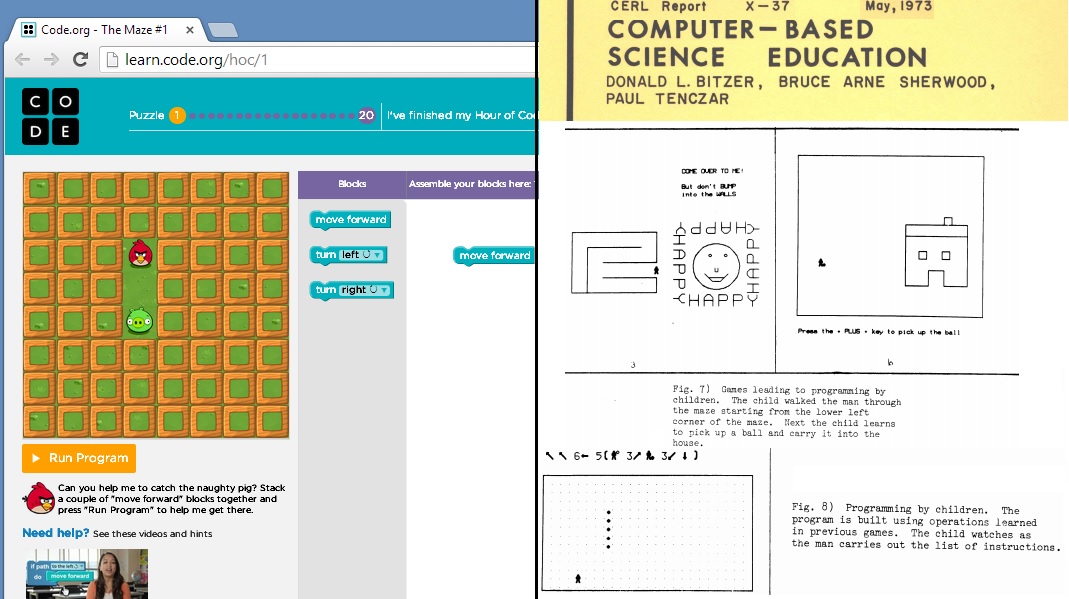
2013 Code.org Like Dumbed-Down 1973 PLATO?
Probably worth mentioning that Code.org's online programming tutorial for kids, created in 2013 with collaboration with engineers from Microsoft, Google, Twitter and Facebook, is kind of like a dumbed-down, albeit slicker, version of online instruction given to children in 1973 on the University of Illinois' PLATO computer-assisted instruction system.
Programming by Children (1973): "Young children can be taught the basic elements of programming...In Figure 7a the child has walked the man, one step at a time, through a maze."
Overview of Code.org's Hour of Code activity (2013): "Our activity is a set of 20 self-guided puzzles that teach the basics of computer science for users with no prior experience. In each puzzle, students write a program that gets a character through a maze."
-
Re:Yeah, no ...
You couldn't be more wrong.
Disclaimer: I helped with an Hour of Code session in a public highschool this morning. And I've been teaching "block based programming" all semester in this same highschool as part of the "Teals" program (http://www.tealsk12.org)
Go here. Do it. Then do it with kids you know.
The Blockly stuff is _Exactly_ how I figured I would teach my own kids about programming years ago. I had planned to make something like blockly at some point, and I was thrilled when I saw that someone else had done so.
Go through the hour of code blockly sample. It is simple enough that my 6 year old got through all 20 exercizes. He needed a little help on a few of them.
But ask yourself - what is the hardest part of programming? It is typing in the code?
I contend that it isn't.
IMO, the interesting stuff is decomposing the problem, and then finding out ways to solve each step of the problem. If you want to be elegant, you figure out which sub-problems are similar to other sub-problems, and you can make your code more efficient; you can increase re-use, etc.
Making kids figure out the instructions to solve a maze is EXACTLY how I'd teach young people about CS. A maze is a problem every child understands. What they may not understand is how to write precise instructions to implement what they already know.
The language and the tooling are irrelevant. Some programming paradigms are more mind-bending than others for a given problem, but fundamentally, if you know how to break down problems, and you know the context/paradigms of a particular language or tool set, you can do whatever you need to do.
We've been teaching highschoolers using "BYOB". Sure, they aren't about where to put the asterisk on a function decl. But all of these kids have been successful at implementing a variety of simple sprite based games -- galaga, hangman, a scrolling Mario, etc.
Don't you dare say its not programming just because they're not typing the code.
I've seen some real ingenuity out of our highschoolers. The tools allow them to be productive quickly; they do a better job of holding their interest than a text editor.
-
Re:Self-serving philanthropy
I just had a look at their website and much of it seems to be device and platform agnostic, in fact some things are just critical-thinking tasks that don't even require a computer. I doubt it would be difficult to tie all the corporate and private donors together to come up with some big conspiracy theory about how this is all to enslave everybody as corporate drones and somebody should think of the children but there doesn't really seem to be anything to actually support that notion so wouldn't a more effective use of that time be producing an alternative to the specific elements - if any - that you disagree with?
-
Code.org: Inspire Students with Male Role Models
Kind of odd that just a few paragraphs after saying it will cap teachers' grants for classes with too many boys, Code.org instructs teachers to: 'Inspire your students: introduce computer science and make it exciting, creative and for everyone. Show your students the Code.org film, "What Most Schools Don't Teach": it features Microsoft founder Bill Gates, Facebook founder Mark Zuckerberg, and Black Eyed Peas founder will.i.am and NBA star Chris Bosh talking about the importance of programming."
-
Re:Volunteer work
Teach kids how to code. Talk to schools in the neighbourhood, set up something in the library... Or whatever.
-
Looks like a mix of people to me
Look at the people at http://www.code.org/quotes. Some are politicians but many are from the computing industry. Quit whining and actually look.