Slashdot Mirror
Domain: collegeboard.org
Stories and comments across the archive that link to collegeboard.org.
Stories · 19
-
Chan Zuckerberg Initiative Claims It Has Enabled Its Partners To 'Double the Number of Black and Latinx Students and Girls Taking AP Computer Science' (chanzuckerberg.com)
theodp writes: In a Monday blog post, the outgoing Head of Education for Facebook CEO Mark Zuckerberg's Chan Zuckerberg Initiative made the claim that "we've made investments that enabled our partners to double the number of Black and Latinx students and girls taking AP Computer Science." The claim is an apparent reference to the highly-promoted and wildly-successful new AP Computer Science Principles course (dubbed "Coding Lite" by the NY Times), which the NSF and College Board began development on in 2009. Zuckerberg's CZI LLC was created in late 2015. -
The College Board Pushes To Make Computer Science a High School Graduation Requirement
theodp writes: Education Week reports that the College Board wants high schools to make it mandatory for students to take computer science before they graduate. The call came as the College Board touted the astonishing growth in its Advanced Placement (AP) computer science courses, which was attributed to the success of its new AP Computer Science Principles (AP CSP) class, a "lite" alternative to the Java-based AP CS A course. "The College Board is willing to invest serious resources in making this viable -- much more so than is in our economic interest to do so," said College Board President David Coleman. "To governors, legislators, to others -- if you will help us make this part of the life of schools, we will help fund it."
Just two days before Coleman's funds-for-compulsory-CS offer, Education Week cast a skeptical eye at the tech sector's role in creating a tremendous surge of enthusiasm for K-12 CS education. Last spring, The College Board struck a partnership with the Chan Zuckerberg Initiative with a goal of making AP CSP available in every U.S. school district. Also contributing to the success of the College Board's high school AP CS programs over the years has been tech-bankrolled Code.org, as well as tech giants Microsoft and Google. The idea of a national computer programming language requirement for high school students was prominently floated in a Google-curated Q&A session with President Obama (video) following the 2013 State of the Union address. -
The College Board Pushes To Make Computer Science a High School Graduation Requirement
theodp writes: Education Week reports that the College Board wants high schools to make it mandatory for students to take computer science before they graduate. The call came as the College Board touted the astonishing growth in its Advanced Placement (AP) computer science courses, which was attributed to the success of its new AP Computer Science Principles (AP CSP) class, a "lite" alternative to the Java-based AP CS A course. "The College Board is willing to invest serious resources in making this viable -- much more so than is in our economic interest to do so," said College Board President David Coleman. "To governors, legislators, to others -- if you will help us make this part of the life of schools, we will help fund it."
Just two days before Coleman's funds-for-compulsory-CS offer, Education Week cast a skeptical eye at the tech sector's role in creating a tremendous surge of enthusiasm for K-12 CS education. Last spring, The College Board struck a partnership with the Chan Zuckerberg Initiative with a goal of making AP CSP available in every U.S. school district. Also contributing to the success of the College Board's high school AP CS programs over the years has been tech-bankrolled Code.org, as well as tech giants Microsoft and Google. The idea of a national computer programming language requirement for high school students was prominently floated in a Google-curated Q&A session with President Obama (video) following the 2013 State of the Union address. -
High School Computer Science: Look Ma, No Textbooks!
theodp writes: Computer Science Teacher Alfred Thompson wonders how other high school CS teachers use textbooks. "It's not a conversation I hear much about," he writes. Indeed, many teachers apparently don't rely on CS textbooks much at all. In fact, the highly-touted new AP Computer Science Principles (AP CSP) course does not require a CS textbook for students (sample College Board AP CSP syllabus), albeit to the chagrin of some. Some of the bigger providers of AP CSP curriculum -- e.g., BJC and Code.org, both of whom partner with Microsoft TEALS -- don't require a traditional CS textbook. But with teachers being recruited to teach Computer Science even if they don't have a CS background, should students learning CS have a textbook? Or is the high AP exam pass rate enjoyed by AP CSP students proof that no-more-books works? -
Arkansas Will Pay Up To $1,000 Cash To Kids Who Pass AP Computer Science A Exam
theodp writes: The State of Arkansas will be handing out cash to high school students who pass an Advanced Placement test in computer science. "The purpose of the incentive program is to increase the number of qualifying scores (3, 4, or 5) on Advanced Placement Computer Science A exams," explained a press release for the Arkansas Advanced Placement Computer Science A Incentive Program (only 87 Arkansas public school students passed the AP CS A exam in 2016, according to College Board data). Gov. Asa Hutchinson added, "The Arkansas Department of Education's incentive for high scores on the AP Computer Science A exam is a terrific way to reward our students for their hard work in school. The real payoff for their hard work, of course, is when they show their excellent transcripts to potential employers who offer good salaries for their skills." The tiered monetary awards call for public school students receiving a top score of 5 on the AP CS A exam to receive $1,000, with another $250 going to their schools. Scores of 4 will earn students $750 and schools $150, while a score of 3 will result in a $250 payday for students and $50 for their schools. The program evokes memories of the College Board's Google-funded AP STEM Access program, which rewarded AP STEM teachers with a $100 DonorsChoose.org gift card for each student who received a 3, 4, or 5 on an AP exam. DonorsChoose.org credits were also offered later by tech-bankrolled Code.org and Google to teachers who got their students coding. -
College Board Mainstreams AP Computer Science (collegeboard.org)
New submitter Pollux writes: In the Fall of 2016, the College Board will begin a new course titled "AP Computer Science Principles," designed to "introduce students to the central ideas of computer science, instilling the ideas and practices of computational thinking and inviting students to understand how computing changes the world." This course will not replace the existing "AP Computer Science A" course, but has been added, "To appeal to a broader audience, including those often underrepresented in computing." A short list of differences between the two courses notes that instructors can choose a language of their choice. The curriculum framework directs the focus of instruction away from programming as a skill and towards programming as an activity, "enabling problem solving, human expression, and creation of knowledge (PDF)." -
College Board Mainstreams AP Computer Science (collegeboard.org)
New submitter Pollux writes: In the Fall of 2016, the College Board will begin a new course titled "AP Computer Science Principles," designed to "introduce students to the central ideas of computer science, instilling the ideas and practices of computational thinking and inviting students to understand how computing changes the world." This course will not replace the existing "AP Computer Science A" course, but has been added, "To appeal to a broader audience, including those often underrepresented in computing." A short list of differences between the two courses notes that instructors can choose a language of their choice. The curriculum framework directs the focus of instruction away from programming as a skill and towards programming as an activity, "enabling problem solving, human expression, and creation of knowledge (PDF)." -
College Board Mainstreams AP Computer Science (collegeboard.org)
New submitter Pollux writes: In the Fall of 2016, the College Board will begin a new course titled "AP Computer Science Principles," designed to "introduce students to the central ideas of computer science, instilling the ideas and practices of computational thinking and inviting students to understand how computing changes the world." This course will not replace the existing "AP Computer Science A" course, but has been added, "To appeal to a broader audience, including those often underrepresented in computing." A short list of differences between the two courses notes that instructors can choose a language of their choice. The curriculum framework directs the focus of instruction away from programming as a skill and towards programming as an activity, "enabling problem solving, human expression, and creation of knowledge (PDF)." -
Despite $30M Tech Push, Half of US States Had Fewer Than 300 AP CS Test Takers
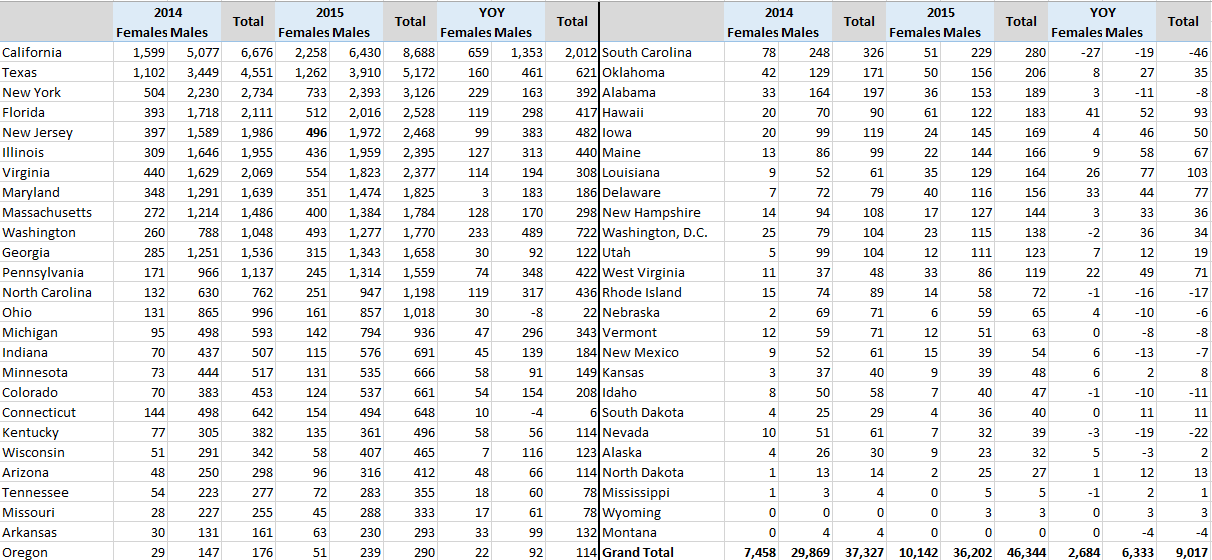
theodp writes: As President Obama was 'taught to code' last December, Politico reported that the $30 million tech-financed campaign to promote computer science education was a smash success. And indeed it has been, at least from a PR standpoint. But Code.org and its backers have long spun AP Computer Science test metrics as a true barometer of CS education success, and from that standpoint, things don't look quite so rosy. The College Board raved about "massive gains in AP Computer Science participation (25% growth) AND scores" in a June tweetstorm and at its July conference, where AP CS was declared the '2015 AP Subject of the Year.' But a look at the recently-released detail on 2015 AP CS scores shows wide differences in adoption and success along gender and ethnicity lines (Asian boys and girls, in particular, set themselves apart from other groups with 70%+ pass rates). And, for all the praise the NSF lavished on Code.org for 'its amazing marketing prowess', half of the states still had fewer than 300 AP CS test takers in 2015, and ten states actually saw year-over-year declines in the number of test takers (if my math is correct — scraped data, VBA code here). -
AP CS Test Takers and Pass Rates Up, Half of Kids Don't Get Sparse Arrays At All
theodp writes: Each June, the College Board tweets out teasers of the fuller breakouts of its Advanced Placement (AP) test results, which aren't made available until the fall. So, here's a roundup of this year's AP Computer Science tweetstorm: 1. "Wow — massive gains in AP Computer Science participation (25% growth) AND scores this year; big increase in % of students earning 4s & 5s!" 2. "2015 AP Computer Science scores: 5: 24.4%; 4: 24.6%; 3: 15.3%; 2: 7.1%; 1: 28.6%." [3 or above is passing] 3."Count them: a whopping 66 AP Computer Science students out of 50,000 worldwide earned all 80 pts possible on this year's exam." 4. "Remember that AP exam standards are equated from year to year, so when scores go up, it's a direct indication of increased student mastery." 5. "Many AP Computer Science students did very well on Q1 (2D array processing–diverse array); >20% earned all 9/9 pts" [2015 AP CS A Free-Response Questions] 6. "The major gap in this year's AP Computer Sci classrooms seems to be array list processing; Q3 (sparse array): 47% of students got 0/9 pts." -
Justified: Visual Basic Over Python For an Intro To Programming
theodp writes ICT/Computing teacher Ben Gristwood justifies his choice of Visual Basic as a programming language (as a gateway to other languages), sharing an email he sent to a parent who suggested VB was not as 'useful' as Python. "I understand the popularity at the moment of the Python," Gristwood wrote, "however this language is also based on the C language. When it comes to more complex constructs Python cannot do them and I would be forced to rely on C (which is incredibly complex for a junior developer) VB acts as the transition between the two and introduces the concepts without the difficult conventions required. Students in Python are not required to do things such as declare variables, which is something that is required for GCSE and A-Level exams." Since AP Computer Science debuted in 1984, it has transitioned from Pascal to C++ to Java. For the new AP Computer Science Principles course, which will debut in 2016, the College Board is leaving the choice of programming language(s) up to the teachers. So, if it was your call, what would be your choice for the Best Programming Language for High School? -
New AP Course, "Computer Science Principles," Aims To Make CS More Accessible
theodp writes: "CS Principles," explains the intro to a Microsoft Research talk on a new Computer Science Toolkit and Gaming Course, "is a new AP course being piloted across the country and by making it more accessible to students we can help increase diversity in computing." Towards this end, Microsoft has developed "a middle school computing toolkit, and a high school CS Principles & Games course." These two projects were "developed specifically for girls," explains Microsoft, and are part of the corporation's Big Dream Movement for girls, which is partnering with the UN, White House, NSF, EU Commission, and others. One of Microsoft's particular goals is to "reach every individual girl in her house." According to a document on its website, Microsoft Research's other plans for Bridging the Gender Gap in computing include a partnership with the University of Wisconsin "to create a girls-only computer science Massive Open Online Course (MOOC)." -
Despite Push From Tech Giants, AP CS Exam Counts Don't Budge Much In Most States
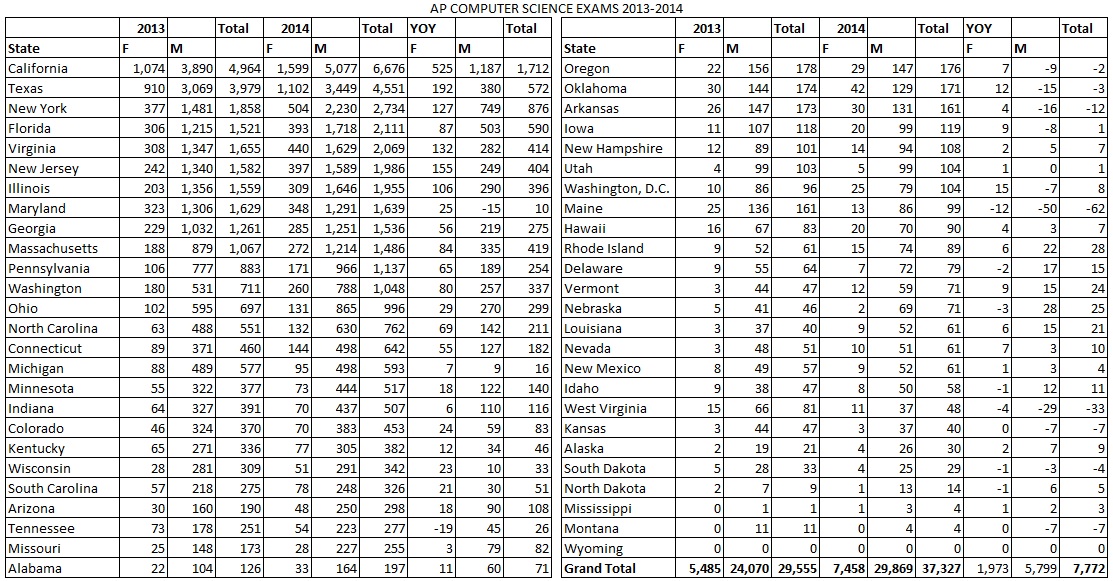
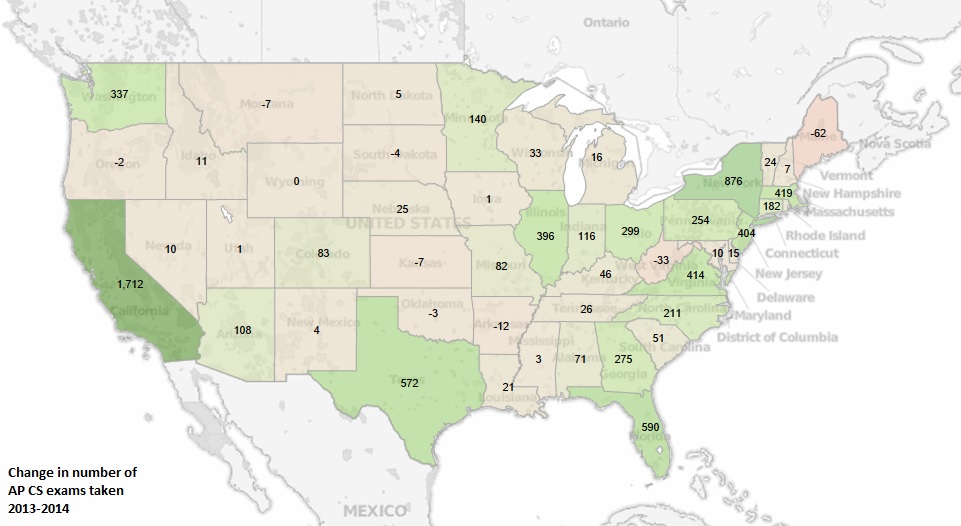
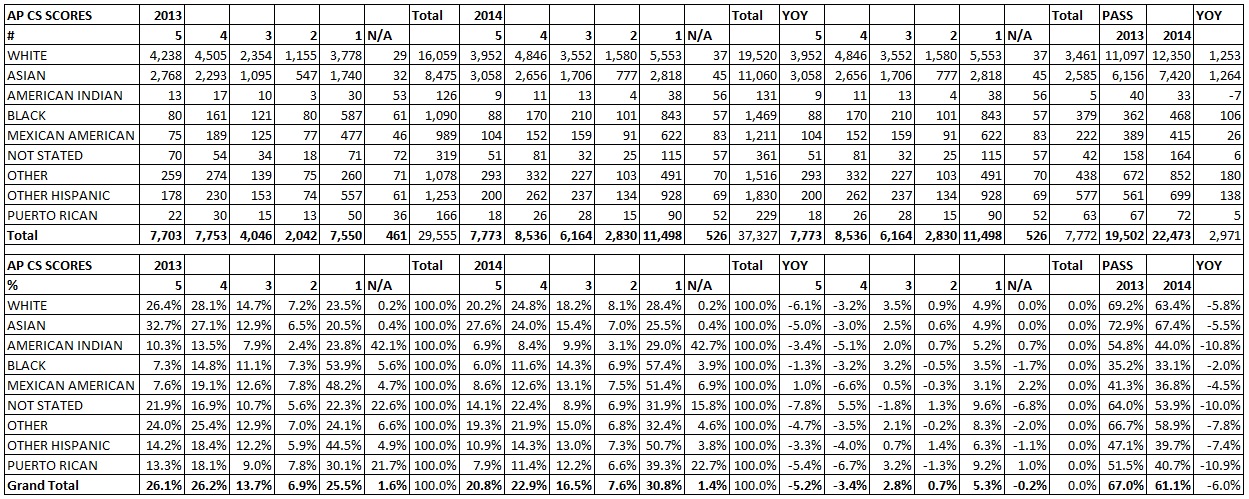
theodp (442580) writes "Well, the College Board has posted the 2014 AP Computer Science Test scores. So, before the press rushes out another set of Not-One-Girl-In-Wyoming-Took-an-AP-CS-Exam stories, let's point out that no Wyoming students of either gender took an AP CS exam again in 2014 (.xlsx). At the overall level, the final numbers have changed somewhat (back-of-the-Excel-envelope calculations, no warranty expressed or implied!), but tell pretty much the same story as the preliminary figures — the number of overall AP CS test takers increased, while pass rates decreased despite efforts to cherry pick students with a high likelihood of success. What is kind of surprising is how little the test numbers budged for most states — only 8 states managed to add more than 100 girls to the AP CS test taker rolls — despite the PR push by the tech giants, including Microsoft, Google, and, Facebook. Also worth noting are some big percentage decreases at the top end of the score segments (5 and 4), and still-way-too-wide gaps that exist between the score distributions of the College Board's various ethnic segments (more back of the envelope calcs). If there's a Data Scientist in the house, AP CS exam figures grabbed from the College Board's Excel 2013 and 2014 worksheets can be found here (Google Sheets) together with the (unwalkedthrough) VBA code that was used to collect it. Post your insight (and code/data fixes) in the comments!" -
Google: Teach Girls Coding, Get $2,500; Teach Boys, Get $0
theodp (442580) writes "'Public school teachers,' reads the headline at Khan Academy (KA), 'introduce your students to coding and earn $1000 or more for your classroom!' Read the fine print, however, and you'll see that the Google-bankrolled offer is likely to ensure that girls, not boys, are going to be their Computer Science teachers' pets. 'Google wants public high school students, especially girls, to discover the magic of coding,' KA explains to teachers. 'You'll receive a $100 DonorsChoose.org gift code for every female student who completes the [JS 101: Drawing & Animation] course. When 4 or more female students complete it, we'll email you an additional $500 gift code as a thank-you for helping your students learn to code.' While 'one teacher cannot have more than 20 of the $100 gift codes activated on their DonorsChoose.org projects,' adds KA, 'if the teacher has more than 20 female students complete the curriculum, s/he will still be sent gift codes, and the teacher can use the additional gift codes on another teacher's DonorsChoose.org project.' So, is girls-are-golden-boys-are-worthless funding for teachers' projects incongruent with Khan Academy's other initiatives, such as its exclusive partnership with CollegeBoard to eliminate inequality among students studying for the SAT?" -
Is the New "Common Core SAT" Bill Gates' Doing?
theodp writes "'I want to explain why Common Core is among the most important education ideas in years,' wrote Bill Gates in a USA Today op-ed last month that challenged the "dangerous misconceptions" of those who oppose the initiative (pretty confident for a guy who conceded there wasn't much to show for his earlier $5B education reform effort!). 'The Gates Foundation helped fund this process,' acknowledged Gates in quite an understatement of his influence. Receiving $6.5M in Gates Grants was Student Achievement Partners, whose founder David Coleman was dubbed the 'Architect of the Common Core.' So it's not too surprising that at last week's SXSWedu, Coleman — now President and CEO of The College Board (no stranger to Gates money itself) — announced a dramatic overhaul of the SAT that includes a new emphasis on evidence-based reading and writing and evidence analysis, which the AJC's Maureen Downey calls 'reflective of the approach of the Common Core State Standards.'" (Read more, below.) "And over at The Atlantic, Lindsey Tepe reports that the Common Core is driving the changes to the SAT. "Neither Coleman nor the national media," writes Tepe, "have really honed in on how the standards are driving the College Board-as well as the ACT-to change their product." In conjunction with the redesigned SAT, The College Board also announced it would exclusively team with Khan Academy (KA) to make comprehensive, best-in-class SAT prep materials open and free in an effort to level the playing field between those who can and can't afford test prep services. In a conversation with KA founder Sal Khan — aka Bill Gates' favorite teacher and a beneficiary of $10+ million in Gates Foundation grants (much earmarked for Common Core) — Coleman stressed that Khan Academy and CollegeBoard will be the only places in the world that students will be able to encounter free materials for the exam that are "focused on the core of the math and literacy that matters most." "There will be no other such partnerships", Coleman reiterated. Game, set, and match, Gates?" -
College Board To Rethink the SAT, Partner With Khan Academy
An anonymous reader writes "According to the NY Times, 'Saying its college admission exams do not focus enough on the important academic skills, the College Board announced on Wednesday a fundamental rethinking of the SAT, eliminating obligatory essays, ending the longstanding penalty for guessing wrong and cutting obscure vocabulary words. ... The SAT's rarefied vocabulary words will be replaced by words that are common in college courses, such as "empirical" and "synthesis." The math questions, now scattered widely across many topics, will focus more narrowly on linear equations, functions and proportional thinking. The use of a calculator will no longer be allowed on some of the math sections.' The College Board will also be working with Khan Academy to provide students with free, online practice problems and instructional videos. The new version of the SAT will be introduced in 2016." -
The Whole Story Behind Low AP CS Exam Stats
theodp writes "At first glance, the headline in The Salt Lake Tribune — Very Few Utah Girls, Minorities Take Computer Science AP Tests — appears to be pretty alarming. As does the headline No Girls, Blacks, or Hispanics Take AP Computer Science Exam in Some States over at Education Week. Not One Girl Took The AP Computer Science Test In Some States warns a Business Insider headline. And so on and so on and so on. So how could one quibble with tech-giant backed Code.org's decision to pay teachers a $250 "Female Student Bonus", or Google's declaration that 'the ultimate goal of CS First is to provide proven teaching materials, screencasts, and curricula for after-school programs that will ignite the interest and confidence of underrepresented minorities and girls in CS,' right? But the thing is, CollegeBoard AP CS exam records indicate that no Wyoming students at all took an AP CS exam (xls) in 2013, and only a total of 103 Utah students (xls) had reported scores. Let's not forget about the girls and underrepresented minorities, but since AP CS Exam Stats are being spun as a measure of CS education participation (pdf) and equity, let's not forget that pretty much everyone has been underrepresented if we look at the big AP CS picture. If only 29,555 AP CS scores were reported (xls) in 2013 for a HS population of about 16 million students, shouldn't the goal at this stage of the game really be CS education for all?" -
Code.org: More Money For CS Instructors Who Teach More Girls
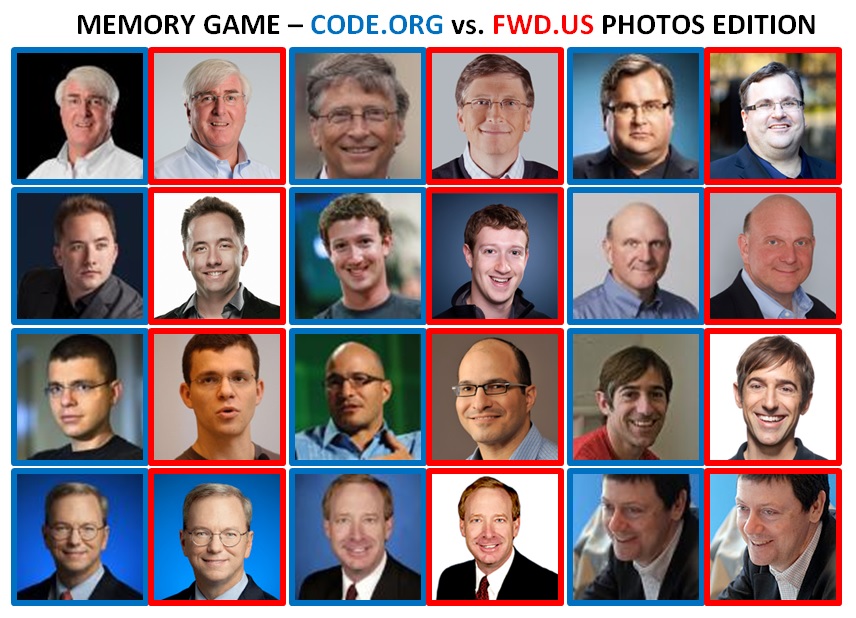
theodp writes "The same cast of billionaire characters — Mark Zuckerberg, Bill Gates, Steve Ballmer, Eric Schmidt — is backing FWD.us, which is lobbying Congress for more visas to 'meet our workforce needs,' as well as Code.org, which aims to popularize Computer Science education in the U.S. to address a projected CS job shortfall. In laying out the two-pronged strategy for the Senate, Microsoft General Counsel and Code.org Board member Brad Smith argued that providing more kids with a STEM education — particularly CS — was 'an issue of critical importance to our country.' But with its K-8 learn-to-code program which calls for teachers to receive 25% less money if fewer than 40% of their CS students are girls, Smith's Code.org is sending the message that training too many boys isn't an acceptable solution to the nation's CS crisis. 'When 10 or more students complete the course,' explains Code.org, "you will receive a $750 DonorsChoose.org gift code. If 40% or more of your participating students are female, you'll receive an additional $250, for a total gift of $1,000 in DonorsChoose.org funding!" The $1+ million Code.org-DonorsChoose CS education partnership appears to draw inspiration from a $5 million Google-DoonorsChoose STEM education partnership which includes nebulous conditions that disqualify schools from AP STEM funding if projected participation by female students in AP STEM programs is deemed insufficient. So, are Zuckerberg, Gates, Ballmer, and Schmidt walking-the-gender-diversity-talk at their own companies? Not according to the NY Times, which just reported that women still account for only about 25% of all employees at Code.org supporters Apple, Google, Facebook, and Microsoft. By the way, while not mentioning these specific programs, CNET reports that Slashdot owner Dice supports the STEM efforts of Code.org and Donors Choose." -
How Can New Programmers Contribute to Open Source?
DanPeng asks: "I'm an inexperienced programmer who has been following the Open Source movement for a few years now, and recently I've been looking for opportunities to write some code and contribute to an Open Source project. As a a senior in high school, I've taught myself C, C++, Perl, and a few other languages. I have a basic understanding of algorithms from AP Computer Science, and I've toyed with GNOME/GTK+ and *NIX programming. I lack, however, any 'real' programming experience writing code for projects of any great size or importance. How should a new developer contribute to Open Source?""I've worked with no more than one or two other people on programs of no more than a few thousand lines of code each. The 80 MB sources of Linux and the 160 MB sources of Mozilla seem to me these enormous morasses of code far too deep and intricately interconnected to wade through at all. Surely there must be thousands of similar students with basic programmming skills who want to help but are intimidated by the sheer enormity of even finding their place in hundreds of megabytes of source code. I would think that after the experience of a few projects, one would get the hang of it, but how can a new programmer get a foothold for that first experience? What kind of project should he be looking for?"