Slashdot Mirror
Domain: cornell.edu
Stories and comments across the archive that link to cornell.edu.
Stories · 225
-
Devin Nunes Faces an Uphill Battle in His Lawsuit Against Twitter (nbcnews.com)
Devin Nunes, R-Calif., escalated the feud between conservatives and Twitter earlier this week with a lawsuit accusing the company of defamation and negligence -- two different allegations, one of which poses a more serious question for the social media platform and technology companies in general. Nunes is claiming that Twitter negligently violated its terms of service when it allowed people onto its online "premises" to say false or disparaging things about him. He is seeking $250 million in damages due to "pain, insult, embarrassment, humiliation, emotional distress and mental suffering, and injury to [Nunes'] personal and professional reputations" brought on by what Twitter users said about him. From a report: Defamation is an interesting legal matter to discuss, at least in theory, but suing for defamation is seldom profitable in reality. Negligence may not sound as exciting as defamation, but this theory of liability quietly drives most successful civil litigation. Relatively easy to prove, it generally requires that the defendant show conduct that came up short of what can be expected, and that this shortcoming caused the plaintiff's damages. [...] The primary reason that technology companies are not sued into oblivion is the existence of the Communications Decency Act, or CDA, and in particular Section 230, which states that providers of an interactive computer service shall not be treated as the publisher or speaker of any information provided by another information content provider. Ordinarily, a lawsuit like this is properly filed against the Twitter user or account (like "Devin Nunes' Mom") and not Twitter itself.
Section 230 and the CDA have become the targets of growing backlash against the idea that technology companies should not be held responsible for what is published on their platforms. Technology companies have voluntarily taken steps to moderate some content, such as extremism, conspiracy theories and fake news, but most personal insults and parodies are still allowed to flourish. Section 230, however, isn't necessarily bulletproof. At least one federal court has stressed that the statute does not "create a lawless no-man's-land on the internet." That provides some basis for Nunes' claim that Twitter has been negligent in keeping its platform from being used to spread damaging statements about him. But a negligence claim against Twitter may still be precluded by the CDA. The test is whether the cause of action requires the court to treat Twitter as the publisher or speaker of content provided by another. In the meantime, one of the Twitter parody accounts that is mocking Nunes -- Devin Nunes' Cow (@DevinCow) -- has gained a lot of attention, with its followers count jumping from about 1200 followers last week to more than 615,000 followers -- and in doing so, surpassed the number of followers Devin Nunes has (about 399k). -
FBI Shuts Down 15 DDoS-For-Hire Sites (techcrunch.com)
The FBI has shut down the domains of 15 high-profile distributed denial-of-service (DDoS) websites. "Several seizure warrants granted by a California federal judge went into effect Thursday, removing several of these 'border' or 'stresser' sites off the internet 'as part of coordinated law enforcement action taken against illegal DDoS-for-hire services,'" reports TechCrunch. "The orders were granted under federal seizure laws, and the domains were replaced with a federal notice." From the report: Prosecutors have charged three men, Matthew Gatrel and Juan Martinez in California and David Bukoski in Alaska, with operating the sites, according to affidavits filed in three U.S. federal courts, which were unsealed Thursday. The FBI had assistance from the U.K.'s National Crime Agency and the Dutch national police, and the Justice Department named several companies, including Cloudflare, Flashpoint and Google, for providing authorities with additional assistance. In all, several sites were knocked offline -- including downthem.org, netstress.org, quantumstress.net, vbooter.org and defcon.pro and more -- which allowed would-be attackers to sign up to rent time and servers to launch large-scale bandwidth attacks against systems and servers. -
Cloudflare Under Fire For Allegedly Providing DDoS Protection For Terrorist Websites
Cloudflare is facing accusations that it's providing cybersecurity protection for at least seven terrorist organizations. "On Friday, HuffPost reported that it has reviewed numerous websites run by terrorist organizations and confirmed with four national security and counter-extremism experts that the sites are under the protection of Cloudflare's cybersecurity services," reports Gizmodo.
"Among Cloudflare's millions of customers are several groups that are on the State Department's list of foreign terrorist organizations, including al-Shabab, the Popular Front for the Liberation of Palestine, al-Quds Brigades, the Kurdistan Workers' Party (PKK), al-Aqsa Martyrs Brigade and Hamas -- as well as the Taliban, which, like the other groups, is sanctioned by the Treasury Department's Office of Foreign Assets Control (OFAC)," reports HuffPost.
"In the United States, it's a crime to knowingly provide tangible or intangible 'material support -- including communications equipment -- to a designated foreign terrorist organization or to provide service to an OFAC-sanctioned entity without special permission," the report continues. "Cloudflare, which is not authorized by the OFAC to do business with such organizations, has been informed on multiple occasions, dating back to at least 2012, that it is shielding terrorist groups behind its network, and it continues to do so." Gizmodo reports: The issue that HuffPost raises is whether Cloudflare is providing "material support" to sanctioned organizations. Some attorneys told HuffPost that it may be in violation of the law. Others, like the Electronic Frontier Foundation, argue that "material support" can and has been abused to silence speech. Cloudflare's general counsel, Doug Kramer, told Gizmodo over the phone that the company works closely with the U.S. government to ensure that it meets all of its legal obligations. He said that it is "proactive to screen for sanctioned groups and reactive to respond when its made aware of a sanctioned group" to which it may be providing services. HuffPost spoke with representatives from the Counter Extremism Project, who expressed frustration that they've sent four letters to Cloudflare over the last two years identifying seven terrorist-operated sites without receiving a reply. Kramer would not address any specific customers or situations when speaking with Gizmodo. He said that's simply company policy for reasons of protecting privacy. -
Experimental Android App Determines Alertness By Examining Eyes (newatlas.com)
An experimental new Android app developed by a team at Cornell University is designed to determine a person's alertness by examining their eyes. The app, called AlertnessScanner, utilizes a smartphone's front-facing camera to gauge the size of users' pupils. "When we're in an alert state, our sympathetic nervous system causes our pupils to dilate so that we can take in information more easily," reports New Atlas. "On the other hand, when we're tired, our parasympathetic nervous system causes our pupils to contract." From the report: In an initial study, test subjects were prompted to use the app to manually take photos of their pupils, once every three hours. Additionally, six times a day they completed a five-minute phone-based Psychomotor Vigilance Test (PVT), which is an established method of gauging reaction time. When the results of the two alertness-testing methods were compared, they were found to be very similar. That said, it was determined that most people wouldn't like having to make a point of using the app so many times every day. Additionally, in order to properly image the test subjects' pupils, the infrared filters of the phones' cameras had to be removed. The researchers managed to address these problems by changing it so that the app automatically takes a one-second-long burst of 30 pupil photos whenever users unlock their phones; and using a larger 13-megapixel front-facing camera. -
Experimental Android App Determines Alertness By Examining Eyes (newatlas.com)
An experimental new Android app developed by a team at Cornell University is designed to determine a person's alertness by examining their eyes. The app, called AlertnessScanner, utilizes a smartphone's front-facing camera to gauge the size of users' pupils. "When we're in an alert state, our sympathetic nervous system causes our pupils to dilate so that we can take in information more easily," reports New Atlas. "On the other hand, when we're tired, our parasympathetic nervous system causes our pupils to contract." From the report: In an initial study, test subjects were prompted to use the app to manually take photos of their pupils, once every three hours. Additionally, six times a day they completed a five-minute phone-based Psychomotor Vigilance Test (PVT), which is an established method of gauging reaction time. When the results of the two alertness-testing methods were compared, they were found to be very similar. That said, it was determined that most people wouldn't like having to make a point of using the app so many times every day. Additionally, in order to properly image the test subjects' pupils, the infrared filters of the phones' cameras had to be removed. The researchers managed to address these problems by changing it so that the app automatically takes a one-second-long burst of 30 pupil photos whenever users unlock their phones; and using a larger 13-megapixel front-facing camera. -
45 Out of 50 Electronics Companies Illegally Void Warranties After Independent Repair, Sting Operation Finds (vice.com)
U.S. PIRG -- a non-profit that uses grassroots methods to advocate for political change -- found that 90 percent of manufacturers it contacted claimed that a third party repair would void its warranty. "PIRG researched the warranty information of 50 companies in the Association of Home Appliance Manufacturers (AHAM) -- an industry group of notorious for lobbying to protect is repair monopolies -- and found that 45 of them claimed independent repair would void their warranty," Motherboard reports. From the report: PIRG poured over the documentation for 50 companies such as Bissell, Whirlpool, and Panasonic to document their warranty policies. When it couldn't find clear language about warranty and repair, it reached out to the companies via their customer service lines. The overwhelming majority of the companies told PIRG that independent repair would void the warranty.
The 1975 Magnuson-Moss Warranty Act states that no manufacturer who charges more than $5 for a product can put repair restrictions on a product they're offering a warranty on. In May, the U.S. Federal Trade Commission sent warning letters to Sony, Microsoft, Nintendo, HTC, Hyundai, and ASUS for violating the act by threatening to void the warranties of customers who repaired their own devices. Within 30 days, many of the companies had complied and changed the language on their websites around independent repair. It was a step in the right direction, but the PIRGs survey of the AHAM members shows that there's still a lot of work to do. -
FTC Warns Manufacturers That 'Warranty Void If Removed' Stickers Break the Law (vice.com)
schwit1 writes: The Federal Trade Commission put six companies on notice today, telling them in a warning letter that their warranty practices violate federal law. If you buy a car with a warranty, take it a repair shop to fix it, then have to return the car to the manufacturer, the car company isn't legally allowed to deny the return because you took your car to another shop. The same is true of any consumer device that costs more than $15, though many manufacturers want you to think otherwise.
Companies such as Sony and Microsoft pepper the edges of their game consoles with warning labels telling customers that breaking the seal voids the warranty. That's illegal. Thanks to the 1975 Magnuson-Moss Warranty Act, no manufacturer is allowed to put repair restrictions on a device it offers a warranty on. Dozens of companies do it anyway, and the FTC has put them on notice. Apple, meanwhile, routinely tells customers not to use third party repair companies, and aftermarket parts regularly break iPhones due to software updates. -
UK Wants To Criminalize Re-Identification of Anonymized User Data (bleepingcomputer.com)
An anonymous reader writes: European countries are currently implementing new data protection laws. Recently, despite leaving the European Union, the United Kingdom has expressed intent to implement the law called General Data Protection Regulation. As an extension, the UK wants to to ban re-identification (with a penalty of unlimited fines), the method of reversing anonymization, or pointing out the weakness of the used anonymisation process. One famous example was research re-identifying Netflix users from published datasets. By banning re-identification, UK follows the lead of Australia which is considering enacting similarly controversial law that can lead to making privacy research difficult or impossible. Privacy researchers express concerns about the effectiveness of the law that could even complicate security, a view shared by privacy advocates. -
Hacking Victim Can't Sue Foreign Government For Hacking Him On US Soil, Says Court (vice.com)
According to Motherboard, a court of appeals in Washington D.C. ruled that an American citizen can't sue the Ethiopian government for hacking into his computer and monitoring him with spyware. "The decision on Tuesday is a blow to anti-surveillance and digital rights activists who were hoping to establish an important precedent in a widely documented case of illegitimate government-sponsored hacking." From the report: In late 2012, the Ethiopian government allegedly hacked the victim, an Ethiopian-born man who goes by the pseudonym Kidane for fear for government reprisals. Ethiopian government spies from the Information Network Security Agency (INSA) allegedly used software known as FinSpy to break into Kidane's computer, and secretly record his Skype conversations and steal his emails. FinSpy was made by the infamous FinFisher, a company that has sold malware to several governments around the world, according to researchers at Citizen Lab, a digital watchdog group at the University of Toronto's Munk School of Global Affairs, who studied the malware that infected Kidane's computer. The U.S. Court of Appeals for the District of Columbia Circuit ruled that Kidane didn't have jurisdiction to sue the Ethiopian government in the United States. Kidane and his lawyers invoked an exception to the Foreign Sovereign Immunities Act (FSIA), which says foreign governments can be sued in the U.S. as long as the entire tort on which the lawsuit is based occurred on American soil. According to the court, however, the hacking in this case didn't occur entirely in the U.S. "Ethiopia's placement of the FinSpy virus on Kidane's computer, although completed in the United States when Kidane opened the infected email attachment, began outside the United States," the decision read. "[It] gives foreign governments carte blanche to do whatever they want to Americans in America so long as they do it by remote control," Nate Cardozo, a staff attorney at the Electronic Frontier Foundation, a digital rights group who represented Kidane in this first-of-its-kind lawsuit, told Motherboard. -
VidAngel Keeps Streaming Videos, Defying Movie Studios and a US Judge (deseretnews.com)
The Deseret News reports that Hollywood studios "aren't happy with VidAngel, saying in a statement Wednesday that the Utah-based streaming service 'continues to illegally stream our content without a license and is expanding its infringement by adding new titles' despite a judge's recent injunction." Or, as VidAngel explains on their blog, "We say we're legal. Disney says we're pirates." Long-time Slashdot reader goombah99 writes: VidAngel...will edit any major movie of objectionable content exactly as you request (and no more than you request), then stream it to you for $1. Such bowdlerizing and DVD streaming services are expressly written into section 110 of Title 17, the copyright act (paragraph 11 added in the 2005 Family Viewing act). Therefore both aspects that the studios are suing over, the streaming of a DVD and the editing of it by a third party, is plainly legal... There's a petition to save this act from encroachment [signed by more than 30,000 families].
In just five days in October, VidAngel raised $10.1 million in a "mini-IPO" -- reportedly the fastest one ever -- to fund their ongoing fight against the movie studios. VidAngel CEO Neal Harmon says "We'll take this all the way to the Supreme Court if necessary. We're happy to pay more. We're happy to rent more. We're happy to pay the prices the studios want us to pay. Just give us filtering." -
EFF: The Music Industry Shouldn't Be Able To Cut Off Your Internet Access (eff.org)
An anonymous reader quotes a report from Electronic Frontier Foundation: No one should have to fear losing their internet connection because of unfounded accusations. But some rights holders want to use copyright law to force your Internet service provider (ISP) to cut off your access whenever they say so, and in a case the Washington Post called "the copyright case that should worry all Internet providers," they're hoping the courts will help them. We first wrote about this case -- BMG v. Cox Communications -- when it was filed back in 2014, and last month, EFF, Public Knowledge (PK), and the Center for Democracy and Technology (CDT) urged the Court of Appeals for the Fourth Circuit to overturn a ruling that ISP Cox Communications was liable for copyright infringement. EFF, PK and CDT advised the court to consider the importance of Internet access in daily life in determining when copyright law requires an ISP to cut off someone's Internet subscription. The case turns in part on a provision in copyright law that gives internet intermediaries a safe harbor -- legal protection against some copyright infringement lawsuits -- provided they follow certain procedures. Online platforms like Facebook and YouTube, along with other internet intermediaries, have to "reasonably implement" a policy for terminating "subscribers and account holders" that are "repeat infringers" in "appropriate circumstances." But given the importance of Internet access, the circumstances where it's appropriate to cut off a home Internet subscription entirely are few and far between. The law as written is flexible enough that providers can design and implement policies that make sense for the nature of their service and their subscribers' circumstances. A repeat infringer policy for the company that provides your link to the Internet as a whole should take into account the essential nature of internet access and the severe harm caused by disconnection. But music publisher BMG wants to use this provision to force ISPs to become tougher enforcers of copyright law. According to BMG, ISPs should be required both to forward rights holders' threatening demand letters to their subscribers and terminate a subscriber's Internet access whenever rights holders allege that person has repeatedly violated copyright law. A subscriber is a "repeat infringer" and subject to termination, they argue, whenever they say so. Cox's appeal of the ruling raises two very important issues: (1) Who should be considered a "repeat infringer" who should be cut off from the Internet, and (2) whether ISPs must either cede to rights holders' demands or monitor their subscribers' internet habits to avoid liability. Slashdot reader waspleg adds: Two landmark Supreme Court cases, Metro-Goldwyn-Mayer Studios Inc. v. Grokster, Ltd., and Sony Corp. of America v. Universal Studios made clear that if a service is capable of significant lawful uses, and the provider doesn't actively encourage users to commit copyright infringement, the provider shouldn't be held responsible when someone nonetheless uses the service unlawfully. -
EFF: The Music Industry Shouldn't Be Able To Cut Off Your Internet Access (eff.org)
An anonymous reader quotes a report from Electronic Frontier Foundation: No one should have to fear losing their internet connection because of unfounded accusations. But some rights holders want to use copyright law to force your Internet service provider (ISP) to cut off your access whenever they say so, and in a case the Washington Post called "the copyright case that should worry all Internet providers," they're hoping the courts will help them. We first wrote about this case -- BMG v. Cox Communications -- when it was filed back in 2014, and last month, EFF, Public Knowledge (PK), and the Center for Democracy and Technology (CDT) urged the Court of Appeals for the Fourth Circuit to overturn a ruling that ISP Cox Communications was liable for copyright infringement. EFF, PK and CDT advised the court to consider the importance of Internet access in daily life in determining when copyright law requires an ISP to cut off someone's Internet subscription. The case turns in part on a provision in copyright law that gives internet intermediaries a safe harbor -- legal protection against some copyright infringement lawsuits -- provided they follow certain procedures. Online platforms like Facebook and YouTube, along with other internet intermediaries, have to "reasonably implement" a policy for terminating "subscribers and account holders" that are "repeat infringers" in "appropriate circumstances." But given the importance of Internet access, the circumstances where it's appropriate to cut off a home Internet subscription entirely are few and far between. The law as written is flexible enough that providers can design and implement policies that make sense for the nature of their service and their subscribers' circumstances. A repeat infringer policy for the company that provides your link to the Internet as a whole should take into account the essential nature of internet access and the severe harm caused by disconnection. But music publisher BMG wants to use this provision to force ISPs to become tougher enforcers of copyright law. According to BMG, ISPs should be required both to forward rights holders' threatening demand letters to their subscribers and terminate a subscriber's Internet access whenever rights holders allege that person has repeatedly violated copyright law. A subscriber is a "repeat infringer" and subject to termination, they argue, whenever they say so. Cox's appeal of the ruling raises two very important issues: (1) Who should be considered a "repeat infringer" who should be cut off from the Internet, and (2) whether ISPs must either cede to rights holders' demands or monitor their subscribers' internet habits to avoid liability. Slashdot reader waspleg adds: Two landmark Supreme Court cases, Metro-Goldwyn-Mayer Studios Inc. v. Grokster, Ltd., and Sony Corp. of America v. Universal Studios made clear that if a service is capable of significant lawful uses, and the provider doesn't actively encourage users to commit copyright infringement, the provider shouldn't be held responsible when someone nonetheless uses the service unlawfully. -
Every US Taxpayer Has Effectively Paid Apple At Least $6 in Recent Years (arstechnica.com)
An anonymous reader shares an ArsTechnica report: Apple has received at least $6 per American taxpayer over the last five years in the form of interest payments on billions' worth of United States Treasury bonds, according to a report by Bloomberg. Citing Apple's regulatory filings and unnamed sources, the business publication found "the Treasury Department paid Apple at least $600 million and possibly much more over the past five years in the form of interest." By taking advantage of a provision in the American tax code, Bloomberg says that Apple has "stashed much of its foreign earnings -- tax-free -- right here in the US, in part by purchasing government bonds." As The Wall Street Journal reported in September, American companies are believed to be holding approximately $2 trillion in cash overseas that is shielded from US taxes. Under American law, companies must pay a 35-percent corporate tax rate on global profits when that money is brought home -- so there is an incentive to keep as much of that money overseas as possible. -
Facebook Lets Advertisers Exclude Users By Race (propublica.org)
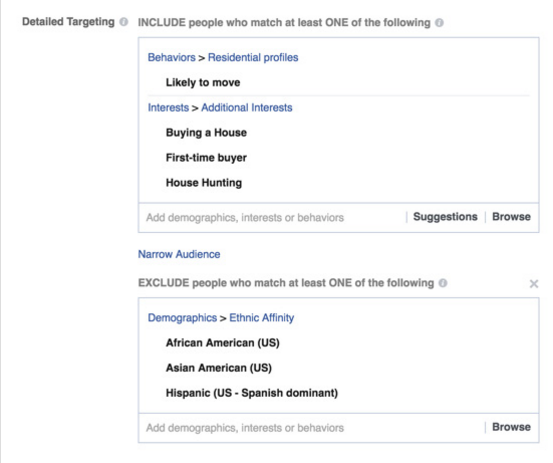
schwit1 quotes a report from ProPublica: Imagine if, during the Jim Crow era, a newspaper offered advertisers the option of placing ads only in copies that went to white readers. That's basically what Facebook is doing nowadays. The ubiquitous social network not only allows advertisers to target users by their interests or background, it also gives advertisers the ability to exclude specific groups it calls "Ethnic Affinities." Ads that exclude people based on race, gender and other sensitive factors are prohibited by federal law in housing and employment. You can view a screenshot of a housing advertisement that ProPublica's Julia Angwin and Terry Parris Jr. purchased from Facebook's self-service advertising portal here. The report adds: "The ad we purchased was targeted to Facebook members who were house hunting and excluded anyone with an "affinity" for African-American, Asian-American or Hispanic people. (Here's the ad itself.) The Fair Housing Act of 1968 makes it illegal "to make, print, or publish, or cause to be made, printed, or published any notice, statement, or advertisement, with respect to the sale or rental of a dwelling that indicates any preference, limitation, or discrimination based on race, color, religion, sex, handicap, familial status, or national origin." Violators can face tens of thousands of dollars in fines. The Civil Rights Act of 1964 also prohibits the "printing or publication of notices or advertisements indicating prohibited preference, limitation, specification or discrimination" in employment recruitment. Facebook's business model is based on allowing advertisers to target specific groups -- or, apparently to exclude specific groups -- using huge reams of personal data the company has collected about its users. Facebook's micro-targeting is particularly helpful for advertisers looking to reach niche audiences, such as swing-state voters concerned about climate change. Facebook says its policies prohibit advertisers from using the targeting options for discrimination, harassment, disparagement or predatory advertising practices. -
US Beekeepers Fear For Livelihoods As Anti-Zika Toxin Kills 2.5M Bees (theguardian.com)
A new report suggests that an insecticide sprayed from airplanes to kill mosquitos carrying the Zika virus may in fact be killing bees, since the "fine mist" is "beaded with neurotoxin." Earlier this week, one beekeeper posted a video showing thousands of dead bees heaped around hives. Meanwhile, South Carolina hobbyist Andrew Mache wrote in another Facebook post that he had lost "thousands upon thousands of bees" and that the spraying had devastated his business. The Guardian reports: "The program head, Dr Mike Weyman, said that though South Carolina has strict rules about protecting pollinators, country officials were using the neurotoxin, Naled, under a clause exempting them in a 'clear and public health crisis.' South Carolina's protocol for Zika infections is to alert local officials of a carrier's residence, which they 'consider a ground zero,' Weman said. Local authorities then target the local mosquitos in a 200-yard radius, in this case with spray. Experts at the Centers for Disease Control and Prevention (CDC), the Environmental Protection Agency (EPA) and independent universities say Naled is far safer than other chemicals. It breaks down rapidly and, in the very low doses at which it is prescribed, should not pose a risk to humans. 'In Louisiana, we use these products quite frequently to reduce mosquitos, but we don't see many non-target effects, because the doses are really small,' said Dr Kirsten Healy, a public health entomologist at Louisiana State University. 'A lot of people don't realize that we always have the environment in mind. We try to have products that have the lowest possible impact.'" The report adds that bees and other pollinators "contribute an estimated $29 billion to farm income" around the U.S. -
Companies Can't Legally Void the Warranty For Jailbreaking Or Rooting Your Phone (vice.com)
Reader Jason Koebler writes: Manufacturers that threaten to void the warranties of consumers who jailbreak or root their phones are violating federal law.
Under the Magnuson-Moss Warranty Act of 1975, manufacturers cannot legally void your hardware warranty simply because you altered the software of an electronic device. In order to void the warranty without violating federal law, the manufacturer must prove that the modifications you made directly led to a hardware malfunction.
"They have to show that the jailbreak caused the failure. If yes, they can void your claim (not your whole warranty—just the things which flowed from your mod)," Steve Lehto, a lemon law attorney in Michigan, wrote in an email. "If not, then they can't." -
Pop Star Tells Fans To Send Their Twitter Passwords, But It Might Be Illegal (arstechnica.com)
Cyrus Farivar, reporting for Ars Technica: As a new way to connect with his fans, Jack Johnson -- one half of the pop-rap duo Jack & Jack, not to be confused with the laid back Hawaiian singer-songwriter of the same name -- has spent the last month soliciting social media passwords. Using the hashtag #HackedByJohnson, the performer has tweeted at his fans to send him their passwords. (Why he didn't go for the shorter and catchier #JackHack, we'll never know.) Then, Johnson posts under his fans' Twitter accounts, leaving a short personalized message, as them. While Johnson and his fans likely find this password sharing silly and innocuous, legal experts say that Jack Johnson, 20, may be opening himself up to civil or criminal liability under the Computer Fraud and Abuse Act, a notorious anti-hacking statute that dates back to the 1980s. "While the entertainer in question likely considers this password collection to be a harmless personalized promotional activity, there may indeed be legal implication of both the fans' and the entertainer's conduct," Andrea Matwyshyn, a law professor at Northeastern University, told Ars. -
Congress Is Trying To Expand The Patriot Act (rare.us)
An anonymous reader writes: The house is scheduled to vote in an hour or so on expanding provisions of the patriot act, allowing massive financial information sharing to include dozens of new offenses ("specified unlawful activities"), including the Computer Fraud and Abuse Act. The house bill is H.R. 5606. My quick read is that this essentially lets FEDGOV expand massive semi-secret databases of financial transactions without a warrant while protecting banks from liability for helping them. In 5 years from 2002-2007, for example, with a smaller ability this led to 35,000 suspects but there were only 21 search warrants. Call your representative. Rare.us reports: "The proposed bill, H.R. 5606, expands Section 314 of the Patriot Act to cover non-terrorism or money laundering related investigations. Critics claim that the bill is a threat to the privacy of innocent Americans and is being rammed through Congress without debate. Section 314 encourages law enforcement to share information with financial institutions on money laundering and terrorism. It also encourages financial institutions to share information with each other." The report says the House Liberty Caucus, led by Congressman Justin Amash (R-Mich.), opposes the bill, claiming that Treasury Department regulations will compromise the privacy of Americans as it will all but mandate financial institutions to share information with the government. The caucus also opposes the bill because it is being brought to the floor under a suspension of the rules, and is not being considered under "regular order." The bill's sponsor, Congressman Robert Pittenger (R-NC) described HR 5606 as an attempt "to stop the flow of illicit dollars to criminals and terror organizations." -
How Sony, Microsoft, and Other Gadget Makers Violate Federal Warranty Law (vice.com)
Reader citadrianne shares a Motherboard article: There are big "no trespassing" signs affixed to most of our electronics. If you own a gaming console, laptop, or computer, it's likely you've seen one of these warnings in the form of a sticker placed over a screw or a seam: "Warranty void if removed." In addition, big manufacturers such as Sony, Microsoft, and Apple explicitly note or imply in their official agreements that their year-long manufacturer warranties -- which entitle you to a replacement or repair if your device is defective -- are void if consumers attempt to repair their gadgets or take them to a third party repair professional. What almost no one knows is that these stickers and clauses are illegal under a federal law passed in 1975 called the Magnuson-Moss Warranty Act . To be clear, federal law says you can open your electronics without voiding the warranty, regardless of what the language of that warranty says. -
Alien Contact Unlikely For Another 1,500 Years, Says Study (msn.com)
An anonymous reader writes: Astronomers at Cornell University predict based off estimates that alien contact is unlikely for another 1,500 years. MSN reports: "According to the astronomers, signals from Earth would need to reach half of all the solar systems in the Milky Way in order to be picked up by an intelligent life form. Given that signals from TV and radio were first sent into space as a byproduct of broadcasting 80 years ago, it will take around 1,500 more years for aliens to receive, decode and respond to the signals." A co-author of the paper who will present it at the American Astronomical Society's meeting on June 16, Evan Solomonides, said, "We haven't heard from aliens yet, as space is a big place -- but that doesn't mean no one is out there. It's possible to hear any time at all, but it becomes likely we will have heard around 1,500 years from now. Until then, it is possible that we appear to be alone -- even if we are not. But if we stop listening or looking, we may miss the signals. So we should keep looking." Stephen Hawking and Russian entrepreneur Yuri Milner announced a $100 million research program in April to send robotic probes the size of postage stamps to nearby stars within a generation. -
Feds Used 1789 Law To Force Apple, Google To Unlock Phones 63 Times (arstechnica.com)
An anonymous reader writes: The FBI has been citing a 1789 law, the All Writs Act, to compel Apple to assist the authorities in unlocking the iPhone 5c belonging to San Bernardino killer, Syed Farook. The law allows for judges to issue orders for people or companies to do something despite Congress not passing laws to cover specific instances. According to the Civil Liberties Union, the U.S. government has cited the All Writs Act in 63 cases since 2008 to compel Apple or Google to assist in accessing data stored on an iPhone or Android device. Most of the orders involved Apple. "To the extent we know about the underlying facts, these cases predominantly arise out of investigations into drug crimes," said Eliza Sweren-Becker, an ACLU attorney. -
FCC Fines Another Large Firm For Blocking WiFi
AmiMoJo writes: Another company is learning about the fine points of Section 333 of the Communications Act, which prohibits willful interference with any licensed or authorized radio communications. This time, M.C. Dean, who provided the Baltimore Convention Center's in-house WiFi service, were caught by the FCC sending deauthentication frames to prevent hotspot users maintaining a connection. The complainant alleged that M.C. Dean's actions were identical to those that had earned Marriott a $600,000 fine only weeks earlier. -
'Zeno Effect' Verified: Atoms Won't Move While You Watch (cornell.edu)
An anonymous reader writes: One of the oddest predictions of quantum theory – that a system can't change while you're watching it – has been confirmed in an experiment by Cornell physicists. Graduate students Yogesh Patil and Srivatsan Chakram created and cooled a gas of about a billion Rubidium atoms inside a vacuum chamber and suspended the mass between laser beams (abstract).
In that state the atoms arrange in an orderly lattice just as they would in a crystalline solid. But at such low temperatures the atoms can "tunnel" from place to place in the lattice. The famous Heisenberg uncertainty principle says that position and velocity of a particle are related and cannot be simultaneously measured precisely.
The researchers observed the atoms under a microscope by illuminating them with a separate imaging laser. A light microscope can't see individual atoms, but the imaging laser causes them to fluoresce, and the microscope captured the flashes of light. When the imaging laser was off, or turned on only dimly, the atoms tunneled freely. But as the imaging beam was made brighter and measurements made more frequently, the tunneling reduced dramatically. -
Law Professor: Genetic Engineering Is (Probably) Protected By the First Amendment
Jason Koebler writes: The dawn of cheap genome editing techniques such as CRISPR understandably have people across the political spectrum worried about what a future of designer babies, more pathogenic viruses, deextincted species, clones, and glow-in-the-dark sushi might look like. But does putting limits on genetic engineering violate scientists' constitutional rights? The First Amendment has been interpreted by the Supreme Court to encompass not just the freedom of speech, but also the freedom of expression and expressive conduct, which likely includes acts of science, according to Alta Charo, a bioethicist and law professor at University of Wisconsin Law School, who says that science is inherently political. -
CNN and CBC Sued For Pirating YouTube Video
vivaoporto sends word that in a rare case of an individual taking on large corporations for copyright infrigement, a New York man has sued news networks CNN and CBC after they took a video of his from YouTube and broadcast it on the air without licensing it. His video shows a winter storm in Buffalo generating huge amounts of lake effect snow. The man, Alfonzo Cutaia, decided to enable monetization on his video, selecting the "Standard YouTube License," "a worldwide, non-exclusive, royalty-free, sublicenseable and transferable license to use, reproduce, distribute, prepare derivative works of [the video]. All other rights are reserved to the copyright owner and standard copyright laws and exceptions apply." Cutaia says the CBC used his video with their logo on it. The CBC confirmed this, and said they received a 10-day license from CNN, who had no legal right to do so. His lawsuit now accuses them both of "intentional and willful" copyright infringement. -
Supreme Court Overturns Conviction For Man Who Posted 'Threatening' Messages On Facebook
schwit1 sends news that the U.S. Supreme Court has ruled 7-2 in favor of Anthony Elonis, a man who wrote a series of angry messages on Facebook. The posts included quotes from rap lyrics containing "violent imagery," and were directed at Elonis's wife, his co-workers, law enforcement, and a kindergarten class. Elonis was charged and convicted under a federal statute that outlaws "any communication containing any threat to kidnap any person or any threat to injure the person of another." The jury in his case was told the standard for judging such a threat was whether a "reasonable person" would interpret it as such. According to the Court's ruling (PDF), that standard was not enough to convict him. They call it "a standard feature of civil liability in tort law inconsistent with the conventional criminal conduct requirement of 'awareness of some wrongdoing.'" The case is notable for being the first Supreme Court ruling about free speech on social media, but the ruling itself was quite narrow. -
US NAVY Sonar/Lidar Editing Software Released To the World
New submitter PFMABE writes The Naval Oceanographic Office (NAVO) has spent 16 years developing the Pure File Magic Area Based Editor (PFMABE) software suite to edit the huge volumes of lidar and sonar data they collect every year. In accordance with 17 USC 105, copyright protection is not available to any work of the US government. Originally developed to run on RedHat OS with network distributed storage, it has been migrated to Windows 7. This software, and accompanying source code (Win & Linux), has been released to the public domain at pfmabe.software, free for download with registration. -
Canadian Supreme Court Rules In Favor of Warrantless Cellphone Searches
An anonymous reader writes In a surprising decision, a split Supreme Court of Canada ruled this morning that police can search cellphones without a warrant incident to an arrest. The majority established some conditions, but ultimately ruled that it could navigate the privacy balance by establishing some safeguards with the practice. Michael Geist notes that a strongly worded dissent disagreed, emphasizing the privacy implications of access to cellphones and the need for judicial pre-authorization as the best method of addressing the privacy implications. The U.S. Supreme Court's June 2014 decision in Riley addressed similar issues and ruled that a warrant is needed to search a phone. -
Be True To Your CS School: LinkedIn Ranks US Schools For Job-Seeking Programmers
theodp writes "The Motley Fool reports that the Data Scientists at LinkedIn have been playing with their Big Data, ranking schools based on how successful recent grads have been at landing desirable software development jobs. Here's their Top 25: CMU, Caltech, Cornell, MIT, Princeton, Berkeley, Univ. of Washington, Duke, Michigan, Stanford, UCLA, Illinois, UT Austin, Brown, UCSD, Harvard, Rice, Penn, Univ. of Arizona, Harvey Mudd, UT Dallas, San Jose State, USC, Washington University, RIT. There's also a shorter list for the best schools for software developers at startups, which draws a dozen schools from the previously mentioned schools, and adds Columbia, Univ. of Virginia, and Univ. of Maryland College Park. If you're in a position to actually hire new graduates, how much do you care about applicants' alma maters? -
Diners Tend To Eat More If Their Companions Are Overweight
BarbaraHudson writes: A University of Illinois study (abstract) that shows that people tend to eat more in the presence of an overweight person. From the article: "The test involved a sample of 82 college coeds who were observed helping themselves to a simple pasta and salad meal. Each of the coeds were themselves of normal weight. The students first required to watch what they believed was a fat woman serving herself some of the food. The fat woman was actually an actress wearing a fat suit.
After observing the "corpulent" woman serve herself, the students were allowed to come forward and serve themselves pasta and salad. On average, the coeds each served themselves more pasta than the "fat" woman had selected while taking less salad than she did. When the same study was performed with the actress appearing sans the fat suit, researchers observed that students ended up eating more salad than pasta. The conclusion was simple: people may consume more unhealthy food and eat less healthy food when in the presence of an overweight person." As anyone on a diet will tell you, a waist is a terrible thing to mind. Weight control is a lot more complex than the article makes it seem, though some will welcome the opportunity to blame someone else. -
Why the FCC Is Likely To Ignore Net Neutrality Comments and Listen To ISPs
Jason Koebler writes: Time and time again, federal agencies like the FCC ignore what the public says it wants and side with the parties actually being regulated — the ISPs, in this case. Research and past example prove that there's not much that can be considered democratic about the public comment period or its aftermath. "Typically, there are a score or so of lengthy comments that include extensive data, analysis, and arguments. Courts require agencies to respond to comments of that type, and they sometimes persuade an agency to take an action that differs from its proposal," Richard Pierce, a George Washington University regulatory law professor said. "Those comments invariably come from companies with hundreds of millions or billions of dollars at stake or the lawyers and trade associations that represent them. Those are the only comments that have any chance of persuading an agency." -
Type Ia Supernovae As Not-Quite-So-Standard Cosmological Candles
Shag writes "Type Ia supernovae are used as cosmological 'standard candles' to measure distance because of their strong similarity to one another. This has made possible, for example, the research into universal expansion that led to the Nobel-winning discovery of 'dark energy.' For years, astrophysicists believed white dwarves exploded when they accreted enough mass from companion stars to reach a limit of 1.38 times the mass of our Sun. A decade ago, the 'Champagne supernova' (SN 2003fg) was so bright astrophysicists concluded the limit had been exceeded by two white dwarves colliding. Now a new paper (PDF) from the Nearby Supernova Factory collaboration suggests that type Ia supernovae occur at a wider range of stellar masses. Fortunately, there appears to be a calculable correlation between mass and light-curve width, so they can still fill the 'standard candle' role, and research based on them is probably still valid. (I took data for the paper, but am not an author.)" -
ATF Tests Show 3D Printed Guns Can Explode
Lucas123 writes "The ATF has been testing 3D printed guns over the past year and, not surprisingly, has found that depending on the thermoplastics, 3D printers and CAD designs used, some can explode on the first attempt to shoot them. The ATF published videos this week of the tests on YouTube showing what looked like a Liberator model of a 3D gun exploding upon being fired. Another model, created with the popular ABS polymer and an advanced printer, could fire as many as 8 shots. The tests were published at a time when a law passed in 1988 banning the sale of guns made entirely of plastic is set to expire next month." I hope they post the videos when they do the same tests on Solid Concepts' 1911. -
Robots Can Learn To Hold Knives — and Not Stab Humans
aurtherdent2000 writes "We humans enjoy not having knives inside of us. Robots don't know this (Three Laws be damned). Therefore, it's important for humans to explain this information to robots using careful training. Researchers at Cornell University are developing a co-active learning method, where humans can correct a robot's motions, showing it how to properly use objects such as knives. They use it for a robot performing grocery checkout tasks." -
Vimeo Held Covered By DMCA Safe Harbor
NewYorkCountryLawyer writes "In a recent 56-page decision (PDF) in Capitol Records v. Vimeo, LLC, a federal court in Manhattan found Vimeo to be covered by the Digital Millenium Copyright Act, rejecting Capitol Records' arguments that it was not entitled to the statute's "safe harbor". However, Vimeo is not yet out of the woods in this particular case, as the Court found factual issues — requiring a trial — as to 10 of the videos on the question of whether they were uploaded at the direction of Vimeo users, and as to 55 of the videos whether Vimeo had actual knowledge, or red flag knowledge, as the existence of an infringement." -
A Scientist's Quest For Perfect Broccoli
HonorPoncaCityDotCom writes "For all the wonders of fresh broccoli, in most parts of the country it is only available from local growers during the cooler weeks at either end of the growing season, nowhere near long enough to become a fixture in grocery stores or kitchens. But now Michael Moss writes in the NY Times that Thomas Bjorkman is out to change all that by creating a new version of the plant that can thrive in hot, steamy summers like those in New York, South Carolina or Iowa and is easy and inexpensive enough to grow in large volumes. And Bjorkman's quest doesn't stop there: His crucifer is also crisp, subtly sweet and utterly tender when eaten fresh-picked and aims to maximize the concentration of glucoraphanin, a mildly toxic compound used by plants to fight insects that in humans may stimulate our bodies' natural chemical defenses to aid in preventing cancer and warding off heart disease. The Eastern Broccoli Project's goal is to create a regional food network for an increasingly important and nutritious vegetable that may serve as a model network for other specialty crops to help shift American attitudes toward fruits and vegetables by increasing their allure and usefulness in cooking, while increasing their nutritional loads. 'If you've had really fresh broccoli, you know it's an entirely different thing,' says Bjorkman, a plant scientist at Cornell University. 'And if the health-policy goal is to vastly increase the consumption of broccoli, then we need a ready supply, at an attractive price.'" -
A Scientist's Quest For Perfect Broccoli
HonorPoncaCityDotCom writes "For all the wonders of fresh broccoli, in most parts of the country it is only available from local growers during the cooler weeks at either end of the growing season, nowhere near long enough to become a fixture in grocery stores or kitchens. But now Michael Moss writes in the NY Times that Thomas Bjorkman is out to change all that by creating a new version of the plant that can thrive in hot, steamy summers like those in New York, South Carolina or Iowa and is easy and inexpensive enough to grow in large volumes. And Bjorkman's quest doesn't stop there: His crucifer is also crisp, subtly sweet and utterly tender when eaten fresh-picked and aims to maximize the concentration of glucoraphanin, a mildly toxic compound used by plants to fight insects that in humans may stimulate our bodies' natural chemical defenses to aid in preventing cancer and warding off heart disease. The Eastern Broccoli Project's goal is to create a regional food network for an increasingly important and nutritious vegetable that may serve as a model network for other specialty crops to help shift American attitudes toward fruits and vegetables by increasing their allure and usefulness in cooking, while increasing their nutritional loads. 'If you've had really fresh broccoli, you know it's an entirely different thing,' says Bjorkman, a plant scientist at Cornell University. 'And if the health-policy goal is to vastly increase the consumption of broccoli, then we need a ready supply, at an attractive price.'" -
Federal Judge Rejects State Secrets Claims: EFF Case To Proceed
The EFF has been attempting to sue the government over illegal surveillance since the Bush administration, and, despite repeated attempts to have the case dismissed because of State Secrets, a federal judge has now ruled that the case must go forward in public court, throwing out the government's State Secrets argument. From the order: Having thoroughly considered the parties' papers, Defendants' public and classified declarations, the relevant legal authority and the parties' arguments, the Court GRANTS the Jewel Plaintiffs' motion for partial summary adjudication by rejecting the state secrets defense as having been displaced by the statutory procedure prescribed in 50 U.S.C. 1806(f) of FISA. In both related cases, the Court GRANTS Defendants' motions to dismiss Plaintiffs' statutory claims on the basis of sovereign immunity. The Court further finds that the parties have not addressed the viability of the only potentially remaining claims, the Jewel Plaintiffs' constitutional claims under the Fourth and First Amendments and the claim for violation of separation of powers and the Shubert Plaintiffs' fourth cause of action for violation of the Fourth Amendment. Accordingly, the Court RESERVES ruling on Defendants' motion for summary judgment on the remaining, non-statutory claims." Although some statutory claims were dismissed, the core Constitutional questions will be litigated. -
Boston Marathon Bomber Charged With Using 'Weapon of Mass Destruction'
New submitter bunkymag writes "Dzhokhar Tsarnaev has now been indicted on over 30 charges relating to his part in the Boston Marathon bombing. Of particular note however is a charge of using a 'Weapon of Mass Destruction.' It's a bit out of line with the commonly-held perception of the term, most notably used in justifying the invasion of Iraq. However, U.S. criminal law defines a 'weapon of mass destruction' much more broadly, including virtually any explosive device: bombs, grenades, rockets, missiles, mines, etc. The question arises: is it wise for Tsarnaev to face such a politically-loaded charge? From an outsider perspective, it would seem easy enough to leverage any number of domestic anti-terror laws to achieve anything up to and including the death penalty if required. Why, then, muddy the waters with this new WMD claim, when the price could be giving further ammunition to groups outside of America that already clearly feel the rules are set up to indict them on false pretenses, and explicitly use this sense of outrage to attract new terrorist recruits?" -
Boston Marathon Bomber Charged With Using 'Weapon of Mass Destruction'
New submitter bunkymag writes "Dzhokhar Tsarnaev has now been indicted on over 30 charges relating to his part in the Boston Marathon bombing. Of particular note however is a charge of using a 'Weapon of Mass Destruction.' It's a bit out of line with the commonly-held perception of the term, most notably used in justifying the invasion of Iraq. However, U.S. criminal law defines a 'weapon of mass destruction' much more broadly, including virtually any explosive device: bombs, grenades, rockets, missiles, mines, etc. The question arises: is it wise for Tsarnaev to face such a politically-loaded charge? From an outsider perspective, it would seem easy enough to leverage any number of domestic anti-terror laws to achieve anything up to and including the death penalty if required. Why, then, muddy the waters with this new WMD claim, when the price could be giving further ammunition to groups outside of America that already clearly feel the rules are set up to indict them on false pretenses, and explicitly use this sense of outrage to attract new terrorist recruits?" -
Supreme Court Overturns Defense of Marriage Act
12 U.S. states have adopted same-sex marriage over the past decade, and many other states have adopted legislation specifically intended to prevent same-sex marriages from being performed or recognized within their borders. The landscape has just changed on that front, though: the 1996 Defense of Marriage Act, which barred federal recognition of same-sex marriages, has been ruled unconstitutional by the U.S. Supreme Court; here's the ruling itself. From the NBC News version of the story: "The decision was 5-4, written by Justice Anthony Kennedy. “'DOMA instructs all federal officials, and indeed all persons with whom same-sex couples interact, including their own children, that their marriage is less worthy than the marriages of others,' the ruling said. 'The federal statute is invalid, for no legitimate purpose overcomes the purpose and effect to disparage and to injure those whom the State, by its marriage laws, sought to protect in personhood and dignity.'" One major area this affects is tax law; that's one of the salient points in U.S. v. Windsor, the case that drove the court's conclusion. There's more on the story at many major news outlets, and at law-centric sources like SCOTUSblog. The Boston Globe is also live blogging various reactions.
Update: 06/26 16:58 GMT by T : In a separate decision, the court disappointed supporters of California's Proposition 8, a law passed by voter initiative, under which "only marriage between a man and a woman is valid or recognized in California." The court ruled that the private parties which had taken up the Prop 8 banner did not have standing to do so; as the story says, "The 5-4 decision avoids, for now, a sweeping conclusion on whether same-sex marriage is a constitutional "equal protection" right that would apply to all states." -
SCOTUS Says DNA Collection Permissible After Arrest
schwit1 writes in with news about a ruling on the legality of the police collecting your DNA after an arrest. "A sharply divided Supreme Court on Monday said police can routinely take DNA from people they arrest, equating a DNA cheek swab to other common jailhouse procedures like fingerprinting. 'Taking and analyzing a cheek swab of the arrestee DNA is, like fingerprinting and photographing, a legitimate police booking procedure that is reasonable under the Fourth Amendment,' Justice Anthony Kennedy wrote for the court's five-justice majority. But the four dissenting justices said that the court was allowing a major change in police powers. 'Make no mistake about it: because of today's decision, your DNA can be taken and entered into a national database if you are ever arrested, rightly or wrongly, and for whatever reason,' conservative Justice Antonin Scalia said in a sharp dissent which he read aloud in the courtroom. Details of ruling available here. -
You Don't 'Own' Your Own Genes
olePigeon (Wik) writes "Cornell University's New York based Weill Cornell Medical College issued a press release today regarding an unsettling trend in the U.S. patent system: Humans don't "own" their own genes, the cellular chemicals that define who they are and what diseases for which they might be at risk. Through more than 40,000 patents on DNA molecules, companies have essentially claimed the entire human genome for profit, report Dr. Christopher E. Mason of Weill Cornell Medical College, and the study's co-author, Dr. Jeffrey Rosenfeld, an assistant professor of medicine at the University of Medicine & Dentistry of New Jersey and a member of the High Performance and Research Computing Group, who analyzed the patents on human DNA. Their study, published March 25 in the journal Genome Medicine, raises an alarm about the loss of individual 'genomic liberty.'" -
You Don't 'Own' Your Own Genes
olePigeon (Wik) writes "Cornell University's New York based Weill Cornell Medical College issued a press release today regarding an unsettling trend in the U.S. patent system: Humans don't "own" their own genes, the cellular chemicals that define who they are and what diseases for which they might be at risk. Through more than 40,000 patents on DNA molecules, companies have essentially claimed the entire human genome for profit, report Dr. Christopher E. Mason of Weill Cornell Medical College, and the study's co-author, Dr. Jeffrey Rosenfeld, an assistant professor of medicine at the University of Medicine & Dentistry of New Jersey and a member of the High Performance and Research Computing Group, who analyzed the patents on human DNA. Their study, published March 25 in the journal Genome Medicine, raises an alarm about the loss of individual 'genomic liberty.'" -
9th Circuit Affirms IsoHunt Decision; No DMCA Safe Harbor
crankyspice writes "The federal Ninth Circuit Court of Appeals recently affirmed, in Columbia Pictures Industries v. Fung (docket no. 10-55946), the summary judgment and injunctions against Gary Fung and his IsoHunt (and 3d2k-it) websites, finding liability for secondary copyright infringement for the sites' users' BitTorrent (and eDonkey) file sharing, under the 'inducement' theory (set forth by the Supreme Court in Metro-Goldwyn-Mayer Studios, Inc. v. Grokster Ltd. , 545 U.S. 913 (2005)). The injunctions were left largely intact, with modifications required to make it more clear to the defendants what BitTorrent (etc) related activity they're enjoined from." Bloomberg has a short article on the case, too. -
GOP Study Committee Director Disowns Brief Attacking Current IP Law
cervesaebraciator writes "Saturday an article was featured on Slashdot which expressed some hope, if just a fool's hope, that a recent Republican Study Committee Brief could be a sign of broader national discussion about the value of current copyright law. When one sees such progress, credit is deservedly given. Unfortunately, others in Washington did not perhaps see this as worthy of praise. The committee's executive director, Paul Teller, sent a memo today disavowing the earlier pro-copyright reform brief. From the memo: 'Yesterday you received a Policy Brief or [sic] copyright law that was published without adequate review within the RSC and failed to meet that standard. Copyright reform would have far-reaching impacts, so it is incredibly important that it be approached with all facts and viewpoints in hand.' People who live in districts such as Ohio's 4th would do well to send letters of support to those who crafted the original brief. I cannot imagine party leadership will be happy with so radical a suggestion as granting copyright protection for the limited times needed to promote the progress of science and useful arts." -
Scientists Reverse Engineer Animal Brains To Create Bionic Prosthetic Eyes
MrSeb writes "Utilizing neuroscience, gene therapy, and optogenetics, a pair of researchers from Cornell University have created a bionic prosthetic eye that can restore almost-normal vision to animals blinded by destroyed retinas. Prosthetic eyes have been created before, but for the most part these have been dumb prosthetics — chips that wire themselves into the ganglion cells behind the retina, which are the interface between the retina and optic nerve. These chips receive optical stimuli (via a CMOS sensor, for example), which they transmit as electrical signals to the ganglion cells. These prosthetic eyes can produce a low-resolution grayscale field that the brain can then interpret — which is probably better than being completely blind — but they don't actually restore sight. The Cornell prosthetic eye however, developed by Sheila Nirenberg and Chethan Pandarinath, is a much closer analog to a real eye, almost completely restoring sight in mice — and within 1 or 2 years, humans (PDF)." -
A Faster Jigsaw Solving Algorithm
mikejuk writes "Andrew Gallagher at Cornell University in Ithaca, New York has improved the standard approach to automated jigsaw solving by copying what humans do in finding groups of pieces that best match and working outwards from there. With a speed of 10,000 pieces per 24 hours, it can solve large puzzles. Not only that, but the type of jigsaw it solves is more difficult than the usual in that the pieces are square and can be placed in any orientation. It is so good it can even solve problems consisting of a number of mixed up pieces without being told how many or their dimensions. Of course, as well as having fun beating humans at another recreational pastime, the technique could be used to unscramble shredded documents, as per the recent DARPA challenge." -
Selling Used MP3s Found Legal In America
bs0d3 writes "After some litigation; ReDigi, a site where people can sell used MP3s has been found legal in America. One of the key decisions the judge had to make was whether MP3's were material objects or not. 'Material objects' are not subject to the distribution right stipulated in "17 USC 106(3)" which protects the sale of intellectual property copies. If MP3's are material objects than the resale of them is guaranteed legal under the first sale' exception in 17 USC 109. Capitol Records tried to argue that they were material objects under one law and not under the other. Today the judge has sided with the first-sale doctrine, which means he is seeing these as material objects." -
Selling Used MP3s Found Legal In America
bs0d3 writes "After some litigation; ReDigi, a site where people can sell used MP3s has been found legal in America. One of the key decisions the judge had to make was whether MP3's were material objects or not. 'Material objects' are not subject to the distribution right stipulated in "17 USC 106(3)" which protects the sale of intellectual property copies. If MP3's are material objects than the resale of them is guaranteed legal under the first sale' exception in 17 USC 109. Capitol Records tried to argue that they were material objects under one law and not under the other. Today the judge has sided with the first-sale doctrine, which means he is seeing these as material objects."