Slashdot Mirror
Domain: coyoteblog.com
Stories and comments across the archive that link to coyoteblog.com.
Comments · 28
-
I'll see it when I believe it.
Here is a counter-argument to that kind of stuff:
Matt Ridley quoted at Coyote Blog here:
Even put together, wind and photovoltaic solar are supplying less than 1 per cent of global energy demand. From the International Energy Agency’s 2016 Key Renewables Trends, we can see that wind provided 0.46 per cent of global energy consumption in 2014, and solar and tide combined provided 0.35 per cent. Remember this is total energy, not just electricity, which is less than a fifth of all final energy, the rest being the solid, gaseous, and liquid fuels that do the heavy lifting for heat, transport and industry....
Meanwhile, world energy demand has been growing at about 2 per cent a year for nearly 40 years. Between 2013 and 2014, again using International Energy Agency data, it grew by just under 2,000 terawatt-hours.
If wind turbines were to supply all of that growth but no more, how many would need to be built each year? The answer is nearly 350,000, since a two-megawatt turbine can produce about 0.005 terawatt-hours per annum. That’s one-and-a-half times as many as have been built in the world since governments started pouring consumer funds into this so-called industry in the early 2000s.
At a density of, very roughly, 50 acres per megawatt, typical for wind farms, that many turbines would require a land area greater than the British Isles, including Ireland. Every year. If we kept this up for 50 years, we would have covered every square mile of a land area the size of Russia with wind farms. Remember, this would be just to fulfil the new demand for energy, not to displace the vast existing supply of energy from fossil fuels, which currently supply 80 per cent of global energy needs.
follow the link, it only gets better:
Their trick is to hide behind the statement that close to 14 per cent of the world’s energy is renewable, with the implication that this is wind and solar. In fact the vast majority — three quarters — is biomass (mainly wood), and a very large part of that is ‘traditional biomass’; sticks and logs and dung burned by the poor in their homes to cook with. Those people need that energy, but they pay a big price in health problems caused by smoke inhalation.
-
mandate warrants
Of course warrants should be mandated. Without monitoring and checks, the victims of police have little or no protection or legal recourse. To prevent abuse the police should be monitored and checked constantly in every way feasible while on the job. Here are just a few of the recent examples of police corruption and abuse.
- In Denver, the police are stealing cars.
- In New York, police handcuffed and raped a teenager. Then over a dozen other cops threatened the victim to prevent her from reporting the crime.
- Police steal more than criminals.
- In Utah a cop who assaulted and arrested a nurse for objecting to his inappropriate demands to draw blood from a suspect.
- In Los Angeles a cop was caught by his own body cam planting drugs on a suspect.
-
Re: Profound Retardation
AC due to moderation.
It doesn't need a peer-reviewed journal. I'm a "skeptic" as much as this blogger, and I'd (like him) count myself in the 97%. It was due to the nature of the survey.
http://www.coyoteblog.com/coyo... -
Re:"Progressive" solution to inequality
There is no breakdown by region and there is no way to discern, what exactly is the reason of the longevity/lack thereof. Is it all healthcare? Or climate? Or traditional diet? Or various life-style choices and wealth — and resulting availability of personal cars? Or misguided dieting advice?
Worse, different countries use different standards and rules for counting they very number we are comparing. Some, for example, count all humans, while others discard the still-born babies — thus improving their averages. Even more — some countries would not count babies born live but underweight.
Finally, consider two European countries: Moldova and Lithuania. The former is very poor and corrupt, the former — an EU and NATO member doing reasonably well for an ex-Soviet republic. Both provide "free" healthcare to citizens and long-term residents. Life expectancy in Moldova is 81.4, in Lithuania — 73.9. Why?
-
Cops Steal More than Criminals
I posted this link a few days ago here on
Cops Now Steal More from Citizens than do Actual CriminalsAnd also on the "policing for profit" topic: Prisoners are now billed for their time in jail.. More here with some commentary here.
-
Fencing the Goods
-
Re:Controversial because?
Inner city schools do have access to federal and state funding to address this.
See here: http://www.coyoteblog.com/coyo...
Agree with you completely on the anti-gentrification and anti-development comments those activities are not helping.
-
Re:Hidden agenda that might bite us?From Coyote Blog: http://www.coyoteblog.com/coyote_blog/2015/02/sorry-but-all-you-internet-users-appear-to-be-idiots.html
The phones that were in my home at my birth in 1962 were identical to the one in my dorm room when AT&T was broken up in 1982. We are turning the Internet into a public utility -- name three innovations from an American public utility in the last 40 years. Name one.And all you free-speech advocates, do you really think the Feds won't use this as a back-door to online censorship? We are talking about the same agency that went into a tizzy when Janet Jackson may have accidentally on purpose shown a nipple on TV. All that is good with TV today-- The Sopranos, Game of Thrones, Arrested Development, etc. etc. etc. results mainly from the fact that cable is able to avoid exactly the kind of freaking regulation you want to impose on the Internet.
Apparently the 1934 Telecommunications Act imposes a legal obligation on phone carriers to complete calls no matter who they are from. Sounds familiar, huh? Just like net neutrality. It turns out this law is one of the major barriers preventing phone companies from offering innovative services to block spam calls.
-
Re:Killed because of the message
Or not... its a stretch to say its more extreme than it has been over the past thousands of years. http://www.coyoteblog.com/coyote_blog/2013/12/explaining-the-flaw-in-kevin-drums-and-apparently-science-magazines-climate-chart.html
-
Re:They don't understand the difference
They have either a poor understanding or perhaps no concept at all that short term temperature fluctuations are merely data points in a longer term trend
Couldn't agree with you more..... http://www.coyoteblog.com/coyote_blog/2013/12/explaining-the-flaw-in-kevin-drums-and-apparently-science-magazines-climate-chart.html
-
Couple good reads from Warren Meyer...
Skeptic, but his perspective and analysis is spot-on:
http://www.coyoteblog.com/coyote_blog/2012/02/heartland-documents-whose-biases-are-being-revealed-here.html
http://www.forbes.com/sites/warrenmeyer/2012/02/21/peter-gleick-admits-to-stealing-heartland-documents/Does this really reveal anything nefarious about anyone other than the clergy of the Church of Global Warming? It rightly *is* the goal of the skeptical community to combat the hysteria with both science and by exposing the lack of trustworthiness of those who would have us sink our hard earned money into this far from settled theory.
If anything, this has now backfired and truly exposed how the tide is turning in the AGW debate.
-
Re:Careful what you wish for
Do you think it was within the authority of the commerce clause to use the full power of the state to prevent a man from simply growing a crop on his own land to feed his own animals?
Yes, given that there was a nationwide regulatory system in effect to stabilize the price of that crop, and he was trying to get around it. It's quite similar to the vaccination debates that have been going around lately; it's not a crisis if one person skips getting vaccinated for various serious diseases, but if it becomes a common trend, it can be disastrous.
For somebody who is so liberal with the important words of the Constitution, you're sure strict about the interpretation of rants on the internet
Naw, I'm just a bit pedantic.
So, for you the barrier to representative balance and justice is... a building?
I don't think it's a significant barrier. I have no problems with enlarging the number of representatives, and while this might -- lot of emphasis on might, there -- result in representatives that are more attentive to their constituents and less liable to be bought by moneyed interests, I am very skeptical as to whether or not the House would be able to function reasonably well.
And of course, there are other concerns like mere logistical ones. I think that increasing the number of House seats is a serious issue and we shouldn't just assume it'll be a panacea.
Indeed, I'd expect to be a wash at best. We have more serious problems in our democratic institutions.
Build a new capitol.
I'm opposed to that. While I have my issues with the current building, I'm too concerned that any replacement would be in a more modern style. The last thing we need is a building designed by Gehry or one of those other shitheads. The risk is too great to allow for a new building. Maybe when architects stop building ugly crap. (This is not an imagined danger -- check out what happened to the Florida capitol in the 70's. The pictures on Wikipedia do not do it justice, so see it here)
Also, where would it be put? DC has gotten pretty built up over the years.
As for specific gerrymandering reforms, take the authority of districting away from the people who get the seats for starters.
No problem. We're talking about the US House, and the districts for that are drawn at the state level. Congressmen don't have authority over it.
I said that without reform corruption cannot be stopped from growing
And again, while I think it might be nice, we have more serious causes of corruption which I do not believe this will address. We may want to prioritize.
-
Re:Just stop it
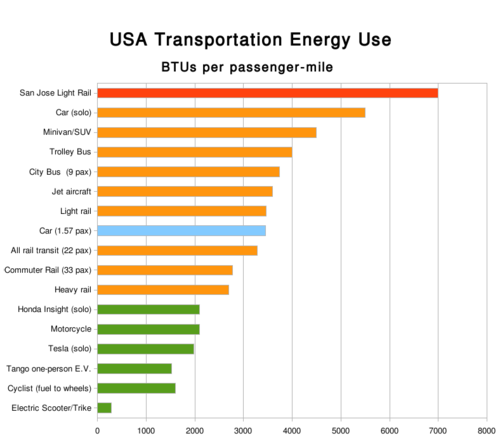
Re: energy/pollution.
not all that much better.
http://www.coyoteblog.com/coyote_blog/images/2008/08/04/transenergy.pngan electric scooter is the ultimate for that with electric cars coming in far ahead of any rail and even regular cars coming in ahead of city busses.
-
Re:No. Way.
Not all that energy efficient
http://www.coyoteblog.com/coyote_blog/images/2008/08/04/transenergy.png
My first conclusion is that we would get more efficient by pushing
small, fuel efficient vehicles instead of pushing transit, and at
a lower cost.A full bus or trainload of people is more efficient than private cars,
sometimes quite a bit more so. But transit systems never consist
of nothing but full vehicles. They run most of their day with light
loads. The above calculations came from figures citing the
average city bus holding 9 passengers, and the average train (light
or heavy) holds 22. If that seems low, remember that every packed
train at rush hour tends to mean a near empty train returning down
the track.Transit vehicles also tend to stop and start a lot, which eats
a lot of energy, even with regenerative braking. And most
transit vehicles are just plain heavy, and not very aerodynamic.
Indeed, you'll see tables in the DoE reports that show that over the past 30 years,
private cars have gotten 30% more efficient, while buses have
gotten 60% less efficient and trains about 25% worse. The
market and government regulations have driven efforts to make cars
more efficient, while transit vehicles have actually worsened.In order to get people to ride transit, you must offer frequent
service, all day long. They want to know they have the freedom to leave at
different times. But that means emptier vehicles outside of
rush hour. You've all seen those huge empty vehicles go by, you just
haven't thought of how anti-green they were. It would be better
if off-hours transit was done by much smaller vehicles, but that
implies too much capital cost -- no transit agency will buy enough
equipment for peak times and then buy a second set of equipment for
light demand periods. -
Re:Informative?
The purpose was to create a boost during a bad time AND get better cars on the roads. In fact, 1 person I know bought a new car for the 1st time and normally would never do so.
That was a very high cost to get a "better car" on the road.
-
Re:Can somebody say
Okay.
Retail sales data put into a chart (with links to origin of graph and the sales data itself, which came from the government, in case the right-wing bias of hotair.com makes you want to disregard). Here is the original graph/blog and person that made it.. It also has a variety of other info, like the cost per ton of CO2 reduced, etc.
-
Meh
I'm not that surprised. Haven't you seen what the Florida state capitol building looks like? Check it out.
-
Re-evaluate
There are lots of good reasons to hate on Walmart
Hrm, seems you've found them to be behaving ethically. Wal*Mart was also the only company with the logistics to get relief supplies in after Katrina (the Southern Baptists being the other bright spot). And they're associated with small business growth.
AFAICT, the good reasons to hate on Wal*Mart are if you're in direct competition with them or are a union organizer. It's true that they source to China for goods, but that's only because our Government has made our goods uncompetitive. If US goods are cheaper they source here.
-
Re:McCain is right on Global Warming
Even if all the hullaballoo surrounding whether humans are the primary cause of global climate change or not, if we take actions now to stem wholesale dumping of greenhouse gasses into the atmosphere, whether it turns out that we have a huge impact on the global ecosystem or not, at least the world we leave behind will be cleaner and more hospitable for our children and future generations.
That might be true. However, it really depends on how much it costs abate C02 production. If the costs are too high, our children might be worse off being poorer and cooler rather than richer and warmer.
For example, the cost in lives that result from hurricanes in Florida is *MUCH* lower than the costs in lives of similar hurricanes (typhoons) in significantly poorer countries. There are a number of reasons for this, but they all result from the fact that we have more money to use to protect ourselves from hurricanes. It's clearly better to be richer with hurricanes than to be poorer and defenseless.
The same tradeoff has to be considered when thinking about how to deal with climate change. Are we better off being cooler & poorer or richer and warmer? So far as I can tell, it's just an assumption that "poorer and cooler" is better. But there are those who are skeptical. -
Re:Orson Scott Card: Laugh at Gore, Please
Try reading the following report. You will find it a lot harder to refute a lot of what this guy is saying.
http://www.coyoteblog.com/Skeptics_Guide_to_Anthro pogenic_Global_Warming_v1.0.pdf
The only thing is, it would be asking you to take a couple of hours of your time to read through the paper - something that I am not sure you are willing to do before making up your opinion on the topic.
I can see the benefits of environmental economics - but not of policy being based on unestablished science. Paper is well worth the read. -
The reason for Kyoto not being ratified.
Coyoteblog had a good article a few months back on why we did not sign the Kyoto Treaty. It mentions some of the critiques of the United States.
-
Re:This is a good argument for school choice!
The idea is that more private schools would open up to accommodate all the kids with vouchers. The biggest problem would be zoning regulations that are stacked against private schools. Of course school choice exists today, provided you have few ethics.
-
Re:This is a good argument for school choice!
The idea is that more private schools would open up to accommodate all the kids with vouchers. The biggest problem would be zoning regulations that are stacked against private schools. Of course school choice exists today, provided you have few ethics.
-
Re:This is a good argument for school choice!
The idea is that more private schools would open up to accommodate all the kids with vouchers. The biggest problem would be zoning regulations that are stacked against private schools. Of course school choice exists today, provided you have few ethics.
-
Re:But the FREE MARKET!So, the government mandates that all chargers must be USB. Which means that no one, not even apple, can create a new innovative power connection for charging things. If you believe that USB chargers are the best solution that anyone could ever come up with, then this is a good deal. But if you think that, I think you underestimate human creativity. The people under this rule will be precluded from freely being able to purchase new technology. And that's good, how?
The free market DOES produce the best results for the consumer. To quote one of my favorite bloggers:
Economics is a science. Willful ignorance or emotional rejection of the well-known precepts of this science is at least as bad as a fundamentalist Christian's willful ignorance of evolution science... In fact, economic ignorance is much worse, since most people can come to perfectly valid conclusions about most public policy issues with a flawed knowledge of the origin of the species but no one can with a flawed understanding of economics.
- Warren Meyer -
Re:They'll Still Be Remembered For What They Did
I once a read a blog entry that dealt with the same subject, although it criticized the technocrats on the left. It looks like technocracy is a bipartisan practice.
-
Re:DumbassesI believe that I do understand the meaning of socialism:
Socialism refers to a broad array of doctrines, and may also refer to political movements that aspire to put these doctrines into practice. These movements generally envisage a system of social organization in which property and the distribution of income are subject to social control. As an economic system, socialism is usually associated with state or collective ownership of the means of production. This control may be either direct, exercised through popular collectives such as workers' councils, or it may be indirect, exercised on behalf of the people by the state.
Of course, public schools have local oversite. But they simply do not have control. And if you want an example of that, I submit to you No Child Left Behind. How many people who don't like the rules imposed have any control to supercede them?
I don't think you have a very good understanding of the words "Personal Responsibility". What they mean is that if you don't like the private school you're sending your kids to, it's your responsibility to either influence change or leave. If you don't like the terms of your employment, it's your responsibility to find a new employer. In general, you are responsible for the condition of your life. If you don't like it, change it.
I love taking shots at public entities because they are
- expensive
- ineffective
- destroyers of freedom
And all in the name of insulating people against the consequences of free choices. I'm glad you think that public institutions provide you excellent service. I submit that they are the highest cost producer and if we sent less of our money to them and didn't allow them to spend as much as they do, we'd all be better off and richer.
-
Re:Right
Here's a counterpoint worth reading for anyone thinking about global warming:
http://www.coyoteblog.com/coyote_blog/2006/01/cool er_but_poor.html
Personally, if global warming is happening, we need to prepare for it, and not waste our energy trying to change it.