Slashdot Mirror
Domain: crazyhorse.org
Stories and comments across the archive that link to crazyhorse.org.
Comments · 7
-
Re:Tag this:
I'd like to point out that the greatest works of art of all time were produced in an era where there were no such things as copyright laws. It's called patronage, and it worked for thousands of years.
Maybe if every teeny bopper whore who wants to pout at a camera, sing to an over-produced track and get paid millions for it suddenly can't make money because the artificial monopoly supporting such a business model vanishes, we wouldn't be innundated with mindless crap. Maybe we would all be better off if the only people who made art were the ones that were passionate enough to make it without thought of getting paid.
Nah, you're right. That's crazy.
Hear fucking hear! Well said sir. But not only that, and without "patronage" as such...
The Lascaux Cave Paintings, Native American Rock Art, Inuit Art, The Epic of Gilgamesh, The Talmud, The Koran, The Bible, The Great Pyramids, The Parthenon, The Coliseum, The Pyramids of Teotihuacan...
The awe inspiring list of the ancient art of man goes on and on. Yet today we see nothing of the like of our "primitive" ancestors. Why?
It can easily be argued that copyright, capitalism and democracy are severely detrimental to the quality and caliber of human works of art.
Art is innate in man, it is its own reward.
I can think of only one modern example that lives up to the works of our ancient past, and that is the family that has over two generations now been slowly carving a colossal statue of Crazy Horse from a mountain. And as one would expect of great art, no personal profit is expected. -
Just get rid of it.
The western flank of Cumbre Vieja volcano on the island of La Palma in the Canaries is going to slide into the Atlantic one of these days: a diagonal fracture has already separated it from the main body of the volcano, and only friction still keeps it attached.
If it's just sitting there, waiting to fall into the ocean (with catastrophic results), why don't we start disassembling it now? There's got to be a safe way to slowly rip it apart and reduce the potential risk.
If not nuclear bombs, then TNT, or jackhammers. Whatever. Just rip it apart and throw it into the ocean piece by piece, safely.
If there's any truly useful area for robots, this is it. Send a whole fleet of robots up there armed with pickaxes, to reduce the mountain to dust and rubble, slowly, over the course of a couple decades or longer.
If one foundation can build the Craze Horse Memorial over a time frame of 65 years (and counting!), surely this is possible. -
Use university computer labs!My suggestion would be to hit every college and university you can. I drove across the country and back 2 years ago, and imagined I'd find lots of wireless too. School computer labs or plain old dialup was *much* more realistic.
Along your route, I stopped at University of Utah (Salt Lake City), which has a big lab in the library, with wireless. However, you have to be a student to get access. I just used a floppy (remember floppies?) to move stuff from the laptop to a lab machine and did the FTP from there. Or, try unplugging an ether cable from a lab machine and plugging yours in. Might work - it does at University of Vermont (heh heh).
While on campus, try wandering around outside the dorms. I imagine you'll pick up a few access points there.
As for stuff to see, if you're not in a huge rush, take the scenic route across North Dakota and drive through the Teddy Roosevelt National Park, then go south and see Mt. Rushmore and the Crazy Horse Memorial (crazyhorse.org, thanks to a previous poster). I cannot say enough about this one - it's about the most awesome sight I've seen. I hit it before Mt. Rushmore (they're about 35 or so miles apart) and it made Rushmore look small and insignificant.
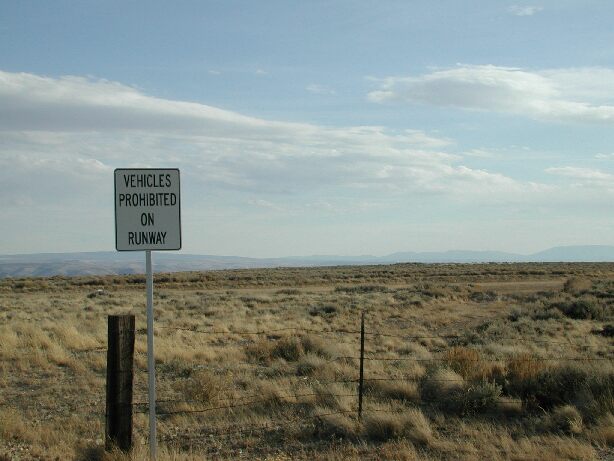
When in Green River, Wyoming, don't forgt to see the Greater Green River Intergalactic Spaceport (along the road to the Flaming Gorge Dam and Recreational Area). Then again, don't bother - it looks like this. The Bonneville Salt Flats are mightily impressive.
One other thing - you will not get a decent cup of coffee until you get to California. When I was in Cheyenne, I drove half an hour out of my way to find a Starbucks. Get a french press (you can get them in plastic - reccomended) and grind up some beans before you leave.
One other other thing - never eat, or even stop, at Stuckeys. Trust me on this.
Other than that, have a great trip, and like others here have said, don't let the tech get in the way of enjoying it. -
don't miss the real hotspots...Looks like you'll be passing some of america's finest roadside attractions as well, like the Mitchell Corn Palace, Bedrock City, and the statue of Crazy Horse under construction in South Dakota. After that it's straight into Jackalope territory
-
My list:
1) Big Brutus, in West Mineral, Kansas - the second largest electric shovel in the world, and (IIRC) the only one still in (more or less) one piece. If you are in Branson, MO you are a couple of hours out.
2) The Kansas Cosmosphere and Space Center, Hutchinson, Kansas. See where Apollo 13 and Liberty Bell were restored, and (in a couple of months) watch them restore a V2 rocket (and even help them do it!). (While here, if it isn't Sunday, get directions to The Carrage Crossing restaurant).
3) EBR-1 the world's first breeder reactor, and the first reactor to make electric power, just outside Arco, Idaho (first city to be powered by nuclear power) (while here, you can go through Craters of the Moon National Park, one of the places that the Apollo astronauts trained. Stay in the DK inn, and you have a good chance of staying in one of the rooms they stayed in).
4) The Very Large Array, outside Socorro, New Mexico. While here, you could also go through White Sands National Park.
5) The London Bridge V2.1 in Lake Havasu, Nevada, where the entire London Bridge was relocated to.
6) The Jefferson National Expansion Memorial a.k.a. The Saint Lewis Arch - there is quite a museum below the arch, and I found it mind-blowing to realize that Saint Lewis is an ocean port.
7) Mount Rushmore National Park - go through the Rushmore Borglum Story for how they carved it and the tricks Borglum used to make the faces look more alive. While there, stop by....
8) Crazy Horse Memorial to see such a work being created.
9) Mesa Verde National Park, near Cortez, Colorado, and Walnut Canyon National Monument, near Flagstaff, AZ, are great examples of how people can eake out a living and build a city where you wouldn't think anybody could survive.
Of course, just look at The National Parks Service website for all sorts of cool places to go. -
Re:I'd make a big statuehow come it seems like the age of big statues is behind us?
I'd like to point out that it's not. If you go to SD you will find that there is another mountian being carved right now.
Ths is really quite something to see, and it is being done on a budget of less then $1e9.
JFMILLER
-
Re:Uh...ninth wonder of the world.
The Coral Castle is a wonder of the world? How'd that happen...? Sure, it's unique but I can find any number of unique structures anywhere in the US, let alone the world. How about Crazy Horse Memorial, using the entire mountain as a canvas?