Slashdot Mirror
Domain: dnull.com
Stories and comments across the archive that link to dnull.com.
Comments · 26
-
Re:I started on one of those
This. When I started shopping for a PC in 1978, the choices were: Apple ][+, TRS-80, and Commodore PET...I picked the PET because it was so cool to be able to do "graphics" simply as printable extended ASCII characters, and animate them with PEEK and POKE directly into video RAM...
You could do that with the TRS-80, too. (I am not sure about the Apple.) Unfortunately the TRS-80 "graphics" were blocky monochrome things... I was attracted to the TRS-80 because I thought it was neat that it came with its own monitor, and I liked the crisp 64 x 16 screen full of text. It was *not* good for most graphic games, but some creative types did great things with it (witness Leo Christopherson's Dancing Demon).
-
This bill is crazy.
So what happens when someone streams CNN on justin.tv or ustream?
Many people are starting to cancel their cable service as the bills have started to become excessive and the content has gotten crappier. (or maybe it's just seems like it as I get older)I really want to start a Cable TV service over the Internet , as in IPTV.
http://www.videotechnology.com/tv/ Try the space bar to change channels.All the technology is in place for this already, and I know how to get legitimate content licenses.
So yesterday I spoke on the phone briefly with Steve Wozniak who expressed a slight interest. I really need to get sponsors and a few people with some pull to make these things happen.
I also am planning on starting an Open source project for an Alternative to Google TV (Android) called Amorphous OS, that's based on Linux.
http://www.dnull.com/~sokol/amorp/ I gave a talk on this 10 years ago, since then we have done some experients but I could really use some help on security and Object models.We need the Open Source community to step up and own this technology otherwise we'll all be left out again like the Phone Companies and Microsoft did to us in the past.
I think an open source alternative to Google TV / Apple TV could easily find it's way in to Televisions if the effort is put in to such a project.
Few people realize that most of these BlueRay players, and Set top boxes such as TiVo are based on Linux already. What remains is the next layer up.
X windows is unacceptable for some things, and things like KDE and other windows managers just aren't consumer friendly.Android's model of Apps is really out dated. Even Java Applets are more advanced in that they don't get "Installed" and "upgraded" or "updated"
I want to take this to another level for the way applications are build, offered, managed and secured.I believe that Amorphous OS can be the way to do this, with Micropayment it could even make the Open Source Model profitable and still remain open.
Anyone with any real interest can reach me at videotechnology.com
John
-
Method to block DOS attacks.
I wrote this back in 2001, and it's still relevant!
http://www.dnull.com/dos/DOS-Block.htmRunning through something like a Citrix Netscaler helps filter out much if your lines aren't overwhelmed.
http://www.citrix.com/English/ps2/products/product.asp?contentID=21679There are a few other companies that seem to have a solution, but this really looks more like a CDN with enough capacity and some filters to ride out what ever attack could be launched at them.
http://www.prolexic.com/index.php/why-prolexic/ddos-mitigation-services/
http://www.arbornetworks.com/stop-ddos-attacks.html -
Re:Neat...
Check this out...
Article at
Everything that you wanted to know and more. An interesting read. -
This is not too hard to solve.
-
This has been around a long time.
1.) There is TCP/IP over Infrared (IrDA) and comes standard on Windows and works also in Linux.
http://web.pdx.edu/~mendyke/ip7780.html2.) there are many laser link systems out there.
I even worked on one.
http://www.dnull.com/zebraresearch/company-mail.html3.) The 802.11 standard also includes the 802.11 Infrared (IR) Physical Layer. 802.11 IR defines 1Mbps and 2Mbps operation by bouncing light off ceilings and walls to provide connectivity within a room or small office. This infrared version of the standard has been available since the initial release of the 802.11 standard in 1997.
4.) Spectrix Corporation of Mundelein, Illinois had a proprietary solution for this. I think they are out of business now.
http://books.google.com/books?id=QZrrXcs1R9gC&pg=RA1-PA207&lpg=RA1-PA207&dq=%22Spectrix+Corporation+%22&source=bl&ots=kMxMofcTd7&sig=qd4QvwoREWQloJKwnpmp63j-Z-I&hl=en&sa=X&oi=book_result&resnum=4&ct=resultIf you explore the link above from the book "Wireless Computing" By Ira Brodsky Published by John Wiley and Sons, 1997. This book goes in a lot of detail about many IP over optical solutions available at that time.
-
Re:Only the paranoid survive (not)
I was 19 or 20 when this happened, I really didn't have a clue. Now I would just have called his bluff.
Just scraping the $2000 together to get custom R2R ladders resistor modules made to produce the units took months. On the $28K per year I was making while at Stanford University as a Life Science Research Assistant things were tight.
Remember I made these things to try to get more money, there wasn't any extra for lawyers.
Even the first prototypes were made by soldering 18 loose resistors in to a DB25 connector, burning our finger the whole time. We made a few hundred this way, I even made several aluminum jigs to hold the resistors while we soldered them together.
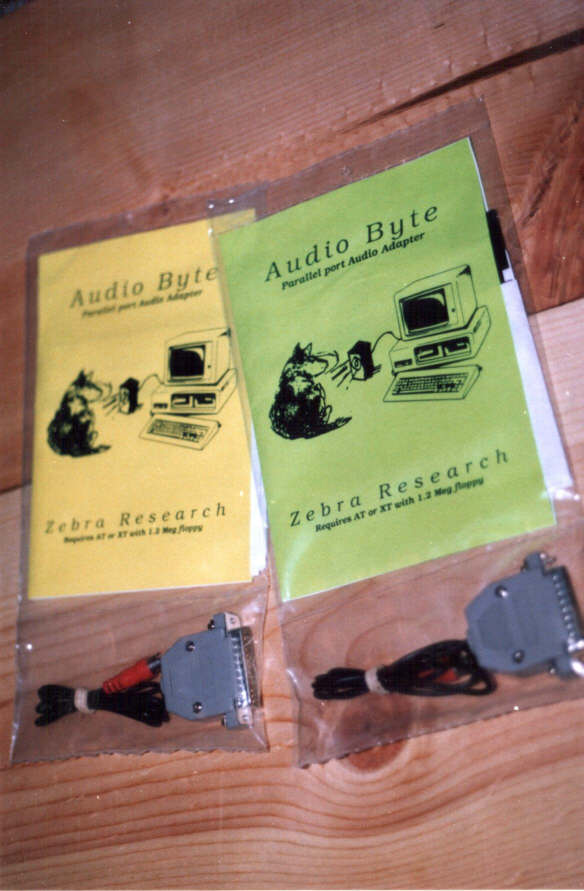
This is the product we put out!
http://www.dnull.com/zebraresearch/images/audiobyte-pack1m.jpgI really needed the $10K to make professional packaging to get it in to Fry's electronics. We knew the founders of Fry's but just couldn't afford real packaging.
This package was made from some Ace Hardware gutter lining plastic that was heat sealed using a home made heat sealer I made from some toaster parts, wood and fiberglass!
My total cost per unit was $5 and we sold for $30.
-
Re:Only the paranoid survive (not)
"I had the very first audio every on most computer platforms. From digital audio on the Apple II, Lisa and Mac, C64, IBM PC and XT and even the Tandy Model 2 and 3. I had the first PC digital audio products on the market the Sound Byte, then someone literally took my name trade marked and and sent me a cease and desists on the name! So I renamed it Audio byte. http://www.dnull.com/zebraresearch [dnull.com]"
Why didn't you just say "This name and concept is mine- give me all your money or else?" A trademark is automatically invalidated if it was in use prior to the trademarking. And if you marketed the first product by that name you would win- big. But of course you might have to be able to feed a few lawyers to make it work though. -
Re:Only the paranoid survive (not)
I partly agree.
Most ideas are considered stupid by most people.
Even more ideas that are good, were already thought of and may even be on the market already.But still there are the few really ground breaking ones.
If I had a dime for every one of my ideas stolen I'd be rich.
Here is where I disagree, execution is a matter of resources.
I had the very first audio every on most computer platforms. From digital audio on the Apple II, Lisa and Mac, C64, IBM PC and XT and even the Tandy Model 2 and 3.
I had the first PC digital audio products on the market the Sound Byte, then someone literally took my name trade marked and and sent me a cease and desists on the name! So I renamed it Audio byte. http://www.dnull.com/zebraresearchThen another company (first byte) reverse engineered my Digital Audio on the PC speaker and patented it, and tried to sue a number of game companies who also reverse engineered my code and used it. This was Intel Assembly language, almost as easy to reverse as JAVA. So many of these paid me and used my Prior Art to toss out the patent suits.
But the kicker was after 3 years and selling some 5000 units at $30 each, Creative Labs came out with an inferior product for $115 and sold 47,000 units in there first month. Past us by like we were standing still. I found out that the same VC we pitch financed them while not financing me. And there plan used us as an example of market feasibility!
So much for execution. It's all a matter of resources. If you don't start off with enough money, and try to boot strap from sales like I was doing, you going to get killed if it's a really important product.
I have repeatedly had this happen with different ideas. Many I did execute on and for some was even selling and making a profit.
* Wearable computers with VR goggles 1984
* Hand held Oscilloscope 1984
* VOIP (internet phone calls) in 1987
* Streaming internet video 1988.
* 13000 streaming video viewers (VQ) with 384 video servers on SUN Microsystems network 1990
* Online Banking for Wells Fargo, 1992
* Livecam (JPEG, GIF, and MPEG1 & 2, modified H.261) 1994
* The CDN where I built the first on for video in 1994. IN 1997 we had over 1M simultaneous views at 56K. One of the largest consumers of Bandwidth on the Internet, and no one knew who we were, because it was adult.
I can directly trace back to specific individuals where Genutity's Hopscotch network and Digital Islands CDN directly copied what I was doing!
Peer1 that host Youtube is now using one of my methods that I pioneered for CDN.* load balancing of internet servers 1995
* Caching web servers 1996
* TCP/IP Selective Acknowledgment implemented in my ECIP. 1996 http://www.ecip.org/
* Streaming H.263/MPEG4 video and MP3 1996/1997
* the first Stand alone IP Camera 1996
* Fanless servers to improve reliably in our CoLo's 1997 (used heat pipes on CPU, HD and PS)
* The first CCTV DVR 1997 done in Partnership with Korean company. Also included the first multichannel(16 input) video capture board.
* Cell processors & Blade servers http://www.enumera.com/
1999* silent computers * computer cooling in 2002
My new stuff I am keeping under wraps now till I can get better resources lined up.
I am not listing these to brag, but to show how much effort I have put in over the past 20 years, with great technical success but only partial business success.
It's always boiled down to one thing, lack marketing budget. Lack of money to manufacture. Lack of the "right connections" to raise money or make large sales because I wasn't part of the good old boys/rich kids club. There is a class system in this country whether you believe it or not.
Almost every one of these ideas I filed or tried to file a patent on, then ran out of money to comp
-
Amazing, this just kills me to read.
I have only been explaining this architecture since 1990 or so, "Head in hands shaking it" why doesn't anyone get it when I explain it!
Worse yet when they do "get it", it's like some new invention as if they never heard it before.I have tried 3 times to get set top box companies going to do this since 1994 only to have "money people" not "get it".
Decentralized is the solution with high demand, high up time services for the internet.
Like Google for example. It's also worked great for Torrent and Skype.
There isn't any reason, Set top Boxes, for video aren't doing it right now, but fear and incompetence. When they do, Cable as we know it IS DEAD!!!! Oh youtube may also go by the way side.
They just need to get that couch potato channel flipping going correctly. This several seconds to change channels blows.
If I sound in an off mood maybe my Mc Donald's coffee wasn't hot enough.
I also have a badly explained idea for an OS that does this type of "millions of these boxes each acting as a mini data center"
http://www.dnull.com/os/ Amorphous OS - It came out better in the talk...Isn't this the whole frigging concept of Peer to peer and the WHOLE Internet FTP Unix bla bla bla back in the 1970 and 80!!!! I mean before PC's were even allowed to play on the Internet as more then Dumb Terminals.
Has the web perverted people view of things so much that when they realize they can use their local PC for more then viewing web pages it's some major revelation.
Some of you need to go read the "Hobbes' Internet Timeline" and learn a bit more about how this network came to be.
Below is a good paper I did on this in 2003.
http://www.videotechnology.com/economics_of_video.htm2005
http://www.videotechnology.com/startrek/Video Internet: The Next Wave of Massive Disruption to the U.S. Peering Ecosystem (v1.2) By William B. Norton
http://www.blogg.ch/uploads/Internet-Video-Next-Wave-of-Disruption-v1.2.pdf -
It's a bum rap
From my testing these older chips did more "work" per clock tick then the current line of P4's and use less transistors, and so make a much better candidate when choosing a candidate for a cluster of processors on a single chip.
http://www.dnull.com/cpubenchmark/budmark3.html
When I was researching doing this type of thing back in 2001 It turned out that using even smaller lower and processors and running them faster makes even more sense.
I think there choice for using the P54C really is the best decision, but it is just not obvious without all of the facts.
The P54C with 2GHz clock rates up is like a P4 3Ghz but uses less power, it's a better design and much smaller lower transistor count and now using modern high res fabs they are getting 32 probably in the same silicon as one single current Pentium D Extreme.
I really think this is going to be the coolest chip out in a very long time.
-
This reminds me of a post I wrote once long ago
It's here. It was 1994. It helps to not drink too much beer before you decide to replace your OS.
Patience, friend. You'll get it. We're here to help. A great many people on Slashdot are here to help you through this difficult moment. Even though we're not the official support channel for your software we're eager to see you have a good experience with it.
Now, start with describing the platform you installed it on and we'll go from there. We'll need to know either the OEM make and model or at least the model of motherboard you're on. It would also help if you could be more specific about your German DSL provider. Who is it, and specifically which type of DSL? If it goes too long we can go to better forum for this.
One last thing... if your DSL isn't working how did you manage to post this?
-
Software should fight back!
Is there any reason the virus's and worms can get through the P2P can't?
Bit Torrent is already showing it's age.
I would like to get some team together to create on based on erasure codes, ECIP http://www.ecip.com/
or LT Code, the Luby Transform (Michael Luby), Fountain Codes (from Digital Fountain), network codes, Tornado codes, Online Codes, and Raptor codes.
In addition the P2P engine should morph and change it's communications similar to stealth viruses do.
So no static filtering scheme could work.
And it should also detect networks that attempt to block them and immediately launch a DOS attack against the router and infrastructure that attempts to block them. Let's not call is DOS attack, but basically by attempting to slow or stop P2P transfers to conserver bandwidth the system just starts to pour on the traffic even higher.
back in 1996 to 1999 Aryeh Friedman and myself worked on what we called Rude protocols, SPAC.
the basic idea was to provide a guaranteed data throughput on the receiver side without any regard to how much it had to send on the sending side.
This is critical for fix rate video transmission if you are to get good quality and is a very different approach to the QOS RSVP where your begging ISP's to allow your traffic to have a higher priority. We just Take it very rudely.
In 1997 we did a broadcast with Sir Arthur C. Clarke (who died yesterday) from Sri Lanka to the US.
It was over the Island of Sri lanka's only internet connection and 64K line that had 90% packet loss.
By pushing out almost 1 Mbps at the 64K like we were able to get a clean 60Kbps at the receive side for a live streaming video event! We had permission from the country's ISP at that time since the event lasted only for 1 hour.
http://www.livecamserver.com/ and http://www.dnull.com/~sokol/clarke.html
But during ours test in So Cal, we were on a Dual T3 Circuit that went into Mae West, Large data interchange, pushing 10Mbps video and the network had some small outage and we pummeled the entire California internet down to an almost complete outage, 1997. this only lasted for maybe 10 minutes or so as almost every network Backbone admin was scrambled to try to stem the 100Mbps flood of UDP packets that our protocol started to push down the line.
We took a lot of flack for that out, lost our Co-Lo at that location.
Anyhow since that time we just added some cap's on the maximum.
Point being, that any deliberate attempts to stem the flow would in a sense create back pressure, that would only force an increase of the data being sent, and so creating network blockages would have the opposite of the desired effect by costing them even more bandwidth instead of saving it.
Wouldn't that be a fun thing -
Memories of Paradise
Back in 1997 I did a live internet streaming event with Arthur C. Clarke, it was the first of it's type, and literally sent video across a 12 hr time difference to Chicago, even then Clarke was making internet history and I was privileged to be part of it.
I actually got to travel to Sri Lanka and meet him. It was truly the experience of a life time. I had been following the foot steps of many other great people. Astronauts, writer, Hollywood types and scientists that have all traveled there to meet him. I had lunch at his home, got to play ping pong with him, it was one of the few physical activities he was still up to. He showed me original sketches of the Space elevator that he and Buckminster fuller had drawn. Even gave me a signed copy of one of his books.
Unfortunately I was so broke at the time all I could afford was one of those 10 Dollar disposable cameras and none of the photo's I took came out, maybe the X-ray machine zapped em. The grand old British hotel there the Galle Face Hotel built in 1864 was incredible but was killing my finances at $150 per night. http://www.gallefacehotel.com/
The video streaming even was at UIUC in celebration of Hal's birthday.
It was amazing to see the turn out. On the large theater screen he was larger then life and it really seems th e internet owes him a large debt of gratitude. For he has been an inspiration for so many.
Sri Lanka was Paradise. In spite of the Civil war, I have never been anywhere so majestic, the people were so hospitable, even strangers on the street were inviting me to there homes to have some food and drink with them. I must have walked every part of Colombo in the week I was there. The food was fantastic, the women were so beautiful, the ocean breeze and the sun sets. Oh the sun sets they put even the best ones in Santa Monica to shame. I still feel almost home sick for Sri Lanka even though I have only been there the one time.
I can completely understand why he moved there. I would if I could also.
Never making it back there is something that I deeply regret. Hearing this news really drove that home this afternoon. Meeting him has been one of the defining moments in my life.
Godspeed Arthur.
For Clarke is for us techies far more significant to us then Prices Dianna ever was.
It's nice to see that this slashdot page it turning into a memorial. I wonder if more formal memorial services would happen around the world.
http://www.dnull.com/~sokol/clarke.html This is from the streaming even and some video clips of him.
I actually think this may be the longest clip up on youtube, somehow they must have allowed it to slip through there size restrictions. -
Re:Screw Intel. They need to be ARM Based.
I would really like to be able to talk directly with the OLPC People, I haven't made any attempts as of yet.
I have alway been very good at squeezing out the most from minimal hardware.
The PXA has a what they call "Wireless MMX" this is an FPU !! The similar MMX that is supported by the x86 processors!
http://www.theregister.co.uk/2004/04/12/intel_ships_bulverde/
We are paying around $15 per chip for the PXA270's right now and I know the price could easily come down, but the PXA3xx is the newer lower cost chips with increased speed and more I/O.
Anyhow I don't see anyone complaining about the processing power and graphics on the iPhone and that plays all kinds of cool graphics tricks.
Why does OLPC care so much about MPEG4?
Last time I worked with a bunch of MIT Media Lab Weenies was on a project called charmed. they pushed me out and made something that looked like an old army canteen based on PC104.
http://creativetech.inn.leedsmet.ac.uk/staff/rb/Wearable.html
It never went anywhere. At the same time I was working on a 3rd gen of my wearable based on a new super chip that I was working on with Chuck Moore. http://www.intellasys.net/products/index.php this was based on http://www.colorforth.com/ X25 chip, sorry he pull that page down. http://www.ultratechnology.com/ml0.htm see X25
We did get a prototype wearable done from this.
In the mean time I also made the mistake of teaching some Chinese how to build the goggles, be never the the funding to keep them exclusive to my project. http://www.dnull.com/goggle/p.html BTW: I get them Whole Sale cheaper, and that site is not the manufacturer but a reseller.
My whole system BOM was $35 in quantity, technically what I had would do the job of the OLPC except for power consumption and it's wearable screens not laptop style, but maybe better if your herding goats. After all who cares about getting middle class kids cheaper PC's let mom buy them a new Laptop for $750.
Also SATA, no way, use SD Flash now. USB sure the kids in Africa and India will have all the latest USB gadgets as soon as Fry's open up a store there, NOT.
The Gold Leopard King PC is literally one chip, probably some 8 bit core, most likely downloaded from opencores.org with Pirated game roms and Sells for $5 (350 rupees). There probably using the same fabs for digital watches and calculators. I'd love to know how to find them.
We could put one or more 500 Mhz arms in one chip, 64Meg DRAM with 2 gigs of SD and a Kent Display and some simple wireless, Even a camera and get the whole BOM down to $20 to $30 in 100K volumes with about $10M in development. It would of course run stock Linux. The display wouldn't be fast for clear video, but slow video and good audio would be great. Or for a little more add a tiny 1x1 inch LCD for the video.
Again, why are they trying to build these things like High end Gaming machines. The point is to make something closer to the French Minitel http://en.wikipedia.org/wiki/Minitel, basically get them on the web, and E-mail and access to the worlds Knowledge and educational software. Not to be able to play WarCraft, surf porn and watch YouTube! Or worse yet create a larger army of 409 scammers.
Buy trying to play this venture using more traditional technology and , AMD, Intel, M$ etc, they just invited grinches to attack. Intel would have to kill this just to ensure there middle class parents -
Proposed MailClad system
MailClad system that doesn't require any secure hardware or networks..
This is a very rough draft but any criticism and suggestions are appreciated.
my approach, it's actually very simple, and based on the same solution that the Horse racing tracks, Vegas Casino's, lotto lottery system uses and many others.
Plain Random numbers, in a secure data base, no encryption at all. The "software" and underlying network, will not be able to alter or bias any of the results.
See: http://www.dnull.com/~sokol/patent/WO2005048082A2.pdf
This is related and similar in concept.
Mailclad is very similar to the scratch off lottery tickets. Something time tested, secure since there is a LOT of money at stake and something even old people can use.
Mail is assumed to be too cumbersome to interfere with and not go unnoticed. There are already laws in place protecting it and special agencies already in place to investigate mail theft.
So a person gets a letter in the mail, in that letter there is printed numbers, possibly with bar codes. maybe scratch off or tear off or anything really. That person then can enter those number into a web site, over the phone, or at a polling location, that is using regular off the shelf PC's or Mac, or anything with a web browser or some data collection GUI or scripts to collect these number.
The numbers are all unique, for each candidate, and voter. The only place the "meaning" of these numbers is recorded is in 2 locations.
1.) on the paper mailed out.
2.) in a Vault where the letters were printed and mailed out from.
#2 is a process that is identical to the Lotto and racetrack tickets, where again a LOT of money is at stake and has never been cheated.
So number are collected, and shared publicly with all parties.
After the election, the number and there associations to the "votes" are shared publicly also. So at that point anyone can compute the election results.
The data that connects a voter to there numbers only is on the mailed letter, and not recorded, so there is know knowledge who received what numbers.
Hence the Name MAILCLAD, where the public mail service provides much of the security, and the sheer physical BULK and tamper proof mail envelopes.
In my scheme, Total anonymity is given, while results can easily be verified.
Problem here is several,
Computers can not be trusted.
Humans from any single organization can not be trusted.
(I assume some small centralized over site by several opposing parties is safe)
Communication network can not be trusted.
Any cryptographic system based on Primes can be cracked with sufficient CPU power, or Quantum computers.
This covers all DES, AES, RSA, PGP and public key systems
cryptography seems to ignore information theory, specifically what is needed to extract a signal from noise or alter it.
Based on information theory my system is unbreakable
Other considerations here.
Voters must be protected from coercion, such as from a workers Union that might wish to verify someones vote. -
I have beaten this several times.
Roy is attempting to break a legendary cross-country driving record known to most people as the Cannonball Run. The time: 32 hours, 7 minutes, set in 1983 by David Diem and Doug Turner.
I grew up in New Jersey just 14 Miles from NYC. But have lived in California since I turned 18.
One thing I have alway found is anything above 120 Mph and the cops would turn on their lights and just disappear into the distance behind me.
When I was in High School in New Jersey we used to do this regularly to mess with the cops on Interstate 80, We would even pelt them with eggs as we passed them doing over 120Mph.
Just in case we had also taken some other measures such as the ability to monitor and jam police radio's.
I also had a US WW2 surplus Super high power flash tube designed for night airial photography.
This was capable of igniting a news paper near by, we placed in the rear window, fortunately never got to try it in traffic, but at the top of Garret Mountain facing New York City we could make the whole skyline light up. Let's not mention the bowling balls, super balls, and oh yea and the rail road flairs.
Ok, So maybe I/we were a bit out of control..
After I moved to CA, every year I used to take I-80 the whole distance to NY and back, to visit my parents. Always flat out pedal to the metal.
On my first trip I easily beat this record with a 30 hour driver using a beater. 1979 Mercury Montego Station Wagon with a souped up engine in 1987. I was hitting a top speed of over 150 Mph. The started motor didn't work, so I couldn't even turn off the engine because we'd never get the car started again.
I had stopped to rest with the engine idling a few times so some time was lost there.
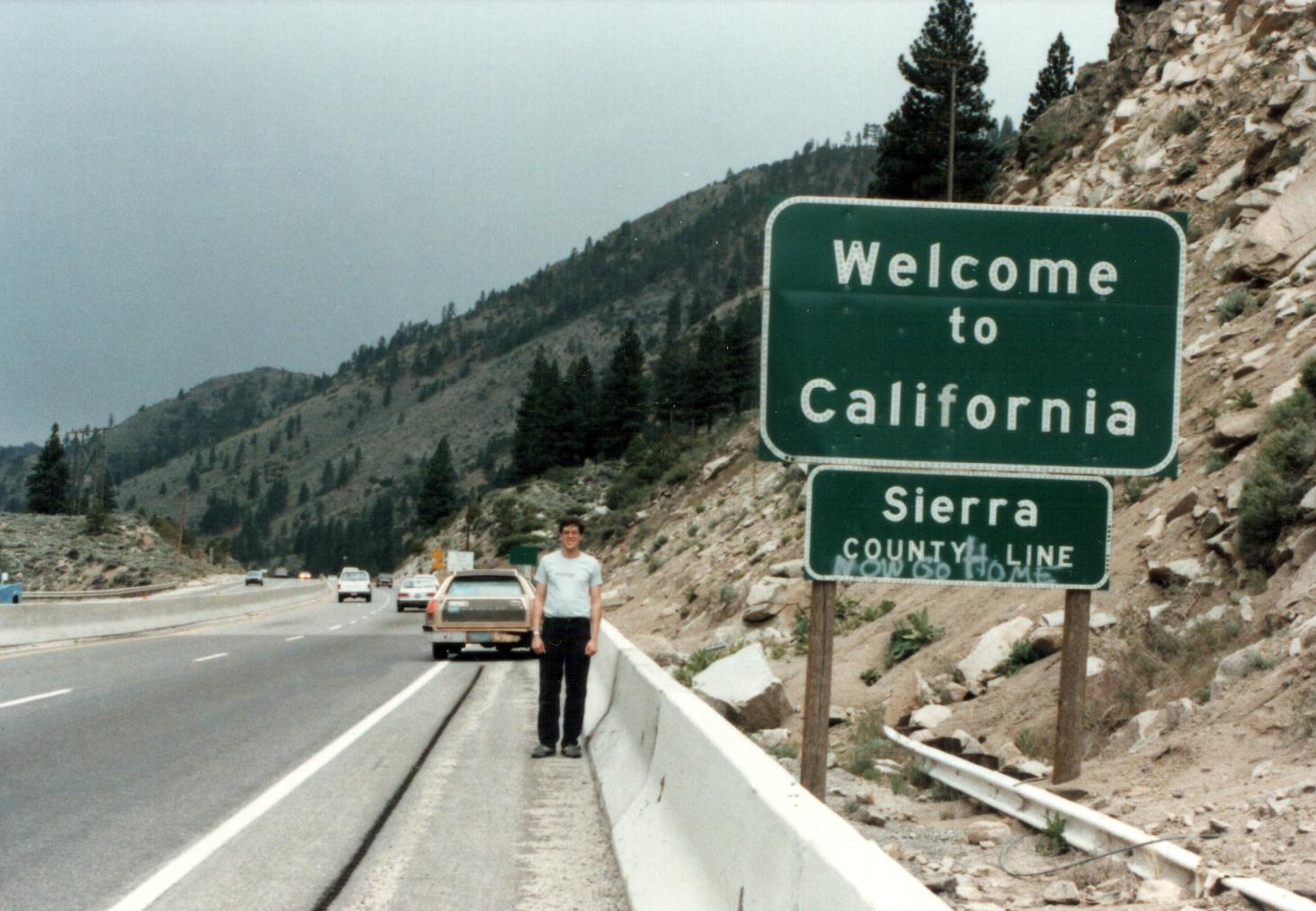
In Nevada I was ticked for doing 130Mph, The same cop had chased me from Elko to the CA boarder, when I made the mistake of slowing down to 40 to appreciate the incredible view just before the California Boarder. I had even stopped in Reno to get some gas.
Photo from that trip right after cop ticketed me. http://www.dnull.com/~sokol/images3/welcome.jpg
My best time was 28 hours from Redwood City California to New York City around 3000 Miles in a 1990 Nissan Sentra in 1992, while listening to Ozzy's Mama I'm Comin Home. My wife has just left me and went back to NJ and I was a tad upset at the time.
The other big trick is to pick times that avoid rush hour when passing through larger cities. -
Jatropha Photo's and my research on it.
I spend several weeks in India last summer studying Jatropha.
My wife's father S.W. Mensinkai founded University of Agricultural Sciences in Dharwad, near Hubli in Karnataka India (8 hrs by train north of Bangalore). He is considers the father of plant genetics in India. They are doing genetic engineering of Jatropha there.
See photo's
http://www.dnull.com/~sokol/images6/index.html
One of the programs they are pushing is for farmer to plant Jatropha on the borders of other crops in the fields, turns out the bulls that wonder freely in India will not go near the stuff, so a row of these trees keeps them out of the farmers crops.
Very interesting work.
I brought back a hand full of seeds with me, and planted them, but they didn't take, maybe the Airport X-ray scanners killed them.
Anyhow;
Jatropha is related to the Castor bean plan that is responsible that the neurotoxin ricin is derived from.
It also have a toxin called curcin that is similar to ricin.
I don't know if burning Jatropha oil release this curcin toxin into the air?
But apparently when it's pressed to get the Oil out, the curcin remains in the "Cake" this is the solids left behind after the seeds have all the oils squeezed out.
From: http://www.intox.org/databank/documents/plant/jatropha/jhast.htm
-------------
2.5 Poisonous parts
All parts are considered toxic but in particular the seeds.
2.6 Main toxins
Contains a purgative oil and a phytotoxin or toxalbumin
(curcin) similar to ricin in Ricinis.
------------
Apparently Canola oil (Short for Canadian Oil)is a genetically modified Rape seed (in the mustard family) with the toxins removed.
So if Jatropha had it's toxins removed through genetic modification it could also be a valuable food product.
Later in 2006 I moved to Santa Barbara and it turns out the first company in the US to start producing Jatropha Oils and Bio-Diesel was here in Santa Barbara. http://www.biodieselindustries.com/ They were even doing a project with the local High School to grow Jatropha.
Also Jatropha Oil is being use on the Indian Railways for some time too. I guess the plan is to plant Jatropha trees along the tracks, it keep the animals off the tracks and also since labor is very cheap, they would use the same trains to harvest the tree's for oil to power the trains.
One of the projects I was thinking of was to develop an engine optimized to run on Jatropha Oil.
More importantly these three wheeled auto-rickshaws (called Tuck Tucks in Thailand) all use the exact same engines, so the idea is to make a direct drop in engine for rickshaws. The rickshaws there are Two-stroke gas engines and are a major source of pollution there spewing clouds of choking soot behind them. Maybe some day.
More good links:
http://journeytoforever.org/biodiesel_yield.html
http://www.thehindubusinessline.com/2005/10/20/stories/2005102002021100.htm
http://www.biodieseltechnologiesindia.com/
http://www.greencarcongress.com/2007/04/tnt_starts_biod.html -
This was my companys idea in 2001
It's was called Enumera www.enumera.com
I started to work with Chuck Moore, the author of the FORTH Language on a 7X7 array of very fast small processors.
From at talk I did, February 16, 2001
From http://www.dnull.com/~sokol/amorp/emtalk.ppt On this size Chip a 7x7 array (49 CPU's) with ram could be
build. Co-processors could also be added.
Each CPU's would be operating at 2400 MIPS x 49 for a total of 117 Billion operations per second.
The power consumption would be 1 watt 1.8 Volts a 500 mA.
With this level of computing power new applications that were unthinkable before, now become possible. Also mention earlier on Slashdot:
http://developers.slashdot.org/comments.pl?sid=138 584&threshold=0&commentsort=0&mode=thread&cid=1160 0799
And earlier here:
http://www.colorforth.com/ 25x Multicomputer Chip
This eventually became IntellaSys after Enumera failed. IntellaSys CTO Chuck Moore to Present at In-Stat Spring Processor Forum; Scalable Embedded Array Platform for Implementing Asynchronous, Scalable Multicore Solutions Using Elegant VentureForth Programming to Be Discussed in Detail http://www.intellasys.net/products/24c18/SEAforth- 24A-3.pdf
http://www.findarticles.com/p/articles/mi_m0EIN/is _2005_Oct_24/ai_n15730157
http://www.findarticles.com/p/articles/mi_m0EIN/is _2006_May_1/ai_n16135032
Also for older info see:
Specifically look at the P21 / I21/ F21 chips...
http://www.enumera.com/chip/
http://www.ultratechnology.com/ml0.htm
http://www.ultratechnology.com/f21.html#f21
http://www.ultratechnology.com/store.htm#stamp
http://www.ultratechnology.com/cowboys.html#cm -
Re:I prefer working on the real problems.
Well there are several scenarios that had come across, 2 were under NDA's so I can't talk about those,
But let's take the situation of Multiheaded displays.
You can put 4 to even 16 screens on One PC. Or even one really massive high res big screen.
Think ultimate extreme programming or gaming.
One user has a screen, another user has their own, but either could just move the mouse off of one screen onto the others display and start using the apps there, Copy and paste, and come back to their screen. Or even grab a whole window and drag it back to his screen. Now take this to the next level and do this between separate networked PC's.....
Lets say, I am working on a document, I can just drag it over to another screen right now just fine, but what if I wanted my friend to started editing on it.
I'd have to save, quit, copy (or shared net drive), then they would have to re-open and find where I was in that document before they could resume edits in the same place. Usually it's much easier to just get up from you chair and let them take your keyboard and mouse.
But with what I am proposing you could just drag it over to their side of the screen or over their screen and let them take over the focus on that app, then you could just go onto something else without giving up what else your doing.
It would allow several people to collaborate very tightly.
Since I have come up with this idea Microsoft did something a little similar, but far less ambitious. http://slashdot.org/article.pl?sid=07/05/06/166231 Microsoft Invents Split Screen PC
Until you have worked in some similar situations it's hard to imaging it's value, but it's that multi-person interaction that I think makes things like second life so popular.
With some hacking/coding with teams working very closely, ether in the same room, or remotely with skype and IM,
Right now the closest I have come is with VNC or gotomypc where, I am helping another programmer, and can take over his editor, fix something and let him resume, all on the same desktop and window.
Also another entirely different thing is look at Multitouch screen where they grab an object with to pointers in the video demo it was 2 finger and can rotate and scale an image at the same time, see advancedgui.com
But having several people operating on one large virtual desktop would really increase productivity.
http://www.panoramtech.com/ for an example. Large control center screens that look like Apollo Mission control.
http://www.michaelp.org/photos/kennedy_space_cente r/apollo_mission_control_center_2.jpg with large screens that wrap around a whole room.
Anyhow now that I have explained it here on slashdot, I wonder how long before it shows up on Ubuntu. I'd love to see it.
I have this sort of whole Ted Nelson-ish vision I call Amorphous OS, http://www.dnull.com/os/ that would make Linux, Apple and Microsoft's current GUI implementations look as obsolete as the old DOS command lines.
Sorry my online document doesn't go into nearly as clear and deep details as I'd like. -
Re:This is terrible!
It has on several occasion done just that.
In the cast with the First byte patent on Digital audio for PC internal speaker, Activision paid me to help overturn that patent.
But in that cast I had posted code to CompuServe that kept an unbiased date and time stamp.
http://www.dnull.com/zebraresearch/
Being able to document the inventions date is very important, even when it is released into the public domain. If you can not produced evidence as to when you released it into public or even came up with it privately, then it's will not be valid evidence for overturning a patent.
In a later case US patent 6,108,703, August 22, 2000 the so-called "Leighton-Lewin patent", which cover a "two-level DNS" method used by both Akamai and Digital Island to route web traffic to edge-of-network caches.
I have well documented proof and could clearly show that a company Digital Island acquired a company that had copied that technology, because I had a CoLo server hosted at there site from 1995 to 1998, and the patented technology years later was nearly identical.
There is a long paper trail, I had tried to file this patent on two seperate occasions one with a California corp NetSYS inc. in 1994 and again later under another California corp DVT (Digital Video Technology) inc, were the technology was actually deployed at 40 CoLos globally for first and largest adult video network at that time in 1995 to 1998. Pussycat.net and later vidx.com We supplied for recorded video feeds to 2500 of the top adult video sites on the net using my Livecam video, we were delivering almost 600Mbps of video 24/7. We called this SDSN - (Symmetrically distributed server network).
I contacted both parties that I had Prior Art, since it's a Civil suit, and both wanted control over the IP and not to have it in Public Domain like my patents that failed to be competed had done. Both parties didn't want to hear anything about my prior art, very deliberately choosing to not be aware of it.
There are several other stories like this, but I'd have to fish through many past E-mails to detail them.
I find most legal wrangling is lots of posturing and bluffing, much more poker then logic.
If they know your not bluffing or have a trump card they will fold. -
Same as ECIP
With my ECIP protocol we were doing that for video distribution in 1996 and 1997 with the largest network of adult video.
www.ecip.com
I called is server based routing, were a cluster of servers would keep tabs on each others status and network communication quality.
How much latency and loss between each node.
Then when a message was to be sent, they could try direct or go around the blockage by reflecting packets off a series of servers.
Packets would also be split of across multiple paths.
Specifically we had 3 T1 lines at our source site. The end was a user on a PC, we had 40 servers in 40 Co_Lo's on as varied and different backbones as possible.
ECIP would carry the video from the main site with live entertainment to the 40 servers.
End users would get directed via HTML to the server they had the best connection with an then livecam video www.livecamserver.com
would be sent to them.
This as also used for several live video streaming events with Arthur C. Clarke. From Sri Lanka and ECIP
was able to get video out over a very bad and over congested 64K line that provided all Internet to Sri Lanka in 1997.
http://www.dnull.com/~sokol/clarke.html -
More pro oil propaganda to kill BioFuel investment
This one is so over the top it's hard to know where to start.
The agriculture here in the USA is already messed up.
By using petrolium based pesticides, and fertilizers
By depending on petrolium based irrigation and farming equiptment.
BioFuel's don't need to take up food crop resources. There are 1000's of plants that are suitable for BioFuels, many are weeds! They aren't edible, they grow much better then wood and they don't require fertile soil or irrigation.
I just spent several weeks in India researching biodiesels. Specifically Jatropha and Pongamia - http://www.dnull.com/~sokol/images6/ trip photos.
The Indian railway system is planting GM Jatropha along it tracks and plant to operate all of it's railway system on mixtures with Oil from these plants.
Here is an article I found, Google pull up many articles on this...
Biodiesel Train on Track in India
SolarAccess.com, 17 Jan 2003
The first successful trial run of a passenger train was conducted on December 31, 2002 when the Delhi-Amritsar Shatabdi Express used 5% biodiesel as fuel. Biodiesel will enable Indian Railways to save on its rising fuel bill while controlling pollution levels. Sulphur and lead emissions were reduced significantly when biodiesel was used, according to the Railways. Ultimately, the percentage of biodiesel would go up to 15% in unison with the accepted global norms. The new green fuel is extracted from the seeds of the Jatropha plant and Indian Oil is now engaged in laboratory tests of biodiesel. The plant can easily be grown on either side of railway tracks as it adopts itself well to arid and semiarid conditions, demanding low fertility and moisture. The other advantages are the fuel's contribution to the national energy pool and the potential of creation of jobs in rural sector. -
I have a paper on this.
http://www.dnull.com/dos/DOS-Block.htm
Proposal for a new method to block distributed denial-of-service (DOS) attacks.
-
Here is a benchmark I did from 386 to P4
benchmark
This is just looking at core cpu performance, not bus and external cache issues.
-
You are looking too close to see the real problem
I read many of the coments and complains posted so far. Many are implementation specific gripes.
Some are architecture specific, but Unix is what it is. You really can't change that. And that is the root of the problem.
I mean Unix was/is a major step forward. Almost all major OS's have a unix like engine under the hoods these days(MS Windows included).
Unix has accomplished every goal originaly set out for it. But it's also very limited in it's own over all vision and architecture.
To overcome that requires finding a very different way of thinking about programs, OS's and computers then the way we now do.
For example, I can access a remote machine with VNC. I love it so much I have several PC that I almost only access that way.
There are many significant adventages when using a computer this way that most people don't realize.
1.) When I log in, all my applications are right were I left them. Windows open, word processors and E-mails half written, cursor sitting just where I had last contunued even though I many have flown 2000 miles. (or had my local computer reboot)
X windows can't do this! Although I love X for many reasons, X tunneled over SSH is very cool. VNC also tunnels.
Back in the Early 90's Novel had something sort of like this, at least your whole windows work enviorment and files would follow you from computer to computer, but would loose run time states. Sun is also working hard on systems like this.
2.)Thing like IM and E-mail , gnutilla etc continue to function even when I am not online.
In the command line world we have had this in UNIX for a long time "nohup" and "cron" for example.
But why do I need a graphics card at all. Why can't I just have many virtual desktop sessions that I can VNC into(on a single Server)? Then I can then leave them in different states for each project I am working on.
Here is another one.
Why Can't I take a program, pause it(swap it out)
generate a file of it's run state. Copy it across the net and resume execution right where it left off, but on a completely different computer? Or maybe after a reboot.. (HP had this years ago, or was it Tandem?)
I had some thoughts on this that I gave a talk on. It's missing much, and still not polished, but there are still a lot of good ideas in there.
Amorphous OS talk Sorry it's a powerpoint, but I know you Linux guys can still read it.