Slashdot Mirror
Domain: dumbscientist.com
Stories and comments across the archive that link to dumbscientist.com.
Comments · 540
-
Re:Premature
As I've explained, climate is the global average over at least ~20 years. That's a limitation of modern science; raw data simply isn't dense enough, and not enough decadal oscillations can be simulated precisely enough to meaningfully talk about "climate" on a shorter timescale. Trends of 8-9 years are probably under the noise floor, and (as I explain in that link) it's important to remember that just because CO2 is the most significant forcing, that doesn't mean other forcings are completely insignificant.
Because of this limitation, climatologists primarily use hindcasts through proxy records to validate the models, among other techniques. Making a prediction and then waiting 20 years to see if it comes true isn't practical, so few peer-reviewed papers tend to ask "Hey, what did that model 20 years ago predict?" But these analyses are informally performed and they seem both honest and generally positive to me. You can verify this yourself by downloading the GCM source codes and global temperature data in the sources listed here. Remember to smooth over at least 20 years, and compare the projected emissions used to the actual values. (Most projections give several "scenarios" where CO2 emissions change differently to account for uncertainty in future human behavior.)
-
Re:Premature
I finally got around to posting our conversation, which I mentioned months ago but never got around to. Thanks again for your interesting comments.
-
Re:Premature
Climate models for the most part do not conserve energy and/or have unphysical boundary conditions, and all of them are parameterized in unphysical ways. Anyone who isn't sceptical of them is missing something.
Here are links to the source code for many GCMs. Please name the model which doesn't conserve energy. If you're feeling generous, it would also be nice to know how to reproduce this (obviously serious!) problem.
Last year, you said something similar:
But you're not a computational physicist, or you would have noticed the lack of energy conservation in some models (it is added by hand as a correction on each time step) or unphysical boundary conditions in others (ocean surface in particular). If you were a computational physicist you'd know how big a deal these approximations are in long-term integrations of even very simple systems, much less complex ones like GCMs. I was a lot more convinced by the AGW argument before I started looking at the models than I am now. [radtea, July 28 2009, @07:57AM]
I'm baffled by these statements. Energy conservation is a fundamental law of the universe, but floating point calculations are necessarily imprecise. Correcting for roundoff errors that affect energy conservation in every time step seems like good programming practice.
Also, there are other reasons to apply conservation laws "after the fact." Several years ago I studied the gravitational effects of shifting precipitation patterns. The GRACE satellites measure the global gravity field every month, which changes because of heavy rainfall, droughts, etc. Comparing the GRACE monthly gravity field to the gravity field implied by hydrology models like GLDAS revealed interesting discrepencies like a consistent phase lead in the GLDAS model which we hypothesized was due to a flawed river model.
But none of that would have been possible if I hadn't "added in mass conservation by hand as a correction in every time step." You see, GLDAS only provides the mass of water over the land every month. If this total mass is integrated, it's not constant in time. Which just shows that the water is being swapped between the land and the oceans. So I wrote a short script to add a spatially uniform layer of water to the ocean each month that forced the total amount of water on Earth to be constant. (Obviously this was only a first order estimate because I neglected water vapor and oceanic circulation patterns which violate the assumption of spatial uniformity.)
Incidentally, my confidence in GCMs is drawn primarily from their demonstrated skill in completely different validation techniques. I'm not surprised or concerned that tuning parameterizations simplify microphysics, perhaps to the extent of oversimplifying them. As my comments in that linked conversation show, I do consider such imperfect approximations to be good reason not to consider GCMs sophisticated enough to produce regional climate predictions. But their track record with global averages seems impressive.
I'm also not sure what you mean by unphysical boundary conditions at the ocean surface, but I'm eager to learn what you meant by that statement.
-
Re:Premature
Climate models for the most part do not conserve energy and/or have unphysical boundary conditions, and all of them are parameterized in unphysical ways. Anyone who isn't sceptical of them is missing something.
Here are links to the source code for many GCMs. Please name the model which doesn't conserve energy. If you're feeling generous, it would also be nice to know how to reproduce this (obviously serious!) problem.
Last year, you said something similar:
But you're not a computational physicist, or you would have noticed the lack of energy conservation in some models (it is added by hand as a correction on each time step) or unphysical boundary conditions in others (ocean surface in particular). If you were a computational physicist you'd know how big a deal these approximations are in long-term integrations of even very simple systems, much less complex ones like GCMs. I was a lot more convinced by the AGW argument before I started looking at the models than I am now. [radtea, July 28 2009, @07:57AM]
I'm baffled by these statements. Energy conservation is a fundamental law of the universe, but floating point calculations are necessarily imprecise. Correcting for roundoff errors that affect energy conservation in every time step seems like good programming practice.
Also, there are other reasons to apply conservation laws "after the fact." Several years ago I studied the gravitational effects of shifting precipitation patterns. The GRACE satellites measure the global gravity field every month, which changes because of heavy rainfall, droughts, etc. Comparing the GRACE monthly gravity field to the gravity field implied by hydrology models like GLDAS revealed interesting discrepencies like a consistent phase lead in the GLDAS model which we hypothesized was due to a flawed river model.
But none of that would have been possible if I hadn't "added in mass conservation by hand as a correction in every time step." You see, GLDAS only provides the mass of water over the land every month. If this total mass is integrated, it's not constant in time. Which just shows that the water is being swapped between the land and the oceans. So I wrote a short script to add a spatially uniform layer of water to the ocean each month that forced the total amount of water on Earth to be constant. (Obviously this was only a first order estimate because I neglected water vapor and oceanic circulation patterns which violate the assumption of spatial uniformity.)
Incidentally, my confidence in GCMs is drawn primarily from their demonstrated skill in completely different validation techniques. I'm not surprised or concerned that tuning parameterizations simplify microphysics, perhaps to the extent of oversimplifying them. As my comments in that linked conversation show, I do consider such imperfect approximations to be good reason not to consider GCMs sophisticated enough to produce regional climate predictions. But their track record with global averages seems impressive.
I'm also not sure what you mean by unphysical boundary conditions at the ocean surface, but I'm eager to learn what you meant by that statement.
-
Re:Premature
Read the abstract closer. They specifically state that "the reversing trend may relate to a possible recovery of stratospheric ozone concentration."
-
Re:This is not science.
My comments have been copied here.
-
Re:This is not science.
I see that they found no significant problems with the McIntyre and McKitrick papers either.
They weren't convened to critique the MM03/05 papers, so describing MM's misunderstandings of selection rules in principal component analysis would be outside the scope of the report. I've listed some peer-reviewed papers here (see item 7d in the index-- ~3 pages from the top) which cover those topics in more detail.
-
Re:For our sake
To be blunt about it, it appeared to me that you cherry-picked specific parts of my posts and presented them out of the context of our actual exchange, in such a manner to make your side of the conversation appear to be more reasonable, and mine to be less.
Yes, and 2 minutes later I replied: I omitted the rest of your remarks to focus on the science, and as an act of mercy to my (undoubtedly overwhelmed) readers. Everyone wanting to read the rest of what you wrote can follow the numerous links leading to the original Slashdot conversation.
Most of the nonscientists I've spoken with display a very low ratio of "interesting physics-related comments" to "whiny conspiracy theories/insults". As a result, their comments are abridged to focus on the few interesting comments. For example, compare my abridged version of Stormcrow309's rant to the Slashdot original. Notice how he actually seems more reasonable in my version; that's because my goal is to strip away the nonsense and focus on the science. Again, links to the originals are always available.
Understand that in light of this, for whatever this statement may be worth here, you do not have my permission to post my comments elsewhere. If I find that you are doing so, I shall cease to exchange any words with you at all, and I shall post my reasons for that clearly not only on Slashdot, but also, if possible, on the offending site.
Well, as you can tell I've already posted this conversation. Goodbye.
-
Re:For our sake
To be blunt about it, it appeared to me that you cherry-picked specific parts of my posts and presented them out of the context of our actual exchange, in such a manner to make your side of the conversation appear to be more reasonable, and mine to be less.
Yes, and 2 minutes later I replied: I omitted the rest of your remarks to focus on the science, and as an act of mercy to my (undoubtedly overwhelmed) readers. Everyone wanting to read the rest of what you wrote can follow the numerous links leading to the original Slashdot conversation.
Most of the nonscientists I've spoken with display a very low ratio of "interesting physics-related comments" to "whiny conspiracy theories/insults". As a result, their comments are abridged to focus on the few interesting comments. For example, compare my abridged version of Stormcrow309's rant to the Slashdot original. Notice how he actually seems more reasonable in my version; that's because my goal is to strip away the nonsense and focus on the science. Again, links to the originals are always available.
Understand that in light of this, for whatever this statement may be worth here, you do not have my permission to post my comments elsewhere. If I find that you are doing so, I shall cease to exchange any words with you at all, and I shall post my reasons for that clearly not only on Slashdot, but also, if possible, on the offending site.
Well, as you can tell I've already posted this conversation. Goodbye.
-
Re:For our sake
To be blunt about it, it appeared to me that you cherry-picked specific parts of my posts and presented them out of the context of our actual exchange, in such a manner to make your side of the conversation appear to be more reasonable, and mine to be less.
Yes, and 2 minutes later I replied: I omitted the rest of your remarks to focus on the science, and as an act of mercy to my (undoubtedly overwhelmed) readers. Everyone wanting to read the rest of what you wrote can follow the numerous links leading to the original Slashdot conversation.
Most of the nonscientists I've spoken with display a very low ratio of "interesting physics-related comments" to "whiny conspiracy theories/insults". As a result, their comments are abridged to focus on the few interesting comments. For example, compare my abridged version of Stormcrow309's rant to the Slashdot original. Notice how he actually seems more reasonable in my version; that's because my goal is to strip away the nonsense and focus on the science. Again, links to the originals are always available.
Understand that in light of this, for whatever this statement may be worth here, you do not have my permission to post my comments elsewhere. If I find that you are doing so, I shall cease to exchange any words with you at all, and I shall post my reasons for that clearly not only on Slashdot, but also, if possible, on the offending site.
Well, as you can tell I've already posted this conversation. Goodbye.
-
Re:For our sake
If all these corrections are annoying (again, sorry...), a version with all corrections applied is here.
-
Re:National Aeronautics and Space Administration
Huh? Dr. Weiler is the director of Goddard, and I spent some time trying to find his peer-reviewed papers, but didn't see any of the nonsense that you're attributing to him.
But that's not surprising, since the urban legend that "scientists predicted an ice age in the 1970s" is false, and only true of sensationalist articles in non-peer-reviewed publications like Newsweek. Most genuinely peer-reviewed scientific journal articles were predicting global warming even in the 1970s. There was a genuine effect called global dimming due to aerosols increasing the albedo of the Earth, but regulation reduced aerosol emissions, and their short lifetime in the atmosphere did the rest.
-
Re:National Aeronautics and Space Administration
Huh? Dr. Weiler is the director of Goddard, and I spent some time trying to find his peer-reviewed papers, but didn't see any of the nonsense that you're attributing to him.
But that's not surprising, since the urban legend that "scientists predicted an ice age in the 1970s" is false, and only true of sensationalist articles in non-peer-reviewed publications like Newsweek. Most genuinely peer-reviewed scientific journal articles were predicting global warming even in the 1970s. There was a genuine effect called global dimming due to aerosols increasing the albedo of the Earth, but regulation reduced aerosol emissions, and their short lifetime in the atmosphere did the rest.
-
Re:Climate change is a security threat
There is a calculation difference of nearly a degree in those climate models, whereas the temperature itself has varied significantly less than that. Do these models really inspire you to trust them? They are not very convincing to me at all.
My point in emphasizing the future projections was to stress that this uncertainty doesn't grow over time (aside from uncertainties as to which emissions scenario we adopt.) But even the "large" uncertainties in current GCMs are small enough to show that anthropogenic greenhouse gases are responsible for the warming since 1970. Even though the two curves have wide error bars, they don't overlap. The entire point of that graph you're fixated on is that the observed temperatures stay within the IPCC's error bars. You couldn't even see the prediction for the temperatures without human greenhouse gas emissions on that plot (as in the Meehl 2004 plot), because they'd be far below it.
-
Re:Climate change is a security threat
Exactly. "We can't explain it any other way." This is about the weakest line of logic ever.
Huh? I just showed you how the greenhouse warming model explains the current observations, has been validated in multiple independent ways, and has no serious competition. That's exactly the same thing I say about evolution, but I gave up trying to explain that to creationists. Perhaps I should give up here for similar reasons?
I'm going to say, your writing style makes me feel like you spend a lot of your time on realclimate.org. I strongly suggest instead that you look at the ipcc report [www.ipcc.ch] (the actual report, not just the summary which a lot of people don't feel represents the report). realclimate.org has a kind of propaganda-ish feel, and the IPCC report covers tons and tons of ground. If you are an information junkie, that is where you should go. It's the good stuff.
Holy crap! You're telling me to look at the source which- in that very article- I've referenced over and over and over and over? Are you serious? Most of the graphs in the article that you were just talking about are from the AR4 report. I've only deviated from it with respect to sea level increase, because their information is out of date and too conservative based on data collected since 2007.
Had it ever occurred to you that maybe I spend most of my time studying the climate as a professional physicist, and that I'm not just regurgitating bullshit I read on the internet?
You've probably already seen the argument I made to the other guy, but I feel I should make it here, too: look at this graph. There is a calculation difference of nearly a degree in those climate models, whereas the temperature itself has varied significantly less than that. Do these models really inspire you to trust them? They are not very convincing to me at all.
How ironic. Maybe you should stop looking at a single realclimate.org graph and consider the AR4 scenarios from the IPCC report. (Yeah, the same ones I linked in my article months ago.) Notice that the uncertainty for each scenario is wide, but the error bars for different emissions scenarios don't overlap. The scenarios are referenced in the second column of page 755 of chapter 10 of the AR4 report.
These uncertainties are estimated using procedures described on pages 805-809, in section 8.5.4: "Sampling Uncertainty and Estimating Probabilities". Those pages describe the role of multi-model ensembles and perturbed physics (i.e. perturbed parameters) ensembles in evaluating the uncertainty of climate projections.
And, yes, I'm impressed by the careful job they've done. The methods they're using to validate the models are ingenious. The error bars don't have to be infinitesimal; just smaller than the difference between emissions scenarios. And they are.
-
Re:Climate change is a security threat
What abrupt climate change? The only thing you mention before this is a modest rise in sea level 90 years from now. 90 years is not an abrupt climate change.
I've repeatedly stressed that atmospheric CO2 has increased 35x faster than at any point in the last half million years, and as a result the global average temperature (averaged over a period of at least several years) is increasing at a rate that's probably faster than at any point in the last 1000 years.
I've defined "abrupt climate change" in a popup over the words at the beginning of the article: A large-scale change in the climate system that takes place over a few decades or less, persists (or is anticipated to persist) for at least a few decades, and causes substantial disruptions in human and natural systems.
-
Re:Climate change is a security threat
What abrupt climate change? The only thing you mention before this is a modest rise in sea level 90 years from now. 90 years is not an abrupt climate change.
I've repeatedly stressed that atmospheric CO2 has increased 35x faster than at any point in the last half million years, and as a result the global average temperature (averaged over a period of at least several years) is increasing at a rate that's probably faster than at any point in the last 1000 years.
I've defined "abrupt climate change" in a popup over the words at the beginning of the article: A large-scale change in the climate system that takes place over a few decades or less, persists (or is anticipated to persist) for at least a few decades, and causes substantial disruptions in human and natural systems.
-
Re:Climate change is a security threat
one of the fundamental physical principles of atmospheric CO2 is that each successive doubling of CO2 has a cumulatively smaller effect on temperature
Can you give me a respectable citation on that?
I'm just guessing here, but it sounds like he's repeating the "CO2 is saturated" argument that seems to be popular these days. It's old news, of course, integrated into GCMs in the 1950s.
-
Re:Climate change is a security threat
I'm going to ignore the rabid conspiracy theories you're presenting. As a scientist who sees a lot of evidence that our CO2 emissions are changing the climate, you'd probably just dismiss me as lying scum with a political agenda anyway.
But just in case someone else reads this, greenhouse warming models predict cooling and contraction of the stratosphere. The cooling is predicted to be strongest between altitudes of 40 and 50km.
The quick explanation is that greenhouse warming shifts the effective radiating layer of the planet to a lower altitude. As a result, the surface warms but the stratosphere cools. In fact, I consider this good evidence for the link between CO2 and increasing global temperatures. No other single cause warms the Earth from the surface like a greenhouse gas. (For example, an increase in solar illumination wouldn't have this effect.)
So if it warms, it's global warming. If it doesn't warm, it's well trained global warming.
Did I get that right?
-
Re:Bullshit
Did you read the DRAFT paper you cited.
That's because it's the publically accessible version. Here's the version you want if you're on campus. Citation: Annan, J. D., and J. C. Hargreaves (2006), Using multiple observationally-based constraints to estimate climate sensitivity, Geophys. Res. Lett., 33, L06704, doi:10.1029/2005GL025259.
I've already discussed the lag between temperature and CO2. Aside from your conspiracy theories, the only other thing you say is that model parameterizations in general can't be used to learn about the universe. What a weird attitude coming from someone who's using technology created with the help of computer models!
-
Re:Climate change is a security threat
You summarized one of my points as "The earth's temperature is warmer than it has been in the past" but in fact what worries scientists is the rate of the warming, which is probably higher than at any point in the last 1000 years. Scientists are concerned about the abrupt nature of these changes, not the absolute temperature.
I don't think many people realize that the entire link from CO2 to the warming is based on computer models not being able to think of any other explanation.
It's based on the fact that global circulation models account for temperatures after 1970, which can't be explained by any other process like increasing solar illumination, magnetic effects, etc. Those GCMs have been validated in multiple ways, by correctly predicting climate response to volcanic eruptions, by comparison to independent paleoclimate data and modern temperature records (which are independent because GCMs are dynamical models, not empirical models.) As I've explained, GCMs are able to reproduce strange features of modern warming like the cooling stratosphere which can't be explained using other hypotheses.
That point alone is suspect when you consider that from the time the study you linked to was published until now, the temperatures have not continued to rise as those models predicted would happen. What this means is that there are other factors affecting global temperature, that are unknown, that are at least as big as CO2 (otherwise they would have continued to rise).
Nonsense. I've already been over this. ENSO variation isn't important to the long term climate.
The computers predict a rise from 1.2 degrees to 5 degrees or so. In order to do this, they rely on feedbacks in the environmental system.
Very close. Modern estimates assign a maximum likelihood value of 2.9C, with a 95% confidence that it's less than 4.9C but greater than 1.7C.
Now, any scientist who claimed to understand all the potential positive and negative feedbacks in the system would be laughed out of the room...
Of course. What's troubling is that our estimates of the long-term feedback effects are known to be too small to account for the Milankovitch glaciation cycles.
there are known important feedbacks that they aren't considering, such as clouds (to understand the difference clouds can make, consider the difference in temperature on a cloudy day and a clear day, or even the difference of temperature in the shade of a tree).
Yes, I've already had to explain that I'm aware of how important clouds are. But why do you say clouds aren't being considered? In fact, all models take clouds into account. I've previously linked to a new paper describing recent improvements to models of clouds.
As for the fourth point, even on your web page you admit it is nothing more than a worry.
Yeah, it's a worry about the future of human civilization.
-
Re:Climate change is a security threat
You summarized one of my points as "The earth's temperature is warmer than it has been in the past" but in fact what worries scientists is the rate of the warming, which is probably higher than at any point in the last 1000 years. Scientists are concerned about the abrupt nature of these changes, not the absolute temperature.
I don't think many people realize that the entire link from CO2 to the warming is based on computer models not being able to think of any other explanation.
It's based on the fact that global circulation models account for temperatures after 1970, which can't be explained by any other process like increasing solar illumination, magnetic effects, etc. Those GCMs have been validated in multiple ways, by correctly predicting climate response to volcanic eruptions, by comparison to independent paleoclimate data and modern temperature records (which are independent because GCMs are dynamical models, not empirical models.) As I've explained, GCMs are able to reproduce strange features of modern warming like the cooling stratosphere which can't be explained using other hypotheses.
That point alone is suspect when you consider that from the time the study you linked to was published until now, the temperatures have not continued to rise as those models predicted would happen. What this means is that there are other factors affecting global temperature, that are unknown, that are at least as big as CO2 (otherwise they would have continued to rise).
Nonsense. I've already been over this. ENSO variation isn't important to the long term climate.
The computers predict a rise from 1.2 degrees to 5 degrees or so. In order to do this, they rely on feedbacks in the environmental system.
Very close. Modern estimates assign a maximum likelihood value of 2.9C, with a 95% confidence that it's less than 4.9C but greater than 1.7C.
Now, any scientist who claimed to understand all the potential positive and negative feedbacks in the system would be laughed out of the room...
Of course. What's troubling is that our estimates of the long-term feedback effects are known to be too small to account for the Milankovitch glaciation cycles.
there are known important feedbacks that they aren't considering, such as clouds (to understand the difference clouds can make, consider the difference in temperature on a cloudy day and a clear day, or even the difference of temperature in the shade of a tree).
Yes, I've already had to explain that I'm aware of how important clouds are. But why do you say clouds aren't being considered? In fact, all models take clouds into account. I've previously linked to a new paper describing recent improvements to models of clouds.
As for the fourth point, even on your web page you admit it is nothing more than a worry.
Yeah, it's a worry about the future of human civilization.
-
Re:Climate change is a security threat
I'm going to ignore the rabid conspiracy theories you're presenting. As a scientist who sees a lot of evidence that our CO2 emissions are changing the climate, you'd probably just dismiss me as lying scum with a political agenda anyway.
But just in case someone else reads this, greenhouse warming models predict cooling and contraction of the stratosphere. The cooling is predicted to be strongest between altitudes of 40 and 50km.
The quick explanation is that greenhouse warming shifts the effective radiating layer of the planet to a lower altitude. As a result, the surface warms but the stratosphere cools. In fact, I consider this good evidence for the link between CO2 and increasing global temperatures. No other single cause warms the Earth from the surface like a greenhouse gas. (For example, an increase in solar illumination wouldn't have this effect.)
-
Re:Climate change is a security threat
I actually disagree with you on your assessment of the risk, there is no really good scientific evidence of a threat from CO2 (and I seriously doubt you can show me any good evidence of a link).
I've tried to condense the science into a (hopefully) accessible summary, complete with dozens of references to genuine peer-reviewed scientific articles showing the seriousness of the threat posed by CO2.
-
Re:But it goes beyond the computer models.
I've already discussed this issue:
Surfacestations.org is saying that the surface temperature record is contaminated by the "urban heat island" effect-- that temperatures are only rising around cities because of economic growth. One example he shows is that exhaust vents have been placed closer and closer to the sensors over the years.
This is a superficially compelling argument, but it's also one that scientists have considered and rejected. One test is that the urban heat island effect should be less pronounced on windy days than calm days. That's because if this warming is just caused by local exhaust vents, wind should carry that heat away whereas calm weather won't. This doesn't happen: calm and windy days have the same warming trend. This conclusion is from an article published in Nature by Dr. Parker in 2004; here's a BBC article quoting it. Other studies have confirmed this result using different methods and data in 2003, 2006, and 2008.
NOAA recently published an answer to that specific website. They took the 70 stations that surfacestations.org designated "best" or "good" and created a time series based on them. Then they used all 1218 stations to create another time series. Both of those time series are plotted on page 3. They're practically identical.
Also, scientists don't have to blindly trust these sensors because surface temperature measurements are also confirmed by satellite measurements and proxies such as ice cores, boreholes, coral growth, tree rings, stalactites, fossil beds, ocean sediments and glacial deposits.
-
Re:Great...
There are no mountains of research that show why any climate change is happening or even IF climate change is happening.
I've collected dozens of independent, peer-reviewed articles in my article devoted to engaging with climate skeptics. I even described my own personal research which independently confirms Greenland and Alaskan glacier melt through their effects on time-variable gravity. Just last month at the most recent GRACE Science Team Meeting, my advisor displayed the most recent GRACE results over Greenland, showing that the mass loss is accelerating and spreading from the southeast coast to the entire western coast.
There most certainly is a mountain of evidence showing that abrupt climate change is happening, and that it's due to anthropogenic CO2 emissions.
Arctic ice cover has increased every year since 2007...
As I keep repeating, 2007 was the steepest drop in ice cover on record. It scared a lot of us when the extent of the drop was shown at the 2007 AGU conference because the climate models weren't predicting such a huge drop. The subsequent increases actually confirm that this decrease was due to weather, not climate, which tends to validate the models.
...while the AGW models pushed by the NSIDC and IPCC don't allow for any such increase.
Completely wrong. Global circulation models allow for short-term variability due to weather. That's the whole point of taking an ensemble with varying initial conditions and parameterizations. Please remember that weather is different than climate, which is an average over at least several years.
Carbon dioxide is routinely pushed by politicians as the cause of global warming...
When studying any science, it's best to ignore politicians and only focus on peer-reviewed scientific articles. In this case, you should be paying attention to the fact that scientists are saying CO2 is causing abrupt climate change.
...and yet it is a simple calculation to show that there is already more than sufficient carbon dioxide in the atmosphere to absorb ALL of the IR radiation radiating from Earth that is in the wavelength where it can be absorbed by carbon dioxide... within the first few hundred meters of the atmosphere.
Again, I've discussed this in detail many times. You're neglecting to consider pressure broadening, which forces any realistic climate model to treat each layer of the atmosphere differently. CO2 isn't saturated in the highest layer of the atmosphere, which is what really matters.
It is even easier to show that gas-phase H2O in the atmosphere (commonly referred to as humidity) is present in much higher concentrations in the atmosphere than CO2 and is a far more potent 'greenhouse' gas than CO2...and yet the planet is obviously still able to radiate sufficient heat to space in the non-absorbable IR wavelengths to cool itself.
Yet again, I need to repeat that water vapor is a feedback in the climate, not a forcing. We can't change the amount of water vapor in the atmosphere because it establishes equilibrium with the oceans in a matter of weeks. However, because we're increasing the temperature of the planet by increasing CO2 concentrations, water vapor will tend to provide positive feedback which will make the problem worse.
Also, water vapor isn't well-mixed to t
-
Re:Great...
There are no mountains of research that show why any climate change is happening or even IF climate change is happening.
I've collected dozens of independent, peer-reviewed articles in my article devoted to engaging with climate skeptics. I even described my own personal research which independently confirms Greenland and Alaskan glacier melt through their effects on time-variable gravity. Just last month at the most recent GRACE Science Team Meeting, my advisor displayed the most recent GRACE results over Greenland, showing that the mass loss is accelerating and spreading from the southeast coast to the entire western coast.
There most certainly is a mountain of evidence showing that abrupt climate change is happening, and that it's due to anthropogenic CO2 emissions.
Arctic ice cover has increased every year since 2007...
As I keep repeating, 2007 was the steepest drop in ice cover on record. It scared a lot of us when the extent of the drop was shown at the 2007 AGU conference because the climate models weren't predicting such a huge drop. The subsequent increases actually confirm that this decrease was due to weather, not climate, which tends to validate the models.
...while the AGW models pushed by the NSIDC and IPCC don't allow for any such increase.
Completely wrong. Global circulation models allow for short-term variability due to weather. That's the whole point of taking an ensemble with varying initial conditions and parameterizations. Please remember that weather is different than climate, which is an average over at least several years.
Carbon dioxide is routinely pushed by politicians as the cause of global warming...
When studying any science, it's best to ignore politicians and only focus on peer-reviewed scientific articles. In this case, you should be paying attention to the fact that scientists are saying CO2 is causing abrupt climate change.
...and yet it is a simple calculation to show that there is already more than sufficient carbon dioxide in the atmosphere to absorb ALL of the IR radiation radiating from Earth that is in the wavelength where it can be absorbed by carbon dioxide... within the first few hundred meters of the atmosphere.
Again, I've discussed this in detail many times. You're neglecting to consider pressure broadening, which forces any realistic climate model to treat each layer of the atmosphere differently. CO2 isn't saturated in the highest layer of the atmosphere, which is what really matters.
It is even easier to show that gas-phase H2O in the atmosphere (commonly referred to as humidity) is present in much higher concentrations in the atmosphere than CO2 and is a far more potent 'greenhouse' gas than CO2...and yet the planet is obviously still able to radiate sufficient heat to space in the non-absorbable IR wavelengths to cool itself.
Yet again, I need to repeat that water vapor is a feedback in the climate, not a forcing. We can't change the amount of water vapor in the atmosphere because it establishes equilibrium with the oceans in a matter of weeks. However, because we're increasing the temperature of the planet by increasing CO2 concentrations, water vapor will tend to provide positive feedback which will make the problem worse.
Also, water vapor isn't well-mixed to t
-
Re:Great...
There are no mountains of research that show why any climate change is happening or even IF climate change is happening.
I've collected dozens of independent, peer-reviewed articles in my article devoted to engaging with climate skeptics. I even described my own personal research which independently confirms Greenland and Alaskan glacier melt through their effects on time-variable gravity. Just last month at the most recent GRACE Science Team Meeting, my advisor displayed the most recent GRACE results over Greenland, showing that the mass loss is accelerating and spreading from the southeast coast to the entire western coast.
There most certainly is a mountain of evidence showing that abrupt climate change is happening, and that it's due to anthropogenic CO2 emissions.
Arctic ice cover has increased every year since 2007...
As I keep repeating, 2007 was the steepest drop in ice cover on record. It scared a lot of us when the extent of the drop was shown at the 2007 AGU conference because the climate models weren't predicting such a huge drop. The subsequent increases actually confirm that this decrease was due to weather, not climate, which tends to validate the models.
...while the AGW models pushed by the NSIDC and IPCC don't allow for any such increase.
Completely wrong. Global circulation models allow for short-term variability due to weather. That's the whole point of taking an ensemble with varying initial conditions and parameterizations. Please remember that weather is different than climate, which is an average over at least several years.
Carbon dioxide is routinely pushed by politicians as the cause of global warming...
When studying any science, it's best to ignore politicians and only focus on peer-reviewed scientific articles. In this case, you should be paying attention to the fact that scientists are saying CO2 is causing abrupt climate change.
...and yet it is a simple calculation to show that there is already more than sufficient carbon dioxide in the atmosphere to absorb ALL of the IR radiation radiating from Earth that is in the wavelength where it can be absorbed by carbon dioxide... within the first few hundred meters of the atmosphere.
Again, I've discussed this in detail many times. You're neglecting to consider pressure broadening, which forces any realistic climate model to treat each layer of the atmosphere differently. CO2 isn't saturated in the highest layer of the atmosphere, which is what really matters.
It is even easier to show that gas-phase H2O in the atmosphere (commonly referred to as humidity) is present in much higher concentrations in the atmosphere than CO2 and is a far more potent 'greenhouse' gas than CO2...and yet the planet is obviously still able to radiate sufficient heat to space in the non-absorbable IR wavelengths to cool itself.
Yet again, I need to repeat that water vapor is a feedback in the climate, not a forcing. We can't change the amount of water vapor in the atmosphere because it establishes equilibrium with the oceans in a matter of weeks. However, because we're increasing the temperature of the planet by increasing CO2 concentrations, water vapor will tend to provide positive feedback which will make the problem worse.
Also, water vapor isn't well-mixed to t
-
Re:Great...
There are no mountains of research that show why any climate change is happening or even IF climate change is happening.
I've collected dozens of independent, peer-reviewed articles in my article devoted to engaging with climate skeptics. I even described my own personal research which independently confirms Greenland and Alaskan glacier melt through their effects on time-variable gravity. Just last month at the most recent GRACE Science Team Meeting, my advisor displayed the most recent GRACE results over Greenland, showing that the mass loss is accelerating and spreading from the southeast coast to the entire western coast.
There most certainly is a mountain of evidence showing that abrupt climate change is happening, and that it's due to anthropogenic CO2 emissions.
Arctic ice cover has increased every year since 2007...
As I keep repeating, 2007 was the steepest drop in ice cover on record. It scared a lot of us when the extent of the drop was shown at the 2007 AGU conference because the climate models weren't predicting such a huge drop. The subsequent increases actually confirm that this decrease was due to weather, not climate, which tends to validate the models.
...while the AGW models pushed by the NSIDC and IPCC don't allow for any such increase.
Completely wrong. Global circulation models allow for short-term variability due to weather. That's the whole point of taking an ensemble with varying initial conditions and parameterizations. Please remember that weather is different than climate, which is an average over at least several years.
Carbon dioxide is routinely pushed by politicians as the cause of global warming...
When studying any science, it's best to ignore politicians and only focus on peer-reviewed scientific articles. In this case, you should be paying attention to the fact that scientists are saying CO2 is causing abrupt climate change.
...and yet it is a simple calculation to show that there is already more than sufficient carbon dioxide in the atmosphere to absorb ALL of the IR radiation radiating from Earth that is in the wavelength where it can be absorbed by carbon dioxide... within the first few hundred meters of the atmosphere.
Again, I've discussed this in detail many times. You're neglecting to consider pressure broadening, which forces any realistic climate model to treat each layer of the atmosphere differently. CO2 isn't saturated in the highest layer of the atmosphere, which is what really matters.
It is even easier to show that gas-phase H2O in the atmosphere (commonly referred to as humidity) is present in much higher concentrations in the atmosphere than CO2 and is a far more potent 'greenhouse' gas than CO2...and yet the planet is obviously still able to radiate sufficient heat to space in the non-absorbable IR wavelengths to cool itself.
Yet again, I need to repeat that water vapor is a feedback in the climate, not a forcing. We can't change the amount of water vapor in the atmosphere because it establishes equilibrium with the oceans in a matter of weeks. However, because we're increasing the temperature of the planet by increasing CO2 concentrations, water vapor will tend to provide positive feedback which will make the problem worse.
Also, water vapor isn't well-mixed to t
-
Re:I don't think so...
So... because you've changed your mind in the past, there has to be a supernatural force affecting the physics that govern your neurons? Wow.
I've previously said that free will seems like a nearly insurmountable philosophical problem. Supernatural effects don't seem to fix this problem any more than classical nondeterminism through exponential dependence on initial conditions or quantum nondeterminism. These "quick-fixes" either turn a deterministic, predictable system into a deterministic but unpredictable system, or a genuinely nondeterministic system that obeys statistical laws. Supernatural effects seem similar except they wouldn't necessarily have to obey statistical laws.
But just like quantum nondeterminism doesn't adequately explain free-will, supernatural effects don't seem to explain the subjective impression we have of free-will. How would supernatural violations of (say) conservation of energy or momentum result in my subjective impression that I make my own decisions?
Appealing to magic to find a quick answer to a hard problem is tempting. Especially when that answer also implies that death is just a transition to see our departed loved ones, that evil people will be punished in this life or the next, and that we're not insignificant mayflies in an oppressively vast universe.
In contrast, saying "I don't know" isn't nearly as satisfying an answer. But sometimes that's all we can say.
-
Re:Individual rights.
As an example, I'll use homosexuality. According to Judaism, Islam, and Christianity, it's wrong. But why?
Because people are fundamentally herd animals, and fear anyone who's different. This prejudice affects everyone, even the people who wrote those "holy books."
I honestly didn't know the answer. Why would God care if someone found sexual pleasure in a unique way? He wants us to be happy, right? I didn't find out until after I had married and had a child.
Neither will single people, couples who can't have kids, or couples who choose not to conceive. But they're not all sinners because of their choices (depending on the religion in question and the method of contraception.) Also, homosexuals can have children through surrogates and should certainly be able to adopt children.
In a similar manner, someone afflicted with homosexual desires, often simply can't understand why they would resist temptation.
Because God creates people with homosexual tendencies (even though He wants us to all have children) just to watch them squirm. If they manage to suppress the desires He gave them, they don't burn for all eternity. Hey, this sounds plausible and reasonable. Where do I sign up?
The first time I met a homosexual, it was immediately apparent to me that they were undergoing an epic internal struggle, the least of which concerned their sexuality. Yet, to them, this condition has persisted for so long it felt "normal" And without the ability to defer judgment to another's experience, they saw no reason to change. Without any understanding that things could be better, they thought of my position as merely trying to take away what little happiness they did posses.
The first time I met a Christian, it was immediately apparent to me that they were undergoing an epic internal struggle, the least of which concerned their theology. Yet, to them, this condition has persisted for so long it felt "normal" And without the ability to defer judgment to another's experience, they saw no reason to change. Without any understanding that things could be better, they thought of my position as merely trying to take away what little happiness they did posses.
I'm just kidding. I don't really believe that. But it was silly of me to justify a position with such a subjective anecdote, wasn't it? Maybe calling homosexual desires "afflictions" makes you tend to see more of an internal struggle than can be traced back to the fact that gays live in a world that hates and harms them for no good reason?
Having actually seen someone die unexpectedly, it is very clear to me that all human life is valued by God. Until that happened, the abortion issue for me had been largely a philosophical exercise. It wasn't until I witnessed the death of a human being that my mind changed dramatically. But I realize that most reading this have not had that experience.
Maybe it's very clear to you how that conclusion follows from witnessing an unexpected death. And maybe all the atheists in the world just haven't seen anyone die unexpectedly. (I wonder what the odds of this are?)
Or maybe grief affects everyone differently, and doesn't imply anything about any deity.
In fact, most of us will never have all of the experiences which shaped the Torah or the Bible. We simply have to trust that these tenets of morality were written down and copied throughout the ages because enough people recognized the value and truth in them.
You simply have to trust them. I prefer to think for myself.
-
Re:Transistors Per IC and Planck Time
Very, very few people are actually denying climate change; change is the norm - stasis is the exception.
As I've repeatedly explained, those natural changes happened 35x slower than the abrupt climate change that's occurring now due to human emissions of CO2 and other greenhouse gases.
Is it right, however, to lump together those who are skeptical of evolution with those who are skeptical of AGW, particularly CO2-driven AGW ?
Creationists are making a bigger mistake than climate-change deniers because creationists confuse religious faith with falsifiable science. But in my experience there's a significant overlap between the two groups, and (on average) their arguments are at the same intellectual and educational level.
-
Re:Transistors Per IC and Planck Time
Very, very few people are actually denying climate change; change is the norm - stasis is the exception.
As I've repeatedly explained, those natural changes happened 35x slower than the abrupt climate change that's occurring now due to human emissions of CO2 and other greenhouse gases.
Is it right, however, to lump together those who are skeptical of evolution with those who are skeptical of AGW, particularly CO2-driven AGW ?
Creationists are making a bigger mistake than climate-change deniers because creationists confuse religious faith with falsifiable science. But in my experience there's a significant overlap between the two groups, and (on average) their arguments are at the same intellectual and educational level.
-
Re:Transistors Per IC and Planck Time
Very, very few people are actually denying climate change; change is the norm - stasis is the exception.
As I've repeatedly explained, those natural changes happened 35x slower than the abrupt climate change that's occurring now due to human emissions of CO2 and other greenhouse gases.
Is it right, however, to lump together those who are skeptical of evolution with those who are skeptical of AGW, particularly CO2-driven AGW ?
Creationists are making a bigger mistake than climate-change deniers because creationists confuse religious faith with falsifiable science. But in my experience there's a significant overlap between the two groups, and (on average) their arguments are at the same intellectual and educational level.
-
Re:Transistors Per IC and Planck Time
Very, very few people are actually denying climate change; change is the norm - stasis is the exception.
As I've repeatedly explained, those natural changes happened 35x slower than the abrupt climate change that's occurring now due to human emissions of CO2 and other greenhouse gases.
Is it right, however, to lump together those who are skeptical of evolution with those who are skeptical of AGW, particularly CO2-driven AGW ?
Creationists are making a bigger mistake than climate-change deniers because creationists confuse religious faith with falsifiable science. But in my experience there's a significant overlap between the two groups, and (on average) their arguments are at the same intellectual and educational level.
-
Re:Science
All theory, especially scientific theory is gray, because it changes all the time. Theories of a century ago or even of last week change.
What a breathtaking oversimplification, even for a creationist:... It's a question of degrees of scepticism, based on faith/doubt in the reliability of various kinds of evidence, the relatedness of evidence to theory, the possibility of alternate explanation, the theory-ladenness of evidence and relative trust in those theories, and so on. Surely some of this stuff rings a bell? I can't treat all theories with equal trust or equal scepticism because the claims of the theories are different, the quality of supporting evidence is different, and the quantity of supporting evidence is different.
It is not only gray, but also full of holes. For thousands of years, up until Darwin came along, scientific consensus was that the God theory of creation was the proper one. Now in the last couple of milliseconds of history, a new theory, the theory of evolution where God has been excluded has come about.
Prior to the discovery of evolution, there simply wasn't a decent scientific explanation for the origin of species. It's not that creationism used to be scientific before Darwin; it's that creationism wasn't-- and couldn't-- ever be scientific. Note that I'm not saying creationism is wrong! Quite the opposite! It's just not a scientific theory because it isn't falsifiable.
It's really funny that you should mention gravity, because that is the one force of nature we know the least about and it is also the weakest, being 36 orders of magnitude weaker than the electric force. There are more questions about gravity and unknowns, than any of the other forces that operate in the universe.
Yes, I've briefly described gravity's complexities. But the point is that scientific experiments have repeatedly detected nearly imperceptible flaws in gravitational theory, and subsequently developed more accurate theories. These more accurate theories have to agree with the simpler Newtonian theory when dealing with weak gravitation fields, though.
Also, we know that gravity is much weaker than electricity through the same scientific experiments which demonstrate that positive and negative electric charges attract and cancel. But gravity only comes in positive quantities, so it never cancels. As a result, the universe's large scale structure is dominated by gravitational interactions. Galaxies form because of gravity, and random collisions between objects form the flat disk shape. Stars collapse because of gravity until they become hot enough to fuse hydrogen, then remain stabilized by gravity until it ultimately ends when nuclear fuel runs out, etc.
(....record billions of years rather than a few odd thousands....) You apparently are ignorant that there are two ways to measure time. One is called atomic time, because it depends on the atom an
-
Re:Science
All theory, especially scientific theory is gray, because it changes all the time. Theories of a century ago or even of last week change.
What a breathtaking oversimplification, even for a creationist:... It's a question of degrees of scepticism, based on faith/doubt in the reliability of various kinds of evidence, the relatedness of evidence to theory, the possibility of alternate explanation, the theory-ladenness of evidence and relative trust in those theories, and so on. Surely some of this stuff rings a bell? I can't treat all theories with equal trust or equal scepticism because the claims of the theories are different, the quality of supporting evidence is different, and the quantity of supporting evidence is different.
It is not only gray, but also full of holes. For thousands of years, up until Darwin came along, scientific consensus was that the God theory of creation was the proper one. Now in the last couple of milliseconds of history, a new theory, the theory of evolution where God has been excluded has come about.
Prior to the discovery of evolution, there simply wasn't a decent scientific explanation for the origin of species. It's not that creationism used to be scientific before Darwin; it's that creationism wasn't-- and couldn't-- ever be scientific. Note that I'm not saying creationism is wrong! Quite the opposite! It's just not a scientific theory because it isn't falsifiable.
It's really funny that you should mention gravity, because that is the one force of nature we know the least about and it is also the weakest, being 36 orders of magnitude weaker than the electric force. There are more questions about gravity and unknowns, than any of the other forces that operate in the universe.
Yes, I've briefly described gravity's complexities. But the point is that scientific experiments have repeatedly detected nearly imperceptible flaws in gravitational theory, and subsequently developed more accurate theories. These more accurate theories have to agree with the simpler Newtonian theory when dealing with weak gravitation fields, though.
Also, we know that gravity is much weaker than electricity through the same scientific experiments which demonstrate that positive and negative electric charges attract and cancel. But gravity only comes in positive quantities, so it never cancels. As a result, the universe's large scale structure is dominated by gravitational interactions. Galaxies form because of gravity, and random collisions between objects form the flat disk shape. Stars collapse because of gravity until they become hot enough to fuse hydrogen, then remain stabilized by gravity until it ultimately ends when nuclear fuel runs out, etc.
(....record billions of years rather than a few odd thousands....) You apparently are ignorant that there are two ways to measure time. One is called atomic time, because it depends on the atom an
-
Re:Science
All theory, especially scientific theory is gray, because it changes all the time. Theories of a century ago or even of last week change.
What a breathtaking oversimplification, even for a creationist:... It's a question of degrees of scepticism, based on faith/doubt in the reliability of various kinds of evidence, the relatedness of evidence to theory, the possibility of alternate explanation, the theory-ladenness of evidence and relative trust in those theories, and so on. Surely some of this stuff rings a bell? I can't treat all theories with equal trust or equal scepticism because the claims of the theories are different, the quality of supporting evidence is different, and the quantity of supporting evidence is different.
It is not only gray, but also full of holes. For thousands of years, up until Darwin came along, scientific consensus was that the God theory of creation was the proper one. Now in the last couple of milliseconds of history, a new theory, the theory of evolution where God has been excluded has come about.
Prior to the discovery of evolution, there simply wasn't a decent scientific explanation for the origin of species. It's not that creationism used to be scientific before Darwin; it's that creationism wasn't-- and couldn't-- ever be scientific. Note that I'm not saying creationism is wrong! Quite the opposite! It's just not a scientific theory because it isn't falsifiable.
It's really funny that you should mention gravity, because that is the one force of nature we know the least about and it is also the weakest, being 36 orders of magnitude weaker than the electric force. There are more questions about gravity and unknowns, than any of the other forces that operate in the universe.
Yes, I've briefly described gravity's complexities. But the point is that scientific experiments have repeatedly detected nearly imperceptible flaws in gravitational theory, and subsequently developed more accurate theories. These more accurate theories have to agree with the simpler Newtonian theory when dealing with weak gravitation fields, though.
Also, we know that gravity is much weaker than electricity through the same scientific experiments which demonstrate that positive and negative electric charges attract and cancel. But gravity only comes in positive quantities, so it never cancels. As a result, the universe's large scale structure is dominated by gravitational interactions. Galaxies form because of gravity, and random collisions between objects form the flat disk shape. Stars collapse because of gravity until they become hot enough to fuse hydrogen, then remain stabilized by gravity until it ultimately ends when nuclear fuel runs out, etc.
(....record billions of years rather than a few odd thousands....) You apparently are ignorant that there are two ways to measure time. One is called atomic time, because it depends on the atom an
-
Re:Science
I've discussed this issue repeatedly, and always point out that your idea isn't testable. Yes, maybe God created all life. Yes, maybe He created the Earth (and our memories) 30 seconds ago. But since neither of these notions (or yours) can be tested, they're not competing with evolution because evolution can be tested. For instance, finding a chimp fossil in the Precambrian or a 1950s discovery that all species used different DNA bases. That's what makes evolution a science, while creationism is a religion.
-
Re:What is the net effect?
This word you're using: "factual." I do not think it means what you think it means.
Also, I've been emphatically trying to convince you to focus on evidence in peer-reviewed journal articles. I've even specifically asked people to ignore nonscientists like Al Gore.
-
Re:Don't matter...
So why is it that this sort of thing is touted as being caused by global warming or the new buzz word, climate change. That is another thing that bothers me. Why the switch from global warming to climate change. In fact why are they used interchangeably by many? Most scientists are very careful to focus on climate change, whereas most common folk call it global warming?
I've previously answered that same question. Short version: it's more accurate.
-
Re:What is the net effect?
You quoted from newscientist.com. But this is a "pop" science source. Not a peer-reviewed scientific journal.
You're absolutely right that peer-reviewed journal articles are far superior to pop science sources. But the New Scientist articles he quoted accurately reflect the science in those peer-reviewed journals, which I've linked extensively so you can compare.
But perhaps this all is a cycle, because there is peer-reviewed scientific basis for the prediction of catastrophic "Global Cooling."
Huh? What in the full paper led you to that bizarre conclusion?
-
Re:What is the net effect?
It's a better idea to get your science from scientists rather than politicians. The CO2 emissions by living organisms are part of a closed cycle, and those isotopes don't match the composition of the atmospheric CO2 that's currently ~26% higher than it's been in the last 650,000 years. Other sources such as volcanoes emit 100x less than humans do. Also, water vapor isn't relevant because it has a short lifetime in the atmosphere and isn't well-mixed to the top of the atmosphere. I've discussed all these issues at length.
-
Re:Do they know if this is unusual?
Assuming that large scale warming is already well under way (And that's a big assumption given the major cooling trend we have been in for the last 10 years.)
I've discussed this claim before. Short version: there hasn't been a cooling trend over the last ten years, major or minor.
It is likely, in fact nearly guaranteed that not only can't we do anything about it now, we probably NEVER were able to do anything about it.
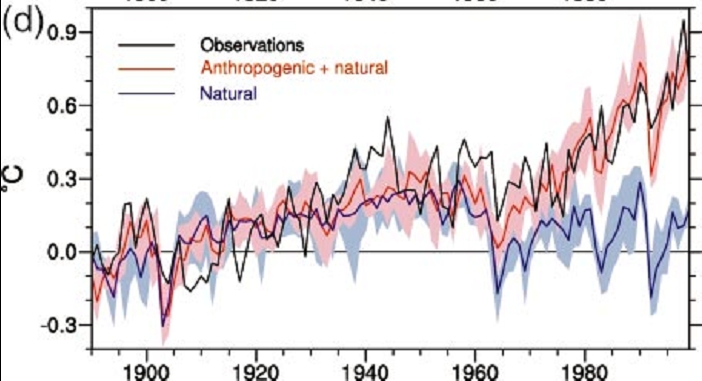
The climate varies naturally on long timescales but Meehl 2004 shows the current warming can't be accounted for by natural forcings. Greenhouse gas emissions are the only way we can explain the temperatures over the last ~40 years.
-
Re:Do they know if this is unusual?
I've repeatedly argued that we need to start building as many modern nuclear fission plants as possible. Preferably pebble bed reactors, using breeder reactors and reprocessing techniques to turn the waste into useful fuel.
And as I've explained on my homepage, I think that cap-and-trade will make coal less profitable, and nuclear power more profitable. It's a very capitalistic approach to the problem of climate change.
-
Re:Do they know if this is unusual?
Exactly. I've described my research into Greenland's ice sheets. My most recent estimates show that Greenland as a whole is losing ~100 Gtons of ice every year, but my advisor believes my estimate is too low by a factor of 2. As you say, northern Greenland is gaining mass, but southestern Greenland is losing much more mass. Climate change is a very serious problem, and I'm really annoyed that health care is currently distracting the Senate from an issue that affects the future of the entire human race.
-
Re:Global Warming
I was actually thinking of that guy in Colorado (Peilke?) who has long argued that global atmospheric heat content is what we should be talking about.
Looked around for Pielke's work mentioning heat content and found this. Is that a good reference? I agree that internal energy of the Earth is a more robust and useful variable than temperature, but I'd go one step further. That is, a much more useful variable would be the internal energy of the atmosphere and ocean combined. That would eliminate the spurious temperature swings associated with ENSO events that seem to mislead many people. This heat transfer between the atmosphere and oceans wouldn't distort such a metric.
You are correct that heat is only one form of internal energy, although physicists have a slightly different take on the nature of heat than chemists, so I don't agree with your characterization of heat as strictly a type of energy transfer.
Actually, I'm a physicist too. Never was that good at chemistry. I still think heat is a form of energy transfer, not a state variable. But I'll drop this argument because (like your point) it doesn't seem particularly interesting or relevant.
So yes, by all means be pedantic and talk about "atmospheric internal energy". That is a physically meaningful quality, whereas neither you nor anyone else has suggested why taking any kind of average of dry-bulb temperatures is in any way physically interesting. And if it is not physically interesting, it is not climatologically interesting.
The internal energy of the atmosphere is a weighted mean of temperatures, where the weightings reflect differing heat capacities. A global average temperature cannot be used to determine the internal energy of the atmosphere because it isn't properly weighted (as I believe you're saying.) But as I've said, even an unweighted average improves the signal-to-noise ratio of temperature trends. More measurements improve the statistics in the same way multi-model ensembles improve climate predictions compared to single-model runs. The global temperature isn't intended as a formal variable, it's simply an easy-to-measure diagnostic of the global climate.
-
Re:Commercial art vs. art that feeds your soul
But honestly, I get 80% of the way there encounter a few interesting problems, overcome them, get 90% of the way there, encounter some pain in the ass problem and stop. After all, the code technically DOES most of the interesting things I want it to do, just not without a small manual tweak here and there. Am I the only one that gets bored like this?
I'm the same way; short attention span and insufficiently masochistic to bother with the finishing touches. But I do enjoy removing the need for manual tweaks. I once spent a ridiculous amount of time automating a system to notify me that a calculation has, for instance, "12 days, 7 hours" remaining. It's easy to write a function that does this but requires frequent manual tweaking, but a fully automated version was surprisingly involved (and still unfinished.) Eventually, an autosave/autorecover functionality was built into this function which is guaranteed to run at a user-specified interval to avoid slowing down the calculation with too-frequent saves but still protects against hardware/software glitches. I like this kind of proactively lazy coding, and often consider my job to be that of building a science factory that is mostly (and hopefully intelligently) automated.
-
Some ideas...
- Graduate education should include mandatory classroom instruction, and a heavier emphasis on giving presentations. I regularly suffer through my colleagues' miserable presentations at conferences, so I strongly believe that scientists need to develop better communication skills.
- Re-orient science classes so they emphasise curiosity and skepticism rather than rote memorization. I've previously complained about the sad state of science education in high school and general collegiate physics courses. Some people still believe that the seasons are caused by the Earth moving farther towards/away from the Sun, and that sinks/bathtubs drain differently in different hemispheres. Maybe if science classes actually taught people how to think like scientists, these silly myths wouldn't be as widespread. Maybe people would even be interested in science in general if they didn't see the subject as a bunch of equations to be mechanically applied.
- The scientific community has a tendency to ignore bizarre claims because they don't want to give credibility to people who believe in things like creationism, electric universe, climate-change-denialism, moon-landing-hoaxers, relativity-deniers, etc. This isn't very productive, because some people apparently get the impression that scientists dismiss these fringe views because of a massive conspiracy of suppression. I think it's a better idea to slowly and patiently explain why these examples of pseudoscience simply aren't consistent with the available evidence. I'm trying to do that on my homepage, but there's only one of me versus a horde of pseudoscientists...
- Science journals need to be made open source, like PLoS ONE and ACP. Maybe the general public's science illiteracy is partially based on the fact that crackpots publish their "research" freely on the internet (which is why the internet is now a tarpit of scientific misinformation), whereas scientists publish articles in peer-reviewed journals that can't be accessed by anyone outside of a major university.
As you can tell, I think this article touches on a very serious problem. Sagan said it best:
"We have designed our civilization based on science and technology and at the same time arranged things so that almost no one understands anything at all about science and technology. This is a clear prescription for disaster." -- Carl Sagan
-
Re:And this is where you would be wrong
Sorry, how do you prove that any portion is anthropogenic when you don't have a control?
See Meehl 2004 for a primary source, but I've also recently discussed a very similar issue.
As a scientist looking at the global warming debate
Just curious: what degree in which field of science? I've described my research here, for quid pro quo.
... it always marvels me that no-one ever talks about the effect that water vapor has on global temperatures, given that water vapor has a heat capacity of 1.8 kJ/kgK, while CO2 has a heat capacity of only 0.8 kJ/kgK, and also given that the concentration of water vapor on average is composes 10X more of the atmosphere than CO2, meaning that the total impact of CO2 is about 20 fold less than water vapor, which is itself highly variable in concentration. Why doesn't anyone ever complain about the deleterious effects of water vapor in the atmosphere? Why aren't we moving to ban hydrogen vehicles that put out huge amounts of water vapor?
I've talked about water vapor in depth, repeatedly. As I've explained, water vapor is a feedback, not a forcing. It's not dangerous because it doesn't remain in the atmosphere long and isn't well-mixed to the top of the atmosphere. That's why legitimate peer-reviewed journal articles don't "complain about the deleterious effects of water vapor in the atmosphere."
What this discovery points out is that, well, maybe we don't really have a handle on this global warming thing, and that we shouldn't cut off the arms and legs of our civilization with an environmentally friendly electric chainsaw before we have a full grasp of what is going on here.
First, this discovery isn't related to abrupt climate change in any significant manner. Second, the goal of the legislation in the Senate is to jumpstart a new industrial revolution. No chainsaw involved.
Therefore, if you want to decrease humanities carbon emissions without murdering people, or subjecting them to poverty, you need only remove all regulations limiting the implementation of nuclear power around the world.
Murderous hyperbole aside, this isn't far from the mark. I'd say we have to make small tamper-proof nuclear reactors like SSTAR available to developing nations, but keep the reprocessing and enrichment technologies tightly restricted. Actinide poisoning of the fuel (to make weaponization more difficult than simply starting a clandestine enrichment program) is also probably a good idea.