Slashdot Mirror
Domain: eclipse.org
Stories and comments across the archive that link to eclipse.org.
Comments · 927
-
Re:So it's like LLVM?
-
Re:techniques
You are assuming that these things do not exist for terminal based editors. They do. It is all about customizing your environment. No, I wouldn't want to use plain old vi for anything other than a quick job, but I get all those things you listed with vim (for example) and I get what vi offers and I don't have to wait for any three rings circuses whatsoever.
You front loaded part of my three-ring-circus-waiting-time with your customization efforts. I may have to wait 30 seconds for the splash screen and the IDE to load up the project, but you just acknowledged that you also spend some amount of time every time you begin developing in a new environment. (And I'd maintain that the graphical presentation of source or program architecture is also valuable, but again not everyone needs or wants it.)
Show me an IDE with a Turing complete context menu and I'll readily concede that point.
Here's one way to do it in Eclipse and here's one way in Visual Studio 2005. I've used it to create a plugin that automates the generation of CppUnit unit test skeletons. I've also created a plugin for VS6 (a very long time ago) that automated the maintenance of a project by watching a folder for new source code modules, automatically adding them into the project, and then building with them. I suppose if someone cared hard enough, they could implement ed in a context menu accessible dialog box, using ! as the menu accelerator key. That actually sounds kind of cool...hmm... anyway, it sounds better than Clippy for vi.
And I totally get your point that some people prefer IDEs. The problem I have is the attitude those people often display is that IDEs are only for beginners or bad coders, which simply is not true. And many of them do it very arrogantly, which is quite off-putting.
I think the bad rep that IDEs get is that people don't see it as the difference between a performance enhancing tool and training wheels. Look at it with different users, though, and it becomes obvious why there can be differences of opinion.
- Do the productivity gains given by an IDE enable a bad coder to write more bad code? Yes, and I think that is heavily related to the biases against IDEs. It enables stupid people to make more mistakes per hour. But that's no different than a stupid person buying a fast car. It doesn't make fast cars bad, it just means stupid people can go faster.
- Will an IDE make a bad coder better? No, although that's a mistaken impression a lot of managers have because the bad coders are more productive. Productive != better.
- Will an IDE help a bad coder become better? (Note the distinction between the previous question.) I believe the complexity of the tools may often hinder learning by hiding important foundational knowledge inside "wizards" or "code generators." But because those tools make a good programmer more productive, they shouldn't be eliminated. Someone will become better only if they're personally interested in improving their skills, but that has nothing to do with their choice of tools.
- Will an IDE make a good coder worse? Absolutely not. There's a learning curve, of course, but anyone able to master programming will have no problem picking up such a tool.
- Will an IDE make a good coder better? I have seen that it can, especially when you're dealing with more than one programmer on a project. Plug in a real-time static code analyzer, and they find mistakes fast. Plug in an architecture visualizer, and they can instantly see if someone is violating layer encapsulation. Plug in a code generator and you el
-
Re:For me.
Agreed. Java GUIs always have a certain "look" to them you can spot right away.
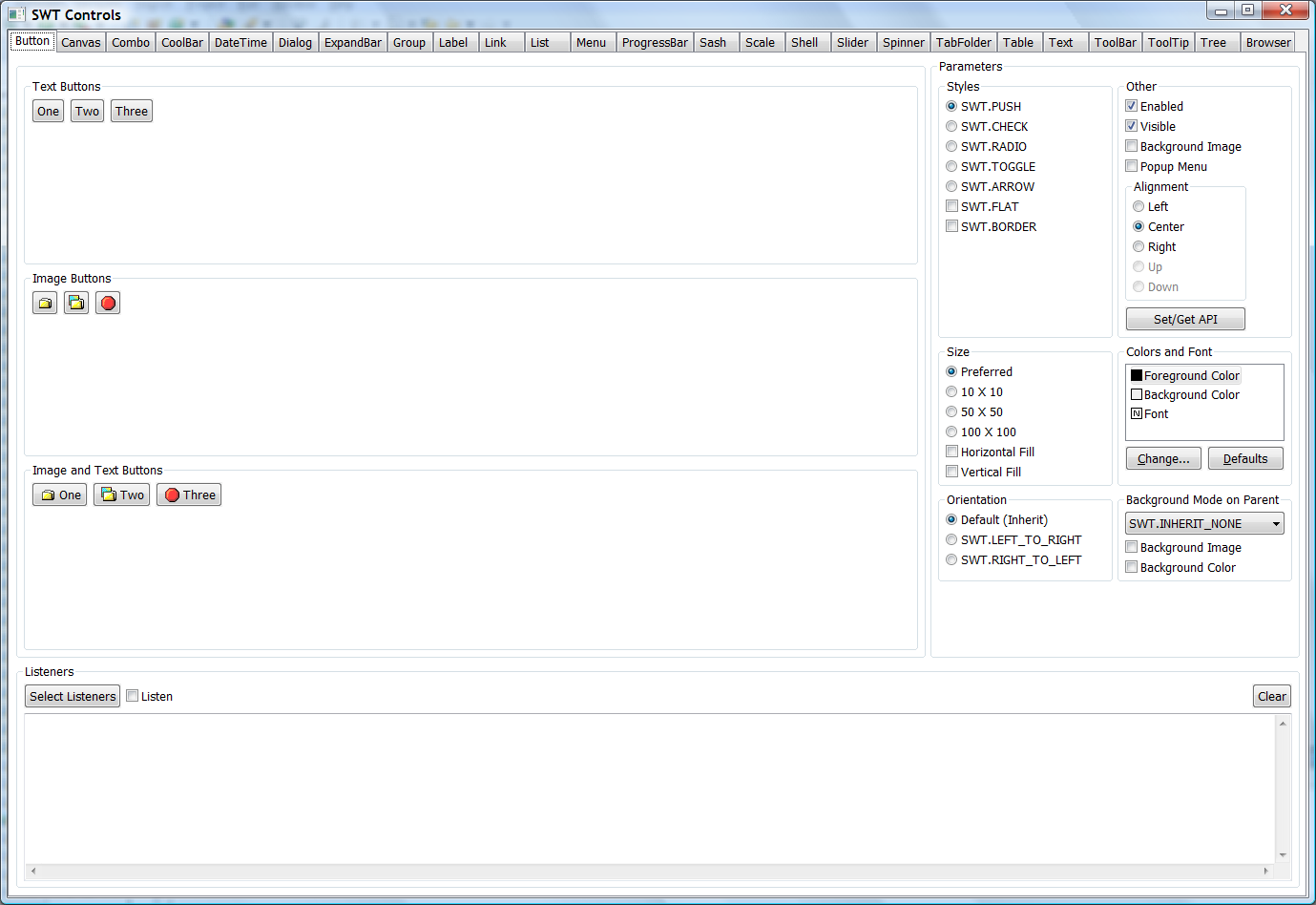
Not always. Please try spotting that "look" here:
http://www.eclipse.org/swt/or here:
http://www.eclipse.org/screenshots/images/SDK-RedFlag_Linux.png -
Re:For me.
Agreed. Java GUIs always have a certain "look" to them you can spot right away.
Not always. Please try spotting that "look" here:
http://www.eclipse.org/swt/or here:
http://www.eclipse.org/screenshots/images/SDK-RedFlag_Linux.png -
Re:For me.
Many of them do, yes, but that's not because of java as much is it is that people take the easy way out and don't put any effort into the look. It's the same way that most visual basic apps look like crap. Even though VB uses the exact same controls as other windows apps, people put no real effort into making it look nice. They leave things at the default (like not adjust the button height, so all your buttons are plump) and just throw things together without giving it much thought.
It is possible to have nice looking java GUIs. For example, look at Eclipse:
http://www.eclipse.org/screenshots/images/SDK-RedFlag_Linux.pngEclipse was built using SWT:
http://www.eclipse.org/swt/ -
Re:For me.
Many of them do, yes, but that's not because of java as much is it is that people take the easy way out and don't put any effort into the look. It's the same way that most visual basic apps look like crap. Even though VB uses the exact same controls as other windows apps, people put no real effort into making it look nice. They leave things at the default (like not adjust the button height, so all your buttons are plump) and just throw things together without giving it much thought.
It is possible to have nice looking java GUIs. For example, look at Eclipse:
http://www.eclipse.org/screenshots/images/SDK-RedFlag_Linux.pngEclipse was built using SWT:
http://www.eclipse.org/swt/ -
Re:Java and .NET falling by the wayside?
Java runs on lots of things, but thats not my point. Will every Java application run on all JVMs? No.
Take Azureus for example - built in Java, but separate downloads for OSX and Windows. And thats all too common in the Java world...
That's because Azureus/Vuze uses SWT, a GUI library developed by IBM that isn't shipped with Java. Because it interfaces with the OS's GUI drawing toolkit, it has a separate version for each OS.
They could have a common download, plus let you download SWT separately, but at a guess they don't (azureus.sourceforge.net is blocked where I work so I can't check).
-
Re:I am a Silverlight Developer
You are are
http://www.eclipse.org/rap/
http://www.eclipse.org/rap/demos/It runs in all web browsers, 100% HTML, no plugins needed, and is very rich experience, it is like a real desktop application but in your browser.
-
Re:I am a Silverlight Developer
You are are
http://www.eclipse.org/rap/
http://www.eclipse.org/rap/demos/It runs in all web browsers, 100% HTML, no plugins needed, and is very rich experience, it is like a real desktop application but in your browser.
-
URL speech
-
That depends
But you will have a hard time distributing your application if it means that you cannot also distribute the libraries that you depend upon.
The internet is a great thing.
Stallman, et al. have publicly taken the position that it doesn't matter who does the linking (the app developer or the customer), that it's still a violation.
I believe that if I write an application that needs a GPLed dynamic library component (for example, one that just happens to be available on most modern Linux distros), that I'm in the clear if I distribute the app. Or even if I distribute the app in a package that calls out the GPLed component as a dependency.
Now, I can easily believe that someone like Canonical might be in trouble if they distribute this app, because they're also distributing the GPLed library. But I think I would be fine just distributing my app, and I think that if I did so, the FSF might wail and gnash their teeth about it, but in the end they wouldn't do anything.
For example, the Eclipse license FAQ states that a plugin is not a derivative work, and yet that "Based upon the position of the Free Software Foundation, you may not combine EPL and GPL code in any scenario where linking exists between code made available under those licenses."
This is IBM very charitably saying "we don't believe this and don't care or enforce it, but obviously the FSF believes this deeply.
I, myself, contribute to a BSD licensed library that can make use of a GPLed library if it's installed. We don't distribute the GPLed library, so I don't think there is an issue. In a way, I'd actually like to see the FSF sue someone about this to get some caselaw on the subject, but they're way too smart for that. Much easier just to sling FUD, even if you do have to write all sorts of monotonous FAQs filled with half-truths. (At least, the FAQs do serve the valid purpose of keeping someone from committing an actual license violation by shipping GPL and non-GPL code side by side, but all the dancing on the head of the pin to avoid admitting there are some nuanced cases that the GPL can't and doesn't control gets annoying after awhile.)
-
Re:Alternatives?
Are you saying that Websphere and Weblogic don't have any JSF dependencies?
The last time I looked, there were very significant Apache dependencies in both Weblogic and Websphere.Lets take a look, specifically at JSF implementations.
Weblogic uses "Sun Microsystems JavaServer Faces Implementation" 1.2-b20-FCS - or 1_2_03-rc2. (Source)
Websphere 7 has the option of two JSF implementations. The default is "Sun Reference Implementation 1.2." The other option is Apache MyFaces 1.2. (Source)
Sounds to me like the reference implementation of JSF 1.2 is the preferred version in these two products!
Even Jetty will have some Apache stuff in its pom.xml, won't it?
Jetty's main configuration file is jetty.xml.
pom.xml is part of an Apache Maven project. Even if you choose to deploy said project to Jetty, that file will not be present in the war/ear file you deploy to Jetty.
-
Re:So obvious question...
Maybe you should stop using '95 AWT and try current GUI libraries like SWT.
-
Re:Why should a non-techie learn programming?
C is certainly not the easiest language to learn but it will give you a very solid base that will make every other language easier to pick up. And yeah, most books are focused on boring bussiness applications but you need to remeber that it's programming you're learning, the bussiness apps are just contrived examples that are designed to touch on all of the basic programming elements.
THE classic C book is K&R, it does not have example applications, it has examples of techniques. If you take the (non-trivial) time to understand K&R from cover to cover you will still not know how to write MIDI drivers but your skills will be such that it will be easy for you to pick it up in a couple of days.
Note that K&R uses unix as it's example operating system but it does not teach you how to compile/link on any OS. Linux distro's usually have the compiler/linker already installed. If you want to use windows then you will need to find (and learn) an IDE, a respectable freebie is Eclipse. -
Re:looks and simplicity over function
Apple has and always will be a company that prioritizes looks and simplicity over function.
I got my MacBook Pro because of functionality and price not because it looks better. Hell, other than the Apple logo on the cover it looks the same as laptops from other companies. And yes I included "price" above. Before I bought my MBP I compared the prices of a few laptops from different companies at the price of the MBP was only $50 higher than the cheapest laptop but much lower than other prices.
It's the same reason their products have almost no user options.
What user options? Like the option to run X11 and apps for it? Like the option of installing
Falcon
-
So Many Choices
There are some web sites dedicated to just source code: http://www.codeproject.com/ is a great place to find useful small applications with an explanation. http://sourceforge.net/ has excellent code. http://apache.org/ has very good projects. These sites don't require you to retype anything. While the programs in codeproject are small, some of the projects in source forge and apache are huge -- but many have very good small tutorials to get you up and running. For little hardware projects look at http://www.instructables.com/. Even the commercial products now have incredible online resources that in many ways surpass what we got in Byte, if you're not familiar with http://msdn.microsft.com/ check it out. Another approach is to install Linux, Ubuntu, Fedora, or any distribution comes with a package manager that allows you to browse applications by the thousands. I set one up in my house and my daughter had Tux Racer installed before I got home from work the next day. Computer magazines didn't go away, they were eclipsed. Oh did I mention http://eclipse.org/ its a full IDE, open source and a development environment as well.
-
Re:Don't let reality get in the way of your anger
everything that is useful in business except for graphic design and web design is run on a PC using Windows XP or Windows 7.
Really? There is no Microsoft Office for Macs? Nor any other office suite? Then I must of been mistaken when I got my Mac and saw a 30 day trial of MS Office installed on it, and I don''t have NeoOffice or Eclipse on it now.
Falcon
-
Re:Scared iPhone developer
I can't see how hobbyists would care for 100% coverage across all devices. Additionally, the UI toolkit for android is basically the same for all versions of the phone. Plus, you can write as many resolution implementations as you like more or less simply by the editor. Hell, why bother spewing useless anecdotes. Just go and get the SDK. It is FREE. Give it a try for 5 days and determine for yourself if its worth beans for YOU.
Eclipse IDE:
http://www.eclipse.org/downloads/Android SDK:
http://developer.android.com/sdk/index.htmlAndroid / Eclipse Integration:
http://developer.android.com/sdk/eclipse-adt.html -
I am still ticked off at Borland.
When I bought my Amiga 1000 part of the reason was that they advertised TurboPascal for the Amiga.
I bought a used Amiga 500 but I don't know if either Turbo Pascal and Turbo C was available for it. I did buy Borland C++ Powerbuilder for my PCs, one running Win 95 another with a DEC Alpha running NT4. The Win 95 PC is long dead and gone but the NT4 PC is under my desk. What I find ironic is that of all commercial software I bought the only one I was able to install on the Alpha was C++ Powerbuilder.
Do you have any idea how much software was written in Turbo Pascal and Turbo C?
And how much of it might have been ported to the Amiga?A lot, that's it. I don't know how much commercial software was written with them. When I took Pascal and C/C++ those are what we used in my classes. Now I use, only to relearn and continue Java but I haven't done much lately because it hasn't been running right, is Eclipse. As for how much was written for Amiga OS/Workbench I don't know. I say about programming with the Mac, Macs can be used to write programs that run on Linux, Macs, and Windows. Well Amigas was able to do that and program for Amigas. From a purely development/programming perspective using an Amiga seemed best. Of course the user interface would have to do programmed separately, however that's where modularity and UML comes in.
Just to many misses.
I'm not sure what you mean here, but I'll answer as if you mean not many programs were written for Amigas. If more Amigas were sold more software would have been written for it. Demand stimulates production. When Microsoft started it had software written for a number of microcomputer systems from Altairs with Intel 8080 CPUs to systems with Motorola 6800 CPUs to Tandy (Radio Shack) TRS-80s with a Zilog Z80 CPU. Even today MS programs for Macs. MS never stopped programming for Apple, though Bill Gates threatened to stop.
Falcon
-
Re:For years?!
Troll. Client side java applications are still very popular in enterprises where something richer than a typical webapp is required (though this may change as browser tech matures), and JWS is a convenient medium for deploying them. Hell, even Eclipse RCP applications can be deployed with webstart.
-
Re:If Only There Was a Way to Integrate This
*Stands out of Chair*
YOU'VE INSPIRED ME.
I've got it. Imagine like... an environment... a virtual environment... thats integrated into the language you are developing in. Just the concept of it is groundbreaking. You could customize it however you want! Now, imagine this... right... the integrated development environment was capable of performing everything you just said!Why, I don't think anyone has ever thought of this before. Not Microsoft, not even the open source community!
Seriously John, lets jump on this.
-
Re:Why C?
orly? because applications using SWT are indistinguishable from native applications: http://www.eclipse.org/
-
Re:Lemmings
there's generally only 1 way to do a specific task which makes it really easy to read somebody else's code
You can certainly write obfuscated code in any language. Simply name your variables poorly and you're done!
But what I mean is that you can generally tell what the JVM will do with any piece of code, even if you don't know what the programmer is attempting. This is definitely not true of C++. Because of operator overloading, even the simplest looking code could compile in unexpected ways. For example, "a == b" looks like a simple comparison. But it might invoke the overloaded comparison operator if it has been defined. Or worse, the compiler might decide that the only way to make the comparison work is to do all sorts of type-conversion on the sides until it can find one that works. It certainly allows it to compile, but it probably won't do the operation the way you expected.
If you see "a->b" do you know that the dereference operator won't initiate some long running algorithm (maybe a computationally heavy database lookup of "a" in some remote location)? I think we both agree that doing anything like that would be bad form. But you cannot know that's not happening simply by looking at the source.
To address your bullet points, java has a few simple rules:
1) If the type name starts with a capital (Object, Integer, etc), it's an object. You can only get a pointer to it. It is always passed by reference.
2) If the type name starts with a lower-case (int, float, char) it's a primitive. You cannot get a pointer to it. It is always passed by value.
Regarding null pointer exceptions, as with dereferencing NULL memory in C family languages, they usually indicate a bug or design flaw: either an uninitialized value or the unchecked result of a map lookup. However, if you cannot fix the design, you can catch them like any other exception and let your thread continue where it left off. This is different from C family languages where those sorts of bugs give you either a crash, or unknowing access to rotten memory. At least with the NPE you get a stack trace and can find it!
Java is very verbose. However, the pain from that can be mitigated significantly by using an IDE that types most of it for you like eclipse
-
Re:I've.never.used.groovy.so.I.have.a.question.
While it's true that Java's library is highly hierarchical, you don't type out whole namespace paths all the time. You just import namespaces.
Java 5 also features static imports:
import static java.lang.Math.PI;
import static java.lang.Math.*;double r = cos(PI * theta);
Free Java IDEs like Eclipse and Netbeans manage imports automatically. You don't have to type them out.
-
Mylyn in Eclipse
I've recently been using Mylyn to give me a focussed view on the code I'm working on. I love the way it automatically adds things to the context as I click around.
Then of course there's the rather gorgeous "Run unit tests in context" to give me feedback on the things I've been tinkering with.
-
Re:eclipse?
Eclipse has an open source Data Tools Platform
For an extremely laid-back Zen-like stream-of-consciousness definition of "has". My stream of consciousness experience trying to grok this thing was extremely irritating.
From Eclipse Data Tools Platform (DTP) Project
"Data Tools" is a vast domain, yet there are a fairly small number of foundational requirements when developing with or managing data-centric systems. (What does it do?) A developer is interested in an environment that is easy to configure (what does it do?), one in which the challenges of application development are due to the problem domain (what does it do?), not the complexity of the tools employed. (What does it do?) Data management, whether by a developer working on an application (what does it do?), or an administrator maintaining or monitoring a production system (what does it do?), should also provide a consistent (what does it do?), highly usable environment that works well with associated technologies. (What does it do?)
Three rules plucked from Ten rules for writing fiction by Elmore Leonard
Never open a book with weather. If it's only to create atmosphere, and not a character's reaction to the weather, you don't want to go on too long. The reader^H^H^H^H^H^Hgeek is apt to leaf ahead looking for people^H^H^H^H^H^Hpurpose.
Don't go into great detail describing places and things (or meta framework), unless you're Margaret Atwood and can paint scenes with language. You don't want descriptions that bring the action, the flow of the story, to a standstill.
Try to leave out the part that readers tend to skip. Think of what you skip reading a novel: thick paragraphs of prose you can see have too many words in them.
I generally get along well with Eclipse, but for the love of God:
What does DTP do?
-
Re:eclipse?
Who modded him offtopic?
Eclipse has an open source Data Tools Platform -
Re:See, this is why I come here
...and only with programs that they want you to use...
Wait, what?! How do you people not get modded down for this blatant misinformation? There are absolutely no restrictions on what applications you can run on OSX, as evidenced by the vast selection of free and open source software available for it, much of it competing directly with apple products.
-
Re:Integration
You can do that management using a web based solution like Trac. AFAIK there are Eclipse/Trac integration plugins. Eclipse Mylyn for example.
-
Re:Why bother?
WTF? It's like saying somebody should buy an F1 car just because it's fastest
I agree 100%. People should buy a machine to suit their needs. Anyone who blindly buys the fastest model available is just being egotistical and foolish.
which does not cost them their house and children
A new Mac mini goes for $599 and a MacBook is $999. This is hardly "house and children" figures. Pick a reasonable Mac then go to Dell and spec out a similar machine. The PC prices will be in a close neighborhood.
not require special fuel and can run on ordinary road
This article is not about the iPhone. It is about Apple systems running OS X that can utilize Boot Camp.
Hardly any "special fuel" required on OS X systems. Take your pick from any of the great open source apps available for the platform: Firefox, Thunderbird, Inkscape, Gimp, VLC, Eclipse, the list goes on. Wanna write some code? Xcode comes free with OS X. Don't wanna use Xcode, then use another IDE or directly use make, gcc, gdb, and vim.
As for your "ordinary road" comment
Way to go on a tangent!
Way to spread FUD. How about we just let people use the computer that best suits their needs.
Getting back on topic, I've been running Windows 7 in both Boot Camp and Parallels 5 with no problems. I don't know what the damage is with this "article".
-
Netbeans ( or others )
Netbeans with the Vi Vim for netbeans plugin.
Netbeans is FOSS, runs on Windows, Linux and OS X. It handles Java, C/C++, PHP, Python, Ruby, Groovy and does a bunch of other stuff.
There is the viPlugin for Eclipse as well - I just happen to like Netbeans better.
The ActiveState folks list VI key bindings as a feature for their Komodo and Komodo Edit products. These are closed source though Komodo Edit is free as in beer. It is cross platform - covering the win/lin/mac world.
I'm sure there are other options but those are the largest projects I know of that do what you want. -
Re:switchers
If you wanted better treatment then why switch to a company that is incredibly sue happy and restrictive? Even the iphone developers have to sign NDA's.
I have never had a problem with that. And though I am not now I used to be a member of the Apple Developer Connection. Going through the iPhone Dev Center I see nothing that says anything about Apple being restrictive and needing to sign NDAs. Searching ADC for NDA I found this: Is content under NDA?
"No. All information presented during the iPhone Tech Talk World Tour is public information and based on the current released versions of iPhone OS 3.0 and the iPhone OS 3.0 SDK."
Now as regards LLVM Open-Source Community Information it says this:
"Reminder: Please do not discuss Xcode information covered under your NDA with Apple in these mailing lists."
Lastly there's LLVM-GCC 4.2 Release Notes which says the same thing.The only, and I mean ONLY Apple requirement for an NDA deals with XCode. Though I have XCode installed I have yet to use it, I use Eclipse which Apple has a downloadable development tool.
Get off my lawn, young-un,
When I got my first Microsoft PC, Linux hadn't even been invented. Heck, Linus hadn't even enrolled in university. It didn't even come with a GUI.
Either you didn't read what I said or you missed where I said "Before I ever got my Linux PC and Mac I wondered why I ever got a Windows PC instead of a Mac, back when I got my first Windows PC you had to be a wizard to install and use Linux. But SGI Irix [wikipedia.org] PCs were available." Right under the desk I'm sitting at I still have my Windows NT4 Workstation, which is more than 10 years old. Not only that but it's CPU is an older DEC Alpha which was new when I got it.
you seem to bash anything slightly critical of a Mac
Now where have I bashed rational Apple criticism? I myself have repeatedly criticized Apple.
I see no reason to continue this when you make things up.
Falcon
-
Re:Hard to deny
Apple is/has become/always was an arrogant company with regard to customer service
Apple has always had a good customer service rating. Year after year Apple was ranked near if not at the top surveys on customer service. After using Windows PC, and dealing with the hassles thereof, for about 10 years I switched to Linux and Mac. In the more than 2 years I've had my Mac I only had one problem with Apple service, which I was expecting. I tried to use Eclipse for programming when I got an error. I knew they probably wouldn't but I was hoping an Apple tech would help me with it, instead I was told to try to get help in the Apple developer forums online.
Falcon
-
Oracle is a big Eclipse supporter too - OEPEDisclaimer - I work for Oracle and came from the BEA Systems acquisition.
My personal opinion is that Oracle is very dedicated to the entire Eclipse ecosystem as well as to JDeveloper. It's about choice. There is an entire free download product that is continually being enhanced called the Oracle Enterprise Pack for Eclipse (Oh-Pee is how we say it within Oracle). In fact I believe it was one of the first, if not the first commercial IDE to support the latest Eclipse 3.5 Galileo. http://www.oracle.com/technology/products/enterprise-pack-for-eclipse/index.html OEPE is targeted for Java and JEE developers and is mostly about supporting the Java standards. Additionally, the majority of the TopLink code was donated as the EclipseLink project and is currently the JPA reference implementation. Just take a look at the presence has at the next Eclipse conference and I think you will see that Oracle is committed to Eclipse. http://www.eclipse.org/eclipselink/
When you get into the "upper-stack" components like SOA Suite for integration and WebCenter Suite for enterprise portal development, and Oracle's Application Development Framework (ADF) that Oracle strongly recommends JDeveloper. Those products have been based on JDeveloper for a long time and the user-experience developing for those products is extremely smooth because Oracle can influence everything about the IDE. If you want to do Java and JEE development in JDeveloper, you can do that too. It's your choice.
-
Re:NetBeans? Really?
A visual Java swing application designer that works for starters!
Like this? (Actually, last I checked, that was horrible for Swing GUIs, but that was a long time ago.)
-
Cygwin or UWIN
If you want "close to the metal" POSIX API compatibility then there's Cygwin which is easier to use IMO and more actively developed but doesn't support the *full* POSIX spec or there is UWIN which supports most of the POSIX spec.
Combine this with OpenGL, OpenAL, the SDL and Cygwin/X, QT, a Java layer using the SWT from Eclipse, *shudder* GLUT *shudder*
jdb2 -
(Non) Reliability
It happens on a lot of levels and with lots of software. It is IMO one of the key issues which might hinder OSS to be adopted in a more professional way. Do note that I'm not stating that this is the case for each and every open source application out there, but there are a lot..
I've experienced this same kind of situation myself.. I'm a fan of the Java language and utilize this both professionally and as a hobby. Do note that I'm not a full time programmer. I've started out with NetBeans version 4.1 and basically kept following the developments around the IDE, now a full platform. The somewhat counter part of NetBeans, Sun Studio, offered support for UML diagrams. And it didn't took the NB developers too long to port UML support into NetBeans. And I can tell from personal experience that they did a really nice job. It wasn't perfect, it was still rough on the edges so to speak, with a few bugs here and there. But as long as you were familiar with the product you could do a lot. And the same applied to NetBeans.
Now all went relatively well until version 6 of NetBeans was released. That version became quite controversial even though I'll be the first to admit that they have done a really fine job. They basically rewrote the entire thing in order to clean out the code. As a semi-professional developer I can recognize and admire the technical impact this must have had. Don't get me wrong here. But as an end user I was appalled to see that several big and important features were gone all of a sudden. No more support for Bean Patterns (an option which made it easier to add or remove fields from a JavaBean), no longer would it offer an overview for JavaDoc (a separate window which would immediately show you what methods and fields you commented, which ones weren't consistent with the actual method or field and which still needed to be commented), and so on.
SO although it also offered a lot of new features (more modular support, support for other languages, etc) one of the primary basics was slightly crippled. Naturally all of this was fixed eventually, right now I'm also a very happy NetBeans 6.7.1 user and it does everything I need. Everything but one thing...
With the full code rewrite many modules also needed to change in order to be compliant with the new standards. Many succeeded, and many didn't. One of those was the UML plugin. Ironically enough for me it was NetBeans / Studio One which somewhat aroused my interest for UML diagrams. And when NetBeans 6.5 got released it was this particular feature which got totally crippled. It was hardly possible to create any decent diagrams, and to make matters worse the plugin now suddenly stopped supporting some (for me) important diagram types (like deployment, sequence, object). And so I eventually stuck to NetBeans 6.1 because I really needed UML support.
Until I suddenly noticed an article on the UML plugin webpage which mentioned Visual Paradigm. Its a company which developes UML modelling software, and one of their key products is the so called Smart Development Environment. And in my opinion its brilliant! Commercial, but brilliant.
This is a plugin which can embed itself in all of the major (Java) IDE's currently available; From Microsofts Visual Studio
-
Re:Shard of glass in my delicious pie! *gruff*
get eclipse http://www.eclipse.org/downloads/ and jdk - that's it. happy coding!
-
Re:closing source
I got into programming probably because the programs on the Apple 2+ system disk had visible source code.
I got into computers period due to sitting in front of a trash, er TRS 80, as well as a dumb terminal connected to a mainframe downtown. I, we, didn't have access to system code. I saw how I could get a computer to do things by writing a few lines of code which is what got me interested in programming. When I started the only source code I saw was code I wrote. I then started sharing code with others.
So it's not helping programmers I mean, it's helping people by giving them the tools to become programmers if they want.
I don't know about MS Windows PCs but Macs come with tools for programmers. Xcode which comes with every Mac. Using it people can write programs in C, C++, Fortran, Objective-C, Objective-C++, Java, AppleScript, Python and Ruby. Apple has the Apple Developer Connection, that's free to join, with programming tools. If you don't want to use Xcode you can use GCC, GNU Compiler Collection. Personally I haven't used either one yet, I use Eclipse.
And yes, closing the source is a choice. It's a choice I want you to NOT have... when writing something derived from my code. Or, I want you to pay me for that choice. I see no reason why I should do anything for free for someone who isn't willing to pass the favor on.
That is your choice, and if a programmer does not want to close their source then they can use the GPL. But if a programmer does not want to close the source then they can not use to GPL. At least not unless they have the right to all of the code and they don't mind if the software is forked. I want the choice to close my source, so when I do I can use the BSD whereas when I don't I can use either license.
Falcon
-
Re:what does open mean?
(I should probably keep this in a text file on my desktop, it's a "batch of advice" which I frequently have to re-write, and it doesn't change much)
I mentioned the term "modern C++" above, though really it's better to call it "sane C++". By this I mean C++ that won't drive you nuts trying to figure out what went wrong, when something inevitably *will* go wrong. Practices that make programs more safe, and introspective.
If you already know C++ (the foundations, I mean), it'll be easier to shift to STL-dependent C++. If you're completely new to C++, these resources will still be very important, but you'll need to learn the lower-level stuff in parallel, so you can understand how STL containers/templates are built from the inside (which is important when you need to choose which ones to use).
A website that should very often sit in the background while you're coding/learning: C++ FAQ Lite. Following these rules will make it much easier to design and maintain your programs.
Another very useful website: cplusplus.com. It's a huge reference site, with a lot of examples.
The books I'd recommend:
Accelerated C++ -- higher-level to lower-level approach.
C++ Coding Standards -- similar to the C++ FAQ Lite in the nature of the advice, but covers more ground and is probably better organized.
C++ Common Knowledge -- This is for a few months down the line, delves into some nuances.
Software:
Windows: Visual Studio C++ Express -- You can force it to stick to ANSI C++. It's still the best IDE for C++ on windows (IMO).
Linux/Mac: Eclipse, probably Eclipse IDE for C/C++ Developers. Remember though that you can tweak Eclipse into just about anything.
If you're writing end-user applications, keep in mind two frameworks: Qt and wxWidgets.
Quick note about Boost: If you can create a structure using some combination of STL components, do that before resorting to Boost. Boost is highly abstracted, and you should only use the parts which would otherwise be extremely complicated to create from scratch (like regexp). -
Eclipse has shared editor functionality
Called Cola, part of the Eclipse Communication Framework
http://wiki.eclipse.org/DocShare_Plugin -
eclipse shared editor
eclipse has shared editor capability: http://wiki.eclipse.org/DocShare_Plugin I saw a demo about a year ago. I thought it was pretty cool. I don't have much need for it. I'm a loner. Regards.
-
Eclipse DocShare (Cola)
I initially read the question as being about real time remote collaboration.
If that's the case, there's Eclipse's DocShare plugin: http://wiki.eclipse.org/DocShare_Plugin
I haven't tried it, and I don't know how mature it is. But I watched a video presentation on it a while ago and it looked very promising.
-
Not Suprised
I've been teaching Eclipse Plug-in and RCP development to US Military and Defense organizations and contractors, as well as for the Australian government, for the past 3 years.
As long as the open source product can be proven as a secure technology, I don't see why the government wouldn't adopt it, especially if there are little to no licensing fees for its use. -
Re:Eclipse just runs
Yes it does. You did something wrong.
No I didn't. I founded the instructions here as well as looked at your link. Notice though how yours does not say how to install Eclipse in OS X whereas mine does. Your instructions are specifically for installing it on Windows. And someone else got a similar error as I did when they installed it in Ubuntu.
Falcon
-
Re:Eclipse just runs
Yes it does. You did something wrong.
No I didn't. I founded the instructions here as well as looked at your link. Notice though how yours does not say how to install Eclipse in OS X whereas mine does. Your instructions are specifically for installing it on Windows. And someone else got a similar error as I did when they installed it in Ubuntu.
Falcon
-
Re:Java still rules server side
It's funny that you mention Web Services, as it's one of the places Java has actually moved forwards.
Gone are the days where you need Apache Axis. Java comes with a web service stack right out of the box now. They're really easy to set up in Netbeans, too.
Unfortunately, the Java poster-child, Eclipse, hasn't adopted this web service stack yet. Not that I dislike Eclipse, but it tends to ignore things added to Java in favor of third party implementations... such as Apache Axis 1... and SWT.
Given that SWT is an Eclipse product, Eclipse has exceptionally poor support for it. Eclipse's Visual Editor Project doesn't even work on Eclipse 3.3, 3.4, or 3.5... the latest stable version of VEP being released on January 30, 2007. It finally resumed development a few months ago, but who knows how long it will be until a stable release comes out.
Servlets are downright evil. JSP's tag soup isn't much better. JSF sounds interesting, but until Facelets become more common, it's fairly useless.
Even Oracle is starting to push certain third party products. Oracle's Eclipse distribution (which we use where I work) includes plugins for webapp tools such as the Spring Framework.
-
Re:Eclipse just runs
Yes it does. You did something wrong.
-
No code completion or debugger?
"Eclipse 3.1 lacks features that MonoDevelop has, including code completion, integrated debugging, refactoring, and unit testing capabilities, Hargett claimed. "I've found in my consulting that people who install Eclipse 3.1 through the [Debian] package manager say, 'This is terrible.' " He said that customers that have installed a version of Eclipse beyond 3.1 like it."
Just out of curiosity, I just downloaded a copy of Eclipse 1.0. This build is from November 2001.
http://archive.eclipse.org/eclipse/downloads/drops/R-1.0-200111070001/index.php
For the record, it has code completion and integrated debugging. I do remember back in 2004 thinking IntelliJ IDEA's refactoring support was far better, so I suppose that was roughly the 3.0 timeframe. I guess I could track the JUnit plugin history and see which version of Eclipse started including this, but I think I've already made my point. I've got nothing against Mono, but geeze, what a load of BS...
-
Re:Will SWT and Swing ever merge in Eclipse?
Take a look at the Rich Ajax Platform Project.