Slashdot Mirror
Domain: eminent-tech.com
Stories and comments across the archive that link to eminent-tech.com.
Comments · 11
-
Re:NXT, anyone?
Planar speakers have been around for decades. Magnepan is one of the oldest, along with Martin Logan, Quad, SoundLab and the defunct Apogee. Sota and Monsoon also made planars for a while.
Yup. I was one of the people who designed and built the Monsoon-branded planar magnetic speakers. Some of the technology was licensed from http://www.eminent-tech.com/main.html.
We also looked at electrostatic speakers, including the "two sheets of conductive material with a compliant spacer" variety. It's easy to make a proof-of-concept device that makes some sound, much harder to do it properly. Problems include:
- High voltages (10s to 100s of volts) required, difficult to produce and a potential safety issue for consumer products.
- Air is surprisingly incompressible when you're dealing with small volumes.
- A single-sided electrostatic speaker is non-linear. As the two plates of the capacitor get closer, the capacitance and the attractive force increase.
- It's hard to get decent bass out of a planar speaker. The coupling to the air drops off very sharply below a certain frequency (depending on the size of the panel). -
Re:What about open source phones?
Luckily for us - er, for perverts - their clicks become smoothed into a nice 30 Hz tone.
Bring on the cell phone subwoofers.
-
Re:So what
-
right back at them
-
Re:Dumb rich material, the best market in the worl
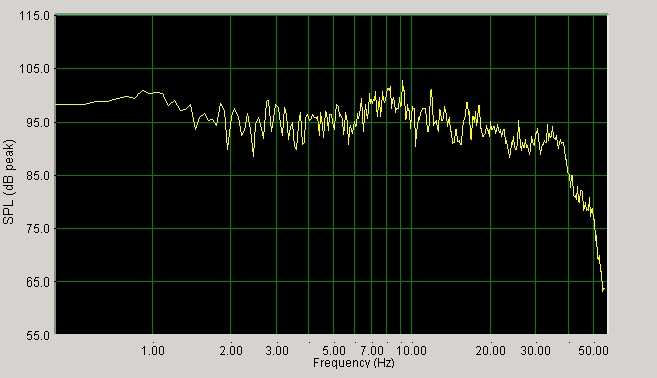
This thing is dumb for other reasons. You know what you call a 100 dB signal at 0 Hz? A stiff breeze. All this thing is doing is spinning the blades like a normal fan to give you your ability to work the fluid (air). Then, the spinning shaft is vibrated axially at whatever frequency to give you the "sound" at that frequency. Looking at the response curve here:
http://www.eminent-tech.com/graphics/RWimage2.jpg
You can see that at most frequencies, the signal is fairly noisy. But as it goes down to 0 Hz, it levels out very nicely. What's going on here? Is this a good thing? Not really. While claiming a flat response down to 0 Hz might sound cool, the effect is that you are proving what this thing really is: a fan. So the ability of this thing to perform as a speaker is dependent on two abilities: how well the fan can spin the blade (and how consistent), and how well the motor can vibrate the shaft axially. A normal speaker is only subject to the second ability, how well the speaker can vibrate the speaker cone axially. So I doubt adding another degree of complexity really helps this system to perform better than traditional systems.
Looking at the noise of the response of this thing in the 10 Hz to 20 Hz range, I'm not impressed. If you are really concerned about getting low frequencies down to around 9 Hz (or further depending on the design), check out infinite baffle (IB) subwoofers. They are custom built into the wall (floor, ceiling, etc) of your sound room with the back wave of the sound going into an infinite baffle (an adjacent room, outside, attic, basement, etc - something with a large volume), and the front wave going into your sound room. Some of these systems have been able to get flat responses down to the single-digit frequency range with very little noise. And if you do the work yourself by learning the technology, it's pretty cheap (and fun). Spend $600 on 4 15" speakers, $400 on the amps, $200 on other related electronic equipment and materials, and $100 on construction materials. And for 1/10th the cost, you can get something that performs better. -
Re:Oh bull.
-
This Guys looks to be for real.
check out this: http://www.eminent-tech.com/tonearm.html
That tonearm sells for something like $2,500. It features a captive air bearing -- there's no "ball bearing" in there. I think it has an airpump so that the thing rides on a cushion of air, like an air hockey puck.
Here's a system that is similar (in some ways) but works with water as the fluid: http://www.kugel.com/ -
Re:10K is a little high...
-
Did anyone look at the pictures?
-
Re:Monsoon Flatpanel
I agree these are nice speakers - I have a Monsoon MM-700 system on my desk.
However these are not "the speakers you'll find in Humvees". They're sold under the same Monsoon brand, but the flat-panel computer speakers are designed and manufactured by a company called Sonigistix in Richmond, BC, Canada. Last I checked, none of the Sonigistix flat-panel technology had yet made it into an automotive application.
The Monsoon speakers are based on planar-magnetic technology, partially licensed from a company called Eminent Technology. Sonigistix took the basic design, and adapted it so that the speakers could be mass-produced and sold at a lower price point. Note that there are several other flat-panel computer speakers on the market that do not use planar-magnetic technology, but instead use a "distributed-mode" technology developed by a company called "NXT". In my (biased, as a former Sonigistix employee) opinion, the planar-magnetic ones sound a lot better. -
Check out this System with Amazing Reviews
Thanks for the mention - I'm an engineer at the company that manufactures the Monsoon speakers ( Sonigistix Corporation ) and I have an MM-1000 system at home. Over the next few months we will be introducing some new models at lower price points, which we hope will be as well-received as the MM-1000 has been.
For anyone interested in the technical details of the MM-1000, it's a pair of 4x8" planar-magnetic speakers using Neodymium magnets and a mylar/aluminum diaphragm, with a regular (cone) subwoofer. The core technology has been around for many years, but we've made some advances in optimizing it for the desktop and for 3-D audio.
Another planar-magnetic computer speaker with excellent reviews is sold by Eminent Technology in Florida.