Slashdot Mirror
Domain: energypost.eu
Stories and comments across the archive that link to energypost.eu.
Comments · 15
-
Fuel cells - a great idea that completely sucks
The basic idea of a fuel cell seems so cool.
The actual physics suck. The practical considerations of trying to use them utterly suck. They aren't close to being practical for other than some niche uses.Here's some more info from people who have built fuel cell vehicles, including a couple of good links in the article:
https://energypost.eu/hydrogen...As for aircraft, in aircraft design it's all about weight.
Decrease the weight and you increase the efficiency, speed, and performance. Unfortunately fuel cells weigh 30 times as much as turbine engines - and still need to be attached to a motor. Turbine engine specific power (power-to-weight ratio) is measured in kilowatts, fuel cell specific power in watts. -
Re:Meanwhile, in America
First off, the majority of America believe in AGW. We can see it with our eyes and most of the R&D has been done here.
Secondly, while probably 75% of the GOP fight against dealing with this issue, the GOP is less than 30% of the VOTING population, which means that around 20% of voting population is against dealing with AGW. So, 80% want us to deal with it.
Thirdly, of the 75% of the GOP that are fighting against dealing with this issues, most simply are opposed to the solutions that are being pushed. That is a whole other issue.
To see which nations are REALLY fighting it, look at Eastern Europe. Poland and Chzech are but 2 that are fighting against lowering their CO2 emissions. -
Re:It's time for the merge!
Never mind the fact that electric cars are snake oil. Lithium ion production from the batteries produces a ton of CO2 and the batteries become toxic waste afterwards. Want an actually environmentally friendly alternative? Check this out.
-
Re:Complete BS
Anything we do is going to be quite an engineering project, and a number of those countries actually are quite stable. As for the "pay", part, grow the right plants and you can actually generate ethanol in a carbon-negative setup: http://energypost.eu/exclusive...
-
Re:Germany is increasing coal use. Duh.
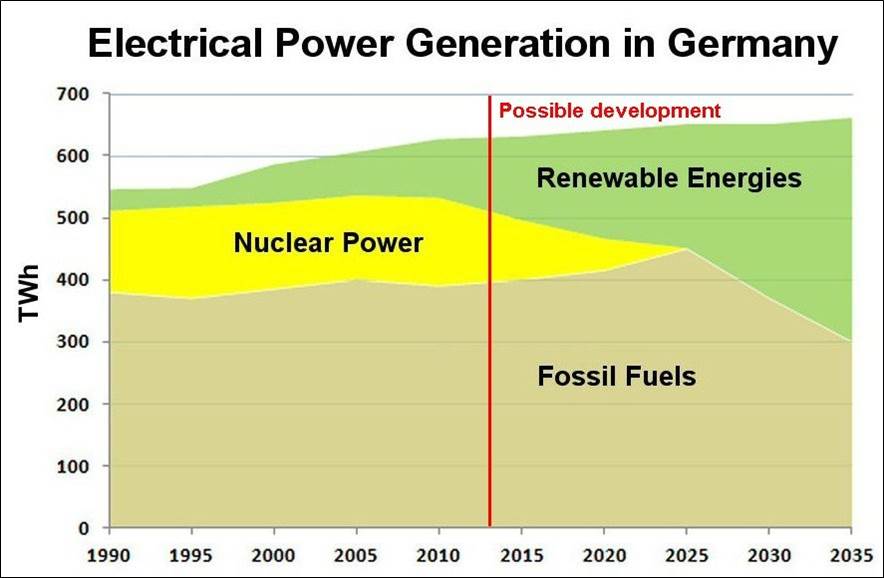
Actually it doesn't. It merely oscillates a bit between hard coal and lignite. The percentage of coal in power generation stays pretty much constant, with natural gas replacing nuclear. See here: http://energypost.eu/wp-conten...
Or another article with more details: http://environmentalprogress.o... -
Re:Nothing to do with renewables
France still plans to reduce nuclear to 50% - just not already by 2025 as planned by the old government.
http://www.mining-journal.com/...
While France exports a huge amount of electricity, this is mostly cheap surplus electricity at times of low demand. At times of high demand or many plants are down (e.g. during heat wave), it often critically depends on imports. In contrast, in the last years this was never the case for Germany.
http://energypost.eu/france-ca...
https://www.reuters.com/articl...But even in total, Germany is about to overtake France as the biggest electricity exporter - especially with all the trouble France had with its nuclear plants this year.
http://www.worldstopexports.co...
https://www.ise.fraunhofer.de/...
https://www.platts.com/latest-... -
Re:Nuclear emergency plans are wishful thinking
Strange that every statistic shows something different
Regarding CO2 emissions in electric power generation, obviously France looks much better there than Germany. No one doubted that.
My point simply was: a decent amount of electric power (roughly 10% of Frances usage) is produced by Germany.
This is focused more on 2016 and more a news than a "report": http://energypost.eu/france-ca...
This is focused on 2014 and an energy report:
You are just seeing what you want to see, not reality. Germany and France both import and export at different times. Any time either is importing, it could be claimed that they can't 'meet their power demand'. You fell for that, because you wanted to. France exports much more than it imports.
France has been the leading net exporter of electricity for years, Germany has been a close second. It is possible they produced slightly more this past year;
https://www.google.com/url?sa=...
https://www.google.com/url?sa=... -
Re:Nuclear emergency plans are wishful thinking
Strange that every statistic shows something different
Germany is the leading exporter.
And France is alternating between an leading importer for a few years and then being a small exporter again.Regarding CO2 emissions in electric power generation, obviously France looks much better there than Germany. No one doubted that.
My point simply was: a decent amount of electric power (roughly 10% of Frances usage) is produced by Germany.
This is focused more on 2016 and more a news than a "report":
http://energypost.eu/france-ca...This is focused on 2014 and an energy report:
-
Re:Really?
Fossil fuel energy generation in Germany is expected to rise to 2025. It started to raise slightly from 2010. It was dropping from 2005 to 2010. http://energypost.eu/wp-conten...
-
Re:Paris accord is a scam
You've listed a number of nuclear myths in your post. There are many more pushed by nuclear proponents.
Here's a rundown of the whole list before you post more:
http://energypost.eu/renewable...(I'd take a look at Myths 5 through 9 to address your concerns.)
-
Re:Madoff is small time compared to Musk
First, thank you for (correctly) calling out Musk as the lying, manipulative douche bag that he is. If you give his cars a bad review, he goes ape shit which results in automotive journalists being very careful what they say. As such I will never never trust a review of a Tesla.
Moving on, cars GM makes that I want/could settle for:
- Cadillac CTS-V
- Corvette C7
- Chevy Camaro
Cars Tesla makes that I want/could settle for:
- (none)
If you travel at all (I do all of the time), Tesla's entire product line is more or less useless. In addition, their cars become very expensive bricks when the batteries die and not recyclable. Meanwhile, an ICE car or hybrid such as the Volt or Karma can run forever and that ICE car is almost 100% recyclable. That, and given that Boeing found a way to produce ethanol efficiently, the more fuel inefficient your car is, the better it will become as far as CO2 goes.
-
Details.
1) Most power is still generated by burning fossil fuels. You're just moving your tailpipe elsewhere.
While at the same time, there are detailed analysis (google is your friend) concluding that
- Even in countries that mostly produce electricity by burning fossils - like TFA's US - electric cars still have a better carbon foot print simply because this "moved away giant tail pipe" is much more efficient that the "original small one" attached to an ICE.
In other words: yup, us power plant also produce carbon. BUT us power plants produce less CO2 per km than would an ICE, simply because the are optimised mostly for their efficiency, whereas the ICE is also optimised for size and for peak acceleration.- In country that don't burn fossils that much for electricity (e.g.: lots of central or northern european countries), carbon foot prints are even better than the above.
- Very few countries like China, India, Australia and a few african countries (so nothing to do with NY) are so much reliant on dirty electricity that, electric cars and ICE don't differ that much in their emissions.
2) Cars don't contribute anywhere near as much to greenhouse gasses as we are led to believe. Cow farts are actually the #1 source. Buying basic goods made abroad also contributes significantly to the problem.
Yes the industry (including agricultural industy) also produce greenhouse gasses, and in bigger quantities than cars.
That doesn't mean that you shouldn't use electric cars, that only means that you *should also* try to recude the industry's greenhouse gaz emission.
(Which is beyond the point of TFA. Also, I don't know in the US, but several countries in Europe are also working toward lowering industry/agriculture emitted greenhouse gazes. e.g.: encouraging local grown food. So it's not as if electric cars were at the detriment of fight emissions in the industry)3) The manufacturing of batteries in electric and electric hybrids is an incredibly dirty process.
4) The batteries in these cars aren't recyclable at all and will have degraded significantly after about 5 years of use. ICE cars don't need a new fuel tank every 5 years.Yeah because ICE cars grow on tree. Organic trees.
Not.
Check detailed studies, most of the serious one also take the battery manufacture into account.
So again, in anything but the few top most fossil heavy countries, the production of the battery is still offset by the reduced emissions while driving.
That includes the US (even if it relies more on fossils than others and thus the advantage is less visible).6) ICE cars can actually be carbon-negative. Boeing developed a workable method to grow ethanol in the world's deserts. Think about it: the Sahara Desert turned into a carbon sink. (Link: http://energypost.eu/exclusive...). With such a fuel, it would actually be better if everyone drove a gas guzzler until we meet an agreed upon level of carbon in the atmosphere.
Nice story, bro. But
- It's still only one of those dozens "soon, new technology will make everything better..." over-hyped big media spin on some scientific advance. (I don't want to denigrate the scientific advance, but it takes a lots of steps between the lab and actual mass production). It's still only a story in some news paper.
Whereas electric cars are currently available from several manufacturer. And low-emission electricity is also a reality in lots of countries.Until Boeing starts producing and selling huge amounts of their bio-fuel, it makes sense to support electric cars.
- Carbon foot-print gets negative *only if* this production method consumes more carbon than the bio-fuel releases at the end.
(e.g.: if only the fruit of a plant are used for fuel, and the rest of the plant stays keeping its carbon -
Re:Driving yes, but charging?'
The Tesla Model S90D has a range of 302 miles. That is an up-market car, but when the Tesla Model 3 comes out, it will have a base range of more than 200 miles, and will certainly have options for increased range with a larger battery. The Model 3 is set to cost $35000 base.
As for batteries, the life of the batteries is actually quite good, if the battery packs have a cooling system. Heat kills lithium ion batteries, so if you keep them cool they last a long time (btw. don't buy a Nissan Leaf...last I heard, they don't have battery cooling). Tesla makes their own batteries, and they are aiming for the batteries to last the life of the car. I have heard of Tesla Model S cars with 250000 km on the original battery.
As for hydrogen, please not this again. Read this or this. TL/DR: From a physics point of view, hydrogen is fundamentally inefficient. It is difficult to compress, store, and transport. It is also made from fossil fuels as a bi-product, which is one reason why the idea doesn't seem to want to die, in spite of having problems that CANNOT ever be solved...the fossil fuel industry is pushing it.
-
Re:Brilliant!
And if there were really that much of a business case for a US to China railway connection, the same case could be argued for a China to Europe railway connection,which already exists.
It's my understanding that while this exists, it's not really terribly useful, and that China is already building new tracks, going so far as as to finance the parts going through poor nations. It's not easy to find much online on this, but here are one discussion and another.
-
Re:Range anxiety isn't really rational
In the last ten days I've seen two articles which, IMO, spell the inevitable death of the electric car's resurgence. The first talked about a new process that breaks down normal plant cellulose into sugar, meaning that the entire corn crop can be converted into ethanol rather than just the second and the second talks about a huge breakthrough by Boeing. I can't find the link to the first, but here's the second:
http://www.energypost.eu/exclu...
The Boeing breakthrough basically means we can turn the Sahara Desert into a giant farm to grow ethanol crops. And unlike with conventional fuels or even electric, you can build inefficiencies into the system to absorb more CO2 than you expel back into the atmosphere. Better put, you can have carbon negative fuels.