Slashdot Mirror
Domain: esa.int
Stories and comments across the archive that link to esa.int.
Comments · 950
-
ESA Mars Webcam
There's a similar thing going on for some time on ESA Mars Express mission, where public is invited to participate in obtaining, processing, etc. of images taken with a camera that was meant originally to observe Beagle separation.
-
Re:FTL Information?
Here. Look for the word "instantaneously".
-
Re:Where's the big science I heard about?
Here is quick overview of the ESA budget for 2010, released together with the full Audio of the ESA DG Press Meet.
ESA 2010 Budget: http://esamultimedia.esa.int/multimedia/DG/ESA_2010_Budget.pdf (pdf)
ESA DG Speech Audio: http://esamultimedia.esa.int/multimedia/DG/DG_press_breakfast_EN.mp3 (mp3)
Additionally, while in the US, the ISS is seen as more american than anything else, be aware that more than 50% of the currently pressurized space on the ISS, comes from European modules in the spacestation.
And one quick word about the budget. The UK is not part of the ESA Human Spaceflight programme, and their part of the ESA budget is not paying for anything on the ISS. -
Re:Where's the big science I heard about?
Here is quick overview of the ESA budget for 2010, released together with the full Audio of the ESA DG Press Meet.
ESA 2010 Budget: http://esamultimedia.esa.int/multimedia/DG/ESA_2010_Budget.pdf (pdf)
ESA DG Speech Audio: http://esamultimedia.esa.int/multimedia/DG/DG_press_breakfast_EN.mp3 (mp3)
Additionally, while in the US, the ISS is seen as more american than anything else, be aware that more than 50% of the currently pressurized space on the ISS, comes from European modules in the spacestation.
And one quick word about the budget. The UK is not part of the ESA Human Spaceflight programme, and their part of the ESA budget is not paying for anything on the ISS. -
Re:Where's the big science I heard about?
Don't get me wrong, I'm not saying this is all Obama and I am an American but... to think that just because one nation wants to let their science programs slip even more doesn't mean that anyone should pull the plug on anything.
After the ISS is completed, the annual cost of maintaining it will be $4.5 billion a year. By comparison, the total budget of the ESA for 2010 is $5.4 billion (3.74 billion Euros). Keep in mind that's what the ESA spends for all of its projects -- the portion for human spaceflight and exploration is half a billion dollars.
You say it is $4.5 billion per year? I would love to see a private contractor be simply offered the opportunity to:
- Build a heavy launcher capable of sending large payloads into orbit
- Put up a privately-built spacestation with interior volume at least equal or greater than the current internal volume of the ISS
- Have power generation capabilities of at least double the current power levels, including at least double the current energy storage in terms of batteries.
- Includes facilities, life support, and other ammenities to support a crew of at least 8 astronauts
- Includes multiple docking berths for both Russian Soyuz and American space craft docking standards
- Be capable of operating this space station, once built, for at least 5 years including ground support and consumable supplies
I argue that if you offered a space prize equal to $4.5 billion for the first company to put up a space station with a guaranteed lease agreement for $500 million per year after that for an additional 5 years, you would have companies tripping over themselves just to get such a vehicle built. I'm not talking $4.5 billion for the whole thing, but just for competing for an X-Prize type contest to get this as a one time deal.
Instead of one, I bet there would be two or three of these things built as well.
Too bad NASA would never consider doing that. For me, if they could simply de-orbit the ISS today, shut down the Shuttles completely and vacate KSC, and then offer for private contractors to get launch pads at KSC for their own heavy lift vehicles, no only could this happen and be affordable, but I think you would find that such a space station would be built well before 2020.
Heck, Robert Bigelow at Bigelow Aerospace has already offered to send up a space station module with the same volume as the ISS for about $1 billion (give or take some). It is even already designed, and all he is waiting on now is a customer to fly it. BTW, he does have experience operating space stations too, as he has two of them in orbit right now.
I'm not questioning the amount of money you have quoted here, as the number feels correct too. It just seems like NASA is incredibly wasteful of the money they have, and that it practically is the very definition of how to spend money in the most foolhardy method possible. Yes, I do know why it cost so much more to run it as a government operation, which is seriously getting off topic to go further.
-
Re:Where's the big science I heard about?
Don't get me wrong, I'm not saying this is all Obama and I am an American but... to think that just because one nation wants to let their science programs slip even more doesn't mean that anyone should pull the plug on anything.
After the ISS is completed, the annual cost of maintaining it will be $4.5 billion a year. By comparison, the total budget of the ESA for 2010 is $5.4 billion (3.74 billion Euros). Keep in mind that's what the ESA spends for all of its projects -- the portion for human spaceflight and exploration is half a billion dollars.
-
Re:Best GIS software ?
For visualizing terrain data the open source NEST ESA SAR Toolbox is great. It automatically downloads SRTM tiles as needed to orthorectify SAR images. When the interferometry modules are ready it will also be able to generate new DEMs from SAR images
-
Unfortunately not enough
Kepler and Corot are the missions which have been launched and will be searching for exoplanets over the next few years. WISE and Herschel are the missions that have been launched, which are not targeted at exoplanets, but instead in the IR region. WISE tends to be focused as a total sky survey mission in the near-IR while Herschel is focused more on the mid-far IR at more specific targets.
Combined they potentially give use the ability to begin the search for Matrioshka Brains. IMO, one of the primary problems with astronomy and astrophysics is that the physicists (and most physics based research activities) start with the assumption that the "Universe is dead". But what if thats not true? What if it is in fact quite "alive"? This makes things horribly more complex for the physicists and astronomers because "life", esp. advanced intelligent life, can stretch the boundaries of what is determined by the laws of physics. Even more difficult -- for a complete "Theory of Everything" it probably means the physicists and astronomers are going to have to enter into serious discussions with the biologists and sociologists (to determine the characteristics that advanced civilizations might possess.
The Kepler and Corot missions, because they are focused on stellar photometry (brightness) can detect transients of other objects in front of stars. So they may be able to provide some limits on the abundance of various "dark objects" orbiting between our solar system and those stars (the planet searches are obviously looking for repeats, but the data, once public could be scanned for transient occultations (i.e. one time apparent occultations which indicate something between us and the star, be it a nearby asteroid or a more distant Matrioshka Brain). Freeman Dyson has suggested that the study of stellar occultations would be useful (presumably recognizing that not every stellar occultation indicates a planet around the star -- some might represent intervening objects transiting across the field of view. Know the size of the object being viewed, and one can set limits on sizes/distances of what is being viewed). (And Jupiter Brains or Matrioshka Brains clearly fall outside of the realm of classical (read acceptable to the "realm of comfortability" of most astrophysicists). [I have been to several conferences of gravitational microlensing astronomers -- this statement is made on the basis of direct experience -- they think in terms of hard data and they will only reluctantly acknowledge ideas which conflict with those in which they have been trained).
Now the WISE and Herschel missions are more interesting from the perspective that they begin to allow us to ask the fundamental question of "What is the rate at which Stars go dark?", i.e. what is the rate at which civilizations migrate from a pre-Kardashev type I level civilization (where we are now) to a Kardashev type II level civilzation (which does not require but is significantly enabled by the development of mature molecular nanotechnology [in the robust Drexler/Merkle/Freitas framework]. So the possible development rate could be measured in anything from months (which is feasible within our solar system, to decades, to centuries (solar system development has varying degrees of "difficulty")). And one measures that rate at that which a solar system goes "dark", with a slow conversion of visible light radiation (an undeveloped star) into an IR star (that being intelligently harvested) (i.e. the star effectively goes "dark"). We are just posed on this transition point ourselves, so it is not unworthy of study or discussion. Perhaps most importantly, the currently launched missions enable the setting of limits on the abundance of Advanced Extraterrestrial Civilizations. And it is useful to
-
Don Quijote
ESA also has a mission concept for asteroid deflection from 2005, called Don Quijote...
http://www.esa.int/SPECIALS/NEO/SEMZRZNVGJE_0.html -
Re:Europa or bust -- Titan sucks..
Err, that is exactly where the Europa Jupiter System Mission (EJSM) currently under study by ESA and NASA is suppose to go, as the name suggests.
Yes, it's more expensive than TiME and will, in principle, take longer to develop, because it's bigger and more ambitious than TiME, but it's much further along in terms of studying its technical feasibility, and so (IMHO) has a better chance of happening before TiME does. Plus, NASA is not exactly swilling in cash at the moment and if EJSM is chosen for implementation, it'd be a struggle to do TiME as well.
More details at:
http://sci.esa.int/science-e/www/object/index.cfm?fobjectid=42291
http://opfm.jpl.nasa.gov/europajupitersystemmissionejsm/
http://en.wikipedia.org/wiki/Europa_Jupiter_System_MissionTiME does sound like a very exciting concept, but I too am worried about how they intend to get data back to Earth without an orbiter relay: the numbers don't immediately stack up for an omnidirectional broadcaster from the surface of Titan, as the power available is essentially the same as Huygens had (just much longer-lived) and there's no way we can count on Cassini to be working by then to act as a relay.
-
Re:How do they know it's methane
indeed on Titan the ground rocks are constituted of almost pure water ice, and over there ice just will be rock-hard forever.
The pebble on these Cassini-Huygens lander photos are ice: http://www.esa.int/SPECIALS/Cassini-Huygens/SEMEMY71Y3E_0.html (visible on the orange vertical image that is the "last photo" Huygens took once on ground)
Hervé -
And given the possibility of life...
Prior to this, the main evidence that Titan might have liquid methane was based on the reflection of radio waves detected by the Cassini probe. In particular, there were discrepancies between what one would expect and what was observed in the percentage of reflection in the ELF range (about 2 to 30 Hz). This discrepancy suggests some form of boundary layer, such as a boundary between liquid and solid methane or between liquid methane and some other solid substance. There's also a lot of evidence for a large internal methane sea under the solid surface. We still know very little about Titan. We've only sent a single probe (Huygens) actually dedicated to investigating it. However, even Huygens wasn't much and was just a part of the larger Cassini mission. The next scheduled mission is the TSSM (Titan Saturn System Mission) (http://en.wikipedia.org/wiki/Titan_Saturn_System_Mission http://sci.esa.int/science-e/www/object/index.cfm?fobjectid=44033) which will focus a lot more on Titan. Hopefully a lot of the mysteries about the moon will then be answered.
Titan is routinely used as an example of a moon that might have life. Unfortunately, if there is any life, it is almost certainly microbial. So no one is appreciating the view from the planet.
-
Re:I'm excited
-
Re:I'm excited
-
Re:Wow.
Perhaps one more for the conspiracy theorists. Oddly enough the
-
Existing space PnP spec
You mentioned the existing PnP spec, but didn't provide any details! The effort is called Space Plug and Play Avionics (SPA).
Also I'm sure you already know this, but for the rest of the
-
ACES to follow Gravity Probe B
Even after Gravity Probe B, some issues remain, and ESA is planning to send to space the ACES clocks to settle of some long-standing debates.
-
Re:Not the Pioneer Anomaly
The European Space Agency's ESA Portal has a short article on the unexplained variations in orbital energy experienced by these spacecraft.
See http://www.esa.int/SPECIALS/Operations/SEMUCV3VU1G_0.html
-
Re:Evidence of artificial structures on Mars?
The guy who created the web-page was working based on the JPEGs you get at http://esamultimedia.esa.int/images/marsexpress/137-021104-0533-6-3d2-01-HaleCrater_H.jpg
Not at all scientific - the artifacts are seen in all the lighter colored areas due to the compression used. He should be more concerned about the purple pixel in the top center: Obviously artificial!
-
Link to the application
Here's a link to the application...and good luck to you all.
What I find most interesting, is that Canada is a member of the ESA:
The candidate’s nationality and residence is restricted to ESA member states participating in the ELIPS programme (Austria, Belgium, Switzerland, Germany, Denmark, Spain, France, Greece, Italy, Ireland, Norway, The Netherlands, Portugal, Sweden, United Kingdom or Canada).
-
His bioBio here
I didn't check my tags above. Oh well. It's past my bed time....
-
Re:Summary is incorrect
I think ion thrusters would be a better way to go for ISS boosting.
These calcs show the drag force on the ISS is about 0.25N.
These tables show that to get 250 mN thrust you are going to need ~10 kW of constant electrical power. That is 8-ish % of the ISS available electrical power. It seems very do-able.
Possibly ISS electrical power is so stretched that using it to boost is considered a waste. Certainly it is possible without VASIMR.
-
Flawed Technology
If it's built right into the clothing, how will you attach it to other objects to get a transporter lock? Rip the sleeve right off? Also, the objectives page doesn't even include a status update on the Heisenberg compensators.
Amateurs.
-
pictureThe article shows a poorly sketched picture - the type you'd do on MS Word Art when you were 12.
Going to the website, a proto example of is here
-
Re:I wish they'd post a bit of the sky from both..
Here is a high resolution image from the article: http://www.esa.int/images/FIRST_LIGHT_SURVEY.jpg
Here is a high resolution image from the WMAP data: http://upload.wikimedia.org/wikipedia/commons/e/e2/WMAP_2008_94GHz.pngEnjoy.
-
Re:Do people still argue Hubble is a waste?
Hubble was a waste of space (hahah, I kill me) until its first upgrade which fixed the optics. Even now, there are earth-bound satellites producing images almost as better as Hubble pictures. For the cost of the Hubble, at least tens, if not hundreds of observatory projects could have been funded, with massive mirrors and technological advances. Hubble became the great scientific work horse it is now after its first round of upgrades and the latest upgrades are truly impressive. On the other hand, it is holding up other advances. Instead of having multiple Hubbles with different optical capabilities (near and far IR for example), each costing around a billion or less, US and Europe spent over 7 billion on this machine. ESA's latest IR telescope is an incredible success so far.
-
Re:Get us off this rock
It's been mentioned here in the past, but what would combine the awe and excitement of a 'stunt', along with the progress of science, would be to establish a manned space station/city. It can be fairly near the Earth at first...
you're in luck! We got one. In orbit now. You can see it yourself
(That was, of course, Wehrner von Braun's view, too)
-
Re:One has to wonder...
ATV has already delivered cargo to the station, the shuttle is not required for that.
Soyuz has already proved more than capable of shuttling crew, so the shuttle is not required for that either.
The Shuttle really isn't required (except as a sop to NASA's pride) once the station is built and operational, and trying to extend its lifetime by yet another expensive mission leads me to think that NASA really has lost its way in internal politics and power struggles.
The shuttle should have been shut down years ago and a more efficient alternative explored when it became apparent it was a whole bundle of contradictory solutions looking for a problem. It is well past retirement age.
-
Hershel vs. Hubble
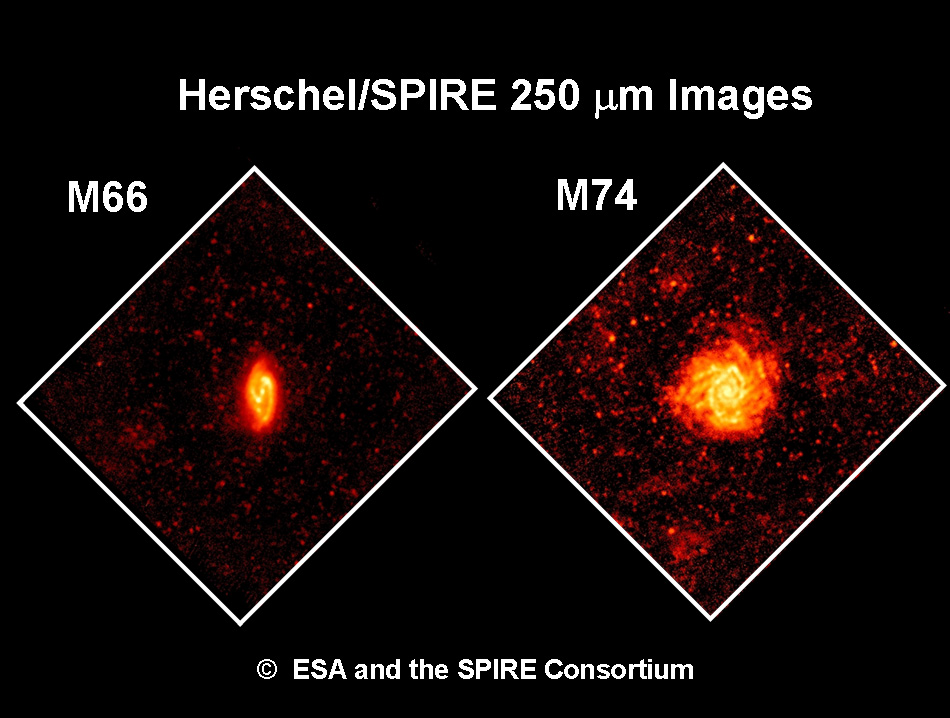
Saying that the blurry ESA's image is showing some unseen features is rather strange. It is an IR image, but still.. Hubble shows amazing detail on M74, and I mean amazing.
Hubble:
http://antwrp.gsfc.nasa.gov/apod/ap071201.html
Hershel:
http://www.esa.int/images/SPIRE250_M66_M74_fig1_H.jpg -
The ESA is awesome.The European Space Agency (ESA) is an admirable organization. It has achieved numerous technological firsts.
Why have the Europeans achieved so much for humanity, yet the Africans have achieved so little?
Note that the ESA has a policy opposing affirmative action. Unlike NASA (in the USA), ESA does not give preferential treatment on the basis of skin color.
-
Re:one last attempt possible?
Web stream from Ulysses mission support area @ JPL starting 30 Jun 15:00 UT
-
one last attempt possible?
Playing with this Java applet that shows Ulysses' position relative to Earth, Ulysses will be a lot closer to Earth in 2013. It'd be interesting to see if the shorter distance will make up for 3 more years of decay of the RTG.
-
The Ulysses mission accomplished a lotHere is a short summary of its results. I especially like this one:
Ulysses collected rare samples of interstellar helium isotopes, supplying evidence to support the idea that the Universe will expand forever because insufficient matter was created in the Big Bang to halt its outward march.
-
Re:first image
Yes, they were taken with one of the main instruments, PACS. PACS has been switched on since shortly after launch. Yes, the cover was only just opened, but this was one of the objects they viewed shortly after the cover was opened. M51 was chosen because they could directly compare it with Spitzer Space telescope images taken at similar wavelengths.
-
Re:first image
Those were not taken by Herschel's main camera, as that was only uncovered a few days ago.
-
I suppose that since this is /.
I shouldn't expect people to actually read the articles before commenting.
The Herschel was designed and built by the ESA, not NASA and the JPL. JPL had nothing to do with it. -
I suppose that since this is /.
I shouldn't expect people to actually read the articles before commenting.
The Herschel was designed and built by the ESA, not NASA and the JPL. JPL had nothing to do with it. -
Re:Whatever happened to...
-
Re:Close giants...
the Herschel Space Observatory is suppose to help with that very problem by being able to detect much colder parts of the universe. it even has the ability to observe structural detail by detecting water.
-
Re:SuperAccurateI am sorry for this not a scientific expression. I heard it from a commenter during the lift-off. Honestly I do not know what he meant, but considering that (from ESA:
... Planck will examine this to a sensitivity, angular resolution and frequency range never achieved before.
I believe this 1% (+- 0.01) can be either the error level of one of the measurements or a general expression for an overall performance (not very scientific indeed). The commenter mentioned 10% (+- 0.1) for WMAP, and something around 40-50% (I do not remember exactly) for COBE.
-
Re:Another Job well Done
"In order to study the coolest places in the Universe the Herschel instruments must be cooled to just above absolute zero. A large cryostat surrounds the instruments maintaining an operational temperature of 1.7 K for a nominal mission lifetime of 4 years." ESA has some great info on their site.
-
Maybe on Nasa/Esa Darwin project?
I requested the full paper but... as we are friday afternoon here in Europe I'll probably get it on Monday
In the meanwhile, from the abstract I feel this'll be more applicable to say checking remotely life hints in Jupiter's atmosphere here, than getting answers for remote stars tomorrow.I for one highly doubt, for instance, that just analysing an exoplanet's transit onto its star will bring any measurable polarization.
Just remember what you see is star light that passed through the planet's *atmosphere*, not reflected onto its ground (and grass/trees).
And as this specific light is moreover buried within the 99,99% of starlight that just didn't cross the planet at all, even with a specifically intense *atmospheric* life (a dense, GREEN atmosphereRather, I see this either for
a) a futuristic payload for the (too futuristic) Darwin project from Esa/Nasa ( http://www.esa.int/esaSC/120382_index_0_m.html/ ), when the dozen of years of development (and equal number of euro and dollar billions) will have been invested: if things go well, no more crises, etc., we then will have a way to just switch the starlight off (via destructive interferometry), and see only planet's light.
Then maybe you'll measure polarization. But then you'll also measure specific wavelength absorptions, so get directly to molecules (which is the raison d'être of the Darwin project)b) as said earlier, maybe in nearer times a way to observe our neighboring planets atmospheres, and suddenly discover they may be polarized (or not, and that check will be quick).
If they were it'd definitely be fun.In my space factory there is a breadboard of the Darwin nulling interferometric concept. Nifty. Representing maybe 1% of the required development work. But nifty, definitely: capable of switchig off a star light that is millions of times superior to the planet's reflected light and at the same time leave planet's light in, when planet is just the pixel against the star's one. As they say on Esa's site, capable of seeing a candle light stuck against a lighthouse firewindow, from 1000 km away.
-
Re:Separation of Science and States
(I'm the AC that also responded to you). After doing some research into their claims, I came across this: impossible dinosaurs. Their claim is as follows:
"Most conventional theories assume that gravity throughout the universe has always been and will always be a constant property of matter.
It took a fair amount of effort to dig up the relevant papers regarding changes in the gravitational constant. (Short answer for the mathematically challenged: it hasn't changed). I'd also point out that if gravity was 1/3 to 1/4 of what it was today, the moon wouldn't have remained in orbit.
The original slashdot article had a post detailing what their predictions were. They were wrong.
Let's just call bad science when we see it. Plasma cosmology predicts few things. When it has tried to, it failed. Much like the yeti, flat earth, luminous aether and timecube, it probably won't go away any time soon. But it really should.
-
Re:In Soviet Russia, experiment volunteers YOU!
Soviets aren't the only ones doing those experiments and finding volunteers:
http://www.esa.int/esaHS/SEM1YPVLWFE_research_0.htmlYou basically get paid for lying around doing nothing while others take care of your needs. For many less fortunate people that's probably a massive improvement from their day to day lives. No need to worry about food, shelter, bills, crappy job and so on.
-
This is a-posteriori explanation of GP-B issue
Martin Tajmar also posits an a-posteriori explanation for the anomalous data from Gravity Probe B based upon Cooper-pair mass in Niobium superconductors in: arxiv.org/abs/0707.3806
Heim Theory predicted such effects in 1950s already. Droscher & Hauser have suggested mechanism based on Heim Theory which was a-priori prediction as commented in the cover story of New Scientist Jan 2006, 3 months before Tajmar's announcement on the ESA homepage.
Here is the latest paper from Droscher & Hauser which gives explanation for outcome of both Tajmar and GP-B experiments.
Personally I like this part:
Numerous experiments by Tajmar et al. were carried out since 2003, and first published in 2006 report on the generation of gravitomagnetic (spacetime twisting) and gravity-like fields (acceleration) in the laboratory. The gravitational effects measured were about 18-20 orders of magnitude larger than predicted by the Lense-Thirring effect of GR. In other words, the rotating niobium ring, having a mass of some 100 grams as utilized by Tajmar et al., produces a gravitational effect similar to the mass of a a white dwarf.
/Joss -
Re:No comment?
There are and will be quite a bit more "telescopes" out there, where I've used the term as loosely as the original poster, i.e. including imaging by other means than actual focussing. Some examples include the Japanese Suzaku mission; ESA's Integral or the small gamma-ray observatory AGILE. Further interesting developments in infrared astronomy are the soon-to-be-launched Herschel mission - the largest mirror before the launch of JWST - and the Japanese-led SPICA observatory.
-
Re:No comment?
There are and will be quite a bit more "telescopes" out there, where I've used the term as loosely as the original poster, i.e. including imaging by other means than actual focussing. Some examples include the Japanese Suzaku mission; ESA's Integral or the small gamma-ray observatory AGILE. Further interesting developments in infrared astronomy are the soon-to-be-launched Herschel mission - the largest mirror before the launch of JWST - and the Japanese-led SPICA observatory.
-
No comment?
I had to reply to this thread, seeing only 9 hidden comments so far. That's a bit sad, since the JWST will be one of the most important science events since the Hubble. It will be an infrared telescope like the Spitzer, but it will effectively be an optical telescope for the distant universe because of red shift! And it will be able to peer into the distant past unlike any telescope prior.
In the sense of being a "space race" this is one area where the US really shines. There's no other nation that really is in the running, although there are lots of international contributions (yay Canada!). Maybe it's because of the language barrier, but I can't think of a single Russian space telescope. I can name a half dozen US scopes and one or two from the ESA. (Be sure to look up the Chandra, Fermi, Spitzer, XMM-Newton)
But then it's not really a space race, it's about science, so maybe it's a little boring for the general public. I only hope Slashdotter's are more aware that this is one of the great scientific adventures of our time.
-
Re:height
-
Re:height