Slashdot Mirror
Domain: eso.org
Stories and comments across the archive that link to eso.org.
Stories · 86
-
Very Large Telescope Captures New 27-Megapixel Deep Field
xyz writes "European Southern Observatory's Very Large Telescope has captured the deepest ground based U-band image of the universe yet. The image contains more than 27 million pixels and is the result of 55 hours of observations with the VIMOS instrument. 'Galaxies were detected that are a billion times fainter than the unaided eye can see and over a range of colours not directly observable by the eye. This deep image has been essential to the discovery of a large number of new galaxies that are so far away that they are seen as they were when the Universe was only 2 billion years old.'" -
Planets Without Stars or Mini-Solar Systems?
iamlucky13 writes "An article today on space.com discusses the discovery of 6 objects by the European Southern Observatory in Chile that are smaller than typical brown dwarfs, larger than Jupiter, and not orbiting any stars. The objects are surrounded by disks of gas and dust possibly similar to the early solar system. In addition to presenting astronomers with a new group of objects to study, the finding also deepens the debate over what makes a planet. The scientists responsible for the discovery sidestep the question by calling them 'Planetary Mass Objects,' or planemos." -
Deep in the Core
meehawl writes "A video of what is currently thought to be the closest star to the supermassive black hole at the centre of our galaxy. The star orbits the black hole in a highly elliptical orbit with a period of 15 years or so, but at its closest approach it swings within 17 light hours of the black hole (around three times the distance between the Sun and Pluto). In the video, you can see the star ricochet past its closest approach to the black hole. This slingshot effect enabled astronomers to further pinpoint the mass of the black hole, which is confidently estimated at 2 million suns or so. The mass observation, coupled with the size constraints observed, indicates the object at the centre of the galaxy is definitely composed of some exotically dense form of matter." -
Deep in the Core
meehawl writes "A video of what is currently thought to be the closest star to the supermassive black hole at the centre of our galaxy. The star orbits the black hole in a highly elliptical orbit with a period of 15 years or so, but at its closest approach it swings within 17 light hours of the black hole (around three times the distance between the Sun and Pluto). In the video, you can see the star ricochet past its closest approach to the black hole. This slingshot effect enabled astronomers to further pinpoint the mass of the black hole, which is confidently estimated at 2 million suns or so. The mass observation, coupled with the size constraints observed, indicates the object at the centre of the galaxy is definitely composed of some exotically dense form of matter." -
Black Hole in Search of a Home
jose parinas writes "Interesting news from the ESO observatory on Paranal about black holes that travel. From the article: 'For 19 of [the low redshift quasars], they found, as expected, that these super massive black holes are surrounded by a host galaxy. But when they studied the bright quasar HE0450-2958, located some 5 billion light-years away, they couldn't find evidence for an encircling galaxy. This, the astronomers suggest, may indicate a rare case of collision between a seemingly normal spiral galaxy and a much more exotic object harbouring a very massive black hole.'" More from the article: "Has the host galaxy been completely disrupted as a result of the collision? It is hard to imagine how that could happen. Has an isolated black hole captured gas while crossing the disc of a spiral galaxy? This would require very special conditions and would probably not have caused such a tremendous perturbation as is observed in the neighbouring galaxy. Another intriguing hypothesis is that the galaxy harbouring the black hole was almost exclusively made of dark matter." Update: 09/17 00:15 GMT by Z : Edited for clarity. -
First Image of Extrasolar Planet Confirmed
An anonymous reader writes "The year-long controversy about whether the European Southern Observatory had indeed captured the first picture of an extrasolar planet has apparently been resolved. Journal publication today of a fuzzy image of this Jupiter-sized, extrasolar planet led Christophe Dumas, a member of the discovery team, to say enthusiastically: 'The thrill of seeing this faint source of light in real-time on the instrument display was unbelievable. Although it is surely much bigger than a terrestrial-size object, it is a strange feeling that it may indeed be the first planetary system beyond our own ever imaged.'" -
First Image of Extrasolar Planet Confirmed
An anonymous reader writes "The year-long controversy about whether the European Southern Observatory had indeed captured the first picture of an extrasolar planet has apparently been resolved. Journal publication today of a fuzzy image of this Jupiter-sized, extrasolar planet led Christophe Dumas, a member of the discovery team, to say enthusiastically: 'The thrill of seeing this faint source of light in real-time on the instrument display was unbelievable. Although it is surely much bigger than a terrestrial-size object, it is a strange feeling that it may indeed be the first planetary system beyond our own ever imaged.'" -
Hubble Snaps Photo of Extrasolar Planet
iamlucky13 writes "Space.com has reported that a Hubble Space Telescope photo supports with a very high degree of confidence that a picture taken by the European Space Observatory does indeed show an extrasolar planet. As many readers know, planets outside our solar system are typically found by watching for wobbles in a star's orbit or for dimming caused by the planet crossing in front of its star. The ESO and Hubble images would represent the 1st and 2nd times that planets outside our solar system have been directly detected. The planet is about 5 times as massive as Jupiter and orbits a brown dwarf a little farther out than Pluto orbits our own sun." -
Exploring Antarctica
dargaud writes "There will soon be some firsts on the high Antarctic plateau: after getting 150km from it last year a Chinese expedition plans on reaching Dome A, the highest part of the Antarctic ice sheet (4200m), farthest to reach and coldest place on Earth, untrodden yet. Then in a few months the French-Italian station of Concordia at Dome C (3200m) will open year-round for its first winter-over, of which I will be part. The location of these ice domes make them great for atmospheric physics, glaciology, astronomy and more. Big projects are getting interested in Antarctica again, just in time for the International Polar Year of 2007, 50 years after the first one." -
Best Images Yet Of Saturn's Moon Titan
DoraLives writes "During recent commissioning observations of a new instrument designed for a completely different purpose, the European Southern Observatory managed to grab the best imagery yet of Saturn's largest moon. Although the imagery bears more than just a passing resemblance to some of the quainter maps of other planets there's no denying the superb, sub tenth arcsecond, resolution of the new images. And of course, if that's not good enough, they're sending a a little something to land on Titan next January. Should be interesting." -
Best Images Yet Of Saturn's Moon Titan
DoraLives writes "During recent commissioning observations of a new instrument designed for a completely different purpose, the European Southern Observatory managed to grab the best imagery yet of Saturn's largest moon. Although the imagery bears more than just a passing resemblance to some of the quainter maps of other planets there's no denying the superb, sub tenth arcsecond, resolution of the new images. And of course, if that's not good enough, they're sending a a little something to land on Titan next January. Should be interesting." -
VLT Smashes Record of Farthest Known Galaxy
rduke15 writes "From this press release of the European Southern Observatory : 'Named Abell 1835 IR1916, the newly discovered galaxy [...] is located about 13,230 million light-years away. It is therefore seen at a time when the Universe was merely 470 million years young[...].' More details and pictures here." -
The Billion-Dollar Telescope
dcmeserve writes "As in all science, astronomers are ever searching for better technology to aid in their task. But when it comes to telescopes, nothing beats sheer bulk of light-gathering capability. This article gives a brief overview of the top contenders for the next leap forward, including a 100-meter behemoth that is expected to run $1 billion." -
The Future of Science Revealed!
Well, one science journalist's opinion, anyway. Charles Seife writes for Science magazine and is the author of Alpha and Omega: The Search for the Beginning and End of the Universe. These are his answers to your questions, and they're very detailed, to the point where you may want to set aside more than a few minutes of quiet time to read and digest them. Q1) "Publishing hype" by BobTheLawyer (#6606631)A1)I'm not embarrassed at all because it's not hype. Scientists now know how the universe will end. Of course, as with all things scientific, there's a big honking asterisk on the word "know," but before I get to that, let me explain why I feel justified in making such an arrogant statement.
We're in the middle of a scientific revolution, in the honest-to-god paradigm-shift sense. This revolution started in 1997 when two groups of astronomers, the High-Z Supernova Search Team and the Supernova Cosmology Project used the bright flashes of a particular type of dying star (a type-Ia supernova) to measure the expansion of the universe at different times in the past. Since then, a whole raft of astronomical observations -- of faint patterns in the afterglow of the big bang, of distributions of galaxies, of the composition of intergalactic clouds of gas, of distortions of light going around massive bodies -- have all forced cosmologists into a remarkable consensus about the composition of the universe and, yes, its fate.
Just to give you a little taste of what the difference in the state of knowledge was like: in 1997, if you asked an astronomer how old the universe is, you'd get an answer somewhere between 12 and 15 billion years. Now, you'll get an answer of 13.7 billion years, plus or minus about 100 million. That's a big jump in precision. Similarly, before 1997, nobody had a clue how the universe would end; now, cosmologists agree on its fate. Some of the details haven't been worked out (what an understatement!), but the gross picture of the ultimate fate of the cosmos seems to be pretty well established for the first time in history. And by the end of the decade, a lot of the details will be fleshed out.
The ongoing revolution isn't just astronomical; it's physical. A decade ago, nobody knew whether neutrinos have mass. (For those who aren't particle physicists, neutrinos are particles that so rarely interact with matter that they can easily pass through the Earth without noticing the big chunk of mass they've passed through. This property makes them exceedingly hard to study.) Now, neutrino physicists are in accord -- and they've concluded that neutrinos, collectively, weigh about as much as all the visible stars and galaxies in the universe combined. High-energy physicists are using an accelerator in Long Island to recreate the condition of the universe a few microseconds after the big bang. By next year, they will formally announce the creation of a new state of matter that existed only in the very, very early universe. (There are alreadystrong hints that they've succeeded.) And another particle accelerator under construction in Geneva is very likely going to discover the particle responsible for exotic dark matter. (More on this shortly.)
All these experiments, all these observations, are pointing in exactly the same direction; they reveal the composition of the universe and its fate. But as with any good scientific revolution, such as relativity or quantum mechanics, it generates more questions than it answers. Scientists now know how the universe will end, but that understanding comes at the cost of a new mystery in physics.
As to the asterisk on the word "know," scientists are acutely aware that their theories are subject to revision. But at the same time, they have good reasons for being confident about their theories -- and they are more confident about some theories than about others. The new cosmological picture that's emerged has a darn high confidence rating; extraordinary claims require extraordinary proof, and the scientific world wouldn't accept the ideas of dark matter, much less dark energy, if there weren't a number of independent lines of evidence that forced scientists to make that conclusion. And while they're not confident about many of the details of the cosmos and the mechanisms that shape it, they are pretty sure that the overall picture is correct. (More on this coming, too.)
Q2) [Almost] Serious question! by Noryungi (#6606694)
and
Q3) Why does the rate of expansion change? by Anonymous Coward (#6606745)
A2,3) The universe will end in... umm... you really want me to give away the ending to my book?
Actually, I reveal the answer in chapter four, because the understanding of the fate of the universe is just the beginning of the current cosmological revolution. So it's not a spoiler to say...
-- drum roll -- the universe will die a heat death, or "Dark & Cold" by your terminology.
In a big bang universe governed by the laws of general relativity, there are two possibilities. (Actually, there are more than two, but all the cases boil down to two real outcomes.) Big crunch or heat death, fire or ice.
The fate of the universe depends on how the universe expands. In general, things that expand cool down and things that are compressed heat up. (This is what causes a propane container to feel so cold after a barbecue -- all the gas that expanded.) After the big bang the universe was extremely hot and was seething with energy. As it expanded, it cooled; free-roaming quarks condensed into protons and neutrons, and wound up as hydrogen, helium, and a handful of other light elements and isotopes. About 400,000 years after the big bang, the universe cooled enough so that the electrons could combine with the nuclei and form neutral atoms. Now, about 14 billion years later, the universe is a pretty cool place.
The expansion of the universe is like a cannonball shot into the air. As the cannonball flies ever higher, the force of gravity tries to drag it back to earth, reducing its upward velocity and slowing it down as it zooms upward. If gravity is very strong, then the cannonball rapidly loses its speed and quickly comes crashing back to the ground. On the other hand, if gravity is very weak, then the cannonball might escape the pull of the earth entirely and zoom away into outer space.
Similarly, the big bang gave the universe an initial cannonshot of expansion. If the mutual gravitational attraction of the objects in the universe is very strong (if there's a lot of matter in the universe) the expansion will slow down, halt, and eventually reverse itself. After the cooling phase of expansion, the universe will begin to swallow itself, getting smaller and smaller each day. This will make it heat up. The skies will get brighter and brighter as galaxies and stars get closer and closer together, and eventually, the universe will become a bath of radiation once more. Electrons will separate from atoms, atoms and then protons and neutrons will shiver into their components, and the universe will collapse in a "big crunch," a reverse big bang. The cosmos will die a death by fire.
On the other hand, if there's not much matter in the universe, then the expansion of the universe will continue forever. The expansion will slow down, but it will never halt and never reverse itself. The universe continues to cool down, and for a long time, space will look pretty much as it does now. Stars will be born and die, and galaxies will age. The night sky would get darker and darker as distant objects get too dim to view, and eventually, as the hydrogen in the universe is consumed, stars and galaxies will begin to wink out. Many billions of years hence, the universe will be a lifeless soup of dim light and dead matter. It will be a death by ice.
In 1997 and 1998, the two supernova teams used the brightness of distant supernovae to measure the rate of expansion at different times in the past. (Because the speed of light is finite, looking into the distance is the same as looking into the past. This causes no end of tense problems when writing a book about cosmology.) What they found was absolutely gobsmacking. Not only was the universe's expansion not slowing down very much -- it was speeding up! The cannonball was zooming into the air faster and faster as if it were propelled by some sort of weird antigravity force. Not only was the cannonball going to escape, it is so OUTTA HERE! This means a death by ice.
Yegads -- an antigravity force. This was a really hard thing for scientists (and probably you) to accept. But there's a number of different lines of evidence that support the idea, and in the book I go through those lines of evidence in great detail. I'll have to settle for a brief summary here. In 2000, a balloon experiment known as Boomerang took very detailed pictures of the ubiquitous afterglow of the big bang, the cosmic microwave background (CMB). This afterglow has hot and cold spots in it, and for years, scientists have been making very, very detailed predictions about the size and distribution of those spots. The results of the Boomerang experiment and the DASI and WMAP experiments matched those predictions incredibly well, giving scientists great confidence in the underlying theory. It also allowed them to figure out the amount of matter and energy in the universe, and 73% of the "stuff" in the cosmos was dark energy, this antigravity force.
There are a number of other lines of evidence, too; the current distribution of galaxies, for example, implies the presence of an antigravity force, and just last month, scientists made a very nice measurement of something known as the late integrated Sachs-Wolfe effect. This effect can't occur unless you have something like dark energy counteracting gravity's pull.
Unfortunately, a fuller exposition requires a lot more writing -- it takes up several chapters in my book. (Shameless plug). But in summary, there's a number of independent observations that all point to the existence of a dark energy. Furthermore, the theories underlying the idea have made very specific predictions that have been verified with incredible precision. It's extraordinary stuff, but no matter how scientists look at it, they're forced by extraordinary evidence to make the same conclusion.
Yes, it's true that scientists don't know the mechanism of dark energy (though they're not entirely at sea) but there's little doubt that the cannonball is zooming into space faster and faster. They don't know precisely why, but the universe is being pushed toward its icy death by an antigravity force. Scientists are watching it happen.
And you don't need to wait billions of years to know the outcome -- you don't need to observe something directly to conclude that it's going to happen. The planet Pluto was discovered in 1930. So why don't people object to the statement that it takes about 250 years to complete an orbit? Just as you don't have to wait until 2180 to confirm the conclusions of Newtonian dynamics, you don't need to witness the end of the universe to be able to figure out its fate or validate the theory that leads you to that prediction.
Q4) Dark Matter by notcreative (#6606772)
A4) You are correct; the nature and location of dark matter are crucial puzzles in modern cosmology, but I think that the answers will be pretty much in hand by the end of the decade.
I've already mentioned results (most notably WMAP) that reveal the amount of "stuff" in the universe, and 73% of it is dark energy. The rest is matter. But the grand total of the matter locked up in visible stars is a mere 0.5% of the stuff in the universe. What is the other 26.5%? That's dark matter, and, in fact, there are two different types.
Scientists have known for decades that most of the matter in the universe is invisible to telescopes. In the 1960s, Vera Rubin measured the motion of stars wheeling around the center of the Andromeda galaxy and concluded that there had to be a lot more matter pulling on those stars than could be seen.
Despite what some contrarians say, dark matter isn't dogma; viable alternatives, like Moti Milgrom's MOND are taken seriously, if not accepted. Unfortunately, all of the alternatives, including MOND, fail in crucial ways. Besides, you can see dark matter, both directly and indirectly. The MACHO and OGLE projects see the twinkle of stars caused by a passing chunk of dark matter, and they can see the distortion of light caused by a huge amount of unseen mass sitting on the fabric of spacetime. (Distant galaxies are stretched into arcs around this gravitational lens.) This is allowing scientists to figure out just where dark matter resides. But at the same time, a number of observations lead scientists to conclude that the minority of the matter (dark or light) in the universe is ordinary, atomic matter -- the stuff of stars, planets, and people. Again, it will take too long to describe all the lines of evidence, but one powerful way of measuring the number of atoms in the universe is to look at the proportion of hydrogen to deuterium, helium, and lithium in primordial gas clouds. In the first three minutes of the universe, atoms were fusing, just as they do in a hydrogen bomb. The universe was a giant pressure cooker, turning protons and neutrons into heavier elements. If there are a lot of atoms, then there is a lot of fusion and a lot of heavy elements made; if there are not very many atoms, then the universe winds up being almost entirely hydrogen. By looking at the ratios of heavy elements to light elements, scientists concluded that atomic matter makes up about 4% of the "stuff" in the universe -- which is precisely what other measurements, like the CMB ones -- imply, too.
So, 27% of the stuff in the universe is matter: 4% "atomic" matter, leaving 23% to be made of "exotic" matter, stuff that's not made of atoms. I've already described some of that exotic matter; neutrinos make up about 0.5% of the stuff in the universe, about the same as the visible matter in the universe. What's the remainder?
That's the big open question, but one that I'd wager will be solved by the end of the decade. There are very good reasons -- particle physics ones, rather than cosmological ones -- for believing that the main constituent of dark matter is a proposed particle known as the LSP. If it is, then the LHC accelerator in Geneva will find it. If not, then the LSP almost certainly doesn't exist and the puzzle will be compounded -- but I think that scientists are extremely optimistic. Again, there's lots more detail in the book about the justification for this.
Q5) variable constants by Cally (#6607000)
A5) The point's well taken, and I'll get to it after a few remarks.
First, you're right in that the supernovae serve much the same purpose as Cepheid variable stars do -- they're both objects of known brightness, or "standard candles," that allow astronomers to make a precise measurement of the distance to a faraway galaxy. However, they are not the same thing. Cepheids are stars that pulsate and the rate of that pulsation reveals its intrinsic brightness. They're what Hubble used to spot the expansion of the universe in the 1920s, but they're relatively dim and impossible to find in very distant galaxies. Type-Ia supernovae are standard candles that are much, much brighter than Cepheids, and so can be seen halfway across the universe. (And as you note, since distant supernovae mean ancient supernovae, they reveal the expansion rate of the universe billions of years ago.)
Second, the time-varying speed of light (or more precisely, the time-varying fine structure constant) is a controversial idea. The scientists that made the observation in question are pretty solid and they're taken seriously. However, my impression is that mainstream thinking is that the results are due to a systematic error. That aside, the effect, even if real, is very small, and it has nothing to do with interpreting the data from standard candles. The interpretation there is quite well established; there's little question that scientists are seeing an expansion of the universe;. Alternative theories, like tired light, fail in countless ways and scientists have even seen the relativistic time dilation caused by the motion of the distant object.
But, yes, it's natural for a layperson to conclude that the concordance cosmological model is looking increasingly kludge-y, and you're naturally led to wonder whether scientists are trying to prop up a failing model with the equivalent of epicycles or aether. I don't think this is the case for a few reasons.
For one thing, the theory isn't really getting added to and made more complex; it's getting subtracted from and being made more simple. This seems counterintuitive, but it comes from the fact that modern big bang theory is really a class of theories, rather than one set-in-stone dictum about the way the universe is. All these theories agree on the basic physics about the manner of the universe's birth, the forces that drive the universe, and the physics behind them; the difference between the theories are the values of a handful of parameters that are not predicted by the theory. These parameters are inputs rather than outputs, and by pinning down the values of these inputs, the acceptable class of theories gets narrower and narrower.
Dark energy is one of these inputs. Although nobody took it seriously before 1998 -- everyone thought that the value of the parameter in question was zero -- it was lurking there nonetheless. It turns out that this parameter is not only non-zero, it's really big, much to everyone's surprise. But this doesn't add complexity to the model, especially since other parameters, such as the "curvature" of the universe as a whole, which many physicists thought would be non-trivial, turn out not to be important after all. (In other words, the universe seems to be slate flat, rather than saddle-shaped or sphere-like.)
So, from a mathematical viewpoint, the model is no more complex than it was in 1997, and is, in fact, significantly leaner. But what about from a physical viewpoint? Dark matter and dark energy seem to fly in the face of Occam. But here, too, the increase in complexity is much less than it appears. Long before this cosmological revolution, astronomers knew that dark matter had to exist; more recently, they've begun to see it. Even without worrying about cosmological questions, astrophysicists had accepted the existence of dark matter. Cosmological measurements like WMAP showed that these astrophysicists were right -- it was an independent confirmation that dark energy exists and that it comes in two forms, something that other astronomers had concluded a while ago.
Dark energy, on the other hand, has more claim to being a "hack" to the theory. It really is something new and unexpected (even though it was always a mathematical possibility, nobody in the physics world suspected it actually existed.) Nevertheless, the groundwork was already there, and modern big bang theory implicitly requires the existence of a form of dark energy in the very early universe. And since the 1930s, scientists knew that even the deepest vacuum is full of energy and can exert pressure (something known as the Casimir effect, which I describe in this book and in my previous book, Zero: The Biography of a Dangerous Idea). Thus, the idea of dark energy wasn't completely alien to physics before 1997, and in some sense, it was a necessary component.
Yes, it's possible that scientists are looking at the cosmos in the wrong way, and somebody will establish a simpler, more elegant theory that takes all these threads and weaves them together. (More on this shortly.) But at the moment, far from having a kludged-up theory, cosmologists have a leaner (if weirder) theory than ever before -- one that makes very precise predictions that are getting verified with stunning accuracy. I think this argues for increased confidence in the theory rather than for increased fear that it's falling apart.
Q6) Universe's container by bios10h (#6606748)
A6) It freaks a lot of people out. There's a lot of philosophical problems with having an infinite universe -- for example, if the universe is truly infinite, and if, as scientists believe, the number of quantum states of a finite volume is finite, then it's hard to escape the conclusion that, some great distance away, there's a bizarro-you on bizarro-earth reading bizarro-Slashdot. On the other hand, there's no positive evidence that I can think of that the universe is truly infinite; it's just the sparest conclusion in a mathematical sense, if not a philosophical sense.
But an infinite universe is not a foregone conclusion. Earlier this year, Max Tegmark at the University of Pennsylvania published an intriguing paper that looked at slight anomalies in the WMAP data that seem to imply that the universe is not only finite, but shaped like a donut. Nobody takes the idea terribly seriously, not even the author, because there are other statistical tests that seem to rule the donut-shaped universe out. But it's the sort of thing that people are looking at very closely.
Whether it's finite or infinite, in a mathematical sense, there's really no need for the universe to be "in" anything -- there are models where our universe is embedded in a higher-dimensional space, but there are models where it isn't. Philosophically, though, I don't see any advantage to embedding the universe in something bigger -- as you say, it just punts the problem forward. (Who, then, will contain the containers?)
It's one of those things that is hard to get comfortable with -- and even when you accept it, it sometimes can cause pangs of uncertainty. Quantum mechanics does this, too... it's just something that's hard to wrap your head around. Take solace in the fact that it's hard for everyone else, too.
Q7) How ultimate is the end of the universe? by Lane.exe (#6606766)
A7) If there were a collapse-type universe, yes, there could be a reboot and a new big bang. (And if Microsoft built the universe, a reboot would be coming sooner rather than later. *duck*)
In fact, the theory behind the cosmic microwave background stemmed from calculations to see whether this was possible. Remember the expansion-cooling/contraction-heating bit I mentioned a while ago? A physicist at Princeton was trying to figure out whether matter would break apart into its constituents in a collapsing universe, so he looked at how the universe heated up as it compressed. He then realized that his calculations worked equally well in reverse -- the young expanding universe was very hot but cooling -- and it had to have an afterglow: the CMB.
There are restrictions on this rebirth argument, though. For one thing, the fact that the universe will expand forever prevents a big crunch in our future, so we're at the end of the line if such a line existed. And in 2001, Alan Guth proved a mathematical theorem that shows that bang/crunch/bang universes can't have an infinite history; they must have started some finite time in the past. (Though there are a few ways around the theorem if you reject a few assumptions.) So yes, it's possible, but there is no reason to believe it actually happened, and there are very good reasons for thinking it won't happen in the future.
Q8) comparable ramifications? by sstory (#6606658)
A8) I'm not going to give the usual B.S. answers about spinoffs (though there are some). And I'm not going to evade the question by saying that genomics hasn't yielded any transformation, because the potential is certainly there. But I will answer this question obliquely.
If I asked you, "Quick! What's the most important scientific achievement of the 20th century?" how would you respond?
You would probably answer relativity or quantum mechanics, or perhaps the Apollo landings. Probably some would say the atom bomb. I suspect that only a handful of people would mention the computer, and even fewer people would say penicillin. (Am I right?)
Science has two faces -- it can transform society (for better or worse), and it can advance human knowledge. The two are not inextricably bound, though they often come together.
Relativity was a profound shift in our understanding of the way the universe works, but you have to look pretty hard to see a direct effect on our lives. Conversely, penicillin wasn't a central advance in understanding biological systems, but it affected all of us -- I suspect many people here on Slashdot wouldn't be alive today without penicillin and its descendants.
For me, though, relativity is a greater scientific triumph than penicillin -- even though penicillin is probably much more important to us. It altered our view of the universe and gave us a greater understanding of the fundamental laws of the universe -- it was a philosophical advance as much as it was a technical one. That's why we seem to admire Einstein more than Fleming and Newton more than Jenner.
The present cosmological revolution won't change our lives dramatically; heck, a good spam filter would probably have more direct effect on our quality of life. But at the same time, it will finally answer some of the most ancient questions of humanity -- where did the universe come from and how will it end -- and when it ends, we will have a firm grasp of the answer of the latter if not the former. It will be a towering intellectual achievement, and I think that is what will set it apart from even the human genome project.
Q9) What is the next paradigm shift? by geeber (#6606890)
A9) I disagree with the idea that there's no paradigm shifts left -- indeed, I think we're in the middle of one now. I think that it will be associated with one in the Standard Model of particle physics that will begin before the end of the decade.
It's hard to say where future paradigm shifts lie, but there are lots and lots of outstanding questions in science, some of which are incredibly basic, yet totally out of scientists' reach. For example, neurologists have a very good idea about how individual neurons work -- how they connect and communicate. But when it comes to explaining how a large sloppy hunk of neurons becomes a conscious entity, they're completely at sea. I don't think there's even a good definition of consciousness, which is crucial if you're going to study it seriously. Even more basic -- scientists are struggling to define what life is. There's a heck of a lot more work to do, and plenty of room for paradigm shifts.
Speaking of paradigm shifts, I'd like to take a bit of issue with the term (which I've used myself a number of times in the responses to these questions.)
For those who don't know, the idea of a "paradigm shift" comes from Thomas Kuhn's Structure of Scientific Revolutions, a seminal work in history of science. While I think that Kuhn's idea of a paradigm shift has a lot of merit -- models and philosophies do change suddenly and dramatically in the face of mounting conflicting evidence and despite resistance -- I think the term itself is misleading. It implies the complete abandonment of one idea and acceptance of a replacement.
In my view, this is not the way modern science works -- I think that science is cumulative. Each model extends and corrects the previous one, and while there might be a dramatic shift philosophically, there is almost never a dramatic shift physically. Relativity, for example, made a profound change in the way we think about time and space and gravity, yet the functional difference between Newton and Einstein is pretty small. All these complicated tensor equations are approximately equal to Newton's laws in the vast, vast majority of cases -- it's only under conditions of extreme gravity, extreme speed, extreme energy, or extreme time that relativistic predictions diverge from Newton's. Similarly with quantum mechanics.
While I think that relativity and quantum mechanics are paradigm shifts, they're not rejections of the Newtonian picture as much as they are extensions. The paradigm shift can be huge philosophically, but its effects tend to be small in magnitude. And with these small corrections, scientists extend the applicability of their model of the universe -- they can explain the orbit of Mercury or the photoelectric effect -- and in the cases where Newton's laws were strong, these models boil down to Newton's laws.
If I remember my Kuhn correctly, he explicitly rejected the idea of cumulative science; he really saw each model getting completely replaced by its successor, rather than as an extension -- and this leads, at least in my view, to the excesses of postmodernism.
I think that this issue goes to the heart of the questions about how scientists can be sure about the end of the universe if their models can be replaced at any time. To that I'd argue that, yes, all models are provisional, but even with "paradigm shifts" models are usually extended rather than replaced. The central findings of the previous model still hold with good accuracy in most cases, even if the philosophical underpinnings are badly shaken. Maybe scientists are missing some crucial understanding that will simplify the way we look at the universe -- and scientists are seriously pondering alternate models to things as widely accepted as the inflationary big bang -- but even if such a shift occurs, it probably won't invalidate today's discoveries.
Q10) What will it mean? by boatboy (#6607285)
A10) One thing's certain. If I knew the answers, I'd be even more insufferable than I am now.
Seriously, I'm not sure that knowing the answers would have a profound moral and sociological effect. While I think that asking and answering big questions is a hallmark of a prospering society, a society doesn't necessarily draw strength or stability from its intellectual curiosity. (For example, Athenian democracy lasted only about 80 years if I remember right.) Even the most profound philosophical ideas can wind up having little real effect on the everyday functioning of a civilization -- for example, I think that Godel's incompleteness theorem hasn't changed society in the slightest.
As for the next big question, I think there are some in biology: what is life? What is consciousness? How did life arise? Are we alone in the universe? In physics, I think there are profound questions yet to be answered in a realm that I'd describe as "information theory" in the broadest sense -- what's really going on in a black hole? What makes quantum mechanics so weird? And I think that answering the question about the true nature of dark energy will probably have to await a future cosmological revolution. But one of the wonderful things about science is that you don't really know what big questions are within your grasp until you begin to grasp them. We'll know the next revolution when it appears.
Editor's note: Due to long answer lengths, we linked to the questions instead of running them directly here in order to keep this page from getting too large. This was an experiment. If you have comments or questions about Slashdot interview formatting, please email Roblimo.
-
Brown Dwarf Companion to Epsilon Indi
silent lurker writes "A team of European astronomers has discovered a Brown Dwarf object (a 'failed' star) less than 12 light-years from the Sun. It is the nearest yet known. Now designated Epsilon Indi B, it is a companion to a well-known bright star in the southern sky, Epsilon Indi (now "Epsilon Indi A"), previously thought to be single. The binary system is one of the twenty nearest stellar systems to the Sun. ...and astronomers believe there might be as many as 12x as many brown dwarf stars as there are visible ones! Hmmmm... Lots o' juicy fodder for SF content creators, dontcha think? ...not to mention astronomers themselves. See press release from European Southern Observatory. Another item is from Science Daily." -
There's a Hole in the Middle of It All
Apparition writes "CNN is reporting that the star at the center of our galaxy is actually a super-massive black hole. The article then claims that it occupies a volume of space about 3 times that of our solar system. If my math is correct, about 230 million suns could fit into that same volume, so it doesn't impress me that the claimed mass of the black hole is only between 2.6 and 3.7 million times that of the sun. So what is up here? Since when do black holes occupy so much space (I thought they were points)? And how can something with a density only 1/100 of our Sun be called super-massive?" I think the article is talking about a maximum possible size of the object, due to limitations on the resolution of our instruments. Nature has a no-registration story about the research. Update: 10/16 23:44 GMT by M : There's an article with more information on space.com, and a press release from the European Southern Observatory. -
Overwhelmingly Large Telescope Closer to Reality
An anonymous reader submits: "The 100m OWL telescope proposed a few years ago by the European Southern Observatory group (ESO) may actually be built. Currently, the largest aperture for a telescope is the Very Large Telescope (VLT) at a 'very tiny' 16.4m by comparison. This monster is predicted to have a light gathering resolution of about 40 times the Hubble Space Telescope and a sensitivity several thousand times greater. Among many other things, it should be powerful enough to detect and gather spectroscopic data of extra-solar planets in order to determine the atmospheric composition and any signatures for life, like oxygen." We mentioned the OWL in this previous article too. -
Overwhelmingly Large Telescope Closer to Reality
An anonymous reader submits: "The 100m OWL telescope proposed a few years ago by the European Southern Observatory group (ESO) may actually be built. Currently, the largest aperture for a telescope is the Very Large Telescope (VLT) at a 'very tiny' 16.4m by comparison. This monster is predicted to have a light gathering resolution of about 40 times the Hubble Space Telescope and a sensitivity several thousand times greater. Among many other things, it should be powerful enough to detect and gather spectroscopic data of extra-solar planets in order to determine the atmospheric composition and any signatures for life, like oxygen." We mentioned the OWL in this previous article too. -
Space Pictures From Near and Far
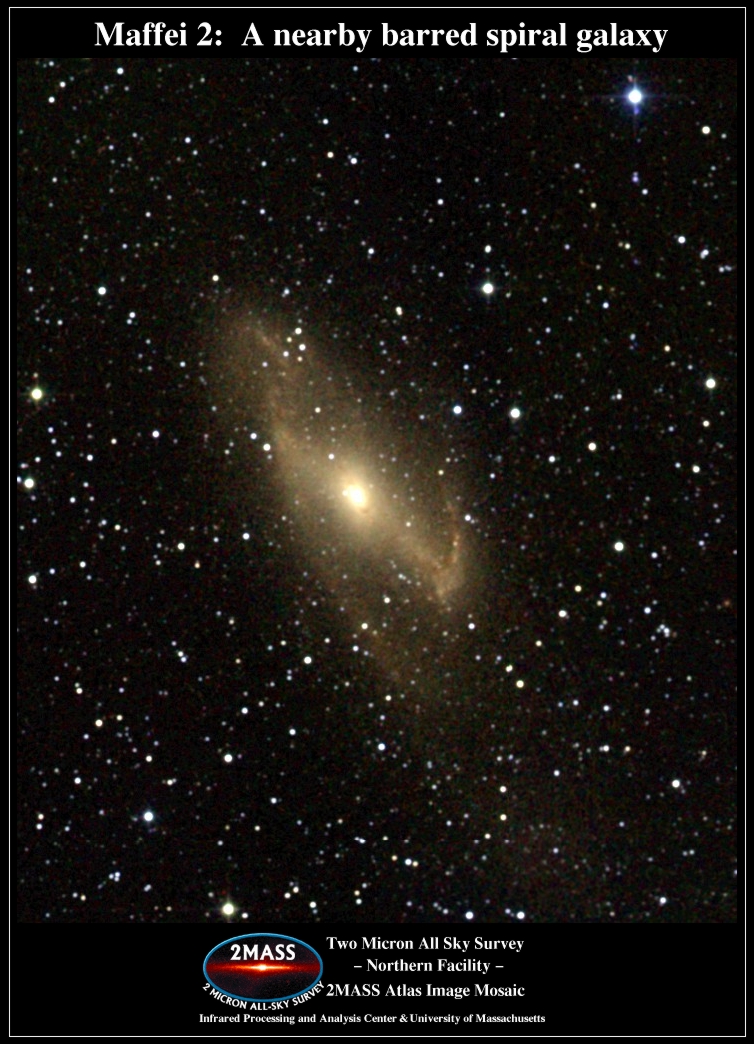
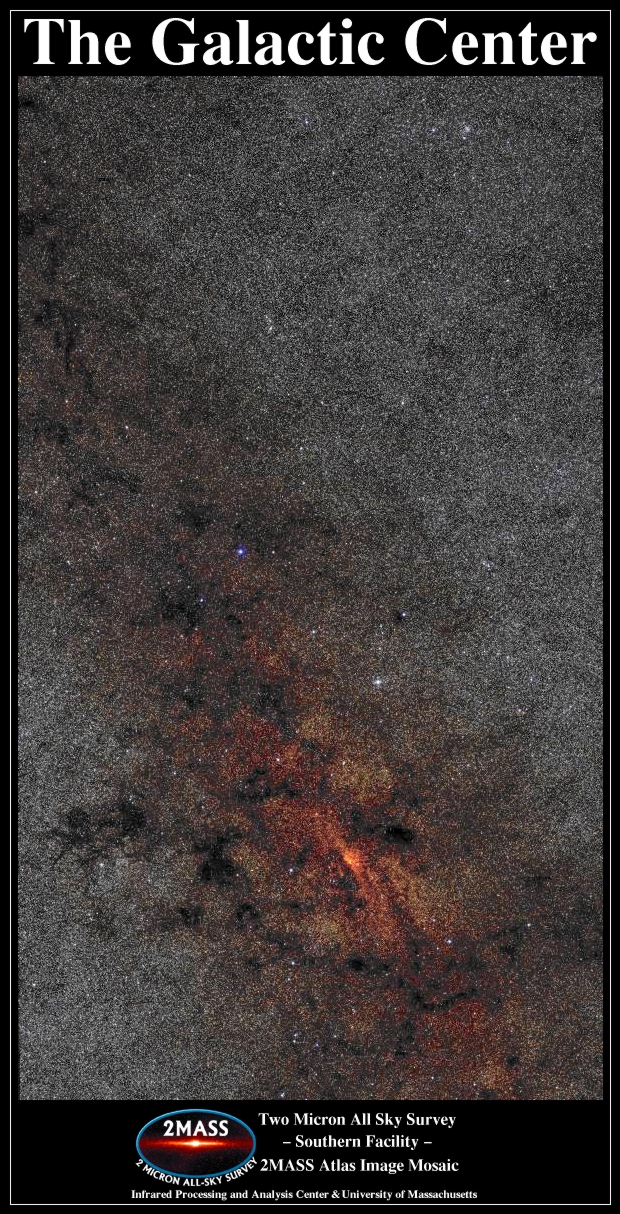
Buran writes: "The BBC News has a fine story about the how our galaxy looks from the outside according to the 2-Micron All-Sky Survey (2MASS). The article describes the shape of our galaxy (a barred spiral; all those books showing concept paintings of a regular spiral galaxy will be out of date now) and how the survey was done (near-infrared measurements of 500 million carbon stars). For the first time, we can see the center of our own Milky Way. All our worldly troubles seem so small..." That takes care of the big picture; Chris McKinstry has submitted news of much closer but just as exciting shots of Saturn -- read below for more on those.mindpixel writes: "I was very excited when I saw this amazing shot of Saturn come up on the control room monitors of the VLT in November, and I'm even more excited that as of today the image is finally public. It is possibly the sharpest view of Saturn's ring system ever achieved from a ground-based observatory. All of us here at the observatory are quite proud of it, especially the NAOS-CONICA team."
-
Designing An Astrophysical Virtual Observatory
SevenTowers writes: "'The Astrophysical Virtual Observatory (AVO) Project is a Phase-A, three year study for the design and implementation of a virtual observatory for European astronomy. A virtual observatory (VO) is a collection of interoperating data archives and software tools which utilize the internet to form a scientific research environment in which astronomical research programs can be conducted. In much the same way as a real observatory consists of telescopes, each with a collection of unique astronomical instruments, the VO consists of a collection of data centres each with unique collections of astronomical data, software systems and processing capabilities.' The article on their site goes into more detail. It's good to see that what the internet was designed for is still a working model." -
Ground-based Telescope as Sharp as Hubble
Midnight Thunder writes: "The BBC has an article describing how the Paranal Observatory has been able to take images that are just as sharp as the Hubble Space Telescope. For a ground based telescope the images are of amazing quality." -
Virtual Telescope from Data Mining
Atomic Snarl writes: "The ASTROVIRTEL project is mining a 7 Terabyte archive from NASA, ESA, and others for all things astronomical. One recent discovery is a new Kupier Belt object larger than asteroid Ceres. APOD story here, ESO press release here. They're looking for more research projects, too. Just the thing for all those spare cycles on your G4 Cube... ;-)" -
Virtual Telescope from Data Mining
Atomic Snarl writes: "The ASTROVIRTEL project is mining a 7 Terabyte archive from NASA, ESA, and others for all things astronomical. One recent discovery is a new Kupier Belt object larger than asteroid Ceres. APOD story here, ESO press release here. They're looking for more research projects, too. Just the thing for all those spare cycles on your G4 Cube... ;-)" -
100 Meter OWL Telescope Project
mindpixel writes: "The European South Observatory (my employer) is getting VERY serious about building the OWL (OverWhelmingly Large) 100 meter telescope. Check out this new site dedicated to the project. You can see some cool diagrams of what the OWL telescope will look like and some simulated images here." For more about telescopes of unusual size, you might read McKinstry's interview last year. -
100 Meter OWL Telescope Project
mindpixel writes: "The European South Observatory (my employer) is getting VERY serious about building the OWL (OverWhelmingly Large) 100 meter telescope. Check out this new site dedicated to the project. You can see some cool diagrams of what the OWL telescope will look like and some simulated images here." For more about telescopes of unusual size, you might read McKinstry's interview last year. -
100 Meter OWL Telescope Project
mindpixel writes: "The European South Observatory (my employer) is getting VERY serious about building the OWL (OverWhelmingly Large) 100 meter telescope. Check out this new site dedicated to the project. You can see some cool diagrams of what the OWL telescope will look like and some simulated images here." For more about telescopes of unusual size, you might read McKinstry's interview last year. -
11 New Extra-Solar Planets Announced
Shooter6947 writes: "The European planet hunting team, including Mayor and Queloz who first found 51 Pegasus b in 1995, have just announced the discovery of 11 new extrasolar planets. The new list includes 2 multiple planet systems, one planet with an orbital eccentricity of .93, and another in a nearly circular orbit near its star's habitable zone. Kickass!" -
Comet Hale-Bopp
mindpixel writes "When Comet Hale-Bopp passed through the inner solar system in early 1997, it was admired in the sky by a substantial fraction of the world's population. Now ESO (European Southern Observatory) has imaged the comet at 2 billion kilometers." Hale-Bopp has a 4000-year period, so savor it while you can. :) -
Comet Hale-Bopp
mindpixel writes "When Comet Hale-Bopp passed through the inner solar system in early 1997, it was admired in the sky by a substantial fraction of the world's population. Now ESO (European Southern Observatory) has imaged the comet at 2 billion kilometers." Hale-Bopp has a 4000-year period, so savor it while you can. :) -
Comet Hale-Bopp
mindpixel writes "When Comet Hale-Bopp passed through the inner solar system in early 1997, it was admired in the sky by a substantial fraction of the world's population. Now ESO (European Southern Observatory) has imaged the comet at 2 billion kilometers." Hale-Bopp has a 4000-year period, so savor it while you can. :) -
The VLT Observes Comet LINEAR's "Shower"
mindpixel writes "Two nights ago, while operating the VLT (the world's largest optical telescope), we got a call into the control room asking us to follow up the Hubble's imaging of Comet Linear a few days prior. As soon as we got the coordinates, I pointed the telescope at the very fast moving comet and started taking pictures. They came in quickly, and they were awesome! We couldn't believe the detail we were getting. The comet was completely shattered. Even in the unprocessed images we were able to count nine mini-comets. Six minutes ago, they released it The VLT Observes Comet LINEAR's "Shower")" -
Chris McKinstry Replies: Telescopes, AI And More
A few weeks ago you asked the multi-talented Chris McKinstry questions, about the telescope projects he's involved with (ESO's Very Large Telescope -- VLT -- and the OverWhelmingly Large telescope -- OWL), about his project to synthesize AI by collecting a database of answers to questions common and obscure, and about the possibilities of discovering extraterrestrial life. Read what he has to say on everything from humans leaving the solar system to telescopes staying here on Earth. [Updated 5 Aug by t:] Chris notes for the record: "The opinions expressed are my own and not necessarily the opinions of the European Southern Observatory."1) GAC
by Dungeon DwellerI have an active interest in artificial intelligence. I study it as part of my major, and hope to do research in it in the future. As a young man coming up in the world, I am hoping to enter into research eventually, am entering into research at my university (WVU).
Your project reminds me of several projects/theories that have been discussed before. In the psychological debate, your system depends entirely upon nurture, it would seem. I like that kind of system and research. I do have a few questions.
- What separates this from other projects in the field?
- Where did you draw your inspiration for this project?
- What kind of support staff do you recommend to an individual who has never led research before, but would like to? (I ask this of many of my professors who conduct research)
- Where are you getting the bulk of your input for this project?
- What do you hope to learn from this project?
- At what time will you consider this project a success?
Chris McKinstry:
Question 1-1:
There are three primary features of the MindPixel Digital Mind Modeling Project (also known by GAC -- for Generic Artificial Consciousness -- which is public interface to the project) that distinguish it from other large scale knowledge projects such as CYC.
- The first phase is a completely public, internet based effort. All the data it will be collecting will come from average people, with no specific training in AI or psychology. It is like seti@home in many respects, except that we're not after your CPU's cycles, but rather your humanness. We're actually seeking to extract the entire content of an average person's mind bit by literal bit from millions of different internet users. We're not trying to write the algorithm for consciousness, but rather create the world's most rigorous fitness test (a Dawkinsian continuous variable) and get it into the hands of researchers who will attempt to make systems that will learn or evolve into consciousness by feeding back against this fitness test. Not only will we be collecting consensus fact, but also consensus emotion. (When the project is fully operational, in addition to collecting information about each MindPixel's truth or falsity, we will also collect emotional data based on Mehrabian's PAD model of emotion.)
- The second phase of the project involves releasing the data collected to the scientific community and providing those researchers with some funds (generated by advertising to the people supplying the data) to conduct their research. As a side note, Jeff Elman's page contrains information about recurrent neural networks that are very good at processing just the kind of data that this project will collect and distribute. Specifically his 1990 article, Finding Structure in Time (PDF) is one of the most important neural network papers ever written; it strongly influenced me.
- Finally, the project is a meritocracy. People will gain voting rights that will give them a say in every aspect of how the project is run, from data collection and use to the distribution of data and research funds, based entirely on the amount of data they have contributed to the project. The more work you do, the stronger your voice becomes.
Question 1-2:
My primary inspiration for the project comes from observation: I observed that computers are stupid and know nothing of human existence. I concluded a very long time ago that either we had to write a "magic" program that was able to go out in the world and learn like a human child, or we just had to sit down and type in ALL the data. When I was studying psychology in the late 80's I wanted to begin to gnaw the bullet and start getting people to type in ALL the data. It was my plan then to get people to enter data as part of an intro psych course, or get the university to allow me ask people for data when they logged on to the university's computer system. I was never able to get permission for either and the idea sat on the shelf until I downloaded my first copy of NCSA's Mosaic in 1994. I saw in following my first hyperlink, a different path.
I decided to collect my data via the internet. But, the problem was, that I needed to think of a standard format for the data; some way of representing human knowledge that an average person could learn quickly. That idea didn't come to me until I was preparing an entry for the 1995 Loebner Prize. Jackie, my program, was a stimulus response creature. You would ask her a full text question, and she scan her database for a canned full text response. My idea for the Loebner competition was to have her talk to a lot of people a get a lot of canned responses (at the time I was consulting for a large insurance company and brought Jackie to work everyday where she could talk to my colleagues) As well, I stored the responses in a number of different ways: phonetically using soundex, again with all the words in each stimulus sorted alphabetically, and also with a primitive concept token system. So, if there was no direct match, she would look for a phonetic match or sorted or conceptual match. Essentially I was breaking down each stimulus and standardizing it like a Fourier transform breaks down a waveform.
Then suddenly Hugh Loebner changed the rules. No longer was passing a text based Turing Test good enough for him. Now he would only award his prize if the system passed a full audio/video Inquisition. I hit the roof! Hell, there were tens of thousands of people on the planet that couldn't pass that kind of test! Anyone blind or deaf are just two obvious examples. I withdrew Jackie in a loud protest, stating that intelligence didn't depend on the bandwidth of the communication channel; intelligence could be communicated with one bit! If you locked a person in a box I could detect them with a series of yes/no questions and nothing more. And there all of a sudden, I had my answer (and a quick paper - The Minimum Intelligent Signal Test - An Objective Turing Test in Canadian Artificial Intelligence, issue 41.) There was a minimum intelligent signal, and it was just one bit. I would store my model of the human mind in binary propositions. I would make a digital model of the mind.
I realized within minutes that a giant database of these propositions could be used to train a neural net to mimic a conscious, thinking, feeling human being! I thought, maybe I'm missing something obvious. So, I emailed Marvin Minsky and asked him if he thought it would be possible to train a neural network into something resembling human using a database of binary propositions. He replied quickly saying "Yes, it is possible, but the training corpus would have to be enormous." The moment I finished reading that email, I knew I would spend the rest of my life building and validating the most enormous corpus I could.
Question 1-3:
Support staff! I recommend using the entire planet as support staff! Seriously, don't even dream about it. Almost every researcher I know works on their own or with a handful of collaborators. When you're a big cheese you might get a student or two, but other than that you'll get nothing more than shared use of a departmental secretary. You'll definitely be writing all your own code for a very long time.
Question 1-4:
I can't tell you that yet because at the time I wrote this, the project was not yet online (should be now though.) What I can tell you is that in 1995 I did try to collect this same data, using a web based form that sent an email back to me. I managed to collect some 450,000 items. This time, I expect to collect more and higher quality data and I expect it to come from a wide cross section of the internet public. I should also note MindPixels will be collected in multiple languages, which opens up the future prospect of mapping the sampled human languages to each other concept by concept. It will be very interesting to see exactly how an artificial consciousness trained in English differs at the conceptual level from one trained in say, Spanish.
Question 1-5:
I hope to learn what the human conceptual network looks like. I hope that in a few years I will be able to access a map of all the concepts in the head of an average person or to have learned why I can't.
Question 1-6:
I will consider the project a complete success when the cover of Science announces that for the first time in history there exists an artificial system that has passed a scientifically strong form of the Turing Test known as the Minimum Intelligent Signal Test.
2) How do you guys do it?
by pc486With exptremely high magnification, how in heck do you keep the telescope still enough to take photos?
The slightest movement ought to mean millions of miles so thoes pesky little earthquakes should be a problem. Not to mention how you guys move the telescope accurately?
Chris: You're quite right about the system being very sensitive; if I walk on the azimuth platform of a VLT telescope while we're observing, I will destroy the observation. For normal tracking we use a software system called Tpoint written by a well known telescope genius named Pat Wallace (Pat has a wonderful and detailed article about telescope pointing that anyone seriously interested in telescope pointing should read); the same system is in use on telescopes all over the world. Basically what we do is build a pointing model for each of our telescopes. This involves pointing each telescope to a number of different points uniformly covering the sky. At each sample point, we observe a guide star and record how it moves from the center of the field over about one minute of tracking time. After we have collected enough data, we build a computer model of the telescope's tracking error. Then we basically run the model backwards into the telescope control system and thus apply corrections that try to cancel out the tracking errors of the telescope. This of course can't correct for any unusual vibrations, we rely on normal guide star tracking and hydraulic isolation of the telescope for that. And baring a large earthquake, Tpoint, automatic guide star corrections and the isolation work pretty well (In the event of a large earthquake, there are giant airbags that inflate to protect the mirror from damage.)
3) How can we help?
by MignonYou probably know about SETI At Home, which lets people volunteer spare CPU time to processing radio-telescope data, in a (so far vain) attempt to find extra-terrestrial intelligence. Is there a similar way that we can help process some of the data that you gather?
As a simple example, one could compute the differences between a sequence of pictures of the same portion of the sky, looking for anomalies like giant asterioids on their way to wiping us all out.
Chris: seti@home is one of the most impressive demonstrations of how the world of science has changed. There are now over 2 million average people working together for a common scientific goal. I just wish they sold advertising to raise funds for other worthy (meritocratically determined) projects. It really bugs me that my Pentium III 450 which has done over 7000 hours of seti@home processing since last June, hasn't shown me a single science supporting ad. What a waste!
Now as for your idea of doing the same thing in optical wavelengths, I think in it there is a great deal of merit. There are a whole pile on new survey telescopes coming online soon that will be useful for just what you proposed. And if you read ahead to my answer to question 11, you'll see I do think it is a problem we have to pay attention to. (As well, I know of at least two virtual telescope projects; the NRC's National Virtual Telescope. See NVO White Paper (PDF) and ESO's ASTROVIRTEL which seek to allow data mining of previously collected telescope data.
In general, I think the future will see a lot more distributed processing projects doing useful science. The question remains whether or not it is more cost effective to build supercomputers for critical projects or harness the CPU's of private citizens, and I think the answer will need to be determined on a case by case basis. As well, there will be some projects (my own for example) where the CPU cycles are incidental; where what we want to harvest is not your electricity and capital equipment, but actually your humanity.
4) Division between Science and Spirituality
by ParticleGirlI am continuously frustrated that people's general perception seems to be that science and art, spirituality, and so forth are divided by an uncrossable schism. People feel the need to pit science against spirituality; logic against intuition. It is a rare thing that people accept the idea that these are different ways of approaching the same reality. As a dreamer and artist as well as a respected scientist, what do you say to people who doubt that scientists can be spiritual and artistic people?
Chris: Science for me at least, is concerned with the external, the measurable; while art is concerned with the internal and immeasurable. Every scientist knows measurement can only go so far; that nature at its most fundamental is immeasurable. Unfortunately many scientists turn away from what they can't measure (and conversely, many artists turn from measurement) instead of finding some way, any way to express it. It is this turning away or fear of the immeasurable (or many artist's converse fear of reduction to measurement) that creates doubt; that separates science from art. The scientist can learn that one does not become any less of a scientist for attempting to express the inexpressible or attempting to measure the immeasurable, just as the artist can learn that because we are neurons and our neurons atoms, doesn't mean we are any less human.
5) CCD or what?
by paRcatWhat kind of imaging does a telescope of this scale use? Is it an OWLCCD or something else? What kind of resolution? And how far away would an object need to be before the resolution becomes a shortcoming?
Chris: I actually can't answer this question. I am only aware of one discussion regarding instrumentation for the OWL and I haven't read it yet. See FROM ISAAC TO GOLIATH, OR BETTER NOT!? INFRARED INSTRUMENTATION CONCEPTS FOR 100M CLASS TELESCOPES (PDF) on the OWL project page.
6) Yeah, they're big ...
by viper21But what do you do with them?
What kind of work do the telescopes at your facility generally do? Do local astronomers get to come in and do research or are the scopes reserved for some large project?
Chris: There is a very wide spectrum of observing programs for the VTL; from the study of comets in our solar system to the detection and measurement of objects on the edge of the observable universe. The VTL operates in two primary modes: visitor and service. In visitor mode, scientists actually travel to Chile and execute their observing program interactively with the support of operations personnel like myself who know the telescope and control system intimately and staff astronomers that know the instruments and science. Visitor mode is best utilized when the program contains interactive components, for example when what the observer does next depends on the results of what he has just completed. In service mode, observers don't travel to Chile but instead submit observing programs that don't have a large interactive component. Service programs are executed by staff astronomers and the data is automatically returned to the observer upon completion. Service mode is much like the old batch mode of mainframe computers. In both service and visitor modes, the programs that get time are determined by an observing program committee made up of scientists from all over the world based on scientific merit. And yes, a portion of the time (I believe it is 10%) automatically goes to Chilean astronomers in exchange for Chile's donation of the land for the project.
7) How parellelizable?
by OmnifariousHow parallelizable is the problem of micro-adjusting small portions of a large deformable mirror to correct for atmospheric distortion?
I remember a Scientific American article stating that you'd have to devote a top-of-the-line Cray to continuously recalculate the deformations needed given data from the guide star, or laser simulated guide star. If this problem is highly parallelizable, you may be able to get away with _much_ cheaper hardware.
I'm sure the idea has occured to you, but I want to know what your thoughts are on it.
Chris: My experience with deformable mirrors is entirely practical and I'm really not qualified to comment on the theory behind them. However, speaking from a practical standpoint, the VLT's 450 force actuators (150 per operating telescope) are each activated about 1000 times per night, night after night almost without error (7 non-critical electronic failures up to May of this year). I see no obvious reason why it shouldn't scale smoothly to 130 or 150 meters with current computer technology. And we certainly don't have any supercomputers doing the deformation calculations.
8) Why single-mirror?
by jdI could have been mis-reading the article, but it seemed to me as though the idea was to build a single-mirror system. On the other hand, in radio astronomy, and in the insect world, arrays are considered the norm. Is there some advantage that a single mirror gives that cannot be duplicated using multiple smaller mirrors? (Simpler optics is an obvious one, paradoxically. :) Or is this (at least in part) NerdTrek III: The Search for Sponsors, where a record-setting single telescope is going to get more interest than a comparable array?
(A supplementary question, to go along with this. Let's say, for the sake of argument, that optical arrays are practical. Do you see any possibility of optical astronomers adopting the same line as radio astronomers, in trying to build an effective 1Km+ optical telescope, using an array?)
Chris: Actually, it isn't a single mirror. It is "filled aperture" telescope. The aperture is filled with many smaller mirrors, just like Keck. And as for optical arrays (interferometers), the VLT (called VLTI in this mode) will be the first real large scale test of such a system. But that stage of the project is still a few years away. In short, we'll have to wait and see how effective it is before we even consider giant optical interferometers.
9) funding
by jmayesWhat's the biggest hurdle to hop over in getting funding for projects like OWL? And how did you pull it off?
Chris: The biggest hurdle for getting funding for projects like OWL, is getting funding for construction! Construction of OWL hasn't been funded, so nothing has really been pulled off, yet. But, if the public really wants projects like this to go ahead, then they need to be active about it. If you're in Europe, write your representatives and mention OWL by name and direct them to the OWL project page. If you're not in Europe, urge your representatives to find some way to participate in this project or projects like it.
10) Terrestrial Optical Telescopes
by pbWhat are the benefits of having an Earth-bound, optical telescope? Or rather, what can a larger optical telescope find better from Earth that we can't already find on other wavelengths and from other venues (i.e. The Hubble)?
If there are no advantages here, is it more cost-effective, or what?
Chris: What you should actually ask is what advantage does a space based telescope have over a ground based telescope? The only thing you gain from being in space for an optical telescope is better image quality due to lack of atmospheric turbulence. By for every other measure (maintenance, support, materials, etc.) being in space is much, much more expensive and limited. Which is why the Hubble and it's 2.4 meter primary cost a number of times more than the projected cost of of the 100 meter OWL. Recent advances in computer technology (adaptive and active optics) have greatly reduced the advantage that being in space provides at optical wavelengths. For some non-optical telescopes (x-ray, IR, gamma ray) there will always be an advantage to being in orbit.
11) might as well ask it now..
by Blue LangI noticed in your 'fave books' section that you have the blind watchmaker, et al.
so, with an eye towards dawkins' views on evolution, what's your personal take on the probability (not the possibility) of humans locating extraterrestrial life without going outside the solar system?
Chris: Actually I'm quite pessimistic about the prospects of us locating ETL, AND independently about leaving the solar system. My main reason for this is that I doubt our civilization can last long enough. Not that I think we're going to self-destruct, but rather I think that nature is going to do it for us. It is my opinion that it is much more PROBABLE that we are driven into or close to extinction by an asteroid collision, than it is we will detect ETL or travel outside the solar system. This is one of the major reasons I strongly support construction of self-supporting Lunar and Martian colonies (and sky survey telescopes!) I just don't like us having all our eggs in the one basket called Earth. Having said all that, if we survive, I am confident we will eventually detect ETL, and that we will leave the solar system.
-
Chris McKinstry Replies: Telescopes, AI And More
A few weeks ago you asked the multi-talented Chris McKinstry questions, about the telescope projects he's involved with (ESO's Very Large Telescope -- VLT -- and the OverWhelmingly Large telescope -- OWL), about his project to synthesize AI by collecting a database of answers to questions common and obscure, and about the possibilities of discovering extraterrestrial life. Read what he has to say on everything from humans leaving the solar system to telescopes staying here on Earth. [Updated 5 Aug by t:] Chris notes for the record: "The opinions expressed are my own and not necessarily the opinions of the European Southern Observatory."1) GAC
by Dungeon DwellerI have an active interest in artificial intelligence. I study it as part of my major, and hope to do research in it in the future. As a young man coming up in the world, I am hoping to enter into research eventually, am entering into research at my university (WVU).
Your project reminds me of several projects/theories that have been discussed before. In the psychological debate, your system depends entirely upon nurture, it would seem. I like that kind of system and research. I do have a few questions.
- What separates this from other projects in the field?
- Where did you draw your inspiration for this project?
- What kind of support staff do you recommend to an individual who has never led research before, but would like to? (I ask this of many of my professors who conduct research)
- Where are you getting the bulk of your input for this project?
- What do you hope to learn from this project?
- At what time will you consider this project a success?
Chris McKinstry:
Question 1-1:
There are three primary features of the MindPixel Digital Mind Modeling Project (also known by GAC -- for Generic Artificial Consciousness -- which is public interface to the project) that distinguish it from other large scale knowledge projects such as CYC.
- The first phase is a completely public, internet based effort. All the data it will be collecting will come from average people, with no specific training in AI or psychology. It is like seti@home in many respects, except that we're not after your CPU's cycles, but rather your humanness. We're actually seeking to extract the entire content of an average person's mind bit by literal bit from millions of different internet users. We're not trying to write the algorithm for consciousness, but rather create the world's most rigorous fitness test (a Dawkinsian continuous variable) and get it into the hands of researchers who will attempt to make systems that will learn or evolve into consciousness by feeding back against this fitness test. Not only will we be collecting consensus fact, but also consensus emotion. (When the project is fully operational, in addition to collecting information about each MindPixel's truth or falsity, we will also collect emotional data based on Mehrabian's PAD model of emotion.)
- The second phase of the project involves releasing the data collected to the scientific community and providing those researchers with some funds (generated by advertising to the people supplying the data) to conduct their research. As a side note, Jeff Elman's page contrains information about recurrent neural networks that are very good at processing just the kind of data that this project will collect and distribute. Specifically his 1990 article, Finding Structure in Time (PDF) is one of the most important neural network papers ever written; it strongly influenced me.
- Finally, the project is a meritocracy. People will gain voting rights that will give them a say in every aspect of how the project is run, from data collection and use to the distribution of data and research funds, based entirely on the amount of data they have contributed to the project. The more work you do, the stronger your voice becomes.
Question 1-2:
My primary inspiration for the project comes from observation: I observed that computers are stupid and know nothing of human existence. I concluded a very long time ago that either we had to write a "magic" program that was able to go out in the world and learn like a human child, or we just had to sit down and type in ALL the data. When I was studying psychology in the late 80's I wanted to begin to gnaw the bullet and start getting people to type in ALL the data. It was my plan then to get people to enter data as part of an intro psych course, or get the university to allow me ask people for data when they logged on to the university's computer system. I was never able to get permission for either and the idea sat on the shelf until I downloaded my first copy of NCSA's Mosaic in 1994. I saw in following my first hyperlink, a different path.
I decided to collect my data via the internet. But, the problem was, that I needed to think of a standard format for the data; some way of representing human knowledge that an average person could learn quickly. That idea didn't come to me until I was preparing an entry for the 1995 Loebner Prize. Jackie, my program, was a stimulus response creature. You would ask her a full text question, and she scan her database for a canned full text response. My idea for the Loebner competition was to have her talk to a lot of people a get a lot of canned responses (at the time I was consulting for a large insurance company and brought Jackie to work everyday where she could talk to my colleagues) As well, I stored the responses in a number of different ways: phonetically using soundex, again with all the words in each stimulus sorted alphabetically, and also with a primitive concept token system. So, if there was no direct match, she would look for a phonetic match or sorted or conceptual match. Essentially I was breaking down each stimulus and standardizing it like a Fourier transform breaks down a waveform.
Then suddenly Hugh Loebner changed the rules. No longer was passing a text based Turing Test good enough for him. Now he would only award his prize if the system passed a full audio/video Inquisition. I hit the roof! Hell, there were tens of thousands of people on the planet that couldn't pass that kind of test! Anyone blind or deaf are just two obvious examples. I withdrew Jackie in a loud protest, stating that intelligence didn't depend on the bandwidth of the communication channel; intelligence could be communicated with one bit! If you locked a person in a box I could detect them with a series of yes/no questions and nothing more. And there all of a sudden, I had my answer (and a quick paper - The Minimum Intelligent Signal Test - An Objective Turing Test in Canadian Artificial Intelligence, issue 41.) There was a minimum intelligent signal, and it was just one bit. I would store my model of the human mind in binary propositions. I would make a digital model of the mind.
I realized within minutes that a giant database of these propositions could be used to train a neural net to mimic a conscious, thinking, feeling human being! I thought, maybe I'm missing something obvious. So, I emailed Marvin Minsky and asked him if he thought it would be possible to train a neural network into something resembling human using a database of binary propositions. He replied quickly saying "Yes, it is possible, but the training corpus would have to be enormous." The moment I finished reading that email, I knew I would spend the rest of my life building and validating the most enormous corpus I could.
Question 1-3:
Support staff! I recommend using the entire planet as support staff! Seriously, don't even dream about it. Almost every researcher I know works on their own or with a handful of collaborators. When you're a big cheese you might get a student or two, but other than that you'll get nothing more than shared use of a departmental secretary. You'll definitely be writing all your own code for a very long time.
Question 1-4:
I can't tell you that yet because at the time I wrote this, the project was not yet online (should be now though.) What I can tell you is that in 1995 I did try to collect this same data, using a web based form that sent an email back to me. I managed to collect some 450,000 items. This time, I expect to collect more and higher quality data and I expect it to come from a wide cross section of the internet public. I should also note MindPixels will be collected in multiple languages, which opens up the future prospect of mapping the sampled human languages to each other concept by concept. It will be very interesting to see exactly how an artificial consciousness trained in English differs at the conceptual level from one trained in say, Spanish.
Question 1-5:
I hope to learn what the human conceptual network looks like. I hope that in a few years I will be able to access a map of all the concepts in the head of an average person or to have learned why I can't.
Question 1-6:
I will consider the project a complete success when the cover of Science announces that for the first time in history there exists an artificial system that has passed a scientifically strong form of the Turing Test known as the Minimum Intelligent Signal Test.
2) How do you guys do it?
by pc486With exptremely high magnification, how in heck do you keep the telescope still enough to take photos?
The slightest movement ought to mean millions of miles so thoes pesky little earthquakes should be a problem. Not to mention how you guys move the telescope accurately?
Chris: You're quite right about the system being very sensitive; if I walk on the azimuth platform of a VLT telescope while we're observing, I will destroy the observation. For normal tracking we use a software system called Tpoint written by a well known telescope genius named Pat Wallace (Pat has a wonderful and detailed article about telescope pointing that anyone seriously interested in telescope pointing should read); the same system is in use on telescopes all over the world. Basically what we do is build a pointing model for each of our telescopes. This involves pointing each telescope to a number of different points uniformly covering the sky. At each sample point, we observe a guide star and record how it moves from the center of the field over about one minute of tracking time. After we have collected enough data, we build a computer model of the telescope's tracking error. Then we basically run the model backwards into the telescope control system and thus apply corrections that try to cancel out the tracking errors of the telescope. This of course can't correct for any unusual vibrations, we rely on normal guide star tracking and hydraulic isolation of the telescope for that. And baring a large earthquake, Tpoint, automatic guide star corrections and the isolation work pretty well (In the event of a large earthquake, there are giant airbags that inflate to protect the mirror from damage.)
3) How can we help?
by MignonYou probably know about SETI At Home, which lets people volunteer spare CPU time to processing radio-telescope data, in a (so far vain) attempt to find extra-terrestrial intelligence. Is there a similar way that we can help process some of the data that you gather?
As a simple example, one could compute the differences between a sequence of pictures of the same portion of the sky, looking for anomalies like giant asterioids on their way to wiping us all out.
Chris: seti@home is one of the most impressive demonstrations of how the world of science has changed. There are now over 2 million average people working together for a common scientific goal. I just wish they sold advertising to raise funds for other worthy (meritocratically determined) projects. It really bugs me that my Pentium III 450 which has done over 7000 hours of seti@home processing since last June, hasn't shown me a single science supporting ad. What a waste!
Now as for your idea of doing the same thing in optical wavelengths, I think in it there is a great deal of merit. There are a whole pile on new survey telescopes coming online soon that will be useful for just what you proposed. And if you read ahead to my answer to question 11, you'll see I do think it is a problem we have to pay attention to. (As well, I know of at least two virtual telescope projects; the NRC's National Virtual Telescope. See NVO White Paper (PDF) and ESO's ASTROVIRTEL which seek to allow data mining of previously collected telescope data.
In general, I think the future will see a lot more distributed processing projects doing useful science. The question remains whether or not it is more cost effective to build supercomputers for critical projects or harness the CPU's of private citizens, and I think the answer will need to be determined on a case by case basis. As well, there will be some projects (my own for example) where the CPU cycles are incidental; where what we want to harvest is not your electricity and capital equipment, but actually your humanity.
4) Division between Science and Spirituality
by ParticleGirlI am continuously frustrated that people's general perception seems to be that science and art, spirituality, and so forth are divided by an uncrossable schism. People feel the need to pit science against spirituality; logic against intuition. It is a rare thing that people accept the idea that these are different ways of approaching the same reality. As a dreamer and artist as well as a respected scientist, what do you say to people who doubt that scientists can be spiritual and artistic people?
Chris: Science for me at least, is concerned with the external, the measurable; while art is concerned with the internal and immeasurable. Every scientist knows measurement can only go so far; that nature at its most fundamental is immeasurable. Unfortunately many scientists turn away from what they can't measure (and conversely, many artists turn from measurement) instead of finding some way, any way to express it. It is this turning away or fear of the immeasurable (or many artist's converse fear of reduction to measurement) that creates doubt; that separates science from art. The scientist can learn that one does not become any less of a scientist for attempting to express the inexpressible or attempting to measure the immeasurable, just as the artist can learn that because we are neurons and our neurons atoms, doesn't mean we are any less human.
5) CCD or what?
by paRcatWhat kind of imaging does a telescope of this scale use? Is it an OWLCCD or something else? What kind of resolution? And how far away would an object need to be before the resolution becomes a shortcoming?
Chris: I actually can't answer this question. I am only aware of one discussion regarding instrumentation for the OWL and I haven't read it yet. See FROM ISAAC TO GOLIATH, OR BETTER NOT!? INFRARED INSTRUMENTATION CONCEPTS FOR 100M CLASS TELESCOPES (PDF) on the OWL project page.
6) Yeah, they're big ...
by viper21But what do you do with them?
What kind of work do the telescopes at your facility generally do? Do local astronomers get to come in and do research or are the scopes reserved for some large project?
Chris: There is a very wide spectrum of observing programs for the VTL; from the study of comets in our solar system to the detection and measurement of objects on the edge of the observable universe. The VTL operates in two primary modes: visitor and service. In visitor mode, scientists actually travel to Chile and execute their observing program interactively with the support of operations personnel like myself who know the telescope and control system intimately and staff astronomers that know the instruments and science. Visitor mode is best utilized when the program contains interactive components, for example when what the observer does next depends on the results of what he has just completed. In service mode, observers don't travel to Chile but instead submit observing programs that don't have a large interactive component. Service programs are executed by staff astronomers and the data is automatically returned to the observer upon completion. Service mode is much like the old batch mode of mainframe computers. In both service and visitor modes, the programs that get time are determined by an observing program committee made up of scientists from all over the world based on scientific merit. And yes, a portion of the time (I believe it is 10%) automatically goes to Chilean astronomers in exchange for Chile's donation of the land for the project.
7) How parellelizable?
by OmnifariousHow parallelizable is the problem of micro-adjusting small portions of a large deformable mirror to correct for atmospheric distortion?
I remember a Scientific American article stating that you'd have to devote a top-of-the-line Cray to continuously recalculate the deformations needed given data from the guide star, or laser simulated guide star. If this problem is highly parallelizable, you may be able to get away with _much_ cheaper hardware.
I'm sure the idea has occured to you, but I want to know what your thoughts are on it.
Chris: My experience with deformable mirrors is entirely practical and I'm really not qualified to comment on the theory behind them. However, speaking from a practical standpoint, the VLT's 450 force actuators (150 per operating telescope) are each activated about 1000 times per night, night after night almost without error (7 non-critical electronic failures up to May of this year). I see no obvious reason why it shouldn't scale smoothly to 130 or 150 meters with current computer technology. And we certainly don't have any supercomputers doing the deformation calculations.
8) Why single-mirror?
by jdI could have been mis-reading the article, but it seemed to me as though the idea was to build a single-mirror system. On the other hand, in radio astronomy, and in the insect world, arrays are considered the norm. Is there some advantage that a single mirror gives that cannot be duplicated using multiple smaller mirrors? (Simpler optics is an obvious one, paradoxically. :) Or is this (at least in part) NerdTrek III: The Search for Sponsors, where a record-setting single telescope is going to get more interest than a comparable array?
(A supplementary question, to go along with this. Let's say, for the sake of argument, that optical arrays are practical. Do you see any possibility of optical astronomers adopting the same line as radio astronomers, in trying to build an effective 1Km+ optical telescope, using an array?)
Chris: Actually, it isn't a single mirror. It is "filled aperture" telescope. The aperture is filled with many smaller mirrors, just like Keck. And as for optical arrays (interferometers), the VLT (called VLTI in this mode) will be the first real large scale test of such a system. But that stage of the project is still a few years away. In short, we'll have to wait and see how effective it is before we even consider giant optical interferometers.
9) funding
by jmayesWhat's the biggest hurdle to hop over in getting funding for projects like OWL? And how did you pull it off?
Chris: The biggest hurdle for getting funding for projects like OWL, is getting funding for construction! Construction of OWL hasn't been funded, so nothing has really been pulled off, yet. But, if the public really wants projects like this to go ahead, then they need to be active about it. If you're in Europe, write your representatives and mention OWL by name and direct them to the OWL project page. If you're not in Europe, urge your representatives to find some way to participate in this project or projects like it.
10) Terrestrial Optical Telescopes
by pbWhat are the benefits of having an Earth-bound, optical telescope? Or rather, what can a larger optical telescope find better from Earth that we can't already find on other wavelengths and from other venues (i.e. The Hubble)?
If there are no advantages here, is it more cost-effective, or what?
Chris: What you should actually ask is what advantage does a space based telescope have over a ground based telescope? The only thing you gain from being in space for an optical telescope is better image quality due to lack of atmospheric turbulence. By for every other measure (maintenance, support, materials, etc.) being in space is much, much more expensive and limited. Which is why the Hubble and it's 2.4 meter primary cost a number of times more than the projected cost of of the 100 meter OWL. Recent advances in computer technology (adaptive and active optics) have greatly reduced the advantage that being in space provides at optical wavelengths. For some non-optical telescopes (x-ray, IR, gamma ray) there will always be an advantage to being in orbit.
11) might as well ask it now..
by Blue LangI noticed in your 'fave books' section that you have the blind watchmaker, et al.
so, with an eye towards dawkins' views on evolution, what's your personal take on the probability (not the possibility) of humans locating extraterrestrial life without going outside the solar system?
Chris: Actually I'm quite pessimistic about the prospects of us locating ETL, AND independently about leaving the solar system. My main reason for this is that I doubt our civilization can last long enough. Not that I think we're going to self-destruct, but rather I think that nature is going to do it for us. It is my opinion that it is much more PROBABLE that we are driven into or close to extinction by an asteroid collision, than it is we will detect ETL or travel outside the solar system. This is one of the major reasons I strongly support construction of self-supporting Lunar and Martian colonies (and sky survey telescopes!) I just don't like us having all our eggs in the one basket called Earth. Having said all that, if we survive, I am confident we will eventually detect ETL, and that we will leave the solar system.
-
Chris McKinstry Replies: Telescopes, AI And More
A few weeks ago you asked the multi-talented Chris McKinstry questions, about the telescope projects he's involved with (ESO's Very Large Telescope -- VLT -- and the OverWhelmingly Large telescope -- OWL), about his project to synthesize AI by collecting a database of answers to questions common and obscure, and about the possibilities of discovering extraterrestrial life. Read what he has to say on everything from humans leaving the solar system to telescopes staying here on Earth. [Updated 5 Aug by t:] Chris notes for the record: "The opinions expressed are my own and not necessarily the opinions of the European Southern Observatory."1) GAC
by Dungeon DwellerI have an active interest in artificial intelligence. I study it as part of my major, and hope to do research in it in the future. As a young man coming up in the world, I am hoping to enter into research eventually, am entering into research at my university (WVU).
Your project reminds me of several projects/theories that have been discussed before. In the psychological debate, your system depends entirely upon nurture, it would seem. I like that kind of system and research. I do have a few questions.
- What separates this from other projects in the field?
- Where did you draw your inspiration for this project?
- What kind of support staff do you recommend to an individual who has never led research before, but would like to? (I ask this of many of my professors who conduct research)
- Where are you getting the bulk of your input for this project?
- What do you hope to learn from this project?
- At what time will you consider this project a success?
Chris McKinstry:
Question 1-1:
There are three primary features of the MindPixel Digital Mind Modeling Project (also known by GAC -- for Generic Artificial Consciousness -- which is public interface to the project) that distinguish it from other large scale knowledge projects such as CYC.
- The first phase is a completely public, internet based effort. All the data it will be collecting will come from average people, with no specific training in AI or psychology. It is like seti@home in many respects, except that we're not after your CPU's cycles, but rather your humanness. We're actually seeking to extract the entire content of an average person's mind bit by literal bit from millions of different internet users. We're not trying to write the algorithm for consciousness, but rather create the world's most rigorous fitness test (a Dawkinsian continuous variable) and get it into the hands of researchers who will attempt to make systems that will learn or evolve into consciousness by feeding back against this fitness test. Not only will we be collecting consensus fact, but also consensus emotion. (When the project is fully operational, in addition to collecting information about each MindPixel's truth or falsity, we will also collect emotional data based on Mehrabian's PAD model of emotion.)
- The second phase of the project involves releasing the data collected to the scientific community and providing those researchers with some funds (generated by advertising to the people supplying the data) to conduct their research. As a side note, Jeff Elman's page contrains information about recurrent neural networks that are very good at processing just the kind of data that this project will collect and distribute. Specifically his 1990 article, Finding Structure in Time (PDF) is one of the most important neural network papers ever written; it strongly influenced me.
- Finally, the project is a meritocracy. People will gain voting rights that will give them a say in every aspect of how the project is run, from data collection and use to the distribution of data and research funds, based entirely on the amount of data they have contributed to the project. The more work you do, the stronger your voice becomes.
Question 1-2:
My primary inspiration for the project comes from observation: I observed that computers are stupid and know nothing of human existence. I concluded a very long time ago that either we had to write a "magic" program that was able to go out in the world and learn like a human child, or we just had to sit down and type in ALL the data. When I was studying psychology in the late 80's I wanted to begin to gnaw the bullet and start getting people to type in ALL the data. It was my plan then to get people to enter data as part of an intro psych course, or get the university to allow me ask people for data when they logged on to the university's computer system. I was never able to get permission for either and the idea sat on the shelf until I downloaded my first copy of NCSA's Mosaic in 1994. I saw in following my first hyperlink, a different path.
I decided to collect my data via the internet. But, the problem was, that I needed to think of a standard format for the data; some way of representing human knowledge that an average person could learn quickly. That idea didn't come to me until I was preparing an entry for the 1995 Loebner Prize. Jackie, my program, was a stimulus response creature. You would ask her a full text question, and she scan her database for a canned full text response. My idea for the Loebner competition was to have her talk to a lot of people a get a lot of canned responses (at the time I was consulting for a large insurance company and brought Jackie to work everyday where she could talk to my colleagues) As well, I stored the responses in a number of different ways: phonetically using soundex, again with all the words in each stimulus sorted alphabetically, and also with a primitive concept token system. So, if there was no direct match, she would look for a phonetic match or sorted or conceptual match. Essentially I was breaking down each stimulus and standardizing it like a Fourier transform breaks down a waveform.
Then suddenly Hugh Loebner changed the rules. No longer was passing a text based Turing Test good enough for him. Now he would only award his prize if the system passed a full audio/video Inquisition. I hit the roof! Hell, there were tens of thousands of people on the planet that couldn't pass that kind of test! Anyone blind or deaf are just two obvious examples. I withdrew Jackie in a loud protest, stating that intelligence didn't depend on the bandwidth of the communication channel; intelligence could be communicated with one bit! If you locked a person in a box I could detect them with a series of yes/no questions and nothing more. And there all of a sudden, I had my answer (and a quick paper - The Minimum Intelligent Signal Test - An Objective Turing Test in Canadian Artificial Intelligence, issue 41.) There was a minimum intelligent signal, and it was just one bit. I would store my model of the human mind in binary propositions. I would make a digital model of the mind.
I realized within minutes that a giant database of these propositions could be used to train a neural net to mimic a conscious, thinking, feeling human being! I thought, maybe I'm missing something obvious. So, I emailed Marvin Minsky and asked him if he thought it would be possible to train a neural network into something resembling human using a database of binary propositions. He replied quickly saying "Yes, it is possible, but the training corpus would have to be enormous." The moment I finished reading that email, I knew I would spend the rest of my life building and validating the most enormous corpus I could.
Question 1-3:
Support staff! I recommend using the entire planet as support staff! Seriously, don't even dream about it. Almost every researcher I know works on their own or with a handful of collaborators. When you're a big cheese you might get a student or two, but other than that you'll get nothing more than shared use of a departmental secretary. You'll definitely be writing all your own code for a very long time.
Question 1-4:
I can't tell you that yet because at the time I wrote this, the project was not yet online (should be now though.) What I can tell you is that in 1995 I did try to collect this same data, using a web based form that sent an email back to me. I managed to collect some 450,000 items. This time, I expect to collect more and higher quality data and I expect it to come from a wide cross section of the internet public. I should also note MindPixels will be collected in multiple languages, which opens up the future prospect of mapping the sampled human languages to each other concept by concept. It will be very interesting to see exactly how an artificial consciousness trained in English differs at the conceptual level from one trained in say, Spanish.
Question 1-5:
I hope to learn what the human conceptual network looks like. I hope that in a few years I will be able to access a map of all the concepts in the head of an average person or to have learned why I can't.
Question 1-6:
I will consider the project a complete success when the cover of Science announces that for the first time in history there exists an artificial system that has passed a scientifically strong form of the Turing Test known as the Minimum Intelligent Signal Test.
2) How do you guys do it?
by pc486With exptremely high magnification, how in heck do you keep the telescope still enough to take photos?
The slightest movement ought to mean millions of miles so thoes pesky little earthquakes should be a problem. Not to mention how you guys move the telescope accurately?
Chris: You're quite right about the system being very sensitive; if I walk on the azimuth platform of a VLT telescope while we're observing, I will destroy the observation. For normal tracking we use a software system called Tpoint written by a well known telescope genius named Pat Wallace (Pat has a wonderful and detailed article about telescope pointing that anyone seriously interested in telescope pointing should read); the same system is in use on telescopes all over the world. Basically what we do is build a pointing model for each of our telescopes. This involves pointing each telescope to a number of different points uniformly covering the sky. At each sample point, we observe a guide star and record how it moves from the center of the field over about one minute of tracking time. After we have collected enough data, we build a computer model of the telescope's tracking error. Then we basically run the model backwards into the telescope control system and thus apply corrections that try to cancel out the tracking errors of the telescope. This of course can't correct for any unusual vibrations, we rely on normal guide star tracking and hydraulic isolation of the telescope for that. And baring a large earthquake, Tpoint, automatic guide star corrections and the isolation work pretty well (In the event of a large earthquake, there are giant airbags that inflate to protect the mirror from damage.)
3) How can we help?
by MignonYou probably know about SETI At Home, which lets people volunteer spare CPU time to processing radio-telescope data, in a (so far vain) attempt to find extra-terrestrial intelligence. Is there a similar way that we can help process some of the data that you gather?
As a simple example, one could compute the differences between a sequence of pictures of the same portion of the sky, looking for anomalies like giant asterioids on their way to wiping us all out.
Chris: seti@home is one of the most impressive demonstrations of how the world of science has changed. There are now over 2 million average people working together for a common scientific goal. I just wish they sold advertising to raise funds for other worthy (meritocratically determined) projects. It really bugs me that my Pentium III 450 which has done over 7000 hours of seti@home processing since last June, hasn't shown me a single science supporting ad. What a waste!
Now as for your idea of doing the same thing in optical wavelengths, I think in it there is a great deal of merit. There are a whole pile on new survey telescopes coming online soon that will be useful for just what you proposed. And if you read ahead to my answer to question 11, you'll see I do think it is a problem we have to pay attention to. (As well, I know of at least two virtual telescope projects; the NRC's National Virtual Telescope. See NVO White Paper (PDF) and ESO's ASTROVIRTEL which seek to allow data mining of previously collected telescope data.
In general, I think the future will see a lot more distributed processing projects doing useful science. The question remains whether or not it is more cost effective to build supercomputers for critical projects or harness the CPU's of private citizens, and I think the answer will need to be determined on a case by case basis. As well, there will be some projects (my own for example) where the CPU cycles are incidental; where what we want to harvest is not your electricity and capital equipment, but actually your humanity.
4) Division between Science and Spirituality
by ParticleGirlI am continuously frustrated that people's general perception seems to be that science and art, spirituality, and so forth are divided by an uncrossable schism. People feel the need to pit science against spirituality; logic against intuition. It is a rare thing that people accept the idea that these are different ways of approaching the same reality. As a dreamer and artist as well as a respected scientist, what do you say to people who doubt that scientists can be spiritual and artistic people?
Chris: Science for me at least, is concerned with the external, the measurable; while art is concerned with the internal and immeasurable. Every scientist knows measurement can only go so far; that nature at its most fundamental is immeasurable. Unfortunately many scientists turn away from what they can't measure (and conversely, many artists turn from measurement) instead of finding some way, any way to express it. It is this turning away or fear of the immeasurable (or many artist's converse fear of reduction to measurement) that creates doubt; that separates science from art. The scientist can learn that one does not become any less of a scientist for attempting to express the inexpressible or attempting to measure the immeasurable, just as the artist can learn that because we are neurons and our neurons atoms, doesn't mean we are any less human.
5) CCD or what?
by paRcatWhat kind of imaging does a telescope of this scale use? Is it an OWLCCD or something else? What kind of resolution? And how far away would an object need to be before the resolution becomes a shortcoming?
Chris: I actually can't answer this question. I am only aware of one discussion regarding instrumentation for the OWL and I haven't read it yet. See FROM ISAAC TO GOLIATH, OR BETTER NOT!? INFRARED INSTRUMENTATION CONCEPTS FOR 100M CLASS TELESCOPES (PDF) on the OWL project page.
6) Yeah, they're big ...
by viper21But what do you do with them?
What kind of work do the telescopes at your facility generally do? Do local astronomers get to come in and do research or are the scopes reserved for some large project?
Chris: There is a very wide spectrum of observing programs for the VTL; from the study of comets in our solar system to the detection and measurement of objects on the edge of the observable universe. The VTL operates in two primary modes: visitor and service. In visitor mode, scientists actually travel to Chile and execute their observing program interactively with the support of operations personnel like myself who know the telescope and control system intimately and staff astronomers that know the instruments and science. Visitor mode is best utilized when the program contains interactive components, for example when what the observer does next depends on the results of what he has just completed. In service mode, observers don't travel to Chile but instead submit observing programs that don't have a large interactive component. Service programs are executed by staff astronomers and the data is automatically returned to the observer upon completion. Service mode is much like the old batch mode of mainframe computers. In both service and visitor modes, the programs that get time are determined by an observing program committee made up of scientists from all over the world based on scientific merit. And yes, a portion of the time (I believe it is 10%) automatically goes to Chilean astronomers in exchange for Chile's donation of the land for the project.
7) How parellelizable?
by OmnifariousHow parallelizable is the problem of micro-adjusting small portions of a large deformable mirror to correct for atmospheric distortion?
I remember a Scientific American article stating that you'd have to devote a top-of-the-line Cray to continuously recalculate the deformations needed given data from the guide star, or laser simulated guide star. If this problem is highly parallelizable, you may be able to get away with _much_ cheaper hardware.
I'm sure the idea has occured to you, but I want to know what your thoughts are on it.
Chris: My experience with deformable mirrors is entirely practical and I'm really not qualified to comment on the theory behind them. However, speaking from a practical standpoint, the VLT's 450 force actuators (150 per operating telescope) are each activated about 1000 times per night, night after night almost without error (7 non-critical electronic failures up to May of this year). I see no obvious reason why it shouldn't scale smoothly to 130 or 150 meters with current computer technology. And we certainly don't have any supercomputers doing the deformation calculations.
8) Why single-mirror?
by jdI could have been mis-reading the article, but it seemed to me as though the idea was to build a single-mirror system. On the other hand, in radio astronomy, and in the insect world, arrays are considered the norm. Is there some advantage that a single mirror gives that cannot be duplicated using multiple smaller mirrors? (Simpler optics is an obvious one, paradoxically. :) Or is this (at least in part) NerdTrek III: The Search for Sponsors, where a record-setting single telescope is going to get more interest than a comparable array?
(A supplementary question, to go along with this. Let's say, for the sake of argument, that optical arrays are practical. Do you see any possibility of optical astronomers adopting the same line as radio astronomers, in trying to build an effective 1Km+ optical telescope, using an array?)
Chris: Actually, it isn't a single mirror. It is "filled aperture" telescope. The aperture is filled with many smaller mirrors, just like Keck. And as for optical arrays (interferometers), the VLT (called VLTI in this mode) will be the first real large scale test of such a system. But that stage of the project is still a few years away. In short, we'll have to wait and see how effective it is before we even consider giant optical interferometers.
9) funding
by jmayesWhat's the biggest hurdle to hop over in getting funding for projects like OWL? And how did you pull it off?
Chris: The biggest hurdle for getting funding for projects like OWL, is getting funding for construction! Construction of OWL hasn't been funded, so nothing has really been pulled off, yet. But, if the public really wants projects like this to go ahead, then they need to be active about it. If you're in Europe, write your representatives and mention OWL by name and direct them to the OWL project page. If you're not in Europe, urge your representatives to find some way to participate in this project or projects like it.
10) Terrestrial Optical Telescopes
by pbWhat are the benefits of having an Earth-bound, optical telescope? Or rather, what can a larger optical telescope find better from Earth that we can't already find on other wavelengths and from other venues (i.e. The Hubble)?
If there are no advantages here, is it more cost-effective, or what?
Chris: What you should actually ask is what advantage does a space based telescope have over a ground based telescope? The only thing you gain from being in space for an optical telescope is better image quality due to lack of atmospheric turbulence. By for every other measure (maintenance, support, materials, etc.) being in space is much, much more expensive and limited. Which is why the Hubble and it's 2.4 meter primary cost a number of times more than the projected cost of of the 100 meter OWL. Recent advances in computer technology (adaptive and active optics) have greatly reduced the advantage that being in space provides at optical wavelengths. For some non-optical telescopes (x-ray, IR, gamma ray) there will always be an advantage to being in orbit.
11) might as well ask it now..
by Blue LangI noticed in your 'fave books' section that you have the blind watchmaker, et al.
so, with an eye towards dawkins' views on evolution, what's your personal take on the probability (not the possibility) of humans locating extraterrestrial life without going outside the solar system?
Chris: Actually I'm quite pessimistic about the prospects of us locating ETL, AND independently about leaving the solar system. My main reason for this is that I doubt our civilization can last long enough. Not that I think we're going to self-destruct, but rather I think that nature is going to do it for us. It is my opinion that it is much more PROBABLE that we are driven into or close to extinction by an asteroid collision, than it is we will detect ETL or travel outside the solar system. This is one of the major reasons I strongly support construction of self-supporting Lunar and Martian colonies (and sky survey telescopes!) I just don't like us having all our eggs in the one basket called Earth. Having said all that, if we survive, I am confident we will eventually detect ETL, and that we will leave the solar system.
-
Ask Chris McKinstry About Giant Telescopes, Etc.
Have you ever heard of Chris McKinstry? If not (I hadn't until a few weeks ago), it's probably because he's been moving too quickly in the background for you to apprehend with human vision. In addition to operating the world's largest optical telescope -- the ESO Very Large Telescope (VLT) at Paramal Observatory (Atacama, Chile) -- he writes and reviews books, hacks consciousness, creates art, and enjoys his family. Chris has agreed to field questions about the VLT, as well as about the upcoming OWL (OverWhelmingly Large) telescope project -- a 100-meter filled-aperture device which would put all current terrestrial telescopes to shame. Please read through the linked sites, then post your questions (one per comment, please) for Chris below; we'll pass along the best ones for his reply. -
Ask Chris McKinstry About Giant Telescopes, Etc.
Have you ever heard of Chris McKinstry? If not (I hadn't until a few weeks ago), it's probably because he's been moving too quickly in the background for you to apprehend with human vision. In addition to operating the world's largest optical telescope -- the ESO Very Large Telescope (VLT) at Paramal Observatory (Atacama, Chile) -- he writes and reviews books, hacks consciousness, creates art, and enjoys his family. Chris has agreed to field questions about the VLT, as well as about the upcoming OWL (OverWhelmingly Large) telescope project -- a 100-meter filled-aperture device which would put all current terrestrial telescopes to shame. Please read through the linked sites, then post your questions (one per comment, please) for Chris below; we'll pass along the best ones for his reply.