Slashdot Mirror
Domain: fas.org
Stories and comments across the archive that link to fas.org.
Comments · 2,098
-
nice try
Try to either actually know something useful, or at least drop your personal political biases, before posting something so glaringly inaccurate.
"...after 40 years of Republican representatives loosening the reins."
REALLY?
The tidal wave of American tech companies moving production to China went into high-gear in the 1990's under the Clinton administration which had a number of financial scandals involving cash from the Chinese government flowing into the Clinton campaigns and administration. Perhaps you are too young to remember Johnny Chung? Let me provide a little link to get you started: one bit of the Clinton-China-cash web
There are indeed some "panda-huggers" among the Washington DC Republicans, and there are some who care little for China but will do whatever their corporate backers want. They are, however, pikers in comparison to the famously sell-the-nation-to-China-for campaign-cash Clintons.
-
Re:Expect a lot of people to be approached
Report every approach by anyone for any reason while at work and after work
Thats going to be some big new databases to spend on and look after filled by the millions of contractors, mil and gov workers.
The the over time for the gov chat down teams that have to go out nationally and internationally to work on ex staff and former staff.
A whole new bureaucracy, set of contractors and funding. How many team members per person of interest? 2 at a min for a buddy system and to confirm? 6 for technical support in shifts? Support and costs for longer international contacts. Language skills, accents, hair cuts, fashion, local transport...
How many people will need contacting?
Number of Security Clearances Soars (Sep.20, 2011 )
https://fas.org/blogs/secrecy/...
'In 2009, the Government Accountability Office had told Congress that about 2.4 million people held clearances " Some of the past numbers are also given around the 1983 and 1993 around a 3-4 million count having some form of "clearances". -
Re:Makes sense to me.
Do wish people wouldn't keep saying this. There is such as thing as a secret patent.
-
Re:Check the Focus!
Quite a lot of speculative fiction in this thread. In point of fact the US (and Russia and
(BTW, my understanding is that you need very complex adaptive optics to get clear views of small stuff on the surface from space. The optics correct for minor atmospheric issues. Same issues that make stars appear to twinkle.)
I didn't work on Hubble's optics (no one in their right mind would put me to work on optics) and it's not unlikely that I wouldn't be able to talk about exactly what went wrong even if I knew because of the probable overlap with highly classified stuff that is probably still classified. But I suspect it was probably a simple screwup. If you're interested in the official story -- which surely could be true -- see http://www.cio.com.au/article/... (Bottom line; a small procedural error during calibration resulted in the optical elements in Hubble being ever so slightly misaligned.)
Here's a link to two decade old intelligence photos leaked in 1997. http://fas.org/irp/imint/kh-12...
BTW since no one else is likely to mention it, the Webb observatory is about a decade late and 400% or so over budget. Moreover, it's not clear that its imaging in the visual spectrum will be much if any better than the big ground based telescopes like this one https://en.wikipedia.org/wiki/... scheduled for about a decade from now. If nothing else the EELT is likely to be a good deal easier to tweak/repair/improve than a telescope meandering around hundreds of thousands of km from earth.
(The IR portion of the Webb device is clearly worthwhile although one might question if it is eight billion dollars worth of worthwhile).
I apologize for being grumpy. But I'm kind of tired of listening to hype, fiction and misrepresentation, and of folks continuing to buy into it.
I appear to be surrounded by slow learners.
-
Re: Say what you will
The law of classification of public material as stated in USAF directives as "under no circumstances attempt to classify public information, so as not to draw attention to said material to the benefit of potential enemies"
Meanwhile, as FAS has demonstrated, Government employees who KNOW a piece of public intel is classified are forbidden to even try to LOOK AT IT. Now that is ignorance.
So the problem for the Hillary haters is they must now prove SHE knew the material in question was classified....except of course, the FBI admits none of this material WAS CLASSIFIED AT THE TIME it was clipped and included. -
Re:"A little sinister!!"
Yes the budget of the NRO was very large. One of the few historic hints was in a 1998 Naval Research Laboratory 75th Anniversary Event
https://fas.org/spp/military/p...
""When the American government eventually reveals the [full range of] reconnaissance systems developed by this nation, the public will learn of space achievements every bit as impressive as the Apollo Moon landings. One program proceeded in utmost secrecy, the other on national television. One steadied the resolve of the American public; the other steadied the resolve of American Presidents.""
Thats a lot of funding to hide and spend on a few hand crafted bespoke satellites that the public sees as a launch or other cargo. The NRO ensured its healthy budget by spending big with a few big US brands that would then lobby for more huge contracts
The result of all the spending was the US became more happy with only using the results of signals intelligence. The other fun new funding split is ODNI centres vs what was mil intel vs dept of energy. -
Re:Worry about China?
Yes the US space commands publications make it clear the role space will play for the USA.
"Vision for 2020" https://fas.org/spp/military/d...
Kind of puts the comments about another science probe with interesting communications needs from China into perspective. -
Re:Its anyone's guess
If they have plutonium (and apparently they do), it's not that much harder to get the lithium-6 using the COLEX process and deuterium from many-staged distillation separations to make the lithium deuteride needed for the Teller-Ulam bomb. It only took the US a few years after Alamagordo.
-
Re:Vast Amount of Money?https://www.fas.org/sgp/crs/we...
Page 1:The F-35 was conceived as a relatively affordable fifth-generation strike fighter.....
Repeat after me... you're full of shit if you're trying to tell people a strike fighter, specifically designed to have TWO roles...air-to-ground and air-to-air combat capabilities are not designed for air-to-air combat. As for not being able to replace the F-15 or F-16.... planes that it was SPECIFICALLY suppose to replace.... you're right, it can't, and i think that pretty much defines it as a worthless piece of shit.
And you can get your panties in a wad and suggest that, for some reason, you know vastly more about it than i do... which might be true.... but what i'm saying isn't my opinion, it's the TEST PILOTS opinion..... and i'm pretty sure he knows more about the fucking flying brick than you do.
They still haven't gotten the HUD to be usable for night flight (so i'll add can't be flown after dusk to the list), the electronics is still shit, and the software is barely north of vaporware... unless you want software that can keep it in the air and not much else. Good luck with that. And as far as wet, i mean in a storm.. you know, where they're not entirely sure it won't just fucking explode from a lightning strike. The good news is it has one of the most powerful jet engines ever in an aircraft... the bad news is, it has to have it because it's a heavy piece of shit, and even with that engine, a floating bathtub has more maneuverability. Good news for the vendors though.... all the extra wear and tear from the engine will mean more money in their pockets fixing that fuck up.
You've got a hardon for the plane, i get it. But it's still a piece of shit that's too fucking expensive, and can't do a damn thing it was supposed to be able to.
Cost overruns don't surprise people... but that's the point, maybe they should. Maybe that's the level of attention that we need. People talk about government waste, then give a pass to things like this because they seem to think the military can do no wrong. The military industries know that, and they know they can leech untold amounts of money from taxpayers. It's an obscenity.... this 237million, and the 1.5trillion for the F-35; neither of those projects should ever have been funded.
And yah know what, i am repeating the same thing i've said before... because it is true; and anyone that's been paying attention anything in the last decade or more could see it all over the media, tech magazines, and congressional hearings. -
Re:How will this be viewed outside the US
Actually Pu238 doesn't fission spontaneously.
Yes it does. The half-life for this mode of decay is 47.7 billion years, a pretty low rate but sufficient to get 2200 neutrons a second from each gram.
-
Re:Tax Inversion
You don't actually understand why capital gains are taxed at the rate they're taxed, do you? The percentage can, arguably, be discussed but first you should understand the reason that the rates are as low as they are. The reason they're low is because you want me to keep my money invested and you want me to do so in the long-term area.
The real situation is the exact opposite of this.
Long term investment is thought to be encouraged by higher taxes on capital gains since there is a significant penalty to taking the money out of investment (this is called "lock-in", yes, it is a well defined, well accepted concept in economics). Defenders of the special low, low tax treatment often throw out this bizarre, factually wrong, and illogical argument. See for example an analysis of this question in The Capital Gains Tax and the "Lock-In" Effect, by Peter Eilbott and Larry Hersh, in Nebraska Journal of Economics and Business, Vol. 15, No. 1 (Winter, 1976), pp. 21-33. You can read it for free on JSTOR if you register (also free). The reverse "lock-in effect" posited by KGill, does not even get mention in the paper because it doesn't really exist in real economics.
More sophisticated defenders of low capital gains taxes, who care whether their arguments actually make some economic sense, argue the reverse. That low capital gains taxes encourage investment because they prevent lock-in, that is money can be pulled out with little penalty for reinvestment at any time, after that "magic" arbitrary one year holding period.
The problem with that argument though is that money pulled out of capital gains is not necessarily reinvested in anything. The money is completely fungible.
The real question is whether low capital gains taxes encourages more investment. And the evidence is that it does not. See for example this recent Congressional Budget Office Study. The key summary (pg. 12: "Capital gains tax rate reductions appear to decrease public saving and may have little or no effect on private saving. Consequently, capital gains tax reductions likely have a negative overall impact on national saving.".
The real principal effect of low capital gains taxes is simply to put more money in the pockets of big investors. It is a tax give-away to them.* As a result there is an enormous policy mill industry devoted to churning out denials of this fact.
*Even Ronald Reagan realized this, which is why he normalized capital gains rates as regular income. You will never see the right-wing of today mention this.
-
Re:Because it made sense to
The spinoffs are a myth.[Federation of Ameican Scientists]
-
Re:I have to come down on the non-gun side here...
I have to come down on the non-gun side here... the people attacked are developmentally disabled, which means that they are members of a class who would not be permitted firearms in the first place, independently of whether or not the general population were more likely to be carrying guns.
I know RTFA is passe, but you should have. The shootings took place at a center for developmentally disabled people that provides services to them, apparently at a Christmas party. "It employs nearly 670 people at its facilities in San Bernardino and Riverside counties,...", and you would expect a Christmas party would have a significant number of said employees present, even if it is just to provide services to the disabled people.
Therefore, unless you consider people who provide services to the disabled to be ineligible for carry permits, there is a significant chance that looser carry policies might have resulted in a different outcome.
Or perhaps the point is that guns with longer range, such as rifles, outclass short range weapons in a firefight.
In an enclosed space, range is not a significant discriminator, the ability to direct fire is. Yes, rate of fire does matter, but your claim that longer range wins out is incorrect.
What is particularly galling about this is that Mr. Obama has chosen yet another tragedy as a chance to politicize the issue. "Obama said Congress should act in a bipartisan manner to close loopholes, including one that allows people on the TSA no-fly list to legally purchase firearms." Because, of course, we know that everyone on the no-fly list is a convicted criminal who has evil intentions towards everyone else on the planet. From this report:
The precise guidelines and particular factors the government relies on to place individuals on terrorist watchlists are not made public. The criteria for placement on the No Fly list, as well as whether a person is on the No Fly list, are considered "Sensitive Security Information" (SSI) and have not been publicly released by the federal government.
So, you can get on the list for some reason, cannot find out who is on the list, and have a difficult time getting off.
Given that the names on the list are not released to the public, it would be very hard for a dealer to know someone is on the list and should not be sold a weapon.
-
Re:Fundamentally Flawed
Your whole extended statement fell apart with the title.
"NSL = for things that DO NOT require a warrant"
Actually, warrants are the mechanism by which a free society achieves balance between personal and collective rights. Absent that...
Nope. Not everything government does requires a warrant. That is an undeniable fact. The case law which says metadata, for example, affirmatively does not require a warrant, has no expectation of privacy, and is not covered by the Fourth Amendment, is over 35 years old.
It got even weaker when you stated that "NSLs DO have massive amounts of LEGAL oversight..." States facts not in evidence. What, exactly, are these "massive" oversight mechanisms?
https://www.fas.org/sgp/crs/in...
"Hey, can you help us out..." is laughable because you characterize this as a friendly understanding between actors who know each other. In fact an NSL is 100% coercive, cannot be challenged, and it's secrecy is the ultimate weapon. An NSL compels the recipient to do as demanded and never tell anyone else. The NSL itself could be illegal but the recipient cannot even inform a lawyer, as that would violate the secrecy provisions. Oh, but do tell us about the "massive" oversight.
But NSLs -- which are nothing more than a letter -- are not illegal. That's the point. In fact, the only thing found unconstitutional about NSLs were the extent and length of the gag orders accompanying them.
By your logic, any law enforcement or government entity should NEVER be able to approach a business about anything and ask for help. It should ALWAYS require a court order, no matter the information requested. That's how you might think it should work, but that is not compatible with reality.
When you state "...if a NSL is used, the person is almost certainly a foreign intelligence target under active investigation..." you put the cart before the horse. Your language is that of conclusions concerning a criminal, as found by a court of law. Except this comes before a court of law has had any chance to hear a case. This is lazy argumentation to support a flawed process.
No, you are putting the cart before the horse by implying that a warrant is required for information or persons who fundamentally DO NOT require a warrant. What you are essentially saying is that a warrant-like approval process needs to happen for any sort of action or information request government takes or makes, ever, to ensure that the government isn't "lying" about it not needing a warrant...which defeats the whole purpose, and timeliness, of not needing a warrant.
Finally, you mention FISA. This joke of a process has a 97% warrant approval rate. Standard court warrants have about a 60% approval rate. Literally nothing else needs be said about how weak the FISA process is; statistically, this approval rate cannot be explained or justified. Except, by repeating what the FISA court really is: A one-sided process meant to produce a Yes answer, with no right of reply or rebuttal. Retroactive FISA warrants are further evidence of the corrupt/flawed/lazy thinking that produced FISA in the first place.
This comment truly shows your ignorance, because you have no idea how FISA works. At all. The IC does not approach FISA with requests that will probably get denied, because it is a massive waste of time and resources for the literal armies of lawyers who submit FISA requests -- for FOREIGN intelligence collection -- on behalf of IC agencies. Law enforcement agencies, however, do this all the time because they have no other choice but to try. So your assumption that just because the approval rate is high is because it's a "rubber stamp" and really doesn't care about what it's approving is false.
Of course, you have already made up your mind and use a lot of specious and absolutely false logic to arrive at your conclusions, so this conversation is moot.
-
Re:I love how the report was originally...
https://www.fas.org/sgp/otherg...
You could look up a classification guide, or just Google any of those dissemination controls.
-
Hey guys, 1979 wants its technology back!
In a limited sense, the navy has been using autonomous underwater drones for ages now.
That aside, though, submarines might well benefit even more than aircraft if you can get them working reasonably autonomously: adding enough room for a human and life support is hardly free in an aircraft; but at least the pressure difference between the cockpit and the outside is always going to be fairly modest. A submarine has no such luxury; with all but the ones purpose-built for deep sea research being restricted to fairly shallow dives by the fact that 'crush depth' is exactly what it sounds like.
If you can get rid of the requirement for a pocket of air, you make surviving the pressures of deep water vastly easier and cheaper. Plus, removing the crew cuts down on limits to endurance: the electronics will require some power, and you still require power if you want to change depth or move; but you could drift with the current, waiting for an activation signal or a suitably interesting passive sonar signature for months on a mere trickle of power.
On the minus side, can you imagine how much fun somebody with an interest in disrupting shipping could have with cheap, long-endurance, largely autonomous submarines? A lousy little fiberglass hull, since it's just to reduce drag, not to resist pressure; a big bladder of diesel, flooded batteries, an epoxy puck of electronics, and a little generator to top up the batteries when they get low. Dive depth would be limited primarily by the desire to keep water out of the generator, which would introduce a few gas pockets that could crush(if this really bothered you, you could flood the generator with a noncorrosive fluid for greatly increased crush resistance; at the cost of having to purge that before you can start running it); and set it loose to drift around the vicinity of the shipping lane of your choice until it hears a ship large enough to be worth blowing itself up against...
Such a thing wouldn't be cheap by consumer standards; even small fishing/pleasure craft can run you 5 to mid 6 figures; and everything costs more underwater; but when a classy nuclear submarine can run you well north of 2 billion; and a 'cheap' diesel-electric ~500million; this sort of IED-of-the-sea would be virtually disposable by comparison. -
Re:ROI on a space program is amazingNASA Technological Spinoff Fables
But the fact that the total NASA investment of $55 billion yielded a paltry $5 billion in true spinoffs, creating entirely new products or industries, suggests a very poor return of ten cents on the dollar. Again, this should not be surprising, given the highly specialized nature of much of the engineering and development work conducted by NASA. So rather than being an unusually good investment paying 7:1 or 22:1 for each dollar invested, NASA has an astoundingly bad 1:10 payoff -- about a factor of 100 worse than the commercial economy as a whole.
-
Re: Thanks anti-nuke extremists!
That's what we feel too. When wind units are allowed to bid negative offers, because their operations costs are offset by government-funded renewable energy credits, it distorts the market to the point that traditional generation cannot compete. This is why the "expiration" of the Renewable Energy Production Tax Credit was such a big deal, in that everyone had to "break ground" by 12/31/2014, which is why there is a flood of windpower energy this year. You cannot build transmission this fast.
http://energy.gov/savings/rene...
-
Re:It also does away with national sovereigty!
The citations are in the documents linked to by the article - go read it and find them.
Here's a reasonable outline if you need assistance.
The actual document is NOT an easy read.
-
Re:Military Blimp
Some of the early funding for the blimp like systems going back in 'public' since 1981.
Tethered Aerostat Radar System
http://fas.org/nuke/guide/usa/...
The real win is the the upkeep, upgrading and new support via different departments, mil or federal gov that just keep the cash flowing over generations of platforms.
The next upgrade for new systems will be long term surveillance above any US city that needs that kind of 24/7 surveillance with a wide selection of civilian/embassy data and optical all weather collection options..
What once looked out over other nations will now always be looking in. -
Re:Misleading Summary
Think of it as truth serum that never fails.
Do you work at the Pentagon? Because that is some weapons-grade bullshit right there!
Torture will produce *some* answer, sure, but if you think it's true I've got an "enhanced interrogation" technique to sell you. The FBI knows it doesn't work. The army knew that too, and in fact still does (pages 97 and 351, or just search for "unreliable").
As for rapists and such, a bullet is good enough for them, once guilt is established beyond a shadow of a doubt. I feel the same way about anybody who permits or engages in the use of torture, whatever side they're on, by the way.
-
Re: How about "no"?
No, Gumbercules. I don't now about Australia, but the vast majority of US criminal laws do not apply extraterritorially. It's not just that the US doesn't bother prosecuting people who use drugs outside of the US; they couldn't even if they wanted to. US law applies in US territory, and not elsewhere, except in certain limited cases.
One exception I'm aware of is that US citizens or permanent residents who have sex with child prostitutes in other countries can be tried in the US, and most likely treason or similar crimes would apply to US citizens overseas, but that's me speculating.
However, almost all other US laws apply only in the US. Extraterritorial laws are the rare exception and not the rule. If you smoke pot in Amsterdam, that's between you and Amsterdam. If you are 18 and get drunk in Puerto Rico (where it is legal), your home state won't go after you.
And, taken to the extreme, even serious crimes like murder are typically only crimes under the jurisdiction in which the murder occurs. If you go kill someone in Mexico, it's Mexico whose law you have violated and Mexico who will punish you. Now, if you go to the US after murdering someone in Mexico, the US will arrest you and send you to Mexico to face justice under Mexico's laws -- but only if Mexico asks. Extradition is not the same as extraterritorial application of law.
Here's a document with information on US extraterritorial application of law, considering it from constitutional, statutory, international law, and lots of other perspectives. Piracy (real piracy; guys on ships with guns or other "stateless vessels") is an extraterritorial application of law that had slipped my mind in my first comment. A few other cases seem to be things like, if you kill the President (or another high-ranking federal official) when he's in Japan, the US will have some beef with you even if Japan doesn't care. But these tend to be limited. Also, it's almost all federal criminal laws that apply extraterritorially; state criminal laws (which are the vast majority of criminal laws in the US) almost never do.
-
Re:I dern't believe it!
As to the Israelis having issues with AT rockets, they were surprised every time that happened from what I can tell. The two wars they had issues with were with the Egyptians in around 1973 and they had problems again in 2006 in Lebanon. In both cases the Israelis were surprised by the weapons and their doctrine did not account for them... and I think that more than anything caused the problem.
Well, yes - but the doctrine in question is exactly the one you're arguing is viable, advancing armor ahead of infantry that could back it up and engage enemy AT
As to the wider issues of urban warfare etc... this is just a question of enemies hiding behind women and children. If you're willing to kill women and children then this defense is gone. If you're not... then the enemy is invulnerable.
It's not so simple. Chechens weren't hiding behind their women and children in Grozny in 1994, for example, and Russians didn't really care either way in any case. But they didn't have the luxury of sitting there and demolishing the city building by building (and in any case they wanted to have the city, not to reduce it to rubble). Grozny still saw very extreme destruction in that war from bombs, artillery and tanks, but that rubble itself then provided plenty of cover to Chechen AT teams.
And again, the key deficiency in Russian planning was that they assumed that tanks could crush enemy infantry, and that they therefore had to lead the assault, while friendly infantry would follow them back at a distance to mop up & secure the area. It was during that initial assault that armor suffered heaviest losses. When they adjusted and put infantry in front as a screen, the losses have dropped significantly.
More reading:
http://fas.org/man/dod-101/sys...
http://www.globalsecurity.org/...
http://smallwarsjournal.com/do...Some notable quotes:
"According to many Russian officers, Chechen use of the antitank, or rocket-propelled grenade launcher (RPG), was the most effective city weapon. It could be used in the direct or indirect (that is, set up like a mortar) fire mode and was effective against people, vehicles, or helicopters as area or point weapons.
"Too many Russian tanks made advances without covering infantry"
"The problem with mobility can be seen in the vertical obstacle clearance capabilities of example tracked and wheeled vehicles. The M2 Bradley is able to clear a three foot obstacle, while the LAV, which has eight wheels, is only able to clear a one foot, eight inch vertical obstacle. In an urban environment, there are many short obstacles, some placed by the enemy and some a natural part of the city. If a vehicle is not able to climb over these obstacles, then it will become trapped in the street, and the Chechen tactics of taking out the lead and rear vehicles will work well against U.S. forces"
"The importance of an effective combined arms team became very evident in this MOUT situation. One of the major problems with sending tanks in by themselves was that they were not able to engage targets above or below the first floor. The main barrel on the T-72 tank, for instance, will not elevate higher than 14 or lower than –6, which is not enough to engage above or below the first floor of a building at close range. To add insult to injury, the Chechens developed a tactic of engaging Russian tanks with more than one RPG simultaneously. The tanks, however, were only able to return fire again
-
Re:False dichotomy
-
Don't get it.
Still don't get why China would launch hacking attacks from their own country's ip range, which is why I'm a little leery of the press reporting on this story. Even the government is giving mixed signals as to China's involvement:
Officials are still investigating the actors behind the breaches and what the motivations might
have been. Theft of personally identifiable information (PII) may be used for identity theft and
financially motivated cybercrime, such as credit card fraud. Many have speculated that the OPM
data were taken for espionage rather than for criminal purposes, however, and some have cited
China as the source of the breaches.and
Speaking at an intelligence conference on June 24, 2015, Admiral Michael Rogers, director of the
National Security Agency and head of U.S. Cyber Command, declined to discuss who might be
responsible for the attacks, stating “I’m not [going to] get into the specifics of attribution.... That’s
a process that we’re working through on the policy side. There’s a wide range of people, groups
and nation states out there aggressively attempting to gain access to that data.” Speaking at the
same conference a day later, however, Director of National Intelligence James Clapper identified
China as the “leading suspect” in the attacks. Mr. Clapper expressed grudging admiration for the
alleged hackers, noting “[y]ou have to kind of salute the Chinese for what they did.... You know,
if we had an opportunity to do that, I don’t think we’d hesitate for a moment.”So, there still is an investigation going on over the breaches, though some intelligence officials like Clapper are already fingering China as the culprit. I think it would be more sensible to follow Admiral Roger's caution as to assigning blame for the breach given the fact that there is are a "wide range" of groups and nations aggressively trying to get access to the data and US systems. Its certainly possible that whoever did it simply used China IP space to launch the attacks in order to cast suspicion on China. So why then is the press and certain government officials beating the drum to cast blame for the attacks on the Chinese?
If the United States chooses to respond in other ways to intrusions from China, experts have
suggested that China has multiple vulnerabilities that the United States could exploit. “China’s
uneven industrial development, fragmented cyber defenses, uneven cyber operator tradecraft, and
the market dominance of Western information technology firms provide an environment
conducive to Western CNE [computer network exploitation] against China,” notes one scholar of
Chinese cyber issues.Ah, now I get it.
-
Re:It depends on who is in charge
http://fas.org/sgp/othergov/in...
Page 6 and 7:
Throughout the history of the United States, certain information has been held “in confidence” to
protect national security. Executive Order (E.O.) 12958, as amended, specifies conditions under
which information may be classified for reasons of national security. Information is eligible for
classification only if it meets all of the following conditions:
(1) an original classification authority is classifying the information;
(2) the information is owned by, produced by or for, or is under the control of the United
States Government;
(3) the information falls within one or more of the categories of information listed in
section 1.4 of this order; and
(4) the original classification authority determines that the unauthorized disclosure of the
information reasonably could be expected to result in damage to the national
security, which includes defense against transnational terrorism, and the original
classification authority is able to identify or describe the damage.1
Furthermore, Section 1.4 of E.O. 12958, as amended, states that information shall not be
considered for classification unless it concerns:
(a) military plans, weapons systems, or operations;1
Part 1, Section 1.1(a) of E.O. 13292, “Further Amendment to Executive Order 12958, as amended, Classified National Security
Information,” March 25, 2003. Cited in Federal Register, Vol. 68, No. 60, March 28, 2003.
UNCLASSIFIED
UNCLASSIFIED
7
(b) foreign government information;
(c) intelligence activities (including special activities), intelligence sources or methods,
or cryptology;
(d) foreign relations or foreign activities of the United States, including confidential
sources;
(e) scientific, technological, or economic matters relating to the national security, which
includes defense against transnational terrorism;
(f) United States Government programs for safeguarding nuclear materials or facilities;
(g) vulnerabilities or capabilities of systems, installations, infrastructures, projects,
plans, or protection services relating to the national security, which includes defense
against transnational terrorism; or
(h) weapons of mass destruction.2
Thus, according to the President of the United States, only information owned by, produced for,
or under the control of the U.S. Government that could cause harm if disclosed in an
unauthorized manner and contained in one of the eight categories listed above (Section 1.4 a
through h) may be classified.The only people authorized to determine the classification of information is the ORIGINAL classification authority. This is the department producing the intelligence, not the person emailing about it.
-
Re:Really?
Most scientists argue that the ISS is not viable and provides little science knowledge with respects to its costs. Money that could be better spent on other scientific pursuits. The SCSC is one example. It would have been 20x more powerful than the LHC which has produced orders of magnitude more data than the ISS, but was cancelled to give money to the military contractors who built the ISS. The whole space spinoff thing is also a fabrication by people with financial incentives in the aerospace industry.
-
Re:Citizen of Belgium here
You are mistaken; money is created out of nothing every day in the private sector. Total mortgage debt was $10.6 trillion in the US in 2007; but derivatives based on that debt were $62 trillion. ( Source: The Rise and Fall of the U.S. Mortgage and Credit Markets.) The difference is pure money creation by the private sector.
As for the IMF funding, consider this passage from International Monetary Fund: Background and Issues for Congress , page 23:
In 1967, the President's Commission on Budget Concepts recommended that U.S. transfers to the IMF be reflected on the federal budget as an exchange of monetary assets of equivalent value to the United States from the IMF, and therefore that they not be recorded in the federal budget as an outlay.
At the time of the next IMF quota increase, which became effective on October 30, 1970, the new budgetary concepts applicable to U.S. transactions with the IMF were not fully implemented. As a result, the transaction was treated as an exchange of assets rather than as an outlay in the official budget, as recommended by the President's Commission on Budget Concepts. For the next quota increase, which became effective in 1978, the U.S. share was subject to the budgetary treatment recommended by the commission: the quota increase was an exchange of monetary assets involving no budgetary outlay and requiring no appropriation.
-
Re:Big giant scam ...
Sure, but we didn't buy enough F-22s.
The production line is gone, shut down, history... If we have to fight someone who can actually fight back, such as Russia or China, those F-22s will simply be too few to do much.
How many would have been the "right" number? One of the principle reasons that production was curtailed was that projected threats from Russian and China did not materialize.
Surprisingly enough, the production line is not gone, though it is shut down. The decision to shutdown production was coupled with a deliberate decision to preserve the F-22 production capability for possible reactivation. The estimated cost for reactivation of the mothballed line is on the order of 200 million dollars, the cost of one or two aircraft. So if a real need for the F-22 were to appear then it would be possible to put it back into production. This is really the best of both worlds: we avoid sinking tens of billions into likely unneeded excess inventory, while still having the capability to produce more if a demonstrated need arises.
-
Re:legalityFrom page 10 of the referenced https://fas.org/sgp/crs/misc/RL33743.pdf:
Expedited Legislative Procedures
Should the above requirements be fulfilled to the satisfaction of Congress, it has agreed to follow certain expedited legislative procedures as defined in Sections 151-154 of the Trade Act of 1974, as amended. In effect, these rules require that Congress must act on the bill sent over by the White House, and in other ways represent a significant departure from ordinary legislative procedures. The major rules are listed below (see Appendix C for greater detail):
(1) mandatory introduction of the implementing bill in both houses of Congress and immediate referral to the appropriate committees (House Ways and Means, Senate Finance, and others);
(2) automatic discharge from House and Senate Committees after a limited period of time;
(3) limited floor debate; and
(4) no amendment, meaning that each house must vote either up or down on the bill, which passes with a simple majority. -
Is that even correct ?
If you have a reflectance of X% for the wavelength considered, that means 100-X% is absorbed. Granted I am not sure how the reflectance of materials is at short wavelength but the weapon considered are at long wavelength compared to visible (the weapon considered seems to be around 1 to 2 micrometer in the near infrared https://fas.org/sgp/crs/weapon...). Source cite a reflectance of 94% to 98% for that wavelength for some type of mirror (silver mirror among others).
At such a 50kW Laser at 95% reflectance would mean 5% absorbance or only 2.5 kW. That means to give the same amount energy at the same distance for the same surface you need 20 time the same time. Or put in another way if you need to give 10.000 Joule to ablate that surface , you would need 4 seconds exposition rather than 1/4 of a seconds for a non reflective surface.
So where do I make an error ? Where do you see that the mirror would quickly lose the ability to reflect compared to exposure time ? Keep in mind that in the case of a balistic projectile, you only need to make sure the laser do not pierce the skin long enough that targeting would be hard. I do not see why you keep telling reflectance has no impact on such laser. It certainly has an impact on how much kW will the target absorb. -
Re:I wonder what Hillary will get?
No, you're wrong. Discussing classified information via unclassified sources has been illegal for some time.
EXECUTIVE ORDER 12958 (notice the signatory)
So, please express how the government can address this without a complete record of the Secretary's e-mails? That's assuming you wish to trust the person receiving legal bribes from foreign governments $200K to $500K at a time through speaking fees for her or her husband.
-
Re:I wonder what Hillary will get?
No, you're wrong. Discussing classified information via unclassified sources has been illegal for some time.
EXECUTIVE ORDER 12958 (notice the signatory)
So, please express how the government can address this without a complete record of the Secretary's e-mails? That's assuming you wish to trust the person receiving legal bribes from foreign governments $200K to $500K at a time through speaking fees for her or her husband.
-
Re:No need to know science ...
The Feds have spent $77 Billion Dollars on Climate Change related activities since 2008.
Even Dr. Evil would think that's a lotta money.
-
Re:If we are going to do numbers that way.....
Checking out the estimated cost of wars through the ages, it seems likely that the "cost per kill" is rising exponentially. The good news is, that's largely because the total number of kills is falling, and the number of US casualties is falling faster.
Discriminating in your targets, and keeping your own soldiers safe, isn't cheap. That doesn't mean it's a bad bargain.
-
Re:Government spending money on anything is terrib
Let's try to put some actual numbers on it. After some googling, the most promising and least-partisan looking numbers I can find are here, which imply (all figures in 2011 dollars):
Wars up to 1860: approximately $6.5 billion
Civil War: ~$80 billion
World War I: $334 billion
World War II: $4.1 trillion
Korea & Vietnam: $1.1 trillion
Iraq (1991): $0.8 trillion
Iraq, Afghanistan and Other, post-9/11 to 2010: $1.2 trillion.It's been noted that these are lowball estimates, particularly in these times of expensive medical care and benefits available to veterans, which will vastly inflate the cost of those more recent wars. However, that's both a controversial assessment and hard to quantify accurately: the best attempt I've seen puts the total cost at "between $4 trillion and $6 trillion", which is quite a range.
So "$7 trillion total" isn't actually as unreasonable as you might instinctively think. It's in the right ballpark.
-
Re:MH370
The problem of find an object siting on the bottom of the ocean is different from finding an object actively propelling itself through the ocean.
One possible method of detecting submarines is looking at the wake they produce. As submarines move through the water they leave an underwater wake that slightly modifies the wave pattern at the surface. One can use radar or lidar along with a bunch of computing power to detect these wakes and thus reveal submarines. Implementing such a system could be done relatively cheaply by mounting such systems on a UAV. Submarines have allegedly been detected from SAR satellites.
Acoustic cancellation is no countermeasure for this, one would have to find a way for the submarine to be propelled without making a wake, which is possible, but probably not practical. Although this detection technique does not work well when there are a lot of breaking waves.
-
Re:Lasers are easy to stop
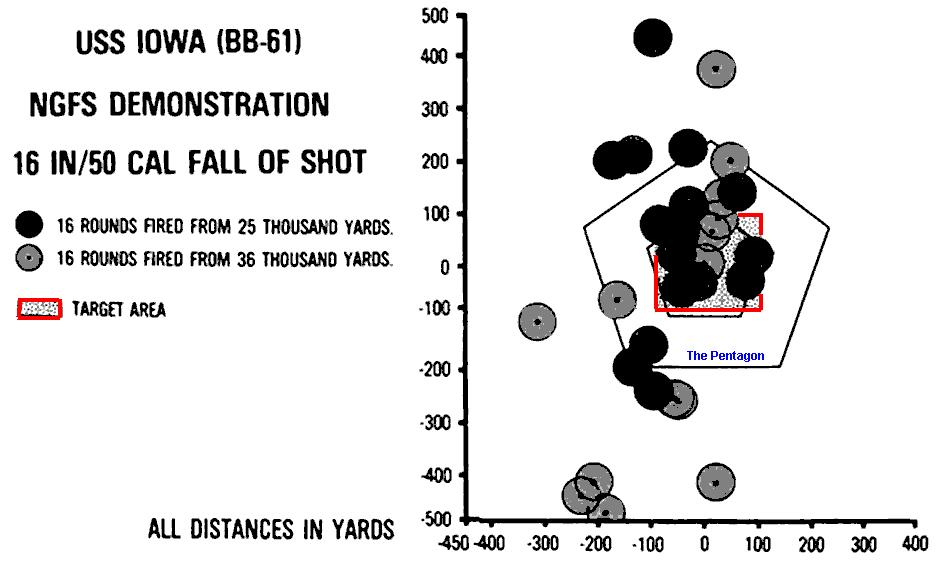
Unpowered unguided shellfire at extreme range is piss-awful inaccurate. Here's an image of the shot pattern from the Iowa BB's 15" guns; 25000 yards is only 14 miles, 36000 yards is about 20 miles.
http://www.fas.org/man/dod-101...
For this test the ship was sitting still, it wasn't travelling at 25 knots rolling in a heavy sea. In contrast a Tomahawk missile fired from a smaller cruiser or even a submarine from hundreds of miles away could hit an individual window in the Pentagon.
Unless railgun projectiles can be terminally guided like, say, aircraft-launched missiles then you can expect their fall of shot patterns to look like the Iowa's, only ten times wider since they'll have ten times as as long to deviate in flight over the extended range.
-
Re: Double Irish
Investment would still be profitable, so people would still invest. Studies back this up..
http://www.fas.org/sgp/crs/mis...
http://www.levyinstitute.org/p...Even Reagan thought that capital gains shouldn't be below income tax.
-
Re:I hope they move it
Who really gives a shit about some metaphorical doomsday clock?
I do and so should you. I've been following the Doomsday clock from my teenage years, when it advanced from 7, 4, 3 minutes to midnight at the culmination of the cold War. The existential threat posed by the clock was real and terrifying. At that time scientists were debating a worst-case scenario of Nuclear Winter.
I've been on board with these folks for many years and as such hold them to high standards. One such standard is that of defining each existential threat as complete as possible, and the other is to identify clearly which threats contribute the most risk for the forward clock adjustment. This is done by rank.
Their standard has slipped.
In their statement the issues were presented as follows:
Climate change, leading off with the 2014 Hottest Year statistical flapdoodle, declaring it an issue that "world leaders must face head on, immediately."
And if they have some spare time left over,
Nuclear modernization programs threaten to create a new arms race.
The leadership failure on nuclear power. Hear, hear!
Dealing with emerging technological threats. Ebola (technological? huh?), cyberattacks, AI killer drones, "dual-use technologies" (box cutters?), the kitchen sink.The Bulletin's ranking is important. If you applaud this headlining of climate change just because you personally feel strongly about it...
Then perhaps you should catch up on the current nuclear weapons counts and capabilities. If a conflict anywhere in the world goes nuclear, do you feel assured that the current leadership of your own country or the closest nuclear power is capable of restraining itself to the use of none --- or at most tactical weapons? If you're one of those folks who like to shout "nuke 'em!", bear in mind that some countries that the United States plays cheeky hardball with, such as Iran, contain resources that China considers to be vital to its National Security. Also since the former Soviet Republic dissolved, Russia and China are becoming more geopolitically allied with one another. Over time perhaps, an alliance will form that is stronger than either one has with the United States. It would be awful indeed to realize this as missiles are crossing in the air.
Perhaps you should evaluate the recent response to Ebola's emergence beyond its historical areas, and ask yourself how prepared even the most developed countries are on this day --- and what could have happened had the outbreak been even slightly less contained. This is ranked towards the end??
Of course, none of these threats, save perhaps a more virulent successor to Ebola with a 100% rate of death or reproductive damage (greetz to Vonnegut) might truly be considered existential. Life would go on and human life especially. Technically we are beyond survival. Even the most ludicrous global warming effects imagined do not convincingly paint a picture of 'mass extinction'; rather, a re-ordering of species numbers, purpose and precedence as nature has done for time uncounted.
But or modern way of life as we know it --- that is truly what is at stake. And it is worth preserving because as a species we are still learning to do better. While there are hot nuclear pickles ready to deploy we cannot be free and clear of the nuclear adolescence posed by Carl Sagan. With Ebola still in the wild without a clear vaccine or some way to deactivate it in its quiescent animal hosts, we cannot be said to have survived that either. And sad to say, a civilization reliant on base load wind and solar is not modern either, especially after a single continent-wide freeze. It's a pa
-
Re:Interesting
'... not supposed
-
Re:No one gets the oil!
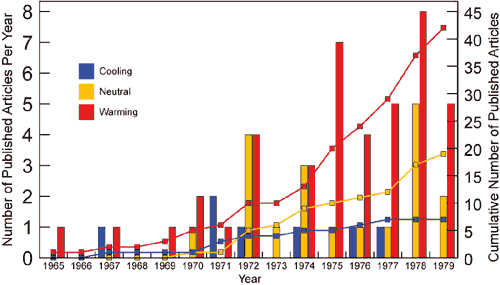
You're regurgitating complete nonsense. Once again, here’s figure 1 from Peterson et al. 2008. Notice that papers predicting warming vastly outnumbered those predicting cooling, even in the 1970s. Ironically:
- The term “global warming” was first used in a 1975 Science article by Wally Broecker called “Are we on the brink of a pronounced global warming?”.
- Sawyer 1972 estimated climate sensitivity as 2.4C, and Schneider 1975 gave a preliminary range of 1.5C to 3.0C.
- Manabe and Wetherald, 1975: “The Effects of Doubling the CO2 Concentration on the climate of a General Circulation Model.”
- In 1977, Freeman Dyson wrote that the “prevailing opinion is that the dangers [of the rise in CO2] greatly outweigh the benefits.”
- In 1977, Robert M. White, the head of the National Oceanic and Atmospheric Administration, wrote a report for the National Academy of Sciences that said “We now understand that industrial wastes, such as the carbon dioxide released in the burning of fossil fuels, can have consequences for climate that pose a considerable risk to future society.” [White, Robert, 1978, Oceans and Climate Introduction, Oceanus, 21:2-3]
- The 1979 JASON report “The long-term impact of atmospheric carbon dioxide on climate” estimated climate sensitivity as 2.4C to 2.8C.
- The National Academy of Science’s 1979 Charney report estimated climate sensitivity as 1.5C to 4.5C and said “If carbon dioxide continues to increase, [we] find no reason to doubt that climate changes will result, and no reason to believe that these changes will be negligible.”
While Jane is reading those papers, he should also consider addressing this issue with his basic thermodynamics:
Your own insistence that power in = power out (assuming perfect conversion and no entropic losses) belies this argument. You are arguing against yourself and you refuse to see that. If power in = power out (your own stipulation)
I'm not the only one insisting that power in = power out through any boundary where nothing inside is changing. Once again, that's a fundamental principle called "conservation of energy". Here are some introductions: example (backup), example (backup), example
-
Re:No one gets the oil!
No,no. Global cooling. Haven't you read the scientific papers from top agencies and researchers from the 70's. Sheesh
You're regurgitating complete nonsense. Once again, here’s figure 1 from Peterson et al. 2008. Notice that papers predicting warming vastly outnumbered those predicting cooling, even in the 1970s. Ironically:
- The term “global warming” was first used in a 1975 Science article by Wally Broecker called “Are we on the brink of a pronounced global warming?”.
- Sawyer 1972 estimated climate sensitivity as 2.4C, and Schneider 1975 gave a preliminary range of 1.5C to 3.0C.
- Manabe and Wetherald, 1975: “The Effects of Doubling the CO2 Concentration on the climate of a General Circulation Model.”
- In 1977, Freeman Dyson wrote that the “prevailing opinion is that the dangers [of the rise in CO2] greatly outweigh the benefits.”
- In 1977, Robert M. White, the head of the National Oceanic and Atmospheric Administration, wrote a report for the National Academy of Sciences that said “We now understand that industrial wastes, such as the carbon dioxide released in the burning of fossil fuels, can have consequences for climate that pose a considerable risk to future society.” [White, Robert, 1978, Oceans and Climate Introduction, Oceanus, 21:2-3]
- The 1979 JASON report “The long-term impact of atmospheric carbon dioxide on climate” estimated climate sensitivity as 2.4C to 2.8C.
- The National Academy of Science’s 1979 Charney report estimated climate sensitivity as 1.5C to 4.5C and said “If carbon dioxide continues to increase, [we] find no reason to doubt that climate changes will result, and no reason to believe that these changes will be negligible.”
-
Re:Muslims?
Getting data on these issues is complicated. If one restricts to the US, then about 10% of all terrorist attacks are Islamic. See http://www.washingtonsblog.com/2013/05/muslims-only-carried-out-2-5-percent-of-terrorist-attacks-on-u-s-soil-between-1970-and-2012.html. But not only is this restricted to the US, it uses a very broad notion of what counts as terrorism. If one weighs in the US by total deaths, then Islamic terrorism swamps everything else primarily due to 9/11. Worldwide, about 70% of all terrorist attacks are by Sunni Muslims but this varies from year to year. See for example the 2011 report NCTC report http://fas.org/irp/threat/nctc2011.pdf. Again, definitional issues can move this number up or down by a lot.
-
Re:What does it matter?
If you think we live under the rule of law then why the fuck hasn't James Clapper being charged with perjury yet?
Because it's not as simple as you appear to wish it to be. And this is from a longtime crusader against government secrecy who is on "your side".
-
Re:Isn't that cutting it kinda close
a geostationary satellite is travelling at just over 3km/sec. With average masses around 9000lb, that's still four tons of metal doing a fair clip by the time it hits the atmosphere should it decide to suddenly come home.
-
Re:Executive Orders Need to Expire, and Quickly
A typical executive order simply designates procedures and requirements to be followed by people working for the Executive branch of the government.
Which is EXACTLY what this executive order does. It is implementing at the Executive Branch the legislation to which it is based, namely the National Security Act of 1947 as amended. It even says so at the start of the order:
by virtue of the authority vested in me by the Constitution and the laws of the United States of America, including the National Security Act of 1947, as amended, (Act) and as President of the United States of America, in order to provide for the effective conduct of United States intelligence activities and the protection of constitutional rights, it is hereby ordered as follows:
http://fas.org/irp/offdocs/eo/...
Also, nothing in this executive order "led to" the warrantless wiretapping as alleged in the story. In fact, there are several places in the order that state that if US citizens are involved, it MUST go through the FBI / Attorney General. Read it. You will see what I mean.
-
Re:Haply so, but exec orders and agencies
Did you even read the executive order?
First of all, it has been modified many, many times since Ronald Reagen the last that I can find was in 2008. http://fas.org/irp/offdocs/eo/...
Second, and more to your points, sprinkled throughout the document are statements like, any intelligence collected concerning United States citizens must go through the FBI / Attorney General. This is so they can begin criminal investigations using the tools (read WARRANTS) to gain physical evidence of a crime. And the collection of that data, according to the order, is tangential to foreign intelligence gathering. As an example, here is 1.1(a)
(a) All means, consistent with applicable Federal law and this order, and with full consideration of the rights of United States persons, shall be used to obtain reliable intelligence information to protect the United States and its interests.
[Emphasis added]
This is 20(A):
(A) The Director of the Federal Bureau of Investigation shall coordinate the clandestine collection of foreign intelligence collected through human sources or through human-enabled means and counterintelligence activities inside the United States;
[Emphasis added]
So sticking to the topic at hand, namely that this order authorizes warrantless surveillance of United States citizens, is patently false. That may be the way it is used but that goes counter to the executive order's language.
By the way, the "human enabled means" is the metadata you are talking about.
-
Re:Radicalization
Saddam never gassed his own citizens, you probably mean Kurdish insurgents.
Assad never gassed his own citizens, you probably mean rebels.
Both strongmen considered their victims to be their citizens and subjects. In the state of rebellion, but citizens nonetheless. Bullshit propaganda much?
How are they NOT "citizens"?
How are they citizens?
Those people have lived within the territorial boundaries their whole lives.
So? The "boundaries" have Israel on one of the sides — why aren't you claiming them to be citizens of Jordan and Egypt? At least, those two neighbors actually once occupied the entire West Bank and Gaza respectively — for twenty years...
The Israeli government is being run by far-right reactionaries
Israeli government has changed many times since the country's establishment — swinging from Left to Right and anything in between. Never once have PLO or Hamas changed their official goal of destroying Israel.
but that won't make it any less true.
Nothing your wrote is true — except for the obvious fact, that downmodding will not make it any less so.
-
Re:Radicalization
Please read the Hamas (aka the elected government of the palestinians) charter:
http://fas.org/irp/world/para/...
Selected quotes:
"The time(16) will not come until Muslims will fight the Jews (and kill them); until the Jews hide behind rocks and trees, which will cry: 0 Muslim! there is a Jew hiding behind me, come on and kill him! This will not apply to the Gharqad(17), which is a Jewish tree (cited by Bukhari and Muslim)(18)."
"Israel, by virtue of its being Jewish and of having a Jewish population, defies Islam and the Muslims."