Slashdot Mirror
Domain: fas.org
Stories and comments across the archive that link to fas.org.
Comments · 2,098
-
Re:Trouble is...
Oh, yeah? Read this.
Perhaps you should stop relying on the German news agencies for coverage of German government excesses.
- -
3000 seconds?According to the text at the url listed in the posting (M.I.R.A.C.L.), the laser their discussing has demonstrated "Reliable operation demonstrated in more than 150 lasing tests and over 3000 seconds of lase time during the last decade."
This laser has only fired 150 times, for a grand total of 50 minutes over its lifespan, and has a "70 seconds maximum lase duration." I'm pretty sure drilling that far down for oil will take more than 70 seconds, and quite probably a single oil well will take longer to drill for than the entire previous experience of the example laser.
Does anyone get the feeling they're getting a little overexcited? Its one thing to create a megawatt class laser in a warehouse for short duration, mostly experimental use... Its entirely another to create one that can survive a hostile environment such as a desert or sea based drilling platform and operate continuously for days at a time. I'm gonna guess technology to make this successfull is still at least a decade out.
-
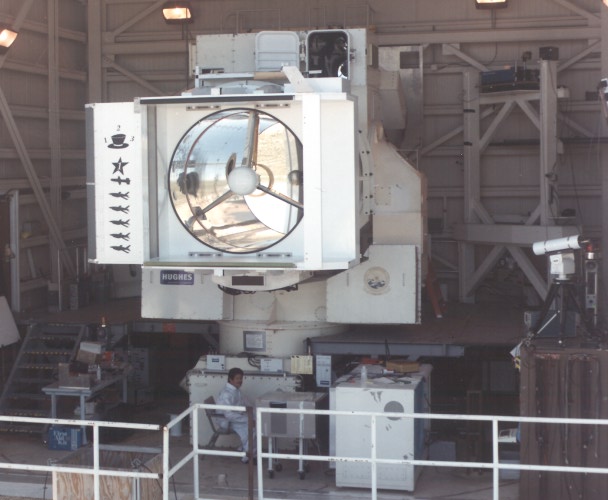
Heh, it's a weapon alright...
Anyone notice the number of kills painted on the side of the laser in the pic off the page?
Looks like five planes, a missile and two other things I can't make out.
Feng.
-
Internet2 video datamining (see screenshots)
Speech recognition, transcipting, and subtitling of audio-video content helps all of us, particularly the deaf, blind and sportsbar drinkers. Unfortunately speech recognition is not perfect. Good speech recognition could save the CIA a pile on FBIS. Searching text transcripts of a/v files, is only the start.
Internet2, a gigabit network for education and research (see PDF map), has a major future use as an audio-video storage library and distribution network. Video-napster? CMU's Internet2 Informedia Library project researchers are designing visual-video search software for faces, on-screen text, images and shapes. Computers finding on-screen people, text and similar programming... scary.
Check out this presentation with screen shots about Internet2, and its cool tools, uses and experiments. Slide 36 shows Facial Recognition and Optical Character Recognition (OCR) at work. It works so well, it finds text (bottom right) on the U.S. Capital's dome columns... whoops. Slide 37 "Similar Shapes/Content" shows examples of similar content of female news anchors, and soccer / football.
remove the nofreakinspam. to e-mail me. -
Re:Some issuesTo address your second point, it would not be that difficult to target from the air at 2000 feet range.
Ever seen an AH-64 Apache attack chopper targetting a ground target with its 30mm chain gun? The pilot/CPG's helmet display is integrated with the cannon's hydraulics so that it aims exactly where the pilot/CPG is looking. He puts the crosshairs on the target and the cannon is effectively boresighted on that target. The weapons computer can adjust for aircraft movement and weather effects.
Asikaa -
Re:We should get M$'s Allchin to comment
Was this traitor using proprietary software or "un-american" free software to do this double-crossing?
Wired, the affidavit, and World Net Daily indicate that he was using Linux and Palms. -
Re:What happened is far from amusing
-
Re:Mobile Launchers
There is one more major system that had a lot of money thrown at it before getting deep sixed; Small ICBM (or MidgetMan.). These really cool looking trucks would tool around a wilderness reservation area in time of crisis, causing the bad guys to waste a lot of warheads to try to eliminate a retaliatory capacity.
-
Re:What about the Soviets
They didn't send people, but they sent a bunch of probes. Anyway, if NASA hadn't, the soviets would probably have done it some time during 1970-71. It's a nice article here.
-
Re:Pico Sattelites Inspiration for Militarycan you show some relvent data as to back this up?
To back what up? That the US is overly dependent on spy satellites for enemy intelligence? That if an enemy can disable those spy sats with cheap picosats loaded with exposive warheads (a.k.a., ASATs), then US forces are essentially blind? That finally someone in the Airfarce was smart enough to figure it out?
-
US Gov't already uses free/public information...
It's a little off-topic, but I thinks it's interesting. The US's Open Source Information System collects huge database of free/public information (includes NIMA and other stuff): http://www.fas.org/irp/program/disseminate/osis.h
t m Side note: the NSA appears to use osis.gov as a domain for surfing purposes. I guess using free/public software is the next step. -
This is the Orange Book, redux
Once upon a time, the U.S. government write a set of specifications for multi-level secure computers, called the orange book. This worked pretty well for mainframes: Multics was rated B2, and was on the 'net as dockmaster.mil.
It was a bit clunky, but had been continuously updated over time, so I still have a machine running Trusted Solaris 7 in my basement.
It's arguably the same task to do this sort of thing with a virtual machine monitor as it is with a security monitor: both create trusted computing bases, which enforce the security rules.
It would look almost exactly like an unmodified system, with optional colored bars on the windows indicating the security level and subject matter that was displayed there.
The rules the TCB would enforce are things like "thou shalt not copy from higher security down to lower security", so the TCB gets asked if it should allow a top-secret cut buffer to be pasted into an merely restricted document.
The Trusted Computing Base (the VMM) gets to say no, and so refuses to allow mapping of that page. The X server gets a -1 return code and errno=NOWAYJOSE, so it then pops up a "sorry, that was a security breach" message... which is exactly what my TS system does when I klutz and try to copy stuff from my confidential files into my unclassified email!
-
Re:OptimisticThey're being a little optimistic about SDI, now, aren't they? When I see evidence to suggest we'll have our Magical Laser Satellites in the next 20 years, I'll believe it.
Actually, not very. A few currently-working-up programs to think about:
- ABL - Airborne Laser: This is a 747-400 freighter configuration with a laser mounted in a turret in the nose. The first aircraft is currently being assembled, with ground and flight tests due to start later this year. A total of seven will be produced once the first finishes testing in 2003. Click here for more a program overview from FAS.
- Navy Theatre Defense/SM-3. The Navy is currently in flight test of a theatre missile defense system based on Aegis cruisers/destroyers and an evolved SM-2 Block IV missile equiped with the LEAP (Lightweight ExoAtmospheric Projectile) hard-kill vehicle.
- Arrow: This is a US-funded, Israeli-developed TMD system originally intended to provide localized target/population center protection for Israel. It has been successfully demonstrated against ballistic missile targets, however, and the program is structured to transfer technology to a next-generation US BMD system.
And the point of war, from a modern standpoint (assuming it's US v China) is to destroy everything your enemy owns. Someone fires the first (nuclear) shot, and we all die.
Actually, that has virtually nothing to do with why and how wars are fought. Wars are fought to compel political behavior. Whether that occurs by means of destroying the opposition's forces (which is actually the hard way to do it), or by means of destroying small, key targets that compel the enemy's behavior (which requires a lot more thought, but is easier to do) is the crux of the issue.
Part of the point of the BMD stuff that's currently circulating is that it removes a major lever from any country that doesn't have >100 nuclear missiles. Simply put, if we can stop any surge attack of
Russia
United Kingdom
France
That's it. China has a total of 24 missiles, 12 (fixed) pointed at Russia, and 12 (fixed) pointed at the US. Israel has less than 100 missiles, with no more than 2-3 that might reach the US (~60 theatre missiles that can't reach the US, and 2-3 satellite launchers capable of FOBS). India and Pakistan have a few theatre weapons, but that's it. Nobody else has declared anything. South Africa has dismantled it's nuclear weapons program under international supervision. Ukraine, Khazakhstan, and the other xSSRs have all handed back their nuclear warheads to Russia (again, under international supervision). There are some loose nukes in Iran, but the capability doesn't exist to put together a greater than 20 IRBM threat (yet). Nobody else has even that much, even if they aren't declared.
-
Re:Marching Up and Down the Square (in space)
Nah. He's real. Now ahem, that's a dumb-sounding name.
-
Re:Interesting but worthlesswhich civillization will be so stupid to use light to cummunicate in open space??!! We don't
You mean, like this?
http://atrey.karlin.mff.cuni.cz/~clock/twibright/
r onja/or this?
"Lighthouse Communications Inc., Littleton, CO Constructed and tested an optical through-the-air communications system with a 10 mile range. Proposed methods and wrote description of a wide area, high speed information broadcasting service. Service would provide terabytes of library type information to subscribers at high data rates. No FCC approval needed."
http://www.djandassoc.com/projects.html
or, like this?
http://www.fas.org/spp/military/budget/peds_98a/0
6 03006a.htm(and we humans are quite stupid).
Speak for yourself.
The ammount of power needed to trasnmit data through a light beam in open space is really big,
No, it isn't.
turning the whole process whortless.
Lasers can removed "whorts," too.
That's why we use laser light in a restricting environment (aka optic fiber). Sorry, but it's the worst use for a telescope I could ever imagine....
Laser light communications holds great promise for providing high bandwidth, line-of-sight communication between points that cannot be spanned by cable. A few years ago, some astronomers pinged a laser modulator off the Galileo space probe when it passed near Earth. If Galileo had been equiped with an optical demodulator, it would have been able to decode our signals as it zipped by at thousands of miles an hour.
See also:
http://www.spie.org/web/abstracts/1400/1417.html
or
http://www.spie.org/web/abstracts/1800/1866.html
"In the Galileo Optical Experiment (GOPEX), optical
transmissions were beamed to the Galileo spacecraft by
Earth-based transmitters at Table Mountain Observatory
(TMO), California, and Starfire Optical Range (SOR),
New Mexico. The demonstration took place over an
eight-day period (December 9 through December 16) as
Galileo receded from Earth on its way to Jupiter. At 6
million kilometers (15 times the Earth-Moon distance),
the laser beam sent from Table Mountain Observatory
eight days after Earth flyby covered the longest known
range for laser transmission and detection.!" -
Stalkers
In Russia, they call themself stalkers - after the novel Roadside Picnic and the movie Stalker
Some of them brag that they can get into Moscow Metro-2.
Workers in Chernobyl investigating the remains of the disaster often ignored safety regulations and radiation limits. They also called themselves stalkers. -
Re:NO! Don't do this!Oooh! Oooh! Oooh! I know!
First off, the C-5 has been out of production for some time, and half of the fleet is essentially being parted out to support the other half. Cost: $184 million per unit, plus additional cost for reopening the production lines.
Secondly, the C-141 is too small for the job. The 747 freighter can carry about 2.5 times what the StarLifter can carry- it just can't carry the laser and all the equipment needed to aim it. In addition, the fleet is aging rapidly.
Just for kicks, I'll throw in the C-17, too. The C-17 is is twice as expensive, can travel half as far, and carries half the payload of a 747. Cost: $348 million per unit, average.
Plus, all of these are designed for cargo operations with easy unloading capabilities (like the ramp in the back). You don't really need that type of capability for this job. And, the list price on the 747-400F is $145 million per plane. That's a new aircraft, ready to be modified.
As for the danger in putting a 'civilian' aircraft to use, we already employ DC-10s as tankers, 767s as AWACS units, 707s for all types of things, and the occasional 737 for airlift. It's nothing new- it's simply another airframe. And if they do in fact shoot down a civilian aircraft, whoever the agressor is has just lost the propaganda war- a really really really bad move (think:pearl harbor style, you're shooting our civilians down, the enemy is pure evil backlash across the world). They'll be careful not to pull something like that.
P.S. I am not a troll, and did not post the first reply. Have a nice day.
What do I do, when it seems I relate to Judas more than You? -
Re:Smooth move USAF
Now an enemy knows that the US has 747's used to shoot down missiles. Doesn't that suddenly make every 747 in the sky a suspect? Someone, please correct me if I'm wrong, but this seems likely in stressful times to make civilian airliners a legitimate target.
The US already uses aircraft based on civilan models, such as the E-3 AWACS, the JSTARS, and the KC-135 all of which are based off the popular 707 aircraft. Having 747s wouldn't add to the problem, they have to have prominent military marking on them, and civilan airliners route away from war zones anyway, so they are unlikely to be mistaken for a ABL and shot down.
-
This is way old news...
The US Air Force has been working on what they call an "Airborne Laser" for years. The idea is to provide a defense against ballistic missiles in a particular theatre of battle. For instance, in the middle east, when Iraq was shooting scuds all over the place. The airborne laser, like the Patriot missile, would be used to shoot down missiles, but unlike the Patriot, which shoots down ballistic missiles as they are approaching their target, the airborne laser would shoot down the missile just after launch. That way, the payload and the missile would fall near the launch site.
If you want more info, go over to FAS, the poor man's Jane's Defense Review.
-
Kids: Don[t play with plutonium!Some known facts:
- The Mk39 was a roughly 2000 kt weapon. That's beefy for a US nuclear weapon--it was the USSR that had the 20 Mt mountain melters. Still, 2000 kt is enough to turn a typical rural county into a burning ruin.
- Nuclear detonation of that magnitude is an active process....it's extremely unlikely something could trigger it accidentally.
- However, it is plausible that the plutonium or uranium on board such a bomb could go critical, thereby causing a toxic, radioactive fire that would poison the area of impact. On the other hand, the damage wouldn't be widespread and the number of casualties would be small.
By the way, if you're thinking about digging that stuff up--think again. One microgram of plutonium oxide embedded in your lungs or ingested into your bloodstream through a cut or scrape will irreversibly destroy your immune system in days. That's not enough to see even with a microscope. The only sign you'll have of something being wrong is that you'll start puking your guts up in about 12-24 hours, and then you'll start bleeding from every orifice. OK, maybe overdramatic, but mainlining heroin is relatively smart compared to a cavalier attitude towards Cold War-era artifacts possibly leaking plutonium!
-
Re:The past
I work at TRW in colorado, and we've got a bunch of them. I still don't admittedly know much about them and if I did odds are I wouldn't be allowed to tell anybody. Here's a picture of them, and an article besides.
-
Re:Fantastic Idea!Actually, thinking a bit more, it may be a good idea. Rail transport is surely cheaper than freighter. And there are a pile of Chinese folk just starting to get their shit together to become the biggest consumer market in the world. Might be nice to transport stuff to them cheaply.
Is it really all that much cheaper? I've moved back and forth to Europe, and I was quite surprised at how inexpensive the freighter (shipped via Panama) portion moving goods was. However, if it really is cheaper, it's isn't Siberia, but China and Korea that may be where the key is. Looking at a world map, it's quite a long way to ship goods, but China is supposed to become a massive economic powerhouse in the next couple of decades (to surpass Europe and possibly the US - well, that's what some say). Trade to China was almost $60billion in 1995 alone (and growing quickly) - that makes the cost of such a project seem not so large in retrospect.
And what with global warming and all, maybe Siberia ain't such a bad spot to visit after all.
Actually, everyone I know that has travelled to Eastern Siberia (about a half dozen, always in the summer), all say that it's worth the trip.
-
Re:All this talk of NASA
I stand corrected sir. $1.3 Billion.
According to the Federation of American Scientists, the cost is over $2 Billion per copy. The FAS references a GAO Report of 1997.
So if the FAS is to be believed... I was not only wrong. I was way friggin wrong. I'm guessing that the USAF will understate the cost of the B-2.
Cheers.
-
Re:All this talk of NASA
I stand corrected sir. $1.3 Billion.
According to the Federation of American Scientists, the cost is over $2 Billion per copy. The FAS references a GAO Report of 1997.
So if the FAS is to be believed... I was not only wrong. I was way friggin wrong. I'm guessing that the USAF will understate the cost of the B-2.
Cheers.
-
Advocates, Killer ConsolesI don't think it's fair to call this an "advocacy site". They do have a very conspicuous right-wing agenda, but their journalism seems honest enough, if somewhat unobjective.
I'm not going to comment on the veracity of the story as such, but the idea isn't that farfetched. SH has a fetish for high tech. If he wants vector hardware and 64-bit CPUs, he can't just place an order with Hitachi or MIPS. The obvious alternative is consumer technology, which is much easier to buy under the counter.
You know, it's this sort of thing that makes me wonder if SH isn't a plant, or at least propped up by his ostensible enemies. If the extremists in that part of the world had some semi-intelligent leadership, they'd be really dangerous. They could buy plans for V2s and such from the Smithsonian and do some serious damage to their enemies.
But what's the use of Obliterating the Spawn of Satan if you have to do it with UnKewl Gizmos? So SH spends big bucks on silly toys like customized SCUDs,superguns, zirconium bombs, etc., etc. Which, even if he had the industrial base to support them, he can't actually use — he has to stay under the western political radar to survive, and dropping nerve gas and fallout on large numbers of people is inconsistent with that constraint.
__________________
-
Is Israel still locked out?
Israel lobbied the US to put a provision into US law prohibiting commercial satellite photography of Israel. Yes, the whole country. Unclear why; maybe they're worried about newer photographs of their nuclear bomb plants or refugee camps.
-
Surprise!
There's a long history of Really Dirty Shit coming out about the United States. The real problem is that the event horizon for this sort of thing is 10 to 30 years. At that point, news about the heinousness may or may not come out. The media gets to make a big stink about it, while keeping an implicit attitude that says "That sort of thing couldn't happen these days". For example, Operation Shamrock, the secret bombing of Cambodia, heinous shit in all of Central and South America, UKUSA, Nixon's dirty tricks, Crypto AG, and the list goes on.
The real problem is that nothing is done to fix the system. The people involved are not taken outside and shot, they're still where they were before. What's the current set of semi-atrocities? If you read a lot of the foreign or independent press, you might find out sooner. -
Re:The horrible truthOf course I have no idea what sort of projects you work on. If you're looking for specific legal advice, I certainly am unable to give it in a slashdot posting, but can only give you my general take on the laws. If you are in a specific situation, you should talk to a lawyer. Looking at the relevant statutes, it's clear that just about any act of disclosure of sensitive information to a foreign agent (i.e. an act of espionage) would certainly be punishable criminally.
My view of the vetoed law is simply that I think it was not a good idea as a matter of public policy to have a General Secrets Act in this country. They do have a General Secrets Act in Britain, but then in Britain the rights of free speech and free press are very different. At present there are many administrative penalties, and there is the possibility of criminal prosecution under certain circumstances, but only under those certain circumstances. Leaking info to the press may in certain circumstances be criminal presently (e.g., there was a man who went to prison for giving a magazine a spy photo of a Russian aircraft carrier in the mid 80s) but in many cases it may not be (because the disclosure of the info in question would not be prejudicial to the interests or safety of the US), although of course the leaker could lose his job or his clearance.
Take a look at the statutes, executive orders and regulations relating to national security for yourself. Executive Order 12958 is informative as it defines the framework of the classification system, and to look at it go here and search for 12958. Another very informative source of information is a booklet published by the Information Security Oversight Office that explains the classification scheme; especially enlightening is the FAQ at the end of the booklet.
All of these statutes and regs require more than the simple fact that information has been administratively classified as confidential as a predicate for the imposition of criminal liability. For example, some of these statutes require that the disclosure be harmful to the safety or interests of the United States or beneficial to the interests of a foreign government to the detriment of the U.S. And there is criminal liability for misappropriation of government property, such as physical documents. Others provide penalties for any unauthorized disclosure in any circumstances of certain categories: such as diplomatic codes, such as nuclear weapon designs, and the identity of American agents. One law certainly does allows the government to administratively classify as criminal the unauthorized disclosure of certain categories of information relating national security to people known to represent foreign governments or Communist organizations. Of course I am generalizing about these laws and a lawyer would need to dig into the language of the laws and the relevant caselaw and regulations to apply the law to a specific fact situation, but if you look at the various statutes, I think you'll see what I mean.
What these statutes do not do is criminalize as a general matter the unauthorized disclosure of classified information simply because it is classified. Rather, there have to be some added circumstances. Leaking information (as long as they are not codes or nuclear secrets or the names of covert agents) to the American press or to Congress in most circumstances (i.e. when it does not harm the interests of the United States)will usually not be a criminal act under present law
I certainly would never encourage people who have signed a Classified Information Nondisclosure Agreement to violate their oaths lightly, as I think that there are many activities that our government engages in that would be best left unknown to our nation's adversaries. National security is not a light matter. However, there have been too many instances, the chief one being that of the Pentagon Papers case, where information classification has been used to try to keep essential or controversial information from other branches of government and from the American people for reasons other than that of national security. I would be very uncomfortable with a General Secrets Act, and think it would contrary to the spirit of our kind of democracy.
Ed
-
Re:The horrible truthOf course I have no idea what sort of projects you work on. If you're looking for specific legal advice, I certainly am unable to give it in a slashdot posting, but can only give you my general take on the laws. If you are in a specific situation, you should talk to a lawyer. Looking at the relevant statutes, it's clear that just about any act of disclosure of sensitive information to a foreign agent (i.e. an act of espionage) would certainly be punishable criminally.
My view of the vetoed law is simply that I think it was not a good idea as a matter of public policy to have a General Secrets Act in this country. They do have a General Secrets Act in Britain, but then in Britain the rights of free speech and free press are very different. At present there are many administrative penalties, and there is the possibility of criminal prosecution under certain circumstances, but only under those certain circumstances. Leaking info to the press may in certain circumstances be criminal presently (e.g., there was a man who went to prison for giving a magazine a spy photo of a Russian aircraft carrier in the mid 80s) but in many cases it may not be (because the disclosure of the info in question would not be prejudicial to the interests or safety of the US), although of course the leaker could lose his job or his clearance.
Take a look at the statutes, executive orders and regulations relating to national security for yourself. Executive Order 12958 is informative as it defines the framework of the classification system, and to look at it go here and search for 12958. Another very informative source of information is a booklet published by the Information Security Oversight Office that explains the classification scheme; especially enlightening is the FAQ at the end of the booklet.
All of these statutes and regs require more than the simple fact that information has been administratively classified as confidential as a predicate for the imposition of criminal liability. For example, some of these statutes require that the disclosure be harmful to the safety or interests of the United States or beneficial to the interests of a foreign government to the detriment of the U.S. And there is criminal liability for misappropriation of government property, such as physical documents. Others provide penalties for any unauthorized disclosure in any circumstances of certain categories: such as diplomatic codes, such as nuclear weapon designs, and the identity of American agents. One law certainly does allows the government to administratively classify as criminal the unauthorized disclosure of certain categories of information relating national security to people known to represent foreign governments or Communist organizations. Of course I am generalizing about these laws and a lawyer would need to dig into the language of the laws and the relevant caselaw and regulations to apply the law to a specific fact situation, but if you look at the various statutes, I think you'll see what I mean.
What these statutes do not do is criminalize as a general matter the unauthorized disclosure of classified information simply because it is classified. Rather, there have to be some added circumstances. Leaking information (as long as they are not codes or nuclear secrets or the names of covert agents) to the American press or to Congress in most circumstances (i.e. when it does not harm the interests of the United States)will usually not be a criminal act under present law
I certainly would never encourage people who have signed a Classified Information Nondisclosure Agreement to violate their oaths lightly, as I think that there are many activities that our government engages in that would be best left unknown to our nation's adversaries. National security is not a light matter. However, there have been too many instances, the chief one being that of the Pentagon Papers case, where information classification has been used to try to keep essential or controversial information from other branches of government and from the American people for reasons other than that of national security. I would be very uncomfortable with a General Secrets Act, and think it would contrary to the spirit of our kind of democracy.
Ed
-
Re:Good, let the robots do it
There are already unmanned surveillance aircraft; one such system is Predator. It can stay airborne up to 40 hours, and has been used in Yugoslavia. There are some computer vision research projects whose goal is to provide automated analysis of Predator video (e.g., counting and identifying vehicles travelling on a road).
-
Re:Governing
Here is a list of signatories of the treaty.
The United States signed it in 1967. -
Re:Garage saleTook me 5 minutes on Google to find it. Just check out: http://www.fas.org/ma n/d od-101/sys/ship/row/rus/1143_5.htm
The USSR apparently had 3 aircraft carriers, 1 is still in (Russian) service, although it's probably been docked for good. 1 they abandoned, 1 was sold by the Ukraine government.
I quote:"Ukraine began trying to sell the ship, and talks with Chinese and British companies were held in 1995. However, it was hard to find a customer. The sale of Varyag for US$20 million was announced on 17 March 1998 for conversion to an entertainment complex and casino."
-
Patriot successIt is generally accepted that the Patriot missiles failed to have any significant success against Scuds. Some analysts have suggested that not one Scud was intercepted.
Look here for the official story, or here for another analysis.
But the really interesting report is the Postol/Lewis analysis, including detailed analysis of video evidence, is here
In the interests of balance, This is a response to it.
-
Patriot successIt is generally accepted that the Patriot missiles failed to have any significant success against Scuds. Some analysts have suggested that not one Scud was intercepted.
Look here for the official story, or here for another analysis.
But the really interesting report is the Postol/Lewis analysis, including detailed analysis of video evidence, is here
In the interests of balance, This is a response to it.
-
Re:from voluntary contributions, duh!Missle defence systems:
We (the United States) actually fielded a missle defence system (as opposed to anti-aircraft) in the early 1970's. It was the Safeguard program, descended from the Sentinel program that was a follow-on to the Nike-X.
Sentinel was meant to be a "shield" over the whole country; Safeguard was much smaller in scope and was meant basically only to preserve our own missles from first-strike attacks. Only one Safeguard installation ever came on-line, and it was closed after less than one year.
Safeguard consisted of two missles and two RADAR systems. The first radar called the Perimeter Acquisition Radar (PAR) was used for long-distance detection of incoming re-entry vehicles (RVs). Today this radar I *think* is still used for tracking orbiting objects. If an RV was detected, the first missle would be launched. This missle, called the Spartan, was based on the Nike Zeus missle, but had more power, and was used for exo-atmospheric interception. The Spartan used a nuclear warhead and depended on the X-rays generated by the warhead to disable incoming bombs.
In the event of the Spartans failing in their mission, another radar and missle system came into play. The Missle Site Radar (MSR) provided pinpoint guidance to a new kind of missle, the Sprint. Sprint missles were the highest accelerating missle ever fielded by the United States, leaving their silos already supersonic and accelerating towards the target at 100 G's. The Sprint had a range of about 25 miles, and was intended as a last-ditch interceptor. It too was nuclear-equipped, but could use blast as well as radiation to disable incoming RV's.
The sprint went from zero to Mach 10 in a mere five seconds. The missle was only about fifteen feet tall and had an ablative nose cone to dissapate the heat generated by its extreme velocities. It was steered by injecting cool gas into the exhaust stream of the rockets; it would turn in the direction that the gas was fired from.
Contamination:
As you know, the materials used in modern nuclear weapons is actually quite small. The smallest weapon fielded by the US was the Davey Crocket, and it only weighed about 50 pounds. Of that, only thirteen or so was the nuclear fuel.
I'd be more worried about irradiated soil (fallout) than anything directly from the bomb. A good reference for American nuclear tests (atmospheric and surface bursts, anyway) can be found at this page.
References: http://www.fas.org/spp/starwars/program/safeguard
. htm http://www.redstone.army.mil/history/vigilant/chap 4.html http://www1.tpgi.com.au/users/mpainf/missiles/HNik eX.html http://www.fas.org/spp/starwars/program/nike_x.htm
Jeff
-
Davy Crockett nukesStandardDeviant wrote:
As a side bit of trivial, you'd be amazed at the number of things we (US) thought of using "small" devices for during the 50's and 60's: civil engineering, fighter-deployed anti-aircraft missles (sure, 1 missle = a squadron of Russian bombers, but I'm sure the folks down wind of that will be _real_ happy...), anti-tank mines, and Jeep-mounted nuke rockets where the range of the missle was less that the lethal radius of the device (I think weapon system was refered to as the Patriot or the Bowie or something like that).
You're thinking of the "Davy Crockett" nuke. The concept, I think, was something similar to shoulder-launched SAMs like the Stinger. The weapon was the M-388 recoilless rifle; the warhead was the Mk-54:
http://www.fas.org/nuke/he w/U sa/Weapons/Allbombs.html
Also check out a comment from a member of a unit that was to have used them in the event of attack (entry of 2000 June 25, 00:25:12).
-
Davy Crockett nukesStandardDeviant wrote:
As a side bit of trivial, you'd be amazed at the number of things we (US) thought of using "small" devices for during the 50's and 60's: civil engineering, fighter-deployed anti-aircraft missles (sure, 1 missle = a squadron of Russian bombers, but I'm sure the folks down wind of that will be _real_ happy...), anti-tank mines, and Jeep-mounted nuke rockets where the range of the missle was less that the lethal radius of the device (I think weapon system was refered to as the Patriot or the Bowie or something like that).
You're thinking of the "Davy Crockett" nuke. The concept, I think, was something similar to shoulder-launched SAMs like the Stinger. The weapon was the M-388 recoilless rifle; the warhead was the Mk-54:
http://www.fas.org/nuke/he w/U sa/Weapons/Allbombs.html
Also check out a comment from a member of a unit that was to have used them in the event of attack (entry of 2000 June 25, 00:25:12).
-
Re:Too much room for abuse
1.You have the problem of who guards the guardians. The backdoors are OK as long as the NSA can be trusted not to abuse them by exploiting them when not appropriate. But can you trust the guardians? Who guards the guardians?
Executive order 12333, which is enforced by the Congressional Select Commitee on Intelligence Activities (or something close thereto). Some of these intel guys are fearless (they've seen it all), but if there's one thing that they fear it's Congress, especially the Select Commitee on Intelligence Activities.
2.You have the problem of leaked information -- how do you know whether some terrorist group or something like that has obtained leaked information about these backdoors? They could be abusing these backdoors to their own ends.
Which is another reason I don't think the NSA is doing this. Half their mission is ensuring the integrity of U.S. Government systems. It's standard practice in the government now to use COTS solutions - the NSA isn't going to let that COTS get installed all over place with backdoors in it for precisely this reason.
As always, these are solely my opinions and not those of my employeer, priest or rabbi. That sounds like the start to a good joke. .
-"Zow"
-
Orange Book
-
Re:Alleged is right
So the question becomes, what can we do to help maintain and improve our position in a world which is increasingly hostile towards us?
Perhaps instead of trying to improve our position (is it really in danger?) we could try to address some reasons why the rest of the world is increasingly hostile towards the US. In The Political Economy of Terrorism, Kendall Clark's response to the perceived threat of terrorism and the recent National Commission on Terrorism report, Clark writes:
"In fact, the solution to terrorism is elegantly simple, though certainly practically impossible to implement without sustained and intense social struggle. The only realistic way to reduce the terrorist threat is to remake American foreign policy according to just and humane principles. Terrorism against the U.S. -- which is already exceptionally unusual -- would be all but imperceptible if American foreign policy were just and humane. But there's the rub: foreign policy cannot be either just or humane as long as U.S. corporations and elites, through their agents in government, will do anything to maintain the U.S. Empire. In other words, if you want to reduce terrorism globally, dismantle the American Empire. The burden of Empire is terrorism. For as long as U.S. corporations and elites fight to maintain their global Empire, there will be people around the world -- largely, if history is any guide, though not exclusively, people of color -- who object, often violently, to being made to pay the price and bear the burdens of that Empire." -
Re:Worried...
The area where I see where this having the most popularity is in spying^H^H^H^H^H^Hlaw enforcement. We already have police dogs that sniff out criminals; electronic smell recognition seems to be a (un)natural extension of this. Can't you imagine the FBI or NSA with a huge database of peoples' "smells" and matching them with gloves left behind at a crime or sperm samples from a rape? Of course, you wouldn't have to register your smell with them -- after all, you don't really need that driver's license!
Actually, this is by no means a new idea. The East German Stasi had a program where smells were gathered through a variety of means and stored in sealed jars. The jars could be opened months, even years later and the scents (usually preserved on a piece of fabric) presented to bloodhounds and the like. Surprisingly enough, this actually worked pretty well.
References to this practice can be found in a number of places, including reporter's notes (search for "smell samples") archived at the Federation of American Scientists.
So it's fairly clear that people and governments are not only capable of doing this sort of thing, but, in fact, it has been done (and will be done again if it's deemed valuable, I have no doubt). However, it must be pointed out that the usefulness of electronic bomb sniffers and smell based weapons locators is huge, and, properly applied, would likely save many lives.
-- -
Re:Worried...
The area where I see where this having the most popularity is in spying^H^H^H^H^H^Hlaw enforcement. We already have police dogs that sniff out criminals; electronic smell recognition seems to be a (un)natural extension of this. Can't you imagine the FBI or NSA with a huge database of peoples' "smells" and matching them with gloves left behind at a crime or sperm samples from a rape? Of course, you wouldn't have to register your smell with them -- after all, you don't really need that driver's license!
Actually, this is by no means a new idea. The East German Stasi had a program where smells were gathered through a variety of means and stored in sealed jars. The jars could be opened months, even years later and the scents (usually preserved on a piece of fabric) presented to bloodhounds and the like. Surprisingly enough, this actually worked pretty well.
References to this practice can be found in a number of places, including reporter's notes (search for "smell samples") archived at the Federation of American Scientists.
So it's fairly clear that people and governments are not only capable of doing this sort of thing, but, in fact, it has been done (and will be done again if it's deemed valuable, I have no doubt). However, it must be pointed out that the usefulness of electronic bomb sniffers and smell based weapons locators is huge, and, properly applied, would likely save many lives.
-- -
Re:A few facts...re: Item 4 -- what height are you assuming? Mountains, to take an extreme case, are visible for quite a bit more than 7 miles!
I found an horizon calculator here, and at a height of just 50 feet (which is what, a 5-story building?) the horizon is ~9.5 miles.
This might be an issue in a suburban office park, but even here in little Baltimore we've got plenty of buildings higher than that. In particular, the World Trade Center in the harbor (which would never be confused with ones in New York) is 423 feet tall, giving an horizon of some 27 miles.
-
Re:Plutonian message
It was intended to be a joke about the metric to english conversion problem NASA had with the Climate Orbiter spacecraft around Mars.
-
Flankers and MiGsI agree. Incidentally, Flankers *ARE* MiGs.
They are not. The NATO designation Flanker (see this page) is the Su-27/30/35 etc. It is from Sukhoi, not from the Mikoyan-Gurevich (MiG) design bureau.
--Calum
-
Re:Yeah, this is beliveable.. but oldActually this is quite believeable and real -- just not very new. Almost all of this has been reported on for decades, with only the 'Echelon' brand name and big huhu with the Europeans (the NATO members among them damm well knew about this long ago) being new. Its old news gathered from better authors repackaged for those who were not paying attention and have been watching too many X-Files episodes.
For example, Campbell cites "TOP SECRET UMBRA" as the top level compartment for SIGINT. Well, it was -- in the 1960's. (It doesn't matter that much as the entire system is being completely revised eliminating TOP SECRET entirely -- see FAS's web site which is generally much better on this kind of thing when John Pike has time to update it.)
It's an important issue, but it would pay to use better sources. To see how old this information is check out David Kahn's The Codebreakers or William Burrows's Deep Black.
there are few things more irritating than a crpto geek . . . ask my wife . .
-
More information...
-
Is this for real?Before we all go off and ask "Could you imagine a Beowulf Cluster of these?":) I'd like to ask if this is actually for real. I mean it looks cool and all, but...
A quick search of "Samowar" or "PR-964" didn't turn up much on Google, nor on the Federation of American Scientists, one of the most respected military analysis sites on the Internet. Where would they get the documentation for a military surplus processor? Why not the scads of other cheap embedded, well known, processors out there like ARM, i960? I know the Eastern European nations are hard for cash and selling say MiG's and Flankers but this is an odd way to make money
Anyways, why would anyone want such a thing? I love seti@home (running at work, our research lab, total about 22 machines) as much as anyone else, but I wouldn't buy specialized hardware for the thing...
--Calum
-
This is (finally) some good newsThis link deals more the the potential abuses that happen with the current scheme of allowing third party cookies through. It's scary to think that just by having a picture on a web page, the time you spend on each page, what you did while you were on a site, and what sites you have visited can all be sent back to a centralized database to be mined for relevant data about you.
Combine this with some of the other available snooping tools and technologies, such (Echelon, C arnivore, etc..) and there are IS no privacy on the net.
Throw ICANN into the mix and see how they are "protecting" the internet, and it makes me very glad the Microsoft, regardless of the disagreements I have from them, is proactively making it possible for users to protect themselves from these abuses.
-
Re:Man, it sorta sucks though.