Slashdot Mirror
Domain: gnome.org
Stories and comments across the archive that link to gnome.org.
Comments · 3,430
-
Re:Usability and UI
Usability and UI are exactly my background. Please explain to me how I can have a positive impact on OSS...
Wow. This reads something like:
I am a hot chick with a geek fetish who desperately wants to get laid. Please explain to me how I might manage to do this...
I think the problem is that you aren't talking to usability folks -- most OSS projects don't currently have a "usability guy" or often even a designated "interface programming guy". It's kinda too bad. I'd like to suggest that if you are interested in GNOME, try the Usability Project folks, who *are* interested in taking and cataloging suggestions. Dropping by their IRC channel and working on identifying user interface issues with GNOME is something that a lot of folks would like. Sun donated some UI people's time to the project for a decently-sized study, but they always would like more input. If you like KDE, try the KDE Usability Project. Since these two are about the most usability-focused projects around, they're probably a good place to put in some improvements, where your work won't get dropped or ignored.
One of the main problems with OSS is that generally programmers are used to, y'know, doing their own thing. It's hard to take advice from someone else on a volunteer project, especially since they might get less of that precious credit for an improvement (and credit must be a primary motivating factor, since the code-for-self motivation generally isn't when it comes to UI). Hence the "well, why don't *you* implement it" business.
I realize that funding is a problem when it comes to doing studies, but you probably *do* have a knowledge of existing problems, stuff that people like Apple have run into in the past (I read interface articles as a bit of a hobby, and I've got a ton of interesting things that people have run into to try to avoid).
Do remember, though -- usability people and artists are the resource in shortest supply in the OSS world. -
Re:Access to Accessibility Tools
The GNOME Desktop project has been putting serious effort into making the Linux desktop accessible for a few years now. It has a screen reader and a top notch maginifier. For instance, the magnifier can be made to watch an area of the desktop for change, so that it notifies you of changes in another part of the desktop while you're entering text somewhere else. It also has extensive tracking and cursor presentation options, much more so that its Windows counterpart. Check out some of the newer features in GNOME, it has improved a lot in just a year. There's also a long Accessibility Guide for GNOME, but it's not very good IMO. Still, all of the tools now have decent integrated help in 2.6.
KDE has a similar effort underway, but it's not as complete as GNOME's. In fact, the current roadmap seems to be to also use parts of the GNOME Acccessibility Toolkit (ATK) in KDE. Xzoom isn't the height of accessibility under Linux/X anymore -
Re:Conquering Windows
All? Have you downloaded and installed the Bitstream Vera families into your X11 font server?
-
Re:Definitely needs a non-commercial Windows licen
Perhaps Trolltech shouldn't have released QT as GPL on any platform - after all, any Linux developer can go and write their own toolkit if they want a GPL one.
Which is exactly what they did -- and it's an almighty coincidence if that wasn't what prompted TrollTech to release Qt under the GPL.And why is it okay to support or argue for the idea of open source (as Linux users often do), but it's "pathetic" to do so if you're a Windows user?
Because you are judged by your deeds, not your words. It's better to light a candle than to curse the darkness.
Anyway, if you're that concerned about Open Source software, why don't you ditch Windows altogether and move to a real Open Source operating system, such as Linux or one of the BSD variants? -
YET ANOTHER PERSON WHO WAN'T READ THE HIG!
Please read this, then use Gnome 2.6! You will see that your comments are -1, obsolete!
-
No, in fact people claiming a move are full of BS
Are the people who control Gnome even considering moving it to a new language?
No, but it makes good fodder around Slashdot, mostly among anti-MS advocates who want something to get riled up about and among a couple of vocal KDE trolls, so several rather misleading stories have slipped their way in. Miguel has been saying for something like two years now that GNOME is not going to be moved to
Here are a few choice quotes from Miguel, the guy doing Mono who also happens to work on GNOME:
The short story is: rewriting code does not pay off, and I agree with the thesis of the article. Rewriting GNOME in C# with the CLR would be a very bad idea, if not the worst possible idea ever.
GNOME is not adopting Mono or
* The headline does not reflect any statements I made on the interview (if you read the interview you will notice this).
* The only future plans that have been approved by the GNOME team (which has 11 voting members on its board) are found here:
http://developer.gnome.org/dotplan/
* I am not the GNOME foundation or control GNOME like Linus controls his kernel, I am just its founder and a contributor.
* GNOME is not built by an individual, its built by a team of roughly 500 contributors in many areas.
* Decisions in the GNOME world are done by active contributors and module maintainers. I have given
my maintainership status on every module I maintained to other members of the GNOME team as I got more involved with Ximian and later on with Mono.
So effectively I have no "maintainer" control.
and
GNOME had always tried to have a good support for multiple programming languages, because we realize that no matter how much we loved C as a programming language, there was a large crowd of people out there that would like to use the GNOME libraries from their favorite programming language, which might not necessarily be C.
This strategy has paid off very well. There are healthy and striving Python, Perl, Guile and Ada communities out there that use the Gtk+ and Gnome bindings to build applications. From rapid prototyping to robust applications: we wanted to empower developers.
The actual scope of
After much researching and debating, we decided that a couple of developers at Ximian will join me in working on a free implementation of these specifications. [.NET/Mono]
This means that there are a few developers who *also* happen to work on GNOME that work on Mono. Guess what? There are people that work on KDE that work on Java -- that certainly does not mean that "KDE is moving to Java". A couple of Ximian developers working on
Miguel has stated in the past that he is dubious about doing rewriting even GNOME-based applications maintained by Ximian -- primarily Evolution. I just can't understand why people have so much problem getting this into their skulls.
I am not sure what people told Richard Stallman about my plans. Given the confusion surrounding
My only i -
Surprise, Surprise... The Poster Wrote The Toolbar
I did a little digging into our poster "rtmyers."
A google search on his email gave me this page, which reveals to us his name.
http://mail.gnome.org/archives/balsa-list/2001-Mar ch/msg00098.html
Then I looked up who registered NaturallyOpen.com at Register.com.
WHOIS lookup on Register.comSurprise, Surprise... the same guy.
He could have told us in the post that he wrote the thing.
-
Re:Basic Disagreements
Too right, Sun never make good use of technology they didn't invent ! Oh, wait...
-
Re:Root Cause Analysis
Plus, Apple and Microsoft have real, thought-out interface guideline documentation.
Uurm, the Gnome project has had those for quite some time now:
GNOME Human Interface Guidelines: This document tells you how to create applications that look right, behave properly, and fit into the GNOME user interface as a whole.
GNOME Accessibility for Developers: How to make GNOME 2.0 Applications Accessible.
It's getting developers to abide by them which is the problem. The oss movement is no different from the proprietary world in that respect, most programs still don't function properly with e.g. a screenreader.
-
Re:Root Cause Analysis
Plus, Apple and Microsoft have real, thought-out interface guideline documentation.
Uurm, the Gnome project has had those for quite some time now:
GNOME Human Interface Guidelines: This document tells you how to create applications that look right, behave properly, and fit into the GNOME user interface as a whole.
GNOME Accessibility for Developers: How to make GNOME 2.0 Applications Accessible.
It's getting developers to abide by them which is the problem. The oss movement is no different from the proprietary world in that respect, most programs still don't function properly with e.g. a screenreader.
-
In other news...
GNOME 2.6 was released the other day, for real. See here. There's your choice people...the story I submitted about this (GNOME) was rejected for some reason, so meh
-
Re:Come on Spinner .. i mean Linux
Longhorn is going to be entirely
Meanwhile there are various Linux/UNIX projects such as Storage, ReiserFS, Cairo, and Keith Packard's Xserver. It will be interesting to see which set of projects finishes first.
Jedidiah. -
Strength is a biggie
You can certainly cop a lot of flak in the FOSS world for having a design focus and trying to stick to it.
There's no end of people, not least on Slashdot, who seem more than willing to chuck a tantrum if their pet quirk isn't looked after.
Well done to the GNOME folks for their latest step down the road to nice software. -
OSS is not _that bad...
First, I admire Daring Fireball in all of it's pedantic glory. Maybe he is just trolling for April 1st.
OSS software is not always easy to use - there are plenty of OSS developers and users who understand this constant plight. This article doesn't seem to recognize that. Gruber always paints with a broad brush and it is hard not to be offended by what he is saying and implying in this article.
Good user interfaces result from long, hard work, by talented developers and designers.
Check this Gruber - Gnome, KDE, Easy Software (CUPS), Freedesktop, Mozilla, Ximian, Trolltech, Activestate, IBM, Sun, Redhat, SuSE, Novell, Mandrake, Debian, Open Office, Apple, and on and on, ALL have talented developers and designers on board. Some are paid, many are not. All of them write, package, repackage, extend, design, evolve, sell services around or just use OSS software. Even if the print setup on Alan Cox computer was too difficult for anyone, it was written by a talented developer and probably looked over by a talented designer somewhere later. It just didn't work this time around. So we move on. We re-examine it. I promise you we didn't need Alan Cox to tell us it needs improvement. Alan Cox is not OSS. Alan Cox problems do not reflect everyone's problems. Certainly not my co-worker who's CUPS install does autodiscover. It even connected to my amazing Apple Powerbook's shared printers running off... CUPS.
There are plenty of failures in OSS usablity. They are being fixed fast (release). The fast (release) is complimented by the fast (performance) of Linux. I use OS X everyday, don't tell me it is more responsive than Linux and it's OSS on equal hardware. You don't have enough proof to refute mine, I don't have enough proof to disprove yours. OSS is also more than just cheap software, it's cheap software that runs on cheap hardware (more on this below). And it will be good. I think it's good right now. Novell and IBM thinks it's so good right now they are rolling it out, company wide.
Talented programmers who work long full-time hours crafting software need to be paid. That means selling software. Remember the old open source magic formula - that one could make money giving away software by selling services and support? That hasn't happened - in terms of producing well-designed end user software - and it's no wonder why....
For example, look at how much Mac OS X has improved in the last three years alone. Even if desktop Linux is improving - and I do think it is - it's improving at a much slower pace than Mac OS X....
Mac OS X printing implementation was built on much of the same software as Alan Cox Fedora install. This is the panacea of the OSS business model - quality free (libre) disparate software, glued together by intelligent programmers. Further I don't understand Gruber's point of view - Apple is making money off OSS and the developers are getting paid. The support and services might be in the form of support software which may not be what the kind of support he was thinking of... but it's still services and support.
This isn't to say desktop Linux isn't growing in use. It is, and will continue to. But it's growing at the bottom end of the market - cheap $400 computers from Wal-Mart. That's a market where software usability is not a key feature.
I'm sorry but Gruber is wrong. It is a key feature in that market - according to Linux developers. Maybe not Apple developers and maybe not Microsoft developers. However, to many, many, many OSS developers, usability importance doesn't scale with price. That's a disgusting, exclusive statement by Gruber.
Posted here too -
Re:I'm sticking with KDE, thanks
until gnome comes up with an integrated all-in-one development IDE ala' kdevelop, I'm not using it.
You haven't looked hard.
What about Anjuta, or MonoDevelop, combined with Glade?
Well, that, and because gnome is slow as ass compared to kde.
Unqualified, unsubstantiated, stupid as ass FUD. -
Re:No
Gnome does not violate any patents (for starters, I've never seen a patent that broad).
Then I guess you haven't seen many patents. Spend an hour browsing uspto.gov for software patents, and I trust you'll see enough to disgust you. It looks as if nearly every nontrivial program falls under 4-6 patents from random large corporations.
There's one patent, for example, which covers the GTK toolkit essential to all GNOME programs. GTK uses object orientation in a non-object-oriented language, therefore they are violating US Patent 5,446,902. -
Re:QT? What about licensing?
GTK+ and wxWindows both allow commercial use. Your application can be closed source. The only restirction is if you make a change to the GTK+/wxWindows source code, you will have to release those changes, however, your _OWN_ code need not be open. Here is a summary.
-
Re:Stop whining about QT licence...
Last time I checked, there were lot of undocumented widgets in the GTK. How are you supposed to figure them out? $1000-$2000 QT licence pays itself quickly back with faster development times.
You should try looking here. The tutorial isn't the official documentation, you know.
As for popular commercial apps, most of those are made with Windows widgets; there's a goodly number of OSS apps that use GTK+ through GLADE, which is in my humble opinion a pretty good interface builder...
-
Re:Stop whining about QT licence...
Last time I checked, there were lot of undocumented widgets in the GTK. How are you supposed to figure them out? $1000-$2000 QT licence pays itself quickly back with faster development times.
You should try looking here. The tutorial isn't the official documentation, you know.
As for popular commercial apps, most of those are made with Windows widgets; there's a goodly number of OSS apps that use GTK+ through GLADE, which is in my humble opinion a pretty good interface builder...
-
Re:GTK is out, then?
-
Re:Good for themIt's structured like "column view" on Mac OS X's Finder.
Given that Windows doesn't implement that, the Nomad Zen didn't (does it now?) implement that, and many other music players don't implement that, no, it *isn't* obvious.
Column view:
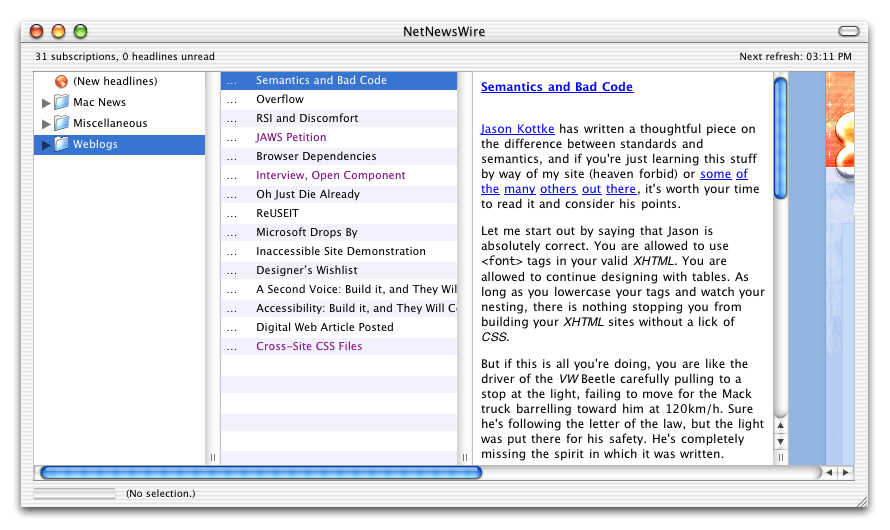
Proposed implementation in a news reader and a mockup.
Nautilus has no plans on implementing column view in v2.6.
A critical look at column view. In the reviewer's words:Column view at its finest: Mac OS X provides a refreshingly convenient way to burrow deep into one's machine or network and find important information. This isn't just another way to view a folder's contents. Instead, it's a new method to jump between and browse among many folders at a time
It's an old idea from NeXT, but new to OS X, and new to much of the world. I don't know if it's worth patenting, but really, until the iPod, no one else had *tried* to copy this browsing mechanism. In that it *is* new, useful, and non obvious, I think it passes the threshold of being patentable. -
Re:Lack of..
-
Re:Windows?
The procedure entry point XML_SetDoctypeDeclHandler could not be located in the dynamic link library xmlparse.dll
This looks like the problem discussed in the Usenet newsgroup comp.graphics.apps.gimp. Does that discussion help you solve your problem?
Does GIMP have a Bugzilla somewhere?
Yes, see http://bugzilla.gnome.org (which, for some explainable reason now points at the Gnome homepage and the lovely Jonita Prifti... ah, where was I?) -
GNOME 2.6 Rescheduled for March 31st
-
Re:text copy
And the text of the update:
A quick status update on the situation:
* No additional damage has been discovered; at the current time we are cautiously hopeful that the compromise was limited in scope.
* ftp.gnome.org is back on now that we have additional confidence in the integrity of the tarballs.
* We've now restored a number of services running on a replacement machine
- Websites including www.gnome.org, and developer.gnome.org are back up in limited service; dynamic content is still off so some parts may be inaccessible.
- planet.gnome.org is again providing all your favorite blogs and gossip.
- Bugzilla is in testing mode; we hope to restore general access in the next day.
Thanks for your patience; we'll continue to provide updates as we move back to fully operational status.
The GNOME sysadmin team
24 March 2004 -
Dear Gnome.orgDear Gnome.org,
If the intruders put that hot girl on the front page, LET THEM BE!
-The voice of 10000 virgins.
-
And all this happening on GNOME Love Day
-
Re:GNOME bounties?
It was evolution: http://www.gnome.org/bounties/Miscellaneous.php3#
1 27552 -
OK, you convinced me; here's my contributionThis article convinced me that it's time to start taking gcj seriously, so I'm going to add gcj support to my 'crosstool' package (which is just a simple, convenient way to build a gcc+glibc toolchain). Maybe that'll help more developers consider using Java.
Also, a couple years ago, I experimented with gnome's corba implementation, Orbit. It was pretty darn lightweight and fast. Since then, Orbit has made so much progress, maybe I should have a look at it again, and see how hard it'd be to add support for that to crosstool, so Corba could be an easy option for people using crosstool-generated toolchains.
-
Re:New File DialogHmmm, comparing KDE with GTK I would have to say mostly it follows the usual difference between GNOME and KDE that has been apparent in the last year or two: GNOME has focussed on a slimmed down, simplified model with emphasis on clean and simple, while KDE has focussed on providing options.
To be honest, however, from what I've gathered the GNOME people have been far more influenced by Apple than KDE.
And finally - when you come down to it, it's a file selector, there;s not a whole lot innovative you can do with it. The KDE file selector doesn't look overly different from the Windows one, so really, is it any surprise that GNOME follows a vaguely similar line?
Jedidiah.
-
GTK release of 2.4It's a great release. It is something that finally the gnome-ers can get their teeth into. And it's not before time.
For anyone who has been following the good work that the gnome developers have been doing, its starting to look like vindication.
Ok, enough of the back slapping, lets see whats on offer: (PS - release notes for GTK at Gnome 2.6 update release notes
Font Changes:- Xft and fontconfig use the same backends - whats that mean to you? - better fonts - everything GTK now plays the same game.
- Fonts and character shapes can take a scripts 'hints' about a font into account - we win, the font creator wins - its about the best of everyones world.
- Using bi-directional text is not forced by the application - it can be extracted or 'hinted' from the original source file itself.
- GLIB update to use unicode 4.0 - many, many people benefit.
- GLIB correctly recovers children processes.
- GRandom is better at seeding. But not cryptographically secure. Yet.
- The threading library with GLIB is now "operation or not" on integers and pointers.
- There is a way to specify an OO 'singleton' or 'once initialisation'
- Extra macros for GObject type writers
- Properties can be added to interfaces (verbatim copied)
- Private data within an instance can contain private data/references within and object (its not clean what this means in a C context, but I think they mean that it's not exposed).
-
Glade2From the Gtk2 Release announcement:
GTK+ has been designed from the ground up to support a range of languages, not only C/C++. Using GTK+ from languages such as Perl and Python (especially in combination with the Glade GUI builder) provides an effective method of rapid application development.
How is Glade2 development coming along in terms of supporting Gtk2 2.4? I visited their website and there doesn't seem to be any mention of it. -
Re:New File Dialog
It does not allow one to navigate as they would be with somthing like the KDE file dialog.
Fortunetely, there is an alternative -
Re:New File Dialog
Please don't tell me your talking about this screenshot. That thing is more horrid than the QT file selector.
-
Just in time for...
...Gnome 2.6, due out March 22nd.
-
Re:Lists
> Are there lists of some sort in a standard C library? I could use those in the near future.
Not in the ANSI/ISO libraries, but GLib should do wat you want. Although usually associated with GTK+ and Gnome, it's mostly a collection of low level datatypes and functions, very useful outside the context of GUI programming as well. Follow the links here for the downloads. -
Re:Lists
> Are there lists of some sort in a standard C library? I could use those in the near future.
Not in the ANSI/ISO libraries, but GLib should do wat you want. Although usually associated with GTK+ and Gnome, it's mostly a collection of low level datatypes and functions, very useful outside the context of GUI programming as well. Follow the links here for the downloads. -
Re:I don't see a problem with it...
The thing about MySQL's GPL licensing nonsense is that it cannot be used from within libgda the GNOME data access system -- and so the backend for MySQL ends up being removed. This probably applies to other systems as well.
-
Re:Linux *has* come very far
I'm not flame bating here, but what does Gnome have to do with Linux aside from the fact that its one of many programs that can run on Linux? From the Gnome about page, it mentions Linux twice with "or UNIX" right beside it.
The same would go for KDE (I have KDE running on a few students' Sun workstations).
What I think is impressive is that Linux is supported by many big vendors now like HP, IBM, Dell, SUN (wtf?), etc. I'm impressed that there are many nongeek household items that come with Linux powering them like the Tivo, Linksys wireless routers, wall mounted digital picture frames, etc. I think its impressive that the thing that I played with in my dorm room and in the physics labs at school now is my career. I'm impressed with the number of archetectures that it runs on. Currently, its alpha arm arm26 cris h8300 i386 ia64 m68k m68knommu mips parisc ppc ppc64 s390 sh sparc sparc64 um v850 x86_64. I'm impressed that when I went to the SuperComputing 2003 conference that Linux was pretty much _the_ OS to run clusters. I really think that Linux is a Good Thing(tm). It just happened, it works, and its not going anywhere. -
Re:One thing you need to know about DeIcaza..
With Gnome, you're guaranteed nothing better than a perpetual second place finish. Gnome amounts to a Windows wanna-be, instead of a Windows-killer, when it didn't have to be that way. Miguel made it that way.
Thanks for ditching the efforts of thousands of volunteers in the current direction of Gnome, that is quite different than Windows'. Miguel currently works solely on Mono, and has no saying in Gnome development.
Of course, I'm sure Gnome's direction would be much better if you were still designing its interface. Heh. -
Re:Yep, it's happening in the Navy, too....This is the dumbest crap I have ever read on
It takes less time to get a random high-asvab grunt up to speed on a windows NT based system than on a linux system.
Do you have an evidence to back up that claim? Any studies? Documents? Or are you just making up crap as you go?
"Sir, the guy we pulled in after the 6 shop got bombed is saying 'what the fuck is this %> stuff all about?'"
I guess there is no such think as a GUI under Linux? I take it you cannot write GUI apps for Linux? All taks need to be done from a terminal? You are very "Insightful" aren't you? -
Re:Gnome and KDE interoperability
If I could, I would mod the parent up as +1, Interesting. But I'll just have to reply instead.
First of all, I did some digging, and discovered a charming utility called "gnome-open". It does the same thing as "start". I just tried gnome-open on one of my
I am intrigued by the idea of a pipe-oriented application to handle File Open and File Save. I don't think it would actually be as big a win as you think. It's possible to use shared libraries, so there is no reason to statically link the libraries. And with the GNOME 2.6 dialogs, it is possible for an app to add extra controls to the dialogs; see the infamous screen shot with "Frob the file" (or the newer "Lart the next user who asks about this checkbox"). You propose switches and pipes for this, but calling a shared library means an application can simply register callbacks--easy and fast.
There are already command-line tools that pop up GUI dialogs, for use in your shell scripts. For GNOME 2.x, the tool of choice is Zenity, which can do what you wanted: for example, it can put up a file selector dialog and return the chosen file on the standard output.
Zenity doesn't currently offer a printer chooser, color chooser, or font chooser. You could probably work around these lacks; for example, you could call gtklp instead of Zenity to deal with printing. Or you could add these features to Zenity.
You could also script in Python instead of shell, and you can do whatever you want (including design nontrivial dialogs in Glade).
steveha -
Re:Gnome 2.6 beta 1 release
When I installed Gnome 2.4, I tried following the installation notes at http://www.gnome.org/start/2.4/notes/rninstallati
o n.html. It's mostly correct, but I still found a number of errors -- omissions, items out of order, and items that didn't exist in the distribution. I'm fairly certain that one thing which helped was the fact that I was upgrading from 2.2, which in turn I had installed by piecemeal replacement of the 2.0 RPM's that came bundled with my Linux distro.A long time ago I tried installing Gnome from scratch, without having any modules pre-installed, and that was much worse. I get the distinct impression that the Gnome installation procedure is designed only for people who already have a previous release of Gnome installed, not for people who are installing from scratch.
-
Nice Job
GNOME vs. KDE will perhaps be one of the holy wars of this millennium, and this is certainly another kick in the teeth for the ever-so-slightly clunky KDE (in my opinion). As said in the article, the developers have done some superb work and, well, put it this way, it is almost making me want to lose Mac OS X on one of my iBooks. Do not underestimate the pulling power of eye candy and the HIG!
Liberal inspiration has, of course, been taken from the Apple way of doing things - the spatial navigation is, as noted in the Ars Technica article, based on the pre-OS X MacOS Finder. And that's no bad thing, certainly if FOSS wants to move towards real usability on the desktop.
The file dialogue boxes are also notably similar to Mac OS X's way of doing things, although the puzzling (at least to me) scrollbars that the Mac uses to browse up and down a directory tree are here replaced with arguably simpler tabs. Very nice touch.
Personally I'll keep Mac OS X on this for the moment, if only to avoid kernel recompiles and incompatibilities arising from that, but hell, if I were a Windows user, I'd be sitting here asking myself why the fuck I am waiting till 2006 for Longhorn when I can have this now...
Zealots were quick to criticise the most prominent competition - Mac OS X 10.3 - in terms of eye candy on the desktop when it came to making comparisons with their darling Longorn (which is, rather pointedly, not available for purchase yet). Now that UNIX is offering two superb alternatives, one of them properly FOSS (and, more importantly, runnable on x86), Windows' days should surely be numbered...?
iqu -
Re:Evolution is not evolving
Actually, Evolution is in its 1.5x (unstable) series. You can check out the latest news from the evolution front here. There is also a roadmap at here. I have been using the unstable branch (from CVS) for quite sometime now, and it is quite stable for me. It is now integrated by default to Spamassasin - so it does spam filtering quite nicely.
The roadmap is also available at webcal://www.gnome.org/projects/evolution/roadmap. ics. -
Re:You wanna know why?
Both are part of the Gnome Office metaproject, and use (optionally, in the case of AbiWord) Gnome libraries, not just plain glib and Gtk.
-
Re:Guerilla Focus Groups?1) Are there groups out there (aside from large companies) that are doing focus groups and similar research aimed at the general public? If so, are they publishing this information and where?
I know you said aside from large companies, but I think Sun's gnome usability study applies here.
2) Is there any kind of tool for submitting bug reports? I hate using Microsoft as an example, but when my Windows machines crash, there is an option to send Microsoft a bug report.I don't use it, but that sounds the same as bug-buddy.
Sorry, I don't know much about KDE, so I couldn't say whether or not they've had anything similar going on. It's not like they couldn't learn from the two cited examples though, that's what OSS is all about, right?
-
It's not terribly original.
I guess I'm going to post this all over until I get modded redundant, but this is not a KDE invention. GNOME has had such a team for two years now and mozilla had one before that.
-
GNOME has had a quality team for years.
2-3, depending on how you want to count. It's good to see KDE catching up.
-
Gnome is NOT a KDE alternative
Everytime KDE is mentioned, gnome advocates try and convince me why is GNOME is better, when it is NOT! Here is a detailed description WHY GNOME SUCKS KDE RULES!
1) The file dialog.
KDE 0.x ALPHAs had a better file dialog than gnome! Today, the KDE one is the best file dialgog in existance, with influence from all desktops.
2) More apps!
KDE comes with over 150 Apps in the full install, with applications for all fields, plus its sleak integration with non kde apps (eg gimp, openoffice) make things more consistant.
3) Configureable as hell.
The KDE control center has loads of knobs/dials/sliders and boxes to fiddle with, yet keeps things elegent. In gnome, half the options don't exisit and you are rudley told "use gconf-editor n00b by gnome zealots" (not joking about this, telling the truth gets you a -1, troll and footnotes).
4) I-kandy!
The Kde eye candy is really powerful, with styles such as dotNEt, mosfet liquid, kermamik, Crystal and more. Looking at art.gnome.org [gnome.org] reveals the same old theme in different colours. Since gnome dosen't provide a colour changing dialog for its widgets most "themes" are just colour changes. The Crystal from CVS is an Aqua killer, your eyes will want to love it.
5) Its development framework rocks.
Take a good look at kioslaves, kparts, dcop, arts and qt and see why KDE is a programmer's dream. Modern c++, wonderful IDE [kdevelop.org], powerful command line scripting. Gnome gives you obsolete c, with a bunch of kludge libraries such as glib, Orbit, bonobo to hack together a application.
6)The defacto choice on Linux. All major Distributions support it by default. This means Mandrake, SuSE, Xandros, ArkLinux, Jamd, Lindows, Slackware, Knoppix, Gentoo and more. How many gnome ones can you mention (Redhat, sure if you like using server distros as your desktop Debian, nope thats the old 1.4 branch Gnoppix, a retarded knoppix rip off.) Most distributions offer gnome as an unsupported alternative.
Also, the only reason why gnome was created in the first place is null and void. Now that Novell has taken over Ximain you can expect VENDOR lock in. Want groupware for linux? Thats $300 a seat.
Get the new Mandrake 9.2 and see the Quality of KDE vs the Sorry state of Gnome 2.4 (and, they STILL haven't fixed that ****ing file dialog), not to mention they REMOVED ALL THE FEATURES. Gnome 2.2 is probably the only gnome version remotley close to kde, that is, KDE 2.0, not the KDE 3.2. I tried the "brokenboring" alpha of it and when it is released this december it will finally put Gnome out of it's misery and kill it off the Linux desktop.