Slashdot Mirror
Domain: gnu.org
Stories and comments across the archive that link to gnu.org.
Comments · 13,360
-
Re:Matchmaker?
I'm a lawyer and I'm not doing anything this evening. I'm sure some FOSS project could use one....But I don't know which or where.
Try emailing and asking the EFF, check the FSF's "Take Action" page and see if any of the listed organizations need your help, and perhaps see if you could help out Groklaw -- maybe PJ could endorse you on her site so that people needing your help would notice.
Or you could always start a "Free Software Lawyer Matching" site yourself -- just submit a Slashdot article about it and I'm sure you'll get lots of help. -
Re:What now?
All right, the election's over, SCO is dead . . . what now? Emacs vs. vi?
p.s. vi kicks emacs' ass
-
Re:I blame the GPL
It was brought to our attention that Linux is copyrighted under something called the GPL, or the Gnu Protective License.
You stupid FUD-spreading dumb shit, try GNU General Public License.
Also, your lawyer's full of crap. -
A few ideas
First, there are two kinds of small languages:
1. small languages like lua, io, and scheme that are small in the built-in libraries and in the total distro. These three are great places to start- both are small, OOPish, allow higher-order programming by passing classes, objects, functions and methods as objects.
2. Then there are languages that are big in some ways, but small in syntax. Some of these are easier to extend than so-called "little languages." The reason is usually that their syntax is small, in an isolated place, easy to get at, and meant to be modified. The two best examples for this are Smalltalk and Lisp. Both of these languages satisfy your other requirements and really kick ass for extention. Unlike the above languages, the so-called little-languages, most Smalltalk and Lisp dialects have big, useful libraries. Unlike a big fat language like perl or C++, having a useful library doesn't mean that the language is a huge pain in the ass to extend.
Both Lisp and Smalltalk have a number of implementations. I am a big fan of Squeak Smalltalk, though systems like Little Smalltalk or even GNU Smalltalk maybe worth checking out.
A lot of people here have bad feelings about Lisp-like languages. It's a shame, since Scheme, ISLISP (OpenLisp is a great implementation) and Common Lisp are all *very* powerful languages. You can be quite productive with them once you get over the part about whining about parens. But Lisp may very well be the best option here, there is a long history of people writing custom-syntaxes and language extensions. Look up Common Lisp macros- power almost beyond comprehension, a lot of fun to play with, and with an elegance all its own.
There are examples of people writing a C-like syntaxes for various Scheme implementations. IIRC, Gambit-C (a Scheme to C compiler) comes with one. On Cliki, there are a bunch of other alternative Scheme syntaxes listed.
To, one of the big advantages to using a language in the second category is that syntax extension/modification is done in the language itself, rather than in C. With that comes the familiarity of the language you're creating and the other benefits you gain by using a high-level language like Smalltalk or Common Lisp.
Just some thoughts... -
Re:Simulations/Models/Programs where Output Matter
Practicaly it would be impossible to enforce without an "ET phone home" function which would move your software into the relm of spyware.
No! The GPL restricts you from modifying a program & selling it without giving out the sourcecode. The changes I'm looking for would be similarly based on a license agreement.When you want to control use, you need a patent, not a copyright.
This is fair, but I think that "derived work isn't nearly so concretely defined as everyone assumes. Copyright law predates software. There was an interesting branch off my post which discussed "performance rights." This is one example. I think a better example would be
collage. To create a collage requires the permission of the copyright holders of the works used in that collage. Even if you change the medium, such as by including long stanzas from plays in a painting. What meaning does "derived work" have for software? Can I print the source code on a T-Shirt? Can I read it out loud at a concert?
The binaries are commonly believed to be under copyright. Yet a machine produced those from my source code. Why wouldn't the plots and other machine produced outputs also be under copyright?A mandate to submit internal changes, to me would be an amalgamation of the worst aspects of FOSS and Proprietary software.
Well you know what they say about the road to Hell! How am I supposed to sell my peers in research on F/OSS when they skeptically ask "What if some other research group takes your code, makes changes, and is then able to print more papers then us, get more funding than us, etc.?"
Sure--I believe in collaboration & F/OSS. I could be tricky & start with a GPLed base & say that I'm stuck with it. That is: yes, the idealistic values that are argued in that short piece are good. No, they don't always trump pragmatic concerns!My estimate is that this would be in violation of the GPL as it places additional restrictions on the work, and if your work contained GPL'd code, you'd be infringing on others copyrights. If your work didn't contain GPL'd code you would OK legaly, but GPL coder's would find your license abhorent.
I agree with this & didn't even start under the pretense that my code would be GPL-compatible or OSI-approved. I know I can't make everyone happy. And I agree that GPLers would find the license abhorent. I don't care--I care more about the views of those actually in my field of research. Most don't worry about licensing. Few write GPLed code. None would care. Everyone would love to be able to start with a shared base that F/OSS provides, but people do care that the playing ground remains level!
If I hade code I told you couldn't be released under an OSI-approved license, would you say "Screw it--go proprietary. Binaries Only. Sell it. Don't share it."
I know I won't be able to release it as Free, but I would think that it would be best to release it with as much rights as possible! People did give UW a lot of flack over Pine's restrictive license. Pine is not Free software. Does that mean that Pine is, as you say, an amalgamation of the worst aspects of FOSS and Proprietary software? Are you going to email them, asking them to stop releasing the source since that is apparently bad? -
Re:Simulations/Models/Programs where Output Matter
So companies are effectively prohibited from making changes to code and releasing it "in house."
Actually, the GPL allows this, (see the faq question http://www.gnu.org/licenses/gpl-faq.html#InternalD istribution)
The biggest problem with EULAs as they are generally implemented is the fact that they cannot be legally binding since the user doesn't actually sign anything either on paper or in the electronic signature sense. Also, the user cannot read them before opening the shrinkwrap, which, if I remember correctly, invalidates the agreement.
Disclaimer: IANAL -
they can keep the project private
Well they don't deny they used other project's code, but until they rewrite everything, they really should:
release code or
keep everything private,
as stated in GPL. -
Re:What a dumb person looks likeSome more GNU/FUD:
You are apparently not bright enough to understand that share is a proportion. And BSD's proportion is shrinking (as is that of OS/2, AmigaOS, and other obsolete, marginalinzed operating systems), even though in raw numbers it's seeing an increase. The pie is growing faster than *BSDs piece, to put it into language you might be able to understand.
Not only the *BSDs experience an increase in raw numbers.
The *BSDs are gaining market share.
These are the most recent data that can be found about it (June 2003).
This means that, "to put it into language you might be able to understand", the *BSDs piece is growing faster than the pie.The FUD you GNU people are continuing to spread is just a display of how your community is pervaded by rotten politics. You're using exactly the *same* disgusting techniques applied by the corporations you hate so much.
What's even uglier, you use them against the BSD people, whose only crime is to believe in freedom and liberty (BSD license) rather than communism (GPL license).
Nope, it's not far-fetched - sadly. -
Re:frist?gcc -std=c99 -o frist_prost frist_prost.c works perfectly without warning. By default, gcc still interprets the code as C89.
This has nothing to do with C89 or C99. The only standard-compliant forms of main are those that return 'int', regardless of which C standard you are talking about. Also, the -std argument to gcc is not sufficient to make it a standard C compiler. RTFM.
The -ansi option does not cause non-ISO programs to be rejected gratuitously. For that, -pedantic is required in addition to -ansi.
The -std options specifying some version of ISO C have the same effects as -ansi, except that features that were not in ISO C90 but are in the specified version (for example, -
Re:Blaming the language...
Bounds checking as a matter of course would serve only to slow things down needlessly. Yes, the ability to exceed bounds can be abused. But you don't always need the check, and UNIX/C philosophy eschews performing any action without an explicit request. Sometimes the check is implicit. For instance, if you do a % or && operation, or are reading from a type such as a char, you already know the limits within which the answer must lie
And so does the compiler, if it implements any sort of robust type inference. A compiler that knows the range of values can perform the checks at compile time; otherwise, how would -Wunreachable-code work? If it can't automatically infer the bounds, you can use an assert to tell the compiler.
And I have a better example than your a[200] immediately followed in memory by b[200]: zero-length arrays at the end of a struct.
Of course it's easier to blame the language, and more so when you are trying to sell people an expensive programming language that claims to make it harder to write bad code {and quite probably harder to write code that runs on anything less than 2GHz, but that's not your concern if you don't actually sell hardware}.
Running a compiled Common Lisp program at human-interactive speed does not take 2 GHz to run.
-
I know who I want to teleport to
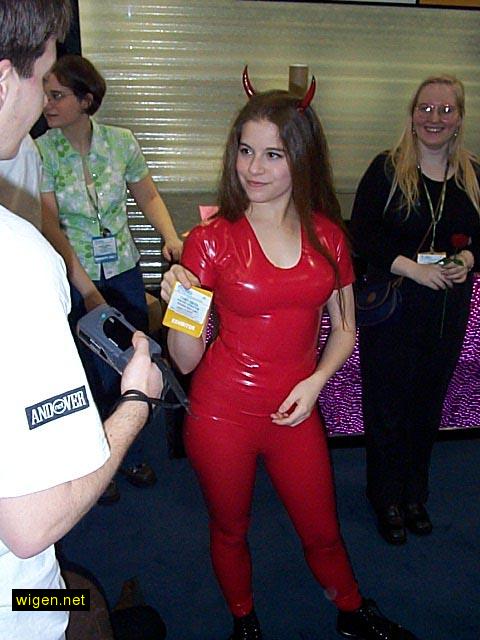
IMPORTANT UPDATE: Please show your support for Ceren in this poll of Geek Babes!
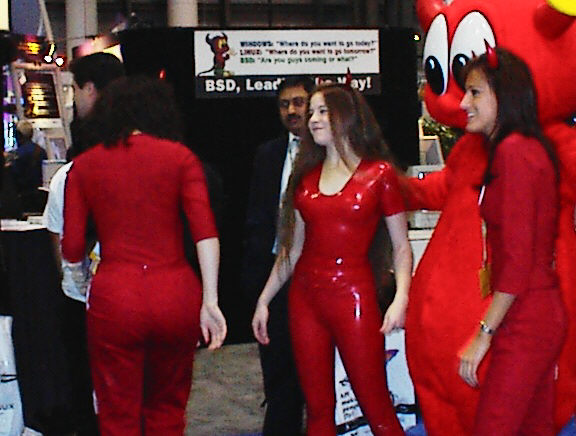
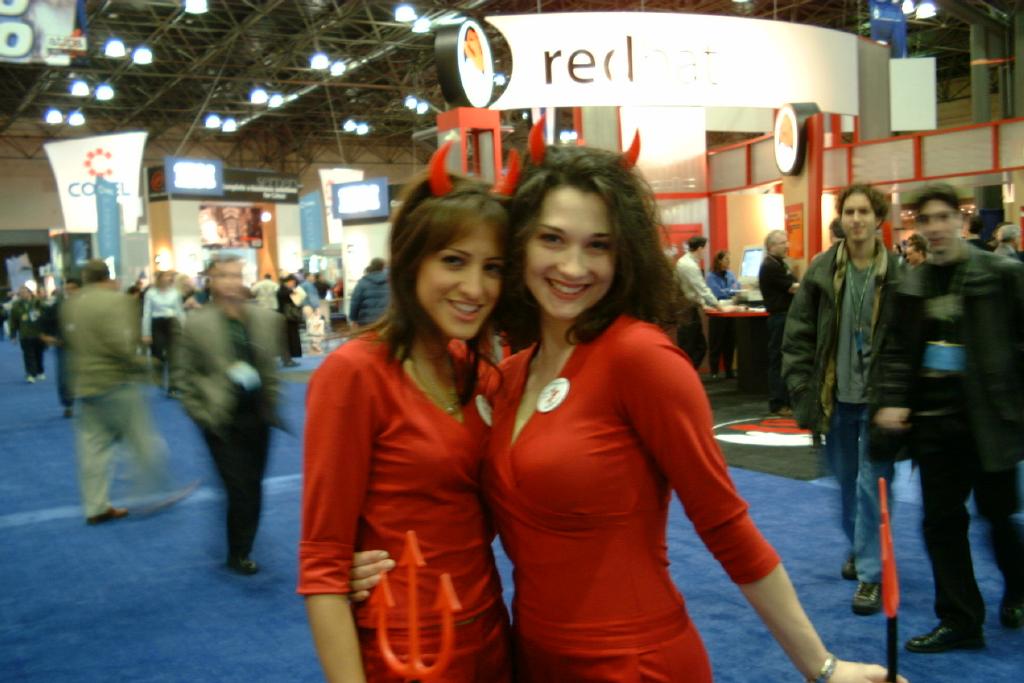
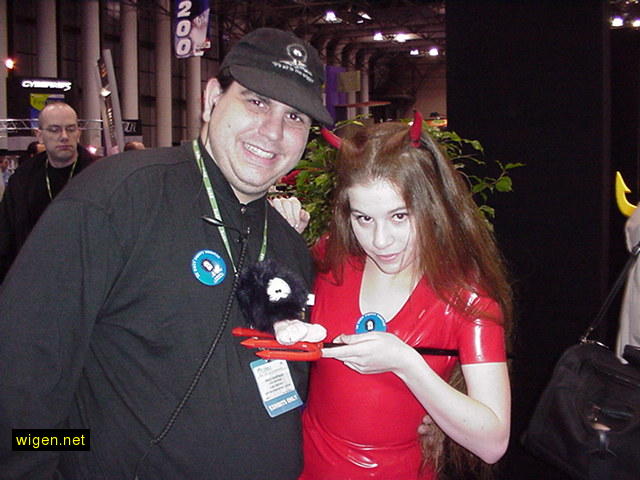
Is it any wonder people think Linux users are a bunch of flaming homosexuals when its fronted by obviously gay losers like these?! BSD has a mascot who leaves us in no doubt that this is the OS for real men! If Linux had more hot chicks and gorgeous babes then maybe it would be able to compete with BSD! Hell this girl should be a model!
Linux is a joke as long as it continues to lack sexy girls like her! I mean just look at this girl! Doesn't she excite you? I know this little hottie puts me in need of a cold shower! This guy looks like he is about to cream his pants standing next to such a fox. As you can see, no man can resist this sexy little minx. Don't you wish the guy in this pic was you? Are you telling me you wouldn't like to get your hands on this ass?! Wouldn't this just make your Christmas?! Yes doctor, this uber babe definitely gets my pulse racing! Oh how I envy the lucky girl in this shot! Linux has nothing that can possibly compete. Come on, you must admit she is better than an overweight penguin or a gay looking goat! Wouldn't this be more liklely to influence your choice of OS?
With sexy chicks like the lovely Ceren you could have people queuing up to buy open source products. Could you really refuse to buy a copy of BSD if she told you to? Personally I know I would give my right arm to get this close to such a divine beauty!
Don't be a fag! Join the campaign for more cute open source babes today!
$Id: ceren.html,v 8.0 2004/08/01 16:01:34 ceren_rocks Exp $ -
Re:Theo de Raadt at its best?
No, he created a kernel, he created a GPL licensed, monolithic and modular kernel.
Linux is _just_ a kernel
By definition of the word Operating system, you're right. Still, though free kernels and user land utilities existed well before Linux, it was his project that kicked off a lot of development around open source operating systems.
Without Linus there would be no Linux, and that's the simple truth.
As FreeBSD user I am well aware of the diversity of ongoing efforts delivering us the final product of a free operating system. Still all the lot would not be possible without the people fighting at the front.
I'll have to stick by Theo on this one, there is a lot of whining about Nvidia binary drivers for their video cards, but that seems to be all it is, whining.
That's just a statement of your personal opinion, not being backed up at all. Just like Theo's. Insulting on the basis of such arguments is unprofessional and does no one any good. Why not try to get together in a proper forum that actually allows bidirectional communication? -
Re:Uh oh a decenter
-
Re:until
Sorry it's not immediately obvious to me. Who are they?
AFAICR AMD paid SuSE to do the original work. I think the main developers were Jan Hubicka, the current x86-64 maintainer, and Andreas Jaeger. SuSE have a few more well-known GCC contributors: look at MAINTAINERS. -
Re:until
Sorry it's not immediately obvious to me. Who are they?
-
I recommend looking elsewhere for an RDBMS.
The Computer Associates Trusted Open Source License (CATOSL) apparently qualifies as an "open source" license, but it would probably not qualify as a "free software" license. The focus on user's software freedom found in the free software movement is important in interpreting what powers the license grants and what the license claims to regulate.
Section 10.1 tries to control use of the program--if one's rights under the license terminates, the license claims that that user's rights to use the program terminate as well. But the FSF tells us that US copyright law doesn't permit setting conditions on merely running a computer program (outside of a license or encryption manager) and that if this were to become accepted, would extend copyright law in a dangerous way. This was part of the rationale for saying the first and second revisions of the Apple Public Source License were not free software licenses.
Section 11.4 of the CATOSL claims that no licensee will bring a legal action under the license more than once a year. When one does bring a legal action, one is supposed to waive a jury trial and hold the trial in the state of New York. Licensees in other districts may enjoy rights which the state of New York does not recognize or grant, including the right to bring suit more than once a year; rights licensees would want to retain should they need to go to court.
I'm sure a more thorough examination of the CATOSL would reveal more problems for users. I don't recommend getting involved with programs licensed under the CATOSL. This shouldn't pose a practical problem for anyone because there are excellent database programs under more amenable licenses, including PostgreSQL (licensed under the new BSD license) and MySQL (licensed under the GNU GPL). I also don't recommend licensing one's own programs under the CATOSL.
-
Don't help distribute problems.
They don't want you getting a driver from some shady site that put a virus in it, and thus giving their company a bad name (at least for dumb-computer-users).
Licensing to disallow distribution of proprietary software doesn't prevent this from occurring, whether the software is "firmware" or an "operating system".
All that is gained with this petition is the ability to help an proprietor more efficiently distribute their non-free software. Users still have no idea what that software will do in the future or how it works now. Users don't gain the ability to fix it when it breaks or improve it to make it do something better.
The proponents of this petition and letter-writing drive are clear in their intent: they are stressing popularity over software freedom; their users are gaining the ability to help their neighbor more conveniently lose their software freedom. In a way, it is ironic that this plea to become proprietary software distributors is championed by those who criticize the strong copyleft in the GNU GPL (which the OpenBSD folks are known to do, putting in time to replacing GNU GPL-covered programs with new BSD-licensed replacements).
It's no accident that this call for increased popularity and out-of-the-box utility is being done in the name of "open source". That movement pushes aside software freedom in pursuit of a message to make businesses feel more comfortable. For the open source movement, proprietary software is merely a less technically efficient way of speaking to businesses. Popularity, to them, is more valuable than software freedom. And that's a shame because history teaches that popularity won't get users freedom. Proprietors are chiefly looking to sell users software which denies users their freedom. Proprietors want to treat users as a market, not contribute to the free software community. The open source philosophy makes this more politically feasible.
From the essay:
The main argument for the term ``open source software'' is that ``free software'' makes some people uneasy. That's true: talking about freedom, about ethical issues, about responsibilities as well as convenience, is asking people to think about things they might rather ignore. This can trigger discomfort, and some people may reject the idea for that. It does not follow that society would be better off if we stop talking about these things.
I realize that not being able to use the latest hardware is inconvenient. But one's software freedom should not take a back seat to convenience.
-
Re:iPod already killed for me
Another was free use of my own files. The iPod, according to the Apple Store, had two modes, which I (not they) call the Free Mode and the Big Brother Mode. The Free Mode, they proudly proclaim, lets you use it as a portable USB drive, plugging in to any computer and doing anything you like with any of your files. Anything, that is, except actually PLAY THEM. That's disabled in Free Mode. This media player won't play any media if you loaded it in Free Mode.
Bullshit. You connect your iPod to the computer and it appears as a standard USB (or Firewire) hard drive, working seamlessly under any OS. Your music is stored in a hidden directory (standard Fat32 "hidden" directory, nothing weird there; it's named "iPod_Control"). File formats natively supported include standard MP3, standard AAC (MP4), AIFF, and WAV. The iPod also knows how to go around Apple's copy protection code, but said copy protection is NOT REQUIRED.If you actually want to use the media files you load, you have to use Big Brother Mode, using a special loader app that doubles as a storefront for exactly one store: Apple's own. Your device has to be registered with this app and there are all sorts of arcane rules about how many units of this can be registered with that on which computer and how to properly disable one before you can move to another, etc. Bah!
There's a binary database that the metadata is stored in. Apple's iTunes knows how to access this DB, as do several other programs like ephPod, GNUpod (which I personally have used without any problems whatsoever), etc.
The arcane restrictions and "registration" of which you speak apply ONLY to Apple's "iTunes Music Store", an integrated but OPTIONAL part of the iTunes program (which you don't even have to use). They have nothing to do with music that you obtained elsewhere, i.e. from CD or an MP3 that you already have on your computer. Even if you do buy music from Apple, the restrictions on how many computers you can transfer the music to do NOT apply to the iPod.
Standard USB or 1394 interface. Standard filesystem. Standard audio codecs. Widely-supported metadata handling (GNUpod, for example, is in Debian.) If you're gonna bash the iPod, at least get your facts right.
-
Re:I've seen this before...Check out this section of the gcc 3.4.2 manual. It includes all three. Your Gentoo system is out of date.
I disagree that these are minor optimizations; register renaming (especially with the web stuff) can give huge speed benefits in some cases.
-
Re:Not bad
A little plain?? Logos are supposed to be plain. Take a moment and look at some memorable logos. They're generally very, very, simple. This makes them easy to associate with the product. It helps build the brand.
If only more Free Software projects would follow the lead of NetBSD. There are a lot of decent logos out there too but by and large Free Software logos constitute strong evidence that Graphic Design is indeed a valuable skill. Not as valuable as coding, but still valuable.
Specifically, it's not about technical prowess in using your favourite graphics program, it's about being able to come up with strong ideas and express them strikingly, visually.
Not that I'm any good at it... -
Re:Not bad
A little plain?? Logos are supposed to be plain. Take a moment and look at some memorable logos. They're generally very, very, simple. This makes them easy to associate with the product. It helps build the brand.
If only more Free Software projects would follow the lead of NetBSD. There are a lot of decent logos out there too but by and large Free Software logos constitute strong evidence that Graphic Design is indeed a valuable skill. Not as valuable as coding, but still valuable.
Specifically, it's not about technical prowess in using your favourite graphics program, it's about being able to come up with strong ideas and express them strikingly, visually.
Not that I'm any good at it... -
BSD is of course completely secure, and has girls
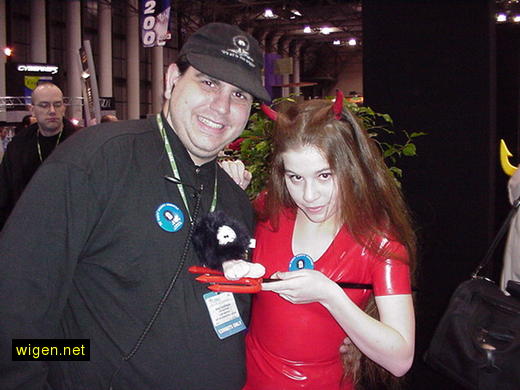
IMPORTANT UPDATE: Please show your support for Ceren in this poll of Geek Babes!
Is it any wonder people think Linux users are a bunch of flaming homosexuals when its fronted by obviously gay losers like these?! BSD has a mascot who leaves us in no doubt that this is the OS for real men! If Linux had more hot chicks and gorgeous babes then maybe it would be able to compete with BSD! Hell this girl should be a model!
Linux is a joke as long as it continues to lack sexy girls like her! I mean just look at this girl! Doesn't she excite you? I know this little hottie puts me in need of a cold shower! This guy looks like he is about to cream his pants standing next to such a fox. As you can see, no man can resist this sexy little minx. Don't you wish the guy in this pic was you? Are you telling me you wouldn't like to get your hands on this ass?! Wouldn't this just make your Christmas?! Yes doctor, this uber babe definitely gets my pulse racing! Oh how I envy the lucky girl in this shot! Linux has nothing that can possibly compete. Come on, you must admit she is better than an overweight penguin or a gay looking goat! Wouldn't this be more liklely to influence your choice of OS?
With sexy chicks like the lovely Ceren you could have people queuing up to buy open source products. Could you really refuse to buy a copy of BSD if she told you to? Personally I know I would give my right arm to get this close to such a divine beauty!
Don't be a fag! Join the campaign for more cute open source babes today!
$Id: ceren.html,v 9.0 2004/08/01 16:01:34 ceren_rocks Exp $ -
Stop the FUD!
What on earth is this? Don't you people know the difference between Free Software and Non-free Software?
From gnu.org:
"The term ``freeware'' has no clear accepted definition, but it is commonly used for packages which permit redistribution but not modification (and their source code is not available). These packages are not free software, so please don't use ``freeware'' to refer to free software." (emphasis added by me)
If it's released under the GPL it is *Free Software* and you can do just about whatever you want with it as long as it stays free (under the GPL license). It might not be gratis (free of charge) but "freeware" has nothing to do with it!
So please, enligthen yourself and stop spreading FUD (that goes for slashdot too)! -
Great journalism
Trademark in the headline, copyright infringement of patents in the summary... That is what I call great journalism. Next time please also add trade secrets somewhere. And Intellectual Property, while we're at it. Capitalised. Thanks.
-
freeware?!?!
Freeware ?!?!?!?
It's even better then that. It's GPL!. How can slashdot write about GPL'ed software that it's freeware? -
You're going to kill Stallman
Or at least drive him (more?) insane!
-
Re:compatibility?Yes, in theory it *should* run on any Java, but GCJ isn't 100% there yet.
Uh, by which I mean GCJ isn't a complete generic Java rather than GCJ doesn't run Derby. As they say hereMost of the APIs specified by "The Java Class Libraries" Second Edition and the "Java 2 Platform supplement" are supported, including collections, networking, reflection, and serialization. AWT is currently unsupported, but work to implement it is in progress.
-
Amiga MODs are machine-readable sheet music
What the hell more do you want? The individual unmixed tracks ready to load up in Pro Tools (or should they use a more OSS-friendly file format)?
"Audacity project" or "multichannel Ogg (Vorbis or FLAC) stream" anyone?
The instruments they were played on and sheet music to go with it?
You just described tracked music, which includes machine-readable instrument definitions (as a sample bank) and machine-readable sheet music (as a note sequence) in a file. Common formats for tracked music include
Another thing some would want is a license allowing use of the work in a GPL program such as a video game for platforms that can't rely on the interpreter exemption because they don't have a file system per se (unless you count things like GBFS).
-
Amiga MODs are machine-readable sheet music
What the hell more do you want? The individual unmixed tracks ready to load up in Pro Tools (or should they use a more OSS-friendly file format)?
"Audacity project" or "multichannel Ogg (Vorbis or FLAC) stream" anyone?
The instruments they were played on and sheet music to go with it?
You just described tracked music, which includes machine-readable instrument definitions (as a sample bank) and machine-readable sheet music (as a note sequence) in a file. Common formats for tracked music include
Another thing some would want is a license allowing use of the work in a GPL program such as a video game for platforms that can't rely on the interpreter exemption because they don't have a file system per se (unless you count things like GBFS).
-
Re:Automated PGP checks!
Every single popular software author should make sure they PGP sign their packages AND verify it automatically at least once a day. I've began doing this for my projects since irssi was backdoored a few years ago. A few different computers download and check the signature of the latest release every single day, and email me if anything went wrong.
Also, you can use GNU Arch, with signed archives. Then, every time you do a commit, your changeset will be signed and every time anyone checks out a copy of the code, arch will automatically check all the signatures (assuming their arch is configured to check signatures).
Good stuff, especially if you can get your users to check stuff out of a public arch archive rather than download tarballs. Of course, setting up and using arch to check stuff out is not completely trivial... Hmm. We need a browser plugin that allows us to publish a URL that refers to a specific version in a specific arch archive and causes the browser/plugin to retrieve that version, get the signers' keys from key servers, verify all of the signatures and unpack the version into a designated directory. If it was as easy as clicking a link to check the stuff out from the source tree, downloading tarballs could become a thing of the past.
Note that that wouldn't completely eliminate this kind of problem, because the attackers could sign the archives and upload their own keys to the key servers, but it would make the attack harder to implement and easier to detect. Some automated monitoring of the archive integrity would still be necessary.
-
Re:What about the Visual Editor project on Eclipse
that leaves you trapped in the "Java trap"... you can't build truly free applications with it.
-
Re:Hmmmm
Was Kylix actually free software? I've just tried to find a copy on their website, and although there's an 'Open' version, it doesn't seem to be free software, just a gratis download.
However, things may have changed. -
Re:Sacrifice hardware for the good of software?
-
HURDI checked the HURD mailing lists and talked with some people on irc.gnu.org #hurd
someone said to me there are 2 developers maintaining the cvs repository of hurd.
A person who tried Debian GNU/HURD said it was usable, but with some unsupported hardware.
There are three distributions of GNU/Hurd: Debian GNU/Hurd, Bee GNU/Hurd and Gentoo GNU/Hurd, together with gnu.org
HURD isn't exactly dead, but I doubt it could replace Linux right now. However, I am excited by the idea of microkernels and I really want to see HURD becoming successful and usable by the general public.
http://hurd.gnu.org/ -
Re:Hurd
Damn, that faq page is the funniest thing I've seen all day.
Some quotes:
The Hurd throws this historical garbage away. We think that we have found a more flexible solution called shadow filesystems. Unfortunately, support for shadowed filesystems is not yet implemented.
Eh? throw the (working) garbage away before the new solution is implemented?
You are using IRQ sharing; GNU Mach does not support this in the least.
Yeah, because that's such an uncommon thing for hardware to use.
GNU Mach does not support loadable kernel modules. Therefore, you will have to compile a new kernel and only activate those device drivers that you actually need.
So much for a microkernel then.
The Hurd will just as happily swap to any other raw disk space and overwrite anything it finds. So, be careful!
Thanks for the warning. That will make me want to install it on my machine.
This FAQ document was probably secretly written by Linus Torvalds to ridicule it, and promote his own views on software development. -
Re:Hurd
Does it say if it still has a 2 GB limit for partition sizes
It appears so.
-
Re:Hurd
There was a time when I thought Ogg Vorbis held the title of "worst name ever". Then I read about the Hurd's name.
-
Incase anyone is intrested ...
The Savane project is another SourceForge-based product. It's what's currently powering Savannah, and it features MySQL compatiable, localization, and a simple setup and configuration system. Although it lacks some of GForge's featuers, most of the same functionality is there and Savane is, IMHO, easier to setup on systems when you can't use apt-get to install gforge. It's definately worth a look.
-
Re:Serious potential
There is no such thing as a permission to *copy*. You only need a permission to *distribute* a work covered by copyright. The "copy" means what book publishers were doing with books 500 years ago. Incidentally, that is also a reason why no one was ever sued for *downloading* music, but only for *uploading*. Today with P2P the difference might be subtle, because almost everyone downloads and uploads at the same time, but it is uploading which is illegal. You don't need a right to listen to music. You don't need a right to read a book. You do, however need the right to publish them. The copyright is a temporary monopoly, and that is not a monopoly to listen or read, but to publish and sell. In my opinion the best thought experiment one can do when thinking about music or movies is think about books instead, because they are much more intuitive. Everyone has a right to read anything. You cannot, however, copy and resell books without permission during the temporary copyright protection period (70 years after author's death).
-
Do we need it?
"GForge is a fork of the original GPL'd SourceForge code and like sf.net provides forums, mailing lists, revision control via CVS or Subversion"
Do we really need another fork? We all remember the last time when the community was divided. It is never easy to marge branches of forked codebase tree. I think Eric Raymond has described all of the disadvantages of frivolous forking more than inadequately. The open source community is already using CVS, RCS, Rsync, Bytekeeper and Subversion. Wouldn't our creative resources be better invested if we tried to integrate some of the already available systems instead of dividing them even more? -
Optional Features of the GFDL
There are severe problems with the GNU FDL, primarily the fact that it's incompatible with the GPL. As I understand it, that makes it problematic to put docs into code (e.g. Doxygen comments) or code into docs (e.g. API usage examples).
If it is your code than you can always dual-license it, or release code examples in the documentation (or documentation in the code) explicitly into the public domain.
The "invariant sections" provision of the FDL is also a worry, and has already been abused by people making their entire contribution an invariant section, which kind of defeats the object.
Invariant sections and cover texts are Optional Features of the GFDL. For example, this is the actual license of Wikipedia: "Permission is granted to copy, distribute and/or modify this document under the terms of the GNU Free Documentation License, Version 1.2 or any later version published by the Free Software Foundation; with no Invariant Sections, with no Front-Cover Texts, and with no Back-Cover Texts."
-
Hmmm...
"The MPL license, like the BSD license, means a company can incorporate Firefox into a commercial product"
I think you better read the MPL again, it hardly looks anything like BSD and more importantly you cannot incorporate MPL code into a GPL program but you can with the modified BSD license. You can see here what licenses are Free but incompatible with the GPL.
"Most of the Mozilla code base is trilicensed under GPL, LGPL and MPL. So although Firefox can't use GPL code, other GPL projects can use Firefox code."
This wikipedia article says Mozilla is released under the MPL and the GPL which indicates you are correct about it being released under the GPL. I don't see why they just don't stick with the GPL, the MPL doesn't offer anything above what the GPL already guarentees. -
Re:LicenseThe Attribution-ShareAlike license is the closest in spirit to the GPL. The Attribution license is the closest to BSD.
There are two big problems with the GFDL, which caused me to change the licensing on my own books to CC by-sa:
- The GFDL requires the work to be distributed in a form that's editable with free software. That's very hard to define. For instance, my books have illustrations in Adobe Illustrator/EPS format. This format is theoretically editable with free software, but in reality it's going to be a long, hard road for me to convert them to Inkscape/SVG and fix all the stuff that gets lost in translation.
- The GFDL's own bearded-hacker community seems to have ambivalent feelings about it, as shown by Debian's decision to reject it as unfree.
Someone actually approached me about using some of my materials in their own book, which is GFDL-licensed. It turned out that the licenses were not really compatible, so I had to offer it to them under GFDL (which I did).
-
Re:LicenseThe Attribution-ShareAlike license is the closest in spirit to the GPL. The Attribution license is the closest to BSD.
There are two big problems with the GFDL, which caused me to change the licensing on my own books to CC by-sa:
- The GFDL requires the work to be distributed in a form that's editable with free software. That's very hard to define. For instance, my books have illustrations in Adobe Illustrator/EPS format. This format is theoretically editable with free software, but in reality it's going to be a long, hard road for me to convert them to Inkscape/SVG and fix all the stuff that gets lost in translation.
- The GFDL's own bearded-hacker community seems to have ambivalent feelings about it, as shown by Debian's decision to reject it as unfree.
Someone actually approached me about using some of my materials in their own book, which is GFDL-licensed. It turned out that the licenses were not really compatible, so I had to offer it to them under GFDL (which I did).
-
Right Tool for the Right Job(TM)
At the risk of being modded down into oblivion I will say that your question touches on one of the very reasons that the now almost defunct jabberdoc.org saw such great demise. Despite pleas from the Jabber community to release JabberDoc under the Creative Commons, the JabberDoc team decided to go with the GNU Free Documentation License instead. This led to many restrictive policies as well as bureaucratic confusion. You can read more about it on old Jabber mailing lists.
Obviously, there was a lot to be learned here, but it is really just a matter of using the right tool for the right job, and in many cases the GNU Free Documentation License is not the right tool for certain jobs. Even RMS himself stated this when first interviewed on the scope of the license. -
License
Does anyone know why the Creative Commons license was used instead if the GNU Free Documentation License? Are those licenses compatible? For example, would it be possible to made that work available on Wikibooks and parts of that documentation incorporated into relevant Wikipedia articles? I hope so, becuase it is going to be a magnificent project and Wikipedia is a central respository of free knowledge today.
-
Re:Ban the EULA
So how does that prevent malware?
Why not standardize the EULA, so companies could pick from a few that meet their needs or create their own, this might allow people to know what is said without having to read it more than once.
-
Begging is not freedom.
Poster writes
[...] In a last-ditch effort to convince Borland to support them, users have put together a letter justifying (and begging) for continued support.
Slashdot places this story in the "fight-the-man dept.".
Asking or begging a proprietor to do what you want is not fighting anyone, it's acknowledging that you are not livin in freedom. Placing yourself in a dependant position by not choosing free software to do the job doesn't bode well for leveraging a free market to supply the desired changes or improvements. Ironically, all the customers the letter cites are capable of paying for the support they want. Perhaps these developers should put some money and/or time into getting someone to distribute a free software program that does what they want so they won't be in this position.
-
Re:Is it an open protocol?The General Public License gives you a license to use that code under certain terms.
Almost true. It gives you a license to distribute that code, under certain terms. No license is needed to use a copy. Read section 5 of the GPL for an elegant confirmation of that.
When they say "free, non-commercial use", and they talk about the GPL, they are making sense. The Linux kernel, which is GPL, may use their implementation.
Sorry, you're way off here. Redhat sells Linux, and their customers use it for commercial purposes. Therefore, the Redhat version of the Linux kernel can't use their implementation. The issue is moot, however, since the non-commercial restriction would make their license non-GPL-compatible. Their implementation couldn't be included even in a kernel which would see non-commercial use only.
Microsoft cannot use their implementation in any of its Windows OSes
Wrong. If MS wanted to make a version which they would give free of charge to private individuals and charitable organizations, they could use it, since that would be entirely non-commercial, both in distribution and in use.
For MS, that would be a problem, but it's the GPL part, not the non-commercial part, that would bite them. As I said above, the non-commercial restriction would render this license incompatible with the GPL.
The GPL does not lend itself to "commercial use", because the "standard" model of software licensing is paying a price per use/copy of the binary, and the GPL doesn't work this way.
Sorry, you've mis-construed non-commercial. Non-commercial typically means not used in commerce. Believe it or not, is is possible to sell software for non-commercial use. If you run your business using the software, that's commercial use. By the way, you should tell Redhat and Novell that bit about the GPL not working for ``paying a price per use/copy of the binary'', that'll be a revelation to them.
-
Re:your code should read like a novel
Micro$oft = "Cheat with your assignment"
"The single line coding format that we all use is an obsolete product from the 1950's when a byte of computer RAM memory cost more than a good restaurant dinner. Those days are gone."
Wrong!
http://linuxdevices.com/
Know your roots.
http://www.gnu.org/
http://www.linode.com/products/
Please support the FreeNet Project, and this is why your should!
http://news.com.com/Digital+Agenda+Homeland+securi ty--A+global+assault+on+anonymity/2009-1009-540594 7.html
http://news.netcraft.com/
I am doing so well, because I am standing on the shoulders of great women and men.
Work smart, and have fun,
-Steve