Slashdot Mirror
Domain: gnu.org
Stories and comments across the archive that link to gnu.org.
Comments · 13,360
-
Worst linux exploit of the year? ftp.gnu.org
ftp.gnu.org 0wned, undetected for four months
FSF writes good software but they suck at system administration. -
This is nothing new, and it's misattributed.
It's ironic but apropos that this essay only talks about the "Open Source" movement which dismisses software freedom and embraces practical development methodology in an attempt to talk to businesses. All of the interaction and software development occurs when people have the freedoms of Free Software (and other freedoms too, such as free speech). People will fight over technical aspects of programs, development strategies, and people will reinvent the wheel. But it's how people have worked since time immemorial in virtually every field of endeavor. These debates reinforce the importance of being able to express ourselves freely (and championing these freedoms widely).
-
Re:value freedom
This is an important point. I think it's also worth pointing at the FSF's statement on the FS vs. OS terminology:
Free Software for freedom
it's a lot more level headed than people seem to expect.
Free Software needs people to stand up for the issue of freedom, especially now when we are faced with a lot of corporate interest trying to hide this issue.
(especially when they encourage people to install proprietary software on top of GNU/Linux or FreeBSD or whatever. We can get by just fine without their software.) -
RPL not GPLThe idea of bureaucratic clones in a corporate hive benefiting, without reciprocation, from the biotech innovations of grassroots technologists is even more repugnant than such parasitic phenomena in traditional information technology.
Clause 2.b of the GPL has been interpreted by everyone from Richard Stallman to Bruce Perens to mean that the larger the organization the less likely they are to publish derivative works because internal distribution is not covered under the GPL. Like many tax policies that penalize small businesses and favor conglomerates, the GPL is designed to encourage bureaucratic growth.
The RPL is more viral. The RPL requires that those who want to keep their derivative works private, find some other licensing arrangement with the authors. If some bureacrat wants to make viruses from free public technology, then he at least gets a viral public license.
-
Re:Let's break down section 3.
A download off your website easily qualfies here. YOU are responsible for providing the download though, you can't just point them at a different copy someone else maintains.
Fine, go explain to a Yale Law professor about how you're better at reading a license than he is. -
an interesting recent essay
Richard Stallman recently pubished an article about why schools should use Free Software exclusively:
http://www.gnu.org/philosophy/schools.html
I'm not a fan of computers in schools, well maybe one or two hours per week in a designated computer room is okay, but Stallmans point is important about how we shouldn't teach our kids not to share.
An audio and a video recording that includes most of this essay is also available on the GNU philosophy recordings page. -
an interesting recent essay
Richard Stallman recently pubished an article about why schools should use Free Software exclusively:
http://www.gnu.org/philosophy/schools.html
I'm not a fan of computers in schools, well maybe one or two hours per week in a designated computer room is okay, but Stallmans point is important about how we shouldn't teach our kids not to share.
An audio and a video recording that includes most of this essay is also available on the GNU philosophy recordings page. -
Re:School Computers....
-
Re:Gimme the PDFs please
I find that annoying because, assuming I'm interested, the first thing I end up doing is printing the HTML page to a PDF file so I can archive it.
This I can't believe. How can a PDF ever be better than HTML for digital archiving? HTML was meant to be read on computer; PDF is intended to be printed out.
Unless you really meant "ugly HTML" instead of merely "HTML". Stupid web pages with colorful toolbars, formatting, background pics, tables-for-layour, ad banners, 'related content' links and 'click here for page 3/21' on the bottom... they're a tough way to read documents, and I suppose a PDF could be an improvement.
But the best way for publishers to present documentation is as simple, usable HTML. Then, if the reader wants a PDF, she can print it herself, and it'll take whatever font and pagination she prefers. (PDFs created by publishers are greatly flawed in that the layout is frozen, instead of being dependent on the qualities of the output device. If I'm reading on a computer, there should be no page breaks.) -
This is all in the GPL FAQ.
This is confirmation of the parent's points from the FSF itself.
-
Re:How do they know the GPL is being violated?
Also, and this is a direct question to you Bruce, what happens if I wrote a program 5 years ago, GPLed it, and have now lost the source code? Am I still liable for fulfilling the GPL?
While I'm not Bruce, I can answer this question. 3b of the GPL states three years. But note that the written offer must be included with your distribution. Alternatively, you can go with 3c if your distribution isn't commercial.If section 3 wasn't fulfilled (fails "provided that you also do one of the following" clause), then it wasn't really GPL'd.
Of course, your next phrasing might use 2 years instead of 5 years. If you went with 3b and lost everything in a fire and nobody has source code... I dunno. The idea that you would commit to 3b and not have a good plan to fulfill it... but to me that "begs" the question of why you wouldn't just go with 3a in the first place.
-
Re:Hold the phone.
The GPL states that those that distribute GPLed software must provide the source to the recipients of the distributions upon request. That does NOT mean that they have to make the source available on their website. It means that people you receive the ditribution, in the form of the DVD player, must receive the source upon request. No one else is entitled to the source, only those that have received the distribution.
I think I see what the confusion here is...
You are not obligated automatically to give the source code to anyone who requests it. You are given three options, although one is only valid for non-commercial distribution. (so we'll just forget about that one for now)
The first option is to include the source with the binaries. In this case you only need to give the source to those to whom you give the binaries. Somebody else wants it? Not your problem.
The second is to include simply a written offer (valid for at least 3 years) to provide source code upon request. In this case you can't turn anyone away. ANY THIRD PARTY that asks you for the source should get it. (you can make it only available on cd and charge for shipping, so long as it's available to anyone)
So if you include the source with the product, THEN only those who buy the product must be able to get the source. If you decide to go for the lazy "ask for the source and we'll give it to you," you have to make it available to anyone who asks. (for 3 years)
ianal, but I have read the GNU General Public License -
Re:Hold the phone.
The GPL states that if the people who bought my boxed version requests me for the source I have to provide it.
Actually he is wrong. And you are wrong. The GPL is easy to download, try reading it next time before making a fool of yourself.
Hint: search for "any third party" -
Re:No doubt the OEMs have not been told
Putting source code on a website is orthogonal to GPL compliance.
huh. you must have read an entirely different GPL than i did.
No. Guess I just understood it better. Let's go through this. The GPL line you quote is from the preamble, which is less precise (and less legally-binding) than the actual license requirements which follow. The requirements really are in section 3, and they say you must either include the whole source code, or an offer to get that source code. "A written offer, valid for at least 3 years, to any third party"
Putting code on a webserver does not satisfy that requirement. It may sound strange, and it's fairly rare, but not everyone has web access. You still need a way to give code to non-web users who contact you. And since the system which works for non-web-users can also serve web-users, putting code on the web doesn't make you more compliant to GPL.
Downloadable source isn't enough to be compliant. Therefore a penny-pinching corporation, who only wants to do the minimum required effort to obey the license, won't do this.
hm. sounds to me like including a web-site address, along with the GPL license in the rest of your legal license statements (you do buy stuff from stores, and not on the grey/black market, correct?) would fulfill the license agreement nicely.
Absolutely not. A URL is not an offer. It can be part of an offer, but it's not enough.
And, "Putting the code on the web" doesn't mean that the website address was included with the product.
along with the GPL license in the rest of your legal license statements
That's a good idea, and completely separate from whether the code is up for download. The company in this case didn't do that. Arguably, that is their biggest violation. -
Re:Hold the phone.The GPL states that those that distribute GPLed software must provide the source to the recipients of the distributions upon request.
It says more than that. They must TELL customers the source is GPL. They can't leave it as a secret for people to guess. Lying about the license status is a license violation.
It means that people you receive the ditribution, in the form of the DVD player, must receive the source upon request. No one else is entitled to the source, only those that have received the distribution.
Why, why, why can't people PRETEND to READ the GPL before going on and lecturing about it?
Here, I will help you. I will paste, and you may read.- Accompany it with a written offer, valid for at least three years, to
- give any third party, for a charge no more than your cost of physically performing source distribution, a complete machine-readable copy of the corresponding source code
Next time before you say anything about GPL, check the original first. -
Re:Another GPL violation
If you think they are in violation of the GPL, then you should read the advice on FSF's site and if you've already followed all their suggestions, then send the documentation you have of the problem to license-violation@gnu.org.
-
Re:How do they know the GPL is being violated?
I'm not trolling - honest! I'd really like to not wind up on "the list".
If you are sincere, I would recommend sending a quick e-mail to the FSF and just ask. My experience is that they are very quick to respond. They seem to be quite willing to work with you to help you understand your rights and what is required of you based on your particular situation.
Of course, I'm sure everybody (especially the FSF) would appreciate it if you read the license itself and all the FAQs FIRST before taking up someone's time with your e-mail.
-
Re:Have they hacked the kernel?
>"... or else what? A bunch of college kids are going to sue us? Not bloody likely."
No, the free software foundation would take care of that. Perhaps also the ACLU would like to help out.
That's why you should give the FSF rights to your GPL software. Then it doesn't cost a dime to protect your freedoms.
Then again, since I'm not a developer, perhaps there's other philosophical issues apart from the legal issues that keep authors from signing their rights over to the FSF. -
Re:time to prove GPL's right in court
Can someone explain to me how GPL is any different from an EULA?
A EULA claims to restrict your right to use software that you own. It's based on the nonsensical idea that by default you have no right to use software that you own - since this claim is not true, EULAs are bunk.
The GPL enhances your right to copy and make derivative works of software. It's based on the observation that, under copyright law, by default you have no right to make such copies or derivative works: "You are not required to accept this License, since you have not signed it. However, nothing else grants you permission to modify or distribute the Program or its derivative works. These actions are prohibited by law if you do not accept this License."
-
Re:How do they know the GPL is being violated?
At the very least you have to provide the source of the stock Linux kernel or a written offer to provide the source on request.
As to the question whether your kernel module must be covered by the GPL or not: That is a frequently asked question. The relevant part is: If modules are designed to run linked together in a shared address space, that almost surely means combining them into one program.
By contrast, pipes, sockets and command-line arguments are communication mechanisms normally used between two separate programs. So when they are used for communication, the modules normally are separate programs. But if the semantics of the communication are intimate enough, exchanging complex internal data structures, that too could be a basis to consider the two parts as combined into a larger program.The only way around this appears to be not distributing the GPL part with your product. NVidia does this with their binary-only drivers and the incompatibility of the GPL and NVidia's license is the reason why no Linux distribution provider can include these drivers (because in order to include them, they would have to be GPL'd).
-
I believe it's called something to the effect of..
...the Free Software Foundation
-
That's unauthorized copying, not piracy.
-
Re:I wouldn't buy a Microsoft-powered car
Not trying to troll here, but Debian, GNU and the people who write the Linux kernel are not the ones I would trust with my operating system of choice.
-
Whoo
I've always loved that Carmack's QIII model is wearing a GNU/T-Shirt.
-
Loaded words and phrases
WOW.
This article probably uses every single one of GNU's "Confusing or loaded words and phrases". Congratulations to the author for showing his utter lack of bias... -
Re:a Better headline would be
Don't want to sound like flamebait, but it seems to me like lots of OSS projects just copy things that others (Apple, even MS) invented.
As I explained a while ago, the seminal "Free Software" project (GNU, founded by Richard Stallman) was explicitly intended to clone existing systems. -
Re:a Better headline would beOSS projects *do* take a lot of ideas from others, but they also do lots of things on their own that nobody else has done.
For example, Python has evolved into an extremely intuitive yet powerful programming language.
Perl was also fairly new in its time.
There's GNU Emacs which is one of the most powerful text editors in existence.
There's the Apache Webserver. Although webservers aren't new, I would hardly call Apache a copy of anything.
I'm not sure whether the first publicly-released blog software was open source, but I think it might have been.
OpenBSD was, AFAIK, the first secure-by-default modern Unix system.
Linux (the kernel) has also done (or been modified to do) several things not done before.
X11 started as a project out of MIT (which I would guess was open-source, even though the phrase hadn't been coined yet.)
GNU readline is also something that is exclusive to open source
I'd guess that ls --color was something new to free software, as well, just because I douby anyone with a pure profit motive would consider it worth the time to implement.
The Debian Project has made several innovations in operating system integration.Anyway, there are plenty of examples. You just have to look.
-
One title is accurate, the other sorely lacking.
What better title can you have than that?
I too think that Prof. Moglen's article's title "SCO: Without Fear and Without Research" is a fine title.
But the Slashdot thread title "OSDL Releases New Paper on SCO's Claims" steers the reader's attention to the wrong movement. I find it interesting that in this instance, the chief counsel for the Free Software Foundation is writing about the GNU General Public License (which both predate the Open Source movement by many years) and yet his work is credited to the so-called "Open Source Development Labs" (OSDL).
The Open Source movement stands for a different philosophy than the Free Software movement. Perhaps people who submit articles for Slashdot don't commonly know who Eben Moglen is, what he does, or what movement's interests he represents.
-
Re:GUI toolkit librariesGTK+ programmers won't touch Qt because the Qt libraries are GPL'd instead of LGPL'd. And frankly, they're right too. Development libraries should not be GPL'd, and this should have been settled long ago.
Interesting how this makes KDE more orthodox than Gnome...
-
Re:So I can copy and paste now?
Let's see...
It's non-root for processes/users for all NT class OSes (NT/2K/XP)
Environment variables have been around since DOS days ($var vs. %var% big whoop)
And emacs?
ACLs are a superior way (although logically equivalent) over the user/group semantics of POSIX. Try implementing "Payroll can read/write, HR can read, compliance can read, users can append" in an easily maintained manner using POSIX semantics.
-
Re:Why is a test release a /. new event?
actually it's not even an operating system, it's a kernel. refer to http://www.gnu.org/gnu/why-gnu-linux.html for more information. nevermind, dna
-
Re:aspell removed for "license problems"?
The social policy of Debian has a "problem" with invariant sections as described in the gnu free documentation license.
-
Re:Question to all Debian Guru's
OK, this might be redundant by now (there wasn't any replies when I started writing this), but I post it anyhow in case it has additional information:
Debian GNU/Linux always has at least three releases in active maintenance: "stable", "testing" and "unstable".
There is different ways of getting Debian. A new way of installing is prepared for Sarge, but works for other versions too I think.
-
Don't give up your rights without a good exchange.
[Apple] just restricts certain computers from playing it [the music file], if they haven't purchased it.
The way you describe it makes it sound as if you are losing at least one freedom you have with CDs--you can take a CD to any CD player and play it. CDs are portable. It sounds like you're saying these files are not portable even for the licensee.
I personally don't see anything wrong with such an approach, it's called LEGAL.
Merely being legal is not enough to justify the public's loss of freedom. Lots of unsavory things are legal. As the FSF reminds us:
The idea that laws decide what is right or wrong is mistaken in general. Laws are, at their best, an attempt to achieve justice; to say that laws define justice or ethical conduct is turning things upside down.
-
How much are your rights worth?
By breaking the means the industry hopes to use to make their business viable you are only going to force them to cancel future projects which make music and other media easy for consumers to buy.
This needs to be tested to be proven true, and it could be that the trade off in copyright power these publishers desire is simply not worth having more published work in exchange.
As RMS explains quite well, copyright was set up in the US to benefit the user (the reader, the listener, the viewer), not the publisher or the author. Copyright is a means to modify the behavior of the author and publisher to give the public more published works. But we have traded away too many valuable rights in exchange for nothing. It's time we stopped buying their scare tactics and conflation of illegality with unethical behavior (as you did by referring to copyright infringement as "steal[ing]") so we can more reasonably decide if we want a few more published works in exchange for losing freedoms we hold dear.
The issue before us does not revolve around giving publishers all the copyright power they desire, nor does it revolve around being afraid to awaken a sleeping giant (as your post would erroneously suggest). We need to decide how much our freedoms are worth and be ready to say no when publishers ask for more power than we're ready to give up.
-
How much are your rights worth?
By breaking the means the industry hopes to use to make their business viable you are only going to force them to cancel future projects which make music and other media easy for consumers to buy.
This needs to be tested to be proven true, and it could be that the trade off in copyright power these publishers desire is simply not worth having more published work in exchange.
As RMS explains quite well, copyright was set up in the US to benefit the user (the reader, the listener, the viewer), not the publisher or the author. Copyright is a means to modify the behavior of the author and publisher to give the public more published works. But we have traded away too many valuable rights in exchange for nothing. It's time we stopped buying their scare tactics and conflation of illegality with unethical behavior (as you did by referring to copyright infringement as "steal[ing]") so we can more reasonably decide if we want a few more published works in exchange for losing freedoms we hold dear.
The issue before us does not revolve around giving publishers all the copyright power they desire, nor does it revolve around being afraid to awaken a sleeping giant (as your post would erroneously suggest). We need to decide how much our freedoms are worth and be ready to say no when publishers ask for more power than we're ready to give up.
-
Constructive copyright review and "IP" critique.
What exactly are the alternatives you propose if the current system is so bad?
I think RMS has some great ideas on copyright, including a good explanation for how copyright is commonly misinterpreted and a great starting place for the kind of policy we ought to pursue. I also agree with the FSF that the term "IP" (or "intellectual property") does more harm than good for informed debate.
-
Constructive copyright review and "IP" critique.
What exactly are the alternatives you propose if the current system is so bad?
I think RMS has some great ideas on copyright, including a good explanation for how copyright is commonly misinterpreted and a great starting place for the kind of policy we ought to pursue. I also agree with the FSF that the term "IP" (or "intellectual property") does more harm than good for informed debate.
-
Stallman hates X-Windows
Robert Stallman recently published a treatise entitled "The X Window's Trap" on his GNU.org personal homepage.
Basically, we as a community trusted them, but then in their last year, the X Consortium made a plan to restrict the forthcoming X11R6.4 release so that it will not be free software. They decided to start saying no to proprietary coders and basically gave the middle finger (a rude gesture in which the middle finger of one's hand is placed upright while others are not) to the community as well.
I highly recommend that all of you, yes, ALL OF YOU, immediately consider what X-Windows is trying to do, and say no to their harmful and careless tactics. Uninstall X immediately and use something non-graphical (Blackbox Lite, NVM, et al.)
We can't say "Fuck Bill Gates" in one breath and then "I love X" in the other and remain morally sound and forthwith. -
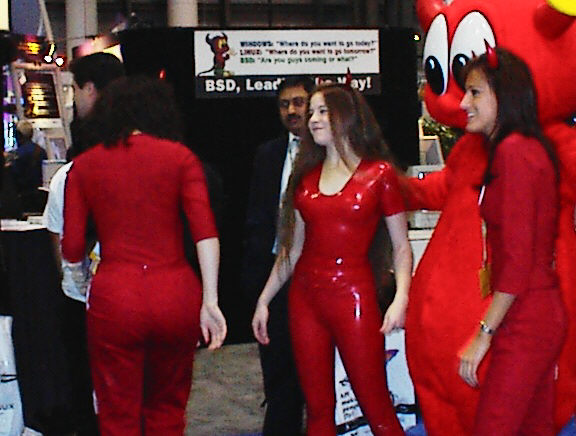
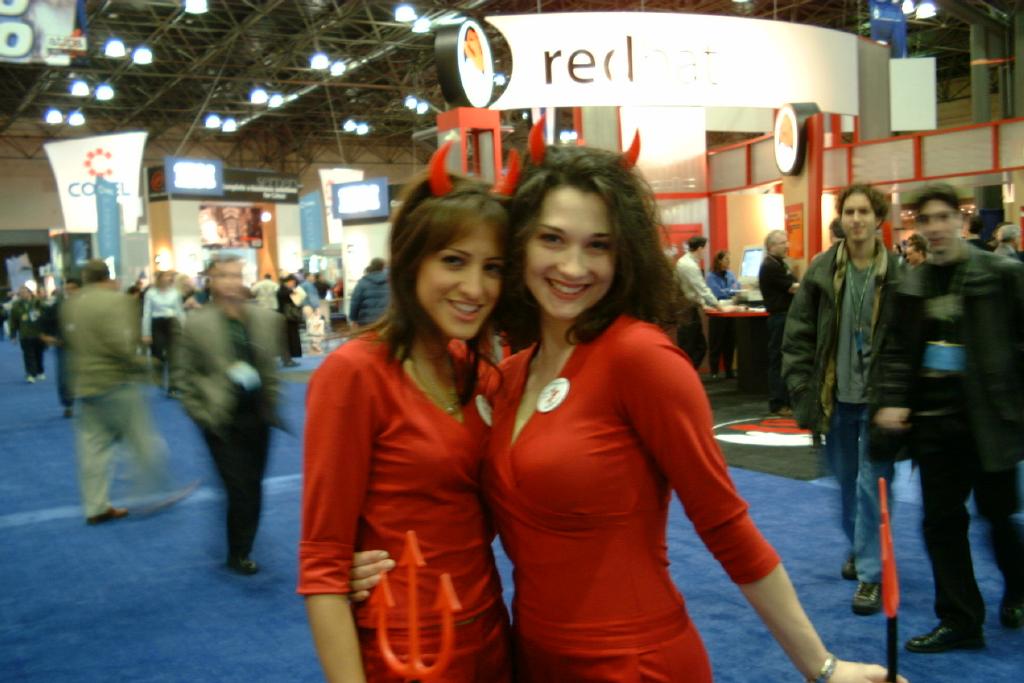
LOLF ROFFLE ROR LMAO
How can people say BSD is dying when it has a mascot like this?! Linux needs to get its act together if it's going to compete with the kind of hot chicks and gorgeous babes that BSD has to offer!
You just can't take Linux seriously when its fronted by losers like these. Would you buy software from them? I don't think so! You Linux groupies need to find some sexy girls like her ! I mean just look at this girl ! Doesn't she excite you? I know this little hottie puts me in need of a cold shower! This guy looks like he is about to cream his pants standing next to such a fox . As you can see, no man can resist this sexy little minx . I mean are you telling me you wouldn't like to get your hands on this ass ?!
With sexy chicks like the lovely Ceren you could have people queuing up to buy open source products. Could you really refuse to buy a copy of BSD if she told you to? Come on, you must admit she is better than an overweight penguin or a gay looking goat ! Don't you wish you could get one of these ? Personally I know I would give my right arm to get this close to such a divine
Join the campaign for more cute open source babes today! -
Re:Not "Good Software"
Huh? So when I downloaded Mozilla onto my uncle's computer, I violated someone's rights?
Well, technically, yes, but the practical matters depend on whether or not your uncle would have done anything with the source code. If your uncle was a hardcore programmer and wanted to actively make contributions to the Mozilla project then yes, you have violated his rights by not giving him the source {although your obligation probably would have been satisfied by telling him truthfully where he could have obtained it}. However, if your uncle simply wanted to use a standards-compliant web browser that did not suck and had no interest in programming, then he {for it is he who is the injured party} is likely to forgive you that minor infraction. That is the problem, not just in the Free Software community but in the world at large: where rights are little-used and easily violated, someone somewhere is trying to take them away.
The users of software have an absolute right to the source code by sole virtue of the software's existence. Just because most of them aren't going to make any use of it doesn't mean you can get away with not giving it to any of them![L]ack of source code does not prevent you from making derivative works. It may be easier to create certain types of derivative works with source code, but nothing in the license agreement says anything about making things easy.
Those are weasel words. Easier yes, but without the source code, it is frankly next to impossible to create a derivative work. Ask anyone who actually programs as opposed to pontificating. Without the source code, your only way to make a derivative work is first to disassemble the binary and then work out what the machine code does. If you want to just change a message or add a few extra lives to a game, that is trivial; but if you want to add extra functionality it can be a ball-ache. You probably -- and if you want to port to another architecture, make that certainly -- are going to end up having to rewrite the whole thing in a higher-level language. And the only consolation is that under fair dealing provisions, the end result most probably would be all your own work and you could release it under an open-source licence.It may be easier to create certain types of derivative works with source code, but nothing in the license agreement says anything about making things easy.
More weasel words. Why should it say so in the licence? It is an implicit assumption. Every human being is obliged to help every other being to the fullest extent possible without actually harming themself. If I can give you my source code without hurting myself, and that would help you, then I must.
See also this essay - choice quote "Freedom is being able to make decisions that affect mainly you. Power is being able to make decisions that affect others more than you. If we confuse power with freedom, we will fail to uphold real freedom."
The real question I find myself asking is why would you want to release something in binary form only? What is in your source code that you are so desperate for me not to see, and why? Are you ashamed of it? Scared it won't work? Do you think people will laugh at your commenting style or the way you use curly brackets? -
Re:Not "Good Software"
Doesn't the FSF deny people the right to copy and distribute software, unless they agree to the GPL?
No.
OK. So I can distribute linux binaries without distributing the source, then?
As long as there is copyright on software, there is a need for the GPL.
No, as long as there is copyright, there is a need for copyleft. The GPL is a half-decent incarnation of copyleft, but it denies people the right to copy annd distribute software without copying and distributing source code unlike other copyleft licenses, such as the QingPL or ShareAlike 1.0.
-
Re:Not "Good Software"
It's up to the creator what they do with their source code
You are falling victim here to the exact same fallacy that lies behind "It's my knife, therefore it's up to me who I stab with it". Don't confuse freedom over your own destiny with power over other people's destinies. Your {real} right not to get stabbed overrules my {false} right to stab you. And your {real} right to use software overrules anyone else's {false} right to try to stop you from using it.
See also here
The benefits of all human endeavour belong to all of humankind. If we are to expect that our fellow human beings will help us to the furthest extent possible short of actually harming themselves, then it follows that we are all obliged to help our fellow human beings to the furthest extent possible short of actually harming ourselves. If we expect any less, then we may as well not have bothered with the whole evolution thing. -
Re:How about the EFF?
Stallmann's moral vision
yes, and since hiring dyslexic Bradley Kuhn, RMS has gone from Stallman to Stallmann. (see above comment.)
Do you not know that it was Stallman that started GNOME? and it was FSF that wrote the LGPL? and it's FSF that are hosting the Xouvert project to help XFree? and that it was Stallmans idea to change ogg vorbis from GPL to BSD license?
RMS was once asked, since there is a free software song, would there ever be a GNU song?
He said no, GNU is not the point, Free Software is the point.
People like misinterpretting him, or finding small flaws, but don't ignore that he's dedicated his life to giving freedom to computer users. -
FSF already got some "Microsoft money"
On www.fsf.org/voucher.html the FSF talks about "Microsoft money". They already got some of that: On www.gnu.org/thankgnus/2003supporters.html the "Microsoft Giving Campaign" is listed under "Contributors ($500 to $999)". Anyways, I hope they get much more of it via the voucher campaign.
-
The creator?
It's up to the creator
The creator wants us to love Him first and our neighbors second, and those who love their neighbors will share the software. This is true whether you belong to the Church of Christ or the Church of Emacs.
It's up to the [author] what they do with their source code.
The rationale for the GNU project is that while it is up to the author to determine the distribution terms for a copyrighted program, some such determinations run against the common good.
-
Re:Not "Good Software"
There's a misunderstanding here. Free, as in beer, is what free software is not, as opposed to free speech. From the Free Software definition, at the GNU website:
"Free software" is a matter of liberty, not price. To understand the concept, you should think of "free" as in "free speech", not as in "free beer". -
or both? (I go with FSF)
yup, EFF are also great, but when I can spare cash, it goes to FSF.
They've been busting their asses to give us freedom for 19 years now, and with Bradley Kuhn as the Executive Director, they've gone from strength to strenght.
If fighting for freedom is lunacy, you can download thirteen 2hr lunacy recodings (sounds fun) on the GNU audio page. Well worth a listen, IMO
(and as a european, I'm very glad of all the work that Stallman has done, and the work of Hartmut Pilch of FFII who's work is funded by FSF)
and my -
Re:Try begging while i give it to the EFF
Something tangible like 273 software packages? Little items like Glibc, GCC, Bash, and the GIMP.
Note that these are GNU packages, meaning that they are provided by the FSF. There are thousands more packages that are merely distributed under the terms of the GPL/LGPL.
-Peter -
Re:Branding, PHP, ASPI think if you read the Manifesto, it's fairly clear RMS was trying to change something about the world, and not just produce code he could debug easily.