Slashdot Mirror
Domain: gnu.org
Stories and comments across the archive that link to gnu.org.
Comments · 13,360
-
Re:Question
-
Use G++ and Common C++ and use #ifdefs liberally!
Use Common C++ for the cross-platform serial I/O, network I/O and threading support. I strongly suggest you use G++/cygwin rather than MS VC++ as the latter has all sorts of minor incompatibilities. G++ does too, but at least it's cross-platform. If you do decide to go with VC++, there's a few tricks you can use to make it closer to standard C++, such as #defining for="if (0) {} else for" (do it in the project pre-processor definitions if you don't want to #include it everywhere) which fixes the for-loop control variable scope problem in VC++. Any point where you do anything remotely Windows-centric when you're coding, at the very least put a comment, or put a #ifdef LINUX (or whatever) and flag an error when you try to compile on the other system, or better, figure out how to do it on the Linux system and write that in the #ifdef.
It's very important to keep in mind that the system will be ported, and soon, otherwise it'll be a huge project to convert it when the time comes. It is probably worth doing things slightly less efficiently from the win32 perspective (use G++) so that the system can be easily ported later.
Good luck!
-
Re:Perfect example of why NOT to use the GPL.
I reasoned that since the objective behind the FSF was providing free software, and Linux was being heavily commercialized while FreeBSD was not, FreeBSD was nearer to the objectives.
Actually, you're using the wrong meaning of "free" here. The FSF itself says: The FSF promotes the development and use of free (as in freedom) software. This is different from the meaning of "no cost" that you claim.
The first clue that the FSF is not opposed to software being non-free (as in no-cost) is on their page: Most of the FSF's funds come from its distribution service. This is why we urge you to order CD-ROMs and manuals (but especially CD-ROMs) from the FSF when you can.
The confusion is understandable, as the ability to get sourcecode anywhere without paying for anything other than bandwidth has made many people assume that the "free" in "free software" means that software should be without cost. -
It IS a GPL violation.Why are people saying that this isn't a GPL violation?
You must provide a copy of the source code when you redistribute software that is under the GPL license. Forked.net and Openosx.com did not do this. Not only that, but they were both charging for the software that they basically just downloaded and repackaged.
Furthermore, i'm pretty sure both parties violated parts A, B, and C of section 2.
From the GPL
2. You may modify your copy or copies of the Program or any portion of it, thus forming a work based on the Program, and copy and distribute such modifications or work under the terms of Section 1 above, provided that you also meet all of these conditions:
a) You must cause the modified files to carry prominent notices stating that you changed the files and the date of any change.
b) You must cause any work that you distribute or publish, that in whole or in part contains or is derived from the Program or any part thereof, to be licensed as a whole at no charge to all third parties under the terms of this License.
c) If the modified program normally reads commands interactively when run, you must cause it, when started running for such interactive use in the most ordinary way, to print or display an announcement including an appropriate copyright notice and a notice that there is no warranty (or else, saying that you provide a warranty) and that users may redistribute the program under these conditions, and telling the user how to view a copy of this License. (Exception: if the Program itself is interactive but does not normally print such an announcement, your work based on the Program is not required to print an announcement.)
Anyway, it's pretty clear to me that there are a lot of Mac folks out there that haven't a clue about open source. It doesn't look like forked.net or openosx.com meant any harm, though. that they didn't mean any harm -- They just don't understand the GPL.
It looks like forked.net isn't charging for downloads anymore, and are trying to make it right. So it looks like it's all taken care of now. -
Re:The GPL doesn't have an advertising clause
Me != lawyer, but wouldn't GPL requirements only apply if I entered into a contract with the owner of their code? I wasn't paying attention, but I don't remember agreeing to an end-user-license-agreement last time I installed linux.
IANAL, but Eben Moglen is. Read what he has to say about enforcing the GPL.
In short, proprietary software vendors usually want to take away rights which copyright law would otherwise grant. This is only possible if both parties enter into a contract. The GPL, on the other hand, adds rights to those provided by copyright law. You are free not to accept the GPL, in which case you are bound by copyright law (ie, no modification or distribution at all).
-
Re:The GPL doesn't have an advertising clause
From the GPL:
1. You may copy and distribute verbatim copies of the Program's source code as you receive it, in any medium, provided that you conspicuously and appropriately publish on each copy an appropriate copyright notice and disclaimer of warranty;...
So yes, you could rip out all the comments as to who did what, but you are required to maintain the copyright notice which would include the developer's names. You can even rename it to Brianux, as long as you maintain that copyright notice, which would include Linus Torvalds, et. al. -
Re:x10.com generates more revenue than Microsoft..
For my penny, I would have a list of "about 236,000,000" web sites that include the word "not." (Doubt me? Try it yourself.)
I tried it. And got 251,000,000 results. Leading the list was GNU's Not Unix. How poetic. -
Re:Oh Lord, How Long?
Actually they've been working on it longer than that. In 1987 they started "negotiating with Professor Rashid of Carnegie-Mellon University about working with them on the development of the Mach kernel". 1991 is only when they started working on a detailed plan. It still took them until 1994 before they got to the milestone of "it boots".
-
GNU deserves a lot of respect, but...
insisting on ``GNU''/Linux and ``the'' Hurd are examples of misplaced priorities.
-
GNU deserves a lot of respect, but...
insisting on ``GNU''/Linux and ``the'' Hurd are examples of misplaced priorities.
-
Re:The father of open source?
RMS claiming that he is the father of open source is like Linus Torvalds claiming he is the father of Linux.
Oh yeah, before you flame this, when has RMS ever said he is the father of open-source? He is the father of the free software movement NOT the open source initiative.
Next time, try to remember the difference! -
Re:Just fork it!
-
It's all about Freedom here...
People, the problem here is not that everybody will feel bad about SourceForge (the site) containing non-free components; if you feel that it's OK and that it really doesn't matter then the FSF Europe article is not really aimed at you (well, it is in the sense that it tries to explain why it is a Bad Thing(tm)).
The problem here is with people that hosted their free software projects in SourceForge (and we all are in debt to VAfor that) not only because it was a very good platform to host a project on but also because it was free software... if the version of the software that is used on SF.net is not free software than it raises several problems for some people (myself included).
I hope this is not the case, but there seems to be a trend on releasing free software, make ppl use it extensively and then close the source when tested. I'm not saying that SF is one of those situations (VA maintains a free version AFAIK), but still, ppl are nowadays more aware of this kind of drifting, and that makes them suspicious.
People seem to forget that the FSF/FSFE view on things is pretty clear and documented... I don't know why people seem surprised when articles like that one are submitted. I for one totally stand behind Loïc's words, and share his concern.
Having one of the most known free software development centres running on a proprietary version of a platform isn't really very flatering for free software as a whole... 'see, they don't even use their free software to host their bloody code!'-type of comments come to mind.
fsmunoz -
It's all about Freedom here...
People, the problem here is not that everybody will feel bad about SourceForge (the site) containing non-free components; if you feel that it's OK and that it really doesn't matter then the FSF Europe article is not really aimed at you (well, it is in the sense that it tries to explain why it is a Bad Thing(tm)).
The problem here is with people that hosted their free software projects in SourceForge (and we all are in debt to VAfor that) not only because it was a very good platform to host a project on but also because it was free software... if the version of the software that is used on SF.net is not free software than it raises several problems for some people (myself included).
I hope this is not the case, but there seems to be a trend on releasing free software, make ppl use it extensively and then close the source when tested. I'm not saying that SF is one of those situations (VA maintains a free version AFAIK), but still, ppl are nowadays more aware of this kind of drifting, and that makes them suspicious.
People seem to forget that the FSF/FSFE view on things is pretty clear and documented... I don't know why people seem surprised when articles like that one are submitted. I for one totally stand behind Loïc's words, and share his concern.
Having one of the most known free software development centres running on a proprietary version of a platform isn't really very flatering for free software as a whole... 'see, they don't even use their free software to host their bloody code!'-type of comments come to mind.
fsmunoz -
Re:Just fork it!
If people out there take serious issue with Source Forge's turn to the proprietary, then take the last release of open source code and start your own Source Forge. I mean isn't that supposed to be one of the magical things about open source, that folks who want to go proprietary cannot because the community will hijack it.
Everyone is focusing on the closing of the SourceForge source. I believe the bigger issue in the article (doesn't seem like many people bothered to read it) is that VA was engaging in some rather questionable activity in terms of trying to get people who assumed their SF contributions would remain Free to assign copyright over to them without being forthcoming about the reasons. It sure sounds sleazy to me.
Other issues are that SourceForge seems to be taking steps to make it more difficult to migrate your project off of their server. Who wants to deal with such lock-in, even if the company has previously been a friend of Open Source?
Unless the FSF is going to fund an open alternative to Source Forge they should get off their high horse.
I guess you didn't read the article before ranting? Otherwise you'd have seen the part where they mention Savannah.
Time to face facts, VA is a sinking ship. Its not a matter of if but when. They aren't making any money and who would fund them in this climate?
I do acknowledge that VA has done some good for the OSS community, but everyone with projects on SourceForge should really be working on a backup plan if they aren't already. No sense hoping the situation will go away. -
Re:Just fork it!
Unless the FSF is going to fund an open alternative to Source Forge they should get off their high horse.
As stated in the article, Savannah is such an alternative supported by thy FSF. -
Re:Did RMS ever answer ESR's question?
As I've posted several times before but it NEVER GETS MODed up, I'm assuming because GPL advocates don't want to know the truth, RMS ALREADY ANSWERED THIS QUESTION LONG AGO.
From: www.gnu.org
What the facts show is that people will program for reasons other than riches; but if given a chance to make a lot of money as well, they will come to expect and demand it. Low-paying organizations do poorly in competition with high-paying ones, but they do not have to do badly if the high-paying ones are banned.
Also from the same page his solution for funding development once commercial software is banned
All sorts of development can be funded with a Software Tax:
Suppose everyone who buys a computer has to pay x percent of the price as a software tax. The government gives this to an agency like the NSF to spend on software development.
But if the computer buyer makes a donation to software development himself, he can take a credit against the tax. He can donate to the project of his own choosing--often, chosen because he hopes to use the results when it is done. He can take a credit for any amount of donation up to the total tax he had to pay.
The total tax rate could be decided by a vote of the payers of the tax, weighted according to the amount they will be taxed on.
The consequences:
The computer-using community supports software development.
This community decides what level of support is needed.
Users who care which projects their share is spent on can choose this for themselves -
Re:The father of open source?He's certainly the father of free software though.
Disagree; as many have pointed out, BSD (and other)-licensed projects were going on years before RMS got his start; and bsd-licensed software is free software.
Now, he's certainly the father of copyleft, the FSF, GNU, (L)GPL, gcc, and emacs... that oughta be enough for anybody.
-
what's with the RMS-bashing?RMS has never tried to claim "all the credit" for free software for himself - he does ask for more recognition for the GNU Project, but that's not just RMS, that's thousands of developers. If you check out the partial "GNU's Who" on the web site, you'll find RMS in alphabetical position, not promoted over the others.
If I were voting for GNOME directors, I should think RMS would make a fine choice. He's an experienced developer himself, he knows a lot about licencing issues, and his committment to free software development is unquestioned. Sure, he'll bring some politics into it, but the whole point of the GNOME Foundation is surely to do the politics, public relations, marketing, and so forth so the developers don't have to.
Danny.
-
Another way of looking at thingsYou say RMS shoud accept "that [commercial products] do have a place."
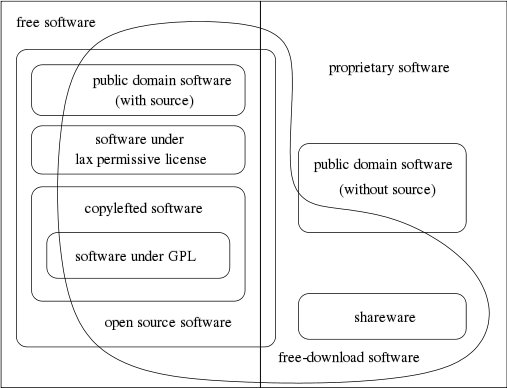
First of all, commercial products and proprietary products are not the same thing. GNU has a clear set diagram that categorises software and makes this clear. RMS has always accepted that commercial products have a place -- he is not a communist. However he believes that these commercial products should embrace the same development methods and openness that the Free Software community does. He has no qualms with CyGNUs Software for example, since all of its work is released under the GNU GPL.
With this in mind, try to name one single case where proprietary software is valid or acceptable. Now you will begin to see what RMS is getting at. Even if you don't, you shouldn't be misrepresenting his ideas like this. -
Re:Stop using the phrase Copy Protection...
Although so many in the Slashdot crowd love to make fun of RMS for his use of better terminology, (and yet simultaneously you use GNU software and the GNU GPL), GNU has you beat here. Check out these words to avoid and you'll find some nicely worded reasons to avoid propaganda terminology like "copy protection".
-
An understanding of licenses needed
Any managers embarking on a project using open source ought to have a clear understanding of licenses and how their IP rights apply.
This may be as simple as reading+understanding the GNU license information page -
Re:Hmmmm....
Just for sake of clarity
< KDE gets awards...
< Gnome gets RMS
Consider that Gnome is an offical part of the gnu project.
If Gnome wants to have Gnu's seal of approval, it has to follow all Gnu coding conventions and as well its philosophy. No more, no less, no bullshit thank you. -
Re:Hmmmm....
Just for sake of clarity
< KDE gets awards...
< Gnome gets RMS
Consider that Gnome is an offical part of the gnu project.
If Gnome wants to have Gnu's seal of approval, it has to follow all Gnu coding conventions and as well its philosophy. No more, no less, no bullshit thank you. -
Results not surprisingThese are not surprising results. Even the gcc developers will admit that many general, not-architecture-specific optimizations done by commercial compilers are not performed in gcc. Most new CPUs, not just Intel CPUs, can benefit from a smarter compiler to take advantage of features like data prefetching, instruction bundling and pipelining, profile-based (feedback-based) optimization, data and control speculation, and much more.
The gcc "open projects" page gives people a good idea of what remains to be done on gcc. The minutes of the IA-64 GCC summit are especially interesting and informative, because it gives a good idea of the current state of GCC and also what GCC needs to be a competitive compiler in the future.
Bottom line: Do not be surprised when commercial compilers beat gcc performance. It's catching up, but it's still got a long way to go.
-
Results not surprisingThese are not surprising results. Even the gcc developers will admit that many general, not-architecture-specific optimizations done by commercial compilers are not performed in gcc. Most new CPUs, not just Intel CPUs, can benefit from a smarter compiler to take advantage of features like data prefetching, instruction bundling and pipelining, profile-based (feedback-based) optimization, data and control speculation, and much more.
The gcc "open projects" page gives people a good idea of what remains to be done on gcc. The minutes of the IA-64 GCC summit are especially interesting and informative, because it gives a good idea of the current state of GCC and also what GCC needs to be a competitive compiler in the future.
Bottom line: Do not be surprised when commercial compilers beat gcc performance. It's catching up, but it's still got a long way to go.
-
Wrong...
What if, besides caruso, Intel's compiler is actually a BETTER compiler than gcc on intel hardware? Then were stuck using gcc for compiling the kernel when something better is or might be some day available. . Locking the kernel to a compiler is a BAD THING[tm].
The Linux kernel is not only available on Intel chips. It is available on ARMs, DEC Alphas, SUN Sparcs, M68000 machines (like Atari and
& Amiga), MIPS and PowerPC, as well as IBM mainframes.
Which makes more sense? Targetting a cross plartform compiler like gcc are targetting individiual compilers for each platform Linux runs on? -
Re:Sheesh
RMS believes that Free Software shouldn't promote proprietary software. That's all. He isn't saying that we should shut down www.staroffice.com, or that people who use WordPerfect should have their hands cut off
What would you say if he advocated that free software development be subsidized by compelling manufacturers and purchasers under the force of law to fund its development? All right here in black and white. I have no problem with Free Software, I just have a problem with him speaking for my views. -
Exact Conditions of GNU software
I really fail to see all the fuss; *any* GNU project should know that refering to proprietary software is a no-no; I'm not arguing here that in same situation one can let it slide, but it's a knwon fact that a GNU program can't refer to a proprietary software.
It's preety explicit. For example:
A GNU program should not recommend use of any non-free program, and it should not refer the user to any non-free documentation for free software. The need for free documentation to go with free software is now a major focus of the GNU project; to show that we are serious about the need for free documentation, we must not contradict our position by recommending use of documentation that isn't free.
and
A GNU program should not recommend use of any non-free program. We can't stop some people from writing proprietary programs, or stop other people from using them. But we can and should avoid helping to advertise them to new customers. Sometimes it is important to mention how to build your package on top of some non-free operating system or other non-free base package. In such cases, please mention the name of the non-free package or system in the briefest possible way. Don't include any references for where to find more information about the proprietary program. The goal should be that people already using the proprietary program will get the advice they need about how to use your free program, while people who don't already use the proprietary program will not see anything to encourage them to take an interest in it. Likewise, a GNU package should not refer the user to any non-free documentation for free software. The need for free documentation to go with free software is now a major focus of the GNU project; to show that we are serious about the need for free documentation, we must not undermine our position by recommending use of documentation that isn't free.
Anyway, ppl are always judging what RMS 'real intention' is, etc. Nobody really checks what he really said or did. Most of the times RMS name is vented the comments are all a FUD feast.
Best Regards,
fsmunoz -
Exact Conditions of GNU software
I really fail to see all the fuss; *any* GNU project should know that refering to proprietary software is a no-no; I'm not arguing here that in same situation one can let it slide, but it's a knwon fact that a GNU program can't refer to a proprietary software.
It's preety explicit. For example:
A GNU program should not recommend use of any non-free program, and it should not refer the user to any non-free documentation for free software. The need for free documentation to go with free software is now a major focus of the GNU project; to show that we are serious about the need for free documentation, we must not contradict our position by recommending use of documentation that isn't free.
and
A GNU program should not recommend use of any non-free program. We can't stop some people from writing proprietary programs, or stop other people from using them. But we can and should avoid helping to advertise them to new customers. Sometimes it is important to mention how to build your package on top of some non-free operating system or other non-free base package. In such cases, please mention the name of the non-free package or system in the briefest possible way. Don't include any references for where to find more information about the proprietary program. The goal should be that people already using the proprietary program will get the advice they need about how to use your free program, while people who don't already use the proprietary program will not see anything to encourage them to take an interest in it. Likewise, a GNU package should not refer the user to any non-free documentation for free software. The need for free documentation to go with free software is now a major focus of the GNU project; to show that we are serious about the need for free documentation, we must not undermine our position by recommending use of documentation that isn't free.
Anyway, ppl are always judging what RMS 'real intention' is, etc. Nobody really checks what he really said or did. Most of the times RMS name is vented the comments are all a FUD feast.
Best Regards,
fsmunoz -
Re:GNUExactly how much of Stallman's code is left in GCC? Under the contributors page, it says:
- Richard Stallman, for writing the original gcc and launching the GNU project.
All RMS appears to do is talk about how everything should be free. Unlike say... Linus who actually does stuff. I'd rather follow somebody who walks the talk, instead of all talk.
-
Re:No "non-free" apps == limited relevanceRMS represents pretty much the extreme of trying to prevent people from using what he considers "non-free" software. He routinely uses both license and PR to try to discourage "non-free" software.
It is true that RMS discourages everyone to avoid using free software. It is also true that he sometimes tries to prevent people from creating non-free software. However, it is incorrect to state that he tries to prevent people from using non-free software.
If he were in a position to do so, I'd expect him to work to work hard to prevent or at least strongly discourage "non-free" software from being able to use GNOME, for example by trying to force changes in the licensing.
I don't think that's likely at all. He has made no moves towards such changes with glibc.
Look at the GNU libc LGPL isssue recently for a fine example of him trying to push the libc in that direction.
Either I missed something big, or you misunderstood what happened. glibc has always been available under the LGPL. Changing to a newer version of the same license was a wholly political move. The terms and conditions of the license are the same.
I'm not sure where all of the anti-RMS vitriol comes from. Certainly people who post here sans clue don't help a lot.
Just bear in mind that what RMS claims to want most is freedom, and his actions are consistent with that. He doesn't support stuff that limits other people's freedom, but he never denies the right of people to voluntarily do stupid stuff (which is how he regards using non-free software).
-
Re:Let me see if I undestand
It may have been a troll, but it wasn't as inaccurate as you think. Free can be "gratis", as in monetarily free, or "libre", as in freedom from restriction.
If that whole "free as in speech, not free as in beer" phrase sounds like nonsense to you, perhaps you might find enlightenment at http://www.gnu.org in the philosophy section. -
Re:Or maybe he just wants to work on GNOME?
Of course, keeping it free will obviously be a concern of his, but it might not be his main concern.
You don't appear to have read his writings. Check out the philosophy section of GNU. -
[OT] Re: TravellerTraveller is still going strong. The Traveller Mailing List is extraordinarily active. There are many sites dealing with it. Steve Jackson Games have even come out with GURPS Traveller, an excellent port of Traveller to the superlative GURPS system.
I myself am working on software for Traveller. Called travtrack, it is in the middling stages. It's very cool, using gtk+ and glib for data structures, classes, inheritance &c. and guile for its scripting language. Ideally, I'd like it to someday be the emacs of interstellar science-fiction RPGs.
Right now it's surprisingly far along, and is doing fairly well on the SourceForge ratings. It's just me working on it, but I'm hoping that once I get release 1.0 of both travtrack (the actual galaxy-tracking software) and travlib (the library which implements Traveller objects) more developers will pitch in.
Traveller's very, very far from dead.
-
Re:Juicy Excerpt
we came in and said there should be a platform that's identical with millions and millions of machines, and the bios of that should be open to everybody to use
I kind of see what BG is saying here, that the free software movement couldn't have taken off without open, commodity hardware. This is wrong. The free software movement, as it came out of RMS and the MIT AI lab was a direct response to proprietary, closed hardware and software. The free software movement grew out of the tradition of open access to software and tools on very non-standard mini computer hardware.
In the early 80s when the FSF was founded, it was not clear yet that the IBM PC would be such a dominant force in the computing world. Commodity home machines aren't even mentioned in RMS's initial announcement. In fact, he is talking about replacing the system on very expensive, practically custom built machines, which were only found in universities and big businesses.
Sure, the pervasiveness of computing has been a major boost for free software, but this is a base rate issue (i.e., there are x free software users out of n*x computer users).
-
Microsoft invented the PC?
MR. GATES: Let me start out, really the reason that you see open source there at all is because we came in and said there should be a platform that's identical with millions and millions of machines, and the bios of that should be open to everybody to use, and all the extensibility should be there.
So, is Bill "Stop stealing from me" Gates now saying that his company is responsible for the open architecture of the IBM PC, and therefore open source in general?How very droll.
-
Re: tail -f /var/log/messagesAnd for those that want a GUI, check out Xlogmaster. It comes in a variety of themes (OK, colours) and can pretty much capture everything you can cat, grep and cut out of your standard *NIX commands and logfiles. And a good deal more besides.
Still, choice is good.
-
Emacs+JDEEFor programming, I use Emacs and Paul Kinkunnan's excellent JDEE package, which turns the editor into a full-fledged, extensible Java IDE. Advantages are that you can use this combo on different platforms (Linux, WinNT,
Emacs contains syntax colouring, etc. for other programming languages as well, so if you want to do some scripting for example (as I do regularly), you don't need another editor for that.
Emacs doesn't have a very nice UI and learning all these bleedin' keyboard shortcuts may be a pain, but once you're past that, nothing can beat it. But this is my personal and humble opinion of course...
-
IDE - Editor or round trip engineering tool?
Well, as always, the text editor itself is really up to you - I use the ubiquitous emacs along with the fantastic jdee IDE that installs inside emacs for syntax highlighting, quick toolbar access to your classes, and easy creation of class from templates.
If you are serious about writing good OO componentised java though, its almost essential now to use a decent UML tool during the design stages and further like rational rose / together.
One of the nice things about together is that it works by placing javadoc comments inside your java - so your design documentation is never out of step with your source. Invaluable.
I don't work for together - but I do find their tool helps me visualise the workings of complex systems without remembering all the methods and stuff.
So if I had to put a finger on it - let developers choose their editor/IDE themselves, but get all developers to use a UML tool independant of the IDE.
Mr Thinly Sliced -
Re:Changelog lacks any real value.
When I give my indoctrination spiel, uh, er, "training lecture" on CVS to coworkers and lackeys, I usually hand down a list of requirements for log/commit messages and a ChangeLog entry.Most of the time it's a variation on http://www.gnu.org/software/guile/changelogs/guil
e -changelogs_toc.html, or sometimes the rules used for ChangeLogs in the GCC project, which I've found to be of immense value when tracking down changes.Personally I can't stand changelogs that don't say a thing. It's just enough "open source" to look good, but not open enough to actually invite help.
-
overlaid filesystem mounting
One of the things I'd personally like to see is some kind of overlaid filesystem so each image by default gets
The HURD has support for such an overlaid filesystem. It's flexible to the point where you could (I believe) mount a CD as a read-only device, and then write changes to the disc, storing your changes elsewhere. I'm pretty fuzzy on exactly how it works, but I've had it explained to me by a couple of HURD hackers and it sounds very neat.
-
Open Group Test Suite License - not Free Software?The Open Group Test Suite License states the following:
You may charge a reasonable copying fee for any distribution of this Package
The FSF's definition of Free Software requires that "A free program must be available for commercial use".
-
Links
Here is a working link to the Motosoto liscense: http://www.motosoto.org/ARCHIVES/0/1/mosl.html
Here is a link to the current list of OSI liscenses: http://www.gnu.org/philosophy/license-list.html -
Re:Quick... which one do I buy?
I have to recommend the 32S II. I have that and the 48GX (both RPN calculators.) The 48GX is big, with every bell and whistle you would ever want in a calculator, and is priced to match - over $170 at Fry's. It usually sits on my desk, being too bulky to carry around.
The 32SII is about $50, and is simply a marvel. It's small enough to fit in my pocket, and is programmable! I carry it everywhere. The only quibble I have with it is the four element stack (there are some tricks you can use with short stacks, but I'm not enough of an RPN wizard to employ them.)
If you want to get a HP calculator, by all means get an RPN one. It's a very efficient system, even if it takes some getting used to (GNU Calc is a great HP calculator emulator, you might want to check it out first.) -
Re:And think...
How long until it becomes true, instead of being a whacked-out conspiracy theory fantasy?
--jeff -
I hate sounding like a broken record. Free != free
Ok, I'm sure I could run through my submission records and just find something to cut copy paste, but everyone here (or a good number) has missed a very important point about the GPL and Open Software, and always miss it. Maybe that's an american thing too
Just because I sell software under the GPL -does not mean I have to give it to you free-. It just means that whoever I distribute - or trade for women, booze, chests of gold, fast cars, whatever - binaries to also gets the source code and the ability to do whatever they want with that source code. Nothing stopping them from turning around and selling it for even more chests of gold! The key point is that they are free to do whatever they want with the software what they want after delivery of the product, as long as they stick with the terms of the GPL.
In many open source projects, everyone can get a binary, so everyone gets the source, too.
This means there's great money to be made in producing customized software for people, scratching other people's itches, you name it. What I see open source doing is commoditizing the common tools - the compilers, the kernel, the window managers - and providing a free platform that the customized stuff can be executed and manipulated on. The customized software, or the engineers working it, is where the money part comes in for most companies, that I can see. The things that Ximian is going with gnome is part of this. I'd have no problem chucking Ximian a few bucks a month to maintain versions and dependencies so I have a up-to-date framework to work on.
There's lots of money in Free software, and it's about freedom - those who pay for software can do what they want with it. Read the GPL. It is quite a departure from how things work now, though.
-
Re:16-bit, 32-bit, 64-bit...
Linux on the Desktop absolutely has to kill/prune this tangled hierarchy. Explain to me the distinction of "/usr/local" on a desktop machine?? *Everything* is LOCAL.
And what "Linux on the Desktop" has to do with file locations? I run GNOME and Nautilus and Mozilla and all the other stuff (only using command line for "tricky" tasks), and I don't need to know anything other than "um, my files are under directory
If we want a "desktop" shell, you just need to get one that supports $PATH - and I think popular shells did this before MS-DOS, our thing of comparison, was even invented.
And as for the explanation of
If you want to manage "packages" under
./configure --prefix="/usr/local/stow/package-1.0"
make
make install
cd
stow package-1.0This will create appropriate links to
Deinstallation:
cd
stow -D package-1.0
rm -rf package-1.0 -
WGET Missing from OS X.1"This assummes you have curl or wget or something."
Well, I did have wget in 10.0 up to 10.0.4, but the 10.1 update "helpfully" deleted it from my system. After several annoyed looks and some time spent searching Google, I found a download site for a precompiled binary for wget that will run under OS X (downloads as an installer
If you really, really want to compile yourself (you need to have installed the developer tools, which come with boxed copies of OS X), the source is here.
Beats me why Apple did this...
-
It's Free Software anyway...
I don't know if the QPL is considered Open Source (...), but the QPL is listed under free software licenses (although GPL-incompatible) on the various licenses list at the GNU website