Slashdot Mirror
Domain: gnu.org
Stories and comments across the archive that link to gnu.org.
Comments · 13,360
-
patent-protection on support for .gifs
This likely falls under stupid questions, especially since I don't have GIMP (what with not having X), but how is GIMP allowed to support the
-
Getting desparate
One of the more interesting essays on the GNU website talks about how money isn't a good incentive for high quality work. Either GNU (i.e. RMS) have changed their tune, or they're getting really desparate for documentation
-
Getting desparate
One of the more interesting essays on the GNU website talks about how money isn't a good incentive for high quality work. Either GNU (i.e. RMS) have changed their tune, or they're getting really desparate for documentation
-
Re:One word:
-
Re:Xfree is part of GNU
you can do whatever you want with it, as long as you don't remove the copyright notices
Or the usage permissions
This includes relicensing it under the GPL
No, you can't really relicense it unless you are the copyright holder. If you make a new derived work that includes the old code from X plus some new code that is under the GPL. The result would only be distributable under the GPL. There's a clause in the X license:
Except as contained in this notice, the name of the X Consortium shall not be used in advertising or otherwise to promote the sale, use or other dealings in this Software without prior written authorization from the X Consortium.
That appears to conflict with the GPL's "no additional restrictions" clause, but apparently it doesn't, since the clause has no effect (even without the clause you would not be entitled to use the the name of the X Consortium). Somwhat unclear, that part, and many people prefer not to mix X-license and GPL code (it's also rather impolite towards the person who wrote the X-licensed code).At least the X license doesn't include the obnoxious BSD licensing clause which is a pain in the backside whether or not you want to mix it with the GPL.
-
Open/Closed Source Debate is not newThe Open/Closed Source debate was as apparent in the early days of the Internet. The History of GNU says a lot of software was free in early 1970's, but most was proprietary by the early 1980's. That inspired GNU.
I tend to agree, although there were sources of sources then. One of those was NASA's COSMIC, but the main web site is shut down -- any mirrors around?
-
XFree and GNU - a final wordOn the software page at www.gnu.org, the X window system (with a link to the XFree page) is listed under "Non-GNU programs that we have decided to recommend."
It is not "part of GNU" in the sense that it was written by or for the GNU project, but it is recommended and used by people in the GNU project.
Overall, it should probably not be called "part of the GNU system."
-
Re:Xfree is part of GNUAll things GNU are GPL
I guess I should forgive you for not having a clue, since the link I posted doesn't work today. Try this link instead. In short, not all of the GNU project is written by GNU, some of it is just included because it is good and it is free. And not all the stuff they collected from other places is GPL, though it is all free.
-
Re:Trademark wars... poll topic?Unfortunately, the Open Source service mark needs to belong to a specific organization. That's the point of the mark - enforcement. "Free software," unfortunately, is used by many commercial software companies to mean "software that can be acquired for no money." The GNU definition is ignored.
The "Open Source" term was registered as a service mark to bring a little sanity to the advertisement of free software. If a company advertises a product as "Open Source," those viewing the advertisement can be confident (theoretically) that the program's license allows free redistribution and modification. If it doesn't, then the owner of the "Open Source" mark can bring legal action against the offender; therefore, the mark is a clear sign that you're getting free software.
Unfortunately, there's a deadly flaw waiting in the wings. Since the ownership of the mark is in dispute, if either organization ( OSI or SPI) takes legal action, the offending software company will argue that the mark belongs to the other organization.
This will have the effect of playing the two organizations off each other, and ultimately destroying the effectiveness and purity of the "Open Source" term. That would be a blow to our movement, since "Open Source" has become, in the past few months, the term under which many of us identify it.
The ownership of the mark must be resolved, soon, before it has to come before a court. I personally don't care which of the two feuding organizations ends up with it; I trust both to use their best judgement to administer the mark. But it has to belong to only one of them.
Eric, Bruce: one of you must display maturity and selflessness and give up your claim on the mark, before you pull it apart like two children in a tug-of-war that ultimately breaks the toy in dispute.
-
HPC software original sources...Some pieces of Sun's HPC software are derivations of freely available code. Their MPI implementation is (or rather was, the last time I looked) based on mpich from ANL. The linear algebra packages are based on ScaLAPACK and crew. Sun may be giving out some tuning implementation, but nothing that can't be found automatically (see the PHiPAC and ATLAS projects). PETsc and PVM are straight builds of older code, bugs and all.
Some of the more interesting pieces, like LSF, are only licensed by Sun, thus will not be included in this `deal.' (For a free improvement over LSF, check out GNU Queue. If it doesn't do something you want, you can support the community and extend it.) If you read the announcement carefully, you'll see that the only new codes to which it applies are the parallel file system (the Sun CTO thinks distributed file systems are dead, anyways), the Prism debugger, and the parallel run-time environment.
Of those, the only with no available substitute is the debugger. The ROMIO library is a good place to start for the MPI file I/O stuff (a good database would be a better place, imho). I already mentioned queue management software. The Ptools Consortium and the Globus Project have links to other HPC cluster tools.
Many of the pieces for debugging are available (combine ddd and gnuplot), but some notable ones are missing. The ability to control multiple GDBs easily from one processes and the visualization of parallel execution are needed, and quite difficult to implement. There seems to be interest in making GDB easier to use from other processes, which is a good start towards solving the larger problem of general, distributed debugging. And both the mpich and LAM MPI implementation have some profiling information, but few tools to dig through it.
To be fair, Sun has contributed (and supported contributions) to the original packages. Why they are releasing the rest under their Exploit the Community license is beyond me.
Jason, ejr@cs.berkeley.edu
-
tar-1.12.64011 for files > 2GB
there is at alpha.gnu.org and mirrors a version of tar which supports 64 bit file access and which can be used with glibc >= 2.1 to make archives bigger than 2 GB on 32 bit hosts. I just have downloaded it and it compiles and checks succeed without any problem. I just can't really test it because I have only 50 MB left...
-
The game of moneyWhile there's some similarities between whats happening in the free software community and the NBA (or whatever), there's also some things that just aren't the same at all. For example, you could look at the money involved in hiring someone. In the free software community in general, people pay more attention to the work itself and other benefits instead of to their paycheck.
I know I've posted this before, but you really should check out ``Studies Find Reward Often No Motivator''.
One of the conclusions of that article is that if money is seen as a reason for doing something, that task will suddenly become less interesting to do. I can't even remember the last time I did something for money; it's just too hard a struggle to become motivated to do something that doesn't interest you, even if the reward is money so you can live for another year.
Thats not saying that you can NOT pay a hacker a good salary though; just that it's not the most important thing. When it comes to money, the importance is that you get enough money so that you can pay your rent, food and buy some interesting toys to play with on your spare time (if you have any). Once that goal is reached, the next issue is about what kind of tasks that the work would involve. I tend to think that hackers are more agressive in this area because many of them often have a very well laid out idea of what they want to do and they'd rather be unemployed than be forced to go out of their way to fit into the company.
Hackers are an easy prey. If someone came to me and asked me if I'd like to for VA, I'm pretty sure I'd jump on that train. The reasons should be obvious; these companies create an athmosphere much like that of the Homebrew Computer Club and other similar organisations, such as all local Linux-based clubs. Being in such an athmosphere is in itself very motivating and interesting and I'd recommend it to anyone out there who gets the chance. -
GPL'ed JAVA
I read in a lot of the above comments that people were wondering if this allows for a GPL'ed version of Java to be developed.
I just thought I'd inform you guys that there are GPL'ed versions of both the Java Virtual Machine and the Java Class Library in development.
The Classpath website has more information.
Felix -
Double edged swordThis is almost a classical example of a double edged sword. Some people will argue that this is a bad thing because it would allow Microsoft to ignore compatibility tests. Other people will argue that this is a good thing, since it enables everyone to write Java interpreters with the freedom of not go through compatibility testing.
I'll side with the last group of people. The idea that you would need "permission" from a third party to distribute software you have written yourself is absurd. As a programmer, I see that this severely limits the ability to make good implementations. Suddenly, our laws would have turned against us, limiting our freedom.
Luckily, this doesn't seem to be the case now. Although we shouldn't loose track of what we're dealing with. This is only a tentative judgement on three issues and while it's good to focus, I think the other issues might be just as important.
There's two places I'd like to ask you to go to, which doesn't relate precisely to the topic at hand, but which talks about programming freedom.
- Patent Reform Is Not Enough by RMS which talks about why it isn't enough to simply patch the current patent laws.
- League for Programming Freedom which is an organization that opposes software patents and other issues that prevents programmers to work freely.
-
Is the Stallman's "The Free Software"song?
The Free Software Song
ouch.. that hurts. -
License for your goalsChoose a license based on your goals. Be really, really careful about evaluating how the license will bring those goals about, taking care to remember that coorporations are extremely license sensitive, and will not work on badly (from the view of them making money) licensed codebases.
Example: If you goal is to destroy the market for properitary software, use the GPL. If you goal is something else (like my goal, maximizing the amount of good open source software), choose a license that aligns with that.
From my analysis, the GPL is directly counter-productive to my goal - it is, however, effective for what seems to be Stallman's goals - forcing all software to be free software. (See especially the end of the manifesto).
A common fallacy is to believe that "all software is free software" is equivalent to "maximize the amont of free software" - it is not.
Personally, I usually choose to use a BSD-style license, in order to optimize the amount of use my sourcebase gets. If somebody use my code in a properitary product - great! They're working on the code, and are likely to send back bug-fixes and enhancements - and if they don't, I'm no worse off than I would be if they didn't use the code.
Besides, usage of free code is much more common in small, innovative comapnies than in the large juggernauts (who can usually just cross-license code anyway). Effectively, I help the innovative part of the commercial segment, kicking the juggernauts in the balls - which doesn't exactly detract from the experience
Eivind.
-
Re:Hope this works...From Why Software Should Be Free:
Those who benefit from the current system where programs are property offer two arguments in support of their claims to own programs: the emotional argument and the economic argument.
The emotional argument goes like this: ``I put my sweat, my heart, my soul into this program. It comes from me, it's mine!''
This argument does not require serious refutation. The feeling of attachment is one that programmers can cultivate when it suits them; it is not inevitable. Consider, for example, how willingly the same programmers usually sign over all rights to a large corporation for a salary; the emotional attachment mysteriously vanishes. By contrast, consider the great artists and artisans of medieval times, who didn't even sign their names to their work. To them, the name of the artist was not important. What mattered was that the work was done--and the purpose it would serve. This view prevailed for hundreds of years.
So why can't RMS be like "the great artists and artisans of medieval times"? The name GNU implies RMS. He wants it be called GNU/Linux for his own personal gratification. It's as simple as that.
I think the writers of free software do deserve credit. But according to RMS, people don't deserve, nor should they desire, credit for their work. According to him, that's just an excuse for proprietary non-free software. Yet when it comes to his own foundation's name, he demands that people give the FSF, and hence RMS, credit. That seems awfully hypocritical to me. -
Re:*pulls out tape recorder, speaks into it*
Right, I forgot to mention also that you can check out the GNU Events page for information about most of Richards talks and in general what's happening in the near future for the GNU Project and the FSF.
-
Re:Hope this works...
Theres some other graphics which you could consider using if you find the default GNU to be ugly. There's a new alternative GNU and also some art by John Bokma.
-
Re:Hope this works...
Theres some other graphics which you could consider using if you find the default GNU to be ugly. There's a new alternative GNU and also some art by John Bokma.
-
X Windows?
It is amusing that someone so bent on "proper" names for systems refers to the X Window System as "X Windows" (shudder).
-
Re: Linux-based G'nooHas anyone read Stallman's originaly essay on `why I must write GNU'? Note that this is not `why I must form a group called GNU or FSF', but, `why I must write an operating system called GNU'.
Actually, Stallman wrote:GNU, which stands for Gnu's Not Unix, is the name for the complete Unix-compatible software system
Anyone who hasn't read the original GNU (`g'noo', not `noo') manifesto really should--see http://www.gnu.org/gnu/manifesto.html -
Re:GPL vs. BSD
> Whether you like to have your program possibly being turned closed source is a matter of personal
> belief, but do NOT tolerate this obnoxious advertising clause! If you decide to use the BSD
> license, do the community a service and remove that clause from your license, or consider another
> license.
Examples are the XFree86-style license or the Modified BSD license.
See for more information about this topic the BSD License Problem article. -
Re:GPL, BSD, Artistic, and so on
Nice summary.
If you want to read more please read the preamble of the GPL. And other articles on the fsf/gnu site starting with What is Copyleft article.
Another good place is the Social Contract of the Debian project. There is some more info on their What does free mean page where they list some different licenses and the features of those licenses. (And a warning against creating Yet Another Free License).
Cheers Carl
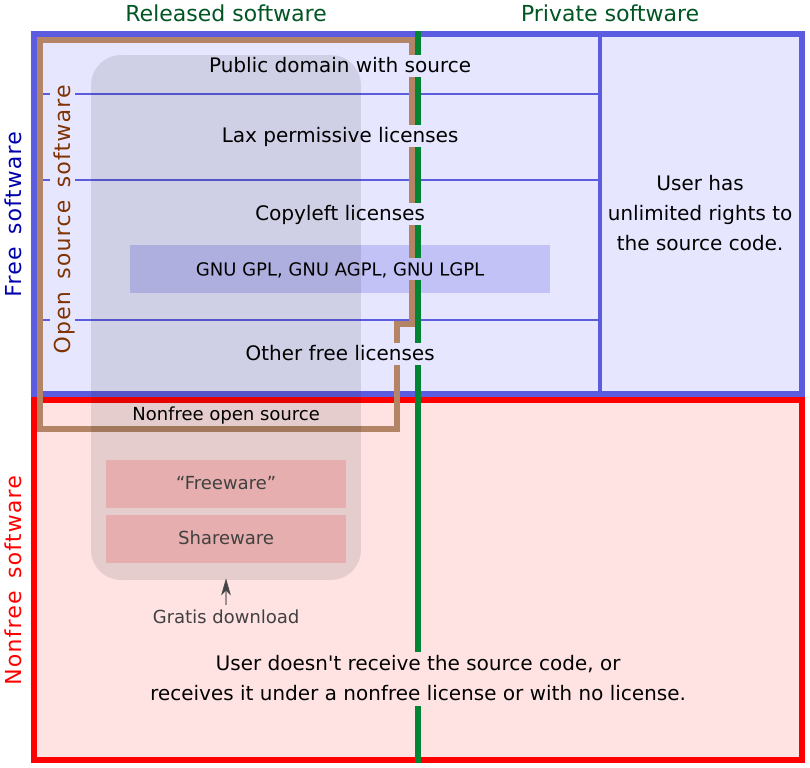
P.S. You might also like the diagram showing relationship between different categories of software. -
Re:GPL, BSD, Artistic, and so on
Nice summary.
If you want to read more please read the preamble of the GPL. And other articles on the fsf/gnu site starting with What is Copyleft article.
Another good place is the Social Contract of the Debian project. There is some more info on their What does free mean page where they list some different licenses and the features of those licenses. (And a warning against creating Yet Another Free License).
Cheers Carl
P.S. You might also like the diagram showing relationship between different categories of software. -
Re:GPL, BSD, Artistic, and so on
Nice summary.
If you want to read more please read the preamble of the GPL. And other articles on the fsf/gnu site starting with What is Copyleft article.
Another good place is the Social Contract of the Debian project. There is some more info on their What does free mean page where they list some different licenses and the features of those licenses. (And a warning against creating Yet Another Free License).
Cheers Carl
P.S. You might also like the diagram showing relationship between different categories of software. -
Re:GPL vs. BSD
How 'bout the GNU LGPL?
GNU Lesser General Public License -
emulation bakeoff: programming contestok you hacks, now that there's so much sand in the box, build your castle and let it be judged.
slashdot moderators should hold a contest w/ the following rules:
- submissions by end of 1-Aug-1999.
- contestant must post a URL to a BLAH.tar.gz file
- this file implements a REBOL interpreter/translator/compiler (your choice) in your favorite other language
- in the interim, REBOL programmers (any that exist) can post programs to add to the Judgement Suite
- judging is as follows:
- the submitted entry must run all of the programs in the Judgement Suite
- one point awarded for each program in the Suite that behaves "reasonably close" to that of the REBOL reference program
- core dumps disqualify the contestant immediately
- fewer lines of 80-column-max code is better
- faster execution is better
- (many) bonus points for synthesis of native language and REBOL (a la kawa)
- prize is three-months bragging rights on slashdot but STFU afterwards, please (until the next programming contest)
- REBOL employees are disqualified
- submitted entry must have open-source license
my guess is that there will be people interested in this sort of friendly competition.
-
Re:But wait...!And you can easily add a non-GNU shell, and voila, you have a running Linux based OS without GNU tools.
Sure you could easily add a non-GNU shell. what compiler would you compile it with? Which C library would you compile it with (hint, all versions of libc for Linux are based on GNU libc). Which termcap would you link to?
You seem to think that Linus wrote the kernel, and then there just happened to be available all the free tools necesary to make a free OS. The reason why all the bits were just there as if by magic was that the GNU project had been adding them, filling in the gaps in the available free software until all there was missing (or rather late) was the kernel.
Do you think the GNU people wrote a C library because it was the most exciting free software project they could think of? I'm sure they would have had more fun writing the LISP-based windowing system they originally planned, but if they had done that we would have had two windowing systems (with X) and no C library. Ie we would not have had Linux distributions.
I can quite understand RMS's frustration that everyone thinks the entirety of the Linux system appeared out of nowhere as soon as Linus wrote the kernel. Probably changing the name isn't the way to raise awareness (gets too many people's backs up, and noone can be bothered with as clumsy a name as GNU/Linux) but I don't know what is.
For those old enough to remember the Yggdrasil distribution (my first) it was labelled Linux/GNU/X. Can't quite remember the order, though I still have the CD somewhere.
And of course what all the above means is that noone would want to call the combination of Tru64 and a lot of free stuff GNU/anything. To suggest otherwise (even as a joke) is to misunderstand totally the motivation behind the GNU/Linux name.
-
Re:But wait...!And you can easily add a non-GNU shell, and voila, you have a running Linux based OS without GNU tools.
Sure you could easily add a non-GNU shell. what compiler would you compile it with? Which C library would you compile it with (hint, all versions of libc for Linux are based on GNU libc). Which termcap would you link to?
You seem to think that Linus wrote the kernel, and then there just happened to be available all the free tools necesary to make a free OS. The reason why all the bits were just there as if by magic was that the GNU project had been adding them, filling in the gaps in the available free software until all there was missing (or rather late) was the kernel.
Do you think the GNU people wrote a C library because it was the most exciting free software project they could think of? I'm sure they would have had more fun writing the LISP-based windowing system they originally planned, but if they had done that we would have had two windowing systems (with X) and no C library. Ie we would not have had Linux distributions.
I can quite understand RMS's frustration that everyone thinks the entirety of the Linux system appeared out of nowhere as soon as Linus wrote the kernel. Probably changing the name isn't the way to raise awareness (gets too many people's backs up, and noone can be bothered with as clumsy a name as GNU/Linux) but I don't know what is.
For those old enough to remember the Yggdrasil distribution (my first) it was labelled Linux/GNU/X. Can't quite remember the order, though I still have the CD somewhere.
And of course what all the above means is that noone would want to call the combination of Tru64 and a lot of free stuff GNU/anything. To suggest otherwise (even as a joke) is to misunderstand totally the motivation behind the GNU/Linux name.
-
Re:RMS stance on taking money from micro$oft?
Check out the donation page on the GNU site. Not quite halfway down, in the section on United Way donations, it reads:
"If your employer has a policy of matching United Way donations, you can take advantage of that. We especially appreciate the donations from Microsoft matching the United Way donations of their employees."
So I guess he doesn't have a problem with this.
-
Straight from the horse's mouth...
Quoting from RMS's speech in 1986 http://www.gnu.org/philosophy/stall man-kth.html
Now, the people who believe that they can own programs, generally put forward two lines of argument for this. The first one is ``I wrote it, it is a child of my spirit, my heart, my soul is in this. How can anyone take it away from me? Wherever it goes it's mine, mine, MINE!!''. Well, it's sort of strange that most of them signs agreements saying it belongs to the company they work for.
So I believe this is one of the things you can easily talk yourself into believing is important, but you can just as easily convince yourself it doesn't matter at all.
Usually, these people use this argument to demand the right to control even how people can change a program. They say: ``Nobody should be able to mess up my work of art''. Well, imagine that the person who invented a dish that you plan to cook had the right to control how you can cook it, because it's his work of art. You want to leave out the salt, but he says ``Oh, no. I designed this dish, and it has to have this much salt!''
That is precisely what is wrong with "if you use my code you can't change my license" and, whilst (ab)used by the FSF for their own ends (and called 'A Good Thing' when it is), it is bashed by their philosophy when anybody else takes that position (and their end's don't match up with the FSF's)
-
Miguel would not gain from lying.Please give counter-examples of "lies" and "false facts" given to the press by Miguel de Icaza.
I fail to see a single reason for why Miguel would lie.
He's a Free Software Foundation volunteer working on GNOME. Besides, he holds a system administrator job at UNAM in Mexico.
So before you claim that someone in our community has lied to the press, please check out what he or they would actually gain from it, before you post as Anonymous Coward.
In this case, Miguel would not gain anything, since he's not receiving money from either of the distribution companies, AFAIK.
So I think you owe Miguel an apology. His email address is miguel@NOSPAM.gnu.org.
-
Re:GNU fund raisingThat's true, for FSF volunteers, who write free software as a hobby.
Here's a section from the ''GNU Manifesto'' by Richard M. Stallman:
How You Can Contribute
At RedHat Software, Inc. there are (according to my latest information from #gimp
I am asking computer manufacturers for donations of machines and money. I'm asking individuals for donations of programs and work.
(...)
If I get donations of money, I may be able to hire a few people full or part time. The salary won't be high by programmers' standards, but I'm looking for people for whom building community spirit is as important as making money. I view this as a way of enabling dedicated people to devote their full energies to working on GNU by sparing them the need to make a living in another way. -
RMS proposal is betterA forced breakup is likely useless, and will probably fail. And is a very heavy-handed government intervention (which causes political problems). Forced open sourcing of Windows is also a bad idea - it completely goes against the spirit of how open-source projects are done.
As usual, RMS hit the nail on the head with his proposal to force Microsoft to reveal/document all internal interfaces and binary file formats in their products - enabling the creation of compatibile competing products, open source or not. Companies (and open-source projects) can still complete on features (even Microsoft) but on a level playing field.
This achieves the nearly same effect in the marketplace as a breakup, without the incentive for the Microsoft (or "baby Bills") to fork their code base (more than it already is, that is).
Who knows, it might also be considered a precedent for how all SW companies should behave (but to make it a universal rule would require legislation). Imagine, a world where software connector conspiracies are illegal!
-
What about when Microsoft changes?Okay, I've never been into marketing or support myself but let's look at development. What would happen if Microsoft changed some of the more important API's (which seems somewhat likely to me)? No doubt the software manufacturers would have to adjust themselves to this. As they would if Microsoft were to be split up. In the price for a software package you almost always add a fair amount called "further development". Thats where this money is supposed to be coming from.
Ofcourse, breaking Microsoft up isn't the best solution. Richard Stallman has written ``The Microsoft Antitrust Trial and Free Software'' article in which he suggests three remedies, should Microsoft loose.
-
Entertainment and creativityIn the article, Linus says that "if you're not interested in doing something, you probably won't do it." This is something I definitly can relate to. It's even one of the reasons I'm getting out of the company I work for now.
I believe we see this in quite a lot of modern companies where you try to create a fun and creative atmosphere instead of the standard cubicle 8am-5pm workdays.
You can't buy creativity for money. On a related note, I'd like to mention ``Creativity and intrinsic interest diminish if task is done for gain'' which was written by Alfie Kohn for the Boston Globe. Even if it's more than ten years old, it is worth reading.
-
Re:Wasn't GPL tested with NeXT and GCC?
RMS talks about the NeXT and ncftp issues in Copyleft: Pragmatic Idealism.
-
"Public domain"The page says
This 3-day course will cover the practical aspects of installing LINUX and the configuration of network services. LINUX kernel compilation and 'public domain' software installation will also be included.I'm willing to overlook the incorrect capitalisation of "Linux". But I strongly suspect they're using "public domain" wrongly.
To quote "Categories of Free and Non-Free Software" ( link):
Public domain software is software that is not copyrighted. It is a special case of non-copylefted free software, which means that some copies or modified versions may not be free at all.
Sometimes people use the term ``public domain'' in a loose fashion to mean ``free'' or ``available gratis.'' However, ``public domain'' is a legal term and means, precisely, ``not copyrighted''. For clarity, we recommend using ``public domain'' for that meaning only, and using other terms to convey the other meanings. -
He seems to be missing the point.> The GNU License says that you cannot sell the software for an unreasonable amount of money.
> I must have missed that part of the GPL. Could you point it out for me?
First read Selling Free Software by RMS: http://www.gnu.org/philosophy/selling.ht ml.
In it, he mentions:
You can charge nothing, a penny, a dollar, or a billion dollars. It's up to you, and the marketplace, so don't complain to us if nobody wants to pay a billion dollars for a copy.
This is manifested in the GPL in section 3, Subsection (b):
The one exception is in the case where binaries are distributed without the corresponding complete source code. Those who do this are required by the GNU GPL to provide source code on subsequent request. Without a limit on the fee for the source code, they would be able set a fee too large for anyone to pay--such as, a billion dollars--and thus pretend to release source code while in truth concealing it. So in this case we have to limit the fee for source, to ensure the user's freedom. In ordinary situations, however, there is no such justification for limiting distribution fees, so we do not limit them.
Accompany it with a written offer, valid for at least three years, to give any third party, for a charge no more than your cost of physically performing source distribution , a complete machine-readable copy of the corresponding source code, to be distributed under the terms of Sections 1 and 2 above on a medium customarily used for software interchange;
It's right there in the GPL!
--
- Sean -
plenty of example where that came fromYou seem to be missing the point totally.
Go to GNU and
do some reading.
Don't come back until you fully understand everything there. -
plenty of example where that came fromYes. That's the point. You don't get paid on the basis of "intellectual property," you get paid for the other services you provide that uses the free software as a backbone.
It's not a theory; people are making *lots* of money *right now* from free software.
Take a trip to GNU, and read up on some of the information over there about how you make money with free software.
There's nothing anti-capitalistic about free software; in fact, you might say that proprietary software (at least vis-a-vis operating systems) is anti-capitalistic, since it discourages direct competition.
-
I like
Of all the solutions I've read, this one really seems like the fairest - instead of trying to cripple Microsoft or hurt them in an effort to make things fair, RMS is simply proposing that the playing field be leveled so that the quality of the final product is the only determining factor towards purchase. I've always liked how RMS has been one of the most level-headed and rational in this debate - see Is Microsoft the Great Satan?, even if he does view Bill Gates personally as a jerk. It seems like a much better way to get what you want, than say, posting a doctored-up image on your website portraying Bill Gates as Hitler, and Windows users as Nazis. (ahem)
-
gui != linux"Who cares if [free software] doesn't dominate the world?"
Richard Stallman and the Free Software Foundation, unless they've been lying to us all these years.
-
"Star Wars US Release Cancelled"You write:
Nobody is going to spend $100 million to make a film if there's no copyright protection. If you're happy reducing the film industry to the level of amateur efforts like 'Star Wars Macbeth' or 'Hardware Wars', then by all means eliminate copyright. Ditto for fiction, music, etc.
It is worth noting that the original Macbeth was produced without benefit of copyright.
It is also worth noting that Linux cost more than a billion dollars to make.
It's hard to predict what people will do in a new situation. But I know I don't want to live in a world like RMS's The Right to Read world.
-
Microsoft adds fire to confusion over Open Source
Maybe Bill Gates sees the division inside the Free Software community over the term "Open Source" and is now trying to add to the confusion.
Anyway, Open Source (TM) is Free Software (Freely Redistributable Software, or FRS).
Open Source is a trademark of the Software in the Public Interest.
And Microsoft is testing the water on violating the trademark. Microsoft is looking for a fight?
Is is time for the community to put aside differences and to stand together in preparation for the coming direct conflict with Microsoft?
-
What's up with Hurd?I did my homework before posting
--
-
What's up with Hurd?Hurd is alive and well. Hurd addresses the high-end issues; Hurd has been designed from the ground up to handle gargantuan (dozen terabyte) files and incredibly high workloads and scale to dozens of CPUs. You can read more about over at the the GNU project website. If you'd like to toy with Hurd, then go download Hurd kernel from the aforementioned website and then get Debian GNU/Hurd, which supplies the user-level operating system environment. It's quite nice, albeit unstable.
Cheers,
Joshua. -
Oh, please... FSF was always "Free Speech"
My original understanding of the FSF's ideals were that they were more strongly geared towards the latter, rather than the former.
Actually the FSF was always free speech they have had to explain (and explain and explain again) that they mean free speech not free beer. The GNU manifesto written in 1985 and modified in 1993 describes the FSF's beliefs. Among the 1993 additions was a footnote trying to clarify the sense of the word "free" since it has more than one sense.
A.C. and proud of it. -
Oopsie.
Apologies for the convoluted grammar in parts of my posting - I finished it in a hurry. "Why Software Should Not Have Owners" is here. Also, see "Why Don't You Move to Russia?" in "Why Software Sould Be Free", where RMS asserts that he is not a "cawmunist".